Caroline M. Yoachim's Blog, page 5
November 26, 2016
2016 Publications
I’ve been seeing a lot of year-in-review/award eligibility posts, so here’s mine. I had 13 new stories out this year, of which the most popular was Welcome to the Medical Clinic at the Interplanetary Relay Station, Hours Since the Last Patient Death: 0, which was the cover story for the March issue of Lightspeed. Here’s my full list of publications:
My collection SEVEN WONDERS OF A ONCE AND FUTURE WORLD & Other Stories came out in August of this year with Fairwood press!
Novelette:
We Will Wake Among the Gods, Among the Stars (w/Tina) (January/February Analog)
On the Pages of a Sketchbook Universe (August 16th; original to my collection)
Short Story:
Welcome to the Medical Clinic at the Interplanetary Relay Station, Hours Since the Last Patient Death: 0 (March, Lightspeed)
You Are Not the Hero of This Story – (March 31, 2016 DSF)
An Army of Bees -(May, Fireside)
First Snow of Winter (May 10, DSF)
Chocolate Milkshake Number 314 (June, Lightspeed — PoC Destroy SF)
The Words on My Skin (July, Uncanny)
Love Out of Season – (July/August issue, Fantastic Stories of the Imagination)
Press Play to Watch It Die (August 16th; original to my collection)
Exquisite Corpse (August 23rd, DSF)
Best Chef Season Three: Tau Ceti e – (September 17, UFO5, edited by Alex Shvartsman)
The Right Place to Start a Family (October 14, Humanities 2.0, edited by Alex Shvartsman)


November 17, 2016
Orycon Schedule!
Here is my schedule for Orycon this weekend. I’m on SEVEN panels! And I have a reading! If you’re at the con, come find me and say hi :D
The Fine Art of Description
Fri 4:00pm-5:00pm
What makes purple prose purple? Are adjectives and adverbs really evil? How do pro writers describe something in vivid detail in the fewest words, and when can writers expand those descriptions?
Speeding Up Your Output
Fri 8:00pm-9:00pm
Fast writing is not necessarily bad writing, and more words per day equals more stories for your readers. Discuss methods for upping your daily word count without sacrificing quality or your life.
Characters Beyond an Author’s Mirror
Sat 12:00pm-1:00pm
Gender, color, culture: What are the challenges authors face when creating diverse characters?
Finding Diverse Voices & Characters in SF/F
Sat 2:00pm-3:00pm
Diversity in the physical, ethnic, cultural, sexual identity, and socioeconomic backgrounds of characters and writers of speculative fiction has become more important to readers and writers in recent years. Where do we go to find these characters and authors? Who are the writers (no matter their background) who are penning accurate and authentic experience? Do we find these books in the SF/F sections or do we need to look to other areas of the bookstore or library?
Science Is Not Boring
Sat 5:00pm-6:00pm
Hard science fiction has a boring reputation. The problem is not the science; it’s the fiction. Get ideas on how to take the exciting science going on every day–and your own fictional extensions of it–and make it sing.
Kick-Ass Femmes: Portrayals of Female Fighters in Geek Culture
Sat 9:00pm-10:00pm
Who doesn’t love a strong, ass-kicking lady? And we’re finally starting to see some in mainstream media — sort of. Often, the characters presented, particularly on film, as strong women fighters are dealt with in problematic ways by their own narratives. Heard of the Bechdel Test? How about the Mako Mori Test? Come find out how they can illustrate how a film is treating it’s Kick-Ass Femmes! We’ll have a few case studies (Zoe, Katniss, Buffy, Black Widow and Imperator Furiosa among them!) but would love to hear about your favorites, too!
Caroline M. Yoachim Reading
Sun 10:30am-11:00am
Come hear me read from my collection!
Hold on to Your Reader
Sun 2:00pm-3:00pm
The wrong word choices can throw your reader right out of the story. Learn how to maintain suspension of disbelief.
October 24, 2016
World Fantasy Convention
I’ll be in Columbus this weekend for World Fantasy! Here’s my schedule:
Friday 1pm, Delaware CD
Fantasy Emerging from Crisis
Chris Phillips, Jason Sanford (m), Gary K. Wolfe, Chrisopher Husberg, Caroline M. Yoachim
Friday 8pm-11pm, Regency Ballroom
Mass Autographing Session
Saturday at noon, Union C
Reading: Tina Connolly & Caroline M. Yoachim
October 20, 2016
Rock, Paper, Scissors, Love, Death at Escape Pod
My Lightspeed Magazine story “Rock, Paper, Scissors, Love, Death” is at Escape Pod! You can listen to it here:
August 25, 2016
Guest Post: Alvaro Zinos-Amaro
Fairwood Press launched five new books last week (including my collection!) and it has been fun to share a release day with some really wonderful authors. Today I’ve got a guest post from one of my fellow Fairwood authors, Alvaro Zinos-Amaro, talking about his new book Traveler of Worlds: Conversations with Robert Silverberg.
Google With a Goatee
Thanks so much for having me on, Caroline! It’s been a pleasure sharing a book birthday with you!
Traveler of Worlds: Conversations with Robert Silverberg is my book-length attempt to provide insight into the life and mind of one of our great science fiction writers, Grand Master Robert Silverberg.
Silverberg is considered by some to be aloof, and that’s certainly one aspect of his persona. Others know him only through his work—novels like Dying Inside, The Book of Skulls, The World Inside, Son of Man, Tower of Glass, Nightwings, Downward to the Earth, Lord Valentine’s Castle, The Face of the Waters, The Alien Years, and a gazillion others, plus hundreds of stories and dozens of edited anthologies—and may be curious about the man behind the words. He’s certainly had a remarkable career, spanning six decades, and a remarkable life.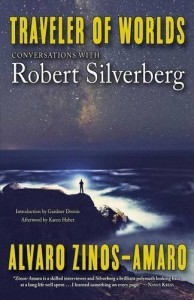
There’s a more personal component to the book, too. Bob and I have been friends for some years, and a previous fiction collaboration, with which he was pleased, suggested to me that he might be amenable to in-depth interviews. Bob is perfectly content to spend much of his time alone, and as well as we get on, I knew that imposing five-or-six-hour interviews upon him might be a bit draconian. So I needed something to soften the process. I suggested dividing the interviews into smaller, theme-bound sections, and then further sub-dividing those to cope with the realities of time limitations, travel logistics, etc. He graciously agreed, and I’m happy to report that I only made him hoarse on one occasion. That’s suffering for art, right there!
Before starting the first interview, I created an outline of all the subjects we were going to cover throughout the book, and where I wanted to go with each one. Editing would help, but the raw material itself needed to be intrinsically interesting to keep readers engaged (and prevent Bob from falling asleep—his preferred couch is comfy indeed).
In the end, I settled on seven chapters, and shared only a few words of description about each one with Bob just a few minutes before delving in. I wanted to capture spontaneous conversations, not a carefully rehearsed series of thoughts. We ended up covering a great many subjects: activism, travel, collecting artifacts, paintings, Nobel-prize winning writers, Bob’s political positions, the meaning of awards, libraries, questions from readers, and so on.
One of my favorite dialogues, which may be of interest to writers reading this blog, revolves around story openings. We go into some detail on the first lines of famous works by Hemingway, Hardy and Conrad. And not all the verdicts are favorable!
Speaking of verdicts, a most reassuring one came from Bob himself. When he read the final manuscript he thought it was coherent, detailed, well-organized. Phew.
What to take away from all this? Interviews can be genuine journeys of discovery, as opposed to mere recitations of positions. To make them work in this more exploratory sense, I’ve found two things are critical.
One is a map. You may be traveling to strange lands, but you need to know how to get back home.
The second component is trust. Provide a safe space, and anything is possible.
And, well, there’s a third factor. It’s the quality of your companion. How to describe Bob as fellow voyager in these conversations? I think Karen Haber, Bob’s wife, says it best in the book’s Afterword. She meant it literally, but it also works in a metaphorical sense: “Traveling with Bob is like having one’s own portable database for a companion. Imagine Google with a goatee, a glass of Bordeaux in one hand and a fork in the other.”
Bio:
Alvaro started publishing around 2008, and has had more than thirty stories appear in magazines like Analog, Nature, Galaxy’s Edge, The Journal of Unlikely Entomology, Lackington’s, Mothership Zeta, Farrago’s Wainscot and Neon, as well as anthologies such as The Mammoth Book of the Adventures of Moriarty, The Mammoth Book of Jack the Ripper Tales, The 2015 Young Explorer’s Adventure Guide, Cyber World, This Way to the End Times [edited by R. Silverberg], Humanity 2.0 and An Alphabet of Embers. Alvaro’s essays, reviews and interviews have appeared in The Los Angeles Review of Books, The First Line, Asimov’s, Strange Horizons, Clarkesworld, SF Signal, Foundation, The New York Review of Science Fiction and Intergalactic Medicine Show; he also edits the roundtable blog for Locus.
August 23, 2016
MidAmeriCon II wrap-up post
I had the most amazing of all possible Worldcons. This will be a somewhat scattered post, because there is so much going on at Worldcon that it felt like I was constantly jumping from one thing to the next, and everything has merged into a chaotic jumble in my mind.
Programming-wise, I was on two shared readings, two autographing sessions, and three panels. One of my panels had Larry Niven as a fellow panelist! At one of my readings, I read “Mother Ship” and made a member of the audience cry.
Tina Connolly and I launched our collections! We had a friendly competition to see who could sell more copies at Worldcon…and ended in a tie: 53 copies each. Which for me was selling out–Patrick sold all the copies he brought PLUS the two author copies that I’d brought with me. I signed nearly all of the copies he sold, and managed to do so without hurting my wrist (something I was worried about, b/c I have a repetitive stress injury).
I got to see old friends and make new friends. I met TONS of people that I previously only knew online. I went to Clarion West in 2006, so this year my class met up at Worldcon for a 10-year reunion. Twelve of us were there, which I believe is the highest number of us in one place since the workshop.
August 16, 2016
Seven Wonders of a Once and Future World is Out!
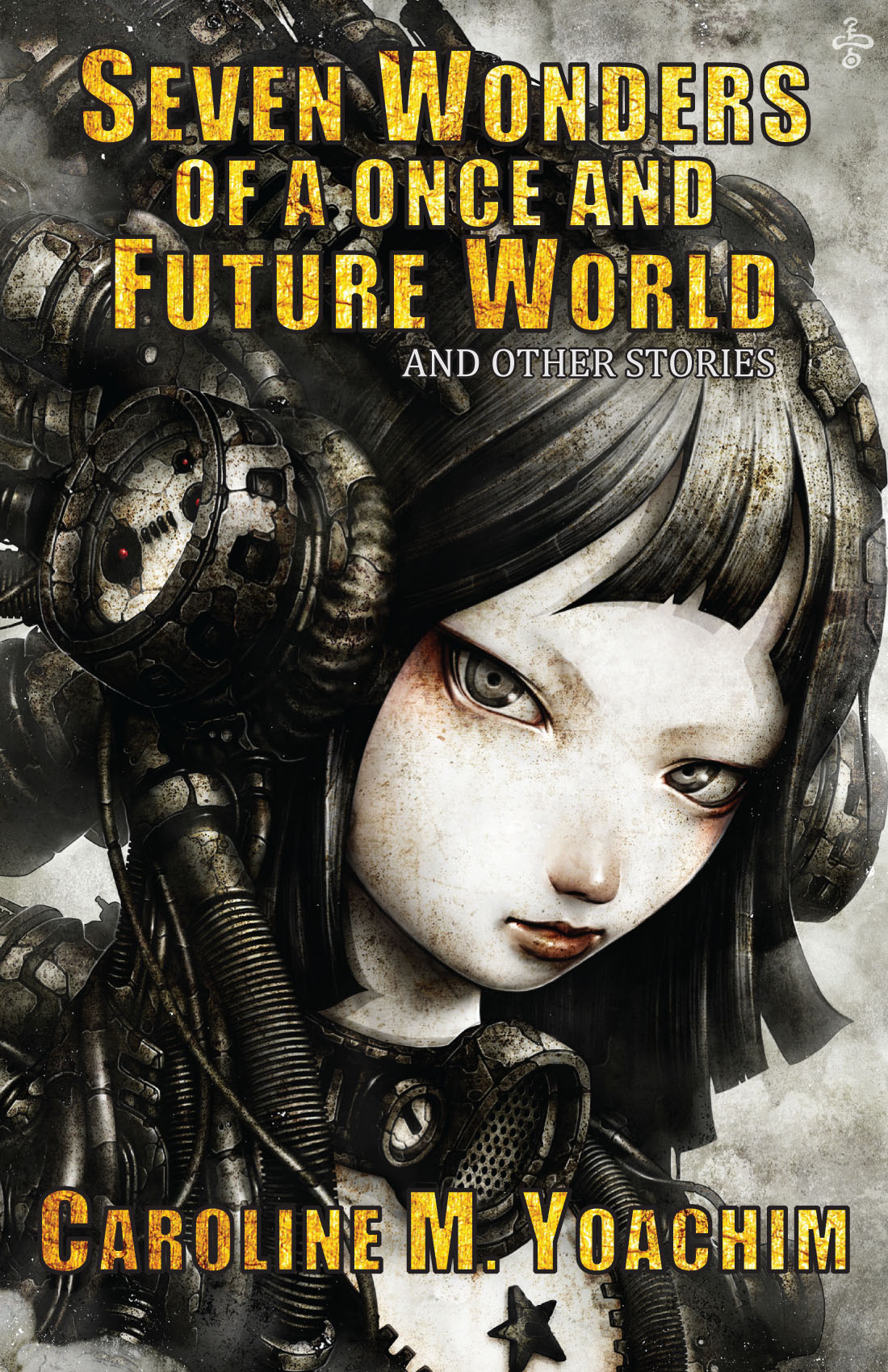 Today is my official release day! I have a book!!!
Seven Wonders of a Once and Future World & Other Stories is now available online at:
Amazon
Barnes & Noble
Fairwood Press
(If you happen to be at MidAmericon II this weekend, Patrick will have copies of the collection available at the Fairwood Press table in the Dealer Room.)
Want to read the book without buying it? Log in to your local library and request it. I love libraries, and I’d be thrilled to have my book on the shelf of yours!
August 15, 2016
First Lines
For the past 27 days, I’ve been posting the first line from each story of my collection on twitter, one line per day. It was interesting to see all of them together because I started seeing patterns in how I tend to start stories. The other thing I noticed was that for some stories I managed to get the hook into the first line, but other times I didn’t. I was often tempted to include more than one line (but it wouldn’t fit into the tweet), and those were the stories where the hook came a little later.
So here they are, the first lines for all 27 stories in my collection, following the order of the table of contents:
Ellie huddled in the corner of her daughter’s room.
Betty was hanging wet towels on the clothesline when a faded blue Plymouth Roadking came up the drive.
Nicole sat on a crowded bus to Spokane, knitting a turquoise scarf.
Kaimu dug his skis into the snow and forced himself onto the steeper slope along the edge of the run.
The second week of kindergarten, Mimi came home with a rabbit.
Nanami was the oldest of the ama. A Japanese mermaid, the tourists called her.
“This is Carla at the Off-Planet Tax Return helpline, how can I help you?”
Callie kept her heart in the front yard, as people often do.
I gave my left arm to Elizabeth.
When Amelia turned six, I took her to the circus.
You do not know me yet, my love, but I can hear you in my future.
Njeri sewed the woman together with hairs from a zebra tail.
Tomiko knelt at the table with her back straight and her webbed hands folded in her lap.
In a sketchbook of pure white paper, a watercolor king met a pencil queen.
Spring followed Horimachi as she hiked up the steep trail.
The magician’s table was covered by a sheet of plywood, four feet square, completely wrapped up in aluminum foil.
The ghost in my attic is Margaret, but she lets me call her Margie.
Dear Ethics Review Board for Research on Insignificant Humans,
The other girls are made of driftwood, but I’m made of bamboo that whistles in the wind.
Lady Earth went to the Galactic Carnival in a gown of watery blue and earthy green, with a shawl of swirling gray clouds.
A honeybee fluttered its wings for the last time.
A kraken came to Edgewood Street on the first day of summer vacation.
My mother was a colony ship.
My tree is a pyramidal cell in the prefrontal cortex of your brain.
Freet peered out from her den.
Nicole went to visit her best friend, Grant, the day before his family left for Opilio.
Mei dreamed of a new Earth.
August 12, 2016
Stories in Fantastic Stories of the Imagination and Uncanny Magazine
I’m a little late in posting this, but I have a couple new flash fiction stories out:
“Love Out of Season” is in the July/August issue of Fantastic Stories of the Imagination
“The Words on My Skin” is in the July/August issue of Uncanny Magazine
August 9, 2016
Short Story Collection Excerpt
My collection comes out on August 16th, one week from today!
If you want a sample of my work, many of the stories are available to read online (see my publications page for a complete list), but I thought it would be fun to post a teaser from one of the two original stories in the collection.
The excerpt below comes from the opening of “On the Pages of a Sketchbook Universe,” a secondary world fantasy novelette.
Seven Wonders of a Once and Future World & Other Stories is available for Pre-order at:
Fairwood Press – Amazon – Barnes and Noble
On the Pages of a Sketchbook Universe
The First Page of the Sketchbook
In a sketchbook of pure white paper, a watercolor king met a pencil queen.
The king was made of sixteen shades of watercolor paint, with colors pressed together in thin diagonal stripes. His fingertips were brushes and his heart was a jar of water that had no lid. He dipped the end of his pinky-finger brush into his heartwater and loaded the brush with yellow paint from the stripe that ran down his neck.
He touched his brush to the blankness of the white, leaving a tiny dot of yellow that spread into a circle as it seeped into the page.
Nothing happened.
The queen was stiff and straight, made of wooden pencils with graphite cores. Her joints were erasers and her heart was a steel blade. She pulled one fingertip across her heartblade until the graphite core came to a delicate point, and tiny curls of wood dropped down to the page. She scooped them up and offered them to the king, but he shook his head. He had no use for them. It seemed wrong to discard little bits of herself, so the queen held the shavings with one hand and used the sharpened finger of her other hand to draw a box.
She drew an outline in delicate straight lines, but nothing happened.
The king came to examine her sketch, and when he reached out to touch it a smear of yellow stained one corner of the box. As the paint dried, the corner began to jut out from the paper, as solid and real as the queen and king.
The queen sketched the king’s yellow circle into a sun, which rose above them and lit the page in a glorious warm light. The king painted the rest of the box, and the queen put her pencilself shavings inside. Together they created a forest of deep green pines and a sparkling blue lake. The queen sketched distant mountains and a handful of clouds to diffuse the light of the yellow sun. Everything she sketched, the king painted, and together they created a beautiful realm.
The clouds darkened, and rain began to fall. Water ran down the king’s face and pulled his paint down to the paper, leaving murky brown puddles of mud on the once-white ground. He ran and hid beneath the branches of a dark green pine, horrified that the clouds they had created could turn against him so thoroughly.
In this, his first moment of need, the queen abandoned him, disappearing into the vast undrawn white. He huddled against the tree and waited for the rain to stop.
#
The pencil queen had come to love the watercolor king, for his colors were beautiful. The box he’d painted for her pencilself shavings fit neatly into her chest, nestling up against the blade of her heart. When the rain drove him into hiding, she decided to sketch him a castle, a place where he could be safe.
A castle required an empty expanse of paper, so she left the forest and walked toward the center of the page. As she traveled, most of the page was pure and blank and white, but halfway between the upper bindings and the unbound lower edge, there was a great rift, a tear in the paper. She detoured to walk the length of the tear. It ran a great distance, starting at the leftmost edge of the page and running nearly to the center. On the right side of the page, there was a second tear, a mirror-image of the first. She sketched a large stone at the end of each tear, in hopes that the weight of the rocks would keep the rifts from spreading. When she finished sketching the king’s castle, she would ask him to paint the rocks real.
The queen continued on past the rifts, and found a wide expanse of blank paper. She sharpened all her fingers to make the work go faster and placed her shavings into their box. White paper gave way to sketched-stone walls–storerooms and apartments and a cavernous great hall, all connected with covered walkways so that the king would never need to face the weather. At each corner, she drew a tall tower, so that he could look out over the realm in all directions. In the center of the castle she sketched an even taller tower, so that she and her king could sleep close to the heavens.
By the time she had finished, the rain had stopped, so she returned to the forest and found the watercolor king.
“Did it honestly take you this long to realize you can’t make anything real without me?” the king asked. His diagonal stripes were smeared from the rain, and all around him were formless blobs of paint where he had tried to make–something–in her absence.
“I was drawing a surprise for you,” she said, but her excitement about the castle was dampened by her guilt at leaving him to suffer the rain alone.
#
It was many days’ work to paint the castle, and by the time it was finished the king had forgiven the queen for abandoning him in the rain. He fell in love with her angles and her strength, and he admired the delicate lines that she drew. He painted the rocks she had sketched to stop the page from tearing, and admired her foresight and ingenuity.
The queen drew birds and beasts and fish to live in their beautiful realm, and he brought them to life with his colors. He painted the night sky black, and she sketched a moon and stars. He painted the celestial bodies in whites and yellows and tossed them into the sky.
“Let’s make ourselves a child,” the king said. It was the right time. From his tower window, he could see reflections of moonlight dancing on the lake. “We’ve made a beautiful world, and all it needs is a child for us to share it with.”
They’d left one wall of their tower bedroom blank with the original page, intended for just such a purpose. The queen began to sketch a pencil child.
“I thought,” the king said, “that we could have a watercolor child.”
“The eldest will be heir to the realm. Clearly a pencil princess is the better choice. When she is finished, she can sketch herself a prince that is to her liking.”
“It is no more your realm than it is mine,” the king answered. “If not for my paint, your sketches wouldn’t even be real. A watercolor prince would make a fine heir.”
“And then what? He would paint a formless princess for me to sketch?” The queen kept drawing her straight-lined wooden child, with a sharp-blade heart and eraser joints. “I’m not going to sketch you a prince.”
“And I’m not going to paint you a princess,” the king said.
So the royal couple remained childless, and the heir was nothing but a sketch, abandoned in the highest tower of the castle.
#
Strange art crept in from beyond the edge of the realm, giant lizards that flew and breathed fire. The king named the creatures dragons. They gathered on the white page beyond the proper boundary of the realm, up near the bindings of the page. Periodically, they fought amongst themselves, soaring high above the page and spewing jets of fire from their mouths.
“The fire is too dangerous. We must fight the dragons,” the queen said, “before they destroy the realm.”
“They have done nothing to attack us,” the king said, “and they only breathe their fire when they are in the sky, well away from the paper.”
“This is our page of the sketchbook, and we have to defend it. The beasts have been flying wide circles over the realm, scouting. It is only a matter of time before the dragons attack the castle, and everything we’ve worked so hard to create will be destroyed.”
“We should have someone to tend the realm if we fail,” the king said, choosing his words carefully. “Perhaps instead of one heir, we could have two, a prince and a princess–”
The queen didn’t let him finish. Her mind was as rigid as the pencils that formed her body, and she lacked the flexibility for compromise. She believed the realm had to be controlled by someone who could sketch. She led the king up to their tower and pointed to her sketch of the pencil princess. “Here. This is your heir. Paint her and be done with it.”
She left without waiting for the king to reply.
The king considered the drawing. It had the form of a princess, true, but that didn’t mean he had to paint the child as pencils. He dipped a red fingertip into his heartwater and painted the core of one pencil red. He did the outside of the pencil in red paint, too, all but the bit of wood where the pencil had been drawn already sharpened. That detail was a credit to the queen–the heir would not begin with blunted fingers, as she had, but would begin life ready to create art.
He stepped back to admire his work. A red pencil with a core of watercolor paint. He set to work on the rest of the sketch, giving the heir watercolor pencils in all his sixteen shades, and four ordinary graphite pencils as a token to the queen.