
Jonathan Hop's Blog: Sunday Go, page 5
April 29, 2012
Go Puzzle Sundays
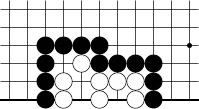
Black to play This problem is aimed at 18-20 kyus, so for those of you who are more experienced players, you should be able to solve this problem in an instant. Where should Black play to kill White?
Solution to last week's problem:
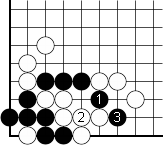 Black 1 is the proper tesuji for this shape. The wedge works because of White's empty triangle. White connects, but then Black plays at 3. White cannot capture Black 1, so his groupis captured.
[image error]


April 25, 2012
Final Round of the Collegiate Go Championship
Just dropping a note and letting everyone know there will not be any "Thursday Go Tips" tomorrow, as I am playing in the final round of the Online College Go Championships. Wish us luck![image error]
April 22, 2012
Go Puzzle Sundays
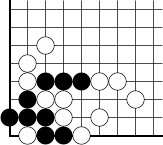 Black to play This one is a lot easier than the one we did last week. I thought you might want a breather. You'll have to find the correct tesuji to save Black's corner group, because it cannot make two eyes. Here's a hint: to save it, you'll have to capture some of your opponent's stones.
Solution to last week's problem:
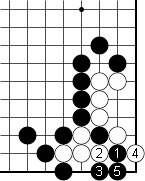 If you saw Black 1, then pat yourself on the back. It's the correct move and the tesuji to remove White's eye. What happens if White takes? Black 3 is a way to come under since White lack's the liberties to cut us.
April 19, 2012
Thursday Go Tips
Over the past few weeks we've been doing a lot to improve our Go. We've played blitz, done Go puzzles, and even rocked out to 80s music (well, maybe not the last part). Today's Go tip is rather simple and is in fact the opposite of my advice from last week . This week, I want you to play a really long game. It can be online or in person, but play a 60 minute game with someone and use up your time. This might actually be harder than playing blitz games, especially if you are the type to come up with a move only after a few seconds. I know I don't think long for my moves unless I need to read out something really detailed. Long games are good for training your concentration. When you play in official tournaments, you'll learn to stay focused and ration your energy so as not to burnout during a game. I don't expect a 15 kyu to be reading out a 100 move sequence, but try to be as detailed and consider as many options as possible. You can feel relaxed in doing so, as there's tons of time!
April 17, 2012
Game Review Part 2
So, if you remember from yesterday we were going over my game from the Online Collegiate Go Championship. I was figuring out how to respond to Black's two space high pincer, and going over the various joseki in my mind. There are a lot of options:
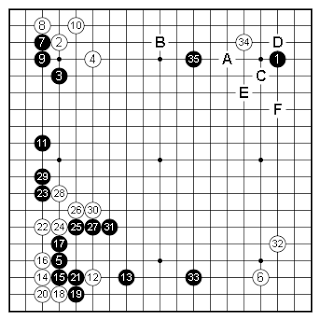 White has tons of options for his next move. I don't like A, B, or D because they're the wrong strategy. C is probably best although F does indeed look shiny. So, where was my genius move?
 I have a friend named Dave, and whenever I review one of his games, if he plays a really weird move constantly, I always tell him "This move is not a thing." Well, White 36 is not a thing. It's not a joseki, it's not anything. My brain fused the idea of playing from the right and attacking the pincer stone with my thickness and ended up accomplishing neither. I was thinking of the avalanche joseki, but it doesn't really work with that extra Black stone on the left.
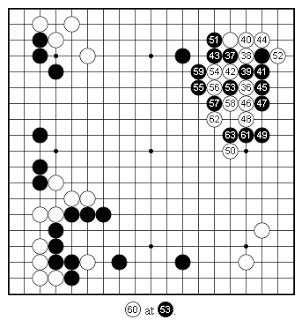
So Black squeezes the crap out of me. Black 51 is sente and I don't have any crosscut antics on the right side. Instead, I'm forced into a brick and Black spears through with 63. We don't need to go over the rest of the game; it's really too horrible to watch. I've already lost. That's the one thing I don't like about higher level Go: if you make a really air-headed mistake, the game is over. There is nothing more to do. When I was 6 kyu it would've been possible to come back from this. In any case, the tournament continues either this Saturday or next. University of Michigan faces off against Princeton. I hope I don't have to play Michael Chen...

 White has tons of options for his next move. I don't like A, B, or D because they're the wrong strategy. C is probably best although F does indeed look shiny. So, where was my genius move?
 I have a friend named Dave, and whenever I review one of his games, if he plays a really weird move constantly, I always tell him "This move is not a thing." Well, White 36 is not a thing. It's not a joseki, it's not anything. My brain fused the idea of playing from the right and attacking the pincer stone with my thickness and ended up accomplishing neither. I was thinking of the avalanche joseki, but it doesn't really work with that extra Black stone on the left.

So Black squeezes the crap out of me. Black 51 is sente and I don't have any crosscut antics on the right side. Instead, I'm forced into a brick and Black spears through with 63. We don't need to go over the rest of the game; it's really too horrible to watch. I've already lost. That's the one thing I don't like about higher level Go: if you make a really air-headed mistake, the game is over. There is nothing more to do. When I was 6 kyu it would've been possible to come back from this. In any case, the tournament continues either this Saturday or next. University of Michigan faces off against Princeton. I hope I don't have to play Michael Chen...
April 16, 2012
Collegiate Go Tournament Championship
So, as some of you may already know, the University of Michigan Go team won its first round against Carnegie Mellon University 3-2. It all came down to the final game with our John Starkweather pulling out the win in an impressive game. Yours truly? I played awful. I'm not sure why, because I played some warmup games and I was doing well, but I encountered some situations where I can only say I just wasn't thinking. A bit more discipline might go a long way. We'll review my game, although I in many ways hate going over games I've lost :P
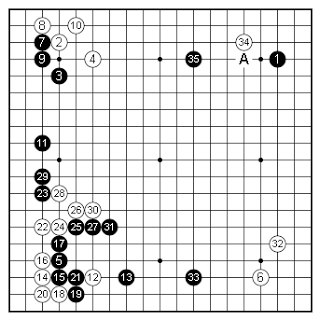 Here's the first part of the game. Not a lot to write home about. The lower left is a not quite joseki. I came out with 24 to fight against Black sealing off the center since him having influence in the lower left quadrant would make the game hard on White. Black could've cut instead of extending with 27, but Black 27 is one of his choices. I pushed one more time to make double sure that this center area doesn't materialize. Black can peep to reduce my corner, but that's small now. Now, Black pincers with 35 to breakup a possible White territorial framework along the top. I kind of regret White 34, it should be one higher at A. Works better with the thickness in the upper left. Now, Where should White play? We have a corner enclosure in the lower right and some thickness in the upper left. We don't have as much territory as Black.
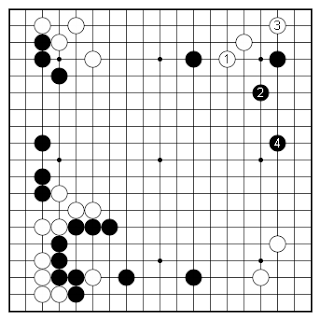 I ruled this standard sequence right out. White 1 and 3 are defensive moves and Black settles ridiculously easy on the right, and my lower right corner enclosure is ...well just two stones making a handful of points; nothing more. This also doesn't use my thickness effectively.
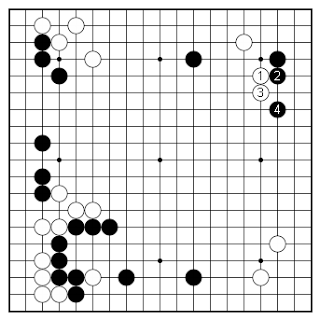 White 1 is the best option. It forces Black low, weakens his pincer stone facing my thickness, and the right side isn't interesting for development anyway. There are some other options for White, and we'll go over some tomorrow, including the fabulous move I chose!
 Here's the first part of the game. Not a lot to write home about. The lower left is a not quite joseki. I came out with 24 to fight against Black sealing off the center since him having influence in the lower left quadrant would make the game hard on White. Black could've cut instead of extending with 27, but Black 27 is one of his choices. I pushed one more time to make double sure that this center area doesn't materialize. Black can peep to reduce my corner, but that's small now. Now, Black pincers with 35 to breakup a possible White territorial framework along the top. I kind of regret White 34, it should be one higher at A. Works better with the thickness in the upper left. Now, Where should White play? We have a corner enclosure in the lower right and some thickness in the upper left. We don't have as much territory as Black.
 I ruled this standard sequence right out. White 1 and 3 are defensive moves and Black settles ridiculously easy on the right, and my lower right corner enclosure is ...well just two stones making a handful of points; nothing more. This also doesn't use my thickness effectively.
 White 1 is the best option. It forces Black low, weakens his pincer stone facing my thickness, and the right side isn't interesting for development anyway. There are some other options for White, and we'll go over some tomorrow, including the fabulous move I chose!
April 15, 2012
Go Puzzle Sundays
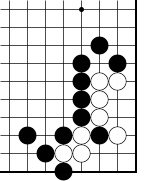
Black to play For this week, we have this doozy of a problem. It's actually quite simple, but the first move is key and might not be intuitive for some. If you need a hint, just think of a way to make the bottom not an eye, since White clearly has a solid eye on the right.
Solution for last week's problem:
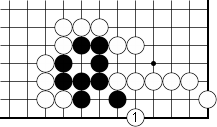 If you saw the tesuji of White 1 then you get a gold star! We need to create miai (a two way street) to get rid of that second eye since the first one is rock solid.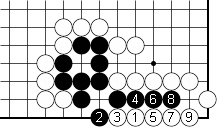
What makes this problem fun is that that sneaky stone in the corner gives us a solid bridge out, so that our stones can take the vital spot without fear of being captured. Try out other variations in your head too! Just because we find the right first move, doesn't mean that we still cannot mess up the followup.

April 13, 2012
College Go Tournament Tomorrow!

Tomorrow (April 14th) is the first round of the Collegiate Go Association's Championship Tournament. I haven't participated in the league at all, as I had been busy, but I decided my team needed me for the championship. So far, we have a pretty strong team. Seungjin, our resident 7 dan, is first board. I'm second board, and Yizao Wang will be third. We'll be facing off against Carnegie Mellon. I have no clue who I'll be facing off against, but it should be very interesting to say the least. You can catch the games on KGS. The festivities will be kicking off at around 1 p.m. Eastern Standard Time. See you there!

April 12, 2012
Thursday Go Tips
I love 10 second Go. My account on KGS is "blitzkrieg" where I only play ten second games of Go. It really gives you no time to plan ahead, study the board, count, or well...do anything besides read out as far as you can, as accurately as you can, in the least amount of time. It gets your heart pumping to say the least. I love blitz and I play it as often as I can because it really helps out my slow games a lot. So, my advice for today is: play a 10 second game of blitz! Set your main time to zero and give yourself 5 byo-yomi periods of 10 seconds. This is not a lot of time to think, and it may be frustrating at first, especially if you're the type of player that likes to really consider each move. Well, time to get you out of your comfort zone! You'll feel weak at first, but for me, blitz is a zen experience. It shows me where I am strong and where I am weak, and translates to more wins in slow games!
April 9, 2012
Professional Profiles: Michael Redmond 9p
 Michael Redmond 9p
Michael Redmond is one of very few Western Go players and plays in Japan. He's the strongest Western professional, weighing in at a whopping 9 dan, and is the author of "The ABC's of Attack and Defense." I had the pleasure of briefly meeting Redmond at the U.S. Go congress in 2006 when he was there. It was kind of cool to discuss a board position, and then turn and say, "Well, what would Michael Redmond 9 dan think of this position? Why don't we just mosey over and ask him?" Redmond became a professional at the age of 18 in 1981 after having been an insei in Japan for four years. He started off a lot later than your average insei, so he probably had to work twice as hard as the other children to catch up. Redmond has racked up an impressive slate of wins and became 9 dan in 2000. He still works hard at improving his Go even into his forties, and concentrates on studying the caste games of Shuusaku and improving his endgame accuracy. In an interview with the AGA E-Journal, Remond said, The result was that I was reviewing very high-quality games, games in which the players were not being greedy, but were going for the balanced moves, and showing very good positional judgment, and I think that reflected onto my game and helped me a lot," said Redmond. "I'm much more aware of what's going on."

Sunday Go
For any and all interested in the ancient Chinese board game known as Go! Go is an immensely entertaining strategy game, inexpensive to play, as well as endlessly challenging. No two games of Go are t
...more
- Jonathan Hop's profile
- 8 followers


