
Josh McDowell's Blog, page 34
July 9, 2018
Did the Bible’s Adam Really Exist?
 Does Adam’s historicity matter?
The overarching theme running through all 66 books of the Bible is the story of God’s creative work, of humanity’s rebellion against God, and of God’s work to redeem fallen humanity.
The straightforward way of reading the Bible is that Adam was a historical person. It also seems clear that Scripture teaches that all humanity descended from Adam and Eve. This view has come under criticism in recent years — but not just from skeptics.
Doubts about Adam’s historicity are hardly surprising in a secular society that largely rejects the authority of the Bible. But there also is debate among Bible-believing Christians. In this blog post we’ll look at just four evangelical views of Adam, each defended by a noted professor of religion. Then we’ll look at what science has to say about Adam and Eve existing as real people.
~ Four Views of Adam ~
The four views of Adam, featured in the book Four Views on the Historical Adam by pastor Matthew Barrett, are as follows. Perhaps you hold one of these views yourself:
>>>No Historical Adam: Theistic Evolution/Evolutionary Creation View
Denis Lamoureux, professor of science and religion, argues that Adam did not exist as a person, but that his story remains “a vital, but incidental, ancient vessel that transports inerrant spiritual truths: only humans are created in the Image of God, only humans have fallen into sin, and our Creator judges us for our sinfulness.”
>>>Historical Adam: Archetypal Creation View
John Walton, professor of Old Testament, asserts that “Adam and Eve are real people in a real past. Nevertheless, I am persuaded that the biblical text is more interested in them as archetypal figures who represent all of humanity. … If this is true, Adam and Eve also may or may not be the first humans or the parents of the entire human race. Such an archetypal focus is theologically viable and is well-represented in the ancient Near East.”
>>>Historical Adam: Old-Earth View
C. John Collins, professor of Old Testament, argues “that the best way to account for the biblical presentation of human life is to understand that Adam and Eve were both real persons at the headwaters of humankind.” In other words, Collins believes that the Fall was both moral and historical.
>>>Historical Adam: Young-Earth View
William Barrick, professor of Old Testament, states, “Adam’s historicity is foundational to a number of biblical doctrines and is related to the inspiration and inerrancy of Scripture. … The biblical account represents Adam as a single individual rather than an archetype or the product of biological evolution, and a number of New Testament texts rely on Adam’s historicity.”
As you can see, it’s possible for Christians to vary widely in their views on whether Adam and Eve were real people. Let’s allow science to weigh in as well.
~ Scientific Proof for Adam? ~
Has science proved or disproved the existence of Adam and Eve? No. At least not yet. But what researchers have discovered might still blow your mind.
While DNA profiling helps to resolve criminal cases and paternity suits, the sequencing of the full human genome by the Human Genome Project provides so much more: a genetic “fingerprint” of 3.2 billion base pairs (“letters” making up the genetic code) in human DNA. This has opened the door for molecular anthropology, which searches for links between ancient and modern human populations around the world.
Genetic information that has been uncovered in the past few decades has shed considerable light on human origins. Evolutionary biologists compare the human genome with those of primates to build evolutionary relationships. Skeptics of Darwinism maintain that genetic similarities between humans and other species are better understood as the result of common design rather than common ancestry. One technique for studying human ancestry is to compare the base-pair sequences of a specified segment of DNA between individuals from different people groups.
Interestingly, such comparisons show that human beings display much less genetic diversity than any other species. Several studies, for example, report a much more extensive genetic diversity for chimps, bonobos, gorillas, and orangutans than for people. And the human similarity is observed worldwide, regardless of race or ethnicity!
Molecular anthropologists pose what they sometimes call the “Garden of Eden hypothesis” to explain the limited genetic diversity. This model maintains that humanity had a recent origin in a single location and the original population size must have been quite small. Comparisons using much longer data sequences from the Human Genome Project confirm the “very limited genetic diversity among human populations,” as well as the conclusion “that the African population groups are the oldest.”
One of the most widely used techniques in molecular anthropology is the study of mitochondrial DNA (mtDNA), which is inherited only from our mothers.
Molecular anthropologists have used it to trace humanity’s maternal line. A landmark study carried out on mtDNA samples from 147 people from five geographic populations was reported in 1987. The study’s authors concluded that all of the mtDNA stemmed from one woman who lived in Africa roughly 200,000 years ago.
Additional studies confirmed the conclusion that humanity can trace its maternal lineage back to one woman in a single location (probably east Africa). The science community named her “mitochondrial Eve.” Does this mean this woman was Eve? Not necessarily. From an evolutionary view, this means only that this female’s mitochondrial DNA is the only lineage not to become extinct and is now ubiquitous throughout the entire human race. However, this viewpoint is compatible with the view that there was an original mother and father who were the first parents of the entire human race.
Since Y-chromosomal DNA passes from father to son, molecular anthropologists study it to trace humanity’s paternal line. The consensus of a number of studies carried out no Y-chromosomal DNA from men representing different races and regions of the world is that humanity can trace its paternal lineage to a single man in a single location in Africa.
Again, this does not prove that this man was Adam, but that this man’s Y-chromosomal lineage is the only one that now runs ubiquitous throughout the entire human race.
Many of us have seen the standard March of Progress diagram depicting the evolution of man, right? The sequence of images starts with a hunchbacked ape and ends with an upright-walking modern human. This iconic diagram summarizes the message that humans evolved. Yet many paleoanthropologists doubt the validity of Darwinism, including the authors of the book, Science & Human Origins.
A 2015 review of human evolution by two leading paleoanthropologists admitted “[t]he dearth of unambiguous evidence for ancestor-descendant lineages,” and states “the evolutionary sequence for the majority of hominin lineages is unknown. Most hominin taxa, particularly early hominins, have no obvious ancestors, and in most cases ancestor-descendent sequences (fossil time series) cannot be reliably constructed.”
And a number of paleoanthropologists have admitted a distinct gap in the fossil record between humanlike members of the genus Homo and apelike species such as the Australopithecines. As the great evolutionary biologist Ernst Mayr stated, “The earliest fossils of Homo … are separated from Australopithecus by a large, unbridged gap.”
Science, in many ways, actually points to a Creator!
~ Trusting God as Creator ~
Within the last 30 years, scientific evidence for Adam has emerged from the study of human genetics. The once-dominant multiregional model of human origins has been replaced with a model of humans spreading around the world from a small founding population in one location, possibly east Africa. The identification of single ancestral maternal and paternal DNA sequences, while not proof of an ancestral pair, is evidence one would expect from the biblical account of origins.
Paleontology and archaeology reveal at least three discontinuities in human history: the abrupt appearance of the genus Homo about two million years ago, the appearance of anatomically modern humans at around 130,000 BC, and the appearance of physical capability underwriting modern human behavior at around 40,000 BC. Physicist John Bloom argues that the two recent, abrupt discontinuities are evidence against a smooth, naturalistic transition and for the special creation of humanity.
I like how Bloom notes that the Bible reveals some things to us that are “hard to understand.” Science, of course, would have us believe that it, alone, is our key to understanding the universe and our place in it. “Interestingly enough, though,” adds Bloom, “the deeper scientists have delved into the nature of nature — in an effort to comprehend how physical reality works at its fundamental levels — they too have found themselves utterly perplexed.”
Bloom also notes that we tend to forget that God’s intelligence, power, and complexity “so far exceeds our comprehension that we have no metaphor or superlative that can even remotely do Him justice.” We should expect perplexing conundrums, even as new scientific discoveries develop, because God will always be mega strides ahead of us.
Was Adam the first human? Only God knows. Let’s take God at His Word: that He, alone, created humanity, and did so as part of His overall plan for creation.

This blog post highlights Josh and Sean McDowell’s recently revised apologetics classic, Evidence That Demands a Verdict. We are certain this fully updated and expanded resource will be an effective evangelism tool for you, and strengthen your faith by answering the toughest questions tossed to you by skeptics. Know what you know, because it’s true. But share this truth with LOVE!
If you’d like to start from the first blog post in this series, click here: Apologetics: Apologizing for Believing in God?.
The post Did the Bible’s Adam Really Exist? appeared first on Josh.org.


July 7, 2018
Interview: How Does Christianity Fulfill our Deepest Aspirations?

Original post by Sean McDowell here. Used with permission.
How Does Christianity Fulfill our Deepest Aspiration? Author Interview.
My friend and Biola colleague Greg Ganssle has written a fascinating new book called Our Deepest Desires: How the Christian Story Fulfills Human Aspirations. Professor Ganssle takes a unique approach to the apologetic task. Essentially, his goal is not to show that Christianity is true, but to argue that when it is properly understood, people should wish it were true. He talks about how tragedy, beauty, and freedom make the most sense in a Christian worldview and that only Christianity fulfills our deepest desires.
Our Deepest Desires is one of the most interesting books I have read in awhile. I hope you will check out this interview and think about getting a copy of his excellent book:
SEAN MCDOWELL: Can you tell us briefly what your book is about?
GREG GANSSLE: As the subtitle indicates, the book is about how the Christian story explains and grounds our basic aspirations. Every person has the same task—that is we all aim to navigate life in the best way we can. We navigate life with some notions of what it is good to be and to do. These notions are widely shared among people, regardless of their religious beliefs or lack of them.
I structure the book around four fundamental commitments that are widely shared.
First, there is the commitment to persons. Nearly everything we care about is connected to human beings. Second, is the commitment to goodness. We want to be good and we enjoy what is good. Third, we are drawn towards beauty. Beauty calls us home in two ways. First, it calls us to see that this world is a wonderful place. Second, it points beyond this world to the next. Lastly, we long for personal freedom. That is the freedom to become the kind of people we want to be.
Each of these areas makes sense in the Christian story. God, the most fundamental reality, is personal. He is good and made a good world for his own good reasons. We are not surprised to find the world to be beautiful because he is a master artist. God created us to embody certain virtues, and we find our own freedom as we experience these.
MCDOWELL: The goal of your book is to convince people they should hope Christianity is true. What do you mean, and why start there?
GANSSLE: I start there because I think that most people do not care whether or not Christianity is true. They are already convinced that it is a story that hinders human flourishing, rather than a story that secures and promotes flourishing. What is startling is the fact that the things most human beings care most about fit better within the Christian story than they do in the various atheistic stories. Once we see this connection, we see that we want the Christian story to be true. Of course, the fact that we want it to be true does not show that it is true. But once a person wants it to be true, the objections to the truth of the Gospel seem much smaller.
MCDOWELL: Who is the primary audience?
GANSSLE: As I wrote this book, I was thinking of the many professors I know who are not yet followers of Christ. I was trying to overcome what I see as the biggest obstacle to belief in Christ–that the Christian story is unattractive. Nietzsche quipped, “What is decisive against Christianity now is our taste, not our reason.” I am trying to overcome the sense that the Christian story is not to be desired.
MCDOWELL: How might those who are already believers use and benefit from this book?
GANSSLE: There are two ways this book can benefit those who are already followers of Jesus. First, it can help us grasp the Gospel more deeply. We often have a superficial understanding of the Christian story. As a result, we fail to see its intrinsic relevance to the deep aspirations of every person. Our own appreciation of the Christian story will be enriched as we reflect on how it provides the resources to capture the most common human aspirations.
Second, this book will be a good tool to start conversations. You can hand it to a thoughtful person and discuss it later. Because it is not a work of scholarship, it is accessible to all kinds of people. I even made sure the chapters were short! I would recommend giving it to neighbors and following up with some questions.
MCDOWELL: What message is there for the church?
GANSSLE: I am convinced that the next horizon for apologetics is the desirability of the Gospel. As one of my colleagues has written (Dave Horner), the Christian story is “too good not to be true.” We have been so keen to defend theological notions such as the sinfulness of every person that we have neglected the deeper theological truths of the value, goodness and beauty of all God has created. We do not believe in the omnipotence of sin. Sin twists everything, to be sure, but it cannot erase that goodness that God has put into the world and into human beings.
MCDOWELL: I have heard you mention how tragedies reveal the deepest human desires. What do you mean, and how does this support the Christian worldview?
GANSSLE: When we encounter suffering, we long for meaning. We want our suffering to be meaningful or to contribute to a meaningful life. Horrendous suffering has the potential to crush a person’s soul. Unless our meaning is securely grounded in the God who brings good out of evil, who experienced evil, and who gives us his presence in the midst of suffering, we may find it impossible to experience a meaningful life in the midst of suffering. It is Jesus weeping at the grave of Lazarus that gives us hope because he is the God who bears our suffering and offers his presence.
Sean McDowell, Ph.D. is a professor of Christian Apologetics at Biola University, best-selling author, popular speaker, part-time high school teacher, and the Resident Scholar for Summit Ministries, California. Follow him on Twitter: @sean_mcdowell and his blog: seanmcdowell.org.
The post Interview: How Does Christianity Fulfill our Deepest Aspirations? appeared first on Josh.org.
July 6, 2018
Student Blogs on “Playing Dead”
Playing Dead: The Swoon Myth
Popularized centuries ago, the swoon myth insists that after being brutally beaten, brutalized and crucified, Jesus… fainted, rather than died. If this myth were true, the central event of Christianity, the Resurrection of Christ, would be lost.
But it takes a lot more faith to believe Jesus only fainted after what was done to him.
For what I received I passed on to you as of first importance:
that Christ died for our sins according to the Scriptures,
that he was buried, that he was raised on the third day according to the Scriptures
1 Corinthians 15:3-4
Study Sessions
Read John 19:30-35. Why did the soldiers not break Jesus’ legs?
How many Roman soldiers (at least) knew Jesus to be dead?
Who is “the man” mentioned in verse 35? What does he know to be true?
Read Mark 15:42-47. How many eyewitnesses of Jesus’ death are mentioned in these verses?

Some people don’t believe in Jesus’ resurrection. They don’t believe that it is possible to come back from the dead.
They believe that he swooned (fainted) and the Romans thought he was dead and he woke up 3 days later and left–but they are wrong. Jesus did not faint or survive somehow in any way.
We know this because it is scientifically proven that it is physically impossible to survive the crucifixion that Jesus suffered.
In the book “Don’t Check Your Brains at the Door,” it explains that Jesus went through excruciating pain, including things that could not humanly be survivable.
It also explains in the book that a Roman centurion had checked the bodies to make sure that they were dead before burying one and if he had missed a live body and they buried it, they would have faced major consequences.
This is why the Jesus’ crucifixion is real.
Katy, age 13

In this week’s chapter the theory and myth was about the crucifixion of Jesus and how many claim the death was false and set up–but from scientific research we can detect that it was completely real.
We can come up with many reasons that the crucifixion was real and that Jesus’s death was real because the Roman soldiers were masters at that. They did this (put people to death) so often and if they had got it wrong they probably would have been executed or even worse punishment.
Also, thanks to scientific research and knowledge in the health department we can detect since when they stabbed Jesus in the side and not just blood but water also came out–that’s scientific proof that Jesus was completely dead.
When you die a little sack around the heart separates the water from the blood.
So in conclusion, this week’s myth was about Jesus’ crucifixion and how he wasn’t completely dead…we can know that is false.
Matthew, age 12
“Today the sincere seeker of truth can have complete confidence, as did the first Christians, that the Christian faith is based not on myth or legend but on the solid historical fact of the empty tomb and the risen Christ.”
(Don’t Check Your Brains at the Door, p. 78)
Know what you believe…and why you believe it.
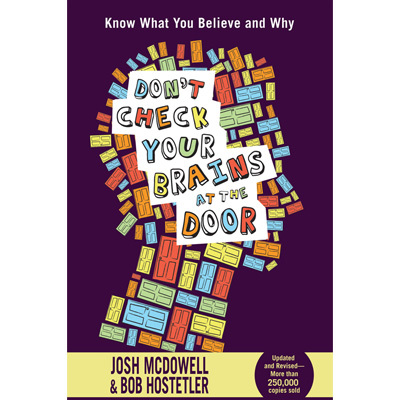
Don’t Check Your Brains at the Door gives teens answers that make sense, even for the toughest of questions:
Does it really matter what you believe, as long as you have faith?
Are there errors in the Bible?
Was Jesus just a good teacher?
Can anyone prove His resurrection?
What does that have to do with me?
Using clarity and humor Josh McDowell and co-author Bob Hostetler expose common myths about God, the Bible, religion, and life to show how Christianity stands up to the test of fact and reason.
With these solid evidences teens will be better understand the faith they live and know what they believe and why.
VIEW DON’T CHECK YOUR BRAINS AT THE DOOR IN OUR ONLINE STORE.
The post Student Blogs on “Playing Dead” appeared first on Josh.org.
Josh McDowell's Blog

- Josh McDowell's profile
- 644 followers

