Jamie Greening's Blog, page 37
December 5, 2018
Advent 2, Year C–Malachi 3:1-4
We read this passage in our worship service last Sunday as the prophetic passage for the first Sunday of Advent. It is one of my favorites.
Behold, I send my messenger, and he will prepare the way before me.
Malachi 3:1
Much is happening here, but it starts with the promise of a messenger. I would like to begin by asking you to think what a weird word choice this is for the Lord. We expect the Lord to send a prophet, one like Samuel, perhaps. We expect the Lord to send a king, maybe one like David. We expect the Lord to send a priest? Like Aaron.
He doesn’t send those. He sends the messenger. I think this is a play on words with the title of the book. The word Malachi means “My Messenger” — and 3:1 might be a self-reference by the author. Maybe he views himself as the messenger. Likewise, I have often though of the similarities between the idea of “messenger” here in Malachi 3:1 and the New Testament word “angel” which is roughly the same–a messenger from God.
Jesus identified John the Baptist as this messenger in Matthew 11:10. That makes, for me, the word choice of messenger that much telling. Why doesn’t it say, “I will send my prophet, or my priest, or my king”? The answer is because Jesus himself is the prophet, the priest, and the king. The messenger can’t be, in relation to the ultimate, any of those. The messenger must decrease, while the Lord must increase (John 3:30).
After The Messenger’s work is done, the Lord will do two things:
Suddenly appear in the temple.
He will purify and refine the sons of Levi
Of course, the language Malachi uses is more beautiful than this.
The Lord whom you seek will suddenly come to his temple . . . who can endure the day of his coming, and who can stand when he appears? for he is like a refiners fire and like a fuller’s soap . . . he will purify the sons of Levi . . . and they will bring offerings in righteousness to the Lord
Malachi 3:1-4
Before we jump to the many messianic concepts here, we must do the work of context. In the book of Malachi there is one central complaint from God: the priests have neglected their work and have brought polluted and inappropriate offerings before the Lord. This is spelled out strongly in Malachi 1. Later, this pollution of sacrifices will be connected to the call for tithes and offerings to be again given by the people and collected by the priests. Malachi finishes abruptly with a flourish about The Day of the Lord.
So, in context, Malachi is looking for the Lord to first send a messenger with a warning, whom Malachi might see as himself, that the priests need to get their act straight because the Lord is coming to purify the priesthood through reform of the offerings.
We can spend a lot of time critiquing the priesthood in the Old Testament, but it is enough to say here that it failed, and that failure was total and complete by the time Jesus arrives on the scene in the early first century. Jesus was many things, and one of those was a reformer and critic of the priests, as was John the Baptist. To emphasize the point, there is a reason why John the Baptist was out in he desert baptizing: he was protesting the Jerusalem temple complex and the priesthood.
The reader of these words from Malachi would do well to connect them, though, not to John the Baptist, but to Jesus cleansing the temple (Mark 11:15-19), running out the priests and their polluted, greedy sacrifices, then teaching every day until the priests gathered enough courage to have Jesus arrested and murdered. But the priests fell into his hands, because this was the way he purified and washed. His blood was the soap and his cross was the fire. What he did, then, was, as Peter put it, was to reject the Hebrew priesthood for something new–a complete reform with a new kind of priest, the priesthood of the believer with immediate access, by the power and presence of the Holy Spirit, to the Lord.
But you are a chosen race, a royal priesthood, a holy nation, a people for his own possession, that you may proclaim the excellencies of him who called you out of darkness into his marvelous light
1 Peter 2:9


November 29, 2018
Advent 1, Year C–1 Thessalonians 3:9-13
The Epistle reading for the first week of Advent seems whittled down for my taste. I would prefer it take a bigger bite and include the earlier material in chapter 3 about afflictions, because the theme of afflictions matches the other readings as all the travail leading up to the Day of the Lord and the coming of the Son of Man will be filled with afflictions. It will get worse before it gets better.
But instead we have these encouraging words. Maybe the lectionary thinks we need some encouragement after the harsher materials from Zechariah and Luke.
“For what thanksgiving can we return to God for you, for all the joy that we feel for your sake before our God, as we pray most earnestly night and day that we may see you face to face and supply what is lacking in your faith.” 1 Thessalonians 3:9-10
How can I thank God enough for you? I got it–I will pray night and day for the opportunity to come fix what it is that you clearly don’t understand yet. Okay, I admit that is a little harsh, but I’ve been reading Paul for so long that I feel like I understand his sarcasm. He is writing 1 Thessalonians because they have questions about things they should have already understood. He clearly perceives they are lacking some finer points of discipleship or theology (v. 10) and he needs to come fix it. For the record, they still didn’t quite get it, which is why we have . . . 2 Thessalonians.
The concept, though, that people who earnestly follow the Lord and try to do and be right, yet have something lacking is intriguing. Paul hints at the same thing in the Roman church (Romans 1:11) and there is no end of problems in Corinth. Here in this time of advent, maybe we should consider–is something lacking in our own faith?
Perhaps our personal faith is lacking. What I mean is, we could devote ourselves to learning more. Stop relying on whatever the pastor is leading and read books on your own, listen to podcasts, do some study. Learn. Fill in the gaps. This personal lacking might be practice as well. Perhaps you don’t pray as often as you should, or at least don’t pray ‘earnestly’ as Paul mentions. Only an arrogant fool would say ‘There is nothing lacking in my spiritual life–I’m a perfect 10.’
It could be something is lacking in our local church. Maybe your church is a sweet fellowship, but it doesn’t lift a finger to help solve the problem of clean drinking water in Africa and could not care less about child sex-trafficking. Flip it around, maybe your church is great at reaching children and young families, but terrible at discipling older adults. Maybe your work is to address what is lacking in your congregation.
There is no way anything is lacking in Western Christianity, though. We have our act together perfectly. #sarcasm.
From this desire to fix a problem, Paul turns to benediction. In fact, this benediction could be crafted and worked very nicely as the spoken benediction to finish a worship service.
“Now may our God and Father himself, and our Lord Jesus, direct our way to you, and may the Lord make you increase and abound in love for one another and for all, as we do for you, so that he may establish your hearts blameless in holiness before our God and Father, at the coming of our Lord Jesus with all his saints.” 1 Thessalonians 3:11-13
Having read the benediction, we see Paul’s desire for the Thessalonians and we see how it fits the familiar pattern. As much as Paul wants to fix their theology and fill in the gaps, the things that really matter in our daily living are:
Love. Paul is quite specific when he says love for one another and ‘for all.’ I take this to mean all people. Love within the church fellowship is important, but love for neighbor, love for stranger, love for enemy, love for the confused, love for the addicted, the immigrant at the border, the extremist Muslim in Malaysia, and even Tom Brady.
Holiness. The curious thing about holiness is Paul doesn’t mention their behaviors when he describes this, but instead their hearts. Remember, Jesus told us that it is what comes out of our hearts (Matthew 15:18) that defiles a person. If we are not holy the root is not behaviors. The root is the heart. In the end, we do what we want to do.
The apex of this benediction is the eventual coming of Jesus, which is a major theme of 1 Thessalonians and it is what I am preaching about this Sunday.
Advent 1, Year C–Luke 21:25-36
The gospel reading for the first week of Advent plunges us into the heart of some of Jesus’ scariest words, near the end of the Olivet Discourse. Jesus is teaching in the temple, in the shadow of his own cross. By the end of the week he will be dead. You can feel the weight of atonement in his words.
Several years ago I translated these passages, let me share them with you here again:
There will be a sign on the sun, and on the moon, and among the stars as well as upon the land. The Gentiles will have anxiety over not knowing what to do, like a sound tossing the sea. Men will have died from fear and the whole inhabitation of the earth will be waiting, for the power of the heavens will be shaken. Then they will see ‘the son of man coming in the clouds’ with power and all glory. Now, when these things begin to occur, you straighten up and lift up your heads because your redemption is near. And he spoke a parable to them, “You see the fig and all those other trees? When it blossoms you see for yourselves and you know now that summer is near. In the same way, when you notice these things happening you will know that the kingdom of God is near. Truly I say to you that this generation will not pass by until everything happens. The heavens and the earth will pass away but my words will never pass away. Watch yourselves, that you do not let wildness, drunkenness, and the cares of everyday life overtake your hearts in those days. It will come upon every one of those living everywhere like a trap. You must be awake at all times; praying that you will have the strength to flee out of all these things that are about to happen and to stand before the son of man.”–Luke 21:25-36
Let’s just pick apart what Jesus is saying in a literal way.
Signs–some kind of omen– will be everywhere–sun, moon, stars and the land.
People will be so afraid, that fear itself will kill them.
The heavens will shake.
The Son of Man will come from the cloud.
I can’t tell whether this is theology or science fiction. This is some worthy of blockbuster special effects. You can see why Christ-followers have struggled for years to imagine this as metaphor rather than literal activities. However, as I contemplate the text, it sounds more and more plausible.
Could a sign not simply be atmospheric changes? Pollution that blots out the sun at day and changes the color of the moon at night could be seen as a sign. The stars I find particularly fascinating as we, today, see far fewer stars in the sky than our ancestor because of light pollution. Then we think of the land. Has the land not changed? Is it not a sign that whales beach themselves, bees die off, and the forest burns constantly?
Then Jesus talks about fear and anxiety that leads to death. Perhaps he means heart attacks, strokes, or paralyzing fear. You know, the kind of fear that would rather die than keep on living. Just being honest, I can think of no better description for some segments of our society today than to describe it as afraid. Politicians make their living stoking fear.
Shaking heavens seems harder to explain, but not entirely so. The powers of the heavens are what is shaken. Maybe this is an allusion to the gods, the false gods who live in the sky. They are shaken because the cosmic order is shuffling. Another view might be a simpler technological idea: airplanes and rockets moving through the sky could be described as powers shaking the heavens.
Last, the son of man comes on the clouds. Perhaps he comes to put a stop to the shaking heavens, the fear, and to heal the land. This is an article of faith, that some day we will look up (maybe not me as odds are death will claim me first, but it will be people who have the same faith convictions I do from all over the world) and Jesus will be coming again to set all things right.
The great teacher says these words, and he sees the trepidation on his disciples face. So he tells them to not be like the gentiles, don’t be afraid. He tells them that when this stuff starts going down, their redemption is near (v. 28). Lift up your heads, he says (Ps. 24), because the King of Glory is coming.
The Lord then comes back with promises.
This generation (the disciples) will not pass away until this happens.
Heaven and earth will disappear, but Jesus’ words will not.
Wildness, drunkenness, and everyday cares will consume peoples thoughts.
Let’s work backwards. The promise of wildness, drunkenness and the trap of being swallowed by the mundane is stated as a warning. Jesus expects his followers to be better than that. His words, which mean his teachings but also, I think, extend out to the entire word of God. Philosophies, political systems, the power dynamics of this world will all disappear but the way of God does not.
But the generation–it surely did pass away and here we are, yet remaining? How can such a thing be? The simple answer is this all began before the end of the week when Jesus was crucified and signs were in the heavens, people were afraid, and everything changed. But it was not the end of this transition, for a generation later Jerusalem itself fell in a great holocaust–and ever since we have lived in the tension between the times. It is the times we live in now when the wildness, drunkenness, and mundane seeks to swallow us alive, trying to make us forget that we serve a God who shakes the heavens and terrifies the world with his death defying love.
November 28, 2018
Advent 1, Year C, Zechariah 14:4-9
In my opinion, there is no more Christological Old Testament book than Zechariah. Word for word, it punches way above its weight. This is especially true in the latter section of text, beginning around Chapter 9. The lectionary reading to start the advent observance doesn’t disappoint. Nestled here in the ‘fly-over country’ of the Bible which most Christ-followers skip are words with deep messianic meaning.
“On that day his feet shall stand on the Mount of Olives . . . [it] shall be split in two from east to west.” Zechariah 14:4
This is probably the idea Jesus is alluding to when he says, rather bluntly, that if we ask for a mountain to be moved in prayer, it will be moved into the sea in Mark 11:24. It should be noted by the interpreter that Mark puts this after the triumphal entry into Jerusalem, a theme which is prevalent in Zechariah (c/f 9:9)
What specifically interests me about the Zechariah reading is the eschatological emphasis.
“On that day there shall be no light, cold, or frost . . . neither day nor night . . . living waters shall flow out of Jerusalem . . . and the Lord will be king over all the earth.” Zechariah 14:6-9
It doesn’t take a brilliant scholar to point out these ideas also emerge in the ending chapters of The Apocalypse.
“The sea was no more . . . behold the dwelling place of God is with man . . . and God himself will be with them as their God . . . To thirsty I will give from the spring of the water of life without payments . . . and I saw no temple in the city, for its temple is the Lord God . . . and there will be no night there . . . the tree of life with its twelve kinds of fruit, yielding is fruit each month. The leaves of the tree were for the healing of the nations. No longer will there be anything accursed.” (from Rev. 21:1-6, 22-25, 22:2-3).
There are, then at least three identifiable themes that emanate from Zechariah 14.
One is the literal earth shattering nature of the coming of Messiah. When partnered with Jesus’ prayer words when he is standing in a place where the Mount of Olives could be seen in the distance for Mt. Zion, we see the power of Jesus’ advent in our own spiritual lives.
The second theme is one of newness. Jesus not only made all things new, he makes all things new in a continual manner. Things cannot stay the way they are and also be in the presence of Christ.
The third theme is healing and wholeness. No frost. No night. The Lord’s presence. Jesus is the balm of Gilead for a sick soul, a sick culture, a sick family or a sick church.
Zechariah’s vision of the future is not about when Jesus comes as a nativity event, but when The Day of the Lord Comes and turns upside down the cosmic order the same way he turned upside down the moneychangers tables in the temple. He turns the frost of winter and Christmas into the springtime of Easter. He exchanges winter’s shortened days with summer’s elongated sunshine. He takes us from the desert wanderings to the living waters in his oasis.
November 18, 2018
The Crimes of Grindelwald is a Crime
[image error]
NO SPOILERS! I PROMISE. NO SPOILERS
Thursday night Mrs. Greenbean and I watched the new Wizarding World flick–Fantastic Beasts: The Crimes of Grindelwald. I was looking forward to it because I love backstory, and these tales seem to me basically back story. Also, Jude Law is an amazing actor and I looked forward to him as a young Albus. Here is my review, in my usual format: The Good, The Bad, The Ugly.
The Good
I liked three things about this movie. First, I liked some of the acting. Jude Law, as I said, was great. Eddie Redmayne and Katherine Waterston were also enjoyable but they take a back seat to Zoe Kravitz, who really does a fantastic job as Leta Lestrange. I also liked the effects. The first scene is clumsy, but after that the imagery gets much sharper and more spectacular. The “final battle” was very well done. Third, I think they did a great job with the setting in Paris.
The Bad
There was a lot of bad. There is “continuity” bad, which has been talked about in many other places, but there is also “story” bad. The plot is confusing and the character’s actions and reactions are hard to reconcile with the way people would actually react. In fact, almost no one in this movie at any time behaves in a way that is believable. There is a particular scene and a choice at the end of the film that I liked as an idea, but the character’s journey to that choice is baffling.
Johnny Depp’s portrayal of Grindelwald is, to put it bluntly, boring. It’s just not very exciting at all. I don’t know if that is Depp or the director, but I’m sure some middle school theater student could have given more life to Grindelwald than did Depp.
There is plenty of other bad, but these are the main offenses.
The Ugly
In an ocean of bad, one ugly rises above the surf. That is the issue of focus. This movie doesn’t know what it is. They seem to have thrown a pot of spaghetti against the wall to see what will stick–and none of it really does. Because of this lack of focus, when credits are rolling, I’m thinking I don’t care about the fate of any of them because I’ve been given no compelling reason to care. It is difficult to characterize this without spoilers, but when you watch it I think you’ll understand. It’s not one story, or even three woven stories. It is more like seven different stories with five different themes and three different genres none of which are intrinsically connected while the whole thing is spiraling out of control in vastly different directions. More time should have been spent tightening up this narrative arc.
Summary
As I have written on this blog before, the Harry Potter films never match the brilliance of their literary light, and this film, which has no literary underpinning, falls even further into the realm of the mundane. This movie might be redeemed if the next one connects some dots, but as it stands now, The Crimes of Grindelwald is the Star Trek III: The Search for Spock of the Harry Potter Universe. It provides interesting filler–no one will ever really care about it–and it is only important because of the film before it and after it.
November 7, 2018
2018 Midterm Elections Analysis
I didn’t even try to predict what would happen last night. After 2016, I have no confidence in my ability to determine what the American people will do but that just makes following it all that much more enjoyable. We popped the popcorn and made the Kool-Aid and I stayed up way too late.
[image error]
But it is the morning after, and that makes analysis the name of the game.
First, let’s start with rating the coverage. That is always fun.
Every time I turned to FOX they were running a commercial.
Did anyone else have a hard time with CNN’s map? The blue looked so much like the gray that I had a hard time differentiating. Also, I love John King’s analysis, but he seemed to be trying to ‘willpower’ more votes from Miami.
NBC had the best set up–both the parent company and MSNBC.
What the deuce was going on at ABC? Did they have 172 people on the screen at the same time? Seriously. Seriously.
Steve Kornacki needs to slow down on the Red Bull. He was yelling and waving his hands like, ‘PEOPLE ARE VOTING !!!!! LOOK AT THE MAP !!!!!!’
Now we can talk about the actual results.
For me, last night was a win all around. I like divided government, and I love that so many more people voted this year. Well done, America. Well done.
If the Dems had taken the Senate as well, which was always a long shot, then I think then we would be seeing impeachment hearings next year, and I am on the record as decidedly against any attempt to impeach The President. It would be horrible for the country. Just horrible.
But, with the Dems in control of the House, they have the power to provide a solid check on The President, which is what we desperately need.
There was no blue wave. No blue tsunami. What we saw was a correction where things balanced out. I think we forget just how much Hillary Clinton tainted the electorate both Red and Blue.
Florida.
Remember boys and girls, never trust exit polls. Never. When a Republican votes, he or she doesn’t want to talk to anyone about it. Democrats, by contrast, want to tell everyone, and will even tell people twice. It skews the numbers.
From what I can gather, the real story is not Blue or Red, but how many women won, and how many veterans won. I made it a priority where I could to vote for people who had military service, and I think other people did as well.
I like how everyone is claiming victory. The best quote I saw on it was a tweet by Jon Acuff–he compared it church church league basketball–everybody won, and the score doesn’t really matter. However, we all know, Trump lost, because his cover in the House, specifically that thrown by Nunes, is now gone.
Beto O’Rourke outperformed, but there was just too much East Texas for him to win. However, him dropping the strongest vulgarity in his concession speech was . . . special . . . and simultaneously showed why he lost.
The upper midwest turned decidedly bluish. The one exception is Ohio–but Kansas was a real shocker as was Iowa. Something is happening there. It could be the mean and debasing rhetoric of the GOP is rubbing the naturally nice and kind people who live in the heartland the wrong way.
I’m not a Nancy Pelosi fan, not by any stretch, but her speech was very nice. If she means it, then maybe things will get better. We will see how the Dems play their hand, but if she is serious about ‘peace’ then I have another reason to be optimistic.
September 10, 2018
Fred and Christopher Made My Weekend
Over the weekend Mrs. Greenbean and I watched two outstanding films, and I want to share them both with you. This is not so much as a review as it is a recommendation.
Sunday evening we watched Won’t You be My Neighbor?, the documentary about Fred Rogers. It was wonderful. Anyone who cares about the quality of life and world we create for our children should watch it. Keep in mind, children shouldn’t watch it—children should watch Mr. Rogers Neighborhood–adults should watch the documentary. Powerful stuff.
[image error]
Saturday night we celebrated one of our nephew’s birthday by watching Christopher Robin at the cinema. I was prepared to be bored and underwhelmed, as these types of films seem to always overpromise and underdeliver. I was pleasantly surprised. I found the dialogue witty, the story compelling, and the visuals captivating. I think children would enjoy the story, but the real target is parents. Ewan McGregor (Obi-Wan Kenobi) and Hayley Atwell (Agent Carter) were delightful, but as far as I am concerned Eeyore steals the show.
[image error]
We live in such a cynical, jaded, and gloomy world right now; I don’t want to minimize that fact, but watching these two films back to back had a therapeutic effect on my soul. I am grateful for them both.
August 22, 2018
Blood Letters: A Book Review
[image error]On the plane ride home from vacation I read the biography Blood Letters: The Untold Story of Lin Zhao, A Martyr in Mao’s China by Lian Xi. The book is a quick read, has lots of notes, and is compelling in the extreme. It is incredible.
The book is a biography of Lin Zhao, a woman who spent most of her adult life in prison under the evil dictatorship of Mao Zedong in China. She was born in China to what I think of as a middle-class family with intellectual leanings. Lin Zhao became enamored with Mao and communism in high school. In college, she studied writing and journalism for the express purpose of facilitating “The Revolution.” Her initial enthusiasm for communism was likely a reaction against the Nationalists abuses and the general confusion following the invasion of China by Japan and the general unsettledness in the world following World War II.
It wasn’t long before she realized that communism was (is) merely a disguise for a new kind of dictator, and her disillusionment lead to the writing of anti-Maoist poetry. Early in her rebellion against the communist regime, she returned to the Christian heritage she had been raised in and which had been nurtured by Methodist missionaries. She participated in the publication of opposition pamphlets, and for that, was imprisoned. She was in prison for eight years where she was tortured until she was executed in 1968.
She continued to write throughout her imprisonment. Deprived of ink and pen, or sometimes out of conviction, she wrote letters, treatises, and even plays in her own blood on toilet paper, which the authorities kept as a apart of her file. Part of that file was released in 1981, which is why we know of her story. It is a story which ranks with those of Dietrich Bonhoeffer and Nelson Mandela as compelling accounts of voices that refused to be silenced.
The book is not always easy to read. Part of this is because of the difficult subject matter of torture and prison, another part is due to my unfamiliarity with Chinese culture and nomenclature. But a big part was the the author’s style. He has an odd time-slip tendency in his writing of moving between years and events without bridges or explanation. Once I got use to this quirk, the reading was easier.
I can’t tell if Lin Zhao was martyred because she was a Christian or if she was martyred because she was a political dissident. Perhaps in Maoist China there was no difference, as the cult of Mao was all that mattered. In that sense, she might be closely akin to Martin Luther King, Jr. who was no doubt assassinated because of his brave political activity against the unjust and totalitarian Jim Crow regime in the American south, but it was no doubt his Christian faith that lead him to be so brave and daring in his prophetic zeal. That is the way I view Lin Zhao–the more she resisted, the more it became clear her strength came from her inner convictions of faith.
I highly recommend the book.
August 21, 2018
Greenbean went to France
To be specific, Greenbean went to Paris.
That Paris. Oui!
And now, for some observations and pics. Per my usual, I have broken these down into categories.
The People
I was expecting French people to be rude, given all I’d read and heard. Nothing could be farther from the truth. We found the French delightful, conversational, fun, jovial, and good-humored. The only rude people we encountered were tourists from other countries–and I’m taking to you rude American woman who cut in line with your two loud-mouth children at Notre Dame.
Also, the French are a well-put-together group of people. They dress well, carry themselves well, love uniforms, and are incredibly fit. The only overweight people we saw were . . . tourists.
But . . . the French smoke. A lot. We were unable to get away from the noxious fumes of cigarette smoke. It seemed specifically bad in restaurants. No one was smoking indoors, but it was summer and windows were open and sidewalk cafes and . . . fumes!
Most everyone spoke English. We never had a problem communicating.
The Food
My new favorite cheese is camembert. Love that stuff. They serve it after the meal to cleanse the palate. Yum.
Oh, and crepes. I had a honey crepe in front of the weird obelisk at Concorde. The guy who made it was funny and wore a little hat.
Duck confit. I had it twice. The ducks on the lake better watch out, because I might just have to try and make that at home.
Baguettes. Every. Meal.
The coffee was good, but they don’t give you a lot of it.
I ate the snails, but wasn’t specifically enamored with them. They tasted earthy to me, like some varieties of uncooked mushrooms.
Perhaps my favorite was the macarons. I especially liked the pistachio.
The Sites
The Eiffel Tower is really tall. Four hundred feet taller than my beloved Space Needle and five hundred feet taller than the Washington Monument. Of all the things we saw, it was the hardest to navigate the lines, waiting, and the top. It was so crowded at the top that it wasn’t as enjoyable as you’d expect.
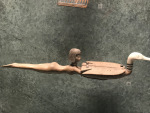
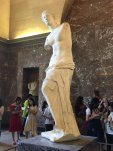
We did the Louvre in one day, and we saw all the floors and all the exhibits. All. The. Things. The big time exhibits were nice, like the Mona Lisa, the Venus de Milo, but the Egyptian exhibit and the paintings on the top floor (where no one else was) were some of my favorites.
We visited Notre Dame, but my favorite was Sacra Coeur in Monmarte. I actually had a genuine spiritual experience there. It was nice, and unexpected.
We skipped Versailles.
It took a while, but we eventually conquered The Metro. I think I’m as much an expert on the Metro right now as a tourist from another country can be.
The Louvre is monumental, but the D’Orsay is more enjoyable because its size is manageable.
Extras
One of the highlights of our trip was watching the new Mission Impossible film, most of which was filmed in Paris, in Paris! That was way cool. The best part was the commercial before the movie started for a doctor who specialized in lice removal.
I thought Delta provided great service getting there and back. Charles De Gaulle Airport is easy to navigate.
I was surprised at how much I enjoyed the Latin District and the night time boat ride on the Seine. Both were extremely pleasant.
We’d been told that going in August would be a drag because people would be gone and the shops would be closed. We didn’t experience that at all. Everything was open and the weather was perfect.
On the plane ride home I read a great book, Blood Letters: The Untold Story of Lin Zhao, A Martyr In Mao’s China. I’ll probably blog about it tomorrow.
The French way of having supper late, like around nine at night agrees with me.
The picnic we had by the fountain under the Eiffel Tower will stay with me as one of the sweetest memories with my family.
And now, some pics!
[image error]
[image error]A statue of Apollo at the Louvre. Looks like he is taking a selfie, doesn’t it? Doesn’t it?
[image error]This is Leonardo Da Vinci’s “John The Baptist”. He looks like Loki, a bit, and we thought it would be a great movie, Tom Hiddleston as Loki AS JOHN THE BAPTIST. Think about it.








[image error]Even heretics go on vacation
July 11, 2018
Texas Rangers, Captain Kirk, and A Reflective Quaker
I’ve finished three different books in the past week. And yes, I don’t think you could find three more distinct and different books–not only in subject matter but in style and genre. The first is a history book about the Texas Rangers, the second a weird Star Trek book, and the third is Parker Palmer.
[image error]Texas Rangers: Lives, Legacy, and Legend by Bob Alexander and Donaly E. Brice.
I bought this book at a great book store in Kerrville and looked forward to reading it for a long time. The history in these pages is wonderful. I wish the authors would have gone into a bit more detail about some of the individuals and escapades, but their intent is more of a survey than specifics. The main problem with Lives, Legacy, and Legend is at times the prose is not quite clear–as the authors seem to try and write paragraphs in the most muddied way possible to demonstrate their clever way of saying common things.
There are also a lot of digs against “Political Correctness” which I never understood in the text. One reference to it is an indulgence. Two references are pushing it. But by the seventeenth time the authors remind us that political correctness and modern sensibilities have no place in studying Ranger history, the point seems belabored.
There are some great photographs and primary documents, which alone is worth the price of the book.
[image error]The Autobiography of James T. Kirk: A Story of Starfleet’s Greatest Captain ‘Edited’ by David A. Goodman.
Two things up front: I enjoyed this book and laughed out loud several times. Also, it is a quick, easy read, unlike the Texas Rangers book, which is slow, plodding and laborious. The problem is, I think I enjoyed the book because I enjoy Star Trek, and the writer clearly does as well. But I don’t think the book is that well written.
The best are the early pages where we learn things about James T. Kirk that aren’t covered in the television shows or movies. But about sixty percent of the book is really lame plot summaries of shows. Yes, we get Kirk’s perspective on those things, but nothing really new is brought to the table.
But the book is funny. That should come as no surprise because it is written by Goodman, called the ‘editor’ on the book cover, who wrote for Family Guy and Golden Girls. What it lacks is emotional depth. The book was given to me as a gift for Christmas by a kind friend, and I looked forward to reading it, thinking it would give more character depth about the famous alpha male. But nope. Goodman is funny, but he is not that good of a writer. He does more ‘telling’ than ‘showing’ and as a result he leaves Kirk shallow.
There are two things that will stay with me a while, though. The first is how Goodman ‘washes’ over Star Trek V: The Final Frontier, the movie almost everyone agrees is the worst ever. It is quite clever, and I must say I like it. The second was this line thrown in to describe the mind-numbing administrative work of being an Admiral that Kirk hated.
[image error]Page 197
Of course the Obama was over budget and behind schedule. Of course it was.
[image error]A Hidden Wholeness: The Journey Toward An Undivided Life by Parker J. Palmer
I’ve read Palmer before, but not this book. What interests me is that I think Palmer believes he wrote a how-to book, when in reality he wrote about the inner voice, overcoming our fears and paranoias, and the need to learn to trust.
The format of the book is laid out as the steps to forming circles of trust. A circle of trust is a group of people who dedicate themselves to allowing people to hear their own soul in protected communication. It is good material, and I recommend the book to small group leaders of any kind, because the principles he shares are nearly universal.
The book is a gem, but what will stay with you for a long time is the story of the woodcarver. I’ve seen Palmer use it before, but I think his exposition of it in this text is his best.
Of the three books I’ve shared about, this one is the most vital; it is the one I think everyone would benefit from.