
Neve Maslakovic's Blog, page 9
February 22, 2012
A duck. And a birthday hat.
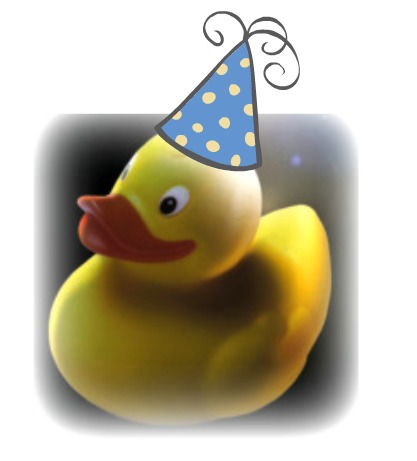
Yes, it's a duck with a birthday hat. (And also definitive proof of why I'd make a really lousy graphic designer. For one, I couldn't figure out how to get rid of the outer square that delineates photo edge -- I thought, being white on white, everything would blend nicely. Second, I cut-and-pasted the duck from my ARC cover. Need I say more?)
Anyway, the duck with the birthday hat is here because it's been a year since my debut novel came out. Thank you to everyone who bought the print or Kindle version of Regarding Ducks and Universes in the past year, or borrowed it from a library, or left a review, or sent me a kind note, or left a comment saying you enjoyed reading it. You guys are great!
I've been getting a lot of questions about the next book -- for now all I can say is that there are things in the works. That's all I can say mostly because that's all I know for now. Stay tuned. More to come.
Cheers,
Neve


January 19, 2012
Signing a Kindle book - Kindlegraph!
Well, I can now electronically sign copies of Regarding Ducks and Universes and future books on the Kindle, thanks to a new site called Kindlegraph (tagline: Making e-books a little more personal.)
The old way of signing books was pretty simple:
The Kindlegraph way of signing books:
From the reader point of view, there's a bit of work involved (though no more than getting yourself to a bookstore, book in hand, I guess). The directions can be found here, but essentially involve joining the site via your Twitter account (it's free), then entering your Kindle's email address (yes, you do have one). This is important: you have to add the site's email address to the list of approved senders on your Amazon's Manage Your Kindle page. Do this before you request the autograph; it will not be delivered otherwise.
Also, make sure the wireless on your Kindle is turned on, or you might get charged a fee by Amazon for receiving the signature document.
Here is my author page on Kindlegraph. Click on Request Kindlegraph -- what arrives will be a page with the book's cover, the personalized message I write, and my electronic signature.
Hopefully the signing process will improve down the line, but for now, it will do. Below is a screenshot of the test Kindlegraph I signed for the site's creator, Evan Jacobs:
[image error]
See what I mean about the signature being wobbly and childlike??? I need more practice.
The old way of signing books was pretty simple:
1. Ready acid-free pen and open book.(While we're on paper books, Uncle Hugo's is the place online to get a signed copy of Regarding Ducks & Universes.)
2. Ask reader for name, then ask again to make sure you have the correct spelling (yes, even if it's something like Jane or Tom.)
3. Think of something pithy and witty to write (pithier and wittier than Best Regards if possible), then write it on the first page of your book.
4. Sign name with flourish.
5. Close book and thank the reader for buying it, etc.
The Kindlegraph way of signing books:
1. Set up an author account on Kindlegraph.com. It doesn't take long, but you do have to have a Twitter account, which I do, having joined the Twitterverse last month (I can be found there as @NeveMaslakovic).
2. Set up your signature. The site is still relatively new, so the only two options available are (a) type signature in a handwriting font, which looked nothing like my actual author signature; or (b) sign using the mouse.
I opted for the second. It's hard to sign with a mouse. My signature kept coming out wobbly and shaky, like I had a seriously high fever or had downed way too many glasses of wine or was under the age of five. After a few tries, I settled on a signature. It still doesn't look much like my normal author signature—it's wobbly and majorly shortens my last name as it tapers upward into a sweeping line—but I reasoned that a shaky one was better than the fake-handwriting one.
3. Wait for a signature request from reader, which arrives in the form of an email via Kindlegraph, type in something personalized and pithy and witty (see above), then click Send Kindlegraph.
4. That's it.
From the reader point of view, there's a bit of work involved (though no more than getting yourself to a bookstore, book in hand, I guess). The directions can be found here, but essentially involve joining the site via your Twitter account (it's free), then entering your Kindle's email address (yes, you do have one). This is important: you have to add the site's email address to the list of approved senders on your Amazon's Manage Your Kindle page. Do this before you request the autograph; it will not be delivered otherwise.
Also, make sure the wireless on your Kindle is turned on, or you might get charged a fee by Amazon for receiving the signature document.
Here is my author page on Kindlegraph. Click on Request Kindlegraph -- what arrives will be a page with the book's cover, the personalized message I write, and my electronic signature.
Hopefully the signing process will improve down the line, but for now, it will do. Below is a screenshot of the test Kindlegraph I signed for the site's creator, Evan Jacobs:
[image error]
See what I mean about the signature being wobbly and childlike??? I need more practice.
January 12, 2012
Dakota County Author Fair, first ever!
On Saturday, January 21, I'll be at Dakota County's first-ever Local Author Fair from 1-4 p.m. with copies of Regarding Ducks and Universes. Come to meet local authors, listen to David Housewright give the keynote address, experience a writing workshop offered by The Loft, enjoy light refreshments, and enter your name in a drawing for free books!
The Galaxie Library is at 14955 Galaxie Avenue in Apple Valley. You can find out more about the fair here.
The Galaxie Library is at 14955 Galaxie Avenue in Apple Valley. You can find out more about the fair here.
December 6, 2011
It's That Time of the Year Again - ABNA 2012
The call went out today for manuscripts for the 2012 ABNA contest:
If you're unpublished (like I was in 2009 when I entered) or self-published, it can be a good way to get your book noticed, even if you don't win. This year the Top 500 manuscripts get Publisher's Weekly reviews. Find out more here.
The Amazon Breakthrough Novel Award brings together talented writers, reviewers, and publishing experts to find and develop new voices in fiction. The 2012 international contest will award two grand prizes: one for General Fiction and one for Young Adult Fiction. Each winner will receive a publishing contract with Penguin, which includes a $15,000 advance.
Open submissions for manuscripts will begin on January 23, 2012 and run through February 5, 2012.
If you're unpublished (like I was in 2009 when I entered) or self-published, it can be a good way to get your book noticed, even if you don't win. This year the Top 500 manuscripts get Publisher's Weekly reviews. Find out more here.
November 25, 2011
Don't Be a Hog and Other Rules for Coffeehouse Writers
True story. The other day I went to my out-of-home "office", the neighborhood coffeehouse (henceforth known as Coffeehouse). Usually I come mid-morning, when there are plenty of free spots — Coffeehouse serves pastries and sandwiches, so at lunch time it can get pretty crowded. This day I was a bit late, so I was happy to get the last free table next to an electrical outlet, by the Coffeehouse fireplace. I put my stuff down, my jacket, research materials, mango smoothie, bagel, and laptop… and reached to plug in my laptop cord. Only to discover that the person at the neighboring table had taken both sockets, top and bottom.
I live in the Twin Cities, so trust me when I say that people usually go out of their way to be nice and act un-hoglike (when grocery checkers ask, "Morning, how are you?", they really want to know.) The socket-taker had a laptop and an e-reader — hence the two cords — and also a long-drained cup of coffee and a thick anatomy textbook. A pre-med student? She must have noticed me arrive, I think, but didn't look up from the textbook or offer to unplug one of her devices. My battery was low, so what could I do? Uncomfortably (as I kinda try to be, as much as I can, one of those nice and un-hoglike people) I interrupted her studying and mumbled a polite inquiry as to whether she really needed both things plugged in. She proceeded to unplug one of the cables, grudgingly, and I was able to get some work done.
The incident (yes, in Minnesota, this counts as an incident) got me thinking about how there should be a set of guidelines for writers and others using public spaces as offices on a regular basis. So this is what I've come up with:
A Coffeehouse Writer's Guidelines:
1. Don't take a 4-person table if there are 2-person tables available. Yes, you need room for your laptop, e-reader and/or books, cellphone, coffee mug, etc., but the coffeehouse has to stay in business (see Rule 2). It's enough that you're using their physical space, their electricity, and their Wi-Fi.
2. Help keep the coffeehouse in business. Don't assume the staff is okay with you buying a lone cup of coffee and staying for four hours. Buy a pastry, a fruit salad, lunch. Don't sneak in your own food. Really.
3. Don't be a hog. Electrical outlets are there for everyone to share. Don't take more than one socket. Invest in a dual outlet adapter. Don't block outlets with your backpack or briefcase or winter coat.
4. Invest in a pair of headphones. It's a coffeehouse, not an office or a library. Don't throw mean looks at the loud party chit-chatting about holiday travel plans or the stay-at-home dad who came in with the boisterous toddler just to get out of the house. They have as much right to be there as you do.
5. Be nice. By now the staff probably knows you by sight, so get to know their names. Ami, the manager of Coffeehouse, took the trouble to learn how to pronounce my name, and the rest of the staff, Carol 1, Carol 2, and Tracey always ask me how I'm doing. This is their workplace. You are, after all, a guest.
6. Don't base characters in your screenplay or novel on the people who work at the coffeehouse. It just seems rude for some reason. Also, if you ever hit it big, they might recognize themselves. Customers, on the other hand, are okay to use for inspiration. Some of them are probably doing it to you in return.
7. Know when to leave. If the coffeehouse gets really busy and your latte or cappuccino is long gone except for a thin, cold puddle on the bottom of the cup, it's time to pack up your stuff and leave. Again, you're a guest. Guests should know when to leave.
8. Finally, the miscellaneous stuff: Don't leave a mess behind, Don't talk loudly on your cellphone, and No, the coffeehouse might not be the best place to play that violent video game you're addicted to. These seem like common sense (though you'd be surprised).
One more thing. Though the above guidelines are meant for writers, most apply to other coffeehouse regulars — like students, website designers, etc. As to the premed student so wrapped up in her studying that she was oblivious to the needs of others? Well, who can blame her? I'll be the first to admit that the rules can be hard to stick to. Lunchtime crowds and empty coffee cups be damned, who wants to pack up and leave if their creative/academic/entrepreneurial juices are flowing? Been there myself.
I live in the Twin Cities, so trust me when I say that people usually go out of their way to be nice and act un-hoglike (when grocery checkers ask, "Morning, how are you?", they really want to know.) The socket-taker had a laptop and an e-reader — hence the two cords — and also a long-drained cup of coffee and a thick anatomy textbook. A pre-med student? She must have noticed me arrive, I think, but didn't look up from the textbook or offer to unplug one of her devices. My battery was low, so what could I do? Uncomfortably (as I kinda try to be, as much as I can, one of those nice and un-hoglike people) I interrupted her studying and mumbled a polite inquiry as to whether she really needed both things plugged in. She proceeded to unplug one of the cables, grudgingly, and I was able to get some work done.
The incident (yes, in Minnesota, this counts as an incident) got me thinking about how there should be a set of guidelines for writers and others using public spaces as offices on a regular basis. So this is what I've come up with:
A Coffeehouse Writer's Guidelines:
1. Don't take a 4-person table if there are 2-person tables available. Yes, you need room for your laptop, e-reader and/or books, cellphone, coffee mug, etc., but the coffeehouse has to stay in business (see Rule 2). It's enough that you're using their physical space, their electricity, and their Wi-Fi.
2. Help keep the coffeehouse in business. Don't assume the staff is okay with you buying a lone cup of coffee and staying for four hours. Buy a pastry, a fruit salad, lunch. Don't sneak in your own food. Really.
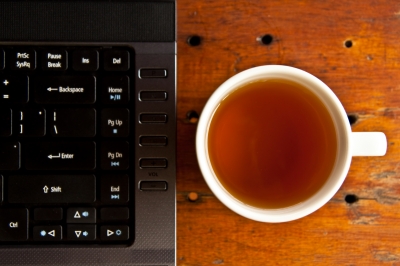
3. Don't be a hog. Electrical outlets are there for everyone to share. Don't take more than one socket. Invest in a dual outlet adapter. Don't block outlets with your backpack or briefcase or winter coat.
4. Invest in a pair of headphones. It's a coffeehouse, not an office or a library. Don't throw mean looks at the loud party chit-chatting about holiday travel plans or the stay-at-home dad who came in with the boisterous toddler just to get out of the house. They have as much right to be there as you do.
5. Be nice. By now the staff probably knows you by sight, so get to know their names. Ami, the manager of Coffeehouse, took the trouble to learn how to pronounce my name, and the rest of the staff, Carol 1, Carol 2, and Tracey always ask me how I'm doing. This is their workplace. You are, after all, a guest.
6. Don't base characters in your screenplay or novel on the people who work at the coffeehouse. It just seems rude for some reason. Also, if you ever hit it big, they might recognize themselves. Customers, on the other hand, are okay to use for inspiration. Some of them are probably doing it to you in return.
7. Know when to leave. If the coffeehouse gets really busy and your latte or cappuccino is long gone except for a thin, cold puddle on the bottom of the cup, it's time to pack up your stuff and leave. Again, you're a guest. Guests should know when to leave.
8. Finally, the miscellaneous stuff: Don't leave a mess behind, Don't talk loudly on your cellphone, and No, the coffeehouse might not be the best place to play that violent video game you're addicted to. These seem like common sense (though you'd be surprised).
One more thing. Though the above guidelines are meant for writers, most apply to other coffeehouse regulars — like students, website designers, etc. As to the premed student so wrapped up in her studying that she was oblivious to the needs of others? Well, who can blame her? I'll be the first to admit that the rules can be hard to stick to. Lunchtime crowds and empty coffee cups be damned, who wants to pack up and leave if their creative/academic/entrepreneurial juices are flowing? Been there myself.
October 27, 2011
The Albino Squirrel
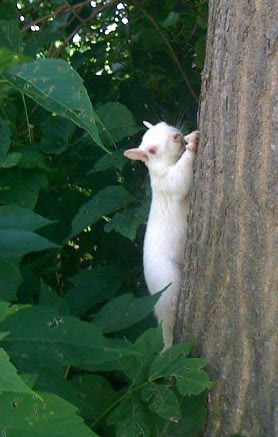 We've now seen it several times on the path that goes around the neighborhood lake. My husband John has seen it, I've seen it at least twice. The albino squirrel.
Actually, for all we know, it could be a whole family of squirrels, not just one, since it's been spotted on opposite sides of the lake. Or it could just be a squirrel that really gets around.
It also seems a bit friendlier than your usual gray squirrel. When it saw me taking the photo, it paused for moment in its scramble up the tree and looked directly at the camera. Or that could be my imagination. I took the photo with my cell phone during the summer, so it's not the greatest (for one thing, you can't see the tail and the leaves are not green nowadays but orange-yellow-red.) Still, it seemed appropriate for Halloween for some reason -- there's something just a bit spooky about coming across a white-coated squirrel.

September 19, 2011
I'm a Writer, Not a Critic
Some people give out book ratings like they're candy. I'm not one of them. A hundred or so books sit on my virtual shelves on Goodreads. I've written a handful of one-sentence reviews, but so far I've only given a single rating -- for an audio book. Stephen Fry reading the Harry Potter books. Phenomenal. Five stars. Easy-peasy to give it a rating. Same with movies -- I've rated dozens and dozens of movies on Netflix, four stars, two stars, five stars, not interested, whatever. No problem.
Books not so much. It's worked for me so far.
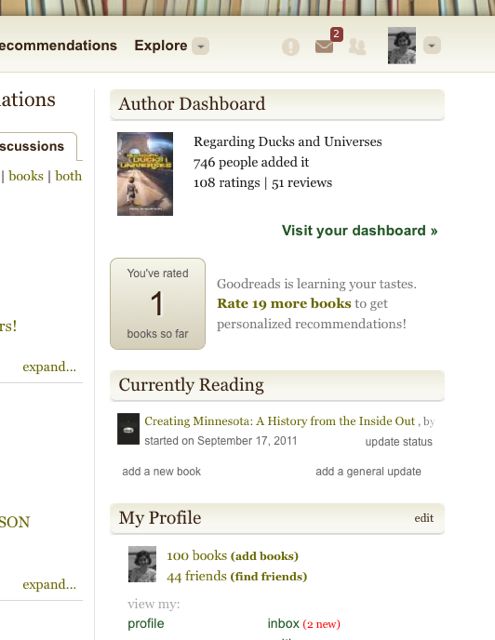
But the other morning I awoke to this on my Goodreads author dashboard:

It's the new recommendations feature. In the large gray square it points out that I've rated only one book (the Stephen Fry reading Harry Potter audio set; Goodreads treats books and audio books the same), and to the right it tells me that I need to rate at least 19 more (twenty being apparently the minimum threshold) to get personalized recommendations from the site.
Maybe it would be different if I'd grown up with the everyone's-opinion-counts-equally-and-should-be-heard system, but I didn't. The hundred books on my virtual shelf are only a sample, a sliver of my reading life, the books I happened to catch sight of on my (real-life) bookcases in the past few months and thought, that's a good book, I should it to my Goodreads shelf. If I added all my P.G. Wodehouses, that be, like, another hundred books right there.
Besides, how do you rate a book you read years ago and remember fondly but suspect that rereading it now that you're an (ahem) older, wiser adult might change your view of it?
How do you rate books by fellow authors?
For that matter, how do you rate a book in the first place? I think I'm too close to them. I rate movies easily because I'm not in the movie industry. Does anyone expect George Lucas to rate films? (Actually, I have no idea. For all I know, he might.)
By the way, I like all the books on my Goodreads shelf. Why go to the effort of adding them otherwise?
Goodreads recommendations are a welcome feature, but I don't think that in itself will nudge me into assigning ratings. One thing might, however. It's not that "1" that sits in the large gray square above. It's the unintended grammar gaffe in it: "You've rated 1 books so far." That will drive me nuts in about a week, and I'll have to rate at least one book to change the "1" into a "2". Once I've done that, well...

Books not so much. It's worked for me so far.
But the other morning I awoke to this on my Goodreads author dashboard:
It's the new recommendations feature. In the large gray square it points out that I've rated only one book (the Stephen Fry reading Harry Potter audio set; Goodreads treats books and audio books the same), and to the right it tells me that I need to rate at least 19 more (twenty being apparently the minimum threshold) to get personalized recommendations from the site.
Maybe it would be different if I'd grown up with the everyone's-opinion-counts-equally-and-should-be-heard system, but I didn't. The hundred books on my virtual shelf are only a sample, a sliver of my reading life, the books I happened to catch sight of on my (real-life) bookcases in the past few months and thought, that's a good book, I should it to my Goodreads shelf. If I added all my P.G. Wodehouses, that be, like, another hundred books right there.
Besides, how do you rate a book you read years ago and remember fondly but suspect that rereading it now that you're an (ahem) older, wiser adult might change your view of it?
How do you rate books by fellow authors?
For that matter, how do you rate a book in the first place? I think I'm too close to them. I rate movies easily because I'm not in the movie industry. Does anyone expect George Lucas to rate films? (Actually, I have no idea. For all I know, he might.)
By the way, I like all the books on my Goodreads shelf. Why go to the effort of adding them otherwise?
Goodreads recommendations are a welcome feature, but I don't think that in itself will nudge me into assigning ratings. One thing might, however. It's not that "1" that sits in the large gray square above. It's the unintended grammar gaffe in it: "You've rated 1 books so far." That will drive me nuts in about a week, and I'll have to rate at least one book to change the "1" into a "2". Once I've done that, well...
I'm a Writer, not a Critic
Some people give out book ratings like they're candy. I'm not one of them. A hundred or so books sit on my virtual shelves on Goodreads. I've written a handful of one-sentence reviews, but so far I've only given a single rating -- for an audio book. Stephen Fry reading the Harry Potter books. Phenomenal. Five stars. Easy-peasy to give it a rating. Same with movies -- I've rated dozens and dozens of movies on Netflix, four stars, two stars, five stars, not interested, whatever. No problem.
Books not so much. It's worked for me so far.
But the other morning I awoke to this on my Goodreads author dashboard:
It's the new recommendations feature. In the large gray square it points out that I've rated only one book (the Stephen Fry reading Harry Potter audio set; Goodreads treats books and audio books the same), and to the right it tells me that I need to rate at least 19 more (twenty being apparently the minimum threshold) to get personalized recommendations from the site.
Maybe it would be different if I'd grown up with the everyone's-opinion-counts-equally-and-should-be-heard system, but I didn't. The hundred books on my virtual shelf are only a sample, a sliver of my reading life, the books I happened to catch sight of on my (real-life) bookcases in the past few months and thought, that's a good book, I should it to my Goodreads shelf. If I added all my P.G. Wodehouses, that be, like, another hundred books right there.
Besides, how do you rate a book you read years ago and remember fondly but suspect that rereading it now that you're an (ahem) older, wiser adult might change your view of it?
How do you rate books by fellow authors?
For that matter, how do you rate a book in the first place? I think I'm too close to them. I rate movies easily because I'm not in the movie industry. Does anyone expect George Lucas to rate films? (Actually, I have no idea. For all I know, he might.)
By the way, I like all the books on my Goodreads shelf. Why go to the effort of adding them otherwise?
Goodreads recommendations are a welcome feature, but I don't think that in itself will nudge me into assigning ratings. One thing might, however. It's not that "1" that sits in the large gray square above. It's the unintended grammar gaffe in it: "You've rated 1 books so far." That will drive me nuts in about a week, and I'll have to rate at least one book to change the "1" into a "2". Once I've done that, well...
Books not so much. It's worked for me so far.
But the other morning I awoke to this on my Goodreads author dashboard:
It's the new recommendations feature. In the large gray square it points out that I've rated only one book (the Stephen Fry reading Harry Potter audio set; Goodreads treats books and audio books the same), and to the right it tells me that I need to rate at least 19 more (twenty being apparently the minimum threshold) to get personalized recommendations from the site.
Maybe it would be different if I'd grown up with the everyone's-opinion-counts-equally-and-should-be-heard system, but I didn't. The hundred books on my virtual shelf are only a sample, a sliver of my reading life, the books I happened to catch sight of on my (real-life) bookcases in the past few months and thought, that's a good book, I should it to my Goodreads shelf. If I added all my P.G. Wodehouses, that be, like, another hundred books right there.
Besides, how do you rate a book you read years ago and remember fondly but suspect that rereading it now that you're an (ahem) older, wiser adult might change your view of it?
How do you rate books by fellow authors?
For that matter, how do you rate a book in the first place? I think I'm too close to them. I rate movies easily because I'm not in the movie industry. Does anyone expect George Lucas to rate films? (Actually, I have no idea. For all I know, he might.)
By the way, I like all the books on my Goodreads shelf. Why go to the effort of adding them otherwise?
Goodreads recommendations are a welcome feature, but I don't think that in itself will nudge me into assigning ratings. One thing might, however. It's not that "1" that sits in the large gray square above. It's the unintended grammar gaffe in it: "You've rated 1 books so far." That will drive me nuts in about a week, and I'll have to rate at least one book to change the "1" into a "2". Once I've done that, well...
August 11, 2011
A Kid and a Kindle
One day last winter, I was in the hallway of my son's elementary school, waiting. I do this every day during the school year – arrive five or ten minutes early to avoid fighting for a parking spot and then wait, sometimes talking with other parents, but mostly just watching the kids shuffle off to school buses or to cars with engines running. The first graders, one of whom I was going to take home, are usually among the last to emerge from the classrooms. (I think this is because it takes them a while to don their gear -- jackets, gloves, hats, boots.) As I waited, I noticed an older kid (elementary school age, so fifth grader at the most). He was leaning against the wall, reading.
This was interesting.
First of all, it's not like the school hallway is a quiet, tranquil place conducive to reading, especially at pick-up time (having tried it myself, I can testify to this). In the fall and spring, non-school-bus kids wait outside, in the school courtyard, but in the winter they are just inside the front doors. Frankly, it can be a bit of a zoo. The kids congregate on the benches in front of the principal's office and there is much merriment, bickering, jostling, and whatever other kind of socializing kids that age do. This happened to be the week just before winter break and there was much excitement in the air, making the book-reading kid stand out even more amongst his brethren.
Secondly, he was reading a Kindle.
The kid, as is right, was blithely unaware that others might hold strong opinions on tree books, e-books, mega-bookstores putting independent bookstores out of business, online retailers threatening to put mega-bookstores out of business, e-readers, traditional publishers, new publishers, the Nook Color, on-demand-printing, self-publishing, e-book rights, audio rights, et cetera.
(Disclaimer: in our house we own a Kindle and also buy a lot of paper books.)
Like the protagonist of Regarding Ducks and Universes, Felix Sayers, who grew up with e-readers and only met paper books in Universe B, I'm becoming aware that many of our preferences are based simply on what we're used to. I am not the Kindle-reader in our house, my husband John is. I say that I like to read paper books because it's easier on my eyes and gives me a welcome break from electronic screens... but even I'm not sure if this is true.
I read a lot as a child -- I walked around at home with an open book in my hands. I don't remember doing it at school, though.
Now, I'm always interested in what people are reading: at the YMCA, I see parents with kids in swim lessons reading novels on the uncomfortable and moist pool-side benches; at the coffee house, textbook and work-related materials seem to be popular; on planes, I see a lot of bestsellers hastily grabbed at the airport bookstore. Can't tell with an e-reader, though.
I didn't ask the fifth-grader what he was reading on his Kindle. Why should other people know what you're reading anyway?
I left that day thinking, I would have liked being that kid, knapsack at his feet, back against the wall, nose buried in his e-reader. I think I was that kid.

This was interesting.
First of all, it's not like the school hallway is a quiet, tranquil place conducive to reading, especially at pick-up time (having tried it myself, I can testify to this). In the fall and spring, non-school-bus kids wait outside, in the school courtyard, but in the winter they are just inside the front doors. Frankly, it can be a bit of a zoo. The kids congregate on the benches in front of the principal's office and there is much merriment, bickering, jostling, and whatever other kind of socializing kids that age do. This happened to be the week just before winter break and there was much excitement in the air, making the book-reading kid stand out even more amongst his brethren.
Secondly, he was reading a Kindle.
The kid, as is right, was blithely unaware that others might hold strong opinions on tree books, e-books, mega-bookstores putting independent bookstores out of business, online retailers threatening to put mega-bookstores out of business, e-readers, traditional publishers, new publishers, the Nook Color, on-demand-printing, self-publishing, e-book rights, audio rights, et cetera.
(Disclaimer: in our house we own a Kindle and also buy a lot of paper books.)
Like the protagonist of Regarding Ducks and Universes, Felix Sayers, who grew up with e-readers and only met paper books in Universe B, I'm becoming aware that many of our preferences are based simply on what we're used to. I am not the Kindle-reader in our house, my husband John is. I say that I like to read paper books because it's easier on my eyes and gives me a welcome break from electronic screens... but even I'm not sure if this is true.
I read a lot as a child -- I walked around at home with an open book in my hands. I don't remember doing it at school, though.
Now, I'm always interested in what people are reading: at the YMCA, I see parents with kids in swim lessons reading novels on the uncomfortable and moist pool-side benches; at the coffee house, textbook and work-related materials seem to be popular; on planes, I see a lot of bestsellers hastily grabbed at the airport bookstore. Can't tell with an e-reader, though.
I didn't ask the fifth-grader what he was reading on his Kindle. Why should other people know what you're reading anyway?
I left that day thinking, I would have liked being that kid, knapsack at his feet, back against the wall, nose buried in his e-reader. I think I was that kid.
June 29, 2011
numbers, Numbers, NUMBERS
Project Author asked me the other day what the hardest thing about writing Regarding Ducks and Universes was. This is what I replied:
Thinking about it some more, I've realized that part of it is that nowadays a newly published author is faced with a barrage of numbers, ones I found myself obsessing over even before the official publication date of my debut novel. For aspiring authors out there, here they are, grouped into four categories:
(1) For starters, we have the numbers that serve as a measure of your writing efforts:
The daily word count. I shoot for a thousand words a day. I've found that that's often unrealistic, especially on days that I need to do research. I try to reach it anyway.
The manuscript word count. It edges upward day to day, except when I trim the ending of a chapter or edit out a scene that turns out not to work within the story. The MS count gives you something to say when people ask, "When is your next book going to be done?"
(2) Then there are the numbers that serve as a measure of your sales:
Amazon rank. It's updated hourly and it's different for the print version and the Kindle version, should you have both available. The e-book rank is usually higher (that is, better) since there are fewer books to compete with in the Kindle store (currently just under a million listed.) Other places to find rankings to obsess over are Barnes & Noble (including the Nook, if your book is on it – mine isn't yet) and, if your book is available internationally, on Amazon UK, Amazon Canada, Amazon Germany, and so on.
Bookscan data, the number of print books sold in the past week, broken down by geographic area. Available in Amazon's Author Central.
And finally, the sales statement sent by your publisher, including, of course, any earned royalties. I receive statements monthly and pore over them with an obsessive parent's eye.
(3) Then we have the numbers that serve as a measure of your promotional efforts:
The number of people who entered your latest giveaway. These can be quite high (on the order of a thousand if you list your giveaway through Goodreads or LibraryThing) or on the low end if you list the giveaway on your blog but don't have many followers yet.
The number of to-reads (people who have shelved your book on their virtual bookshelf on Goodreads, LibraryThing, or Safari and think they might eventually get around to buying it.) There's usually no direct relation between these and your actual sales numbers.
The number of friends/likes you have on Facebook, Goodreads, and other social sites. (I'm not big on friend counting, so I don't worry too much about these. Then again, that might why the "like" count on my Facebook author page is only up to sixty-eight.)
If you have a blog, there is also the number of daily hits to keep an eye on.
(4) Finally, there are the numbers that reflect people's opinions of your book:
The book's average rating on Amazon, Goodreads, LibraryThing, Barnes & Noble, and other sites. I cannot emphasize this enough: People's opinions of your book will vary. You'll get five-star reviews and also one-star ones from people seriously lacking in reading taste. Move on.
Also of interest are the Top 100 lists on Amazon and in the Kindle store in the book's category. There are ones based on sales, and others on the book's average rating. Regarding Ducks and Universes tends to slip in and out of the Top 100 rated category in Science Fiction > Adventure as it and other books accrue ratings daily and get shuffled around.
Speaking of lists, it's good to be on them. Goodreads has ones like Beautiful Book Covers of 2011, Books That Make You Laugh, and Hate the Book, But Can't Stop Reading It! (Regarding Ducks and Universes is on two out of those three, as it happens.)
One last thing -- of all the numbers listed above, only the daily word count and the related MS count are fully under your control. Something to keep in mind!

was. This is what I replied: The writing is the fun part. I enjoy all aspects of it -- filling up a blank page, research, editing... Well, except maybe for proofreading, because you're supposed to be concentrating only on finding typos and such in the manuscript, but I always want to keep making edits. Not big ones, just little details here and there. I hope I didn't drive my editor nuts doing that!
The business side of things is a different story. At some point you have to let go of the book and suddenly there are deadlines to worry about, reviews, sales numbers, marketing, promotion… It was all a bit overwhelming at first, but I am getting to the point where I feel more comfortable with that stuff.
Thinking about it some more, I've realized that part of it is that nowadays a newly published author is faced with a barrage of numbers, ones I found myself obsessing over even before the official publication date of my debut novel. For aspiring authors out there, here they are, grouped into four categories:
(1) For starters, we have the numbers that serve as a measure of your writing efforts:
The daily word count. I shoot for a thousand words a day. I've found that that's often unrealistic, especially on days that I need to do research. I try to reach it anyway.
The manuscript word count. It edges upward day to day, except when I trim the ending of a chapter or edit out a scene that turns out not to work within the story. The MS count gives you something to say when people ask, "When is your next book going to be done?"
(2) Then there are the numbers that serve as a measure of your sales:
Amazon rank. It's updated hourly and it's different for the print version and the Kindle version, should you have both available. The e-book rank is usually higher (that is, better) since there are fewer books to compete with in the Kindle store (currently just under a million listed.) Other places to find rankings to obsess over are Barnes & Noble (including the Nook, if your book is on it – mine isn't yet) and, if your book is available internationally, on Amazon UK, Amazon Canada, Amazon Germany, and so on.
Bookscan data, the number of print books sold in the past week, broken down by geographic area. Available in Amazon's Author Central.
And finally, the sales statement sent by your publisher, including, of course, any earned royalties. I receive statements monthly and pore over them with an obsessive parent's eye.
(3) Then we have the numbers that serve as a measure of your promotional efforts:
The number of people who entered your latest giveaway. These can be quite high (on the order of a thousand if you list your giveaway through Goodreads or LibraryThing) or on the low end if you list the giveaway on your blog but don't have many followers yet.
The number of to-reads (people who have shelved your book on their virtual bookshelf on Goodreads, LibraryThing, or Safari and think they might eventually get around to buying it.) There's usually no direct relation between these and your actual sales numbers.
The number of friends/likes you have on Facebook, Goodreads, and other social sites. (I'm not big on friend counting, so I don't worry too much about these. Then again, that might why the "like" count on my Facebook author page is only up to sixty-eight.)
If you have a blog, there is also the number of daily hits to keep an eye on.
(4) Finally, there are the numbers that reflect people's opinions of your book:
The book's average rating on Amazon, Goodreads, LibraryThing, Barnes & Noble, and other sites. I cannot emphasize this enough: People's opinions of your book will vary. You'll get five-star reviews and also one-star ones from people seriously lacking in reading taste. Move on.
Also of interest are the Top 100 lists on Amazon and in the Kindle store in the book's category. There are ones based on sales, and others on the book's average rating. Regarding Ducks and Universes
tends to slip in and out of the Top 100 rated category in Science Fiction > Adventure as it and other books accrue ratings daily and get shuffled around.Speaking of lists, it's good to be on them. Goodreads has ones like Beautiful Book Covers of 2011, Books That Make You Laugh, and Hate the Book, But Can't Stop Reading It! (Regarding Ducks and Universes is on two out of those three, as it happens.)
One last thing -- of all the numbers listed above, only the daily word count and the related MS count are fully under your control. Something to keep in mind!


![[image error]](http://2.bp.blogspot.com/-ILakK_FBs2s/Txh6KfF8hRI/AAAAAAAAAMI/WSiEuflTPWA/s1600/Picture%204.png)