Cleo Lampos's Blog, page 4
August 27, 2024
A Quilt for the Angels of Bataan
“They were trailblazers for women in the military, for the Army Nurse Corps. They set the example for the rest of the services. Their story told the world…that women are tough, they can serve in combat and they can survive.”
-Lt. Col. Nancy Cantrell, nurse and historian

The 99 Navy and Army nurses, known as “The Angels of Bataan”, grew up in the Great Depression. Some of the women even endured the drought, dirt and deprivation of the Dust Bowl, eating Jack, biscuits and beans every meal of their lives. Others dined on dandelions or tumbleweeds. All lived in communities that knew how to hunker together to survive. That was how their parents made it through a decade of foraging for food, creatively fashioning tools, collecting fabric scraps to stitch into breathtaking quilts, and consoling one another at parlor room wakes. These young women witnessed the deep faith that underpinned the lives of the adults who raised them in desperate times. Like their parents, one day they would draw on that faith to endure uncharted challenges.
These young women were recruited by government workers who combed the small towns ravaged by poverty, seeking persons who knew how to face adversity. And wanted a ticket away from obscurity. With no military or survival training, the high school graduates signed up as Army or Navy Nurses. These medically trained inductees held the rank of second lieutenant and were universally addressed as “Miss”.
Little did they know that the life skills learned in their youth would prepare them to face indescribable hardships as they battled for the lives of the GI’s in the jungles of Bataan and in the Japanese prison camp in Manila.
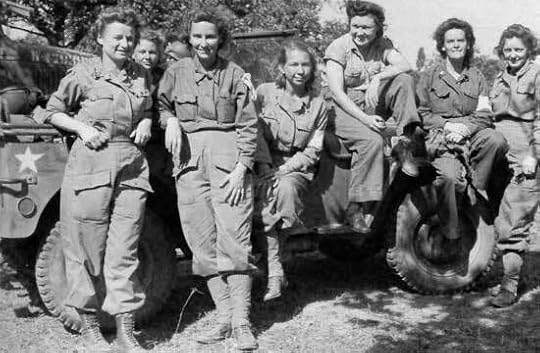
Right after Pearl Harbor, the Philippines fell under Japanese attack. The Army and Navy nurses were the first unit of American women to be sent into service so close to the front lines of battle. They quickly learned day by day to treat the wounded. Not in hospitals, but in outdoor clinics in the jungles of Bataan. Ruth Straub wrote in her journal about the first field hospital on Bataan. “It is jungle land and everyone lives under trees. Rows of beds snuggled under the trees with narrow winding paths between them and the night sky overhead.”
Laboring 24 hours a day for four months, the nurses cared for 6,000 patients while bombs whistled around them. In one day, January 16, 1942, the nurses aided the doctors in 187 major surgeries. The conditions defied medical standards. Lack of mosquito nets led to malaria and dengue fever among patients and staff. Swarms of flies contaminated the meager food and water supplies with dysentery and other parasites. Watching the women endure the same risks and illnesses as themselves, the soldiers fought with inspired courage. But in May, the US forces surrendered to the Japanese and the men were sent on the Bataan Death March. The nurses escaped under sniper fire, mines, and explosions to the Manila Tunnel where they tended the wounded. By then, they had earned their nickname, “the Angels of Bataan and Corregidor”.
The nurses were taken prisoner, sent to Manila and held at a Japanese prison camp at Santo Tomas University with 4,000 prisoners. According to Nurse Mildred Manning, “We were scared and tired, but we kept working. We were under terrific strain, but we just did our job even when we were weak from not eating.” During the imprisonment, the nurses treated fellow prisoners while suffering from beri-beri, dengue fever, malaria and malnutrition. “When your world is crumbling around you, you need this kind of structure,” said Elizabeth Norman, associate professor of nursing at New York University.
The nurses assessed their fragile physical and mental reserves and knew they were dying after three years of prison life. They realized that the whole camp was on a death watch with a clock ticking. They made cynical jokes about it, but Lt. Palmer states, “None of these nurses ever expressed a fear to me about their own deaths, ever, either in battle or in the camp. It appeared to take more courage to live than to die.”
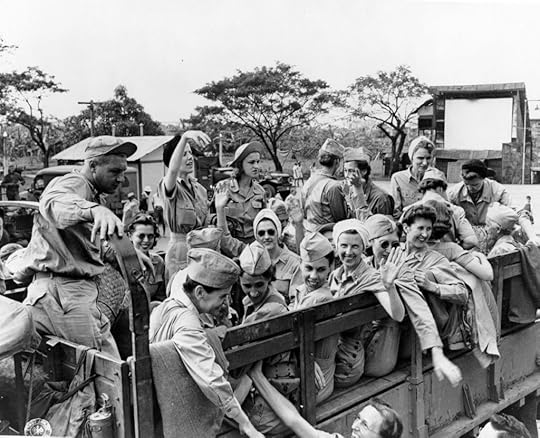
LiberationOn February 3, 1944, the 1st Cavalry Division and 44th Tank Battalion burst through the prison gates. The nurses joined the prisoners as they cried and screamed, then sang, “God Bless America.” When they left the prison on February 22, the women helped one another walk, stumble or limp to the trucks awaiting them. Each refused to be carried out. Ninety-nine nurses. One hundred per cent survival record. A feat unmatched to this day. A tribute to the years of childhood that taught them to hunker together, believe together, and make sure everyone walked out together.
The nurses returned to the States to resume their lives. They married, went back to military service, or worked. The government did not follow up on them, or understand the impact of their experiences on fertility, cancer, heart disease, chronic gastrointestinal problems, or dental work. The emotional and PTSD issues that resulted in relationship problems or suicide attempts never reached the government’s desks. The nurses suffered in silence, another lesson they had learned as they grew up in the depths of the Great Depression.
The children of the 1930’s came to terms with life at an early age, and stared fear in the face: just as their parents did on a daily basis. As young adults, they took on the perils of war with the same meddle as they had shown in their growing up years. Even as parents themselves, they coped with lingering memories and horrors, but rose to the challenge of building a better life for their children.
They have all become what we now know as The Greatest Generation.
The Angels of Bataan did not have quilts or comforters to wrap around themselves while on the battlefield hospital or in the prison camp. In honor of these women, let this Nurse’s quilt be dedicated to their service and an example of unselfish devotion.
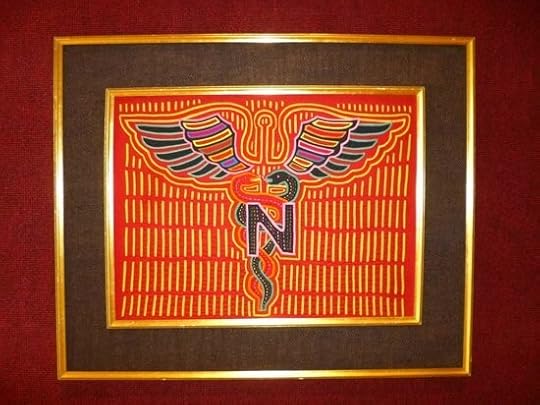
Nurse’s Corp quilt
“These, then, were the values installed in the four young Gates girls: hard work, education, perseverance, self-reliance, care-taking, and independence. With this as a foundation, it hardly seems surprising that one of them would eventually earn the title of hero.”
From the book, Marcia Gates, Angel of Bataan by Melissa Bowersock
“They were the largest group of women POW’s in the history of our country. But there was so much going on- the events at Pearl Harbor, the war in Europe, that their story has been swallowed up.”
-Elizabeth Norman, author of We Band of Angels
“We weren’t brave. We were just doing our job.”
– Lt. Helen Cassiani Nestor, Angel of Bataan
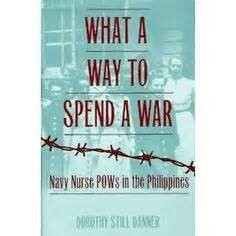
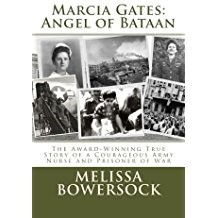
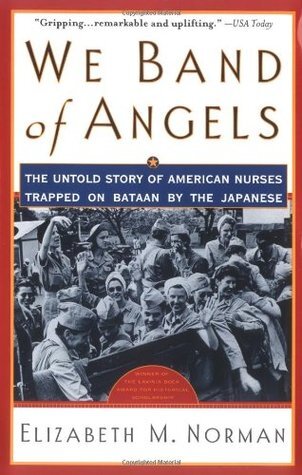
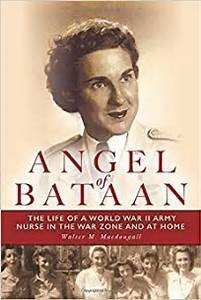
Photo of nurses used for meme from www.centralmaine.com.


A Picture Worth Thousands of Words: The Dust Bowl by Ken Burns
For two hours, Vernon and I watched disturbing, yet stunning visuals flash across our television screen. Frightening images of gigantic black blizzards engulfing barns and cities with devastating results. Plagues of jackrabbits and locusts. Old and young coughing from dust pneumonia. The first DVD of The Dust Bowl, by Ken Burns, sent chills pearling over our spines and minds. Through personal interviews with survivors of the 1930’s, private letters, newspaper accounts and compelling photos, Ken Burns sets out the causes of the worst catastrophe in ecological history in the United States. With iconic photos and news films from the day, the documentary huddled Vernon and I together on our couch as the life stories of unimaginable human suffering filled us with grief and shock.
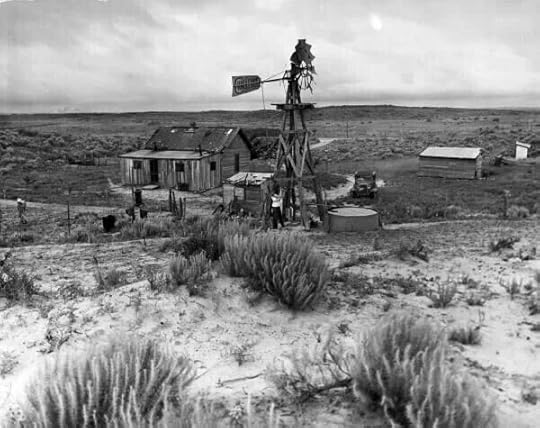
Probably the most disconcerting aspect of Part I of The Dust Bowl was the music. The persons in the interviews recall hymns being sung by their parents during the worst of the droughts. Woody Guthrie sang “So Long, It’s Been Good to Know You” a song he wrote as he sat at a kitchen table believing the end of the world was at hand. In the background of the film, a dulcimer played “Bringing In The Sheaves” as the visuals presented more mile-high dust storms, dead livestock and leathered homesteaders. The disconnect between the song and the reality of the situation heightened our depression as Vernon and I watched thousands of desperate families who faced poverty, foreclosure, starvation and death. Most of all, they tackled fear of the unknown. Every day. On frayed threads of hope.
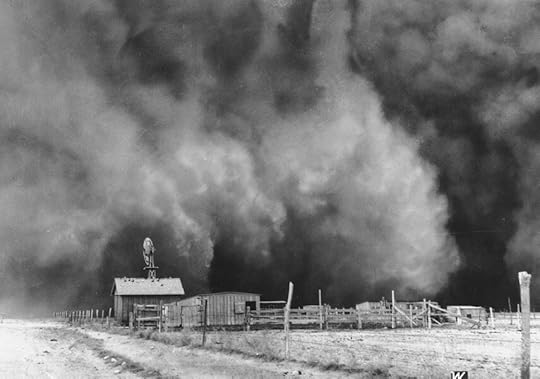
It took courage to watch Part 2 of The Dust Bowl. But the possibility that there was a solution to an unsolvable situation intrigued both Vernon and me. While watching the efforts of President Franklin D. Roosevelt to marshal government efforts to help the farmers who lost 850 million tons of topsoil in one year, I learned to appreciate this man known for his calming Fireside Chats.
But the stories of Henry Finnell and Hugh Bennett are what caught my attention, because these men lifted my heart. They embodied the concept of preparation for “such a time as this” by a providential God. Both Finnell and Bennett possessed the exact scientific backgrounds needed to turn around the results of man’s greed. The story of the dust bowl, which had been so scary and humbling, finally morphed into a realization of the hand of God in the affairs of man. A sense of hope.
[image error]
Lessons LearnedThe dust bowl is an overlooked era in American history. By watching this documentary, my husband and I learned so much about man’s relationship to the land, and the limits of government. We recognized the human capacity for perseverance despite incredible suffering. We acknowledged the providence of God in the affairs of man. The unforgettable images, stories and music of that era fill my heart with admiration for the people of that time and provide insights into the uncertain future our nation faces today.
[image error]
A sobering film of Ken Burns’ finest work.
Anything
One word kept appearing in the book I read with quickening hope. Anything. “The very idea of doing anything demands everything,” the author, Jennie Allen, wrote.¹ Complete surrender to God’s will. At the end of the book’s last paragraph, my prayer was, “Anything.”
In a few days, an e-mail from an author I had met during the summer presented an offer. Would I like to co-author a book? The question resonated deep in my soul. As a teacher who wanted to be a librarian, research defined my projects. Digging out the details for a nonfiction book based on the foods of World War II intrigued me. Knowing nothing on the subject, curiosity spurred me to nod “yes” to the proposal. Gail Kittleson would have a partner for this work.
[image error]
The pursuit of sources of food on the home-front, in the military and overseas took over my life. Usually an eight-hour-a-night sleeper, it became common for me to slip to the computer at three a.m. to dig into a topic with more detail. Bags of books from Amazon Prime appeared at our door, only to be underlined and dog eared within days. Even my dream life involved structuring a chapter about sea cucumbers. The work shaped my days, nights, and thoughts. In a time of retirement and health problems, life surged with purpose and meaning.
Delving into the world events of my parents’ and grandparents’ era, an inevitable soul searching process resulted. Products of the deprivation and insecurity of the Great Depression, an entire generation of men and women stepped into the struggles of a global war.
[image error]
The Weekly Ration For Two People, UK, 1943
Reading about their ability to deny themselves so much in order to procure freedom, my entitled soul searched for deeper meaning in my own life. Realizing the labors of the Women’s Land Army volunteers, Red Cross workers, Rosie the Riveters and Victory Garden tillers as they worked for a common goal, my own sense of gratitude for their sacrifices increased. The perseverance of the men on the front challenged my dedication to making this a better world in their honor.
[image error]
National Archives
Researching the book, The Food That Kept a World Together ², has been a gift from God to me. When I released my will to Him, He answered with a task that proved soul satisfying. By doing what God has equipped my mind and heart to accomplish, I am learning to trust Him. With anything.
Anything: The Prayer that Unlocked My God and My Soul, by Jennie Allen. W Publishing Group, an imprint of Thomas Nelson, Nashville, TN, 2011.The Food That Kept a World Together will be released in the summer of 2020.
Photo credits:
An Unexpected Surprise
“Never be afraid to trust an unknown future to a known God.”
— Corrie Ten Boom
[image error]
Snowflakes blurred my line of vision as my husband and I slogged our way to the thrift store. Leaning into the wind, I glanced at the front window display which always included an artistically arranged grouping of pre-owned furniture and accessories. Standing under the awning, with no snowy obstruction, I spotted the carefully posed quilt lying across a small sofa. The craftsmanship of the design took my breath away. Feathery evergreens sprinkled with bold red berries dominated the material of the hand stitched comforter. Gently used, the sheen of the cotton still glowed under the overhead lighting.
I wanted that quilt for Christmas. On my bed. For peaceful nights.
Turning to Vern, my husband, I proposed that the purchase of this masterpiece in fabric could be my Christmas, birthday, valentine and anniversary present rolled into one. Being a man who hated shopping and wrapping, he said, “Go get it.”
Long story short. The quilt did not have a “sold” sign on it, but the clerk assured me that it had been purchased by one of the store volunteers. I offered to pay more money than the volunteer, but the clerk’s shocked expression closed my lips. That day, I left the thrift store with a stash of unused holiday wrapping paper, and a longing for a Christmas quilt.
On the ride home, I settled the matter. Obviously the volunteer had never had a Christmas quilt, either, and probably needed it more than myself. I envisioned a happy family reading a book under the evenly stitched one-of-a-kind cuddler and felt a little better.
A Surprise PackageThe next day, a manila envelope arrived with the usual catalogs and junk mail. It bore the return address of my foster parent, Doris. My Other Mother had not been in contact with me for over a year, so a stuffed envelope from her was unexpected. I used a pocket knife to slice through the tape on the back. Twelve squares of quilted materials with a Christmas-y feeling slid onto the table. Doris’ note stated that she thought of me and hoped that I could finish making the quilt. I stared at the green and red patterned squares through watery eyes.
On the darkest day of my mother’s life when she lost her two daughters to foster care, God provided Doris. Only ten years older than my twelve years, Doris already was married, mother of four children, and living on a farm with her husband. Merle worked at the Fisher body plant at night, leaving her alone in rural Wisconsin on a farm. My sister and I gave her additional help in feeding and diapering the youngest, reading books and coloring with the older siblings. We cleaned dishes, folded laundry, swept floors and fried pancakes. When the cows bore their calves, my sister watched the preschoolers while Doris and I became bovine midwives. I rode the bus to a one room country school where I helped the teacher with the younger children. God had mercy upon my mother in her time of need, and supplied Doris with youthful help.
Piecing Life TogetherThe trip to the Quilter’s Trunk for fabric to create posts, stiles and backing filled me with warm memories of Doris and my “little sisters”. As my fingers lingered on the smooth cotton bolts, my heart filled with thankfulness for the safety of Doris’ care until my mother could bring us back home. Picking out festive colors perked up a part of me that had lain dormant for many years: the knowledge that God is in control of our lives.
[image error]
Photo by Dominica Cipriani
The inscription on the finished quilt reads: “Stitched by Cleo Lampos and her foster mother, Doris Klug”. With every pull of the thread through the cloth, I grew closer to the truth of Christmas. God sent Jesus to earth to give us peace for our broken lives.
The beautifully crafted quilt in the thrift store belongs in the right family. My comforter represents the pieces of several lives stitched together and bound up in providential love.
Priceless.
“We can be certain that God will give us the strength and resources we need to live through any situation in life that He ordains. The will of God never takes us where the grace of God cannot sustain us.”
-Billy Graham
Photo credits: https://pixabay.com/illustrations/pri...
Another Day, Another Challenge
Another Day, Another Challenge
By Marjorie Strebe, Guest Blogger
Preparing for Michelle’s first day at a new school, I attempted to inform the staff how my little first grader faked illness or injury for attention, but they cut me off.
“Mrs. Strebe, how many children do you have?” asked the principal.
“Three.”
“Well we have three hundred. Don’t tell us about kids. Believe me, we know about kids.”
On September 9, 19192, one week into the school year, I received an urgent phone call from Michelle’s teacher. “Mrs. Strebe, Michelle passed out on the lunchroom floor!”
My daughter started manipulating others before she could walk or talk. And playing sick was her favorite pastime. She loved the attention of doctors and paramedics, police officers and firefighters. She started calling 911 when she was six years old, and it took me four years to break her of it. But that just meant she no longer called them herself. As a preteen, she enticed unsuspecting neighbors to place the call for her. Yet, our main concern was not the emergency personnel rushing to her aid, but the strangers she enlisted to call them. Children with Williams syndrome are unbelievably friendly and they love new faces. I greatly feared that she would bang on the door of someone dangerous.
The older she got, the more supervision she required, so I could no longer allow her outside alone. As she moved into adolescence, she always found a way to get hold of an unguarded telephone to phone the crises center.
“I have a knife.” They dispatched the police.
“I’m going to kill myself.” They dispatched the police and a rescue squad.
Several times, Michelle woke me in the middle of the night. “Mom, the police are at the door. They want to talk to you.” They’d responded to her middle-of-the-night phone call.
In 1988, Michelle was diagnosed with Williams Syndrome (WS), a genetic disorder that most physicians had not heard of at the time of her diagnosis. She functioned higher than she tested, yet far below her peer group. She struggled in all her academic subjects, yet she displayed proficiency in the use of electronics. She easily navigated her way through the Internet but found it difficult withholding personal information from strangers she emailed. On the more severe end of the spectrum, she led our family through medical battles, social dilemmas, and obsessions galore: obsessions that brought the police or rescue squad racing to our front door two or three times a week.
We dealt with the unique challenges of a special needs child who was falling through the cracks of every service designed to support her needs, and the older she got, the more problems she created. Yet, Michelle’s story serves as a reminder that there’s always help available. It’s just a matter of finding it. Another Day, Another Challenge not only covers the various characteristics of WS, but it clearly shows where the system failed and how a conscientious doctor or teacher could have improved the situation. It also gives insight as to what could be going on behind the scenes in the home.
Williams Syndrome affects different people in different ways. And while these children deal with developmental delays and mental retardation, they often speak very intelligently and are usually gifted in music. Yet, most people can’t see past their intelligence to their learning disability. That was one of the biggest challenges I faced with family, friends, and the school system. And 25 years after her diagnosis, few people are aware of the disorder. That is also one of the main reasons I wrote Michelle’s story: to educate people on a syndrome that few know anything about and to help other recognize the best ways to offer much needed support to the family.
Another Day, Another Challenge: the Biography of a Child with Williams Syndrome chronicles Michelle’s life-from birth, through her diagnosis and delayed development, to the never-ending challenges that accompanied this atypical Williams child. From her behavior challenges to a genuine emergency; from mental illness nightmares to obsessive-compulsive behavior, Michelle created problems for everyone around.
And my support system offered no support. Know-it-all doctors and school faculty viewed me as an apathetic parent while ignorant family members and judgmental church leadership were blinded to my daily struggles. They believed that the only problem with Michelle was her parents. In addition, we dealt with ineffective services. Their goal was to keep Michelle in the home, regardless of how many times she threatened to burn it down. Michelle reached the place where she needed 24-hour supervision, and I simply couldn’t give it to her. She was a challenge I could no longer cope with alone. Another day; another challenge!
For more information, visit my website: www.marjiestrebe.com
Another Day, Another Challenge is available at Tate Publishing or Amazon.com.
I want to thank Marjie Strebe for sharing her heart’s concerns with this audience. Having a special needs child is difficult when there are resources to help, but having to “go it alone” is difficult. We need to approach each other with hearts of compassion and arms of love if any of us are to tread through life’s problems. Just sayin’.
Cleo Lampos, author of Diamonds in the Tough:Mining the Potential Every Student
Angels Watching
“Our certainty that angels right now witness how we are walking through life should mightily influence the decisions we make. God is watching and His angels are interested spectators too.”
-Billy Graham
Truth is always stranger than fiction.
That is why biographies and memoirs are my favorite genres to read. As a public school teacher, every day in my classroom was filled with stories that I read aloud from picture books or chapter books. Words, ideas, mentoring for life. A love for literacy and the effect on the human spirit. Bibliotherapy.
One of the most fulfilling decades of my life was when I told the missionary story each Sunday to over one hundred elementary children at the Ashburn Baptist Children’s Service under the direction of Sam Lyons. To prepare for these storytelling sessions, I read a lot of missionary biographies, then re- wrote them into eight to ten themed adventures with a take-home application attached. After I retired as a teacher, several times adults approached me as I shopped in local stores to share that they remembered the lives of the missionaries from these presentations.
One story stood out in their memories.
Angels Protect John PatonThe account of John Paton, missionary in the New Hebrides Islands in the mid 1800’s. He and his wife faced hostile tribes day after day, hoping for a break through to their hearts and minds. One night, natives surround their headquarters, intent on burning the Patons out. Alone in that hut, John and his wife prayed for God’s protection. As rays of daylight seeped into the darkness, they couple realized that the attackers had left. They praised God for deliverance.
A year later, the chief of the tribe was converted to Jesus Christ. In a conversation with the chief, John asked him why he had not torched the house and killed him. The chief replied in surprise, “Who were all those men you had with you there?” John assured him that only he and his wife were present. The chief described hundreds of big men in shining garments with drawn swords in their hands circling the mission. The natives feared to attach such men. John warmed in the realization that God had sent a legion of angels to protect him. The overpowering sense of a God who can do this resonated with so many of our Chicago children.
[image error]
Photo by Project Gutenberg
Angels Amongst UsThere are many accounts of angels in the Bible visiting humankind. Christmas is a time when we celebrate with the angels. History is replete with stories of visitations from angels in times when comfort or protection is needed. These beings are not to be worshipped, for God alone is worthy of worship. They act as God’s secret agents to serve God’s plans. Rick Warren says that angels “comprise a powerful ‘invisible army of God’ who are always on the side of Christians who trust in God even when all hope appears to be lost.
[image error]
Photo from Rebecca Bolton’s blog
There were other stories that I told the children in the church services of missionaries who felt the protection and comfort of angels: Gladys Aylward, Mary Slessor, and Amy Carmichael. All of these eye witness accounts helped youngsters living on the South Side of Chicago to hear of a God who cares for His people in unseen ways. Telling these incidents deepened my own faith. Billy Graham’s admonition became a reality to me: “Believers, look up! The angels are nearer than you think!”
“Forget not to show love unto strangers: for thereby some have entertained angels unawares.” Hebrews 13:2
If you have had an encounter with angels and want to share that experience, please email me at cleolampos@gmail.com. I would like to be encouraged.
“Our valleys may be filled with foes and tears; but we can lift our eyes to the hills to see God and the angels, heaven’s spectators, who support us according to God’s infinite wisdom as they prepare our welcome home.” -Billy Graham
Permission to use the quilt, “Angels Watching Over Me”, was obtained from the quilter, Melissa Sobotka
Amy Rule- Chicago’s Kibbutz
The word, kibbutz, comes from the Hebrew language with one of its meanings, “make desert bloom.” That is exactly why Chicago needs to have a miniature kibbutz in every backyard, empty lot, easement or rooftop. Chicago is a food desert. Many people in the urban areas have no access to fresh produce. Those who can find the vegetables and fruits pay hefty prices for kale, cucumbers, tomatoes or radishes. Organic food that can easily be grown in raised beds, containers or in the ground. Amy Rule decided to have a garden put into the backyard of her North Side home to raise produce with a food mileage measured in feet and inches as well as to expose her children to a natural way of eating.
According to Amy Rule, “Good food is worth its weight in gold these days-we should all be lucky enough to grow it.”1 Amy Rule grew up in the lush green of Ohio where her dad sold equipment for green houses. With her sister, Amy planted and tended a garden, feeling the dirt on her hands and the priceless food in her basket. The importance of raising edible food in a garden filled with the colors from zinnias, snapdragons and cosmos seemed logical to Amy Rule, the wife of Mayor Rahm Emanuel. With the aid of Jeanne Nolan, The Organic Gardener, Amy and her children created a garden with vegetables and herbs, berries , a pear tree, and splashes of eye pleasing flowers. She enjoys sharing that her children walk outside in their bare feet and pajamas to get berries for their cereal, or herbs and veggies for omelets. Even Rahm Emanuel is pleased with this earthy venture. “Just what I always wanted- a kibbutz in my backyard!”2 Rahm exclaimed when he saw it for the first time. A desert blooming. In Chicago.
Gardens bring nature right into our living spaces, whether a back yard or a balcony. What would happen if all of the urban areas started to turn green with organic matter? Wouldn’t we all breathe easier? And eat a lot healthier? Life can change in Chicago, one container or raised bed at a time.
1. Page 246, From the Ground Up:A Food Grower’s Education in Life, Love and the Movement That’s Changing the Nation, by Jeanne Nolan, Spiegel and Grau, New York, 2013
2. Page 247
I met Jeanne Nolan when she signed her book after her lecture in the Evergreen Park Library. The book is a great read on three levels: how to garden, philosophy of organic gardening and a memoir with a heart melting love story. The book is a page turner filled with lots of thought provoking information. Anyone else want to join the Grow Your Own Food Movement?
Addie Mix Story- A Ray of Hope in the Darkness: Ordinary People Living Extraordinary Lives
A Ray of Hope in the Darkness
One Mother’s Story of Tragedy, Trauma and Triumph
By Cleo Lampos as told by Addie Mix
The knife stabbed Jim’s arms as he held them up as a living shield. Again the blade cut through the skin and muscle of Jim’s vain defense. Over and over his assailant plunged the weapon until Jim Mix lay bleeding on the asphalt of a courtyard in a denominational college in Austin,Texas. There, he died. A college student from the south suburbs of Chicago, raised in a gospel believing church by a God fearing mother. Stalked and murdered by a classmate over a fraternity dispute.
The news of Jim’s death shattered the life of his mother, Addie Mix. May 7, 1991, became etched into the schoolteacher’s memory like acid on a lead plate. With strength from the prayers of family and church friends, Addie buried her only son in the Illinois soil that the teen called home. Then she faced the loneliness and memories alone in her Glenwood residence located on the edge of Chicago’s South side.
After the numbness wore off, physical, mental, and emotional agony engulfed Addie. “I felt like a bolt of lightening had struck my body, then stayed,” she recalls. “Every nerve was raw. My flesh felt like an open wound. I walked around in a daze. For weeks, there was no relief. Just continual pain.”
Relatives and friends resumed their lives. Addie wasn’t prepared for their reaction to her. “People would cut me off when I started to talk about Jim,” Addie reflected. “They thought they were helping me because in their minds I was going to go crazy. But I needed to talk. To release the memories of my son. The violent murder of a child who enjoyed life is the most painful experience that anyone can face. As my family hid from me, I developed a deep relationship with God.”
Addie never totally slept after Jim’s death. Now, in the midnight hours until the minutes when dawn thrust rays through the darkness, Addie poured out her pain and anguish to God. As the clock ticked away seconds of time into hours, Addie drew on her faith to keep her sanity.
“A friend gave me the book, God’s Precious Promises. I read it over and over during the night. When my mind focused, it centered upon Isaiah 43:2. ‘When you pass through the waters, I will be with you; And through the rivers, they will not overflow you.’” NAS
Night after night, Addie struggled. “Eventually, Jesus became a fact, not a feeling for me. Circumstances have nothing to do with a person’s relationship to God. You just know that God will help you through.”
In May 1992, near the first anniversary of Jim’s death, the staff of NathanHale School, where Addie taught for 20 years, held a prayer meeting for her. The church she attended did the same. Then Addie flew toTexasto face the trial for the young man who stalked her son. Jim stood defenseless before this assailant, band now Addie felt only the shield of prayer protecting her.
“During the trial, he showed no remorse. Even the parents of this college student could not look me in the eye and say, ‘I’m sorry.’ Although Jim sustained multiple wounds, depicting a defensive posture, and yelled for help, he was murdered. No one helped him. Seventy-five students affirmed that weapons, drugs and gangs are commonplace on this church affiliated college campus.”
Ironically, the day after the murder, Jim and his assailant were to appear before a student review board to mediate their differences. Addie’s eyes well with tears as she recalls the trial for her son’s murderer. “The jury found this young man ‘not guilty’ despite a seemingly airtight case. I am learning to forgive, because my light can’t shine in hatred.” Addie’s resolution parallels Booker T. Washington’s word, “I will allow no man to belittle my soul by making me hate him.”
The jury in the state of Texasfailed to bring justice to Addie, but the schoolteacher’s faith does not depend on the United States Judicial System. It rests on the Lord who has a file of life’s injustices. Uniting with Gloria Randolph, whose son, Dean Catere, was murdered in August 1990 while attending a Californiacollege, the two women have overcome grief by reaching out to others who are suffering. In 1991, these mothers of murdered teens organized a support group for the parents of victims of violent crimes. Reclaim A Youth, or RAY, focuses on academics, social ethics and family life. It is a Christian volunteer organization dedicated to salvaging youth. “Giving is living,” Addie claims.
Utilizing her background as a public school teacher and church worker, Addie organized an outreach to the community’s youth. She developed weekly field trips and summer camps for younger at-risk children. Through RAY, the area teens acquired summer jobs as well as summer school incentives designed to boost academics. College students received care packages at the dorms with letters from adult sponsors. A college orientation program and periodic rap sessions during holiday breaks from their studies encouraged them. Every year, RAY presents renewable scholarships to high school graduates with limited resources. Addie makes time to speak to organizations in theMidwest area about victim’s rights. She meets personally with parents of murdered youth. Her tireless efforts bring spiritual hope and practical help to victims of a violent culture.
After all the meetings and activities, Addie returns to her home. The images of Jim warding off deadly blows from a bloody knife still haunt her. The questions of “Why my son? Why not me?” replay unmercifully as the darkness of night surrounds her bed. But the promises of Scripture focus Addie back to reality. “The waters will not overflow you.” These words pierce the blackness with rays of hope.
In Other Words
“My son was murdered. I say that I have a deep wound that scabs sometimes, and something will break it open and it’ll bleed, but it never heals.”
-John Walsh, father of Adam Walsh
“As we live through the unimaginable heartbreak and sadness, it is a time for gentleness; it is a time to forgive ourselves, our anger and self-centeredness; it is a time to allow ourselves to weep as long and as often as we will.”
-Wanda Bincer, M.D, National Organization of Parents of Murdered Children POMC
“Forgiveness is not an occasional act; it is a constant attitude.”
-Dr. Martin Luther King, Jr.
“As I walked out the door toward the gate that would lead to my freedom, I knew that if I didn’t leave my bitterness and hatred behind, I’d still be in prison.”
-Nelson Mandela
“You know everybody used this word (closure) and banters it around. I don’t have any closure and most parents of murdered children or crime victims don’t really have closure because your life is changed forever by that event.”
-John Walsh, speaker on America’s Most Wanted
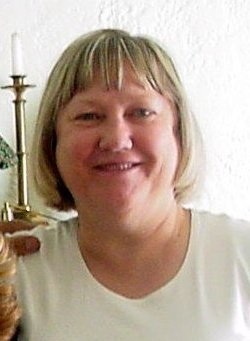 Addie Mix’s story is personal for me because she taught fourth grade in the classroom next to mine at Nathan Hale School. The inspiration that I drew from her faith in God during this time is beyond measure. The parents of murder victims who are able to piece their lives together are true heroes. Here in Chicago, there are so many who need this message of healing that women like Addie Mix and Gloria Randolph can give. Leave a comment for Addie and myself, or contact Reclaim A Youth at www.ReclaimAYouth.org .
Aqua Exercise- Senior Inspirations
Aqua exercise has become a passion of mine for two reasons. Dorthea and Louise, both senior citizens who inspire me to “suit up and show up”at the gym pool twice a week. These women prove the benefits of being in the water.
Dorthea is 74 years old. She swims forty laps in the pool three times a week like a shark on a mission. With a smile. In a one piece suit over a slim athletic body. After her efforts, she lounges in the hot tub for ten minutes “to warm up her muscles.” When I first started the aqua exercise class that meets paralell to the lap lanes, she spotted me huffing and puffing to keep up. After a few weeks, she stopped swimming laps long enough to tell me, “Don’t give up. It will get easier.” I didn’t and it did. Later, I learned that Dorthea is legendary in the gym for her physical fitness and encouraging spirit. When I don’t want to get out of bed early in the morning, I think of Dorthea and slip into my skirted swimsuit. When I get to be 74, I want to be half the woman that she is.
Louise is closer to my age. She just passed 69 and checked off a big event from her bucket list. Since her mid twenties, Louise longed to peruse the great art museums of Europe. A chance to go to Moscow, St. Petersburg and Finland presented itself. Problem? Over the years, Louise allowed gravity and sedentary living to invade her life. Walking around in the world class art galleries would not be possible, unless…. Unless she lost weight and toned her legs and core muscles. In one year. Feeling like a beached whale, Louise joined the aqua exercise at the YWCA in her town. Slowly, she stayed afloat longer and more easily. Weeks splashed into months. Eventually, thirty pounds melted from her body, leaving her knees strong enough to navigate the granite floors of art museums. Last month, Louise spent over two weeks on her dream excursion into the art world with a close friend. All the watery hours in the pool paid off in creative memories.
Senior heroes from the formerly flabby can be found anywhere when you take the time to spot them. Yoga, golf, or walking the trails, they keep their bodies active and their minds focused. They are my inspirations to keep on keeping on in the world of exercise.
5 Lessons for Today’s Teachers from Weedpatch Camp School
 During the darkest days of the Great Depression, thousands of Oklahoma families migrated from the Dust Bowl to California in automobiles piled high with their earthly belongings. The grove owners and truck farmers referred to the penniless refugees from drought as “Okies”. The name carried prejudice toward the migrants trying to escape starvation by working for pennies in the California fields.
The children of these tent dwellers needed an education. Leo Hart gathered fifty ragtag youngsters with a group of dedicated teachers and built Weedpatch Camp School. From the heart wrenching triumph of this educational experiment, the current crop of teachers in the United States could learn five valuable lessons in how to change lives with the right mix of chalk and challenge.
The first lesson to be gleaned from Leo Hart and his staff is a philosophical one. It underlies every curriculum decision, every daily lesson plan, as well as the manner in which the students are embraced. Leo Hart believed that every child is capable of learning and therefore deserved a good education. Leo Hart gazed beyond the ill-fitting feed sack dresses, holey overalls, unwashed bodies, slimy hair and green teeth. He saw raw potential that needed to be unleashed. Youngsters with the same dreams and hopes as kids everywhere. Too often, teachers judge children by social class, zip code, or religious affiliation. They fail to visualize the transformation of a mind in the hands of a caring educator.
In the words of Haim Garrett: “Treat a child as though he already is the person he’s capable of becoming.”
The second lesson involved changing the curriculum to meet the needs of the child. Teachers often quote, “If a child can’t learn the way we teach them, then change the way you teach.” Leo Hart and his faculty developed daily plans designed to civilize the migrant camp kid. Janitors taught school cobbling so the students could repair their shoes. Girls learned to sew and fit the feed sack material used for their clothing. The recipe for toothpaste and its use was demonstrated Self-sufficiency was taught as the fifty youngsters raised livestock, planted gardens, and cooked meals. The staff and pupils built the school from bricks, orange crates, and surplus lumber which developed carpentry skills. Because most students barely knew the alphabet or basic arithmetic, Hart developed lesson plans on their levels. The teachers taught math, reading, writing, history, art and music that challenged the untapped waif’s minds.
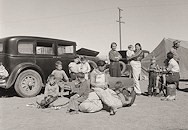
Arriving at Weedpatch Camp from Oklahoma Photo by Dorothea Lange
Robert John Meechem expressed the concept in these words. “Each day we must put forth a greater effort than we’re capable of doing. We can never limit ourselves to do what teachers have done in the past.”
The most common sense lesson that Leo Hart taught his staff was that underfed children find learning difficult. To boost the general health of the children, orange juice and cod liver oil were given in abundance. The school offered a hot breakfast for a penny, and a hot lunch for two cents. Because malnourishment is fatiguing, one hour of rest helped the children stay alert. Eventually, most of the food eaten at the school was grown in the garden, found in the chicken coops or milked from goats and cows. Lessons in health and organic eating.
Jim Hunt believes that “teachers have the hardest and most important jobs in America. They’re building our nation.”
The fourth lesson Leo Hart believed as essential to educating student involved their parents. Every weekend, Leo worked with the parents to build the school. Many of the fathers possessed skills essential to laying water pipes and stringing electrical wires. Edna Hart, Leo’s wife, stayed in the kitchen with the women and canned beets and cooked meals while listening to their country dialects. Because the parents became invested in the school, they stayed longer, trying to find work locally so their offspring could continue in school.
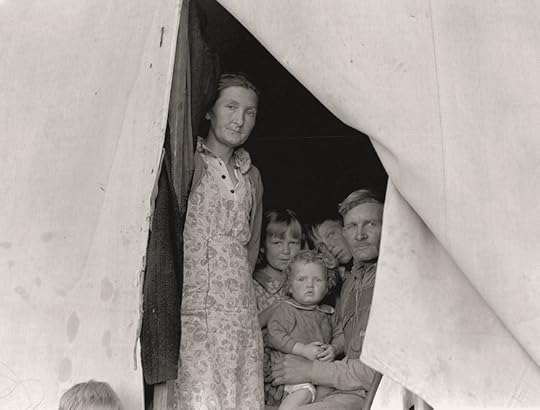
Photo by Dorothea Lange, The History Place
“Every child in your class is someone’s whole world.”- Anonymous
Jane D. Hull obviously worked with parents. “At the end of the day, the most overwhelming key to a child’s success is the positive involvement of parents.”
The final lesson exemplified at Weedpatch Camp School was one of ownership. The students loved their school, their staff, and their opportunity to learn. No more fists raised in anger. No more bullying. The students dug ditches for water lines, scooped out latrines, and created a swimming pool. When their Friday grades reached a high level, they drove the C-46 airplane (where they had classes) up and down the runway. Leo bragged that “we left everything lying around and no one ever stole a thing.” Respect for the school was hard earned, but proved to be valuable.
Carlton Faulconer graduated from Weedpatch Camp School and from Bakersfield Junior College. He realized the gift given to him as an Oakie. “The school gave us pride and dignity and honor when we didn’t have these things. We were special.”
The five lessons from Weedpatch Camp School flow from a long line of teachers who were born to teach. People like Leo Hart. People like Fredrick Douglass, who realized that “it is easier to build strong children, than to repair broken men and women.” It was true then. It is truer now.
Meme photo: Photo of eight boys on bench by Dorothea Lange