Susanna Fraser's Blog, page 26
September 8, 2012
Random Cookbook of the Week - Ruhlman's Twenty
(No pictures with this week's effort, since they all turned out blurry.)
Ruhlman's Twenty is an unusual cookbook. Rather than being organized by ingredient or course, each of its chapters features a technique (e.g. braise, poach, fry) or building-block ingredient (e.g. butter, onion, egg), each beginning with a discussion of its importance and how to work with it.
The recipe I chose to make was a two-parter, beginning in Chapter 2 (Salt: Your Most Important Tool) and winding up in Chapter 19 (Fry: The Hottest Heat).
I began with...
Sage-Garlic-Brined Pork Chops
- 1 1/2 T kosher salt in 3 3/4 c. water
- 1 large shallot, diced
- 10 cloves garlic, smashed with the flat side of a knife
- 1 lemon, halved
- 1 packed T fresh sage leaves
- 2 bay leaves
- 1 T black peppercorns, cracked in a mortar with a pestle or on a cutting board with the bottom of a heavy pan
- 4 bone-in pork chops, each about 8 oz (I used 6 smaller boneless pork chops)
In a medium saucepan over high heat, combine the salt water, shallot, garlic, lemon, sage, bay leaves, and peppercorns and bring to a simmer. Remove from the heat and allow the brine to come to room temperature. Refrigerate until cold.
Submerge the chops in the brine and refrigerate 6-8 hours.
(I had problems with this step because I didn't quite have enough brine. I kept shifting the chops around during the brining process in hopes they'd each get enough salt, but they didn't turn out quite as tender and juicy as brined meat usually does. I'd thought since my chops were smaller it wouldn't matter, but if I do more than 4 again, I'll double the recipe.)
Remove the chops from the brine, discarding the brine. Rinse the chops and pat dry with paper towels. Let them sit at room temperature for about 1 hour before you cook them. They can be sauteed, breaded and panfried, pan-roasted, or grilled.
At Ruhlman's recommendation that pan frying was best, I then went to...
Panfried Pork Chops with Lemon-Caper Sauce
- 4 bone-in pork chops
- Kosher salt
- Freshly ground black pepper
- About 1 c. plain flour
- 1 large egg, beaten with a couple of tablespoons of water
- 1 1/2 c. panko bread crumbs
- Oil for panfrying
Lemon-Caper Sauce
- 6 T butter
- 4 lemon slices, each about 1/8 inch thick
- 3 T capers
- 1 T finely chopped parsley
About 1 hour before cooking the pork chops, remove them from the refrigerator and season liberally on both sides with salt and pepper.
Put the flour, beaten egg, and panko in separate dishes. Dredge each chop in the flour and shake off any excess. Dip in the egg and then dredge in the panko.
Heat 1/4 to 1/2 inch oil in a pan over high heat. When the oil is hot and ripply, lay the pork chops in the pan and cook until golden brown, 3 to 4 minutes. Turn the pork chops and cook until golden brown, about 3 to 4 more minutes. Remove to a rack while you make the sauce. (The chops can be put in a 200 F oven for 30 minutes if you want to hold them or need to cook them in batches; if holding them for this long, cook them rare to medium-rare, so that they finish in the oven.)
Make the sauce: Put the butter in a small saute pan over low heat. When it begins to melt, add the lemon slices in a single layer and the capers. Raise the heat to medium-high and swirl the ingredients in the pan. When the butter is piping hot and frothing, add the parsley. Remove from the heat and stir.
Serve, topping each chop with some of the sauce, including a lemon slice and some capers.
This is an excellent recipe. It made a delicious dinner, along with mashed potatoes and salad, and the leftover chops were still good in my lunch the next two days. I'll definitely make again.

Ruhlman's Twenty is an unusual cookbook. Rather than being organized by ingredient or course, each of its chapters features a technique (e.g. braise, poach, fry) or building-block ingredient (e.g. butter, onion, egg), each beginning with a discussion of its importance and how to work with it.
The recipe I chose to make was a two-parter, beginning in Chapter 2 (Salt: Your Most Important Tool) and winding up in Chapter 19 (Fry: The Hottest Heat).
I began with...
Sage-Garlic-Brined Pork Chops
- 1 1/2 T kosher salt in 3 3/4 c. water
- 1 large shallot, diced
- 10 cloves garlic, smashed with the flat side of a knife
- 1 lemon, halved
- 1 packed T fresh sage leaves
- 2 bay leaves
- 1 T black peppercorns, cracked in a mortar with a pestle or on a cutting board with the bottom of a heavy pan
- 4 bone-in pork chops, each about 8 oz (I used 6 smaller boneless pork chops)
In a medium saucepan over high heat, combine the salt water, shallot, garlic, lemon, sage, bay leaves, and peppercorns and bring to a simmer. Remove from the heat and allow the brine to come to room temperature. Refrigerate until cold.
Submerge the chops in the brine and refrigerate 6-8 hours.
(I had problems with this step because I didn't quite have enough brine. I kept shifting the chops around during the brining process in hopes they'd each get enough salt, but they didn't turn out quite as tender and juicy as brined meat usually does. I'd thought since my chops were smaller it wouldn't matter, but if I do more than 4 again, I'll double the recipe.)
Remove the chops from the brine, discarding the brine. Rinse the chops and pat dry with paper towels. Let them sit at room temperature for about 1 hour before you cook them. They can be sauteed, breaded and panfried, pan-roasted, or grilled.
At Ruhlman's recommendation that pan frying was best, I then went to...
Panfried Pork Chops with Lemon-Caper Sauce
- 4 bone-in pork chops
- Kosher salt
- Freshly ground black pepper
- About 1 c. plain flour
- 1 large egg, beaten with a couple of tablespoons of water
- 1 1/2 c. panko bread crumbs
- Oil for panfrying
Lemon-Caper Sauce
- 6 T butter
- 4 lemon slices, each about 1/8 inch thick
- 3 T capers
- 1 T finely chopped parsley
About 1 hour before cooking the pork chops, remove them from the refrigerator and season liberally on both sides with salt and pepper.
Put the flour, beaten egg, and panko in separate dishes. Dredge each chop in the flour and shake off any excess. Dip in the egg and then dredge in the panko.
Heat 1/4 to 1/2 inch oil in a pan over high heat. When the oil is hot and ripply, lay the pork chops in the pan and cook until golden brown, 3 to 4 minutes. Turn the pork chops and cook until golden brown, about 3 to 4 more minutes. Remove to a rack while you make the sauce. (The chops can be put in a 200 F oven for 30 minutes if you want to hold them or need to cook them in batches; if holding them for this long, cook them rare to medium-rare, so that they finish in the oven.)
Make the sauce: Put the butter in a small saute pan over low heat. When it begins to melt, add the lemon slices in a single layer and the capers. Raise the heat to medium-high and swirl the ingredients in the pan. When the butter is piping hot and frothing, add the parsley. Remove from the heat and stir.
Serve, topping each chop with some of the sauce, including a lemon slice and some capers.
This is an excellent recipe. It made a delicious dinner, along with mashed potatoes and salad, and the leftover chops were still good in my lunch the next two days. I'll definitely make again.


September 4, 2012
Books read, week of 9/4
Finally made it to 75 on the year! Next goal, 100 by December 31.
75) 1493: Uncovering the New World Columbus Created, by Charles C. Mann. A wide-ranging, anecdotal, and fascinating look at how our modern globalized world came to be. It's at once an often-appalling tale of environmental degradation and an inspiring look at human resilience and inventiveness. And now I want to go back and read 1491.
76) Some Like It Hot, by Louisa Edwards. Second in a trilogy about a team of chefs in a fictional cooking competition. It didn't have quite the same resonance for me as the first book, Too Hot to Touch, but I liked it a lot. I'm rarely a fan of small-town contemporary romances, so I love that Edwards bucks the trend and writes books that are love letters to city life. And since good food is one of my favorite splurges and I love shows like Chopped and Iron Chef, these books are even more up my alley.
75) 1493: Uncovering the New World Columbus Created, by Charles C. Mann. A wide-ranging, anecdotal, and fascinating look at how our modern globalized world came to be. It's at once an often-appalling tale of environmental degradation and an inspiring look at human resilience and inventiveness. And now I want to go back and read 1491.
76) Some Like It Hot, by Louisa Edwards. Second in a trilogy about a team of chefs in a fictional cooking competition. It didn't have quite the same resonance for me as the first book, Too Hot to Touch, but I liked it a lot. I'm rarely a fan of small-town contemporary romances, so I love that Edwards bucks the trend and writes books that are love letters to city life. And since good food is one of my favorite splurges and I love shows like Chopped and Iron Chef, these books are even more up my alley.
August 28, 2012
Fast and frugal cooking - pasta with greens and sausage
I have the iPhone app version of Mark Bittman's How to Cook Everything cookbook, and it tends to be my go-to source for everyday culinary inspiration. I love the search function because I can put in an ingredient and immediately pull up a variety of options for how to prepare it.
A couple weekends back I picked up some kale at the farmers' market. One of the recipes the app offered me was Pasta with Greens, a variation on a main recipe for pasta with broccoli or cauliflower. I had several boxes of pasta on hand, bought when they were recently on sale (see, frugal!), and I generally make some form of pasta once or twice per week because it's so fast. A second variation suggested adding sliced Italian sausage. I wanted to add some meat, both for flavor and because Mr. Fraser is a bit of a carnivore, so I picked up some bulk Italian sausage.
Once in the kitchen, I set a pot of water on to boil for the pasta--heavily salted and with a generous dollop of olive oil to impart some flavor to the pasta as it cooked. I chose radiatore, because the recipe recommended penne, ziti, or other cut pasta, but any shape you happened to have on hand would work, I think, including spaghetti or linguini.
While the water heated I washed my kale and roughly chopped it into long, thin strips. Once it boiled, I added the greens (but not the pasta yet). I let the greens boil for about 8 minutes. Meanwhile, I browned half a pound of the Italian sausage (frugally freezing the other half of the package for a future meal) in a large saucepan.
Next I reduced the heat on the sausage, fished the greens out of the boiling water with a strainer, and added them to the saucepan, along with salt, freshly ground pepper, and a pinch of crushed red pepper. I added the pasta to the water (now slightly green) and let it cook as directed, occasionally stirring both the pasta and the sausage-greens mixture. With about a minute to go before straining the pasta, I dipped out some of its cooking water and added it to the sausage and greens to make it a bit more saucelike.
Then, I drained the pasta, tossed it with the sausage and greens, and served with parmesan cheese. Quick, easy, tasty, and reasonably frugal. I'll definitely make it again with either kale, spinach, or chard. (I like collards too, but they're slower-cooking and more strongly flavored. I doubt I'll try the broccoli or cauliflower of the main recipe because I only like those veggies raw or lightly roasted. Boiled, steamed, or baked for more than ten minutes or so and they get all mushy and bleah, for my taste.)
A couple weekends back I picked up some kale at the farmers' market. One of the recipes the app offered me was Pasta with Greens, a variation on a main recipe for pasta with broccoli or cauliflower. I had several boxes of pasta on hand, bought when they were recently on sale (see, frugal!), and I generally make some form of pasta once or twice per week because it's so fast. A second variation suggested adding sliced Italian sausage. I wanted to add some meat, both for flavor and because Mr. Fraser is a bit of a carnivore, so I picked up some bulk Italian sausage.
Once in the kitchen, I set a pot of water on to boil for the pasta--heavily salted and with a generous dollop of olive oil to impart some flavor to the pasta as it cooked. I chose radiatore, because the recipe recommended penne, ziti, or other cut pasta, but any shape you happened to have on hand would work, I think, including spaghetti or linguini.
While the water heated I washed my kale and roughly chopped it into long, thin strips. Once it boiled, I added the greens (but not the pasta yet). I let the greens boil for about 8 minutes. Meanwhile, I browned half a pound of the Italian sausage (frugally freezing the other half of the package for a future meal) in a large saucepan.
Next I reduced the heat on the sausage, fished the greens out of the boiling water with a strainer, and added them to the saucepan, along with salt, freshly ground pepper, and a pinch of crushed red pepper. I added the pasta to the water (now slightly green) and let it cook as directed, occasionally stirring both the pasta and the sausage-greens mixture. With about a minute to go before straining the pasta, I dipped out some of its cooking water and added it to the sausage and greens to make it a bit more saucelike.
Then, I drained the pasta, tossed it with the sausage and greens, and served with parmesan cheese. Quick, easy, tasty, and reasonably frugal. I'll definitely make it again with either kale, spinach, or chard. (I like collards too, but they're slower-cooking and more strongly flavored. I doubt I'll try the broccoli or cauliflower of the main recipe because I only like those veggies raw or lightly roasted. Boiled, steamed, or baked for more than ten minutes or so and they get all mushy and bleah, for my taste.)
August 26, 2012
Random Cookbook of the Week - Blueberries with Lime Sugar from Les Halles Cookbook
I swear I didn't mean to pick the easiest recipe I could find when Anthony Bourdain's Les Halles Cookbook came up in my random cookbook draw for the week. Friday evening I was contemplating coq au vin along with a potato, cheese, and bacon concoction that sounded like the fanciest, Frenchiest interpretation of scalloped potatoes imaginable.
Then I stubbed my toe. Hard. At first I thought for sure it was broken, though it's improved over the weekend that I think it's only bruised. But suffice it to say I realized it'd be stupid of me to spend hours on my feet in the kitchen. Les Halles will come around again in my random draw. Hopefully then I won't have a purple toe, and I can master the art of coq au vin.
Meanwhile, I made....
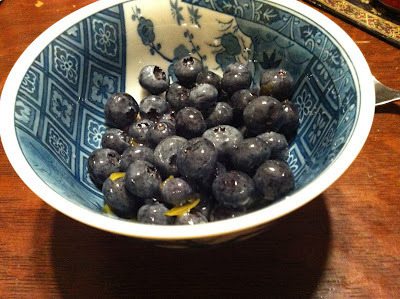
Blueberries with Lime Sugar
3 T. sugar
juice of 2 limes
1 1/2 pints blueberries
1 spring of mint, leaves cut into a chiffonade (I left this out, since I couldn't get fresh mint from the home grocery delivery service I used this weekend to help keep me off my feet)
confit zest of 2 limes
1/2 c creme fraiche (or sour cream)
Since I didn't happen to have any confit lime zest lying around, I began by making...
Citrus Zest Confit
1 grapefruit or 2 limes or 2 lemons or 2 oranges
1 c. water
4 oz. sugar
With a paring knife, remove the peel from the fruit. Cut away the white pith from the peel and cut the remaining zest into thin strips.
Combine the water and sugar in a small pot and bring to a boil. Add the strips of zest and reduce to a simmer. Loosely cover the pot and let the liquid cook until reduced by half. Remove from the heat and allow to cool completely. Strain the zest and store in an airtight container.
This stuff is DELICIOUS. If it weren't such a picky, time-consuming task to pare away the zest and remove the pith, I swear I'd confit the peel of every citrus fruit that passed through my kitchen and eat it like candy.
Anyway, with my zest ready, I went back to the main recipe:
In a large bowl, combine the sugar and lime juice and stir to dissolve the sugar. Add the blueberries and toss well, coating all the berries. Add the mint and lime zest confit and toss well again. Serve with the creme fraiche on the side.
Mr. Fraser and I both enjoyed the results. Blueberries are at their local peak around now, and this was a bracingly bright and summery dish. It turned out tarter than I was expecting. Possibly the limes were a little on the large side--next time I'll either increase the sugar or be less zealous in squeezing every last scrap of juice from the limes.
The next day, on a whim, I used some of the leftovers as a topping for strawberry sorbet. Wow. The sweetness of the sorbet and the tartness of the lime syrup balanced each other perfectly, and I found myself babbling like the giggly young actress judges on the Japanese version of Iron Chef. It made my mouth happy!
Then I stubbed my toe. Hard. At first I thought for sure it was broken, though it's improved over the weekend that I think it's only bruised. But suffice it to say I realized it'd be stupid of me to spend hours on my feet in the kitchen. Les Halles will come around again in my random draw. Hopefully then I won't have a purple toe, and I can master the art of coq au vin.
Meanwhile, I made....

Blueberries with Lime Sugar
3 T. sugar
juice of 2 limes
1 1/2 pints blueberries
1 spring of mint, leaves cut into a chiffonade (I left this out, since I couldn't get fresh mint from the home grocery delivery service I used this weekend to help keep me off my feet)
confit zest of 2 limes
1/2 c creme fraiche (or sour cream)
Since I didn't happen to have any confit lime zest lying around, I began by making...
Citrus Zest Confit
1 grapefruit or 2 limes or 2 lemons or 2 oranges
1 c. water
4 oz. sugar
With a paring knife, remove the peel from the fruit. Cut away the white pith from the peel and cut the remaining zest into thin strips.
Combine the water and sugar in a small pot and bring to a boil. Add the strips of zest and reduce to a simmer. Loosely cover the pot and let the liquid cook until reduced by half. Remove from the heat and allow to cool completely. Strain the zest and store in an airtight container.
This stuff is DELICIOUS. If it weren't such a picky, time-consuming task to pare away the zest and remove the pith, I swear I'd confit the peel of every citrus fruit that passed through my kitchen and eat it like candy.
Anyway, with my zest ready, I went back to the main recipe:
In a large bowl, combine the sugar and lime juice and stir to dissolve the sugar. Add the blueberries and toss well, coating all the berries. Add the mint and lime zest confit and toss well again. Serve with the creme fraiche on the side.
Mr. Fraser and I both enjoyed the results. Blueberries are at their local peak around now, and this was a bracingly bright and summery dish. It turned out tarter than I was expecting. Possibly the limes were a little on the large side--next time I'll either increase the sugar or be less zealous in squeezing every last scrap of juice from the limes.
The next day, on a whim, I used some of the leftovers as a topping for strawberry sorbet. Wow. The sweetness of the sorbet and the tartness of the lime syrup balanced each other perfectly, and I found myself babbling like the giggly young actress judges on the Japanese version of Iron Chef. It made my mouth happy!
Books read, week of 8/25/12
Last week ended up being a slow reading week. There's a bug of some kind making the rounds of the office at my day job. While I got a mild enough case that I didn't have to miss any work, I found myself sleeping away hours I ordinarily would've spent reading, writing, blogging, and the like.
So I'm still not quite to 75 books on the year, though I should get there next week.
73) Cetaganda, by Lois McMaster Bujold. I don't always count re-reads, but in this case I read from beginning to end, rather than skipping and skimming for the "good parts." It's funny how Ivan seems like an entirely different character to me after reading Captain Vorpatril's Alliance. Now I'm a lot more alert to the intelligence he so carefully hides, and aware that in 90% of all situations, I'd be acting like Ivan--smart but kinda lazy, doing very good work but staying in the background, and avoiding danger and trouble--rather than hyper-brainy, manic, attention-seeking Miles.
Anyway, while this isn't the best of the Vorkosigan Saga, it's a fun space opera/mystery, and a welcome chance to visit some of my favorite characters and their world.
74) Hogarth's Blacks, by David Dabydeen. More research for my current work-in-progress. Dabydeen analyzes how William Hogarth and other 18th century artists used images of blacks as social commentary--to oversimplify, in contrast to then-conventional images of Africans and other people of color in their "savage" natural state, he often shows black servants observing the corruption and savagery of wealthy British society. Reading it had the interesting side effect of making me more alert to ways I could use symbolism--my own, not Hogarth's--in my WIP.

So I'm still not quite to 75 books on the year, though I should get there next week.
73) Cetaganda, by Lois McMaster Bujold. I don't always count re-reads, but in this case I read from beginning to end, rather than skipping and skimming for the "good parts." It's funny how Ivan seems like an entirely different character to me after reading Captain Vorpatril's Alliance. Now I'm a lot more alert to the intelligence he so carefully hides, and aware that in 90% of all situations, I'd be acting like Ivan--smart but kinda lazy, doing very good work but staying in the background, and avoiding danger and trouble--rather than hyper-brainy, manic, attention-seeking Miles.
Anyway, while this isn't the best of the Vorkosigan Saga, it's a fun space opera/mystery, and a welcome chance to visit some of my favorite characters and their world.
74) Hogarth's Blacks, by David Dabydeen. More research for my current work-in-progress. Dabydeen analyzes how William Hogarth and other 18th century artists used images of blacks as social commentary--to oversimplify, in contrast to then-conventional images of Africans and other people of color in their "savage" natural state, he often shows black servants observing the corruption and savagery of wealthy British society. Reading it had the interesting side effect of making me more alert to ways I could use symbolism--my own, not Hogarth's--in my WIP.
August 20, 2012
Rita/Golden Heart changes - the judging
For as long as I've been judging Romance Writers of America's Golden Heart and Rita contests, they've had a beautifully simple scoring system: rate the entry on a scale from 1 to 9, with tenths allowed. Compared to the usual multi-page chapter contest scoresheet, I loved judging the GH/Rita. At the end of each entry, I asked myself, "Does this work?" If the answer was yes, I gave a high score, in the 8.5-9 range, and hoped to see the entry among the finalists. If no, I made a quick list of flaws, weighed their importance and severity, and gave what felt like an appropriate score. An entry might get a low score because of half a dozen issues--say, the hero's motivation confused me, the heroine's character was flat and stereotypical, I caught a major historical error that rendered the plot implausible, the author did a poor job managing point-of-view, the pacing was too slow, and the prose ran to purple. Another might get the same low score for one BIG problem--say, a Golden Heart entry with multiple glaring grammatical errors on every page that made it a slog to read. (One hopes such an issue wouldn't arise with a Rita entry, since those are professionally edited!)
But next year all that will change. A perfect score will be 50 instead of 9, and the points will be allocated as follows:
Romance - 1-20 pointsPlot/Story - 1-10 pointsCharacters - 1-10 pointsWriting - 1-10 points
I don't like these changes because they're not how I read, and I don't think they're how editors and agents read when they're evaluating a manuscript. A great book can be more than the sum of its parts. E.g. I've read many a wonderful story where the plot is derivative or predictable, but I don't care because the characters are so charming and the writing just sparkles. Under the old system, I could've given such a book a perfect 9. Under the new one, if I'm being honest and following the rules, I'd probably have to give it a 44 or 45.
And at the other end, sometimes one flaw is enough to ruin an entry for me. If the grammar is so terrible it's an effort to force my way through the entry, or the plot makes no sense at all, that's enough, IMHO, to cancel out the entry's strengths. Maybe not in a chapter contest where the goal is to help unpublished entrants recognize their strengths and weaknesses and thereby improve their craft. But the Rita and Golden Heart are about recognizing and celebrating excellence.
Also, can someone please explain to me how to separate scoring the romance from the characters? Of course you can have strong characterization without romance. I've got a shelf full of science fiction, fantasy, mystery, Age of Sail adventure, children's literature, and the like that qualify. But to me, a romance stands or falls with its characters--if they come alive for me as I read, and if I close the book believing the hero and heroine will live happily ever after, that's a great romance novel. And if the hero and heroine are flat or stereotypical or feel like puppets being pushed through their paces rather than living beings, how can their romance be anything other than wooden and unsatisfying?
But next year all that will change. A perfect score will be 50 instead of 9, and the points will be allocated as follows:
Romance - 1-20 pointsPlot/Story - 1-10 pointsCharacters - 1-10 pointsWriting - 1-10 points
I don't like these changes because they're not how I read, and I don't think they're how editors and agents read when they're evaluating a manuscript. A great book can be more than the sum of its parts. E.g. I've read many a wonderful story where the plot is derivative or predictable, but I don't care because the characters are so charming and the writing just sparkles. Under the old system, I could've given such a book a perfect 9. Under the new one, if I'm being honest and following the rules, I'd probably have to give it a 44 or 45.
And at the other end, sometimes one flaw is enough to ruin an entry for me. If the grammar is so terrible it's an effort to force my way through the entry, or the plot makes no sense at all, that's enough, IMHO, to cancel out the entry's strengths. Maybe not in a chapter contest where the goal is to help unpublished entrants recognize their strengths and weaknesses and thereby improve their craft. But the Rita and Golden Heart are about recognizing and celebrating excellence.
Also, can someone please explain to me how to separate scoring the romance from the characters? Of course you can have strong characterization without romance. I've got a shelf full of science fiction, fantasy, mystery, Age of Sail adventure, children's literature, and the like that qualify. But to me, a romance stands or falls with its characters--if they come alive for me as I read, and if I close the book believing the hero and heroine will live happily ever after, that's a great romance novel. And if the hero and heroine are flat or stereotypical or feel like puppets being pushed through their paces rather than living beings, how can their romance be anything other than wooden and unsatisfying?
August 19, 2012
Random Cookbook of the Week - Peanut Butter Cake from Old-Fashioned Desserts
I decided to change my old 52 Cookbooks series to Random Cookbook of the Week--that way I get to drop the books I know don't work very well and keep the series going indefinitely.
I've got a list of 30 cookbooks and food blogs, which I'll add to as I find new books/blogs. Each week I'm going to draw one from random.org and cook from it unless it's utterly the wrong time of year. I'm not baking in a heat wave, since my kitchen has no AC; nor am I firing up the grill if my deck is standing in six inches of snow or being lashed by one of the November rainy windstorms that make late autumn in Seattle so delightful. But other than that, I cook from the randomly selected book, and make a recipe I've never tried before.
This week I drew Betty Crocker's Old-Fashioned Desserts, a 1992 cookbook I picked up from the bargain table at Border's in Philadelphia at some point in the early to mid '90s. I've taken it with me on all my moves and often thought how lovely the illustrations are and how tasty the recipes sound, but never got around to cooking from it. Today that changed when I made...
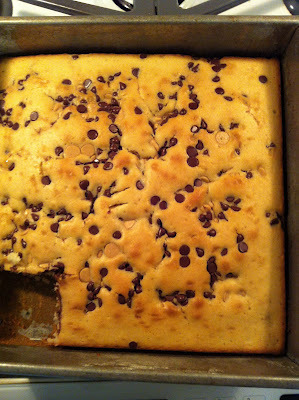
Peanut Butter Cake
1 1/2 c. all-purpose flour
3/4 c. sugar
1/3 c. peanut butter
1/4 c. butter or margarine, softened
3/4 c. milk
2 tsp baking powder
1/4 tsp salt
2 eggs
1/4 c. peanut butter chips
1/4 c. semisweet chocolate chips
Heat oven to 350 F. Grease and flour 9 x 1 1/2 inch round pan or 8 x 8 x 2 square pan. Beat all ingredients except chips on low speed 30 seconds, scraping bowl constantly. Beat on high speed 3 minutes, scraping bowl occasionally. Pour into pan. Sprinkle with chips.
Bake 35 to 40 minutes or until toothpick inserted in center comes out clean; cool.
This is about as simple as a cake made from scratch* gets. It's not very sweet, though that depends to some degree on the peanut butter, I'm sure--I used Adam's No-Stir, which has no added sugar. But at least as I made it, it's more of a breakfast bread or coffee cake than a standard dessert cake. I wasn't blown away by it, but it's so straightforward I'd happily make it again, especially for one of our midweek work potlucks.
*My mom liked to tell the tale of how when I was 4 years old or so, she took me grocery shopping and I eagerly pointed out a cake mix box that showed yellow cake with chocolate icing, my favorite childhood dessert.
She said, "I don't use a mix. I bake my cake from scratch."
"Well, where's the scratch?" I replied, to the amusement of everyone shopping that aisle.
I've got a list of 30 cookbooks and food blogs, which I'll add to as I find new books/blogs. Each week I'm going to draw one from random.org and cook from it unless it's utterly the wrong time of year. I'm not baking in a heat wave, since my kitchen has no AC; nor am I firing up the grill if my deck is standing in six inches of snow or being lashed by one of the November rainy windstorms that make late autumn in Seattle so delightful. But other than that, I cook from the randomly selected book, and make a recipe I've never tried before.
This week I drew Betty Crocker's Old-Fashioned Desserts, a 1992 cookbook I picked up from the bargain table at Border's in Philadelphia at some point in the early to mid '90s. I've taken it with me on all my moves and often thought how lovely the illustrations are and how tasty the recipes sound, but never got around to cooking from it. Today that changed when I made...

Peanut Butter Cake
1 1/2 c. all-purpose flour
3/4 c. sugar
1/3 c. peanut butter
1/4 c. butter or margarine, softened
3/4 c. milk
2 tsp baking powder
1/4 tsp salt
2 eggs
1/4 c. peanut butter chips
1/4 c. semisweet chocolate chips
Heat oven to 350 F. Grease and flour 9 x 1 1/2 inch round pan or 8 x 8 x 2 square pan. Beat all ingredients except chips on low speed 30 seconds, scraping bowl constantly. Beat on high speed 3 minutes, scraping bowl occasionally. Pour into pan. Sprinkle with chips.
Bake 35 to 40 minutes or until toothpick inserted in center comes out clean; cool.
This is about as simple as a cake made from scratch* gets. It's not very sweet, though that depends to some degree on the peanut butter, I'm sure--I used Adam's No-Stir, which has no added sugar. But at least as I made it, it's more of a breakfast bread or coffee cake than a standard dessert cake. I wasn't blown away by it, but it's so straightforward I'd happily make it again, especially for one of our midweek work potlucks.
*My mom liked to tell the tale of how when I was 4 years old or so, she took me grocery shopping and I eagerly pointed out a cake mix box that showed yellow cake with chocolate icing, my favorite childhood dessert.
She said, "I don't use a mix. I bake my cake from scratch."
"Well, where's the scratch?" I replied, to the amusement of everyone shopping that aisle.
August 17, 2012
Weekly reading, 8/17/12
I'm just back from a week of vacation, during which I fully expected to get to 75 books but ended up falling short because I got bogged down in two books I expected to like but didn't--in one case a nonfiction book where the author gave a fascinating interview on NPR, but his writing turned out to be overly dry and technical, the other a well-reviewed novel whose heroine was just too flaky for my tastes. Also, this was a road trip rather than a flight, so I didn't read while in transit. I did my share of the driving, and when my husband drove, I was enjoying the scenery. It was my first trip to the high desert on the eastern flanks of the Cascades in Washington and Oregon, even though I've lived in Western Washington since 1999. I wouldn't want to live there--I love the lush forests and mild climate on this side of the mountains too much--but it's a spectacular place.
Anyway, here's what I did finish:
70) American Nations: A History of the Eleven Rival Regional Cultures of North America, by Colin Woodard. Looks at the impacts the founding populations of each American region had on the historical development and current cultures of the areas in question. At first I was dubious, but Woodard makes a convincing case.
71) Doukakis's Apprentice, by Sarah Morgan, won the 2012 Rita for best series contemporary romance, and deservedly so, I believe. A quick, romantic read that left me believing the hero and heroine truly were destined for happily ever after.
72) Colour, Class and the Victorians, by Douglas Lorimer. I read this as research for my WIP, an interracial romance set in 1813, so my chief focus was on the "before" of the book--race relations in late Georgian England. But it was fascinating, and depressing, to read how British society actually grew more racist in the mid to late Victorian era as part of a general trend in Western thought, and one that took many forms. Religious? You could believe that blacks were descendants of Ham, and thereby condemned to perpetual servility. Secular? Well, it's survival of the fittest, and you get to define "fittest" as "whoever is on top at this precise moment in history, and, whaddya know, that's me!"

August 10, 2012
Weekly reading, 8/10/12
I've got some vacation coming up next week, so there's a good chance I'll be able to reach my initial goal of 75 books read this year by Friday.
67) Guest of Honor, by Deborah Davis. An extremely readable work of nonfiction history about Theodore Roosevelt, Booker T Washington, and the scandal they inadvertently created when Roosevelt asked Washington to a spur-of-the-moment White House dinner and Washington accepted. (No African-American had ever dined at the White House as the President's guest before.) It's a fascinating look at a point in history I haven't much studied, though I was a bit depressed by how familiar the racism of the time seemed. We haven't changed as much in 100+ years as we should've.
68) I'm Not Her, by Janet Gurtler. A gritty, raw YA about a girl who finds herself the only strong one in her dysfunctional family when her beautiful, popular older sister is diagnosed with cancer. Not an easy read, but impossible to put down.
69) The Custom of the Army, by Diana Gabaldon. A short novella featuring Lord John Grey at the Battle of Quebec. That's mostly its reason for being, and to set up The Scottish Prisoner, but I enjoy Lord John and Gabaldon's writing in general, so that's good enough for me.
67) Guest of Honor, by Deborah Davis. An extremely readable work of nonfiction history about Theodore Roosevelt, Booker T Washington, and the scandal they inadvertently created when Roosevelt asked Washington to a spur-of-the-moment White House dinner and Washington accepted. (No African-American had ever dined at the White House as the President's guest before.) It's a fascinating look at a point in history I haven't much studied, though I was a bit depressed by how familiar the racism of the time seemed. We haven't changed as much in 100+ years as we should've.
68) I'm Not Her, by Janet Gurtler. A gritty, raw YA about a girl who finds herself the only strong one in her dysfunctional family when her beautiful, popular older sister is diagnosed with cancer. Not an easy read, but impossible to put down.
69) The Custom of the Army, by Diana Gabaldon. A short novella featuring Lord John Grey at the Battle of Quebec. That's mostly its reason for being, and to set up The Scottish Prisoner, but I enjoy Lord John and Gabaldon's writing in general, so that's good enough for me.
August 6, 2012
Rita/Golden Heart changes - category elimination
Big changes are coming to the Rita and Golden Heart, Romance Writers of America's most prestigious awards for published and non-published romance, respectively. The judging system is changing from simply rating entries on a scale from 1 to 9 to a 50-point system broken down between romance, characters, writing, and plot. I am so opposed to this change that I am saving my annoyance for its own post.
The other big change is in the categories. For 2013, the Rita will include the following categories:
Contemporary Single Title RomanceHistorical Romance (includes Regency Romance)Inspirational RomanceLong Contemporary Series Romance (more than 60,000 words)Novel with Strong Romantic ElementsParanormal RomanceRomance NovellaRomantic SuspenseShort Contemporary Series Romance (less than 60,000 words)Young Adult RomanceBest First BookRegency Romance and Series Romantic Suspense have been eliminated, and Novel With Strong Romantic Elements will be eliminated in 2014.
On the Golden Heart side, the categories are:Contemporary Series RomanceContemporary Single Title RomanceHistorical RomanceInspirational RomanceParanormal RomanceRomantic SuspenseYoung Adult RomanceI have no opinion on getting rid of the Series Romantic Suspense category, since I neither read nor write it. I assume such books can still be entered in either the Romantic Suspense or Contemporary Series categories, though how well they'd fare I have no idea.
I'm frankly stunned the Strong Romantic Elements category is being eliminated, and I'd love to hear the board's reasoning behind it. I've heard rumors that it's something to do with our IRS status being jeopardized by including books outside the boundaries of romance, but that makes no sense to me at all. Why should the IRS care whether or not we open our ranks to books (and their authors) where the romance is a major subplot rather than the dominant plot? Going by the number of finalists (which is based on a percentage of entries in a category), it's popular with authors, and I think the quality and variety of books making the finals speaks well for this subset of women's fiction.
As for the Regency category, I'm sure you expect me to be opposed to its elimination, given that everything I've written so far, published or not, falls between 1805 and 1815. But in this case I think the board made the right call. The Regency category made sense in the heyday of the traditional Regency romance. A typical Regency trad, heavy on the comedy of manners and light on the sexual content, was an entirely different kind of book than the sexy saga-romances that dominated the rest of the historical field back in the day. Now that's no longer the case, so I don't think it makes sense that a few decades at the beginning of the 19th century get a category all to themselves just because it's still the most popular time period while at the same time everything from Tang Dynasty China to Ancient Rome to the Wild Wild West to late Victorian England get lumped in together.
Plus, on a purely self-interested basis, I no longer have to angst over where my books fit. They're certainly Regency in time period, but not so much in tone. Back before I was published, I was something of a contest slut, and I entered The Sergeant's Lady in every contest I could find. It finaled a few times and won once, but it typically got wildly varying scores--a phenomenon I named "Goldilocks feedback" after the time one judge thought my first chapter had too little sexual tension, a second thought it had too much, and the third declared it just right.
But the worst it ever did was when I entered it in the Regency-only Royal Ascot contest. I fondly hoped to get high marks in the Regency-specific parts of the score sheet. If I do say so myself, I'd researched the hell out of my Peninsular War setting, after all. But when my score sheets came back, I found I'd fared terribly in the Regency-specific categories. According to my judges, if I wanted to make it a Regency story, I needed to move the whole thing to England and make it a reunion story, and probably bring my hero several rungs up the social ladder in the bargain. Since the cross-class romance and the war zone setting were what drew me to the story in the first place, I didn't even consider making those changes, but from then on I realized that an 1811 setting and a lot of historical detail did not by themselves a Regency make.
So when I entered The Sergeant's Lady in the Golden Heart and later in the Rita, I chose the Historical Romance category rather than Regency. But I was always nervous my entry would be marked as Wrong Category, or just marked down by some judge who was hoping to find some nice Westerns and medievals opening it up and saying, "1811? Wellington's army? This is a Regency. I'm so sick of Regencies!" As far as I know that didn't happen--though I never finaled with it, my scores were pretty good, and a few judges of impeccable taste gave it perfect 9's.
However, I entered A Marriage of Inconvenience as a Regency, because the hero is a rich viscount and it's set at a house party. What's more Regency than a house party? But I was already worrying over where to put An Infamous Marriage, because it's somewhere in between my previous two books on the war-and-grit vs. aristocratic grandeur scale. But thanks to the changes, problem solved! I don't know how Regency it is, but it's for sure a historical.
All that said, historical romance is a huge subgenre to only get one Rita/Golden Heart. But the best way I can think of to divide it up is comedy vs. drama, like the Golden Globes or the Emmys. Yet I doubt I'd be happy with such a division, for the same reason it annoys me with TV and movies--a show like my beloved Castle is never going to win the big prizes no matter how well-written, well-acted, and well-executed it is because it's a dramedy, caught between the genres. Since I loves me some serious-at-the-core stories that still make me laugh and laugh, I don't want to keep them from being recognized as best of the best in romance.
What about you? What are your thoughts on the category changes?

The other big change is in the categories. For 2013, the Rita will include the following categories:
Contemporary Single Title RomanceHistorical Romance (includes Regency Romance)Inspirational RomanceLong Contemporary Series Romance (more than 60,000 words)Novel with Strong Romantic ElementsParanormal RomanceRomance NovellaRomantic SuspenseShort Contemporary Series Romance (less than 60,000 words)Young Adult RomanceBest First BookRegency Romance and Series Romantic Suspense have been eliminated, and Novel With Strong Romantic Elements will be eliminated in 2014.
On the Golden Heart side, the categories are:Contemporary Series RomanceContemporary Single Title RomanceHistorical RomanceInspirational RomanceParanormal RomanceRomantic SuspenseYoung Adult RomanceI have no opinion on getting rid of the Series Romantic Suspense category, since I neither read nor write it. I assume such books can still be entered in either the Romantic Suspense or Contemporary Series categories, though how well they'd fare I have no idea.
I'm frankly stunned the Strong Romantic Elements category is being eliminated, and I'd love to hear the board's reasoning behind it. I've heard rumors that it's something to do with our IRS status being jeopardized by including books outside the boundaries of romance, but that makes no sense to me at all. Why should the IRS care whether or not we open our ranks to books (and their authors) where the romance is a major subplot rather than the dominant plot? Going by the number of finalists (which is based on a percentage of entries in a category), it's popular with authors, and I think the quality and variety of books making the finals speaks well for this subset of women's fiction.
As for the Regency category, I'm sure you expect me to be opposed to its elimination, given that everything I've written so far, published or not, falls between 1805 and 1815. But in this case I think the board made the right call. The Regency category made sense in the heyday of the traditional Regency romance. A typical Regency trad, heavy on the comedy of manners and light on the sexual content, was an entirely different kind of book than the sexy saga-romances that dominated the rest of the historical field back in the day. Now that's no longer the case, so I don't think it makes sense that a few decades at the beginning of the 19th century get a category all to themselves just because it's still the most popular time period while at the same time everything from Tang Dynasty China to Ancient Rome to the Wild Wild West to late Victorian England get lumped in together.
Plus, on a purely self-interested basis, I no longer have to angst over where my books fit. They're certainly Regency in time period, but not so much in tone. Back before I was published, I was something of a contest slut, and I entered The Sergeant's Lady in every contest I could find. It finaled a few times and won once, but it typically got wildly varying scores--a phenomenon I named "Goldilocks feedback" after the time one judge thought my first chapter had too little sexual tension, a second thought it had too much, and the third declared it just right.
But the worst it ever did was when I entered it in the Regency-only Royal Ascot contest. I fondly hoped to get high marks in the Regency-specific parts of the score sheet. If I do say so myself, I'd researched the hell out of my Peninsular War setting, after all. But when my score sheets came back, I found I'd fared terribly in the Regency-specific categories. According to my judges, if I wanted to make it a Regency story, I needed to move the whole thing to England and make it a reunion story, and probably bring my hero several rungs up the social ladder in the bargain. Since the cross-class romance and the war zone setting were what drew me to the story in the first place, I didn't even consider making those changes, but from then on I realized that an 1811 setting and a lot of historical detail did not by themselves a Regency make.
So when I entered The Sergeant's Lady in the Golden Heart and later in the Rita, I chose the Historical Romance category rather than Regency. But I was always nervous my entry would be marked as Wrong Category, or just marked down by some judge who was hoping to find some nice Westerns and medievals opening it up and saying, "1811? Wellington's army? This is a Regency. I'm so sick of Regencies!" As far as I know that didn't happen--though I never finaled with it, my scores were pretty good, and a few judges of impeccable taste gave it perfect 9's.
However, I entered A Marriage of Inconvenience as a Regency, because the hero is a rich viscount and it's set at a house party. What's more Regency than a house party? But I was already worrying over where to put An Infamous Marriage, because it's somewhere in between my previous two books on the war-and-grit vs. aristocratic grandeur scale. But thanks to the changes, problem solved! I don't know how Regency it is, but it's for sure a historical.
All that said, historical romance is a huge subgenre to only get one Rita/Golden Heart. But the best way I can think of to divide it up is comedy vs. drama, like the Golden Globes or the Emmys. Yet I doubt I'd be happy with such a division, for the same reason it annoys me with TV and movies--a show like my beloved Castle is never going to win the big prizes no matter how well-written, well-acted, and well-executed it is because it's a dramedy, caught between the genres. Since I loves me some serious-at-the-core stories that still make me laugh and laugh, I don't want to keep them from being recognized as best of the best in romance.
What about you? What are your thoughts on the category changes?