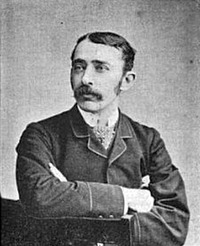
Sir John Ambrose Fleming FRS (29 November 1849 – 18 April 1945) was an English electrical engineer and physicist. He is known for inventing the first thermionic valve or vacuum tube, the diode, later called the kenotron in 1904. He is also famous for the left hand rule (for electric motors). He was born the eldest of seven children of James Fleming DD (died 1879), and his wife, Mary Ann, at Lancaster, Lancashire.
He was an accomplished photographer and, in addition, he painted watercolours and enjoyed climbing in the Alps.
Ambrose Fleming was born in Lancaster and educated at University College School, London, and University College London. He went on to Lecture at several universities including the University of Cambridge, the University of Sir John Ambrose Fleming FRS (29 November 1849 – 18 April 1945) was an English electrical engineer and physicist. He is known for inventing the first thermionic valve or vacuum tube, the diode, later called the kenotron in 1904. He is also famous for the left hand rule (for electric motors). He was born the eldest of seven children of James Fleming DD (died 1879), and his wife, Mary Ann, at Lancaster, Lancashire.
He was an accomplished photographer and, in addition, he painted watercolours and enjoyed climbing in the Alps.
Ambrose Fleming was born in Lancaster and educated at University College School, London, and University College London. He went on to Lecture at several universities including the University of Cambridge, the University of Nottingham, and University College London, where he was the first professor of Electrical Engineering. He was also consultant to the Marconi Wireless Telegraph Company, Swan Company, Ferranti, Edison Telephone, and later the Edison Electric Light Company. In 1892, Fleming presented an important paper on electrical transformer theory to the Institution of Electrical Engineers in London.
In 1894 and 1917 Ambrose Fleming was invited to deliver the Royal Institution Christmas Lecture on The Work of an Electric Current and Our Useful Servants : Magnetism and Electricity respectively....more

 Sign in with Facebook