
Jeffrey Ricker's Blog, page 42
July 30, 2013
What I did on my summer vacation. (Hint: Wrote. A lot.)
I can’t believe this Thursday I’ll be back in Vancouver to finish the first draft of my thesis and get ready for my second year of grad school. Where has the summer gone? And what have I done to make use of the time?
I’m glad you asked! (I know, you didn’t ask, and by implying that I’m putting words in your mouths, but bear with me here.) I decided to tally up everything I’ve written while I’ve been back in St. Louis. It adds up to this:
Thesis: 58,278 words (and counting)
Short story for a submissions call: 7,441 words
Short story for another submissions call (that wound up too long for the room they had so I need to find another home for it): 6,543 words
Blog posts galore! 9,200+ words
And assorted miscellany including 1,100 words on a possible sequel to The Unwanted (coming soon!).
Add to that all of the stories I wrote in my first year of grad school, two graphic novel projects, and part of a middle-grade science fiction book, and this has probably been the most productive year for me writing-wise in ever. So, grad school? Totally worth it.


July 29, 2013
Yes, as a matter of fact I CAN sign your e-book. (But will you review it for me too?)
As I wrote about recently, I’ve gradually become a convert to e-books. It took a while, but I’ve gotten used to purchasing titles to read on screen, even though I’ve read and can pretty much attest to the fact that we read differently on screen than we do in print. I probably wouldn’t want to have read Anna Karenina on my Kobo, and when I decided to tackle A Portrait of a Lady, I bought it in paperback.
Mind you, I haven’t read it yet, but still.
Another reason I still buy some books in print is because they’re written by my friends—and I want my friends to autograph them! You can sign a Kindle, I guess, but eventually you’re going to run out of room on the case for more writers to sign it. Of course, with friends who’ve released e-book-only titles, that’s a bit of a problem. I’ve got three e-shorts from Untreed Reads that fall into that category as well. And, it almost goes without saying (but I’m gonna say it anyway because BLATANT SELF-PROMOTION), my first novel, Detours, is also available as an e-book. How do I sign those for people?
There’s a way around that now. I recently signed up at a site called Authorgraph where you can list titles you’ve written and have readers request signings for them. If you’ve got an iPad or a tablet, it’s pretty slick: type a message, then use a stylus and you can literally sign your name and—whoosh!—off it goes to the reader.
So, if you’ve bought one of those e-shorts or my first novel, you can go over there an request an autograph. I’ll be happy to sign! (On the downside, you’re going to see how terrible my penmanship is.)
But, I do have a favor to ask.
If you liked that title I’m signing, would you be so kind as to write a review? You can put it on Goodreads, Amazon, wherever you bought it. Reviews help other readers find my work, and your opinions give them an idea of what they can expect. My friend ‘Nathan, who’s a reviewing machine (seriously, go check out his blog to see what I mean), offered some helpful hints on how to write a review. It’s easier than you think: you can do it in three sentences!
If you do write a review, first of all THANK YOU. Secondly, THANK YOU again. Thirdly, shoot me an email and let me know about it so I can check it out.
Did I say thanks already? I did? Well, I’ll say it again: thanks!


July 26, 2013
An excerpt from “Scorned” in The Lavender Menace
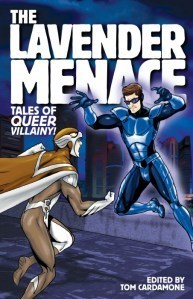 The Lavender Menace: Tales of Queer Villainy is available now from Northwest Press. Edited by Tom Cardmone (a Lambda Literary Award-winning author in his own right), it contains thirteen stories of queer supervillains by writers including Hal Duncan, Charles “Zan” Christensen, ’Nathan Burgoine, and… oh, that’s right, ME!
To give you a preview, here’s the first part of my story, “Scorned”:
“You’re new.”
Marcus Harris had never seen the woman standing in the visitor’s vestibule adjacent to his cell, but her white coat, worn over a charcoal business suit, blared “psychologist.” She wore glasses and kept her curly blonde hair shoulder length. Sitting in the plastic chair reserved for visitors (who never came), she crossed her legs and settled a clipboard over her knees. When she smiled at him, it was completely unconvincing.
“I’m Dr. Emily Wheeling,” she said. “The warden asked me to come see you this morning and ask you a few questions.”
“Oh, is it morning?” Marcus asked, sarcasm edging into his voice. “It’s so hard to tell in here since I don’t have ready access to a clock. Or sunlight. Where’s Dr. Mathis?”
Dr. Wheeling looked down at her clipboard. “He had an unfortunate encounter with a homemade knife in one of the other wings, but I’m told he’ll make a nearly complete recovery.”
“That’s a pity. So why does the warden want you to speak with me?” Marcus asked, even though he knew the answer.
Dr. Wheeling tilted her head so she was looking over her glasses. “I think we can both say we know why, so let’s not start off like that, shall we?”
Marcus smiled. He liked her directness. “Please convey my apologies about his badge.”
“He was a bit more displeased with the second-degree burns to his chest.”
“I know he was attached to that badge, though.”
“Well, fortunately the surgeons were able to remove it successfully.”
Marcus said nothing in response. She was tapping her pen against the clipboard, whether out of nervousness or boredom, he couldn’t be sure. It was a felt-tip pen, of course. They were taking no chances with him now, it seemed. It also seemed like she wasn’t going to speak again unless he did first. He held out as long as he could stand the silence, which wasn’t long.
“So,” Marcus said, painfully aware that she had succeeded in waiting him out, “aren’t you supposed to ask me questions?”
She narrowed her eyes at him. “How are you?”
“How do you think I am?” he asked, not even bothering to mask his anger with sarcasm.
She leaned forward, clasping her hands on top of the clipboard. “Not well, Mr. Harris.”
For some reason, hearing her say his name—his regular name, not Megawatt, his alter ego—sent him over the edge. He launched himself at the barrier and slammed his palms against it. From past experience, he’d learned that open palms made much more noise than fists.
“What the hell do you expect?”


July 24, 2013
What’s your favorite literary mashup?
I think I’ve probably mentioned before that I love mashups. One of my favorite versions of the song “Call Me Maybe” mixed it with a song by Taylor Swift and one by Jessie J (by the way, hello, I have the musical tastes of a thirteen-year-old girl and I will admit to liking all the songs you’re too ashamed to admit that, hey, you like too). I also loved crossover episodes of TV shows, like when Ally McBeal suddenly popped up on another show. (I am completely dating myself by referring to Ally McBeal, I know, but at least it kind of counterbalances the thirteen-year-old’s musical tastes.)
I also love it in writing. Across the Universe by Beth Revis was one of my favourite YA book series recently. It was YA, but it was also science fiction, and the first installment was a murder mystery. YA murder mystery in space—when was the last time you read one of those? My friend Michael Thomas Ford wrote a hilarious series of novels revolving around Jane Austen, living in upstate New York as a vampire bookseller trying in vain (see what I did there?) to get a new novel published.
I guess I like everything a little weird.
It’s all over my own writing too. I just finished a story for a submission call asking for romantic winter-themed stories, so naturally I set mine on an ice planet on the edge of the galaxy. (Because where else would you go to find romance, right?) there was also the story I wrote for Riding the Rails, an anthology that was all erotica revolving around the setting of trains, so my story took place on a train… on Mars. Whenever people ask me to describe Detours, I tell them it’s a romance on a road trip wrapped around a ghost story. (Yes, I do tell them the plot as well. I also ask them to please please please buy a copy, at which point they back slowly away from the crazy man.)
Right now, when I’m not working on my thesis or revising stories I wrote last year, I’m working on a mashup of three of my previous stories: “Lifeblood” and “Maternal Instincts,” two vampire stories; and the private investigator from “Murder on the Midway,” which appeared in the noir anthology Men of the Mean Streets. I’ve had the idea for it for a while, and I have no idea where I could send it once it’s done, but they wouldn’t leave me alone, and I wanted to explore more of the character of Sam Page, the investigator.
So tell me, what’s your favorite literary mashup?


July 22, 2013
It’s official: I’m an e-book convert
I love gadgets and technology, but in a lot of ways I’m a bit of a luddite. In the kitchen, rather than haul out the blender, the food processor, or the bread maker, I’d rather chop, whip, and knead by hand. My lawnmower at my old house was a reel mower (a model I continue to prefer, especially after what happened the most recent time I tried to mow the lawn). I prefer rakes to leaf blowers.
What can I say? I’m a little old-fashioned sometimes.
I’ve been of a similar mindset about books. I love paper books—I keep wanting to call them “real” books, but I know that a book in any form is just as real as another. I have paperbacks and hardbacks on my shelves that I’ve held onto for years and, in a handful of instances, decades.
But they do pile up after a while. It’s been years since I had shelf space for all of my books, and my to-read stack on the nightstand has had to be split into three stacks, most of which are close to hitting the lampshade on my bedside light. As I mentioned earlier, I recently started whittling down the books I own. I still don’t have room for everything that remains, and my to-read stack isn’t much shorter than it used to be. But, I’ve got another pile of books started for the second round of culling, and I’m reading as fast as I can in hopes that I can unload a few more.
I have also, after much reluctance, started buying e-books.
I know, I know—welcome to the twenty-first century, what kept you? Blame Vancouver for the change. Shifting between St. Louis and B.C. for grad school means bits of my library are never where I want them to be. Sure, I can take books back and forth or ship them in between, but that all takes money.
It started out innocently enough. I get e-books from my publisher, and I also use Overdrive to check out e-books from the St. Louis Public Library when I’m away from home. Handy, convenient. I bought a Kobo a couple years ago (before Borders went under) and I also have an iPad, but more often than not I find I prefer reading on my old iPhone-that’s-no-longer-a-phone. I’ve also bought a Humble E-book Bundle, along with a handful of books that are only available as e-books, which is of course how you can get short stories of mine that have been published by Untreed Reads (and there’s my shameless plug for the day).
Each step has been like an e-book gateway drug to the next level, until finally I realized that I’ve just been delaying the inevitable. So, the last three books I bought—The Devil’s Concubine, This Is How You Die, and Welcome to the Greenhouse—were e-books. Apart from kilobytes, they take up no shelf space. And I don’t have to dust around them.I’m sure I’ll still buy some traditional books—when they’re written by my friends, I often want one for them to sign. But more often than not I think an e-book, whether it’s one I buy or one I check out from the library, might suffice just fine.


July 20, 2013
FOOLISH HEARTS cover!
A long time ago—well, actually, it was only four years ago. Four years! It seems like so much more time has passed since then, perhaps because so many things in my life have changed in the interim.
Where was I? Oh, right. So, four years ago my first published story, “At the End of the Leash,” appeared in the anthology Fool for Love: New Gay Fiction, edited by Timothy J. Lambert and R.D. Cochrane. I love this anthology not just because it was my first or because I’m in it, but because so many people I adore were involved, from the editors Tim and Becky to a whole bunch of authors I’ve come to know and love, including ’Nathan Burgoine, Rob Byrnes, Greg Herren, David Puterbaugh, Joel Derfner, and many others.
When Tim and Becky said they were doing it again, I submitted a story titled “Tea” and crossed my fingers. And now, I’m happy to say, it’s going to be appearing alongside work by many of the same writers from the first edition, along with several new people.
This past week we also got this lovely cover reveal:
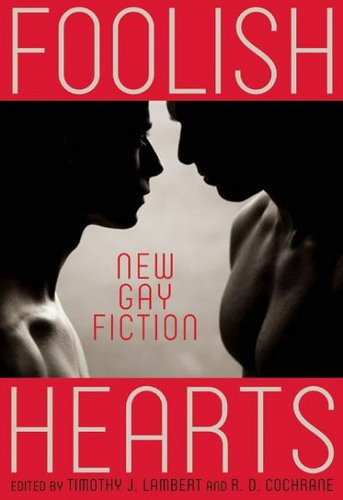
Please note the preponderance of red, which is my favorite color.
Foolish Hearts comes out January 14, 2014. May I suggest it’ll make a stellar Valentine’s Day gift?


July 19, 2013
What a difference a day makes
You never know where the answer to your problems is going to come from.
Wednesday I was ready to start beating the keyboard with my forehead because everything about the book I’m working on just feels wrong at the moment. Then yesterday, in an email conversation with a fellow writer, I explained what the story is about and she asked, Is this a YA?
It’s not, but her question got me thinking. I went for a run a little later (word of advice: don’t go running outdoors at noon on an orange air quality day) and that’s when I had my aha! moment: my main character is too old. I’ve been writing her as thirty-five, but everything she’s going through will make a lot more sense if she’s more like twenty-five. Her younger brother becomes her older brother, and things with her parents take on a different sense of urgency.
Of course, coming to this conclusion halfway through the first draft means I can either stop and revise or keep plowing forward and fix the unevenness later. I always opt for forging ahead in cases like this. If you’re lucky enough to have forward momentum, it’s not the time to reverse course.


July 17, 2013
And now we come to the part where we hate EVERYTHING about this book
So, as of this point, I’ve got 49,067 words down in the first draft of the novel that I’m writing for my thesis.
It’s safe to say that I hate every single fucking word of it.

This should be expected, of course. I’ve reached this point in—well, I was about to say every novel I’ve written (you know, all two of them… that is, if we’re only counting the novels that so far have or will see the light of day), but to be honest here, I’ve reached this point with every thing I’ve ever written. Every short story has reached a stage where I wanted to throw it across the room. (Since I do most of my writing on a laptop, it’s fortunate that I’ve so far resisted this urge.) A time comes when the plot feels contrived, the characters are wooden, and it’s like every aspect of the story wants to deliberately hurt me.
(Let’s pause a moment and talk about how much I love, love, love Willow Rosenberg. Out of all the characters on Buffy the Vampire Slayer, she was probably my favorite. It’s kind of a toss-up between her and [Mrs.] Anya Christina Emmanuella Jenkins [Harris].)
In running, it might be what you call hitting the wall, but I’ve never believed in the wall, much the same way I’ve conditioned myself out of writer’s block. I’m not going to go so far as to say writer’s block doesn’t exist, because I know it’s real for some, but for me, it’s been more like the blerch, that voice in the back of your head that says you can take a day off, you don’t have to write as much, go ahead and have that extra piece of pie, finish the hummus, and hey crack open another bottle of wine while you’re at it, will ya?
Yeah, I try not to listen to the blerch… which is why I’m not stopping at this point, even though I pretty much despise every word that winds up on the screen. I’ve still been writing scenes today, and I’ve started fleshing out my outline more, and I’m remembering the words of advice a friend gave me once:
Let it suck.
Because you can edit a crappy page of writing, but you can’t edit a blank page.


July 12, 2013
Fur
I am a worrier. (People may or may not be aware of this.) I came downstairs this morning and my elderly dog, Dakota, had managed to wipe out in the kitchen and couldn’t get back up. The floor is tile and he doesn’t do so well on that these days, but we’ve put down area rugs and runners all over the place—it looks strange, but it’s mostly effective. Every so often he manages to step in just such a way that none of his paws are on a rug and he goes slip sliding away.
Pause for Paul Simon break!
I picked him up, helped him outside, cleaned up the mess, and now he’s sleeping; understandably, depending on how long he’d been stuck there, he might have had quite the stressful night. Meanwhile, I’m drinking lots of coffee, not wanting to leave the house, and staring at him periodically—is he in pain, and would I even be able to tell?
 The vet isn’t sure quite what’s wrong with him—it could be something neurological and they could do an MRI to see if there’s an intracranial tumor, but even if there were, there’s nothing they could do for it. So, like the song says, that information’s unavailable to the mortal man.
(That’s Dakota to the right, by the way—taken a few days ago.)
Well, what can you do? They come and they go eventually, which I was reminded of yesterday when—well, I should preface this by saying that we are not complete slobs. We keep a reasonably clean house even with two dogs, but inevitably some corners are going to be neglected.
So, that said, let me talk about the recliner at the top of the stairs.
I tend to move around the house when I’m writing. Sometimes I sit at the dining room table, but that chair isn’t very comfortable. Likewise with the kitchen chairs (though they are impressive). I have a desk in the basement (don’t ask), which is comfortable but is like working in a cave. (Sometimes, that’s nice, though.) If I work on the sofa, chances are a nap will follow.
There’s also, at the top of the stairs, a little spot that’s big enough that we put a bookshelf there along with a small recliner from my old house. It’s not fancy, and it’s been well-loved, by which I mean my dearly departed cats Boris and Natasha frequently slept on it and used the back of it as a place to dig their claws in and stretch.
There’s a window at the top of the stairs, and a little table next to the chair, so it’s turned into a nice little spot to sit and write. The chair is comfortable, but not so comfortable that I’m liable to fall asleep (at least, not as much as if I’m on the sofa). I open the blinds, prop my water glass on the window sill, and sit down and write.
Yesterday, when I finished writing and got up, I picked up my water glass and found a strand of hair in it—white, perfectly straight, and just the right length that it very likely came from the guy pictured here on the right (Natasha’s the Siamese on the left):
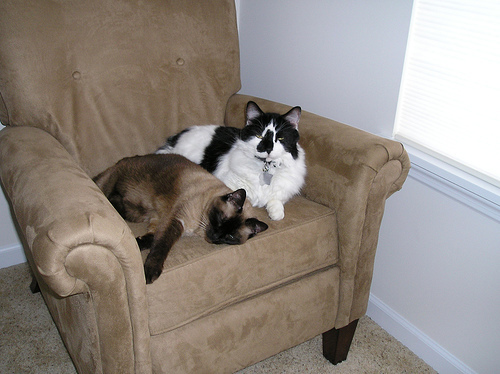
Mind you, we’ve vacuumed the chair and around it many times in the intervening years since they’ve been gone, but as any pet owner knows, the fur flies… and sticks, and reminds you to miss them when they’re gone.
Pause for Anna Kendrick break!


July 3, 2013
‘Friday the Thirteenth’ by Isaac Asimov
I recently finished reading More Tales of the Black Widowers by Isaac Asimov. I’ve been a fan of Asimov’s novels and short stories since I was a teenager, and a recent Twitter conversation with Dr. Harrison Solow about science fiction writers made me remember this. Asimov was one of the first science fiction writers I read, along with Robert Heinlein. My favorite stories by Asimov included the Dr. Susan Calvin robot stories, and Dr. Solow mentioned that the Black Widower stories were her favorites. I vaguely recalled reading some in my teen years, but clearly it was time for a re-acquaintance.
I checked out three collections from the library, including the above-mentioned volume. It should be noted, these are not science fiction tales. The Black Widower stories are mysteries, loosely based around a supper club to which Asimov belonged called the Trap Door Spiders. In the stories, a group of friends gathers for a monthly banquet and invites one guest who enjoys a meal and in exchange submits to a grilling by the group. A mystery is brought forth, and the group discusses it until it is finally, always, solved by Henry, the waiter.
These stories are charming and clever and so enjoyable. He shows what can be done when the author makes the most of character and dialogue. Next up for my reading pleasure is Casebook of the Black Widowers.
There’s another thing that these stories illustrate. At the end of each one, Asimov included an afterword in which he described the circumstances under which he wrote the story and some details of its publication. For example, in the afterword to the story “Friday the Thirteenth” he included this:
Again, Ellery Queen’s Mystery Magazine felt this to be too complicated a situation, and I passed it on to F & SF, which took it. It appeared in the January 1976 issue.
That’s right, even Isaac Asimov got rejected. And what did he do? He took the story and sent it someplace else.
If this doesn’t encourage, I don’t know what will.


![[image error]](http://jeffreyricker.files.wordpress.com/2013/07/ioweyoupain.gif)