
Jeffrey Ricker's Blog, page 22
March 3, 2016
Wait, what happened to Wednesday?
Normally (well, most of the time), on Wednesdays I have a list of stuff I’ve been reading that has caught my interest or made me feel generally a little less stabby, but this week I’ve been under the gun with a deadline (not a fun writing one, sorry; it’s been a freelance editing job, which I love too, but when the client’s waiting, everything else goes on hold).
By the way, since Super Tuesday was this week, it got me thinking: If they scheduled a lot of primaries and caucuses on a Wednesday, could we call it (wait for it) Wonder Wednesday?

Yes, of course that bad joke was purely an excuse to include a Lynda Carter gif. Got a problem with that? I didn’t think so.
Anyway! Here’s some stuff you should read:
First of all, my friend Ruth Daniell has edited Boobs, a collection of essays by women exploring “the burdens, expectations and pleasures of having breasts.” And it’s coming out this month! Check it out here.
This wonderful poem, “Thirty-three weeks” by Rob Taylor: Go read it.
Then, read “You Should Write My Life Story” by Kathryn Mockler.
Congratulations to PRISM international’s nominees for the National Magazine Awards!
Also, if you’re a) in Ottawa and b) on Facebook, be sure to check out the announcement for ’Nathan Burgoine’s book launch May 12 of Triad Blood.
Lastly, I love pretty much everything about this roundup of Poe Dameron fan art. (There’s also a Finn/Poe one, but it would be nice to have some just of Finn. Hi, Finn. :) )


February 29, 2016
How do you keep from getting distracted?
One of the classes I was scheduled to teach at the community college this term is called social media for writers. As it happens, not enough people signed up for it, and I’ll admit, I was a kind of relieved, because I would have felt a little bit like a fraud.
I deleted my Pinterest account at the start of the year; I shut down my personal Facebook profile for three or four weeks in January/February before turning it back on, but have been waffling about it ever since. This doesn’t make me sound like the sort of writer who should be teaching people how to use social media, does it?
Don’t get me wrong; this is not going to be one of those “all social media is bad” tirades (because, let’s face it, how boring is that?). I’ve made a ton of friends from blogging, Facebook, and Twitter (and, if I’m really willing to date myself, from Friendster and MySpace at various points in the dim and distant past). Some of those friends were fellow writers, who also knew editors and who pointed me in the right direction a few times and, as luck would have it, led to my getting published. Not bad, right?
I sometimes wonder, though, if anyone else is as easily distractible as I am. Last November, since it was Nanowrimo, I spent the entire month without checking into social media (with a couple exceptions to look up addresses or when someone pestered me for a response on something). I wrote over 50,000 words on a new novel I hadn’t even planned on starting for a while but figured, what the heck. Once I’m finished with Prophecy Boy, I’m going to focus on that one for the rest of the year (along with short stories here and there, because hey, short stories rock).
That showed me how much I can accomplish when I’m focused. It also showed me how unfocused I can become when social media is the ever-present lever I press to get the pellet. Which, I guess, makes me the mouse.
I question everything I post on social media—is any of it useful? How much? What should I post less of? A recent weekend on Facebook, my profile was littered with ‘80s/‘90s pop music videos that most people would find atrocious but which I find kitschy and enjoyable, if vacuous. But what was the point? Am I just contributing to the noise?
(Believe me, I’m asking myself all of those questions even as I write this.)
Because of that tendency to question everything, I can lose a lot of time debating whether to post something. That’s time I could be spending on lots of other things, like freelance work, cleaning the house (you don’t want to see this place, really) or, I don’t know, writing.
If you’re like me, the interconnectedness of everything (what else is social media but unlimited connections?) is primed to distract you. At some point, there’s only so much of other people’s lives and opinions you can consume. You have to stop, step away, and create something of your own: your own life, your own stories. You don’t have to cut off social media completely, or cold turkey, but if the endless distractions of Facebook and Twitter and Pinterest board are making you feel antisocial (or unproductive) and you need help to rein it in, here are a few things I use.
Freedom
Freedom cuts off WiFi access. I choose what length of time I want to go on “silent running,” and I can’t check e-mail, or Facebook, or look up something on Wikipedia and wind up down a click hole for hours until I’m reading about Prussian wars and wondering “how the hell did I get here?” Nope, I have to focus on whatever I’m doing, which hopefully is writing.
Antisocial
I haven’t bought this one yet, but it specifically blocks social media sites (leaving the rest of the internet open to you for actual work). I haven’t bought it because I’ve cobbled together a set of Chrome browser extensions that, together, help me sort of do the same thing.
BlockSite
This lets me choose specific websites to automatically prevent from loading in my Chrome browser. I use this to go beyond social media and block sites that just make me mad, like CNN—or rather, specifically, the user comments on CNN. (I know that the majority of people are racist and narrow-minded and don’t need the endless reminders of their grammatically challenged comments on news stories. I feel soul-crushed afterwards and like I need a Silkwood shower.)
StayFocused
This one is awesome. It lets you flag distracting websites and set a daily timer for how much time you’re allowed to spend on them. In my case, I allow myself thirty minutes on weekdays from 9 a.m. to 5 p.m. to check Facebook, Twitter, Tumblr, and so on. This is probably the one that saves me the most time.
This one isn’t specifically geared toward saving time on social media, but it makes my online life a lot less distracted. Whenever you visit a page on the Web, you can save a link to it in your Pocket queue, which syncs across devices and makes the content of that page or article available offline once you’ve synced up. If something looks interesting, I can click it, save it to read later, and move on. I can read them on my phone, on my iPod, or on their desktop app. Because you can tag each saved article with keywords, this has also been useful for gathering research links for books and stories I’ve been working on.
And when it comes right down to it, when I need to really focus and shut out all the distractions online, I turn off the computer and pick up a pen or sit at the typewriter. You don’t need a digital device to write, after all.
Do any of you have this problem? What do you use to keep focused? E-mail me and let me know. I’m always looking for tools to improve my focus. Thanks!


February 24, 2016
For Your Own Good
In submission mode? Check out The Masters Review 2016 literary calendar. Covers January through June and is pretty damn awesome.
Also awesome is this review of my wonderful friend Leah Horlick’s second poetry collection, For Your Own Good.
Recently I was talking with a friend about the difference between artists and everyone else. It really might be their brains, according to this study.
If you don’t have the time or the money to travel to a writing workshop, Sarah Selecky has suggestions on going DIY.
And speaking of suggestions, if you’re not reading Neil Gaiman’s Tumblr blog, you’re missing out on a lot of his fantastic advice.


February 21, 2016
“So How’s That Book Coming Along, Jeff?”
I’m glad you asked!
At the moment, I’m on Chapter 14 of the sequel to The Unwanted (working title is Prophecy Boy), and I’ve outlined it to be 18 chapters long. So, I’m more than 75 percent done. This is a good thing, I think. I’m writing this post on Friday, and I’m hoping to finish Chapter 14 by the end of the day, so when this goes live on Monday I’ll hopefully be well on my way to finishing Chapter 15.
I’ve mentioned it in passing before, but I’m just going to put it out here right now: first draft done by April 1. That gives me about a month and a half to finish it. If I wrote one chapter a week, I’d be able to hit that deadline with time to spare. Then, after a break to attend the Saints & Sinners Literary Festival in New Orleans, it’d be time to revise.
Now the revision, that’s going to be a bit of a challenge. “Why?” you ask. I’m glad you asked! Because I was feeling a bit stuck a few chapters ago (chapter 11, to be precise), I started writing the manuscript like this:
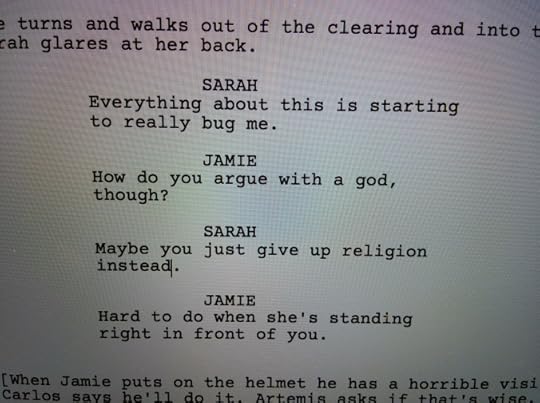
As you can see, it’s kinda-sorta in script format. (Yes, I know it’s not strictly conforming to proper formatting; sue me.) I was beginning to worry that I was spending too much time in Jamie’s head—an easy thing to let happen when you’re writing in first person—and it felt like nothing was actually happening. This being a YA fantasy novel, that’s not good. (I’d argue that’s a bad state of affairs for any novel or story, really.) I got this trick from Chuck Wendig (whose blog is worth following if you’re a writer, I think), who suggested that, if you hate outlining, try writing a screenplay .
Now, I don’t hate outlining, but it occurred to me the screenplay format sits comfortably between both the outline and the fully fleshed out manuscript. And it gets you out of your character’s head, doesn’t get bogged down in backstory—unless you insist on having a character speak all of that backstory, and believe me, that’ll stick out like a sore thumb (note to self: cliché, revise)—and puts speech and action front and center. If it doesn’t get said or happen, it doesn’t end up on the page.
Of course, this means that when I’m revising, I’m going to have to take that screenplay and turn it into narrative. By that point, though, I’m hoping it’s a narrative that moves.


February 17, 2016
Stories to listen to, stories to play, and stories to read
I’ve started teaching an introduction to writing the short story class at the community college, so lately stories have been on my mind—and on my screen, because there are just so many outlets for reading stories available online. One that I stumbled across recently is a website called Cast of Wonders, a young adult fiction podcast. For starters, check out one of their staff favorites, “Now Cydonia.” And since they’re podcasts, you can listen to them while folding the laundry, which is totally what I did.
One of my friends recently said he’d like to see me write a video game because he thinks I’d be good at it. I don’t know about that—I think I’d have to play more of them for starters—but I do know that I’m looking forward to this game: 18 quintillion planets in one video game, just waiting to be explored. (I think I need to get a PlayStation.)
My friend Jeff Howe has a story coming up in One Teen Story, “Making the Cut.” He talks about it here.
Lastly, this one’s not a short story, but it sums up how I feel on a lot of days. If you ever feel like you’re falling behind in life, maybe you’re right where you’re supposed to be, and no 15-point listicle will rush the process. That doesn’t mean you have to sit there passively and do nothing, but sometimes it can’t hurt to trust the process.


February 15, 2016
When it comes to editing: If in doubt, cut it
I’ve been sending out a lot of submissions to magazines lately. One of my targets last year was a submission a month. This year, I’m aiming for a submission a week. Usually, I’ll send the same story simultaneously to two or three magazines that I think would be good fits. (Almost all magazines are willing to consider simultaneous submissions; they’re realistic about their turnaround times and know that writers can’t sit on a story for three to six months waiting to hear back from one magazine.) When a story gets rejected, my usual practice is to send it out again within twenty-four hours. One of my friends a long time ago likened it to an aircraft carrier’s wing: you’ve got to get your planes in the air.
More often than not, though, the stories come back. Usually it’s a form rejection—not much help there, but understandable. (Magazines are understaffed, overworked, and overwhelmed by submissions.) Sometimes it’s accompanied by helpful feedback—the pacing felt off, it wasn’t a good fit for their magazine, or they would have preferred a more complex plot.
If you’re really lucky, they say they’d like to see more work from you and please submit something else in the future.
But, the story’s back, and meanwhile you have to figure out where you’re going to send it next, and if you’re going to edit it before it goes out again. For the most part, I say send it out and keep sending it out.
But.
If you sent it out and got nothing but form rejections, maybe it’s time to take a look at it again. Consider how many rounds of edits it went through before you sent it out. What sort of feedback did you get from your writing group? Are there things you can cut?
Chances are, the answer’s yes.

Cut three pages? Why not?
Maybe it’s a holdover from my training as a journalist and my indoctrination into the inverted pyramid, but it’s almost always possible to make the story tighter, more compact. I just resubmitted a story that’s been out a few times (mostly form rejections, with a couple personalized notes). For me, it’s a short piece, 2,350 words. The last time it came back, I looked at it again and wondered, is it as condensed as it could be?
It’s 2,100 words now.
Sometimes it’s not just a matter of making it shorter, either. You cut the unnecessary pieces to expose the basic structure, and in the process you reveal the gaps that need further build-out.
The trick is figuring out when to edit, and when to leave well enough alone. It’s not an exact science—not a science at all, really. But you can’t beat the exhilaration of taking a red pen to big swaths of your manuscript.
Pliny the Elder said fortune favors the bold. Don’t be timid when it comes to editing. You can always put it back, and you might be surprised what you reveal by deleting.
Psst. If you like this, you might like my weekly completely unannoying newsletter. What’s coming next week? One way to find out: Click here to get started.


February 12, 2016
Friday Reads, or “Project Read My Own Damn Books”—Ella Minnow Pea
So far this year I’ve finished reading five books. I’m pretty pleased with that. I also know I can’t possibly keep up that pace. I’m teaching a class starting next Tuesday, I want to finish my work-in-progress by April 1, and I will need to try to pick up more freelance work in the next couple months if I’m not going to completely deplete my savings. (And I haven’t done my taxes yet. Oy.)
But! Moving on. I’m currently reading three books:
My Antonia by Willa Cather
You Should Pity Us Instead by Amy Gustine
THE QUEEN OF THE NIGHT by Alexander Chee
I put that one in all caps because my heavens, it’s good and I’ve put aside the other two so I can concentrate on it. But more on that once I’ve finished it. Here’s what I’ve finished so far:
The Parable of the Sower by Octavia Butler
Ella Minnow Pea by Mark Dunn
Portrait of an Addict as a Young Man: A Memoir by Bill Clegg
Funny Boy by Shyam Selvadurai
The Vegetarian by Han Kang
 I talked about The Parable of the Sower a couple weeks ago. Ella Minnow Pea is a book I was given for my 40th birthday (thanks, Andy!) but for some reason haven’t gotten around to until now. Who knows why, as it’s a fast read and is written in a style that I have longed to try myself, the epistolary novel. Ooh, fancy word meaning “letters.” As in letters you send to people, not letters of the alphabet. But, as it happens, there’s a double meaning going on in this satire:
Ella Minnow Pea is a girl living happily on the fictional island of Nollop off the coast of South Carolina. Nollop was named after Nevin Nollop, author of the immortal pangram,* “The quick brown fox jumps over the lazy dog.” Now Ella finds herself acting to save her friends, family, and fellow citizens from the encroaching totalitarianism of the island’s Council, which has banned the use of certain letters of the alphabet as they fall from a memorial statue of Nevin Nollop. As the letters progressively drop from the statue they also disappear from the novel. The result is both a hilarious and moving story of one girl’s fight for freedom of expression, as well as a linguistic tour de force sure to delight word lovers everywhere.
Meanwhile, if you’re looking for a book to cozy up with over the Valentine’s Day weekend, Bold Strokes Books is having a 10% off sale on romances if you use the coupon code LOVE16. Check it out.


February 10, 2016
Stories galore

I love the proliferation of short fiction online. It’s possible to find a lot of good stories in a range of genres, although that proliferation sometimes makes it challenging to sift through. That being said, a story by my friend Jen Neale placed second in the Masters Review fall fiction contest. Read “Pool People.” (Congrats, Jen!)
This story captivated me on a recent weekend: “The Traitor Baru Cormorant, Her Field-General, and Their Wounds”
As did this one: “THE IMMENSE MELANCHOLY OF THE SALTVILLE MAMMOTHS”
On the non-story front, I want to see this sci-fi short film: Credence
This is funny, especially having worked on a literary magazine and yet I still do the same darn thing. The most important takeaway though (apart from Chinese takeaway) is this: “Don’t watch the calendar (or the clock) over those old submissions. Instead, write something new.”
And put things in further perspective by reading this: Some Myths About Your Litmag Submissions
When you feel like tearing it all down, read The Empty Container.
“I felt celebrated and also robbed simultaneously.” This reminds me that I need to stop by the library and pick up my reserved copy of The Queen of the Night.


February 8, 2016
Just show up
“I love deadlines. I like the whooshing sound they make as they go by.”
–Douglas Adams

photo by Sonja Langford, Unsplash
Sorry, Douglas. You may be one of my favorite writers, but I’m going to have to disagree with you here. Sort of.
I love deadlines, too. I love hitting them, that is. Deadlines keep me honest. They force me to produce even when I’d much rather do something else. Basically, they force me to show up.
I set myself a number of deadlines because I know otherwise I wouldn’t accomplish as much as I want to. Because they’re self-imposed, I’m not really accountable to anyone other than myself. If I don’t send an e-mail or I don’t post to my blog on a regular basis, sure some readers may notice, but it’s doubtful. So maybe I skip a day or a week, and the world doesn’t end.
I’m not writing my next novel to a contract or a deadline either, so if I don’t hit my goal of having a first draft completed by April 1, no one’s going to be tapping their foot wondering where it is or why it’s not done. I could finish the novel in April or May or June and no one would be any the wiser that I’d let that deadline go whooshing by.
You see where I’m going with this, right?
I’ve skipped a couple of my own self-imposed deadlines lately, and hearing that whooshing noise as they go by makes me queasy. Sure, maybe they’re just self-imposed, but when I don’t hit one, it makes me worry that other deadlines will slide.
Deadlines force me to show up, and I think showing up is half the battle. Deadlines make me sit in front of my computer (or my typewriter, or my notebook—if it came to it, I’d resort to a hammer and chisel, I guess) and put in the time. They make me accountable to something/someone other than myself. Writing involves so many long stretches where the work takes place solely in your own head, or between you and the keyboard, it’s easy to lose sight of the fact that there’s eventually a dialogue between the work and a reader who is not you.
You may not realize it, but when I put out there statements like “I plan to finish the first draft of my next novel by April 1,” you’re helping me keep myself accountable by reading it, so thanks.


February 1, 2016
What’s your origin story?
I’ve been thinking about Wonder Woman a lot lately.

Wind up, spin, repeat.
This comes as a surprise to no one who knows me. I’ve been a huge fan of the amazing Amazon since I was may be seven years old, cutting out pictures of Lynda Carter and pasting them in scrapbooks. I bought the comic book every month, and when she was featured on the cover of other comic titles, I’d buy those too. (I lived for Justice League America storylines where she was front and center instead of (yawn) Batman or Superman.)
Every superhero has an origin story: where they came from, how they discovered their powers, what drives them. You probably know Batman’s (after his parents are killed, rich playboy Bruce Wayne grows up to become a vigilante, etc.), as well as Superman’s (his home planet Krypton dying, Kal-El’s parents send him to Earth as a baby, where our sun gives him amazing abilities).
Do you know Wonder Woman’s, though? You’d be forgiven if you’re left scratching your head. Not many people know it—her mother, the queen of the Amazons, longs for a child but can’t have one, and fashions a statue of a baby girl out of clay and prays to the gods for a daughter of her own, and the gods in their mercy breathe life into the statue, endowing her with the wisdom of Athena, the speed of Hermes, the strength of Ares, and the beauty of Aphrodite.
That’s if you don’t buy into the new origin story, which casts her as the secret love child between her mother, Hippolyta, and Zeus.
Her story keeps changing, really. I have a hard time keeping track with what changes.

Clark Kent is always a reporter for the Daily Planet, Bruce Wayne is always a millionaire businessman, but Diana is sometimes a Navy officer in World War II, secret government agent, operative for the Bureau of Metahuman Affairs, ambassador to man’s world, and on and on.
There’s a new movie coming out in 2017, and I wonder what she’s going to be this time. We already know that at least part of it’s set in World War I, not II, but who knows what else will have changed.

Can’t wait.
I’m really looking forward to the film, and I try not to be disappointed when her background changes (again), which seems to happen a lot in the DC Comics universe. (I would say “DC Comics multiverse,” but I don’t want to geek out quite that much. Yet.)
In an episode of Doctor Who back in the 1970s, someone asks the time-traveling Time Lord and his sidekick Romana where they’re from, and the Doctor, cagily, says sometimes the only way to figure out where you’re from is to figure out where you’re going and then work backwards. Of course, when the man asks where they’re going, the Doctor says, “I don’t know.”
Whenever I’m asked for a bio for a story submission (they often ask for one even before they’ve said whether they want to accept your story or not), I think of it as my origin story. And it’s changed a lot over the years. I mention different publications, different accomplishments as time passes and I have more successes (which will hopefully continue; I still think of myself as an emerging writer). Here’s the thing, though: The origin story might change, but my origin doesn’t. Like the Doctor, I may not know where I’m going, but unlike Wonder Woman, I know where I’m from. And I know where I want to go.

I think we need that sort of grounding, for ourselves as well as for the characters we write.
What’s your origin story? Has it changed?



