
Peter Hitchens's Blog, page 185
September 27, 2015
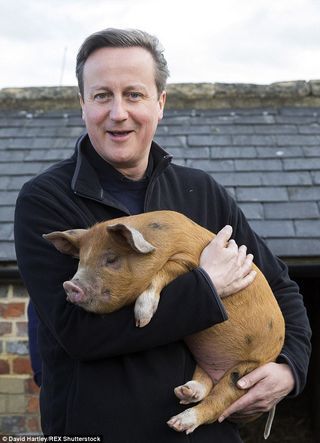
Our PM's done some really stupid things - and none of them involved a pig's head
 This is Peter Hitchens' Mail on Sunday column
If you know something damaging about a major political figure, then, in a democracy, it is surely your duty to tell the voters before they go to the polls. So I am puzzled by Lord Ashcroft���s motives for emptying a huge bucket of slurry over David Cameron���s head just after the Prime Minister has safely survived a fiercely contested General Election.
I have met Lord Ashcroft briefly a couple of times. He gives off an enjoyably sinister whiff of brimstone. He has a smile like the winter sun glinting on a coffin-plate. You wouldn���t be surprised to find he had steel teeth.
He was known in his years of influence as ���The Man Who Bought The Tory Party���, or alternatively as ���Blofeld���, and I don���t imagine he minded. I was never sure what he wanted in return for all his money.
Was it just a ministerial Red Box? Well, he didn���t get it and now he���s annoyed, and who can blame him? If they hadn���t planned to give him anything in return, the Tories shouldn���t have taken his cash. The same applies to those who bankrolled their 2015 victory.
I wrongly thought the Tory Party was impossible to save, a task as hopeless and morally wrong as reviving the popularity of Capstan Full Strength cigarettes. I still think we���d all be better off if it collapsed and died.
But money and lies eventually revived the ghastly old monster. Alas for Lord Ashcroft, it was somebody else���s money. He���d been five years too soon.
So what good came of his expensively compiled book in the end? I���ve never doubted that Mr Cameron, like most of his generation, was disastrously soft on drug abusers, but that���s true of all the major parties, the media, the legal profession and the police, and he took this view openly. I don���t believe the story about the pig.
One important thing remains. Mr Cameron is not fit to be in charge of our foreign policy. His performance over Libya and Syria, the two biggest reasons for the mass migration crisis now menacing all Europe, was historically, politically and militarily illiterate. In a serious country he should resign and vanish into obscurity.
Yet he survives undamaged, which is the true scandal that is never pursued and will never be punished.
Beggar nations can't be choosers
I don't at all mind George Osborne sucking up to the ghastly old waxworks who run the increasingly aggressive and sensitive Chinese police state.
And it is a police state. Peaceable professors, such as Ilham Tohti, are locked up and mistreated after lawless show trials.
Communist activists have recently torn the crosses from 1,200 churches across the People���s Republic, claiming with cynical grins that they are acting to preserve ���safety and beauty���. People disappear into the night and fog of a vast gulag. Human rights lawyers are arrested for defending dissidents.
I don���t mind us canoodling with this awful regime because I can���t afford to. Thanks to the batty, self-defeating foreign policy we have followed since 1914, we are a minor debtor nation in danger of turning into a beggar nation.
Well, this is the sort of country we are now. It���s a shame, and a warning against joining wars when you don���t need to, the root of our fall from power and wealth to our current status. Talking of which, let us examine anew Mr Osborne���s righteous wrath against the Assad government in Syria. Recently Mr Osborne said Parliament had been wrong to veto the planned attack on Syria two years ago. He seems to want to try again.
This can only mean that he still thinks we should have bombed President Assad���s forces in 2013, an action which would have hugely bolstered the factions which soon afterwards became the Islamic State. Given our furious hostility to IS, this seems to me to be very nearly clinically mad.
Indeed, the Cameron-Osborne policy towards Assad has from the start been based on a righteous condemnation of that regime. How can these two men spend so much time seeking favour from the cruel, intolerant despots of China, and imagine that they have any moral right of any kind to condemn Syria?
It is a nonsense, and they should grow out of it. We certainly aren���t the world���s policeman any more, and we���re not the world���s vicar either.
Ohhh Ted...have you seen my iPhone?
Do good books die when nobody can understand them any more? Today���s children would never stand for most of the Victorian and Edwardian books I loved (and still love). The world in which they were written has gone for ever.
But how strange to see this happening to a 20th Century classic, The Go-Between. I was amazed by the favourable reviews of a dreadful BBC TV adaptation of this bitter, brilliant little book. I don���t think the makers or the reviewers can properly have understood it at all.
Apart from the silly, cheap decision to portray one of the main characters naked (when the book makes it quite clear he wasn���t), the biggest problem was (as it so often is) the faces.
The two lovers ��� Ted and Marian ��� looked like models, aching for their smartphones, with nothing going on behind their eyes. It was impossible to see these people as the Victorians they were supposed to be. Instead, they were modernised. A needless bit of class-war resentment (about a handkerchief!) was inserted. And the child at the centre of the drama, the son of a bank manager and book-collector from Wiltshire, was given a Northern accent and asked ���Can I get a cup of tea?��� as he would never have done.
Look, people, manners, customs, belief and language were all different then. Which bit of ���The past is a foreign country; they do things differently there��� don���t you understand?
I don't normally mention my daily struggles with the railways, as most train commuters have it far worse than I do. But I did laugh when the company which tows me back and forth each day, First Great Western, tired of being called (with much justice) ���Worst Late Western��� and grandiosely changed its name to Great Western Railway, after Isambard Kingdom Brunel���s matchless enterprise of superb engineering and inventiveness.
On the very day of the fanfared change, I was, of course, held up for ages behind a ���broken down train��� (You never actually see these, but like ���signal failures��� and ���track circuit failures���, you are told about them a lot). Great Western indeed.
If you want to comment on Peter Hitchens, click on Comments and scroll down


September 24, 2015
A Radio Discussion on Bombing Syria
Some of you may be interested (some of you may not be) in a discussion, on BBC Radio Ulster, of the continuing clamour for military action in Syria. Amazingly, the advocate of such action in this case (Charlie Wolf) still thinks that the ���West��� should do as it madly planned to do two years ago, and bomb the Assad government. Judging by George Osborne���s recent remarks, in which he said Parliament���s veto of action in September 2013 was one of the worst it had made (it was one of the best), the Chancellor (and would-be next prime minister) still yearns for a strike against Assad. I find this attitude genuinely incomprehensible ( as I think I make clear in the discussion that follows)
The discussion can be found here at One Hour 16 minutes into the programme
http://www.bbc.co.uk/programmes/b06cbh1t#play
Why Freedom for BBC Staff to Voice their Views Would End Institutional Bias
Thanks to an ancient personal connection, I found myself a few years ago at a gathering which featured several prominent BBC persons, including the then Director General Mark Thompson. Most of them must have been horrified that I���d been let in at all. He must have thought I was stalking him, as we���d also shared the same train that morning and the previous day.
The encounter enabled me (for once) to finish off the argument (which we���d started on the train but not had time to conclude). My point about BBC impartiality as that it was a fraud.
There were two reasons for this.
One, neutrality between the main political parties, is poorly enforced and in any case is nothing like enough. The BBC, in my view, has a power-worshipping tendency to suck up to, and ignore the problems of, the party it judges to be on the current winning side (the Tories just now, New Labour from 1994 to about 2008) . Likewise it explores with great vigour the splits and other problems of the party it judges to be the loser (currently New Labour, for many years before, the Tories).
Anyone with a memory can recall that in 1997 it was the other way round.
Neutrality is just as vital (though totally absent) on the many cultural, moral and social issues which divide the country ��� immigration, man-made global warming, punishment versus rehabilitation, legalisation of drugs, sexual politics, the European Union, etc.
It is, by the way, the party which is seen as most reliably on the liberal, Blairite side of these questions which generally receives the BBC���s favour. The less Blairite Labour is, the crueller the BBC is to Labour.
This partiality is shown mainly by favours to the chosen party - by respectful interviews, respectful coverage of major speeches, conferences and policy announcements, kind camera angles, and above all by an absence of stories about splits or disagreements, which can always be found if you look for them, and given prominence if you choose to do so.
Once the Tory Party had purged itself of conservative elements on the cultural, moral and environmental front, and chosen a leader who could be portrayed as a ���moderniser��� , it became acceptable in New Broadcasting House and was allowed to compete in the 2010 election on at least equal terms with New Labour. In 2015, Ed Miliband was judged unBlairite(and so doomed).
As the BBC���s editorial staff and presenters are overwhelmingly of the liberal consensus regardless of what party they profess to support (the BBC is careful to employ a few nominal Tories to whom it can point when attacked on this matter) this is where the enforcement of impartiality must take place. But it doesn���t.
Mr Thompson had been batting back all my points with skilled smoothness until I finally got him (I think enough time has passed for me to reveal this not especially private moment, especially as he is no longer in charge of the BBC) . His final line of defence had been the normal ���Devil���s Advocate��� argument. I had pointed out that bias was not actually shown by BBC staff suddenly shrieking ���Vote Labour!��� in the midst of programmes. It was shown (once guests and subjects had been selected to suit that bias and to define the axis of any argument) in the readiness of news and current affairs presenters to show their partiality through oblique, indirect actions.
I cited tone of voice, the asking of such questions as ���are you seriously suggesting that���?���, the selective identification of think tanks as ���right-wing��� when left-wing equivalents were not so identified, the interruption of one guest not matched by interruption of the other, the giving of the last word to one side, always, the use of verbs such as ���claim��� and ���insist��� when a truly impartial person would be restricted to ���say���. I also think I may have mentioned the use of the word ���investment��� to describe government spending, a usage adopted by Gordon Brown in 1997 and immediately copied by BBC presenters who didn���t seem to realise that it was a departure from neutrality.
He ascribed all such things to presenters being ���the devil���s advocate��� - adopting, for the sake of argument, positions they did not hold. I said it was remarkable how much better they were at being ���devil���s advocate��� for left-wing devils than for right-wing ones.
Then I said that the problem was most clearly shown not by what his staff would do but by what we both knew they wouldn���t do.
I asked him to name a single one of his presenters who could subject an opponent of the death penalty (I cited the loveable Clive Stafford-Smith, my favourite abolitionist) to a truly hostile, merciless (devilish?) probing interview.
There was a brief silence while he sucked his teeth. I can���t think of any either.
I now reckon I should have pressed the attack home and asked him if they had anyone who could give a similar hard time to an advocate of the man-made global warming position, or to an advocate of abortion on demand.
The truth is, the BBC as an institution believes such issues were long ago closed, and are the moral equivalent of racial bigotry. It could not be hostile or probing to any holder of the ���correct��� opinions on these issues. That is why I say it is institutionally biased
When I suggested, as I did here...
https://www.opendemocracy.net/100ideasforthebbc/staff-voice-opinions/ (you can if you wish vote for my idea, and/or for several others, if you visit this interesting site)
....that BBC staff should be allowed and encouraged to voice their true opinions, I did so because I was sure (I still am) that if they did so the Corporation���s institutional bias would then be revealed in all its coruscating glory. The total absence of anyone with views similar to mine from any position of influence or prominence would be impossible to conceal. And the Corporation, whose Charter and reliance on a poll tax oblige it to maintain impartiality on issues of public controversy, would be compelled to reform this. As it is, the public maintenance of *formal* impartiality, which is meaningless in practice, actually protects it from such reform.
September 23, 2015
As George Osborne Visits China's Dangerous Far West - an article from my archives
The following article was first published in the Mail on Sunday in December 2009. It can also be found in my e-book 'Short Breaks in Mordor', a collection of foreign despatches.
The streets of Old Kashgar were running with blood on the day I arrived, with slaughter on every street corner.
I am relieved to say that on this occasion the blood was from the throats of hundreds of sheep being ritually slaughtered - the highlight of the Muslim festival of Eid-ul-Adha as celebrated in this lovely old oasis on the Silk Road, which was already ancient when Marco Polo passed this way in the 13th Century.
But in this tense, racially divided and unhappy part of China's hard-faced and increasingly muscular empire, human blood sometimes flows on these streets as well. And it may do so again, Heaven forbid.
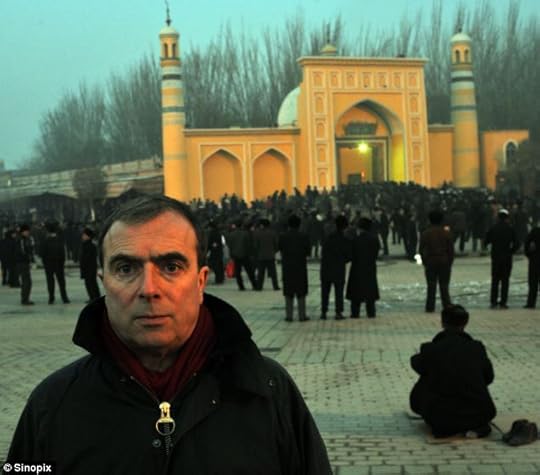
In the eye of the storm: Peter Hitchens outside the Id Kah Mosque in the centre of Kashgar
We do not really know how much killing there has been. Modern China has liberated money and trade, but not information. Locals talk in low voices about anything remotely political.
This, however, is certain: last year, just before the Olympics, two Kashgar Muslims drove a truck into a group of jogging Chinese paramilitary troops, then attacked them with knives and home-made grenades, killing 17.
The two were caught and later executed - probably shot in the head, still a common method of capital punishment in the People's Republic.
The anger follows aggressive colonisation. Ethnic Chinese people have come West in their millions in the past 30 years, encouraged by the state to settle and make the region their own.
The locals fear their homeland is being snatched away from them before their eyes, by strangers who wish to change the place to suit them, rather than adapt to the customs of the country.
What seem to have been race riots broke out in Sinkiang's provincial capital Urumchi last July, with an official death count of 156, plus 800 injured, many, it is said, in horrific slashing attacks by inflamed Muslim mobs. Women were not spared.
Ethnic Chinese retaliated soon afterwards, taking to the streets with iron bars and axes and looking for suitable candidates for gory vengeance. Rumours suggest that the real butcher's bill was much higher than the published figure, around 2,000. Who can say?
A few weeks ago, the authorities announced the executions of 12 more men for their part in the carnage - ten Muslims and two ethnic Chinese, to prove they are not wholly one-sided. Actually, the proportions may be more or less just.
Any sane person must be appalled by such outbreaks of ancient bloodlust, and - as in Tibet last year - the cause of the local people is severely set back in the West by being linked to such cruel horrors.
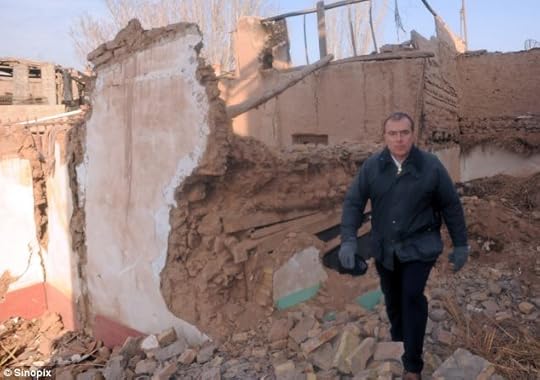
Ruined civilisation: Peter Hitchens in the rubble of an Old Kashgar home destroyed by the Chinese
China's response is understandable, if overdone.
It is physically impossible to telephone abroad, or use the internet, throughout Sinkiang, China's vast, western-most province, thanks to the official and unlikely Chinese belief that the trouble was fanned by exiles in the United States.
In Kashgar and Urumchi, which are both in Sinkiang but 700 miles apart, squads of paramilitary riot police patrol or set up sudden road blocks - in many cases they are in full battle kit, and some wear uniforms of Cold War-era dark green. They are supposed to reassure, but mainly they remind people of recent trouble.
I watched one group file silently down Urumchi's Happiness Street, passing a desolate, darkened Muslim restaurant put out of business by fear.
The city feels as if it's ready to explode
Even middle-class Muslims and ethnic Chinese are nowadays nervous of mixing with each other in public. One Muslim who tried to carry on seeing Chinese friends described to me how she was then shunned by her Muslim neighbours. A sort of apartheid, voluntary but bitter, is springing up in the enormous city.
'When people who have lived alongside you for years suddenly turn on you, you cannot feel safe near them ever again,' said one Chinese resident.
Both Urumchi and Kashgar are full of banners urging ethnic unity for the sake of the motherland. Military trucks are adorned with banners pledging troops will treat the people as if they were their parents, rather unconvincingly, given that they are armed with pump-action shotguns and long rubber clubs.
In Kashgar's main square, across the road from a colossal statue of Mao Tse-Tung, the riot squad exercise their tactics and manoeuvres, a sort of ballet of brutality, as people of both ethnic groups hurry by trying not to catch the eye of authority.
Did I say main square? Not exactly. Kashgar is, in fact, two cities, the ethnic Chinese one, with its mobile phone stores, beer shops and Cantonese restaurants, and the Muslim one, inhabited by the Turkic Uighur people (pronounced 'Wee-gur'), where men in fierce moustaches and fur hats consume quantities of mutton and tea, and you can buy your own sacrificial sheep for perhaps ��50 (though a top-grade ram in good condition costs four times as much).
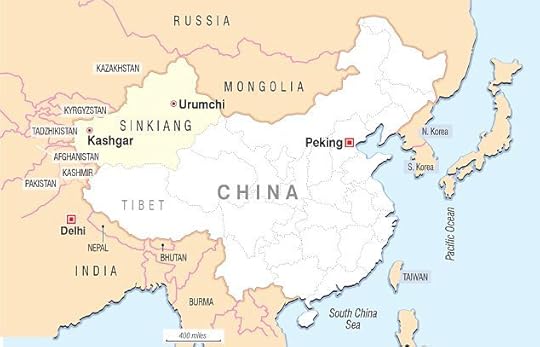
On the doorstep of the West: Sinkiang, at the heart of the Eurasian landmass, means 'new frontier'
It has two main squares. While the huge stone Mao waves jauntily on one, the other is dominated by the ancient Id Kah Mosque, done out in garish yellow but profoundly serious and sombre in the freezing early dawn of this most holy day.
The riot squad are there too, tactfully to one side but bitterly out-of-place as the all-male worshippers, dark-clad and quiet, stream into the square, filling it and the neighbouring streets until the mosque and all the surrounding space are covered with men and boys kneeling on their individual prayer rugs.
It is impossible to be unmoved as they make the solemn gestures of devotion that have been repeated here for more than 1,000 years. It is also hard not to wonder if this is not also a demonstration.
The same feeling - will this explode? - springs urgently to mind later when, with the sun up and the air warming, a band climbs to the roof of the mosque and - matched by another perched above a nearby porch - begins to play the ancient dance music of the Uighurs.
On the mosque steps are groups of beggars, dirty and squalid, displaying stumps. They are waiting for their grisly share - mandated under Islamic law - of the slaughtered sheep that are being butchered all around.
Some are women, grotesquely veiled in the local style, even more restrictive than the Afghan burka. Their entire heads and faces are covered by a sort of brown wool shroud, through which they can presumably see where they are going, though they look horribly like walking corpses as they go about the streets.
Some are old, some are young. But it is not universal. Modern China has had an impact. Many of the Uighur women wear headscarves in the carefree Iranian style, and strut about in high heels.
It is startling enough to see a band on the roof of a mosque, as incongruous as a clown at a funeral. The music they make is even more strange and oddly disturbing. It is relentless, insistent and unsettling.
One man blows a sort of trumpet, a mixture of tooting and buzzing that sounds a little like the old comb-and-lavatory-paper combination familiar to generations of British schoolboys before the days of Andrex. He is accompanied by two others wielding long, curved sticks to pound a relentless beat on two drums, one fast and one slow.
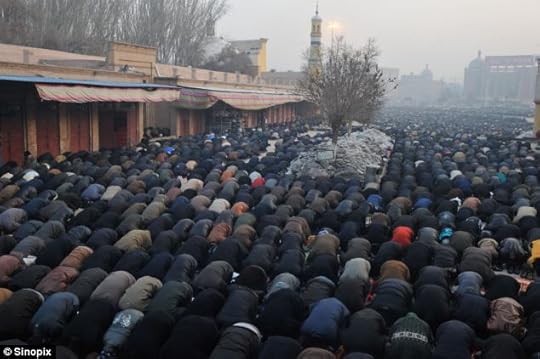
Faith but no hope: Thousands of Uighur Muslims pray outside the Id Kah Mosque
Suddenly one of the fur-hatted men shouts something up to the band. The rhythm changes to a more urgent, yet more haunting tune and within 30 seconds half the men on the square are dancing. It is an old and seemingly simple dance, plainly learned in early childhood, and it feels both sad and angry.
One group abruptly begins circling behind me and one of the dancers, in a kind of trance and indifferent to who or what is in his way, barges into me quite hard.
It is nothing personal (I think) but this sight is definitely not intended to be picturesque or twee. I consider joining in for all of five seconds, and then decide that it would probably get me beaten up for disrespect.
The dancers are mostly pretty unlovely, scruffily dressed and unsentimental. They do not smile. One has a mobile phone clamped to his ear as he moves.
This is a place so old that it was invaded by Genghis Khan... Its orchards were planted before the birth of Christ
It is an affirmation of an ancient and warlike tradition. Later I learn that, 20 years ago or earlier, the whole square would have been dancing, that this culture is dying, or rather that it is being killed.
For we are at the scene of a tragedy nearly as wretched as the similar destruction of Tibet's even more ancient culture. In a few years, if the authorities 2,000 miles away in Peking have their way, Old Kashgar will have ceased to exist.
I got there just in time. Great tracts of the city have already vanished under the bulldozer and the wrecking ball. Broken houses stand open to the sky, and there are large melancholy stretches of bulldozed mud, the size of football pitches.
The loss is unbearable. This is a place so old that it has been invaded by both Genghis Khan and Tamerlane, where many of the tiny houses, built of mud bricks, have secret tunnels beneath them, designed for the inhabitants to hide from murder, rape and plunder as various invaders passed through.
It has in its time been Buddhist, Christian and now Muslim. It stands in the midst of a great desert, ringed with vineyards and orchards planted before the birth of Christ. Yet it is about to vanish for ever.
Guided by a helpful inhabitant, I penetrated into the heart of the maze of streets, whose claustrophobic chaos probably annoys the Chinese authorities as much as anything else. You could never get a tank down these narrow ways, nor even an armoured car, and a foot patrol would need to be very careful if it came this way in troubled times.
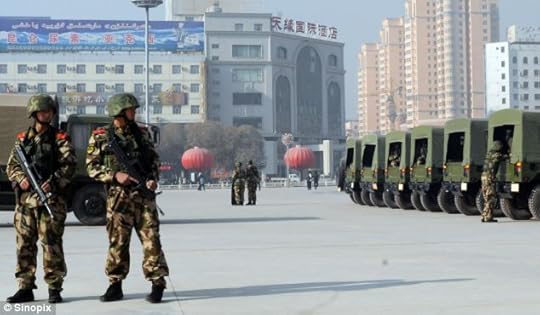
Imposing: Chinese riot police patrol near the Id Kah Mosque
After rounding five corners, I found myself in a narrow alley, partly roofed over. Three men have hold of a quivering black sheep. Another similar beast stands tethered close by, watching and smelling the fate it too will undergo in a few minutes.
They turn its head towards Mecca and hold it down, its throat over a metal pan, as one produces a newly sharpened knife and hacks its throat open. Its head is almost completely off before it finally stops kicking and convulsing. A young boy watching the butchery ends up with streaks of gore on his cheeks.
The sheep, steaming in the freezing air, is then expertly and neatly butchered, a process I will not describe in detail (especially the removal of the skin) but which ends with some rather skilful, intricate business with the entrails.
'Every Uighur man knows how to do this,' a neighbour assures me.
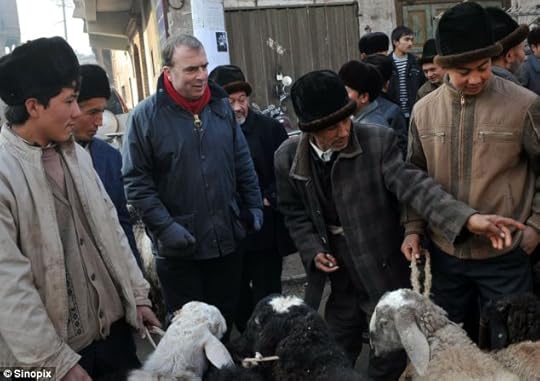
Street bartering: Peter Hitchens stands with sheep traders in the winding streets of Kashgar
Several contradictory thoughts crowd into my mind. The first is a sort of envy at the honesty of all this. These are real men, who are prepared to kill the flesh they eat and to be splattered and smeared with blood as they do it. Whereas we prefer our meat neatly packaged in the supermarket chiller, barely recognisable as the animal it has come from, and think sentimentally about little lambs.
The second is a Christian unease at what is obviously a sort of sacrifice, something which is supposed to have ended at the Crucifixion.
The local name of the festival is 'Corban', from the Arabic word for sacrifice. It commemorates the Muslim belief that Ibrahim - the biblical Abraham - was preparing to sacrifice his son (they say it was Ishmael, the Bible says it was Isaac) when he found a ram trapped in a thicket and sacrificed that instead.
Christians and Jews see the story as an instruction to end human sacrifice. Muslims seem to view it as permission to continue animal sacrifices.
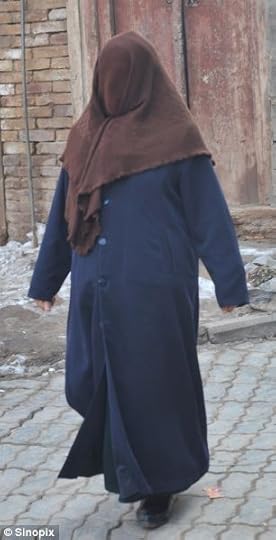
Old ways: A Muslim woman wears a shroud to hide her face on the streets of Kashgar
I must admit I have certainly been desensitised to brutality by what I have seen. Would it be easier, if I had slain a sheep in this way, for me to do the same to a human being? I am sure it would be.
How many sheep had the fanatical killers of Ken Bigley or Daniel Pearl slaughtered and beheaded before they turned their knives on their fellow creatures?
This thought seems most unfair to the smiling, proud, friendly Uighurs who have shown me such hospitality, invited me into their tiny one-room homes and spoken with sad regret of the imminent destruction of a way of life that has lasted for 2,000 years.
'We don't want to go and live in blocks of flats,' one explained to me in poignant terms that many British city-dwellers would completely understand.
'Here we are all together, we see and talk to our neighbours all the time in courtyards and lanes. We do not close our front doors, nor do we need to. But once we are in flats we will cease to be proper people. Once you live behind a locked door, much of your life has gone.'
It is they who are being sacrificed to China's unrelenting drive for modernity, and to the fervent, rather arrogant Chinese nationalism that has taken over from Maoist communism as the binding dogma of the state.
Every city in the country seems destined to turn into a sort of Oriental Las Vegas, with monster six-lane streets lined with showy pillared hotels and fake marble shopping malls devoted to the worship of global brands, all surrounded by mile on mile of grubby, stained concrete blocks of flats. Much of Kashgar already looks like this.
Despite loud protests from Chinese scholars and outsiders, the plan seems to be to destroy almost all of the ancient city, and to rebuild the houses with modern methods, a sort of Disney version of the real thing.
Big signs everywhere in the old city refer to 'dangerous' buildings. This is because the pretext for this official vandalism is 'protection against earthquakes', though up-to-date Chinese buildings (especially schools) failed badly to stand up to earthquakes in Sichuan and Yunnan provinces in 2008 and 2009.
In one outlying portion of the city, you can see the sanitised, tourist version of it that Peking is planning - a ridiculous mini-Kashgar that you must pay to enter, its lanes neatly tiled, its houses labelled in English, its streets tidily signposted to avoid the enjoyable confusion of an unplanned town. No pools of sheep's blood are to be found on its street corners.
How sad it will be when this is all that is left. For this small ancient place is an extraordinarily valuable part of our planet, and of some importance even to us in Britain.
Right up until 1949, we and the Soviet Union both maintained busy consulates here as we continued the Great Game, the old struggle by which Britain sought to keep Moscow's prying hands away from our Indian Empire.
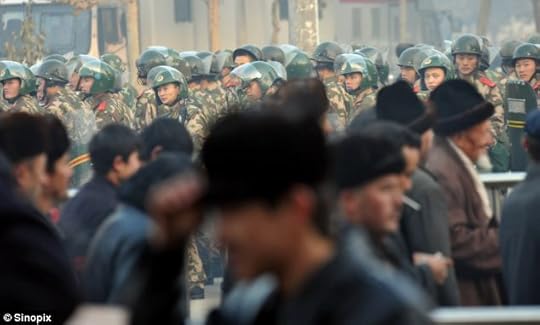
Uneasy streets: Riot police watch Muslims gathering in Kashgar
Thanks to the completely artificial frontier between 'Europe' and 'Asia' we often forget that one unbroken landmass stretches from Calais to Shanghai - a landmass we are much closer to than we used to be, whether we like it or not.
If there is a border between Europe and Asia it is really here, not on the Urals. The word 'Sinkiang' means New Frontier', and China only recently established absolute power in this territory of desert, mountain and oil. That power is pretty much colonial.
In Kashgar, the local language is closer by far to Turkish than to Chinese. The Afghan border is a day's drive away, as is Pakistan and both halves of Kashmir. Iran is surprisingly close, along with the great bubble of oil and gas around the Caspian Basin. Not much more distant is the back door to Tibet, and a mysterious chunk of territory still angrily disputed between India and China. In Urumchi, you see Russian, Arabic and Chinese script jostling for supremacy on the shop signs.
And here the astonishing jigsaw of 'stans' - Kazakhstan, Turkmenistan, Kyrgyzstan, Uzbekistan, Tadzhikistan - fits untidily together at the landlocked heart of the Eurasian landmass, each of them wooed for its oil or strategic position by both Moscow and Washington.
They'll turn it into a sort of Oriental Las Vegas
China is keenly aware that until 1991, these were all subject provinces of an apparently mighty Kremlin in Moscow. Now they are all independent states, until Moscow regains its strength - or Peking gobbles them up. Peking cannot, will not contemplate such independence for Sinkiang, its Western outpost and also full of oil and gas.
The mightiest symbol of this newly vigorous empire is the almost unbelievable 700-mile railway between Urumchi and Kashgar, completed ten years ago, most of it driven through desert as barren as the surface of Mars, or climbing laboriously through mountains, fenced against the camels that can be seen roaming untethered by the tracks.
Even here, way beyond the back of beyond, the remotest place on Earth is bound tightly to the motherland with links of concrete and steel.
The railway's centralising, imperial purpose is clear above all from its suspicious attitude to the natives. Travellers from Kashgar are searched for knives and subjected to identity checks before they can board the train, a reflection of the Chinese prejudice against supposedly knife-wielding Uighur Muslims.
Nobody but China builds railways like this any more. As the world's other empires evaporated, collapsed, died or weakened, China slowly woke to the realisation of its giant, almost limitless potential.
So far we have tended to view this rebirth with wonder and a certain amount of admiration. As we learn more of its ruthlessness, its touchy sensitivity to criticism, its unashamed imperial purpose and its newly passionate national fervour, we might also begin to feel a little apprehension as well.
China once bestrode Asia but turned its face away from the rest of the world. Soon it hopes to land its first man on the Moon and to sit as of right at every top table of power and diplomacy.
It is immensely rich, in fact its growth outstrips anything we can imagine, yet it is not free, nor is it likely to be. The world has not seen such a power before.
In Defence of Council Housing
���Paul P��� submitted a comment on 21st September. I strongly disagree with it, having come to see the sale of (some) council properties as a social disaster and a severe economic mistake, not in the least conservative. I wince every time I hear ���right-wing��� people thoughtlessly praising this action.
For clarity and immediacy, I have interleaved my responses in the original comment ,marking them ***
Mr ���P��� began :
���In the 1980s the Conservative government under Margaret Thatcher began the sale of council houses to their tenants. The socialists squealed in horror, as well they might for the Achilles Heel of state control was about to be severed.���
***PH responds. Socialists certainly protested, often for reasons of self-interest (control of housing stock, possibly resulting in influence on voting patterns) and it was a pity (see below) that nobody else did. Was state control ���severed���, though? The state certainly intervenes far more in housing than it did in the 1980s, not least through the payment of Housing Benefit, last year almost ��24 Billion, roughly a third of the entire welfare bill and greater than the cost of the entire Royal Air Force. The effect of raising and spending this sum on the economy, the housing market and on individuals is huge, though I must accept that the state gets very little in return for its money. It does not own the land or the stick, and it victimises itself by stimulating the growth of high rents for low-quality rentals, thus raising the housing benefit bill to the taxpayer.
The very large empire of ���social housing��� owned and operated by Housing Associations is also very heavily state-subsidised, though( again) not controlled by anyone much. Is this good, or sensible? Is this country���s housing policy a model for the world?****
Mr ���P��� continued: ���You may or may not be familiar with council houses and council estates, but in the pre-Thatcher years they were known for their uniform drabness.���
***PH writes. I am not sure this was so. I was myself a council tenant in Swindon in the early 1970s, and knew others who were. I rented, for a reasonable but not tiny sum, a sensitively-converted flat in Brunel���s old Railway Village, which I seem to remember won a design award for good restoration. Other council houses varied, many being indistinguishable from private speculatively built houses, generally well-proportioned and with reasonable sized gardens. I had sent a good deal of the period 1968 to 1975 delivering copies of the ���Socialist Worker���; to buyers (I won���t say they were necessarily readers) on council estates in York, Oxford and Scarborough. I was more than once invited to stay overnight in the council homes of members of the International Socialists. I���d hesitate to generalise about them. The old Parker Morris standard, mandating a minimum 775 square feet, man they were in many cases more spacious than modern private homes. There was almost always a lot of green space and a reasonable number of trees. Schools, shops, pubs and bus stops were conveniently placed.
I���d have to stress that this couldn���t be said of some of the new high-rise housing going up at the time (there was, mercifully, very little of this in Oxford and, I think, none in York). But, as we shall see, the high-rise housing and flats in general were the parts of the public housing estate that nobody much wanted to buy and which have often remained in the public sector.
The quality of building in that era wasn���t especially good in private or public sectors. From my experiences around that time, which involved some house sharing in the private rented ���sector���, I���d say there was little to choose between bottom-end private housing and modern council houses.
AS for the ���drabness���, etc, no doubt there was plenty (there is plenty in some forms of private housing too, I think Mr ���P��� will concede, especially those long terraces, flat-fronted or bow-windowed, which were thrown up by spec,. builders in the 1890-1914 period in many English cities) but for many people the 1950s and 1960s council estates offered a new world of space, greenery and brightness. See this passage from the obituary, http://www.theguardian.com/news/2002/mar/23/guardianobituaries.booksobituaries
in the left-liberal ���Guardian��� newspaper, of Harry Wingfield, who himself lived on council estates and drew them, as clean, neat, green, pleasant, orderly and spacious for the ���Ladybird Books��� series:
���Wingfield's pictures did everything to bolster this aim (encouraging] parents to help their children learn to read, and [perhaps to foster] better family relationships), and it was only a slight embellishment of what he saw around him. While he dismissed the idea that there was a particular girl on whom he had modelled Jane, he certainly drew from life, which gave his early pictures, especially, their characteristically clean-lined look.
���His work was based on photographs he took of children playing on the new West Midlands council estates around where he lived. He drew what he saw, and his pictures showed the realities of these children's lives. The offspring of respectable workers, they dressed neatly, were obedient, and conformed to the stereotypes of the time, with Peter helping Daddy and Jane giving Mummy a hand in the kitchen.���
I would say these estates, by mixing skilled and unskilled working-class families, created workable communities in which 'bad elements' could be discouraged by the great mass of responsible and law-abiding people, aided by the council and the police. Once the better-off were able to sell up (and in many cases leave) this balance was destroyed. I would be interested to know if there is any research on the decline in order since the sale of council houses became general. Since it happened at a time when so many other malign influences (family break-up, the withdrawal of the police from preventive patrol, the abolition of the old 1915 alcohol laws, the widespread availability of technically illegal drugs, the breakdown of school discipline) were going on ****
Mr ���P��� continues:
���They generally comprised terraced rows of identical housing 'units' of a most basic kind, their guttering, windows and doors all painted the same, usually drab, state colours. These estates were depressing in the extreme. They were 'worker camps'.���
***PH writes: I���ve no doubt there���s some justice to this claim, especially on the very big old estates in large industrial cities, where the job of managing and maintaining a huge housing stock must have tended towards drab uniformity by its very nature. It would have been an unusually imaginative and wealthy council which, before the modern era, would have tried to achieve variety and brightness.
But as readers of George Orwell���s ���Road to Wigan Pier��� will recall, these estates were intended by their builders to transform the lives of people who up till then had been used to incomparably worse conditions. There was a disagreeable bossiness about them which Orwell noted, and which made him shudder.
But then again, the lofty intentions often led to greatly improved conditions, health and welfare and to handsome, enduring design. The 1930s design adopted by Oxford city council with which I am very familiar, has lasted extremely well. many have been sold, though some remain under council ownership. Many were in pleasant suburban or even central locations. The building of an estate in Cutteslowe, North Oxford, led in the 1930s to the astonishing episode of the ���Cutteslowe Walls��� in which the owner of a neighbouring(and pre-existing)private estate actually built brick walls, topped with revolving spikes across two roads where council and private estates met. Despite various ���accidental��� demolitions (including one by a tank during the war) the walls stayed up, with the support of the courts, until 1959. Buses were routed round them, and the roads changed their names where private and council territory met. They still do, though I suspect only the postman notices now. In my childhood, a small section of one of the walls, spikes and all, was still visible but it seems to have been demolished in the 1980s (it should, if not actually preserved, have been placed in a museum, for , like East Germany, the whole episode is becoming unbelievable).
An illustration here http://www.oxfordshireblueplaques.org.uk/plaques/cutteslowe.html
clearly shows the considerable difference between inter-war council and private housing, much of it being a matter of style rather than solidity or space -though the council house windows are of course not the original ones. ***
Mr ���P��� continues:
���After the tenants had bought the houses remarkable changes took place.���
***Indeed they did. What he does not mention is that the new owners had been given very large subsidies of up to 50% of the normal market price. In recent years (See ���Guardian 12th September) these have been up to 70% And that the more desirable properties were quickly sold on to new buyers or to property companies.
This account in ���the Guardian��� by Andy Beckett http://www.theguardian.com/society/2015/aug/26/right-to-buy-margaret-thatcher-david-cameron-housing-crisis
is a counter to the optimistic and problem-free version believed by most Thatcherite or Heseltine Tories (Lord Heseltine, in other respects Mrs Thatcher���s perpetual antagonist , was in this issue at one with her)/IT also makes the point that flats sold poorly, while buyers were given a vast state subsidy, and there was a rush of cash into state bank accounts, those who continued to rent now experienced large increases.
Mr ���P��� rhapsodises :��� The windows, doors and gutterings were re-painted in the colours of their tenants' choice. Roofs were improved or re-laid. Some tenants, now owners, clad the exteriors with ersatz stone tiles, then fashionable on many private houses. And the gardens, too, became better cultivated and vibrant with colourful planting. You could see what was happening. It was as if the council house tenant, now owner, had taken a new interest in life.���
***PH replies: Well, yes, and I suppose many of us, if handed a large free gift by the taxpayer, like a huge unexpected legacy, might lavish some of it on improving surroundings in which we had a stake. We might even have to. All homeowners also know how quickly their property also becomes a demanding and hungry eater of money. Roofs, walls, pointing, windows, wiring, woodwork need constant and costly attention, which tenants were of course spared by the council���s policy of drab uniformity, paid for and controlled by the town hall. I am also told that many of the houses were swiftly sold on to property companies which then rented them out to tenants (with no stake in maintaining property or garden) , but at market rents far higher than the old council rents. I have seen no figures on this****
Mr ���P��� notes And that was the significant marker. It did not go unnoticed by Tony Blair.
***PH writes: Well, it probably did go unnoticed by him, actually. He told the Sedgefield Labour Party that he���d grown up on ���an estate��� (which was true) in Durham, not mentioning that it was a private estate. I doubt he had very much experience of council housing , then or later, except as he scampered form door to door grinning and shaking hands. I wonder if he even knew which door to knock on. But his advisers did.
Old Labour, he divined, was state drabness. New Labour was private colourfulness. Blair divined that old socialism was dead and that new socialism, i.e. New Labour, was the new banner of the new working-class. And he was right. New Labour went on to win, more or less with landslides, the next three general elections. You may think it all tasteless pap, shallow showboating from an opportunistic Blair who, unlike Brown, was essentially un-tribal and in it for fame and fortune.
****PH writes. Or you may think that nobody ever lost votes by giving large sums of taxpayers��� money to the voters, whatever party they were.. There was no obvious loser at the time. It became clear more recently that we had sold off a major national resource, council land and council housing, and now had to cope with the large number of poor people needing to be housed and unable to afford market prices or rents, through the (far more expensive) system of Housing Benefit, which does not purchase any new assets for the taxpayer, just pours the money down an enormous drain, highly profitable for private landlords. Most private housebuyers have never realised that the ���right-to-buy��� released an inflationary tidal wave of money into the market in the mid-1980s and onwards, which pushed all housing prices relentlessly upwards. This was fine for those already on the ladder ��� but not so good for those who had saved to get on to it, and found the ladder being pulled up out of reach again, just as they were about to reach the bottom rung.
Mr ���P��� writes: ��� Many of the council estates looked, and still do, discordantly ridiculous with one terraced 'unit' covered in Cotswold-stone tiles and with a red roof, and the one next door, still in council hands, still drably Orwellian. But working-class aesthetics is not the point. The point is that the working classes were on the move, and the move was away from state socialism. Blair in the end had run his personal course and with premier Brown there was a brief hiatus and a tilting once more at traditional working-class tribalism, but it couldn't last, and it didn't. The Conservatives in the meantime had taken up the mantle of Blairism and, though forced into coalition, were the party of working-class choice. With Corbyn taking the Labour Party back to state drabness and the 'working-class camp', the Conservatives will be in power for evermore. Blairism, then, is the privatisation of socialism. It is the merging of capitalism and welfare statism. It is, at its root, giving the working classes what in the era of Blair and Cool Britannia the Spice Girls would chant 'what they really, really want'.
***PH responds. Well, this is of course the great political question of the coming decade. Leave aise Mr ���P��� and his vapourings ion taste. And it might be sensible for him to realise that the ���working class��� was destroyed about the same time by the annihilation (by being exposed to EU competition and by Geoffrey Howe���s economic genius) of manufacturing and extractive industry.
But is Mr Cameron���s world view, of ever-increasing prosperity etc, the one which most voters will share in May 2020? Or is the Corbyn view, of a country of housing shortages, low wages, poor public services, shuttered shops and few opportunities, what they see, or will see? Will the general economic state of the country change this perception towards the Corbyn view in the next few years, or more towards the Cameron view? I���m not wholly sure. I think the Tories would be unwise to assume that everyone is as happy as official statistics suggest they ought to be. Or that chickens, even rather old one���s never eventually come flapping home to roost. It���s odd that a party that allegedly stands for sound money is so proud of the magic creation of billions of pounds out of nothing. I can hear a grim Scots voice intoning ���Nothing will come of nothing���, and I can also hear it being repeated, tight-lipped and cold, by a voice in an austere Grantham household, many years ago.
Three verses of that fine poem ���The Gods f the Copybook Headings���, spring to mind.
They are:
With the Hopes that our World is built on they were utterly out of touch,
They denied that the Moon was Stilton; they denied she was even Dutch;
They denied that Wishes were Horses; they denied that a Pig had Wings;
So we worshipped the Gods of the Market Who promised these beautiful things.
And���
In the Carboniferous Epoch we were promised abundance for all,
By robbing selected Peter to pay for collective Paul;
But, though we had plenty of money, there was nothing our money could buy,
And the Gods of the Copybook Headings said: "If you don't work you die."
Then the Gods of the Market tumbled, and their smooth-tongued wizards withdrew
And the hearts of the meanest were humbled and began to believe it was true
That All is not Gold that Glitters, and Two and Two make Four
And the Gods of the Copybook Headings limped up to explain it once more.
To which I would add Housman���s briefer statement of the same truth:
���To think that two and two are four, and neither five nor three, the heart of man hath long been sore, and long is like to be���.
Oh, and in Stalinist Moscow they did actually at one stage put up posters declaring
���2+2 =5���.
This referred to an official claim that a five-year plan had been achieved in four years. The statistics, rather as George Osborne's figures show that we live in a booming economy, showed that it had been.
Changing the BBC
If you visit the following site, you may read and (if you choose) vote for my (and many other people's) suggestions about how to reform the BBC (scroll down a bit for me)
https://www.opendemocracy.net/100ideasforthebbc/staff-voice-opinions/
My suggestion is (most simply) that BBC staff should no longer be required to pretend they have no opinions, but should express them openly.
September 21, 2015
At Last! Doubts about 'ADHD' go mainstream
Readers who have endured my many (rather lonely and much-abused) attempts to resist the unscientific ���diagnosis��� of huge numbers of healthy children with the non-existent complaint ���ADHD��� may be interested by this article by William Sutcliffe(and the book to which it refers) in the normally-conformist and conventional-wisdom-infested ���Independent��� newspaper. Does Mr Sutcliffe know what he has let himself in for? Geysers of slime will be directed at him from the potent 'ADHD' lobby.
My summary of the case against ���ADHD��� and the drugs given for it is here
Mr Sutcliffe���s article is
Here
September 20, 2015
PETER HITCHENS: You wanted honest leaders - so stop whining now that you've got one
This is Peter Hitchens's Mail On Sunday Column
We say we want politicians who are open and honest. And then, when we get one, we angrily pelt him with slime until he cringes to the mob, starts hiding his real views, and hires a spin doctor just like all the others.
So don���t let me hear you complaining again that our leaders are too smooth and obsessed with their images.
I loathe and despise most of what Jeremy Corbyn stands for, but a reasonably long life has taught me that quite a lot of people agree with him and not with me.
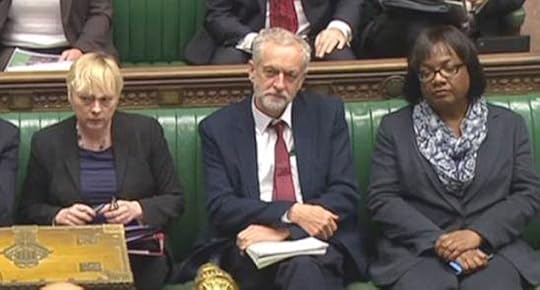
We say we want politicians who are open and honest. And then, when we get one, we angrily pelt him with slime until he cringes to the mob, starts hiding his real views, and hires a spin doctor just like the others
I think our wonderful laws and constitution thrive because of this difference. Nobody is right all the time. A fierce and principled opposition stops a fat, complacent government from making stupid mistakes.
We all live in that inch or two of difference that ought to exist between the two main parties, but which recently vanished.
And I might add, these freedoms were what the Spitfire and Hurricane pilots saved when they won the Battle of Britain. Some of them may have been unsure about the Monarchy, if they���d had time to think about it. And I wonder how many of the soldiers who slogged doggedly through the Western Desert, Burma, Italy and Normandy were a bit Left-wing, too.
The world���s full of countries where you have to salute the leader and sing the party song in public. This isn���t one of them, so to hell with all the superpatriots who condemned Jeremy Corbyn for not singing God Save The Queen.
What are they patriotic for, exactly, if not the freedom to dissent, the crown of all our liberties and our greatest achievement?
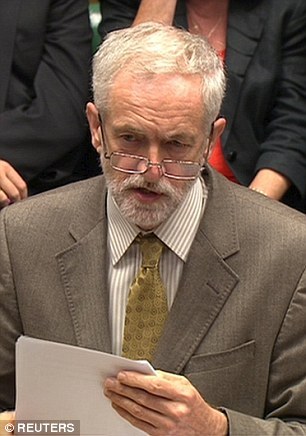
So don���t let me hear you complaining again that our leaders are too smooth and obsessed with their images
And do you really think that the Blairite smoothies, who pretended to be patriots and monarchists, really were? Do you prefer liars to honest men?
I���d much rather have a lone and awkward Jeremy Corbyn, respectfully staying silent during the singing of a song he didn���t agree with, than the ghastly pretence of Anthony Blair���s fake welcome to Downing Street in 1997, when Labour Party workers were bussed into Downing Street and ordered to impersonate a patriotic crowd.
How most of them must have hated waving the Union Jack, a flag such people despise. Yet through such fakery, attacked at the time only by me, Blair came to office and was able to smash up much of our free constitution.
As for the rest of them, I have to note that Mr Rupert Murdoch, owner of the media keenest to harry Mr Corbyn, has pledged his own allegiance to the American Republic and said, in a Sydney lecture in 2008: ���If I were in a position to vote, it would be for a republic.���
Mr Murdoch, who kept a bust of Lenin in his rooms at Oxford, declared during Australia���s last referendum on the Monarchy: ���The British Monarchy has become irrelevant to this generation of Australians.���
Which brings me to Malcolm Turnbull, new leader of Australia���s answer to the Tory Party, and another avowed republican. There���s no organic connection between these careerists and our ancient traditions.
As I survey the smarmy, modernising ranks of Mr Cameron���s Blairite rabble, I feel pretty sure that they would abolish the Crown in a moment if they thought it would help them stay in office.
I want Mr Corbyn to lose any Election he fights, but I want him to lose it to people who really disagree with him, not people who pretend to do so.
The pills myth finally crumbles
The huge power of the pill-makers, and the potent lobby of influential people who swallow their products, have long prevented a serious discussion of alleged antidepressant medications.
Do they have severe side effects? (Yes.) Are they as effective as their makers claim? (No.)
This is hugely important, as in some parts of this country one person in six is taking such drugs.
Last week, the dam began to break. First, an Oxford University study noted that young people aged 15 to 24 who take certain kinds of ���antidepressant��� medication are more likely to commit violent crimes, more likely to be involved in non-violent crime, and to have alcohol problems.
They didn���t say the pills caused these difficulties. They don���t know. But they called for further research. So do I. Soon afterwards, scientists writing for the New Scientist re-examined drug trials of an ���antidepressant��� and found that the original test was dangerously wrong, and that none of the 22 named authors of the resulting report had actually written it.
It was instead penned by a writer hired by the manufacturer of the drug.
This sort of thing stinks, as do the colossal amounts of money made by this industry. Nothing short of a proper Government-backed inquiry will do.
Beguiling Anna... betrayed by a pathetic ending
The ending of the BBC Sunday night drama Odyssey, starring Anna Friel, was an infuriating disappointment.
Instead of tying up its multiple plots, it ended with almost nothing resolved, and a sort of plea for a second series.
I fear this isn���t going to happen ��� the drama was shoved into a later slot in its final weeks, never a sign of network enthusiasm.
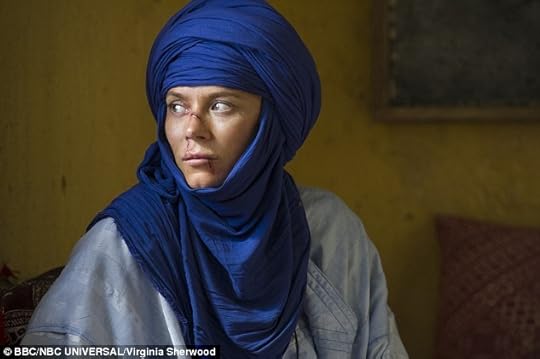
The ending of the BBC Sunday night drama Odyssey, starring Anna Friel, was an infuriating disappointment
I suspect many watchers, like me, came to care about the characters despite the often incredible storyline and the ladles full of political correctness.
Can someone please tell us what happened to them in the end?
Power cuts are now a real danger.
Mad warmist rules are about to force the needless closure of Eggborough Power Station in Yorkshire, a perfectly sound, coal-fired plant which ��� until it shuts ��� can supply electricity to two million homes.
This follows the equally insane destruction of Didcot A last year. I promise you, windmills won���t fill the gap.
******
You may have missed last week���s extraordinary double rebellion by David Davis, the man who ought to have beaten David Cameron to the leadership of the Tory Party.
Grammar school-educated Mr Davis grew up on a council estate and had a successful career in business before going into politics.
His eloquent objections to foolishly restrictive trade union laws, and his defiant vote against the abrupt withdrawal of tax credits from working families, were in fact the most interesting political events of the week.
*****
Yes, it is disgusting, isn���t it, to call for IRA men to be honoured?
Those responsible for forcing the Queen to invite Martin McGuinness to dinner at Windsor Castle should certainly be made to apologise in public.
September 17, 2015
If Vladimir Putin had Done This, There'd Have Been More Fuss
The many gullible (or just crudely and ignorantly anti-Russia) journalists and politicians who sided with the Kiev putsch of February 2014 really ought to be more interested in the latest news from Ukraine.
The supposedly heroic new President of the supposedly free and uncorrupt and generally wonderful new Ukraine, the oligarch who doesn���t like being called an oligarch, Petro Poroshenko, has announced a ban on lots of journalists (and indeed other individuals).
These people are accused of promoting ���terrorist activities��� ( a charge very similar to catch-all offences under the Blairite Terrorism Act which are still, shamefully on our own statute book) or of being a ���threat to national interests���.
The decree is barmy and self-defeating, and in a way laughable. But can you imagine the enormous fuss that would be made if Vladimir Putin were to do the same? Compare, then, and contrast the minimal coverage it has received, because it issues from Ukraine.
Will the vast crowds be back on Kiev���s Maidan to protest against this? Will Victoria Nuland and Guido Westerwelle and John McCain and the rest of them be there with them, clutching bags of biscuits and smiling their support? Will all those civil society groups, dedicated to bringing freedom of speech and press to the borderlands, be outraged and working their little socks off to get the ban overturned, setting up the tents and soup-kitchens to house and feed the massing army of protest? Don���t be too sure.
I am reminded by this of the ridiculous claims made by apologists for the putsch that the Maidan was in fact an unstoppable movement for freedom and against corruption, rather than a manipulated mob helping to overthrow a government which had annoyed the ���West��� . If this were really so, the crowds would have been almost perpetually back on the Maidan ever since. Somehow, they haven���t been. Nor will this shoddy action bring them there.
And so we know all we need to know about the ���February Revolution���, its true nature and objectives.
'The Long Good Friday' Revisited
There���s now a cleaned-up version of the 1979-80 London gangster film ���The Long Good Friday��� (largely made in London in 1979, released quite a bit later) which (once again) I���ve been lucky enough to see on a full-size screen but which is also available on DVD and no doubt other forms of modern technology for those who care. It���s surprisingly violent for a film made so long ago, but if you can face that, then you should certainly see it.
(By the way, when I say 'cleaned-up', I mean technically, not morally, hisses, scratches and blurs eliminated).
The film, starring the late Bob Hoskins and the still-very-much-alive Helen Mirren was recently given generous praise by my old friend Simon Heffer in ���Standpoint��� magazine, but alas I cannot link to his interesting article and cannot lay my hand on it, and I���m sure that some of the things he said will be reflected, even possibly repeated in what I write here. Well, if so, he���ll just have to take it as a compliment.
A kind reader has now provided this link
But be warned - it gives away the plot :
http://standpointmag.co.uk/culture-and-anarchy-december-14-bad-manors-simon-heffer-bob-hoskins
As with so many films, I thought I remembered it (and four or five particular scenes are stuck in my mind, not necessarily in a good way, though I���d forgotten the worst of the violence and wonder whether it had been cut from the version I saw in 1980 or 1981). But 35 years is a long time and memory ( as the authorities need to realise) is a lying jade, especially when it is at its most persuasive.
One of the things it has lost is the extreme slickness it seemed to have when it first came out. By modern standards it is slow-moving and rough-edged. The luxury isn���t especially luxurious, the smart cars are practically antiques, the flash and glitter of London now looks dun-coloured and cheap.
But the special fascination is that it was made in London at the very beginning of the Thatcher era, in a city quite recognisable to me (I lived there from 1977 to 1984).
I���ve been trying for some days to work out what exactly is so different. An opening scene shows Paddington Station, which I���ve been travelling through since 1963. Let���s start with some details and see how we get on. Taxis and other authorised vehicles at that time could still drive straight through the station, coming in alongside Platform 8. Now only members of the Royal family and Politicians can bring cars even close to the trains. Trains were blue and grey affairs with big openable windows and engines hitched to the front end. Loudspeaker announcements were more or less impenetrable. Cappuccino hadn���t yet been invented.
The scene involves the unloading of a coffin from a guard���s van. I���m not going to tell you whose it is, where it has come from or why he���s dead, in case you haven���t seen the film. It���s much better if you don���t know. I���m not sure if anyone would send a coffin anywhere by train any more, or where they would put it if they did. (Coffins seem to feature in many of the films I review here. Pure coincidence).
For the guard���s van, with its many uses (I once, in the early 1960s, saw one full of Dartmoor prisoners in transit, or at least I think I did) is now a vanished feature of rail travel. The old HS125s have spacious guard���s vans in the locomotives at both ends, but they are always locked in case of terrorists, so instead they have carved a small bicycle space out of the quiet carriage, where presumably the terrorist danger is thought to be less).
As a cyclist, I used to spend a lot of time sitting on the floors of guard���s vans (seats in what was then called second class being hard to find) next to my machine. The inward-opening doors could be useful if the train stopped for ages at a signal near your destination. It was perfectly possible to open them up, sling your bike on to the track, watch as fellow-passengers shut them behind you, and ride home from wherever it was (unthinkable in these times). It���s still just possible to *shut* some train doors yourself, and to open them once they���ve been centrally unlocked, though this is rare. But these days we���re not trusted with doors (or windows) we can open ourselves, in case we tumble out on the tracks or otherwise misbehave ourselves. We���re not trusted in general. Life is increasingly like being a toddler in day care, every surface cushioned, big notices everywhere telling us to be careful (I think there are now six separate warning notices on the exit doors of my usual train) , and large smiling nannies everywhere, who stop smiling abruptly if challenged.
Gone also, and forgotten, are the strange British Rail uniforms of the time, halfway between Edwardian postman and French Foreign Legion. We laughed at them then, but sort of got used to them. Now they look like something from a 1930s newsreel.
The tracks at Paddington have been moved several yards further from London to make way for fast food stalls and shops.
But there���s something about the point at which Paddington station (like all big railway stations an enchanted place of fantasy and reverence for railway enthusiasts) gives on to London. The modern post-Thatcher Paddington is almost as glossy as an airport, and the contrast with the scruffy, seemingly untartable-up zone of Praed Street is so strong that people arriving from abroad on the Heathrow Express must wonder where on earth they���ve fetched up. This bit of London is haunted by an especially glum spirit, probably dating back to the days of Boadicea, and I wonder if they���ll ever manage to brighten it up as they���ve done at King���s Cross.
But in 1979 even Brunel���s railway cathedral was grubby, untidy and close to the ground, not polished, as it is now, in the cause of commerce. London in general was closer to the ground, not seeking to impress or intimidate, just there, and all the more powerful a capital as a result, in my view. You only realised it by bit that you were in the midst of great power, much as you might realise rather slowly that the slightly scruffy, elongated tweedy gent at the table next to you in the restaurant was in fact a decorated war hero, senior diplomat and author of an indispensable memoir of his life and travels.
As I see once more that very different station, I begin to imagine the London and the Britain that lay beyond it, chillier, greyer, smellier than today���s, but not in all ways worse. In some fashion, I mourn its loss, because ( and Bill Bryson was rather good about this in one of his books, Notes From a Small Island���) the Britain of this era had rather a lot of good characteristics, now lost.
Anyone who wanted to work, could work. Wages for normal jobs, which were reasonably secure, bore some relation to the cost of living, though at a much lower level than people now aspire to. We were considerably shabbier, worse dressed, and living in houses which were much less smart and well-equipped. There was, in an indefinable way, more kindness. I suspect it couldn���t have lasted.
Now, I don���t myself view this as a paradise wholly destroyed by Mrs Thatcher in an act of lone spite, though her government did play a significant part in the hurricane that would tear through it. Thatcherism, so-called, was far less planned (especially the privatisation) than everyone now seems to think, and very nearly came completely off the rails (and would have done without the North Sea Oil). If Jim Callaghan had won in 1979, he���d have had to do much the same, I fear. Denis Healey had already begun the process as his Chancellor. I see it as the last, dying afterglow of the Butskell era ( the USA had a similar settlement, of full employment and reasonably high wages, known I believe as ���The Treaty of Detroit���) . It was doomed by the cultural revolution, which had already begun to rip families to bits, and by the EU, which was exposing the protected bits of our economy, though most people weren���t fully aware that we had lost our independence or any real control over our destiny.
Another interesting film from rather earlier in this era which I���d like to see again is ���Sunday, Bloody Sunday��� from 1971, in which strikes and the failing balance of payments are the background music, and a scruffy, rather feverish post-Swinging Sixties London, with a homosexual man���s dilemmas thoughtfully portrayed, in the foreground.
Mrs Thatcher, in my view, reacted to her circumstances rather than having any coherent strategy. This was certainly so in the Falklands, where the Navy saved her from her own grave errors of judgment. But it was also the case in the economy, where so much manufacturing industry vanished in what might these days be called ���collateral damage���.
Hence her reliance in the end on secondary bubbles ��� banking and property ��� to fill the gap left by the disappearance of manufacturing and of many old-fashioned office jobs too.
One of those bubbles, property, provides the plot for ���The Long Good Friday���. Reasonably prophetically, the hero/villain, played by Bob Hoskins, reckons he can turn his seedy, violent Kray-like crime empire (presumably based on extortion and protection rackets) into a legitimate big business if he can get into property on the banks of the Thames east of Tower Bridge. This is of course the true scene of a gigantic property revolution, as anyone who knows London well knows. If you didn���t know the city before its transformation, you can see here just how huge the change has been.
Hoskins has the usual collection of scarred and deadly henchmen, but also has the unlikely assistance of Helen Mirren, playing a public schoolgirl gone to the bad, putting her looks and charm at the service of Hoskins���s gangland outfit. Without her, it���s hard to see how Hoskins (first shown arriving home on Concorde from New York in a blaze of vulgarity) could have won the trust of the Cosa Nostra smoothies he is trying to persuade to invest in his Docklands scheme.
We see, for the last time, the undeveloped empty and abandoned wharves as they were before the real money men came in.
We also see and hear a fair amount of casual racial bigotry which no director would risk now, and are shown London pubs, restaurants, swimming baths and domestic interiors, unselfconsciously as they were, plus the odd fashions in hair and clothes which people thought normal at the time, as they always do. Drink is incessantly taken. Smoking is shown as it often was, a thoughtless reflex, not as a device to show we���re in the past.
And then there are two rather sad semi-patriotic soliloquies delivered by the squat and noisy Hoskins (who in truth couldn���t really play nasty enough for the role), one all but raving about the great new future Britain has in Europe, and the other vapouring about how Britain stood alone in her finest hour, as so many people still do when they can���t think of anything else to say. When will we arrive at the point when we recognise that this event , 75 long years ago, was not *our* finest hour but that of our fathers and grandfathers - who might not be that impressed by what we���ve done with the resulting victory.
In the middle of a gutted London, once the Heart of Empire, a forest of masts from Tower Bridge to Greenwich, a petty gangster (whose national service, we learn, ended in the glasshouse) wraps himself in the flag as he prepares to import much bigger gangsters from abroad. Perhaps it���s a metaphor for something. And it wouldn���t be a bad theme by itself ��� but when it goes wrong, it goes really, really wrong. It will make you think, and it well entertain you. It deserves a full revival.
Peter Hitchens's Blog

- Peter Hitchens's profile
- 299 followers

