Kay Keppler's Blog, page 9
August 30, 2012
A new chapter

 This week I started an MFA program–that’s Master of Fine Arts–at McDaniel University. And the best part–it’s about romance, analyzing and writing. And the next best part–it’s an online class, so I don’t have to relocate temporarily to Maryland, where McDaniel is. The program will last for a year. It’s taught by Pam Regis, who’s a professor there, and Jennifer Crusie, who’s a world-class writer. The program was funded by Nora Roberts, who as everybody probably knows, is surely the most prolific and and astonishing romance writer ever.
So far this week we’ve been reading two novels, Montana Sky by Roberts and Heaven, Texas, by Susan Elizabeth Phillips. The post office or the book company I ordered from has screwed up the delivery of Heaven, but I’ve read it a million times so I remember the plot decently enough. But if I don’t get my copy soon, my first paper will be on Montana Sky.
I’m so excited to be part of this smart bunch of people who sit around their computers all day, talking about books! It’s hog heaven over here.


July 1, 2012
Happy Independence Day, and the publishing phenomenon that helped bring it about
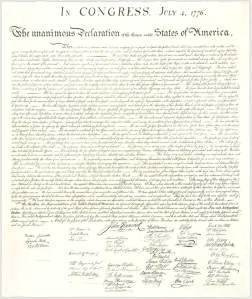 I’ve always liked American history, especially colonial history. The American war of colonial independence, otherwise known as the Revolutionary War, is a true David and Goliath story. On one side, the colonists: outnumbered, outgunned. On the other side, the British: world rulers. Start the smackdown!
The colonists’ desire to divest themselves from British rule did not develop swiftly. Ultimately it was fueled by the publication of political pamphlets, the most influential of which was Common Sense, written by Thomas Paine and published in January of 1776. In the first three months Common Sense sold 120,000 copies, an astonishing number. To compare: In 1776, the colonial population was 2.5 million. In today’s numbers, Common Sense would have sold 15 million copies in three months. By year’s end (1776, that is), 500,000 copies of Common Sense were sold–that means that 20 percent of the entire colonial population, including children and the many adults who couldn’t read, had bought a copy. That’s 60 million copies in today’s numbers. Compare those stats to the sales of 50 Shades of Grey, today’s blockbuster. The most recent numbers I could find report that 16 million copies of the Grey series have sold in the United States. And that’s the fastest-selling book in publishing history. And its sales records don’t hold a candle to Common Sense.
 The rhetoric of Common Sense helped to sway the general population (by the middle of May 1776, eight colonies had decided that they would support independence), although many representatives to the Continental Congress were already persuaded. Richard Henry Lee of Virginia had put out a resolution for independence, a committee was formed, Thomas Jefferson was asked to write the draft, John Adams and Benjamin Franklin edited it, and the Continental Congress voted to adopt the Lee resolution of independence on July 2, 1776 with 12 of the 13 colonies supporting it (New York abstained). At the time, John Adams wrote in a letter that for many years in the future, Americans would be celebrating July 2 as their independence day. But in fact, July 4–the day the Declaration’s wording was approved–became Independence Day. New York approved the action on July 9, and the document itself was signed on August 2, 1776.
And that declaration set off a whole lot of fireworks in Great Britain. Following is the text of the document that summarized the political philosophy of John Locke and the Continental philosophers and listed the colonial grievances against the King: [drum role, please]
The unanimous Declaration of the thirteen united States of America.
When in the Course of human events, it becomes necessary for one people to dissolve the political bands which have connected them with another, and to assume among the powers of the earth, the separate and equal station to which the Laws of Nature and of Nature’s God entitle them, a decent respect to the opinions of mankind requires that they should declare the causes which impel them to the separation.
We hold these truths to be self-evident, that all men are created equal, that they are endowed by their Creator with certain unalienable Rights, that among these are Life, Liberty and the pursuit of Happiness.–That to secure these rights, Governments are instituted among Men, deriving their just powers from the consent of the governed, –That whenever any Form of Government becomes destructive of these ends, it is the Right of the People to alter or to abolish it, and to institute new Government, laying its foundation on such principles and organizing its powers in such form, as to them shall seem most likely to effect their Safety and Happiness. Prudence, indeed, will dictate that Governments long established should not be changed for light and transient causes; and accordingly all experience hath shewn, that mankind are more disposed to suffer, while evils are sufferable, than to right themselves by abolishing the forms to which they are accustomed. But when a long train of abuses and usurpations, pursuing invariably the same Object evinces a design to reduce them under absolute Despotism, it is their right, it is their duty, to throw off such Government, and to provide new Guards for their future security.–Such has been the patient sufferance of these Colonies; and such is now the necessity which constrains them to alter their former Systems of Government. The history of the present King of Great Britain is a history of repeated injuries and usurpations, all having in direct object the establishment of an absolute Tyranny over these States. To prove this, let Facts be submitted to a candid world.
He has refused his Assent to Laws, the most wholesome and necessary for the public good.
He has forbidden his Governors to pass Laws of immediate and pressing importance, unless suspended in their operation till his Assent should be obtained; and when so suspended, he has utterly neglected to attend to them.
He has refused to pass other Laws for the accommodation of large districts of people, unless those people would relinquish the right of Representation in the Legislature, a right inestimable to them and formidable to tyrants only.
He has called together legislative bodies at places unusual, uncomfortable, and distant from the depository of their public Records, for the sole purpose of fatiguing them into compliance with his measures.
He has dissolved Representative Houses repeatedly, for opposing with manly firmness his invasions on the rights of the people.
He has refused for a long time, after such dissolutions, to cause others to be elected; whereby the Legislative powers, incapable of Annihilation, have returned to the People at large for their exercise; the State remaining in the mean time exposed to all the dangers of invasion from without, and convulsions within.
He has endeavoured to prevent the population of these States; for that purpose obstructing the Laws for Naturalization of Foreigners; refusing to pass others to encourage their migrations hither, and raising the conditions of new Appropriations of Lands.
He has obstructed the Administration of Justice, by refusing his Assent to Laws for establishing Judiciary powers.
He has made Judges dependent on his Will alone, for the tenure of their offices, and the amount and payment of their salaries.
He has erected a multitude of New Offices, and sent hither swarms of Officers to harrass our people, and eat out their substance.
He has kept among us, in times of peace, Standing Armies without the Consent of our legislatures.
He has affected to render the Military independent of and superior to the Civil power.
He has combined with others to subject us to a jurisdiction foreign to our constitution, and unacknowledged by our laws; giving his Assent to their Acts of pretended Legislation: For Quartering large bodies of armed troops among us: For protecting them, by a mock Trial, from punishment for any Murders which they should commit on the Inhabitants of these States: For cutting off our Trade with all parts of the world: For imposing Taxes on us without our Consent: For depriving us in many cases, of the benefits of Trial by Jury: For transporting us beyond Seas to be tried for pretended offences For abolishing the free System of English Laws in a neighbouring Province, establishing therein an Arbitrary government, and enlarging its Boundaries so as to render it at once an example and fit instrument for introducing the same absolute rule into these Colonies: For taking away our Charters, abolishing our most valuable Laws, and altering fundamentally the Forms of our Governments: For suspending our own Legislatures, and declaring themselves invested with power to legislate for us in all cases whatsoever.
He has abdicated Government here, by declaring us out of his Protection and waging War against us.
He has plundered our seas, ravaged our Coasts, burnt our towns, and destroyed the lives of our people.
He is at this time transporting large Armies of foreign Mercenaries to compleat the works of death, desolation and tyranny, already begun with circumstances of Cruelty & perfidy scarcely paralleled in the most barbarous ages, and totally unworthy the Head of a civilized nation.
He has constrained our fellow Citizens taken Captive on the high Seas to bear Arms against their Country, to become the executioners of their friends and Brethren, or to fall themselves by their Hands.
He has excited domestic insurrections amongst us, and has endeavoured to bring on the inhabitants of our frontiers, the merciless Indian Savages, whose known rule of warfare, is an undistinguished destruction of all ages, sexes and conditions.
In every stage of these Oppressions We have Petitioned for Redress in the most humble terms: Our repeated Petitions have been answered only by repeated injury. A Prince whose character is thus marked by every act which may define a Tyrant, is unfit to be the ruler of a free people.
Nor have We been wanting in attentions to our Brittish brethren. We have warned them from time to time of attempts by their legislature to extend an unwarrantable jurisdiction over us. We have reminded them of the circumstances of our emigration and settlement here. We have appealed to their native justice and magnanimity, and we have conjured them by the ties of our common kindred to disavow these usurpations, which, would inevitably interrupt our connections and correspondence. They too have been deaf to the voice of justice and of consanguinity. We must, therefore, acquiesce in the necessity, which denounces our Separation, and hold them, as we hold the rest of mankind, Enemies in War, in Peace Friends.
We, therefore, the Representatives of the united States of America, in General Congress, Assembled, appealing to the Supreme Judge of the world for the rectitude of our intentions, do, in the Name, and by Authority of the good People of these Colonies, solemnly publish and declare, That these United Colonies are, and of Right ought to be Free and Independent States; that they are Absolved from all Allegiance to the British Crown, and that all political connection between them and the State of Great Britain, is and ought to be totally dissolved; and that as Free and Independent States, they have full Power to levy War, conclude Peace, contract Alliances, establish Commerce, and to do all other Acts and Things which Independent States may of right do. And for the support of this Declaration, with a firm reliance on the protection of divine Providence, we mutually pledge to each other our Lives, our Fortunes and our sacred Honor.


Happy Independence Day, and the publishing phenomenon that brought it about

 I’ve always liked American history, especially colonial history. The American war of colonial independence, otherwise known as the Revolutionary War, is a true David and Goliath story. On one side, the colonists: outnumbered, outgunned. On the other side, the British: world rulers. Start the smackdown!
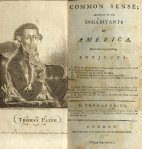
The colonists’ desire to divest themselves from British rule did not develop swiftly. Ultimately it was fueled by the publication of political pamphlets, the most influential of which was Common Sense, written by Thomas Paine and published in January of 1776. In the first three months Common Sense sold 120,000 copies, an astonishing number. To compare: In 1776, the colonial population was 2.5 million. In today’s numbers, Common Sense would have sold 15 million copies in three months. By year’s end (1776, that is), 500,000 copies of Common Sense were sold–that means that 20 percent of the entire colonial population, including children and the many adults who couldn’t read, had bought a copy. That’s 60 million copies in today’s numbers. Compare those stats to the sales of 50 Shades of Grey, today’s blockbuster. The most recent numbers I could find report that 16 million copies of the Grey series have sold in the United States. And that’s the fastest-selling book in publishing history. And its sales records don’t hold a candle to Common Sense.
The rhetoric of Common Sense helped to sway the general population (by the middle of May 1776, eight colonies had decided that they would support independence), although many representatives to the Continental Congress were already persuaded. Richard Henry Lee of Virginia had put out a resolution for independence, a committee was formed, Thomas Jefferson was asked to write the draft, John Adams and Benjamin Franklin edited it, and the Continental Congress voted to adopt the Lee resolution of independence on July 2, 1776 with 12 of the 13 colonies supporting it (New York abstained). At the time, John Adams wrote in a letter that for many years in the future, Americans would be celebrating July 2 as their independence day. But in fact, July 4–the day the wording of Declaration was approved–became Independence Day. New York approved the action on July 9, and the document itself was signed on August 2, 1776.
And that declaration set off a whole lot of fireworks in Great Britain. Following is the text of the document that summarized the political philosophy of John Locke and the Continental philosophers and listed the colonial grievances against the King: [drum role, please]
The unanimous Declaration of of the thirteen united States of America.
When in the Course of human events, it becomes necessary for one people to dissolve the political bands which have connected them with another, and to assume among the powers of the earth, the separate and equal station to which the Laws of Nature and of Nature’s God entitle them, a decent respect to the opinions of mankind requires that they should declare the causes which impel them to the separation.
We hold these truths to be self-evident, that all men are created equal, that they are endowed by their Creator with certain unalienable Rights, that among these are Life, Liberty and the pursuit of Happiness.–That to secure these rights, Governments are instituted among Men, deriving their just powers from the consent of the governed, –That whenever any Form of Government becomes destructive of these ends, it is the Right of the People to alter or to abolish it, and to institute new Government, laying its foundation on such principles and organizing its powers in such form, as to them shall seem most likely to effect their Safety and Happiness. Prudence, indeed, will dictate that Governments long established should not be changed for light and transient causes; and accordingly all experience hath shewn, that mankind are more disposed to suffer, while evils are sufferable, than to right themselves by abolishing the forms to which they are accustomed. But when a long train of abuses and usurpations, pursuing invariably the same Object evinces a design to reduce them under absolute Despotism, it is their right, it is their duty, to throw off such Government, and to provide new Guards for their future security.–Such has been the patient sufferance of these Colonies; and such is now the necessity which constrains them to alter their former Systems of Government. The history of the present King of Great Britain is a history of repeated injuries and usurpations, all having in direct object the establishment of an absolute Tyranny over these States. To prove this, let Facts be submitted to a candid world.
He has refused his Assent to Laws, the most wholesome and necessary for the public good.
He has forbidden his Governors to pass Laws of immediate and pressing importance, unless suspended in their operation till his Assent should be obtained; and when so suspended, he has utterly neglected to attend to them.
He has refused to pass other Laws for the accommodation of large districts of people, unless those people would relinquish the right of Representation in the Legislature, a right inestimable to them and formidable to tyrants only.
He has called together legislative bodies at places unusual, uncomfortable, and distant from the depository of their public Records, for the sole purpose of fatiguing them into compliance with his measures.
He has dissolved Representative Houses repeatedly, for opposing with manly firmness his invasions on the rights of the people.
He has refused for a long time, after such dissolutions, to cause others to be elected; whereby the Legislative powers, incapable of Annihilation, have returned to the People at large for their exercise; the State remaining in the mean time exposed to all the dangers of invasion from without, and convulsions within.
He has endeavoured to prevent the population of these States; for that purpose obstructing the Laws for Naturalization of Foreigners; refusing to pass others to encourage their migrations hither, and raising the conditions of new Appropriations of Lands.
He has obstructed the Administration of Justice, by refusing his Assent to Laws for establishing Judiciary powers.
He has made Judges dependent on his Will alone, for the tenure of their offices, and the amount and payment of their salaries.
He has erected a multitude of New Offices, and sent hither swarms of Officers to harrass our people, and eat out their substance.
He has kept among us, in times of peace, Standing Armies without the Consent of our legislatures.
He has affected to render the Military independent of and superior to the Civil power.
He has combined with others to subject us to a jurisdiction foreign to our constitution, and unacknowledged by our laws; giving his Assent to their Acts of pretended Legislation: For Quartering large bodies of armed troops among us: For protecting them, by a mock Trial, from punishment for any Murders which they should commit on the Inhabitants of these States: For cutting off our Trade with all parts of the world: For imposing Taxes on us without our Consent: For depriving us in many cases, of the benefits of Trial by Jury: For transporting us beyond Seas to be tried for pretended offences For abolishing the free System of English Laws in a neighbouring Province, establishing therein an Arbitrary government, and enlarging its Boundaries so as to render it at once an example and fit instrument for introducing the same absolute rule into these Colonies: For taking away our Charters, abolishing our most valuable Laws, and altering fundamentally the Forms of our Governments: For suspending our own Legislatures, and declaring themselves invested with power to legislate for us in all cases whatsoever.
He has abdicated Government here, by declaring us out of his Protection and waging War against us.
He has plundered our seas, ravaged our Coasts, burnt our towns, and destroyed the lives of our people.
He is at this time transporting large Armies of foreign Mercenaries to compleat the works of death, desolation and tyranny, already begun with circumstances of Cruelty & perfidy scarcely paralleled in the most barbarous ages, and totally unworthy the Head of a civilized nation.
He has constrained our fellow Citizens taken Captive on the high Seas to bear Arms against their Country, to become the executioners of their friends and Brethren, or to fall themselves by their Hands.
He has excited domestic insurrections amongst us, and has endeavoured to bring on the inhabitants of our frontiers, the merciless Indian Savages, whose known rule of warfare, is an undistinguished destruction of all ages, sexes and conditions.
In every stage of these Oppressions We have Petitioned for Redress in the most humble terms: Our repeated Petitions have been answered only by repeated injury. A Prince whose character is thus marked by every act which may define a Tyrant, is unfit to be the ruler of a free people.
Nor have We been wanting in attentions to our Brittish brethren. We have warned them from time to time of attempts by their legislature to extend an unwarrantable jurisdiction over us. We have reminded them of the circumstances of our emigration and settlement here. We have appealed to their native justice and magnanimity, and we have conjured them by the ties of our common kindred to disavow these usurpations, which, would inevitably interrupt our connections and correspondence. They too have been deaf to the voice of justice and of consanguinity. We must, therefore, acquiesce in the necessity, which denounces our Separation, and hold them, as we hold the rest of mankind, Enemies in War, in Peace Friends.
We, therefore, the Representatives of the united States of America, in General Congress, Assembled, appealing to the Supreme Judge of the world for the rectitude of our intentions, do, in the Name, and by Authority of the good People of these Colonies, solemnly publish and declare, That these United Colonies are, and of Right ought to be Free and Independent States; that they are Absolved from all Allegiance to the British Crown, and that all political connection between them and the State of Great Britain, is and ought to be totally dissolved; and that as Free and Independent States, they have full Power to levy War, conclude Peace, contract Alliances, establish Commerce, and to do all other Acts and Things which Independent States may of right do. And for the support of this Declaration, with a firm reliance on the protection of divine Providence, we mutually pledge to each other our Lives, our Fortunes and our sacred Honor.




June 16, 2012
While I was away…

 I spent a few weeks in Wisconsin, in the lovely Door County, which is a vacation spot for locals. You know what I mean: lots of water frontage, kayak rentals, fudge shops. Very low key. Green. Restful.
While we were there, we went to the outdoor theater to see a double feature of Dark Shadows and The Avengers. The theater was a blast–kids played soccer in the open field in front of the screen before the shows, and watching the obsessive SUV drive into spot after spot looking for the perfect parking place was almost entertaining enough on its own.
Both movies were extremely fun, and much popcorn was consumed. But is it just me? Watching Dark Shadows, I recalled what many writers have said about prologues: Kill them. I just thought that opening sequence went on forever and I waited… and waited… and waited for the movie to start. I love Tim Burton and I’d watch a movie of Johnny Depp doing his laundry. But he wasn’t in the prologue except as a voiceover. Maybe that was the problem.





March 14, 2012
There’s zero gravity here
 I got the cover for my new book today. The book—really a novella, just in case you’re thinking it’s more the length of War and Peace—is called Zero Gravity Outcasts, and it’s sort of a humorous space opera story. The cover is great. Don’t let the dark colors fool you. There’s shooting, but there’s pink boots, too, which do plenty of walking. And like the cover says, zero gravity, in all ways. I put the cover up on the home page, natch, but here it is again, just because a person never gets tired of cool women swinging a wrench and fighting the bad guys.





There's zero gravity here
I got the cover for my new book today. The book—really a novella, just in case you're thinking it's more the length of War and Peace—is called Zero Gravity Outcasts, and it's sort of a humorous space opera story. The cover is great. Don't let the dark colors fool you. There's shooting, but there's pink boots, too, which do plenty of walking. And like the cover says, zero gravity, in all ways. I put the cover up on the home page, natch, but here it is again, just because a person never gets tired of cool women swinging a wrench and fighting the bad guys.
March 2, 2012
Book of the month: March
Last month when I talked about the book I had most recently read, The Villa Dante, I said I'd write a monthly blog about a book that's been lost or forgotten or maybe barely ever known. Having made it a Policy (because I'm so good with Policies), I wanted to think of a clever name for the Monthly Lost Book Post, so I could categorize the entries and they'd be easy to find. Well, not this month. I drew a blank this month. Maybe next month I'll be able to think of a clever name. What do you think? The Irresistibles? The Irrepressibles? Something.
 This month: Lightning that Lingers by Sharon and Tom Curtis, aka Laura London and Robin James. Sharon and Tom Curtis are hardly unknown—they sold a ton of books in the 1980s—but they haven't written a new book in more than two decades as far as I can tell. They wrote romance novels, which they got into because they thought it would be fun. They hadn't taken a class, and they didn't have a clue. They just sat down one night after Tom got home from his truck driving job and Sharon got home from her book store job and started. Their best-known book, The Windflower, still sells (new) in hardback on Amazon for $423.78 and has 4.5 stars with 68 reviews. Not too shabby for a book that came out in 1984.
I didn't get that book, because of not wanting to shell out $423 and change, so I went for Lightning that Lingers, which was a pittance by comparison, and the only book of theirs that's available on the Kindle. Lightning that Lingers was originally a category romance that Loveswept, a Bantam imprint, published. It's the story of a devilishly handsome wildlife biologist who sleeps with baby owls to keep them warm and harbors a disabled chicken in the kitchen. (I'm sure Sharon and Tom wrote that on purpose, just so we could say "chicken in the kitchen" out loud.) Our heroine is a shy librarian (okay, 1984, people).
The book is a little dated—there are references to M*A*S*H* reruns and est:
"If that's the best fight you can put up when you think something horrible is about to happen to you, I'm going to enroll you in est. Do you know what's in front of us?"
Her heart had given up its weak effort to do anything more than syncopate, and all she knew how to do was handle this strange thing that was happening to her one moment at a time. She pretended to squint out the blank front windshield before she said, "A dumpster?"
And that's why so many people like Sharon and Tom Curtis's work, I think. Because it's well-written and heartfelt and unexpected. And sometimes, laugh-out-loud funny.
You could do a lot worse than read Lightning that Lingers. Other books by the Curtis's are still available used for a lot less than the $423 new hardback price I quoted.





February 26, 2012
Going once, going twice
 If you're a writer and you're having trouble finishing (or starting) your book, you might want to check this out. Beth Barany, who's a writing coach over at the Writer's Fun Zone, is giving away the Kindle edition of The Writer's Adventure Guide: 12 Stages to Writing Your Book today and tomorrow. You might remember this title: it's the prize I offered for my stage of the Mistletoe Madness blog hop this past holiday season. If you're having those downhome, teary-eyed, lonesome-doved writing blues, this book might help. And, hey. Free's a great price.





February 24, 2012
The play’s the thing
 I went to a play this week, A Doctor in Spite of Himself. It was hilarious. It poked fun at the medical profession and how health care is delivered. It poked fun of the rich. It poked fun at politicians. It poked fun at itself and the audience. I haven’t laughed that hard at a play since I don’t know when. And Moliere wrote it in 1666. Which just shows you that great writing never grows old.
This production went from Seattle to New Haven to Berkeley, where I saw it. Check it out if you’re in the neighborhood! Photo courtesy of kevinberne.com.





The play's the thing
I went to a play this week, A Doctor in Spite of Himself. It was hilarious. It poked fun at the medical profession and how health care is delivered. It poked fun of the rich. It poked fun at politicians. It poked fun at itself and the audience. I haven't laughed that hard at a play since I don't know when. And Moliere wrote it in 1666. Which just shows you that great writing never grows old.
This production went from Seattle to New Haven to Berkeley, where I saw it. Check it out if you're in the neighborhood! Photo courtesy of kevinberne.com.