
Medea Benjamin's Blog, page 16
September 6, 2013
URGENT: JOIN THE PEACE INSURRECTION
We are starting a Peace Insurrection encampment on the Hill to say NO to War on Syria till the vote goes through sometime next week. We will be spending all day and all night for the next week at Congress, and invite you to join us for this urgent cause. We will be drafting a People’s Resolution as an alternative to war, visiting our elected representatives every single day, painting and chalking and creating visuals, building a dialogue booth for folks to talk about long-lasting solutions to this impending invasion, and anything YOU want to do. Bring your chairs, sleeping bags, pots and pans, art supplies, spirit and positive energy! Camp Peace Insurrection, starting tonight at the corner of Independence and New Jersey Ave. at 5 pm (across from Cannon Building). Let’s do this, and stay tuned for updates!
Call: 415-235-6517 (Medea) or 845-625-3725 (Noor) if you need any more information, or e-mail noor@codepink.org


September 5, 2013
From Syria with Love: Letter to CODEPINK from a Syrian-Lebanese-Armenian Woman
I was deeply touched when I read your e-mail, asking Americans to do their best to avoid another war. I understand you and feel with you. Allow me to share with you the perspective of a Syrian-Lebanese-Armenian woman who grew up in war.
I feel with every single mother whose son is going to go to yet another war, which is not even their war, which they most likely do not relate to. I feel with every single child who will have to say goodbye to their parent, not knowing whether they will see them another time, trying to remember how they smile and somewhat freezing that moment in their minds. War is cruel; war is harsh and unfair; war steals away the most precious moments that we can live peacefully; and of course, war steals people we love; it even steals away parts of ourselves. I know that because unfortunately, I have had first-hand experience with wars. I was born in 1977 when my parents naively thought that the Lebanese civil war was over. Of course, they were mistaken; war had only started. So I grew up in war-torn Beirut (Lebanon) and remember very well the smell of shelters; the smell of fear; the horrendously deafening noise of airplanes, explosions, missiles; and of course, the uncertainly of it all. I can still smell the acidic stench of urine sprinkled generously on shelters walls. People (including my parents) risked their lives every day to get bread and also to go to work (by crossing several “internal” borders in a country divided and fighting itself).
After the Lebanese civil war, we were blessed with a couple years of peace; and Lebanon did blossom. But…instability remained, lurking around like a ghost; hatred and greed gave way to more uncertainty and explosions. In 2006, when Israel intensively bombed Lebanon for over a month, memories of war were no more memories. Live and painful; our apartment would dance at times, shaking and shivering. Yes. Stones. Rocks. Even concrete is scared of war. I remember feeling helpless, scared and at times even numb.
And now… yet another war. Why? Since when does violence solve problems originally caused by violence? Why have we become so agile in waging wars in the name of freedom and democracy, when we know very well that we will cause more harm? Since when have be become so shrewdly keen on convincing other to partake in war with us, so we share the responsibility of a predictable catastrophe and feel less guilty about the whole process. Why can’t we love more and fight less?? I know it may sound silly; but we need to love more, accept more and judge and fight less. These are questions that my friends and I ask every day. I know these are questions that you also ask yourselves every day. I am a Syrian-Lebanese woman who has lived in Lebanon for most of her life; my two countries are bleeding. There are more than one million Syrian refugees in Lebanon (with its already limited resources).
So I KNOW the horrible aftertaste of war and I KNOW its devastating effects also. I KNOW the fear that still haunts me in nightmares and panic attacks. I KNOW that war does not keep anybody at bay… and it destroys mercilessly. I KNOW that after war, you are never the same person. And mostly, I KNOW that the answer to one war is NOT by creating another one. But…to tell you frankly, I do NOT know that many people here who support war; actually I do NOT know that many people in Syria who support war; and I do NOT know that many people in the US who support war… In Armenian, which is my mother tongue, war translates as “baderazm”; “bad” means wall. That was my very first encounter of war.
My first encounter with war (or the one I remember) was when I was five. While accidentally listening to the news, my uncle told me that the reason why there were so many dead people was because there was a “baderazm” in Lebanon. He said this, while gently closing my eyes with his hands. At five, I equated war with wall. It is a WALL, a dead-end and a black hole.
I truly admire the work that you are doing. I want to thank you on behalf of all the women and men who voices are lost in war: all the mothers and fathers who want to see their children wearing school uniforms and walking to school on a peaceful October morning, when the Mediterranean sun shines gracefully… I am sure there is another way OUT, other than war. Please spread the word; spread the love.
Thank you,
With Love,
Nayiri B.


September 2, 2013
Oppose The War: Where To Be For the Next Two Weeks
Schedule for Stop Attacks on Syria & Close Gitmo events September 3-15, 2013
Tuesday, September 3, 2:00pm, Hart 216: Senate Foreign Relations committee hearing on Syria with Sec State John Kerry & Sec Def Chuck Hagel. Meet at 1
6:30 pm: White House protest with ANSWER
Wednesday, September 4, 12 pm: House of Representatives Foreign Affairs committee hearing, 2171 Rayburn, Sec State John Kerry (closed hearing; we will be outside starting 11:30am
Saturday, September 7
Noon-2 pm: No Attack on Syria rally at White House & march to the Capitol -ANSWER, CODEPINK
5 pm: Funk the War, McPherson Square
Sunday, September 8
10 am: Action at home of major cheerleader for war; for more info contact medea@codepink.org
12 noon: Rally at White House
Monday, September 9
8-9 am: Leaflet Congressional staffers at Capitol South Metro Station
Syrian-American Forum rally (time and place to be announced soon)
9am-4pm: Daily Outside Vigil at Independence & New Jersey-between Cannon & Longworth on the Capitol side (leaflets & banners)
9am-4pm: Daily Hub in Rayburn House building Cafeteria for Lobbying Congressional offices (Info packets, List of key Congressional offices to visit
***Be ready to attend short-notice hearings or debate at the Capitol***
Tuesday, September 10 through Friday, September 13
9am-4pm: Daily Outside Vigil at Independence & New Jersey-between Cannon & Longworth on the Capitol side (leaflets & banners)
9am-4pm: Daily Hub in Rayburn House building Cafeteria for Lobbying Congressional offices (Info packets, List of key Congressional offices to visit)
***Be ready to attend short-notice hearings or debate at the Capitol***


August 19, 2013
US encourages democracy in Yemen, then turns deaf ear
Pam Bailey & Medea Benjamin
“Blowback” is a lesson the United States government should have learned in the mountains of Afghanistan, the streets of Iraq and the wild territories of Pakistan: Be careful what you sow, because you will reap it tomorrow.
A small delegation of CODEPINK peace activists traveled to the beautiful country of Yemen in June (and yes, despite the images in Western media of a dangerous country overrun by terrorists, it is a country rich with culture and a welcoming population).
We were greeted with some wise words from Abdul-Ghani Al Iryani, a political analyst and founder of Tawq, Yemen’s Democratic Awakening Movement: “In the fight against al-Qaeda and the extremism it represents, we can do it the easy way, by killing, and thus have to do it again and again, or the hard way and really solve the problem. To truly fight al-Qaeda and similar groups, we must deal with the root causes of its growth – poverty, injustice, lack of rule of law…and drone strikes.”
That last part – Iryani’s inclusion of drone strikes as a root cause of extremism -seems to be lost on the Obama administration (as it was with the George W. Bush team). In what has come to be a trademark “kill-first-analyze-later-only-if-challenged” intervention style, Obama has authorized nine drone strikes in Yemeni territory since July 28, in a kneejerk response to intercepted Internet “chatter” suggesting an imminent terrorist attack against Western targets somewhere in the world.
To date, 38 individuals labelled as “suspected militants” have been assassinated, although US officials admitted to The Washington Post that they have “no indication that senior al-Qaeda operatives in Yemen have been killed…It’s too early to tell whether we’ve actually disrupted anything. What the US government is trying to do here is to buy time.”
So, basically, the US government is pre-emptively retaliating in response to a vague threat by infiltrating another country and killing people without any certainty of who they are, whether they are involved in an internal struggle or trying to kill Americans, or if their murder would actually have any effect – “just to buy time”.
Innocents caught in the crossfire
When we were in Yemen, we met with many families whose loved ones were injured or killed by drone strikes – becoming “collateral damage” as the United States (sometimes with the Yemeni government’s overt or covert cooperation) killed anyone suspected of affiliation with al-Qaeda, along with their unfortunate companions and neighbors.
Here is just one of the many stories we heard as we traveled the country:
It was 9 am on a Tuesday and Ahmed Abdullah Awadh was at home with his 26-year-old son, Majed, in the small village of Ja’ar in southwestern Yemen. Suddenly, they heard a loud explosion. The house of Awadh’s neighbour, a man he described as “an ordinary taxi driver,” was hit. Everyone in the largely residential neighbourhood, including Awadh and his son, ran to see what happened and help rescue anyone who was hurt.
The 33-year-old taxi driver was dead; fortunately, the rest of his family had not been at home. Fifteen minutes later, as neighbours were still sorting through the rubble, there was a second strike in the same spot. This time, with almost the entire neighbourhood concentrated in one location, the entire block was reduced to rubble, about 20 residents were injured and another 14-26 died – including Majed.
“Majed was burned over 50 percent of his body,” recalled Awadh through an interpreter. “But there is only an emergency clinic in Ja’ar, and they said he was too seriously injured to be treated there. The nearest hospital is in Aden, and the main road was closed. It took four hours to get there. I held him in my arms while we were driving, and he kept bleeding. On the third day in the hospital, at 2:30 am, Majed’s heart stopped and he died.”
Was the taxi driver actually affiliated with al-Qaeda? Awadh and his fellow residents – and American citizens, whose taxpayer dollars pay for this warfare – will never be told. They were merely left to pick up the pieces.
Faisal bin Ali Jaber, a Yemeni engineer who lost his cousin and brother-in-law in a drone strike in August 2012, published an open letter to President Obama and Yemeni President Hadi. He wrote that his brother-in-law was an imam who had strongly and publicly opposed al-Qaeda, and that his cousin was a policeman. “Our town was no battlefield,” he said.
“We had no warning. Our local police were never asked to make any arrest. Your silence in the face of these injustices only makes matters worse. If the strike was a mistake, the family – like all wrongly bereaved families of this secret air war – deserve a formal apology. To this day I wish no vengeance against the United States or Yemeni governments. But not everyone in Yemen feels the same. Every dead innocent swells the ranks of those you are fighting.”
Even when drone targets are confirmed affiliates of AQAP (al-Qaeda in the Arabian Peninsula), we were told that in most cases they could have been easily arrested and brought to trial, if the political will existed. And then there is the fact that many of the so-called “targets” have no possibility, or intent, of harming Americans.
One family we met told us that their 17-year-old son had been imprisoned on a trumped-up charge by former Yemeni dictator Ali Abdullah Saleh, kept in a tiny cell and terribly abused. While in prison, he met some members of al-Qaeda and decided to join them in anger at his government – not at the United States. Yet, he soon became fodder for US drones.
Yemenis vote ‘no more drones’
Should the United States be free to intervene in Yemen, a country with which it is not at war, and assassinate anyone it suspects of terrorist affiliations, along with the unlucky individuals who happen to be around them?
Yemen’s Interim President Hadi seems to think so, since he has given his consent to President Obama. But the Yemeni people have answered that question with a resounding “No”. Although their brave, historic vote was only reported in international media such as Al-Jazeera and Press TV, a nearly unanimous majority of the 565 participants in Yemen’s multi-party National Dialogue Conference – the grand effort to bridge the many internal divides and reach consensus on the future for the country - voted last month to criminalize drone strikes and all other forms of extra-judicial killings. Under the governing rules of the NDC, once the conference completes its work in about a month’s time and a new constitution is drafted, the ban against drones is required to become law.
There are many critics of the NDC, but it is the most democratic institution that exists in Yemen right now, and as such has been embraced by the United Nations, the Gulf states and Western nations – including the United States. However, despite the vote against drones, the attacks continue.
“Despite all of Washington’s recent commitments and actions in supporting the transition towards democratic elections in Yemen, the drones did nothing but edge Yemenis in the opposite direction,” wrote Farea al-Muslimi, a Yemeni youth activist, in The Independent . “More than 10 million Yemenis remain in need of humanitarian assistance, but none of that is on the tongues of policymakers in the West…Instead, the US suddenly, via the drones, sent a message that (the NDC) and its delegates are much less important, and would be taken less seriously, than the shared enemy of both Yemenis and the US – al-Qaeda.”
There are other ways to ensure our national security, although it requires more thought and effort in the short term: 1) Improve the quality of our intelligence, and work with the Yemeni government to arrest and try those individuals who are actually linked to terrorist plots against the United States. Leave action against those who have internal disputes to Yemen. Yes, that was difficult in the past when the country was led by former President Saleh, who tried to curry favor with both the United States and al-Qaeda.
But there is a new order now and Yemen deserves the chance to act as a sovereign body. If not, we will delegitimize an already weak government in the eyes of its people – a consequence that will carry its own blowback. 2) Increase our non-military aid to Yemen to focus on the root causes of social discontent – poverty and lack of employment opportunities high among them.
If the United States truly supports and wants to encourage democracy as every American politician claims, then it is time to put our “money where our mouth is”. Real political leadership and courage requires listening to and respecting the voice of the people, not just the transitional leaders, most of whom are hold-overs from the old regime and firmly in our orbit. Let’s give them a chance to run their own country.
Pam Bailey is a freelance journalist and activist. She recently traveled to Yemen in June, in part to interview families impacted by American drone strikes.
Medea Benjamin is co-founder of Global Exchange and Codepink: Women for Peace.


August 8, 2013
PINK Up a Congressional Town Hall!
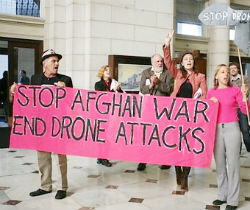 You know it’s that time of the year, when Congress comes back home for the month of August! Many of our Congressional leaders suffer from “inside the beltway” thinking and have sold out to lobbyists. In order to give our members a good jolt of reality, attending a Town Hall meeting is an excellent opportunity to talk about peace issues.
Please consider joining a Town Hall meeting in your district! Here are some tips in creating effective PINKness at a public meeting.
Organize!
Invite members of your local CODEPINK chapter!
Ready, steady, go! Make signs, wear t-shirts and find creative ways to visually display that you are with CODEPINK.
Get to the Town Hall meeting early and sit near the microphones. Don’t all sit together – it will help show that there is a large group spread out through the audience.
Chose someone in your chapter to film and take photos. Afterward, post on social media!
Make Your Voice Heard! Prepare your hard question(s) ahead of time and write them down, in case they only take written questions. Have some facts at your fingertips. Do the research!
Message!
Ground the Drones! Tell about the growing story of US drone strikes in Yemen, Pakistan & Somalia. Explain that there are victims of US drone strikes.
Bring Our War $$ Homes! Discuss the wasteful spending on the war in Afghanistan and the need to bring our war dollars home.
Close Guantanamo! Share the plight of the hunger strikers at Guantanamo and demand to close the illegal prison.
Bradley Manning! Support whistle blowers and end NSA surveillance.
Arms Are For Hugging! We need a comprehensive plan to address weapons in our communities and it starts with holding the NRA accountable.
Expose AIPAC! Urge Congress to distance themselves from AIPAC, a dangerous lobby that lobbies for $3 billion for the Israeli military
Check the CODEPINK website for more information on the campaigns!
How to find a Town Hall meeting?
Check the websites of your members of Congress (usually under “news” or “events”) to see if they have any constituent events coming up, such as a town hall, breakfast or open meeting. Can’t find anything online? Call their local or state office and ask if there are any upcoming opportunities to hear from the representative/senator in your area.
Also, check online organization calendars!
DRM Action Coalition Town Hall Schedule
National Active and Retired Federal Employees Association Congressional Schedule
Contact your Congressional Leader to locate a Town Hall meeting in your District
Tools and resources!
Hand out the 10 Ways to reduce the Threat of Terror Attacks on Americans
CODEPINK fliers and sign up sheets
Post your Town Hall gathering on the CODEPINK action calendar
Post a report back with photos and videos on the CODEPINK locals tumblr
News!
Expect More Than Just Town Hall Protests This August


August 6, 2013
10 Ways to Reduce the Threat of Terrorist Attacks on Americans
Declare a moratorium on drone strikes: The head of Al-Qaeda, Ayman al-Zawahiri, is calling on jihadists to retaliate for US drone strikes in Afghanistan, Pakistan and Yemen. The Yemeni group Al Qaeda in the Arabian Peninsula (AQAP), where the US says the threats are emanating from, is also calling for retaliation for drones strikes (there have been four strikes in Yemen since July 28). Drone strikes have become the number one recruiting tool for extremists. By grounding the drones, we will stop creating new enemies faster than we can kill them.
Close the US drone base in Saudi Arabia. One of the reasons Osama bin Laden said he hated the United States was that the US had military bases in the Holy Lands in Saudi Arabia. President Bush quietly closed those bases in 2003 but in 2010 President Obama secretly reopened a base there for launching drones into Yemen. It’s a national security threat ripe for blowback. So are many of the over 800 US bases peppered all over the world. We can save billions of taxpayer dollars, and make ourselves safer, by closing them.
Free the 86 Guantanamo prisoners cleared for release. The US treatment of Guantanamo prisoners, holding people indefinitely without charges or trials and brutally force-feeding the hunger strikers, is an affront to people throughout the Muslim world and a blatant hypocrisy of our American values. Of the 166 prisoners left in Guantanamo, 86 have been cleared for release, meaning the US government has determined they represent no threat to our nation. President Obama can use the waiver system, certifying to Congress that it is in the US national interest to release them. He just did this, for the first time, for two Algerian prisoners. He should do this for all 86 cleared prisoners, then bring the remaining prisoners to the US for trials.
Apologize and compensate innocent victims. There is a perception in the Muslim world that the US government does not value their lives. Airstrikes have killed many innocent people and only in the cases of Afghanistan and Iraq has there been a way, albeit woefully inadequate, for aggrieved families to seek redress. The US should agree to apologize and compensate the families of innocent people who have been killed or maimed by the US armed forces or CIA.
Go for the “zero option” in Afghanistan: withdraw all US troops. The 11-year US occupation of Afghanistan has provided fodder for the Taliban in both Afghanistan and Pakistan, while propping up an unpopular and corrupt regime in Kabul. And if the US troops were not in Afghanistan, the Taliban would not be trying to cross the Pakistani border to kill US soldiers. President Obama promised to end the US occupation by the end of 2014, but is now weighing options for keeping thousands of troops and military contractors behind. Bad idea.
Sit down and talk. The Taliban opened an office in Qatar in June to finally start long-delayed talks with the US. But due to President Karzai’s objections, the talks were nixed. It’s long past the time to talk to the Taliban, and then move on to talk to those elements in Al Qaeda who are more rational and open to negotiations. If you look at the Rand Corporation’s study of the demise of 268 terrorist groups, 43% dissolved by joining the political process, 40% from better policing, and only 7% through military action. We’ve been using military action for over a decade; it’s time for another approach.
Stop supporting dictatorships and repressive militaries. The US recently signed the largest arms deal in history with the monarchy of Saudi Arabia, the same government that rolled its tanks into neighboring Bahrain to crush the democratic uprising there. In Egypt, US weapons and tear gas were used for decades against peaceful demonstrators, and continue to be used against peaceful protesters supporting ousted Muslim Brotherhood. While weapons sales to undemocratic and/or unstable regimes might be good for US weapons manufacturers, they are bad for the reputation and security of the American people.
Support non-violent democracy movements. Terrorists thrive best where there is chaos and instability. Nurturing democratic institutions and non-violent civil society are key to thwarting the growth of extremist movements. The US needs to do more than support these efforts; it also needs to listen to them. In Yemen, the US is helping to fund the 6-month experiment in democracy called the National Dialogue Conference, where 565 extremely diverse members of society are meeting daily to map out the nation’s future. The Conference recently passed, by overwhelming vote, a resolution declaring drones strikes and all extrajudicial killing illegal. Unfortunately, the US has refused to abide by the popular will thus far.
Adhere to the international rule of law. In its war on terror, the US has been killing terror suspects with blatant disregard for international law and national sovereignty. A July 18 Pew poll of 39 nations found fierce global opposition to US drone strikes, particularly in the Muslim world. If the US wants help and sympathy in rooting out would-be attackers, it has to show the world it will stop using extrajudicial assassinations and start adhering to international law.
Spend foreign aid money on education, healthcare and lifting people out of poverty. For a fraction of the money we keep wasting each month on the failed war in Afghanistan or supporting the already wealthy Israeli military, we could be building schools in Afghanistan and Pakistan, helping Yemenis find a solution to their water shortages, and providing humanitarian aid to Syrian refugees. We’ll make a lot more friends building clinics, wells, electrical grids and schools than vaporizing people with Hellfire missiles.
This 10-point plan would significantly reduce terrorist threats, save taxpayers billions of dollars and make Americans more loved and admired in the world. After a decade of wielding the military stick, it’s time for some carrots.
Medea Benjamin, cofounder of CODEPINK and Global Exchange, is author of Drone Warfare: Killing by Remote Control.


August 5, 2013
Reflections on Hearing the Report on the CodePink Delegation to Yemen
I hear the anguish in her trembling voice
As she describes the fate of people who have no choice
Husbands, fathers and sons plucked into thin air
Leaving behind families in utter despair
Many suffering the double loss of family and the schism
Resulting from heartbreaking community ostracism
For if their loved one is in Guantánamo the community insists
They surely must be guilty of being a terrorist
Wives separated from husbands in a manner cruel and mean
Left caring for the children their fathers have never seen
The gut-wrenching injustice tears at your heart
Of the evil forces keeping these families apart
The men in question were long ago cleared
But remain in remain imprisoned because it is feared
Their experiences in custody will lead them to strike back
And launch new terrorist attacks
The situation here is clearly insane
And results in incredible pain
And it certainly is no mystery
Why it represents a black mark on America’s history
And it exposes the presidents abject hypocrisy
In talking about America’s democracy
The venal crimes of Congress we can understand
But not the actions of such a highly intelligent man
Medea told him Mr President you have the way
He even acknowledged she had something important to say
But nothing has happened the prisoners remain
And Guantánamo’s still there an ugly deepening stain
But CodePink has reached out and touched the hearts
Of a few people whose world has been rendered apart
Reaffirming for us in this world of insanity
There still remain messengers of love and humanity
HP Charman MD August 3, 2013


August 1, 2013
You Don’t Seem to Care About the NSA Reading Your Emails. But You Probably Should.
In our heart of hearts, many of us already awake to a transition into states of securitization, militarization, and surveillance, could have guessed that we are all being watched. Turns out we are not crazy! I wish there was more comfort in that thought. NSA specialists and all responsible intelligence agents (even throughout the duration of the Senate Judiciary Hearing on July 31st, “Strengthening Privacy Rights and National Security: Oversight of FISA Surveillance Programs” have enjoyed harping on the alleged fact that they cannot get personal communication information from the meta data collected by NSA programs such as PRISM and XKeyscore. Upon shedding the ill-advised acceptance of “Trust us! We have your best interests in mind. Love, the NSA,” we find that assertion to be dreadfully inaccurate. Once our beloved national security forces have an email address and a simple “justification” for looking into your affairs, they can conveniently skirt around those pesky safeguards of warrants, judicial review, and general accountability/transparency to access anything they so wish. It’s smooth sailing into email databases, browsing activity (searches, websites, etc) all social media accounts, private emails and chats, word documents, and phone calls (duration, contacts, and LIVE TIME CONVERSATIONS, people). They can even see all of those who have visited any website they want to check into. Essentially, they see everything. Frightened yet? Oh right, YOU have nothing to hide. I’ll get to that.
Our system is not set up to protect everyone equally. With that in mind, we have to consider the already existing systems of oppression and domination that are exacerbated when the powers that be are able to dictate who they find suspicious and worth investigation. People of color are disproportionately criminalized in the US, especially, for this context, when it comes to terrorist investigations and prosecutions. When a white man opens fire into a crowd of people, whether in a packed movie theater or school, he is deemed to be acting on his own accord, blaming it on psychiatric breaks, violent cultural influences like video games, and a background of bullying, among other external forces. Yet somehow, this is not categorized as “terror”. This term is solely reserved for the justification of the US’s ideological war. NSA and executive access to personal information through social media, phone, email, and personal documents benefits only a few. They have the power to selectively piece together a person’s identity to prove “extremist” and “terrorist” connections, despite how far-fetched.
OR, you can just google search pressure cookers for cooking your lentils and perhaps a little research on the Boston bombing and the po will show up at your place of residence! Comforting. What was that again about you not looking into my personals, NSA? And it happens more than you may think. Then again, I will be the first to admit that this story still has some facts up in the air. As the cherry on top, in case you needed a reminder, Obama recently won back the right to indefinitely detain people under the NDAA. Here’s to hoping you don’t get caught up with your Google searches because these days, they don’t even need a charge to hold you.
Today, August 1st, the NSA came out with a response to a Guardian article explaining the XKeyscore program, part of which states, “Continuous and selective revelations of specific techniques and tools used by NSA to pursue legitimate foreign intelligence targets is detrimental to the national security of the United States and our allies, and places at risk those we are sworn to protect – our citizens, our war fighters, and our allies.” What a lovely attempt to demand that we stop searching for answers. It’s in our best interest after all. Meanwhile, as the NSA assures us that their information gathering is strictly for national security, multinationals are once again stepping in as the entities having the most to gain from human rights violations, with the power to bleed the world and its people dry. Chevron, figuring ‘hey why not take a leaf out of the NSA book and ask our friendly neighborhood service providers (Google, Microsoft, and Yahoo) to hand that information on over to us, since we know they have it and all.’ Shocking to nobody, they requested ALL of the information on the 100+ people, including environmental activists, lawyers, and attorneys surrounding the lawsuit against them in Ecuador where they are responsible for poisoning part of the Amazon Rainforest with toxic oil waste. What a petrifying precedent for Judge Lewis Kaplan of the U.S. District Court to set by ACTUALLY GRANTING this subpoena, all on the basis that because “they had not shown they were US citizens”, they are not granted constitutional protections.
Information is privatized and securitized, boarded up, while the rest of us hold a glass cup up to the wall hoping to catch a snippet of the real story. The worst part is that we continue to let it happen, giving them full authority to dictate in our absence. Private, handpicked meetings with little to no knowledge for the public continue to go on. The NSA is paying a British spy agency in secret funds. Yearly meetings and ongoing collaboration (beginning in the 1950s and paired with decades of denying its very existence) with the most powerful people and entities in the world are discussing the major issues facing our globe with ZERO press, agenda, or reports. This year in June, one of the bullet points that they so graciously provided to the public was “How big data is changing almost everything.” In the wake of the NSA leaks, we need to demand answers. Instead, they expect us to be comforted by their website statement, “thanks to the private nature of the conference, the participants are not bound by the conventions of office or by pre-agreed positions. As such, they can take time to listen, reflect and gather insights.” So much for accountability. I dare say I see a trend.
Let’s not kid ourselves about the reaching influence of this whole state of affairs. This is not solely about one leak or even the whistleblower responsible. The safeguards in place surrounding information and its proliferation on top of the vast lengths the US, among others, are signing off on to keep the public in the dark is of undeniable concern. It proves how valuable this information and the secrecy of the government programs are when they are willing to go to great lengths to track down and/or imprison those who seek to air their dirty laundry, important enough to stake out a bribery-laden manhunt, discounting nations’ sovereignty in the process So maybe, JUST MAYBE it’s important enough for us to pay attention to. Whether or not you believe in the power of the state as a body of power is an entirely different question but one cannot ignore the hypocrisy. This behavior will continue to be more of a threat to our national security than Edward Snowden and his leaks yet there’s no protection coming from the US. It mirrors the way this administration continues its drone strikes, despite evidence that killing innocent civilians radicalizes people against the US. However, we’ll save that discussion for a later date. For now I think we can agree that the master’s tools are a bitch.
Knowledge is being criminalized, hidden, and purposefully withheld. Funny how back in the times of the Cold War, the US mobilized the public by portraying the USSR as an oppressive, Big Brother state, the antithesis to our home of the free. Now we have our fearless leader telling us we have a decision to make between national security and privacy. It is quite convenient (and not terrifying at all) when the state seems to enjoy controlling our modes of thought for their advantage and overreaching hunger for imperialist power.
In the recent surveillance hearing, Senator Patrick Leahy opened by talking about the importance of having conversations about privacy and national security, making sure the government and its agencies are held accountable for surveillance programs that may intrude on the rights of US citizens. Sounds dandy. BUT in the next breath, he chastises the NSA for letting “a high school dropout” release classified information. What is it they say? You can’t have your cake and eat it too? I can’t say I’ve ever truly understood the phrase but I think it applies here. The reason that these conversations and hearings are able to happen in the first place is because of the information Snowden exposed. Instead of recognizing that, Leahy inquires whether or not anyone has been fired for this “slip up.” He should be thanking Snowden for being more honest than our intelligence/national security agencies and giving him the tools to be an educated public servant. But that would make too much sense.
“In the end the Obama administration is not afraid of whistleblowers like me, Bradley Manning, or Thomas Drake. We are stateless, imprisoned, or powerless. No, the Obama Administration is afraid of you. It is afraid of an informed, angry public demanding the constitutional government it was promised – and it should be. – Edward Snowden July 1st, 2013. Keep in mind that Edward Snowden did not release all of the documents and is hesitant because of the direct threat to his personal safety. (Hooray for him being safe in Hong Kong as of today!) Who knows what else is going to come to light. Stay tuned. In the meantime, we know they will be doing the same, combing through your property currently being ‘protected’ by the Constitution. We should be outraged, as both citizens of the US and about these implications regarding our global family as compassionate citizens of the world.
Jessika Seekatz will be entering her last year at San Diego State University this fall, studying Women’s Studies as well as International Security and Conflict Resolution. She is currently interning with CODEPINK in DC for Summer 2013.


July 22, 2013
Egyptian Turmoil Brings Greater Suffering in Gaza
By Pam Bailey and Medea Benjamin
It unfortunately has become a truism that when Egypt sneezes, Gaza catches a cold. Fearful of the “terrorist elements” automatically associated with Hamas, the governing party in Gaza, neighbouring Egypt is quick to shut what amounts to “prison gates” at the first sign of turmoil either inside or outside the densely populated strip. Israel keeps its own crossings into Gaza on permanent lock-down, with permitted traffic a bare trickle, while also prohibiting travel by air and sea.
The current unrest in Egypt is no exception. As the world sits on the edge of its seat, polarised in its debate about whether the ouster of Mohammed Morsi was really a coup and what will happen next, the 1.7 million Palestinians in Gaza are paying the price.
On July 5, just two days after forcing Morsi from his post as president, the Egyptian military closed the Rafah crossing into Gaza for six consecutive days. Thousands of Palestinians attempting to enter Gaza to be with their families, or travel out of Gaza for medical care or study, were stranded – often with no money or shelter. Some who were travelling home were detained upon arrival at the Cairo airport and then deported to the countries they had left, at their own expense.
Yousef Aljamal, for instance, was deported to Malaysia, even though that country had merely been an interim stop on his way home from a conference in New Zealand. Fortunately, Malaysia’s Palestinian solidarity community has welcomed Yousef, finding him a temporary place to stay and helping to relieve his sadness of being apart from his family during the holy holiday of Ramadan.
When the numbers of Palestinians stranded at the Cairo airport became overwhelming, the Egyptian authorities instructed international authorities to prohibit individuals with Palestinian passports from boarding flights bound for Cairo. In Jeddah, Saudi Arabia, for instance, about a thousand pilgrims have been unable to return home.
Mariam Ashour Perova, who has been studying in the United States, longed to visit her family after an absence of five years. However, when she changed flights in Belgium en route to Egypt and showed her Palestinian ID, the agent at the gate asked if she had any other passport she could show. Luckily, Perova has dual Russian citizenship, and she was able to continue her fight. The agent advised her to hide her Palestinian ID. “I didn’t want to do it,” Perova said from Gaza. “But I wanted to see my family so badly.”
In response to a rising outcry from the affected families and their supporters, Egypt finally re-opened the Rafah crossing on July 10 on a limited basis. However, it has been far from sufficient. On July 10 , for instance, only about 400 persons needing documented medical care, holders of foreign passports and Egyptians were allowed to leave Gaza. On the other side of the border, only about 1,200 stranded Palestinians were allowed to return. Contrast that with a backlog of would-be travellers estimated to be “in the tens of thousands”. Meanwhile, the ban on Palestinian air travel into Egypt remains.
Destruction of tunnels causing severe fuel shortages
Meanwhile, Palestinians are suffering in other ways as well. Even before anti-Morsi protests broke out on June 30, Egypt had intensified its destruction of the tunnels between Egypt and Gaza, tunnels that Gazans rely on for a majority of their fuel and construction materials. This resulted in severe shortages as well as steep price hikes. Although fuel is available from Israel, it is too expensive for the average resident of Gaza. According to the Palestinian Centre for Human Rights , the majority of gas stations have been forced to close. Iyad al-Qatarawi, public relations manager for the Environmental Quality Authority in Gaza, told Al-Monitor on July 8 that the fuel crisis threatens to shut down the 190 oil wells (which need electricity to pump) that serve most of the citizens of Gaza, as well as 57 stations for collecting and disposing of sewage. A spokesman for the Ministry of Health in Gaza added that only 20 per cent of its gas reserves remain.
“Ramadan is for worshipping, but in Gaza thousands are waiting in gas stations to fill their taxis, trucks and tuck-tucks [three-wheel motorcycles],” wrote journalist Mohammed Omer on Facebook. “This is also a form of worship under unbearable sun.”
Egypt has not only restricted land access, but sea access as well. On July 8, the Egyptian navy for the first time reportedly opened fire at a Gazan fishing boat, warning it away from Egyptian waters. Until then, it was Israel alone that prevented Palestinians in Gaza from venturing far enough out to get a catch decent enough to make a living.
Palestinians accused of fomenting rebellion
What is the rationale for this crackdown on Gaza? Although no credible evidence has been revealed, Egyptian media are rife with rumours accusing Hamas of sending in operatives to support the deposed Muslim Brotherhood government – including several armed attacks on Egyptian soldiers and checkpoints in the Sinai. On July 13, Daily News Egypt reported that after armed assailants attacked security checkpoints in the Northern Sinai, three Palestinian suspects were apprehended, who ” provided the police with important information during interrogation”. Given the track record of Egyptian security, that statement conjures up images of torture. In response, the publication said, ” a warplane dropped flyers over the residents of Al-Arish (a small seaside town) reading: ‘To the honourable people of Sinai, this is your armed forces. Be assured… we are here to protect you, so please do not allow any person who does not belong to this pure land to attack us.’”
The people who are accused of not “belonging to this pure land,” are – as usual – the Palestinians, whose families were forced from their ancestral lands to become refugees no one seems to want.
Egyptian pubic opinion has followed a predictable trajectory, shaped in large part by rhetoric such as the words of Sameh Seif Elyazal, a former Egyptian general. On the Al-Tahrir channel, Elyazal reportedly claimed that “Egyptian law will punish, with sentences that could reach 25 years in jail, the Palestinians and Syrians and Iraqis who have made calls for incitement to violence at the demonstrations at Rabaa Al-Adawiya (the site of the army’s recent shooting of as many as 51 pro-Morsi demonstrators) in return for money.”
The general’s allegations echoed a government prosecutor’s assertion that “elements from the Muslim Brotherhood” were recruiting Palestinians and Syrians to attack pro-army demonstrators. The prosecutor also accused a Palestinian leader of handing out shotguns and cash payments to fellow Palestinians in Cairo, dispatching them to pro-Morsi demonstrations to attack opponents. These claim, however, were not independently verifiable.
In some opinion polls , Egyptians are now saying Hamas – and by extension, Palestinians – “have transformed from being a ‘thorn in Israel’s side’ into being one in Egypt’s side”.
The tragic irony in this case is that although they are accused of fomenting unrest in support of the Muslim Brotherhood, Palestinians in Gaza didn’t fare significantly better under the Mohammed Morsi administration than they did under Hosni Mubarak. Although clearly more sympathetic, Morsi was under great pressure from the United States and others to maintain Egypt’s treaty with Israel and thus stability in the region. It is clear that even under Morsi, the military maintained its long-standing control of the balance of power .
For example, in May (under Morsi’s watch), Egyptian police – enraged by the kidnapping of seven colleagues by unidentified militants – closed Rafah crossing for five days in response, stranding hundreds of Palestinian travellers on both sides. The closure caused the death of Ghazza al-Khawaldi from Khan Younis , who needed medical treatment abroad that she couldn’t get in Gaza. Weeks later, the Egyptians’ launched the tunnel destruction campaign.
According to Palestinian officials , the Rafah crossing terminal has been frequently closed over the last year, with Egyptian authorities turning back two to three busloads of travellers almost daily. No matter who is in power at the time, the collective punishment of the entire Gazan population in retaliation for the actions – or mere suspicions – of a few is an ongoing pattern, a knee-jerk reaction to turmoil.
Meanwhile, the world looks the other way, as if the suffering of 1.7 million is a mere side show to the “main stage act.”
Pam Bailey is a freelance journalist and activist who has lived and worked in the Gaza Strip. Medea Benjamin is co-founder of Global Exchange and Codepink: Women for Peace.


Hearing Before the Senate Judiciary Subcommittee on the Constitution, Civil Rights, and Human Rights Statement submitted by CODEPINK: Women For Peace
Hearing Before the Senate Judiciary Subcommittee on the
Constitution, Civil Rights, and Human Rights
Statement submitted by CODEPINK: Women For Peace
July 16h, 2013
Our organization, CODEPINK, recently returned from a delegation to Yemen, where we met with many family members who have loved ones in Guantanamo. We also met with government officials, from the Prime Minister to the Minister of Human Rights. We spent time at the National Dialogue Conference with 565 delegates from around the country. Universally, we found that the Yemeni people are upset that Yemeni prisoners, particularly the 56 already cleared for release, have not been sent home.
Most of the Guantanamo detainees (91 out of 166) are from Yemen. President Obama had banned the release of Yemeni prisoners in 2010 after a man trained by militants in Yemen attempted to blow up a U.S.-bound plane in 2009 with a bomb concealed in his underwear.
In his May speech, President Obama announced that he was lifting this self-imposed ban. Congress immediately tried to block the President by passing an amendment to the National Defense Authorization Bill (NDAA) on June 14 that prohibits using Defense Department funds to transfer detainees to Yemen for one year. The amendment, sponsored by Rep. Jackie Walorski (R-Indiana), passed 236 to 188. The resolution says: “None of the amounts authorized to be available to the department of defense may be used to transfer, release, or assist in the transfer or release, during the period beginning on the date of enactment of this act and ending on December 31, 2014, any individual detained at Guantanamo (as such term is defined in section 1033 (f) (2)) to the custody or control of the republic of Yemen or any entity within Yemen.”
We were in Yemen when House Resolution 1960 passed, and we felt the immediate outrage. “This resolution simply tells the Yemeni people—in a very condescending way—that Yemeni life is of no value,” said Nadia Sakaff, a prominent member of the National Dialogue Conference. Thanks to Ms. Sakaff, hundreds of delegates to the National Dialogue Conference signed a letter denouncing the resolution and calling on Congress and the Administration to repatriate the Yemeni prisoners cleared for release.
Fortunately, HR 1960 is not law, since it has not been passed by the Senate and we are thankful that some members of the Senate are trying to ease the way for the President to close the prison. We hope the full Senate will pass the provisions inserted in the 2014 NDAA by the Senate Armed Services Committee that would allow the Pentagon to send detainees to the United States for medical treatment, sustained detention, and prosecution.
We hope that Congress will listen to the growing movement of activists throughout the country who are speaking out on this. Various petitions to the President have gathered more than 400,000 signatures, the most prominent was signed by Lt. Colonel and former Chief Prosecutor at Guantanamo, Morris Davis.
People have rallied and held vigils in cities and towns, flooded the White House and Southern Command with phone calls and, by the hundreds, fasted in solidarity with the hunger strikers. The faith community has called Guantanamo a deep moral wound, and 38 senior religious leaders sent the President and Congress a letter calling for the closure of Guantanamo.
Most dramatically, several U.S. citizens — among them military veterans — are now deep into open-ended fasts, risking their health and even their lives in their effort to see Guantanamo closed.
If any other country were treating prisoners the way we are treating those in Guantanamo we would roundly and rightly criticize that country. We can never retake the legal and moral high ground when we claim the right to do unto others that which we would vehemently condemn if done to one of us.
The story of Guantánamo remains the shameful case of the U.S. government rounding up nearly 800 men and boys, indiscriminately labeling them “the worst of the worst,” and throwing them into an island prison designed to exist beyond the reaches of the law, where they would have no right to challenge their detention or abuse. The vast majority of the prisoners at Guantánamo should never have been detained in the first place. Many were simply in the wrong place at the wrong time and were fleeing the chaos of war when U.S. forces entered Afghanistan.
The prison at Guantánamo continues to exist in violation of both ethical and legal standards, and at risk to our collective safety. President Obama and Congress risk making Guantánamo and the Bush detention regime permanent features of the U.S. system. .
That’s why we call on the following:
• Congress must work with the administration to charge or release the men detained at Guantánamo. In 2004 and 2008, the U.S. Supreme Court ruled that the prisoners at Guantánamo may challenge their detention in U.S. federal court by means of habeas petitions. Since then, federal judges have ruled in the great majority of cases that the government lacked evidence sufficient to justify the continued detention of the petitioners. Other men at Guantánamo have been cleared for release by the U.S. government’s own Guantánamo Review Task Force, which consists of representatives from every government agency with a stake in the matter, including the Department of Justice, the Department of Defense, and the CIA. All men ultimately cleared for release by the courts or the government should be immediately repatriated or resettled, and all others should be formally charged and tried in a fair and open proceeding.
• Lift the ban on resettling men into the United States. More than 15 countries, including France, Spain, Portugal, Ireland, Hungary, Belgium, Switzerland, Albania, Latvia and Palau, have accepted detainees for resettlement without incident. The U.S. government should also offer a home to men who have won their habeas cases or been cleared for transfer and have no other safe country to go toOffering to resettle such men would also encourage other countries to make similar offers and help shut Guantánamo.
• Fully investigate the deaths of men who died in detention, including the three who died in 2006. Three detained men who were never charged with any crime died at Guantánamo in June 2006. Initially reported as suicides, new evidence from four soldiers stationed at the base has raised serious questions about the circumstances surrounding their deaths. Until now, the Obama administration has not only failed to conduct an independent and thorough investigation of the deaths but has opposed inquiry and review by the courts.
• Take responsibility for the well-being of the men after they are released and compensate those who have been wrongly imprisoned. The U.S. government must not hold men without charge in inhumane conditions for years, subject them to abuse including torture, and then repatriate and resettle them in far corners of the world, leaving their rehabilitation and reintegration to other governments, organizations, and individuals. The government has a responsibility to ensure that the men have adequate support and resources after release.
President Obama himself said that Guantanamo has become a symbol around the world for an America that flouts the rule of law. It is high time, over a decade after the 9/11 attacks, for the US to turn the page on this sordid chapter of our history.


Medea Benjamin's Blog

- Medea Benjamin's profile
- 92 followers

