Joshua Palmatier's Blog, page 34
August 21, 2013
New Book Discussion!
The first of the August book discussions is now up at the DAW Books blog (
 dawbooks
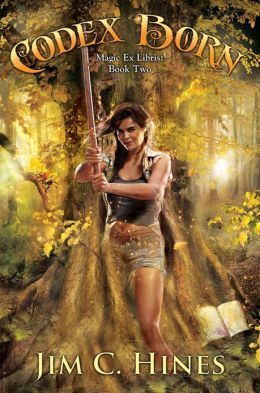
)! We're discussing Jim C Hines' second Magic Ex Libris novel Codex Born. Swing on by and check it out! Leave comments on what you thought of the book if you've already read it.
dawbooks
)! We're discussing Jim C Hines' second Magic Ex Libris novel Codex Born. Swing on by and check it out! Leave comments on what you thought of the book if you've already read it.
dawbooks
)! We're discussing Jim C Hines' second Magic Ex Libris novel Codex Born. Swing on by and check it out! Leave comments on what you thought of the book if you've already read it.

August 20, 2013
Last July Book Discussion
The last book discussion for the July DAW Books (
dawbooks
) releases is now up! We're talking about Tad Williams' The Dirty Streets of Heaven, the first book in his Bobby Dollar series. Swing on by and check it out!

dawbooks
) releases is now up! We're talking about Tad Williams' The Dirty Streets of Heaven, the first book in his Bobby Dollar series. Swing on by and check it out!Signal Boost: "The Z Radiant" by Jessica Reisman
Jessica Reisman's first book The Z Radiant was published by Five Star in 2004 and is now available in ebook format. This is what she says was once called "social SF," so if you're into that, check it out! She has a post about it here, which includes a link to the first chapter and other interesting links.
August 18, 2013
Book Review: "Long Hot Summoning" by Tanya Huff
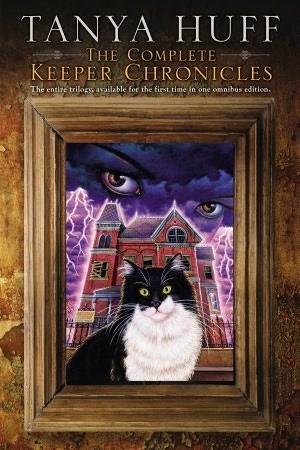
This is the third book of the Keeper Chronicles series, which can now be found in the omnibus edition appropriately called The Complete Keeper Chronicles. I've read the first two and obviously enjoyed them enough to continue with the series. Overall, the first book is the best in the series--the most interesting and compelling--probably because it presented a new idea, new characters, and a cool setting. This one was fun, and it was good to visit with known characters, but it didn't draw me in as much as that first one.
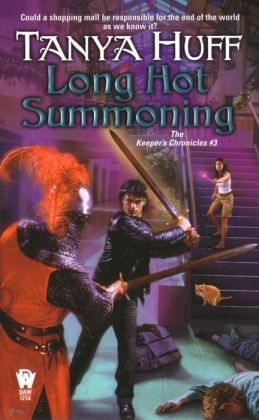
The basic premise is that the forces of darkness are attempting to take over the world by using a mall. Essentially, they're creating a mall on the Otherwide that mimics a mall in our world. The darkness is trying to sync up the two malls, thus creating a segue, a gateway between the two worlds. If you enter the mall in our world, you cross over to the Otherside, and vice versa. Diana, just graduated from high school and now an official Keeper, is Summoned on her first day of freedom, and of course Claire goes along to help. Can they stop the segue from being completed? And how is REALLY behind the segue in the first place?
This was most certainly an entertaining read, and the idea behind the segue and how the two malls are syncing up was a blast. Tanya Huff certainly played with "seepage," with pieces of the Otherside crossing over and being sold in our world, as well as people and objects slipping to the Otherside as well. Huff had fun poking at malls, shopping, teens, and pretty much everything else she could reasonably include in a fantasy novel set in a mall. One of the best aspects of this book in comparison to the other two is that the cats are used more here. We see Austin and Sam participating much more than in the previous books, and that was fun. We also see Dean doing more in this book by himself, with an entire subplot where he has to deal with a particular visitor to the bed and breakfast that started this series out in the first place.
Another aspect that I thought was good was that this book was most definitely centered on Diana, whereas the first two were focused more on Claire. The change of viewpoint character was smart on Huff's part, because there really isn't much more she can do with Claire and Dean that wasn't more or less covered in the first two books. Shifting to Diana gave us a fresh perspective and, while we dealt with Diana quite a bit in the second book, here we get an entire story arc that's centered on her. The change of pace was nice.
I also liked that on the Otherside, Diana and Claire were both restricted in their powers, unable to access the possibilities with breaking the Rules (thus allowing the Otherside to break the Rules as well). This made it much more difficult for them to solve their problems, and of course made the plot and final outcome more uncertain.
I have nothing negative to say about this book. It was a most enjoyable read, a little lighter in content than the first book, but definitely entertaining. A good series overall and one I'd recommend for those who like their modern world poked fun at with some good old fantasy thrown in.
The basic premise is that the forces of darkness are attempting to take over the world by using a mall. Essentially, they're creating a mall on the Otherwide that mimics a mall in our world. The darkness is trying to sync up the two malls, thus creating a segue, a gateway between the two worlds. If you enter the mall in our world, you cross over to the Otherside, and vice versa. Diana, just graduated from high school and now an official Keeper, is Summoned on her first day of freedom, and of course Claire goes along to help. Can they stop the segue from being completed? And how is REALLY behind the segue in the first place?
This was most certainly an entertaining read, and the idea behind the segue and how the two malls are syncing up was a blast. Tanya Huff certainly played with "seepage," with pieces of the Otherside crossing over and being sold in our world, as well as people and objects slipping to the Otherside as well. Huff had fun poking at malls, shopping, teens, and pretty much everything else she could reasonably include in a fantasy novel set in a mall. One of the best aspects of this book in comparison to the other two is that the cats are used more here. We see Austin and Sam participating much more than in the previous books, and that was fun. We also see Dean doing more in this book by himself, with an entire subplot where he has to deal with a particular visitor to the bed and breakfast that started this series out in the first place.
Another aspect that I thought was good was that this book was most definitely centered on Diana, whereas the first two were focused more on Claire. The change of viewpoint character was smart on Huff's part, because there really isn't much more she can do with Claire and Dean that wasn't more or less covered in the first two books. Shifting to Diana gave us a fresh perspective and, while we dealt with Diana quite a bit in the second book, here we get an entire story arc that's centered on her. The change of pace was nice.
I also liked that on the Otherside, Diana and Claire were both restricted in their powers, unable to access the possibilities with breaking the Rules (thus allowing the Otherside to break the Rules as well). This made it much more difficult for them to solve their problems, and of course made the plot and final outcome more uncertain.
I have nothing negative to say about this book. It was a most enjoyable read, a little lighter in content than the first book, but definitely entertaining. A good series overall and one I'd recommend for those who like their modern world poked fun at with some good old fantasy thrown in.
August 15, 2013
Last Chance for CLOCKWORK UNIVERSE: STEAMPUNK vs ALIENS Anthology!
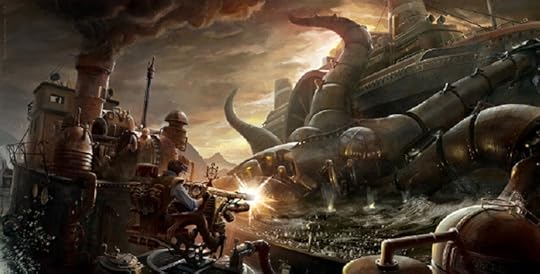
There are less than 16 hours left to get in on the Clockwork Universe: Steampunk vs Aliens anthology kickstarter! We're just below $15,000 and if we reach that goal, all backers who've pledged $15 or more will receive a free ecopy of Bradley P. Beaulieu's first Lays of Anuskaya series, The Winds of Khalakovo. In addition, the contributing authors will get a pay raise! Also recently introduced, a free for-backers-only magnet for those who've pledged between $5 and $50, and a free for-backers-only t-shirt for those pledged at $50 or higher. Keep in mind that ONLY THE BACKERS OF THE KICKSTARTER will be able to get the first edition of the paperback! After that, it's a second edition POD (print on demand) version, NOT the exclusive off-set printing. So if you were wavering on whether to support the kickstarter, NOW'S THE TIME TO DECIDE! Head on over the kickstarter page and pledge! Or risk being devoured by the STEAMPUNK OCTOPUS!!!!
August 13, 2013
Only THREE Days Left in the CLOCKWORK UNIVERSE: STEAMPUNK vs ALIENS kickstarter!
There are only THREE days left in the CLOCKWORK UNIVERSE: STEAMPUNK vs ALIENS anthology kickstarter! This anthology will include stories by Scott Lynch, Seanan McGuire, Ian Tregillis, Gini Koch, Bradley P. Beaulieu, Gail Z. Martin, and more. When aliens invade Earth, they discover a nineteenth century steampunk society. It's space ships vs dirigibles, and laser cannons vs steam tech! And the first edition off-set printing will only be available to kickstarter backers. After that, it becomes a POD (print on demand) second edition. Get in NOW! You can find all of the details here.
Signal Boost: "Single Witch's Survival Guide" by Mindy Klasky
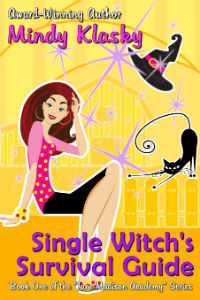
Another signal boost today for Mindy Klasky's Single Witch's Survival Guide, the first book in her Jane Madison Academy series. You can read the first chapter here, and you can buy this book and her other books here.
Signal Boost: "The Gambler's Fortune" ebook by Juliet E McKenna
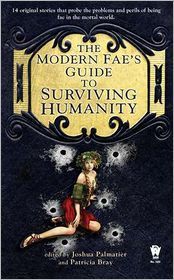
I first read Juliet E. McKenna's Tales of Einarinn years ago, when they were first being released here in the US. I loved them. Especially after meeting Juliet at Boskone, where we were doing a kaffeeklatsch together and no one showed up. We had a great discussion between us, though, about books, writing, book covers, etc. You'll notice that Juliet is in both of the two anthologies I co-edited with Patricia Bray.
So of course I'm going to signal boost the release of the third Einarinn book The Gambler's Fortune in ebook format. You can see what Juliet has to say about the release here, and you can simply skip to the ordering part of it here. Just FYI, Kindle and Nook version will be available soon.
So of course I'm going to signal boost the release of the third Einarinn book The Gambler's Fortune in ebook format. You can see what Juliet has to say about the release here, and you can simply skip to the ordering part of it here. Just FYI, Kindle and Nook version will be available soon.
August 11, 2013
Signal Boost: Elizabeth Bear Book Sale!
Author Elizabeth Bear has decided that she just has way too many copies of some of her own books, so she's holding a book sale to cut down on the awesomeness. Swing on by her LJ entry to see what she's got available! And then buy, buy, buy!
August 8, 2013
Kickstarter: A New Frontier?
Ok, I recently posted the following little article up on an online writing workshop called The Online Writing Workshop for Science Fiction, Fantasy, and Horror, which I was a member of more or less when it first started and have supported ever since. It helped me hone my craft, more from critiquing other people's work than from the critiques I got on my own stuff, but some of those critiques were also extremely helpful. This is geared toward that audience, but I figured it was worth showing to other as well, so decided to post it here.
Hey, everyone. My name is Joshua Palmatier and way back when OWW was first started, I became a member. I was a member for many, many years, even after I managed to get DAW Books to finally say yes to one of my books. I’ve supported the group by critiquing (I think I had close to 400 credits the last time I critiqued something), posting, running review contests, occasionally posting articles in the newsletter, etc. When people at cons ask about critique groups, I always bring up the OWW.
I’m posting here today for two reasons: First, I’d like everyone to know about my Kickstarter for an anthology called “Clockwork Universe: Steampunk vs Aliens,” and second because I’d like to share some thoughts and experiences regarding Kickstarter and how I see it affecting the publishing industry.
If you aren’t aware of it, Kickstarter is essentially a crowd-funding platform. If you have an idea for a project or product that you think the world would be interested in, you can post your proposal for that project up on Kickstarter and those interested in it can “back” it with their own money. It’s a way to generate funds for the project or product that you might not have been able to generate on your own. Typically, the proposals are set up so that each “backer” gets the product once it’s produced, or some other type of incentive for whatever they are pledging.
I’m running a Kickstarter to do two things: First, I’d like to publish an anthology called “Clockwork Universe: Steampunk vs Aliens” which will feature 14 or more short stories from published writers such as Scott Lynch, Seanan McGuire, Ian Tregillis, Gini Koch, Bradley P. Beaulieu, Gail Z Martin, and others. (Note that half of those authors were members of OWW at some point in the past.) The stories will all explore the idea that when aliens invade Earth, they find a steampunk society ready to fight back. So it’s spaceships against dirigibles, laser cannons against steam tech. But I want to do more with the Kickstarter than simply publish an anthology. I also want it to launch a new small press called Zombies Need Brains LLC, which I hope will bring anthologies like this one to the SF&F community for years to come. I feel that many of the anthology markets have dried up or imploded recently, and I’d like to fill that gap with this new press. (And yes, I do expect to have open submissions for the anthologies in the near future. Not for this project or even the next, unfortunately, but soon. I want the press to gain its feet before I attempt an open submission.)
And that’s the main reason I’m posting on the list today. I want to talk about how the market is changing (because it is, dramatically) and comment on some of the things that I’ve learned about the Kickstarter experience so far and how it can be used in this changing market.
As I mentioned, the anthology markets seem to have dried up. Patricia Bray and I have edited two anthologies sold to DAW Books through Tekno. We thought we’d be able to continue editing anthologies in this vein, but then Martin Greenberg unfortunately passed away and Tekno has yet to recover from that loss. Patricia and I realized that we wouldn’t be publishing anything through Tekno—to DAW or anyone else—for a while, although we waited a few years to see if Tekno could sort itself out. But it hasn’t, yet. So we started looking for other options, perhaps other small presses would be interested. We approached a few, but even though we may have been met with interest at first, we discovered that it didn’t lead to anything concrete. So we had a choice. Either let the idea of editing anthologies go, or try to figure out how to publish them ourselves.
And that’s where Kickstarter came into the picture. We could use Kickstarter to help fund the expense of publishing an anthology. Those interested in the anthology could essentially “preorder” the book by helping to fund the Kickstarter, and at the same time they’d be helping to set up a small press that would produce new anthologies in the future!
I’m not the first to think of this use for Kickstarter. I’ve seen multiple SF&F anthologies and books proposed on Kickstarter, including some by some fairly big names in the field. I think that Kickstarter is a viable market for writers who have books or short story compilations that, for whatever reason, are no longer in print by major publishers, or are just not catching the interest of other publishers out there. I’ve also seen writers whose series has been dropped after two or three books turn to Kickstarter to get the funding to produce the remainder of the series on their own. Kickstarter provides authors with an avenue to publication that targets the market interested in that particular book and helps alleviate some of the financial burden of producing the book on their own. And all of these situations—backstock books that are now out of print, novels that just aren’t finding a home, abandoned series—are the reasons that I also want to form a small press with my own Kickstarter. A small press is where all authors were forced to turn before the advent of Kickstarter and the ability to spread the word about a project through social media outlets. But now, authors can do this on their own—because of crowd-funding platforms like Kickstarter and because it is so much easier now to publish an ebook or even a paperback through a printer, and still get it to the public via a distributor. All of those hurdles—funding, printing, distribution—were major obstacles ten years ago. In today’s market, they are merely steps on the way to making a book available.
My Kickstarter is just over the halfway point, but I’ve learned a few things even so. First off, it isn’t easy to get a project funded. It takes careful planning months ahead of time. You’ll have to think about how you’re going to present your project to the public, and how you’re going to get the word out about it as well. Don’t just throw a proposal together and put it up. I went through probably a hundred revisions of my project ahead of time, and even then I ended up revising it multiple times after it went live. You have to research exactly what your costs are going to be so that you have a reasonable minimum funding level for your project. You have to carefully consider the reward levels you’re going to offer, exactly what your project is going to fund, and why someone would be interested in funding that project. All of these aspects need to be included in your proposal before it can go live. And both before and after the project goes live, you have to work on getting word of that project out to the public. Posting on your Facebook and tweeting on Twitter are only going to get you so far. And posting for 30 days straight is only going to annoy your friends. So think about what you can do as the project continues to bring something new to the project, so that you aren’t simply saying over and over that the project exists.
Hopefully what you’re getting out of this is that there’s a ton of work involved both beforehand and during the Kickstarter. There’s a metric truckload of forethought involved. So it isn’t as easy as simply saying, “I’ll run a Kickstarter to fund the publication of my book!” I haven’t even gotten to the work involved after the fact if the Kickstarter is successful. (I’ll do an article or post about that after this little experiment is all done.)
And finally, I’m not saying that you should resort to Kickstarter as the way to get your book published right now. Send it out to the traditional publishers and short story markets first. Exhaust that avenue. Then send it to the small presses and see if you can’t spark some interest in your work there. Exhaust that avenue as well. But if both of those attempts fail—and you’ve honestly tried—then Kickstarter is a possible new road to publication. Notice that in my own process, I attempted to work something out with the traditional publishers and small presses first and only turned to Kickstarter when it seemed like those roads were closed. Because running a successful project on Kickstarter is not easy.
If you’re into steampunk and aliens, please swing on by Kickstarter at www.kickstarter.com and search for “Clockwork Universe”. The project should pop right up. Check it out and see if you’d like to be part of this experiment and help set up the small press Zombies Need Brains LLC. Otherwise, I hope I opened up some interesting thoughts on Kickstarter and yet another change in the shifting publishing markets out there.
Joshua Palmatier/Benjamin Tate
www.joshuapalmatier.com
www.benjamintate.com
Hey, everyone. My name is Joshua Palmatier and way back when OWW was first started, I became a member. I was a member for many, many years, even after I managed to get DAW Books to finally say yes to one of my books. I’ve supported the group by critiquing (I think I had close to 400 credits the last time I critiqued something), posting, running review contests, occasionally posting articles in the newsletter, etc. When people at cons ask about critique groups, I always bring up the OWW.
I’m posting here today for two reasons: First, I’d like everyone to know about my Kickstarter for an anthology called “Clockwork Universe: Steampunk vs Aliens,” and second because I’d like to share some thoughts and experiences regarding Kickstarter and how I see it affecting the publishing industry.
If you aren’t aware of it, Kickstarter is essentially a crowd-funding platform. If you have an idea for a project or product that you think the world would be interested in, you can post your proposal for that project up on Kickstarter and those interested in it can “back” it with their own money. It’s a way to generate funds for the project or product that you might not have been able to generate on your own. Typically, the proposals are set up so that each “backer” gets the product once it’s produced, or some other type of incentive for whatever they are pledging.
I’m running a Kickstarter to do two things: First, I’d like to publish an anthology called “Clockwork Universe: Steampunk vs Aliens” which will feature 14 or more short stories from published writers such as Scott Lynch, Seanan McGuire, Ian Tregillis, Gini Koch, Bradley P. Beaulieu, Gail Z Martin, and others. (Note that half of those authors were members of OWW at some point in the past.) The stories will all explore the idea that when aliens invade Earth, they find a steampunk society ready to fight back. So it’s spaceships against dirigibles, laser cannons against steam tech. But I want to do more with the Kickstarter than simply publish an anthology. I also want it to launch a new small press called Zombies Need Brains LLC, which I hope will bring anthologies like this one to the SF&F community for years to come. I feel that many of the anthology markets have dried up or imploded recently, and I’d like to fill that gap with this new press. (And yes, I do expect to have open submissions for the anthologies in the near future. Not for this project or even the next, unfortunately, but soon. I want the press to gain its feet before I attempt an open submission.)
And that’s the main reason I’m posting on the list today. I want to talk about how the market is changing (because it is, dramatically) and comment on some of the things that I’ve learned about the Kickstarter experience so far and how it can be used in this changing market.
As I mentioned, the anthology markets seem to have dried up. Patricia Bray and I have edited two anthologies sold to DAW Books through Tekno. We thought we’d be able to continue editing anthologies in this vein, but then Martin Greenberg unfortunately passed away and Tekno has yet to recover from that loss. Patricia and I realized that we wouldn’t be publishing anything through Tekno—to DAW or anyone else—for a while, although we waited a few years to see if Tekno could sort itself out. But it hasn’t, yet. So we started looking for other options, perhaps other small presses would be interested. We approached a few, but even though we may have been met with interest at first, we discovered that it didn’t lead to anything concrete. So we had a choice. Either let the idea of editing anthologies go, or try to figure out how to publish them ourselves.
And that’s where Kickstarter came into the picture. We could use Kickstarter to help fund the expense of publishing an anthology. Those interested in the anthology could essentially “preorder” the book by helping to fund the Kickstarter, and at the same time they’d be helping to set up a small press that would produce new anthologies in the future!
I’m not the first to think of this use for Kickstarter. I’ve seen multiple SF&F anthologies and books proposed on Kickstarter, including some by some fairly big names in the field. I think that Kickstarter is a viable market for writers who have books or short story compilations that, for whatever reason, are no longer in print by major publishers, or are just not catching the interest of other publishers out there. I’ve also seen writers whose series has been dropped after two or three books turn to Kickstarter to get the funding to produce the remainder of the series on their own. Kickstarter provides authors with an avenue to publication that targets the market interested in that particular book and helps alleviate some of the financial burden of producing the book on their own. And all of these situations—backstock books that are now out of print, novels that just aren’t finding a home, abandoned series—are the reasons that I also want to form a small press with my own Kickstarter. A small press is where all authors were forced to turn before the advent of Kickstarter and the ability to spread the word about a project through social media outlets. But now, authors can do this on their own—because of crowd-funding platforms like Kickstarter and because it is so much easier now to publish an ebook or even a paperback through a printer, and still get it to the public via a distributor. All of those hurdles—funding, printing, distribution—were major obstacles ten years ago. In today’s market, they are merely steps on the way to making a book available.
My Kickstarter is just over the halfway point, but I’ve learned a few things even so. First off, it isn’t easy to get a project funded. It takes careful planning months ahead of time. You’ll have to think about how you’re going to present your project to the public, and how you’re going to get the word out about it as well. Don’t just throw a proposal together and put it up. I went through probably a hundred revisions of my project ahead of time, and even then I ended up revising it multiple times after it went live. You have to research exactly what your costs are going to be so that you have a reasonable minimum funding level for your project. You have to carefully consider the reward levels you’re going to offer, exactly what your project is going to fund, and why someone would be interested in funding that project. All of these aspects need to be included in your proposal before it can go live. And both before and after the project goes live, you have to work on getting word of that project out to the public. Posting on your Facebook and tweeting on Twitter are only going to get you so far. And posting for 30 days straight is only going to annoy your friends. So think about what you can do as the project continues to bring something new to the project, so that you aren’t simply saying over and over that the project exists.
Hopefully what you’re getting out of this is that there’s a ton of work involved both beforehand and during the Kickstarter. There’s a metric truckload of forethought involved. So it isn’t as easy as simply saying, “I’ll run a Kickstarter to fund the publication of my book!” I haven’t even gotten to the work involved after the fact if the Kickstarter is successful. (I’ll do an article or post about that after this little experiment is all done.)
And finally, I’m not saying that you should resort to Kickstarter as the way to get your book published right now. Send it out to the traditional publishers and short story markets first. Exhaust that avenue. Then send it to the small presses and see if you can’t spark some interest in your work there. Exhaust that avenue as well. But if both of those attempts fail—and you’ve honestly tried—then Kickstarter is a possible new road to publication. Notice that in my own process, I attempted to work something out with the traditional publishers and small presses first and only turned to Kickstarter when it seemed like those roads were closed. Because running a successful project on Kickstarter is not easy.
If you’re into steampunk and aliens, please swing on by Kickstarter at www.kickstarter.com and search for “Clockwork Universe”. The project should pop right up. Check it out and see if you’d like to be part of this experiment and help set up the small press Zombies Need Brains LLC. Otherwise, I hope I opened up some interesting thoughts on Kickstarter and yet another change in the shifting publishing markets out there.
Joshua Palmatier/Benjamin Tate
www.joshuapalmatier.com
www.benjamintate.com