
Heidi Anne Heiner's Blog, page 32
November 24, 2016
The Cecelia and Kate Novels by Patricia C. Wrede and Caroline Stevermer for $1.99 (For all 3!)
[image error]

Happy Thanksgiving! I'm taking a "sit break" real quick from my Thanksgiving hosting demands and sharing this treasure because it makes me smile just to think about it.
The Cecelia and Kate Novels: Sorcery & Cecelia, The Grand Tour, and The Mislaid Magician by Patricia C. Wrede (Author) and Caroline Stevermer (Author) is on sale for $1.99--it's usually $9.99 so that is a bargain. That's 3 books for two bucks and they are excellent books, too.
I've recommended these repeatedly over the years with about a 98% success rate of people loving them. Sorcery & Cecelia was a cult classic for years that was out of print with paperback editions selling for sometimes $100. Yes, that was years ago and I am old. But Wrede and Stevermer then wrote the two sequels and the first book got reprinted as a result. Now they never have to go out of print again with the digital age. Love that!
So if you haven't read these, they will make a nice escape once your six hours of Gilmore Girls watching has been completed this weekend. Because according to the media that is what everyone will be doing instead of shopping. And I will be one of them! I'm ready for a trip to Stars Hollow myself.
Book descriptions:
A trio of bewitching novels featuring devoted cousins who must juggle their magical powers with their duties as ladies in Regency-era England.
Enter Regency-era England—and a world in which magical mayhem and high society go hand in hand—with three novels featuring cousins Cecelia and Kate.
In Sorcery & Cecelia, the two cousins have been inseparable since girlhood. But in 1817, Kate goes to London to make her debut into English society, leaving Cecelia behind to fight boredom in her small country town. While visiting the Royal College of Wizards, Kate stumbles on a plot to destroy a beloved sorcerer—and only Cecelia can help her save him.
In The Grand Tour, Cecelia and Kate, along with their husbands, are inaugurating married life with a trip to the Continent. When a mysterious woman in Calais gives Cecelia a package intended for Kate’s mother-in-law, however, the two young wives realize they must spend their honeymoons preventing an emperor-in-exile named Napoleon from reclaiming the French crown.
In The Mislaid Magician, it is 1828 and the cousins are now society matrons. The steam engine is announcing its arrival and the shaking of the locomotives begins to disrupt England’s ancient, underground magical ley lines. When the disappearance of a foreign diplomat threatens to become an international incident, Cecelia departs to fight for the future of magic—leaving Kate to care for a gaggle of disobedient, spell-casting tots.
Blending history, romance, and magic, these charming novels from the author of the Enchanted Forest Chronicles will delight anyone who loves Harry Potter or Susannah Clarke’s Jonathan Strange & Mr Norell.


November 22, 2016
New Book: Beast by Brie Spangler
[image error]

Beast by Brie Spangler was released last month. It's a Beauty and the Beast retelling so that's catnip for the majority of the readers here. It's on my own TBR list for that reason.
Book description:
A witty, wise, and heart-wrenching reimagining of Beauty and the Beast that will appeal to fans of Rainbow Rowell and David Levithan.
Tall, meaty, muscle-bound, and hairier than most throw rugs, Dylan doesn’t look like your average fifteen-year-old, so, naturally, high school has not been kind to him. To make matters worse, on the day his school bans hats (his preferred camouflage), Dylan goes up on his roof only to fall and wake up in the hospital with a broken leg—and a mandate to attend group therapy for self-harmers.
Dylan vows to say nothing and zones out at therapy—until he meets Jamie. She’s funny, smart, and so stunning, even his womanizing best friend, JP, would be jealous. She’s also the first person to ever call Dylan out on his self-pitying and superficiality. As Jamie’s humanity and wisdom begin to rub off on Dylan, they become more than just friends. But there is something Dylan doesn’t know about Jamie, something she shared with the group the day he wasn’t listening. Something that shouldn’t change a thing. She is who she’s always been—an amazing photographer and devoted friend, who also happens to be transgender. But will Dylan see it that way?
"Writing smartly in Dylan's voice, Spangler artfully represents both main characters: the boy who feels like a freak and the witty, imperfect, wise trans girl he loves. Very lightly borrowing on the classic fairy tale, she allows them to fail and succeed without resorting to paper villains or violent plot points to manipulate compassion. A believable and beautiful human story."--Kirkus, starred review
"Spangler’s captivating portrayals of Dylan and Jamie offer piercing insight into the long, painful battle to shatter stereotypes in order to win dignity, love, and acceptance."--Publishers Weekly, Starred review
November 20, 2016
New Book: Elf Queens and Holy Friars: Fairy Beliefs and the Medieval Church (The Middle Ages Series) by Richard Firth Green
[image error]

Elf Queens and Holy Friars: Fairy Beliefs and the Medieval Church (The Middle Ages Series) by Richard Firth Green was released a few months ago. I learned about it shortly after and have been stalking it ever since. Which is funny because it's not my top tier catnip but this topic and time period fascinate me.
Book description:
In Elf Queens and Holy Friars Richard Firth Green investigates an important aspect of medieval culture that has been largely ignored by modern literary scholarship: the omnipresent belief in fairyland.
Taking as his starting point the assumption that the major cultural gulf in the Middle Ages was less between the wealthy and the poor than between the learned and the lay, Green explores the church's systematic demonization of fairies and infernalization of fairyland. He argues that when medieval preachers inveighed against the demons that they portrayed as threatening their flocks, they were in reality often waging war against fairy beliefs. The recognition that medieval demonology, and indeed pastoral theology, were packed with coded references to popular lore opens up a whole new avenue for the investigation of medieval vernacular culture.
Elf Queens and Holy Friars offers a detailed account of the church's attempts to suppress or redirect belief in such things as fairy lovers, changelings, and alternative versions of the afterlife. That the church took these fairy beliefs so seriously suggests that they were ideologically loaded, and this fact makes a huge difference in the way we read medieval romance, the literary genre that treats them most explicitly. The war on fairy beliefs increased in intensity toward the end of the Middle Ages, becoming finally a significant factor in the witch-hunting of the Renaissance.
Table of Contents
Introduction
Chapter 1. Believing in Fairies
Chapter 2. Policing Vernacular Belief
Chapter 3. Incubi Fairies
Chapter 4. Christ the Changeling
Chapter 5. Living in Fairyland
Postscript
Notes
Bibliography
Index
Acknowledgments
You can read an excerpt on the publisher's site.
November 1, 2016
Bargain Ebook: Egg and Spoon by Gregory Maguire
[image error]

Egg and Spoon by Gregory Maguire is on sale in ebook format for $1.99. This book features Baba Yaga and Russian folklore. Maguire has written several fairy tale retellings for both young and old although he is of course most famous for his Wicked. This is the first time this has been on sale to my knowledge.
Book description:
In this tour de force, master storyteller Gregory Maguire offers a dazzling novel for fantasy lovers of all ages. Elena Rudina lives in the impoverished Russian countryside. Her father has been dead for years. One of her brothers has been conscripted into the Tsar’s army, the other taken as a servant in the house of the local landowner. Her mother is dying, slowly, in their tiny cabin. And there is no food. But then a train arrives in the village, a train carrying untold wealth, a cornucopia of food, and a noble family destined to visit the Tsar in Saint Petersburg—a family that includes Ekaterina, a girl of Elena’s age. When the two girls’ lives collide, an adventure is set in motion, an escapade that includes mistaken identity, a monk locked in a tower, a prince traveling incognito, and—in a starring role only Gregory Maguire could have conjured—Baba Yaga, witch of Russian folklore, in her ambulatory house perched on chicken legs.
October 28, 2016
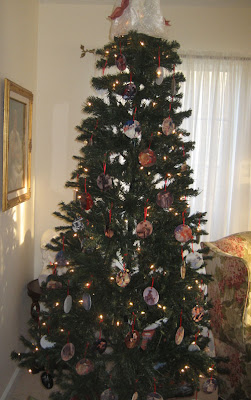
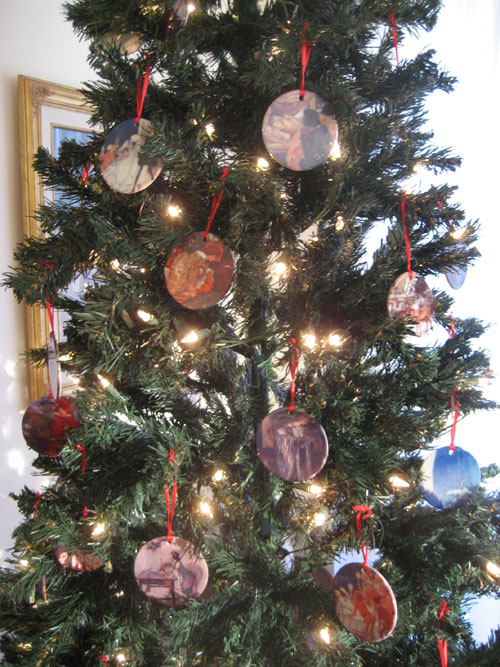
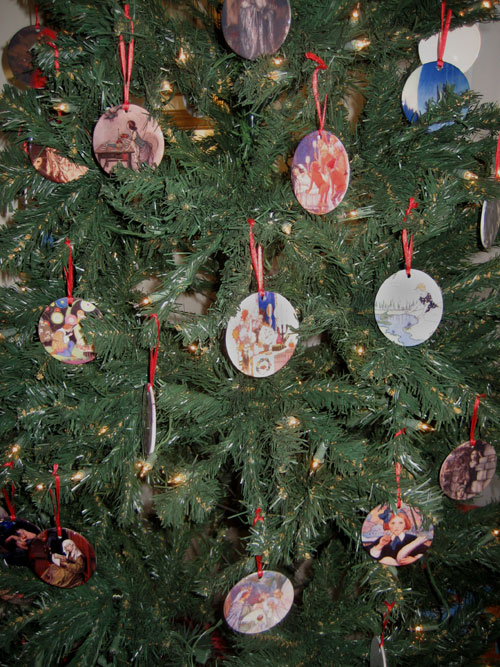
Fairy Tale Christmas Tree Ornaments
(Small sample of my collection. You can click on the photo above to see it larger.)
This is an edited repost from previous years for the weekend:
Okay, so it's that time of year when we start thinking of pulling holiday decorations from their dark, almost forgotten storage areas. I have noticed that a few people are ordering the fairy tale themed ornaments on CafePress. They are finding them in the CafePress Marketplace for $14.99 each, sometimes able to use a coupon there to purchase.
But for you loyal readers here, I'll let you in on a secret. They are available for $7.99 in the SurLaLune CafePress shop. You can't use a coupon there but this price still beats any coupon promotion in the Marketplace. Many Golden Age illustrations are available in the Ornaments shop I created years ago. And, yes, SurLaLune gets more than double the commission on the sale, too, despite the much lower price. Everyone wins!
SurLaLune isn't getting rich but proceeds from CafePress help pay for the site maintenance and it's upcoming redesign in early 2017! After all, the SurLaLune main site will be 18 years old in December. The site has been part of my life for 41% of my life now. (Do the math and figure out my age!)
As seen in the photos here, I own a lot of these ornaments. I don't decorate with fairy tales much in my house--sometimes I need a separation of church and state--but these ornaments have been favorites for years. That's actually our tree in 2011 when I didn't pull out the other ornaments to fluff the tree more. We now have a bigger tree in a different house so I get to fill it with these ornaments even more.
Now that all the nephews and nieces are older, they really enjoy identifying the stories on the ornaments. Each year I catch one of them studying the ornaments and looking for favorites. This year I am thinking of figuring out everyone's favorites and buying some to save for when each of the kids start their own trees someday. My house is one of the holiday hubs so those ornaments are part of the subtle holiday memories for my beloved brood.

New Book: Ireland's Immortals: A History of the Gods of Irish Myth by Mark Williams
[image error]

Ireland's Immortals: A History of the Gods of Irish Myth by Mark Williams is a new book released this week. If you are interested in Irish folklore, this is a must for you.
This is a hefty tome of nearly 600 pages. I received a review copy but haven't had the time to read it closely yet. However, I have read some passages and the first impression I have is, "Wow, I didn't know that about ____." Fill in the blank to whatever I was reading on the page.
The second impression is "This is surprisingly very readable for how scholarly and informational it is." Because, yes, I, too, struggle with twenty-five cent words in many academic texts. If I paused to consider a sentence while I was reading this, it wasn't to parse the meaning of the sentence but to contemplate that meaning. The tone is even conversational with first person perspective offered which may be off-putting to some but which I find refreshing since that is the way I approach much of what I write. Reading this book makes you think that Mark Williams would make a fascinating dinner companion.
I mean really, here is a paragraph from the first page of chapter 1:
The earliest written evidence for native gods comes from early Christian Ireland, not from the pagan period; this is a pivotal fact which must be emphasized. Christianity did not entirely consign the pagan gods to the scrapheap, but the consequences of its arrival were dramatic and affected Irish society on every level. Pagan cult and ritual were discontinued, and a process was set in motion that eventually saw a small number of former deities reincarnated as literary characters. Christianity—intrinsically a religion of the book—enabled the widespread writing of texts in the Roman alphabet. Some of these have been transmitted to the present, with the paradoxical upshot that we owe our ability to say anything at all about the ‘personalities’ of Ireland’s pre-Christian gods to the island’s conversion.
That's fascinating and highly readable stuff if this is the type of stuff you like to read. Which if you are here, you most likely do.
There is also an excellent index which is what I used to look up passages with names and concepts I am familiar with--Yeats is represented abundantly but I also found Lady Jane Wilde--some of who's Ancient Legends, Mystic Charms, and Superstitions of Ireland I have been reading recently, she was a folklorist of sorts and mother to Oscar Wilde--as well as other writers such as James Stephens and Walter Sharp.
So if this topic interests you at all, I'd consider this one to be a new important addition to your library. It's earned a place on my shelves.
Book description:
Ireland’s Immortals tells the story of one of the world’s great mythologies. The first account of the gods of Irish myth to take in the whole sweep of Irish literature in both the nation’s languages, the book describes how Ireland’s pagan divinities were transformed into literary characters in the medieval Christian era—and how they were recast again during the Celtic Revival of the late nineteenth and early twentieth centuries. A lively narrative of supernatural beings and their fascinating and sometimes bizarre stories, Mark Williams’s comprehensive history traces how these gods—known as the Túatha Dé Danann—have shifted shape across the centuries, from Iron Age cult to medieval saga to today’s young-adult fiction.
We meet the heroic Lug; the Morrígan, crow goddess of battle; the fire goddess Brigit, who moonlights as a Christian saint; the mist-cloaked sea god Manannán mac Lir; and the ageless fairies who inspired J.R.R. Tolkien’s immortal elves. Medieval clerics speculated that the Irish divinities might be devils, angels, or enchanters. W. B. Yeats invoked them to reimagine the national condition, while his friend George Russell beheld them in visions and understood them to be local versions of Hindu deities. The book also tells how the Scots repackaged Ireland’s divine beings as the gods of the Gael on both sides of the sea—and how Irish mythology continues to influence popular culture far beyond Ireland.
An unmatched chronicle of the Irish gods, Ireland’s Immortals illuminates why these mythical beings have loomed so large in the world’s imagination for so long.
Mark Williams is the Simon and June Li Fellow in the Humanities and Tutor in English at Lincoln College, University of Oxford, where he teaches medieval Irish, Welsh, and English literature. He is the author of Fiery Shapes: Celestial Portents and Astrology in Ireland and Wales, 700–1700.
Reviews:
"Scholars and researchers will leap to add [Ireland’s Immortals] to their collections."--Publishers Weekly
Endorsements:
"In 1896, George Russell wrote to W. B. Yeats announcing that ‘the Gods have returned’ to Celtic realms; Mark Williams’s brilliant and powerful book makes good the claim. Learned, discursive, masterfully organized, and often very funny, it illuminates the cults, characters, personalities, and uses of Irish divinities from their emergence in saga, pseudohistory, and folklore through to their exploitation in the Celtic Revival and the literature of fantasy, and their analysis in modern scholarship. This is an important contribution to the history of religion, nationalism, and Gaelic culture; it is also so well written as to be unputdownable."--R. F. Foster, University of Oxford
"With its huge range, constant new insights, colorful material, and sparkling style, this is a truly remarkable book. It should delight a very big readership."--Ronald E. Hutton, University of Bristol
"This magnificent book is a tour de force and a great leap forward in the study of Irish mythology. Mark Williams tells the whole story of the Irish gods, tracing their transformation from ancient times through today. His discussions of medieval sagas, early modern scholarship, Celtic Revival mysticism, and contemporary fiction are equally assured, original, and substantial. Lively and engaging, Ireland's Immortals will appeal to general readers as well as students and scholars."--Ralph O'Connor, University of Aberdeen
"This is an extremely important book. It not only brings together known texts in new and exciting ways but also introduces important new interpretations. Mark Williams is one of the very few people with the expertise and good sense to be able to write a volume like this."--Paul Russell, University of Cambridge
TABLE OF CONTENTS:
List of Illustrations ix
Abbreviations xi
Preface xiii
Guide to Pronunciation xxi
PART ONE
1 Hidden Beginnings: From Cult to Conversion 3
2 Earthly Gods: Pagan Deities, Christian Meanings 30
3 Divine Culture: Exemplary Gods and the Mythological Cycle 72
4 New Mythologies: Pseudohistory and the Lore of Poets 128
5 Vulnerability and Grace: The Finn Cycle 194
6 Damaged Gods: The Late Middle Ages 248
PART TWO
7 The Imagination of the Country: Towards a National Pantheon 277
8 Danaan Mysteries: Occult Nationalism and the Divine Forms 310
9 Highland Divinities: The Celtic Revival in Scotland 361
10 Coherence and Canon: The Fairy Faith and the East 406
11 Gods of the Gap: A World Mythology 434
12 Artgods 489
Acknowledgements 503
Glossary of Technical Terms 507
Conspectus of Medieval Sources 511
Works Cited 517
Index 557
October 27, 2016
New Book: Fairy Tales for the Disillusioned: Enchanted Stories from the French Decadent Tradition
[image error]

Fairy Tales for the Disillusioned: Enchanted Stories from the French Decadent Tradition (Oddly Modern Fairy Tales) edited by Gretchen Schultz and Lewis Seifert is officially released this week.
So I admit that my studies of French literature have been limited. I have a French minor that didn't go too far beyond Antoine de Saint-Exupéry and Moliere, to be quite honest. My own studies and research have focused on original fairy tales texts from the French Salons from Villeneuve to Perrault and many of the French folklore collectors of the 19th century, not so much the literary retellers. We won't get into the argument here that even those collectors were literary retellers--that's for somewhere else, not this book's review.
So I am not very familiar with the French Decadent Tradition. Which is why this book is so much fun and intriguing at the same time! I get to learn about a literary movement and read some more relatively modern interpretations of fairy tales.
The decadent is a moral description--these tales are filled with references to sadomasochism, hedonism, etc. Nothing was overly graphic in the tales I have read so far, the time and place when these were written were usually more subtle in their descriptions and references. Perhaps even more apt is the "disillusioned" moniker. These tales are not hopeful and don't deliver "happily ever afters" but are retellings, new tales, or codas to familiar tales that debunk the HEA. So it may not be a book for reading in one sitting either. The mood created while reading them can be quite grim. Perhaps I shouldn't use grim--how about morose or bleak?
But they make excellent windows into a period in history, especially in France, when politics and world strife--most were written in the decades before and during WWI--made it hard to embrace the HEA of the popular fairy tales, especially those of Perrault. So Cinderella, Sleeping Beauty and Bluebeard get many morbid treatments here.
Finally, many of the tales in the collection have been translated and published in English for the first time. See the Table of Contents below to see those.
Book description:
The wolf is tricked by Red Riding Hood into strangling her grandmother and is subsequently arrested. Sleeping Beauty and Cinderella do not live happily ever after. And the fairies are saucy, angry, and capricious. Fairy Tales for the Disillusioned collects thirty-six tales, many newly translated, by writers associated with the decadent literary movement, which flourished in France in the late nineteenth century. Written by such creative luminaries as Charles Baudelaire, Anatole France, and Guillaume Apollinaire, these enchanting yet troubling stories reflect the concerns and fascinations of a time of great political, social, and cultural change. Recasting well-known favorites from classic French fairy tales, as well as Arthurian legends and English and German tales, the updated interpretations in this collection allow for more perverse settings and disillusioned perspectives--a trademark style and ethos of the decadent tradition.
In these stories, characters puncture the optimism of the naive, talismans don't work, and the most deserving don't always get the best rewards. The fairies are commonly victims of modern cynicism and technological advancement, but just as often are dangerous creatures corrupted by contemporary society. The collection underlines such decadent themes as the decline of civilization, the degeneration of magic and the unreal, gender confusion, and the incursion of the industrial. The volume editors provide an informative introduction, biographical notes for each author, and explanatory notes throughout.
Subverting the conventions of the traditional fairy tale, these old tales made new will entertain and startle even the most disenchanted readers.
"Fairy Tales for the Disillusioned brings together fairy tales by canonical and noncanonical nineteenth-century French authors. Many of these works have not been anthologized for an English audience--nor a French one--and these translated texts provide a complex view not only of the decadent tale but also of the possibilities of the fairy tale in general."--Anne E. Duggan, author of Queer Enchantments
"French fairy tales are too often associated only with the emergence of the genre, especially Charles Perrault's influential stories, and then much later with fairy-tale films. Where did all the fairies go in the nineteenth century? Featuring a wide range of translated decadent fairy tales from France, this welcome and entertaining collection fills a large gap in English readers' access to such texts. It will definitely have a place in my library."--Cristina Bacchilega, author of Fairy Tales Transformed?
TABLE OF CONTENTS:
List of Illustrations xi
Translators' Note and Acknowledgments xiii
Introduction xvii
TALES [Those marked with * are translated into English for the first time in publication]
Charles Baudelaire
Fairies' Gifts 3
Alphonse Daudet
The Fairies of France 6
Catulle Mendès
Dreaming Beauty 11
Isolina / Isolin 17
The Way to Heaven 22
An Unsuitable Guest 27*
The Three Good Fairies 31*
The Last Fairy 36
The Lucky Find 41*
The Wish Granted, Alas! 45
Jules Lemaître
The Suitors of Princess Mimi 48
Liette's Notions 60*
On the Margins of Perrault's Fairy Tales: The White Rabbit and the Four-Leaf Clover 68*
Paul Arène
The Ogresses 72*
Jules Ricard
Fairy Morgane's Tales: Nocturne II 77*
Marcel Schwob
Bluebeard's Little Wife 84
The Green She-Devil 88
Cice 92
Mandosiane 95
Willy
Fairy Tales for the Disillusioned 101*
Henri de Régnier
The Living Door Knocker 108
Rachilde
The Mortis 115*
Jacques d'Adelswärd-Fersen
Sleeping Beauty Didn't Wake Up 128
Jean Lorrain
Princess of the Red Lilies 137
Princess Snowflower 142*
Mandosiane in Captivity 148
Renée Vivien
Prince Charming 152
Albert Mockel
The Story of the Prince of Valandeuse 157*
The Pleasant Surprise 165*
Pierre Veber
The Last Fairy 173*
Anatole France
The Seven Wives of Bluebeard 183
The Story of the Duchess of Cicogne and of Monsieur de Boulingrin 210
Emile Bergerat
The 28-Kilometer Boots 226*
Cinderella Arrives by Automobile 233
Guillaume Apollinaire
Cinderella Continued, or the Rat and the Six Lizards 238
Claude Cahun
Cinderella, the Humble and Haughty Child 243*
Bibliography 247
Biographical Notes 251
Bargain Ebook: Charming (Pax Arcana Book 1) by Elliott James

Charming (Pax Arcana Book 1)
by Elliott James is on sale in ebook format today only for $2.99. This is the first book in a series.Book description:
John Charming isn't your average Prince...
He comes from a line of Charmings -- an illustrious family of dragon slayers, witch-finders and killers dating back to before the fall of Rome. Trained by a modern day version of the Knights Templar, monster hunters who have updated their methods from chain mail and crossbows to Kevlar and shotguns, John Charming was one of the best--until a curse made him one of the abominations the Knights were sworn to hunt.
That was a lifetime ago. Now, John tends bar under an assumed name in rural Virginia and leads a peaceful, quiet life. That is, until a vampire and a blonde walked into his bar...
CHARMING is the first novel in a new urban fantasy series which gives a new twist to the Prince Charming tale.
October 25, 2016
New Book: New Approaches to Teaching Folk and Fairy Tales edited by Christa Jones and Claudia Schwabe
[image error]

New Approaches to Teaching Folk and Fairy Tales edited by Christa Jones and Claudia Schwabe was released in August.
First of all this is not a text book. It is a collection of articles about different methods of teaching folklore in the classroom. The contributors share their experiences in the classroom, sometimes including the syllabi for the classes they have designed.
The articles are wide ranging in their approaches, including but not strictly limited to political, linguistic, and gender studies. They are valuable because they offer perspectives from real world experiences from professors who have used these approaches. One of the themes I found most fascinating was the discussion about choice of translations and adaptations to share in the classroom, including Christine A. Jones' course that studies the translation of French tales.
In the end, the articles make you wish to be a student again--if you aren't now--with the ability to take all of these classes (since they are scattered at various universities around the globe) and participate in the classroom discussions, to see and feel how these materials spark inspiration and understanding of folklore and dare I say the world, too, for the students.
Book description:
New Approaches to Teaching Folk and Fairy Tales provides invaluable hands-on materials and pedagogical tools from an international group of scholars who share their experiences in teaching folk- and fairy-tale texts and films in a wide range of academic settings.
This interdisciplinary collection introduces scholarly perspectives on how to teach fairy tales in a variety of courses and academic disciplines, including anthropology, creative writing, children’s literature, cultural studies, queer studies, film studies, linguistics, second language acquisition, translation studies, and women and gender studies, and points the way to other intermedial and intertextual approaches. Challenging the fairy-tale canon as represented by the Brothers Grimm, Charles Perrault, Hans Christian Andersen, and Walt Disney, contributors reveal an astonishingly diverse fairy-tale landscape.
The book offers instructors a plethora of fresh ideas, teaching materials, and outside-the-box teaching strategies for classroom use as well as new and adaptable pedagogical models that invite students to engage with class materials in intellectually stimulating ways. A cutting-edge volume that acknowledges the continued interest in university courses on fairy tales, New Approaches to Teaching Folk and Fairy Tales enables instructors to introduce their students to a new, critical understanding of the fairy tale as well as to a host of new tales, traditions, and adaptations in a range of media.
Contributors: Anne E. Duggan, Cyrille François, Lisa Gabbert, Pauline Greenhill, Donald Haase, Christa C. Jones, Christine A. Jones, Jeana Jorgensen, Armando Maggi, Doris McGonagill, Jennifer Orme, Christina Phillips Mattson, Claudia Schwabe, Anissa Talahite-Moodley, Maria Tatar, Francisco Vaz da Silva, Juliette Wood
Table of Contents:
Foreword by Donald Haase
Introduction by Christa C. Jones and Claudia Schwabe
Fairy tales, myth, and fantasy by Cristina Phillips Mattson and Maria Tatar
Teaching fairy tales in folklore classes by Lisa Gabbert
At the bottom of a well: teaching the otherworld as a folktale environment by Juliette Wood
The fairy-tale forest as memory site: romantic imagination, cultural construction, and a hybrid approach to teaching the Grimms' fairy tales and the environment by Doris McGonagill
Grimms' fairy tales in a political context: teaching East German fairy-tale films by Claudia Schwabe
Teaching Charles Perrault's histoires, ou, contes du temps passé in the literary and historical context of the Sun King's reign by Christa C. Jones
Lessons from Shahrazad: teaching about cultural dialogism by Anissa Talahite-Moodley
The significance of translation by Christine A. Jones
Giambattista Basile's The Tale of Tales in the hands of the Brothers Grimm by Armando Maggi
Teaching Hans Christian Andersen's tales: a linguistic approach by Cyrille François
Teaching symbolism in "Little Red Riding Hood" by Francisco Gentil Vaz da Silva
Binary outlaws: queering the classical tale in François Ozon's Criminal lovers and Catherine Breillat's The sleeping beauty by Anne E. Duggan
Teaching "Gender in fairy tale films and cinematic folklore" online negotiating between needs and wants by Pauline Greenhill and Jennifer Orme
Intertextuality, creativity, and sexuality: group exercises in the fairy-tale/gender studies classroom by Jeana Jorgensen
October 24, 2016
Bargain Ebook: Ray Bradbury's The Halloween Tree for $1.99
[image error]

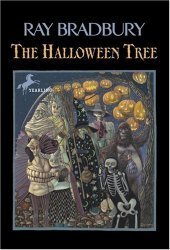

Below is my post from two years ago about Ray Bradbury's The Halloween Tree which is currently on sale in ebook edition for $1.99.
From 2014:
The Halloween Tree
by Ray Bradbury: I wanted to recommend it as a great book that shares Halloween traditions with readers young and old. The folkloric content is of interest to the usual SurLaLune reader which is why I am sharing here. A dear friend loves the book and has written a much better post about the book and how it has become an annual part of her Halloween celebration at this post: The Halloween Tree. I missed recommending it here last year because it was too late when I thought of it. Why torture you with what you couldn't order in time to use for the holiday?Book description:
Special indeed are holiday stories with the right mix of high spirits and subtle mystery to please both adults and children--Charles Dickens's "A Christmas Carol," for example. Or Ray Bradbury's classic The Halloween Tree. Eight boys set out on a Halloween night and are led into the depths of the past by a tall, mysterious character named Moundshroud. They ride on a black wind to autumn scenes in distant lands and times, where they witness other ways of celebrating this holiday about the dark time of year. Bradbury's lyrical prose whooshes along with the pell-mell rhythms of children running at night, screaming and laughing, and the reader is carried along by its sheer exuberance.
Bradbury's stories about children are always attended by dread--of change, adulthood, death. The Halloween Tree, while sweeter than his adult literature, is also touched at moments by the cold specter of loss--which is only fitting, of course, for a holiday in honor of the waning of the sun.
This is a superb book for adults to read to children, a way to teach them, quite painlessly, about customs and imagery related to Halloween from ancient Egypt, Mediterranean cultures, Celtic Druidism, Mexico, and even a cathedral in Paris. (One caveat, though: Bradbury unfortunately perpetuates a couple of misconceptions about Samhain, or summer's end, the Halloween of ancient Celts and contemporary pagans.) This beautiful reprint edition has the original black-and-white illustrations and a new color painting on the dust jacket. --Fiona Webster
Heidi Anne Heiner's Blog

- Heidi Anne Heiner's profile
- 44 followers
Heidi Anne Heiner isn't a Goodreads Author
(yet),
but they
do have a blog,
so here are some recent posts imported from
their feed.

