
Heidi Anne Heiner's Blog, page 167
April 10, 2012
Lena Headey Joins the 'Grimm Fairy Tales' Animated Series
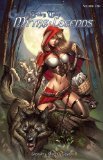
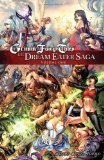
From Lena Headey Joins the 'Grimm Fairy Tales' Animated Series by iamrogue:
Fairy tales aren't just for scaring the hell out of children. In this post-postmodern age, fairy tales are exactly the type of familiar, malleable properties that audiences expect to see turned on their heads to illuminate new elements of the old stories. While there are current and upcoming movies and television series based on the familiar stories, there's just one animated series, Grimm Fairy Tales, and the project has found its vocal leading lady in Lena Headey.
Grimm Fairy Tales is based on the comic book series that Zenescope Entertainment has published since 2005. Every issue contains a familiar fairy tale being retold by Dr. Sela Mathers, a literature professor whose twisted versions of these stories are pointed cautionary tales. Lena Headey will voice Sela, and will also be a major creative force on the series.
Frequent Metalocalypse and Venture Bros. director Jon Schnepp is directing the entire series, and he's promised that Grimm Fairy Tales will be appropriately violent and unhinged. The idea is to create a Heavy Metal-style anthology with an unapologetic R rated sensibility.
So, no, not one for the kids or family.
There's also a Kickstarter page and here's a video, too.


Favorite Adaptations: Snow, Glass, Apples by Neil Gaiman
Jhane from the Philippines submitted two entries to the Favorite Adaptations giveaway to win a copy of Kill Me Softly by Sarah Cross. This is her first one. I will share the other later this week.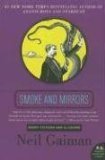
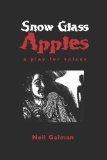
One of my most favorite adaptations or versions of Snow White is Neil Gaiman's Snow, Glass, Apples.
It may not have been directly revealed that it is a retelling of Snow White, but it is more than implied that it is.
It is dark and a really different version that you would really think otherwise of Snow White, and maybe, just maybe, side with the Queen this once. It will make you think a lot - how it made sense that Snow White is actually this or that [I do not want to spoil!] and that you'd realize you have been fooled by the many beautiful versions of the fairy tale.
I enjoyed it a lot, seeing the story on a different perspective and having a lot more to consider and think about. i was immersed in this particular short story for a short while, and it has made its mark in my mind. I am pretty sure everyone's going to like it, if not love it. :)

Fairy Tales in Stitches: Patterns by Sandy Orton

These are two long out of print patterns by Sandy Orton which Austintatious Offerings has listed at a hefty price that still tempts me. The Rapunzel pattern is my favorite--there's even the scissors details that delights me--but I like the Sleeping Beauty as well. Actually, even Rapunzel's expression appeals to me since she appears to know exactly what is going on. I would love to own both, but the price is a little out of my price range right now. Too bad they haven't been reprinted during all of this fairy tale popularity right now.
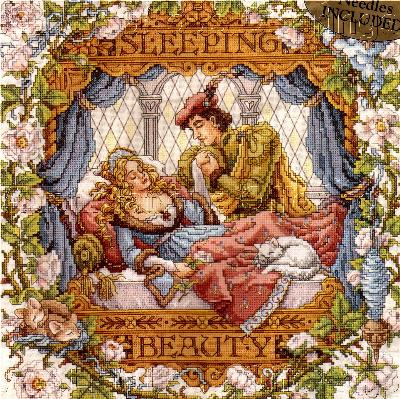
There was one more pattern in the series from the late 1990s, a Cinderella naturally. I could only find a good picture of it through a defunct listing on iOffer. Nevermind that all three characters look alike in this series.


April 9, 2012
Favorite Adaptations: The Coachman Rat by David Henry Wilson
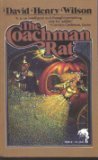
A book I can highly recommend – and wish more people knew about – is David Henry Wilson's The Coachman Rat. The main character is, naturally, the rat turned coachman from Cinderella, named Robert. After the iconic story, the book then goes on to chronicle Robert's life post-transformation (or rather post-post-transformation, as he's turned back into a rat at the stroke of midnight). The writing is wonderful, but that's only one of the many good things about the book. Cinderella, her stepfamily, and the Prince may be minor characters, but for me, they stand out from other modern versions. Further, Robert as a rat has a unique, non-human viewpoint that he's willing to discuss with the more open-minded characters in the book. Though there are plenty of close-minded characters as well, who want to fit Robert's experience in with either their expectations or their plans.
But it's not all a fun fairy tale. At about the middle of the book, the story takes a very dark turn. It veers off so wildly that I don't want to say how, as it would ruin the surprise. And even though it is a radical departure from the first half, it is completely in line with the personalities that lead up to it. Perhaps the reason it comes as such a surprise is that it's not the sort of thing that usually shows up in tales like these, which for me made it all the better.
Although it's likely to be found in libraries, it's unfortunately out of print. Which is a shame, as it really is one of the more creative versions of a very often-told tale.
My blog address is http://art-sam-ples.blogspot.com/– which contains, among other things, pages from Frog Prince and Gingerbread Man books I made for my kids, along with other fairytale-inspired drawings. My website is http://www.samuelvalentino.com/.
Thanks very much - Sam Valentino

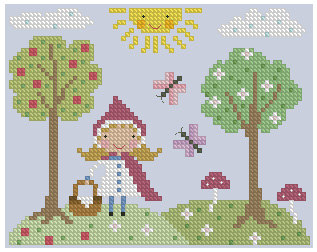
Fairy Tales in Stitches: Fairy Tales Collections from The Floss Box
 Here is a collection of fairy tale cross stitch patterns available through Etsy seller Theflossbox. The Princess and the Pea and Rapunzel ones are my favorites. These would make a great series on a nursery wall. I like them because they are simple enough to finish fairly quickly. And they'd be very easy to adapt to a desired color scheme, too.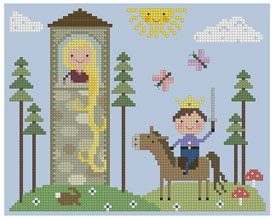
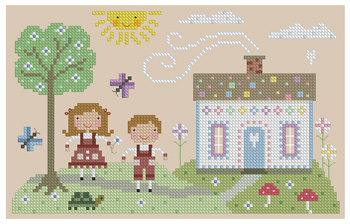
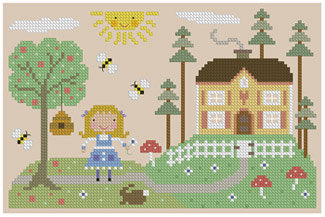
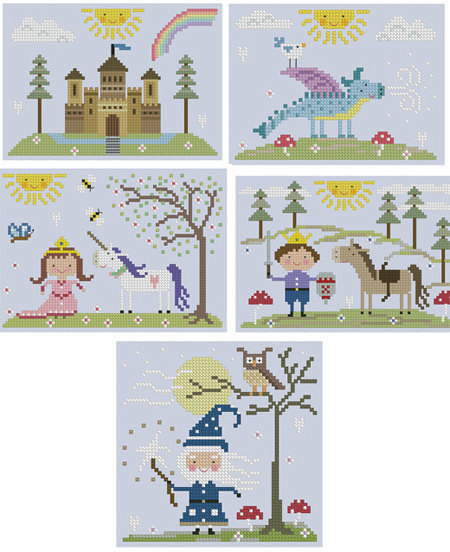

April 8, 2012
Fairy Tales in Stitches: Little Red Riding Hood Pattern

Here is a sweet pattern for a cross stitch Little Red Riding Hood presented by lilredbuttonboutique at Etsy. This has been one of my favorites for Riding Hood. This would work well on a larger sampler, too.
From the seller:
***PDF PATTERN EMAILED TO YOU WITHIN 24 HOURS***
Once upon a time there was a little girl who lived in a village near the forest. Whenever she went out the little girl wore a red riding cloak, so everyone in the village called her Little Red Riding Hood...
Red riding hood is 41/4" tall x 41/16" wide (10.8 cm x 10.2 cm) when stitched on 14 count fabric.
This 4 page PDF cross stitch pattern includes:
*A DMC floss chart with thread conversions for Anchor and JP Coats
*A color photograph of the finished cross stitched pattern
*Two full color stitch graphs (one with the pattern in reverse)
©Lil Red Button Boutique 2011. All rights reserved.
Pattern is for personal use only and is not to be sold, copied or redistributed in any form.
Thank you and happy sewing!


April 6, 2012
Favorite Adaptations: Beauty by Robin McKinley
Here is the another entry in the Favorite Adaptations Giveaway. This entry is by Christine Ethier, too. Read more about the giveaway here to learn how to win a copy of Kill Me Softly by Sarah Cross. I am extending the deadline on entries through April 14th since I didn't think ahead about this week being spring break and vacations for so many. Probably because this week has been anything but for me...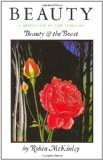
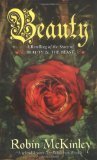
There is something about the Beauty and the Beast story that is attractive to society in general and to the literature, movie making crowd in particular. Jane Eyre, Wuthering Heights, Middlemarch and other books in varying literary quality draw on the motif, subverting, perverting, or simply retelling it (One of my faves is Jane Yolen's version which is a mash up with O Henry's Gift of the Magi). It is no surprise that Robin McKinely was drawn to the tale, twice, and any reader can see the germ of the second novel in this book, her first.
McKinley's writing, in particular The Hero and the Crown, was one very important touchstone of my childrhood, as it seems to be for many fantasy reading women of my age. I can't help but wish that teen girls of today would read her the obessive way and in the vast amount of numbers of those that read Twilight or Harry Potter and the Sorcerer's Stone. McKinley writes better, and she will most likely last longer.
This book, McKinley's first and her first retelling of Beauty and the Beast, was totally ripped off by the Walt Disney Company for thier movie. It's actually sad and insulting because not only did Disney rip it off, but they totally shortened the Beauty character (now, before people come and demand my Tigger shirt back, I happen to like the Disney movie, but a spade is a spade. Get over it).
McKinley draws heavily on the French version of the story, yet she makes it her own. Beauty likes to read, but unlike Disney's Belle (Beautiful in French), Beauty reads literature, not the romance novels of her day. Belle's love of reading is based on her love for romantic adventure; Beauty's is based on a love reading for itself and for knowledge. She is a scholar. It is difficult to imagine Disney's Belle having the same reaction to the library in this book, that Beauty does (also, we are never given a title of what Belle reads, hmmm).
Another change that McKinley makes, and she is one of the few authors who does this, is make Beauty's family a loving family. Beauty not only loves her father, but she loves her sisters. She and her sisters get along. They take to each other, not down to each other. They are not in competition. This isn't a fairy tale of the bad sisters being punished and the good (always the young one) being rewarded; it's about a loving family being rewarded.
Because this is early McKinley, there are flaws in the book, flaws that make the reader understand why McKinley basically rewrote the story in Rose Daughter. Beauty, for instance, is almost too perfect. She is the girl who stands out because she is not only more bookish, but more boyish than the other women. This perfection is dealt with in the end sequence. Additionally, Beauty's gaining of Greatheart feels like a wish fullment version of the horse movie of the week. But these are really, almost nit-picking. The most serious flaw is the fact that Beauty's sisters, Grace and Hope, are almost interchangable, though fully likable. McKinley also presents the view that being non-bookish is not any worse than being bookish, which is nice.
What I truly love, now, however, is simply that I only realized when I re-read this book as an adult. Beauty and the Beast from its earliest days was always a story about women and marriage, in particular the fear of marriage that must have developed in a society when the marriages were arranged and husband and wife barely knew each other. McKinley keeps this, and adds, understandably, a fear of desire and of changing into an adult. In many of Beauty's reactions to Beast there is the change of pubertry but also that struggle of coming to terms with adult desire, love, and one's own sexuality.
Thanks, Christine!

April 5, 2012
Fairy Tale Crafty: Snow White and Rose Red by Castle of Costa Mesa

This is for all of you Snow White and Rose Red fans. After reading and looking at the wonderful story of Snow White and Rose Red as created and presented by Castle of Costa Mesa, I wanted to make some of these dolls myself. I am feeling creatively hobbled right now thanks to the move of the decade. All of my stuff is packed and I would love to relax with some needle and fabric right now. At least I have my Kindle and more than enough books to read on it or I would be going insane after posts like this!
Anyway, when it comes down to it, this is one of the best illustrated versions of the story I have seen and all created for a children's party by an enterprising Waldorf-loving mom who also makes dolls for her Etsy store. The selection is small right now, but I want a prince or even a Snow White and Rose Red of my own. Perhaps after the move...
I am only showing a select few pictures but there are over 40 available on the Castle of Costa Mesa blog spread out over two posts: The Making of the Dolls and The Puppet Show. Do not miss these. There are many charming images not to be missed. These were inspired by Making Fairy Tale Scenes which I posted about earlier today.


Fairy Tale Crafty: Making Fairy Tale Scenes by Sybille Adolphi
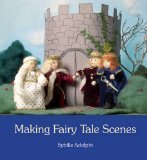
Making Fairy Tale Scenes
 by Sybille Adolphi. This post is just sharing the book. But I am going to share another post today from someone who was inspired by the book and Adolphi's work. It's amazing! These dolls are popular with Waldorf schools.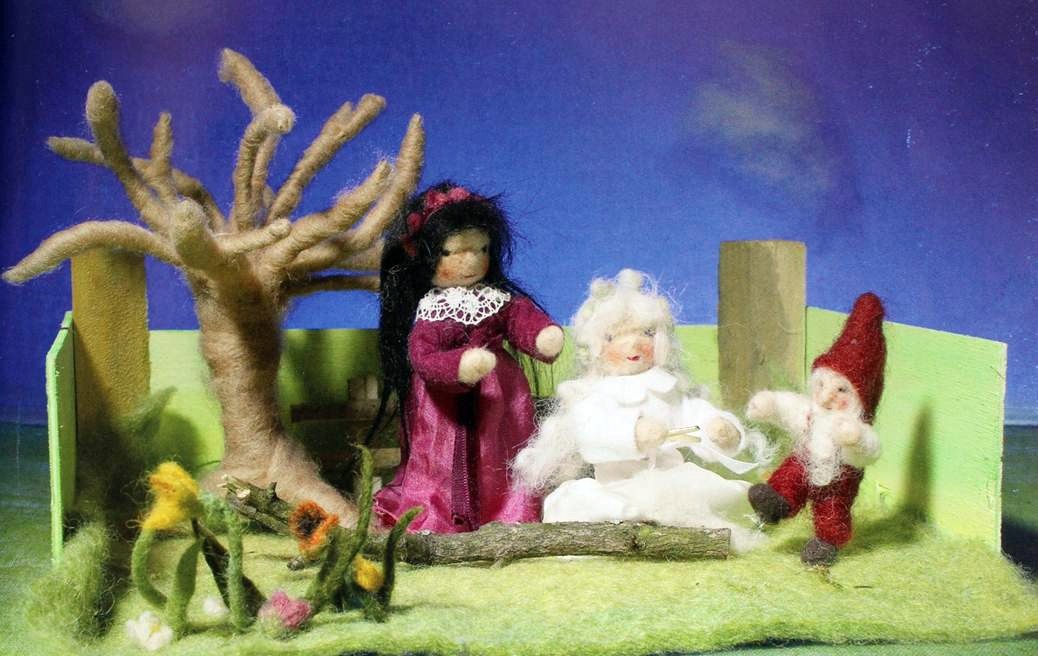
Book description:
Children will thoroughly enjoy making and playing with the range of well-known fairy tale scenes and characters provided in this book, which include Cinderella, Hansel and Gretel, Sleeping Beauty, Rumpelstiltskin, Tom Thumb, Rapunzel, and Snow White and the Seven Dwarves. The scenes are made from a range of easy-to-find natural materials, such as wool, felt and cotton, and are great fun to make. This book contains all the patterns and instructions you will need, and is clearly illustrated with diagrams and photographs. The scenes are organised according to season, so the story can be matched to the appropriate time of year.

April 4, 2012
Favorite Adaptations: The Alchemy of Stone by Ekaterina Sedia
Here is the first entry in the Favorite Adaptations Giveaway. This entry is by Christine Ethier and I'm sure is an unexpected choice for many readers here. Read more about the giveaway here to learn how to win a copy of Kill Me Softly by Sarah Cross. Remember you only have six days left to submit your own entries.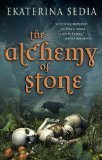
When I re-read The Little Mermaid as an adult something about it bugged me. This something bugs me more and more each time I re-read the story. It's not the pain the mermaid feels when she walks; all of Andersen's characters seem to get tortured, the Ugly Duckling was a male and he got frozen in the ice. No, with the mermaid, it's how the prince treats her. She sleeps at the foot his bed, he rests his head on her breast. It's like she's his personal lap girl with whom he has groping benefits.
I can't help wondering if Ekaterina Sedia feels the same way for The Alchemy of Stone is very reminiscent of "The Little Mermaid".
Unlike "LM", Mattie, the protagonist, isn't looking for a soul; she's looking for her independence, to be her own person. She is a clockwork girl, which means even so often her gears run down. There is only one key that winds her up. This process makes her feel violated. (In fact, whenever Mattie is opened, it almost feels like a rape. This is a brilliant touch). Guess who has it and doesn't want to share?
You guessed it. Her creator, a man.
Her creator, Lornarri, has freed her, but he still exerts control over her in a variety of ways, not all of which sit well with Mattie, her friends, or the reader. Lornarri reminds me very much of the prince in "The Little Mermaid", crueler, but he has that same selfish thinking, that disregard for the women who are connected to him. A me first attitude, and let's not think about anyone's feelings, at least anyone who is not my equal.
Mattie is an alchemist and despite being non-politic, soon finds herself caught up in the revolution that is taking place in her world. This comes about due to her desire to help the gargoyles. No Disney cutie pies, the gargoyles are the creators and keepers of the city where Mattie lives, and they find themselves dying off without any means of reproduction. In this struggle for control of an unnamed city, Sedia touches on the cause and effects of terrorism, the roots of revolution, and the effects of such violence on the community and the groups within that community. It is true that these issues are not dealt with startling depth. This isn't to say that she does a bad job; she doesn't. In fact, the book is timely in the topics it covers; it is hard not to see some of it as a mirror of current events.
The focus of the book, however, isn't on politics, but on gender roles and the idea of humanity. Reviews on the back of the book liken Mattie to any women and considering the roles of female supporting characters, the idea of a woman's role and woman's independence is what Sedia seems to be examining. Who doesn't feel like a wind-up girl sometimes? These gender roles are also used in "The Little Mermaid". The mermaid wanted a soul, more than she wanted the prince, so she wouldn't become foam on the waves. Mattie is not looking for a soul, though one could she has one and the best one of the novel. Is she more human than those around her? Does she have more of a soul? The same questions are raised in Andersen's tale, when the mermaid's compassion is compared to the thoughtless of the prince. Why do her sisters help her, but the prince cannot even think about her? It is easy to see the connection of this story to Andersen's fairy tale.

Heidi Anne Heiner's Blog

- Heidi Anne Heiner's profile
- 44 followers

