
Heidi Anne Heiner's Blog, page 143
October 10, 2012
Twelve Dancing Princesses illustrated by Sheila Robinson

The Centre for Children's Book Studies (CCBS) at Anglia Ruskin University in Cambridge has published an old but new edition of The Twelve Dancing Princesses by Sheila Robinson. I'll let the description and press release explain.
Book description from seller site:
First published edition of the Brothers Grimm's 'The Twelve Dancing Princesses', designed and illustrated by Sheila Robinson.
The edition of the Brothers Grimm's The Twelve Dancing Princesses, beautifully designed and illustrated by Sheila Robinson in the late 1940s, has never been published before, the original having lived in the Fry Art Gallery in Saffron Walden for a number of years since being donated by Robinson’s daughter, the artist Chloe Cheese.
The original book is in the form of a single completed, hand-made, hand-bound edition, created to the exact format of the Picture Puffin series, alternating between colour and black and white spreads. This first published edition incorporates a wraparound dust jacket showing examples of the preparatory drawings Robinson produced for the book, along with a short essay by Professor Martin Salisbury and afterword from Chloe Cheese.
In publishing the edition, the Centre for Children's Book Studies worked with leading London design company Webb & Webb to correct minor errors in spelling and grammar in the original hand rendered text and to 'clean up' some of the evidence of ageing in the original without losing the integrity of the original. All proceeds from sales will be used further research publications.
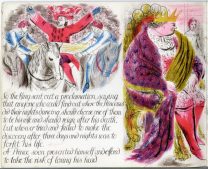
You can also read more about it at the book's press release, Dancing Princesses finally take centre stage:
From daughter Chloe:
"The beautiful pen and ink drawings and delicate text of this book fascinated me when I was a child and drew me into the enchanted world of the fairy tale.
"Although she hoped for publication at the time, she was still a young woman and I think other things, such as working on The Festival of Britain, marrying and having children, took over her life so that this book was put to one side.
"The princesses in the boats rowing across the lake in particular is an image that fired my imagination and inspired me to emulate my mother to become an illustrator myself. Looking at this illustration now I admire the lightness of touch and the use of light and shade. The picture still takes me to the edge of the lake and into the story."

You may see larger images on the Projects and Research page.


Einstein, Niels Bohr and Grandmothers … A Fairy Tale
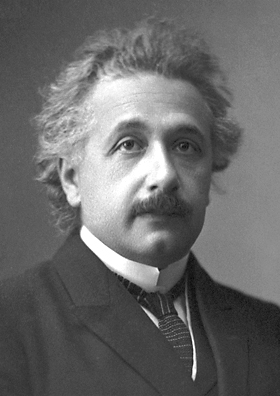

From Beyond Einstein and Bohr’s science Play explores physicists’ love of fairy tales by Sebastian Murdock:
It wasn’t all equations and formulas for physics giants Albert Einstein and Niels Bohr. In the midst of their debates and disagreements on quantum mechanics, they shared mutual philosophies on beauty, children and fairy tales.
Now, 79-year-old Len Barron — who looks quite a bit like Einstein himself — hopes to bring these philosophies to others in his new play, Einstein, Niels Bohr and Grandmothers … A Fairy Tale.
“Einstein and Neils Bohr were raised on fairy tales, so they learned at a very early age to believe in impossible things,” Barron says. “For them, fairy tales are the embodiment of our highest ideals, our sense for the possible. Fairy tales are really a state of mind, and this is what they said about children: ‘If you want your children to be intelligent, read them fairy tales. If you want your children to be more intelligent, read them more fairy tales.’”
The play was performed this past weekend in Boulder, Colorado, but I just discovered this article about it and had to share.

October 9, 2012
Cunning and Guile: Erica Wagner interviews Marina Warner and Hanan al-Shaykh: What can The One Thousand and One Nights teach the modern world?
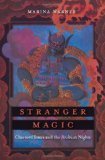
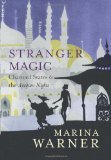
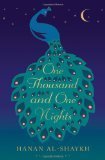
From Cunning and Guile: Erica Wagner interviews Marina Warner and Hanan al-Shaykh: What can The One Thousand and One Nights teach the modern world?:
The introduction:
The stories of The One Thousand and One Nights, Scheherazade’s crafty tales spun so as to postpone death, have long tantalized imaginations in the West. While the tales have informed writers from Borges to Flaubert, they’ve also given rise to a host commercial interpretations of folkloric figures, sanitized variations that contain little of their original lust or guile. Reading the full tales, composed of fable, aphorism, poetry, and riddle, people are often surprised to meet with the running theme of how the powerless employ their cunning to undermine the powerful.There is much, much more to read--this is only the preface to the conversation, so do click through and read it all.
“Most of the stories are about how to humanize the dictators,” says novelist Hanan al-Shayhk, author of a recent translation (One Thousand and One Nights: A Sparkling Retelling of the Beloved Classic, see image above for UK edition) of the tales. This tangled cornucopia of stories has diverse origins, having been gathered over centuries throughout ancient Persia, India, and Mesopotamia, among other places. But in spite of their complex origins, the tales are framed around a central conceit: the triumph of wit over tyranny. King Shahryar, angered by his wife’s infidelity, has concluded that women are not to be trusted and so—after executing her—begins to marry a succession of virgins, condemning each to death the day after the wedding night.
Eventually there are no more virgins to be found except for Scheherazade—the daughter of the vizier charged with the task of finding wives for the king. She volunteers, despite her father’s reluctance, and on her wedding night begins to tell Shahryar a story that she doesn’t finish, causing the king to postpone her execution so that he might hear the ending. The next night Scheherazade concludes the story, but then begins a new tale, and in this way she continues to buy another day of life for one-thousand-and-one nights. In the end Scheherazade’s stories teach the tyrant humility and wisdom, and he spares her life.
The One Thousand and One Nights has the potential to not only challenge the way in which an oppressor views the world, but also to demonstrate how humor, courage, and bold explicitness can be used to effectively speak truth to power.
This past May, al-Shayhk convened with two other women writers at London’s Asia House to discuss these themes and the lessons that the tales offer those of us following or embroiled in the struggles throughout the Arabic-speaking world in the twenty-first century. Marina Warner is a novelist, cultural historian, mythographer, and critic. She is the author of Stranger Magic: Charmed States and the Arabian Nights. Erica Wagner is the literary editor of the Times of London.
In a dialogue spanning continents and centuries, the discussants consider the politics and poetics of the tales, scrutinizing “how in the West the Arabian Nights have been both infantilized and bowdlerized.” In particular, they explore the shifting position of woman as storytellers and story subjects, and the distance between the West’s penchant for vulnerable Sleeping Beauty, as opposed to the intelligent cunning of Scheherazade and the figures of her imagined world. While Western fairy tales are marked by what Marina Warner calls a “collective desire to discipline young girls into inaction,” The One Thousand and One Nights presents a different arc, wherein female and male characters alike seek justice and revenge, and expose the frailty and fleetingness of power.
And really, who doesn't adore Scheherazade?

Job Posting: Director, Smithsonian Center for Folklife and Cultural Heritage
I don't post many of these, mostly because I don't actively look for them, but I am always happy to share job postings for folklore related jobs to give SurLaLune readers an idea of possible career tracks in the folklore field. So many of you are students wanting to know if you can pursue this field and continue to like eating. It's always fun to meet those of you in person who tell me that SurLaLune was one of your gateways into entering this field of study. At 14 years old this year, SurLaLune has helped inspire a few of you to follow your dreams. Thank you!
Right now there is a job posting for the position of Director at the Smithsonian Center for Folklife and Cultural Heritage. The full job listing and application is a PDF which will eventually disappear off the internet so here is most of it:
1
Director, Center for Folklife and Cultural Heritage
Announcement # EX-13-01
The incumbent of this position serves as Director, Center for Folklife and Cultural Heritage (CFCH), appointed by the Secretary of the Smithsonian and under the supervision of the Under Secretary for History, Art, and Culture. The Center for Folklife and Cultural Heritage is responsible for planning, developing, and managing programs, cultural heritage policy, and training initiatives that have as their major objectives the research, documentation, presentation, and sustainability of living traditional and grassroots folk cultures of the United States and of other countries.
As Director, the incumbent is responsible for the administrative direction and management of all Center program activities including the Smithsonian Folklife Festival, Smithsonian Folkways Recordings, Ralph Rinzler Folklife Archives and Collections, exhibitions, symposia, scholarly research, cultural heritage policy, educational projects, professional training, and all media (including websites, social media, apps, video and film documentaries, etc.), as well as the participation of other Smithsonian museums and programs in appropriate national celebration events and National Mall events. The Director represents, at national and international levels, Smithsonian concerns relating to the understanding of the cultural representation of living heritage, as well as public sector folklore, and policies related to them.
The Director oversees approximately 40 scholarly, technical and administrative staff members, as well as scores of scholars and technicians working on a contractual or short-term basis, hundreds of interns and volunteers, and is responsible for the well-being of hundreds of Festival participants and Folkways artists annually.
The Center enjoys financial support from federal appropriations and Smithsonian Trust funds. However, significant funding must be raised from a variety of sources including national governments, foundations, corporations, and individuals to support the annual Smithsonian Folklife Festival and other programs. Effective revenue generation is also critical. Smithsonian Folkways Recordings relies on the generation of millions of dollars of earned income. Festival food and beverage concessions and its internally operated marketplace bring in essential additional revenues.
DUTIES AND RESPONSIBILITIES
1. The Director is responsible for developing and revising the Center’s vision and strategic plan and formulating the Center’s goals and objectives in consultation with staff, advisory council and board, and other stakeholders, and in concert with the Smithsonian Strategic Plan and the Institution’s leadership.
2
2. The Director is responsible for the overall programmatic and administrative management of all Center program activities, which include the Smithsonian Folklife Festival, Smithsonian Folkways Recordings, Ralph Rinzler Archives, collections, exhibitions, scholarly research, all media and educational outreach, and cultural heritage policy projects as well as national celebration events and those involving collaborations with other Smithsonian museums and programs, while delegating certain of these areas to key subordinates. The Director issues and oversees operating policies, priorities, and procedures for Center program planning and development consistent with Smithsonian guidelines and regulations. The Director makes major policy and program decisions, including matters of budget, staffing, program planning, and priority.
3. The Director is responsible for monitoring, integrating, and coordinating the efforts of scholars and researchers involved with CFCH programs. The Director provides leadership and guidance, working with stakeholders, in defining the goals, objectives and priorities for scholarly research and for collections as well as for their presentation and use in a broad range of programs and products. The Director ensures that CFCH research and resultant programs are scholarly, ethical in light of disciplinary and human subjects research guidelines, participatory with communities and artists, and respectful and sensitive to the beliefs and traditions of the participants. Director ensures that collections—whether documentary or artifactual, are acquired and cared for in a manner consistent with Smithsonian policies and guidelines.
4. The Director prepares, oversees and implements Federal and Trust budgets that realize CFCH goals, and operates within those budgets. The Director oversees the preparation and submission of CFCH Federal budget requests to the Smithsonian for consideration by the Office of Management and Budget and by Congress, and the preparation and submission of the Smithsonian Trust fund budget. The Director allocates budgets within Smithsonian guidelines and directives.
5. The Director oversees, encourages, and pursues gift, grant, and contract activity for the CFCH ensuring resources secured are adequate to meet the Center’s goals. The Director prepares National Campaign and development plans for securing funds from individuals; foundations; corporations; foreign governments; state, federal, and international agencies; and/or appropriate partnerships in the pursuit of CFCH objectives. The Director meets with potential funders, sponsors, and partners, making presentations, securing funds, and managing donor relations.
6. The Director oversees, encourages, and pursues nonprofit business activity for the CFCH, working closely with the Director of Smithsonian Folkways Recordings, Festival concessions, shops, and other such operations to assure the financial success of these activities., The Director works with Smithsonian Enterprises and other partners, as appropriate, and in accord with Smithsonian policies and guidelines.
3
7. The Director provides leadership for all staff, associates, fellows, interns, and volunteers of the CFCH, directly supervises senior staff members, and coordinates supervision of all staff members in a broad range of program activities. The Director encourages thoughtful, creative, innovative, ethical, and participatory performance through the organization. The Director issues CFCH policy guidelines and instructions consistent with Smithsonian guidelines and regulations and models those guidelines to assure the continued high quality of staff work performance. The Director assures that subordinate supervisors are effective in carrying out their responsibilities, and approves performance standards for key subordinates and periodically reviews their work performance. The Director reviews and approves recommendations on personnel matters relating to reassignment, promotion, performance appraisal, and disciplinary actions. The Director takes a proactive role in setting standards for and encouraging workplace civility among Center staff.
8. The Director is responsible for the achievement of a diverse staff and for assuring the representation of multiple perspectives in Center programs and activities. The Director encourages the training, recruitment, and career development of members of minority groups, women, and individuals with disabilities.
9 The Director represents the Smithsonian at high level disciplinary and policy meetings and conferences with international organizations, foreign governments, federal agencies, educational institutions, research centers, professional organizations, etc. to promote and foster the Institution’s folklife programs and issues of cultural policy, and to develop and coordinate programs of mutual interest for the research, documentation, representation, and sustainability of traditional and grassroots folklife and cultural heritage. The Director represents the CFCH as primary spokesperson to the media, Congress, and the public. The Director works closely with counterparts in the American Folklife Center at the Library of Congress, the American Folklore Society, and the National Endowments for the Arts and Humanities, and other federal, state, local agencies and organizations on the development of cooperative programs for the advance of the Nations’ interest in folklife, and works with agencies such as the U.S. Department of State, and intergovernmental organizations such as UNESCO on issues of the representation and conservation of living cultural heritage.
10. The Director serves as the principal advisor to the Secretary and the Under Secretary for History, Art, and Culture on matters relating to the folklife programs of the Institution, and as the lead in the management of cooperative programs with other Smithsonian museums, research centers, and programs, particularly, but not exclusively, the National Museum of American History, the National Museum of the American Indian, the National Museum of African American History and Culture, the National Museum of African Art, the Freer and Sackler Galleries, the Smithsonian American Art Museum, the Anacostia Community Museum, the Department of Anthropology of the National Museum of Natural History, the Smithsonian Latino Center, the Asian Pacific American Program and the Consortia for Understanding the American Experience and World Cultures.
4
11. The Director serves as ex-officio member of the CFCH Advisory Council, working closely with the Chair to organize annual meetings, and with the Council members on issues relevant to the Center and in concert with the Council’s bylaws. The Director also serves as ex-officio member of the Folkways Advisory Board and participates in its meetings and deliberations. The Director participates with other Smithsonian advisory bodies including the Smithsonian National Board, and, as appropriate, the Board of Regents.
12. As a scholar and/or practitioner, the Director makes original contributions to the theory and practice of folklore and/or cultural heritage and allied fields. The Director publishes books, articles, or chapters on the folklife and cultural heritage of particular communities, on theory, policy, or on the practice of public work. The Director participates in scholarly and professional conferences and seminars and gives expert guidance and advice to colleagues in the cultural fields.
13. Depending upon the organization of CFCH, the Director of CFCH may occasionally serve concurrently as the Director of Smithsonian Folkways or the Director of the Smithsonian Folklife Festival or another division of the Center, responsible for the functioning of that division, and may be assisted by a principal deputy, associate, or assistant director for operational and various managerial functions.
EVALUATION CRITERIA
The following criteria will be used to determine the highest qualified candidates:
Knowledge of folklore and/or ethnomusicology/ethnology/oral history/cultural heritage as evidenced by an advanced degree and/or a body of work that includes public programming or policy formulation/assessment, or scholarly achievement emphasizing living cultural heritage.
Leadership/management experience at a level that sets the goals and objectives for a scholarly or educational or service organization and includes the responsibility for management of the fiscal and human resources in a complex organization.
Successful track record of raising funds from individuals, foundations, corporations, and governmental organizations (domestically and/or internationally) through gifts, grants, and contracts.
Demonstrated successful track record of nonprofit business entrepreneurship generating significant revenues or entrepreneurial leveraging of substantive partnerships in the service of organizational mission.
Knowledge of world and/or American styles, systems, or traditions of cultural expression, as well as experience in representing exemplary cultural forms and practitioners in an important public and educational context and in an increasingly global, digital age.
5
Experience with domestic and international cultural programs and the communication and social skills to represent the organization to senior management, government officials, international dignitaries and collaborating organizations.
IMPORTANT NOTICE
This is a Smithsonian Trust position. This is NOT a Federal Civil Service position. Smithsonian Trust positions are paid with revenues generated by our business enterprises and other non-government funding sources. Trust employees are “private sector” employees and are eligible to enroll in their own comprehensive benefit program including a lucrative, fully vested, retirement program with TIAA- CREF ( www.si.edu/benefits). A Federal employee who accepts a Trust position must resign from Federal service. Federal retirement payments are not affected by Trust employment.
The Smithsonian offers a competitive starting salary commensurate with experience.
HOW TO APPLY
We are only accepting E-Mail applications for this position. Please E-mail your resume or C.V. to Executiveresources@si.edu. Place EX-13-01 in the subject line. We will accept resumes until the closing date November 9, 2012
Applicant Survey Form (Attached) All candidates, except Smithsonian Institution employees, are requested to complete and submit the enclosed Applicant Survey Form with the application. This form will be used to determine the demographics of applicants who apply for vacancies at the Smithsonian Institution, and will not affect consideration for this position. The applicant survey form may be obtained on our website at www.si.edu/ohr.
Relocation expenses may be paid at the discretion of the Smithsonian
The individual selected for this position is subject to a full-field background investigation and will be required to file a confidential statement of employment and financial interests.
The Smithsonian Institution is an Equal Opportunity Employer. We believe that a workforce comprising a variety of educational, cultural and experiential backgrounds support and enhance our daily work life and contribute to the richness of our exhibitions and programs. See Smithsonian EEO program information: www.si.edu/oeema
The Smithsonian provides reasonable accommodations to applicants with disabilities. If you need a reasonable accommodation for the application/hiring process, please call (202) 633-6370 (voice) or (202) 633-6409 (TTY).
6
For questions, nominations or other inquiries concerning this announcement contact
Tom Lawrence
Smithsonian Institution
Office of Human Resources
Executive Resources Office

October 8, 2012
Free Ebook: Grimm: The Essential Guide (NBC)
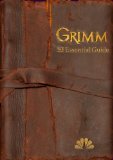
Grimm: The Essential Guide
 is currently a free ebook download but it appears to only work on color Kindle gadgets and apps like the Fire or some of the phone apps. It is also available at Barnes and Noble. I ordered it and sent it to my Fire but since I hardly use that device, I probably won't be looking at it soon. I also am way behind on Grimm--watching, not reading about it--but my husband is growing more and more interested in it.
 Book description:
Grimm: The Essential Guide is here! Download this interactive eBook and let the NBC hit drama series Grimm, inspired by the Grimm brothers’ fairy tales, come alive!
Learn about Homicide Detective Nick Burkhardt and the rest of the characters on Grimm.
Enter Aunt Marie’s Trailer and view her mysterious artifacts.
Read the pages from the family journal passed down by generations of Grimms.
Navigate through the Creature Gallery.
See behind-the-scenes photos from the filming of the television series.
Be one of the first to see the terrifying new creature, Mauvais Dentes.
Meet the cast and so much more!
Both die-hard fans (aka Grimmsters) and curious newcomers will discover the ancient secrets of the supernatural Wesens that live among us in Grimm: The Essential Guide.
Get it now before it’s too late!

Fitz & Floyd UNTIL MIDNIGHT Cinderella Cookie Jar Coach

I found this Fitz & Floyd UNTIL MIDNIGHT Cinderella Cookie Jar Coach on eBay with these great photos and had to share. It sold in 2011 for $460. The photos are credited to the seller, Little King of the Woods. This is an amazing cookie jar, yes? From the listing:
Part of the magical Signature Collection by Fitz & Floyd, here is a limited edition cookie jar featuring Cinderella's Coach. Amazingly beautiful and intricate...the horses bridles and saddles have real tassles and the threaded reigns go into the hands of the carriage driver. Designed by artist Rhonda Lynn Havins (she also created the Noah's Ark cookie jar from the same series). Our thanks to Johayden who had the following information about this jar online: 2006, Limited to 1500 pieces (not numbered), with 35 Hand-painted separate attachments made from 186 molds, and 18 inches long.


October 7, 2012
Once Upon a Time Season 2: Less Fairy Tales?

Looks like there will be less and less fairy tale coverage of OUAT. And, yes, reading between the lines is that the focus is really more about Disney characters coming to visit than anything else. Mulan, Captain Hook, all Disney animation. I don't think we will be seeing Jane Eyre. We're more likely to see


or Herbie the Love Bug--or wait! Isn't that Emma's car already?
From 'Once Upon a Time' producers pledge intense season 2 by James Hibberd at EW:
Here’s what I find interesting about the characters you’re adding this season. Mulan is a Chinese historical figure. Captain Hook is an early 20th century literary creation and Lancelot is a fifth-century possible historical figure. Those aren’t fairy-tale characters.
KITSIS: Go back and look at the pilot when you see Henry’s book and the book flips [through the pages of illustrations from different stories]. Also the episode with the Mad Hatter when you see all the doors [to other worlds]. If you Tivo-pause those doors there are some that look different than what you might think.
HOROWITZ: Fairy tales are ground zero. They’re the first stories we hear … Will Chewbacca show up in Storybrooke? Probably not, because that’s a Lucasfilm property.
KITSIS: But he’s welcome to!
You play a lot with Disney characters. What’s something you’re not allowed to do?
KITSIS: Cinderella is not going to be doing an 8-ball in a Boogie Nights scene.
But you wouldn’t write that anyway.
HOROWITZ: You get the sense of where the line is and you try to push as far over that as you can without going too far. We want to do cool dark stories, but we don’t want to sully the characters. We had Snow “under a curse” and not behaving as herself, capture and torture a guard with an axe and threaten him. It was very real to what our Snow was doing at the time, but it’s not something traditionally Disney would want to do with that character.
KITSIS: That was our Quentin Tarantino moment.
HOROWITZ: And we had things like the Red Riding Hood episode where she kills her boyfriend and eats him. We’re getting families to watch this, but we were able to get the dark things we wanted to do.
KITSIS: For us it’s about character. Everybody has darkness in them.

October 6, 2012
New Book: The Three Ninja Pigs

The Three Ninja Pigs
 by Corey Rosen Schwartz (Author), Dan Santat (Illustrator) is a new release with a fun book trailer which will take care of the burden of showing illustrations to you. And it feels a little like watching Saturday morning cartoons. Enjoy!
Book description:
Practice makes perfect in this kick-butt fractured fairy tale
When the big bad wolf threatens their village, three pigs sign up for different martial arts lessons to prepare to take him down. Pig One and Pig Two don't stick with their training, though, and are no match for their foe. But after practice and dedication, Pig Three becomes great at karate (including perfecting the perfect pork chop!) and saves the day.
Corey Rosen Schwartz serves up a fun combination of smart-aleck dialogue and tongue-in-cheek rhymes that'll have kids howling, and rising star Dan Santat's spunky illustrations are sure to pack a punch!

October 5, 2012
The Fairies Return Giveaway
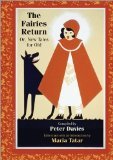
There is a giveaway on GoodReads sponsored by the pubisher, Princeton University Press, for a chance to win one of five copies of The Fairies Return: Or, New Tales for Old (Oddly Modern Fairy Tales)
 (Amazon link). The giveaway will run through October 26th. To enter, go to GoodReads to sign up for the giveaway.
It's an interesting book--and has a Peter Pan connection for those of you who are fans--since Peter Davies as a child was Barrie's inspiration for the character. I shared more about the book, including Table of Contents, in a previous post.
And how many of you dear readers use GoodReads? I'm not a regular user myself but know at least a few of you are.

New Book: Seed by Seed: The Legend and Legacy of John "Appleseed" Chapman
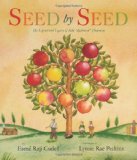
I really don't give enough love to American folklore figures here at SurLaLune, so today I will highlight a new book, Seed by Seed: The Legend and Legacy of John "Appleseed" Chapman
 by Esme Raji Codell and Lynne Rae Perkins. The book is about John Chapman, better known as Johnny Appleseed. He was a real person, of course, but his story is so much a part of the American folklore fabric that I wanted to share.
Book description:
His real name was John Chapman.
He grew apples.
But wait. So what?
Why should we remember him
and read about him
and think about him
and talk about him today,
more than two hundred years after he was born?
Why should we call him a hero?
Esme Raji Codell and Lynne Rae Perkins show us, in eloquent words and exhilarating pictures, why Johnny Appleseed matters now, perhaps more than ever, in our loud and wired and fast-paced world.
When you look through the book at Amazon, you see a story with two modern children traveling in time to observe Appleseed's life. This would make a great companion book to one of my favorite Johnny Appleseed books, Johnny Appleseed
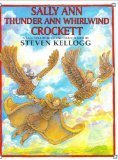
 by Steven Kellogg. I am a Kellogg fan and always had fun reading Sally Ann Thunder Ann Whirlwind Crockett
 for storytime when I was a librarian in California. I'm Southern born and the accent just pours out of me when I read that book outloud. It was always a bit of a shock for my audience. My shelves have a small library of Kellogg's American folklore books. Lovely.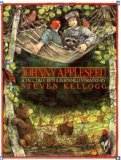

Heidi Anne Heiner's Blog

- Heidi Anne Heiner's profile
- 44 followers
Heidi Anne Heiner isn't a Goodreads Author
(yet),
but they
do have a blog,
so here are some recent posts imported from
their feed.

