Phil Giunta's Blog, page 28
November 17, 2019
Celebrating The First Ten Years…
On November 20, 2009, my first novel, Testing the Prisoner, was published by Firebringer Press. During the intervening decade, I managed to publish two follow up novels and nearly 20 short stories across 11 anthologies and a few websites. To date, I’ve written or contributed to 14 titles.
Compared to some of my contemporaries—referring specifically to indie authors who also hold full time jobs—that number might seem unremarkable, but I’ve reached an age where I’m less interested in competing with others and prefer instead to stay focused on my own career and produce at a pace that works for me.
Of course, I’m deeply grateful to all of the veteran writers who mentored me, the publishers and editors who accepted my work, and the friends and readers who supported me along this emotionally turbulent, but ultimately exhilarating, journey.
I’m proud of every story I’ve published whether online or in print and look forward to the next ten years of challenges. So what’s ahead in 2020? Keep scrolling…
 The First Ten Years…
 In February, my short story, “Burn After Writing,” will be published in Scary Stuff, a horror anthology by Oddity Prodigy Productions. Scary Stuff was inspired by such classic EC Comics titles as Tales from the Crypt, Vault of Horror, Haunt of Fear, and the magazines Creepy and Eerie. Oddity Prodigy is currently running an Indiegogo campaign to fund the publication.
 Slated for a mid-year release from Firebringer Press is the third installment in the Middle of Eternity anthology series—Meanwhile in the Middle of Eternity. I created and edited this series with the goal of providing an outlet for as yet unpublished writers and a few established names. We began in 2014 with Somewhere in the Middle of Eternity and continued in 2016 with Elsewhere in the Middle of Eternity. Our third book will be the largest volume yet with a diverse array of tales from SF, fantasy, and the paranormal.
More info forthcoming on these exciting projects!


November 16, 2019
About This Writing Stuff…
This week, Kristen Lamb delves into the traits of a perfect villain and reminds us of the importance of story mastery above all else. Anne R. Allen offers advice on writing that challenging first chapter while Marie Eberle would like to see less of certain hackneyed character types in SF and Fantasy.
It’s a foregone conclusion that conflict is the heart of storytelling, but what about conflict management? L. Deborah Sword discusses.
Over at Writer Unboxed, Jim Dempsey encourages us to delve into our characters’ values to find their ultimate motivation, and speaking of characters, Donald Maass suggests examining psychological archetypes as a means for crafting character arcs.
If you’re struggling to build a readership, there may be a good reason for that. In fact, as Shannon Ashley reveals, there might be at least twelve reasons.
All that and a little more. Enjoy!
On Writing: Why Mastery Should Matter To the Serious Author by Kristen Lamb
The Villain: Crafting Scoundrels, Sinners, and Substance of Legends by Kristen Lamb
Finding and Using Competing Book Titles in Your Book Marketing by Penny Sansevieri
Writing that First Chapter: 10 Dos and Don’ts for Starting a Novel by Anne R. Allen
Avoid these Crutch Words by Dana Isaacson
Story Conflict: It’s Not as Simple as We Think by L. Deborah Sword via Jami Gold
Nine Ways for Your Hero to Earn the Clues They Need by Chris Winkle
The Two Types of Archetype by Donald Maass
What Really Drives Your Characters? by Jim Dempsey
12 Reasons Nobody Wants to Read Your Writing by Shannon Ashley
3 Types of Fantasy and Sci-Fi Characters We’ve Seen Enough Of by Marie Eberle
What is a Vignette & How Do I Write One? by Amanda Patterson
November 12, 2019
Climb “Purple Hills” with the Infinite Bard!
Click here to read Rigel Ailur’s FREE short story!
November 11, 2019
After Action Report: Philcon 82
 The 82nd annual Philadelpha SF Convention (Philcon) has come and gone and, for me, it was one of the best yet. I participated in four edifying and—in the case of Compassionate Representation of Mental Illness in Fiction—intense discussion panels.
I was not scheduled for any panels on Friday, which allowed me to browse the dealer room and pick up over 20 classic SF paperbacks before enjoying dinner at Houlihan’s with Sharon Van Blarcom and Sarah Yaworsky from the Farpoint Convention and fellow writer Chris Ochs.


Saturday was a busy day with three discussion panels and an autograph session. I was honored to share the autograph table with Hugo and Nebula award-winning SF author Michael Swanwick. We had a delightful conversation about classic speculative fiction authors such as Robert Silverberg, Harlan Ellison, Phil K. Dick, Philip José Farmer, and others.
 Saturday Discussion Panel – How Does a Reader Discover New Authors? – Photo Credit: Michael Ventrella
 Sunday Discussion Panel – Your Story Doesn’t Start until Page Eleven? – Photo Credit: James Beall
In between panels, I sat with Farpoint Chair Sharon Van Blarcom at the Farpoint Convention table. Once we closed up at 6PM, I joined Sharon, Farpoint committee member Brian Sarcinelli, and Shore Leave Co-Chair Inge Heyer in the hotel restaurant for about an hour before joining writer pals Aaron Rosenberg, Glenn Hauman, Heather Hutsell, and several others for dinner at Whole Hog BBQ.
One of the highlights of the weekend was the launch of the Indiegogo crowdfunding campaign by Oddity Prodigy Productions for their upcoming horror anthology, Scary Stuff. My ghost story, “Burn After Writing” will be included in the book. Scary Stuff is an homage to the classic EC Comics titles such as Tales from the Crypt, Vault of Horror, Haunt of Fear, Creepy, etc. Click here to learn more about the project including the contributing authors and the various donation levels. Thank you for supporting small press authors!
 Sunday morning saw me at two discussion panels–Your Story Doesn’t Start Until Page Eleven? and Rituals for Conjuring Novel Titles. Both of which were fun and engaging for the panelists and the audience.
As I was packing my car to leave on Sunday, I noticed this massive Christmas tree directly across from the Crowne Plaza hotel on Park Avenue. Although still a bit early in the season, it was a cheerful ending to a succesful weekend. As always, I look forward to returning next November!
November 10, 2019
Book Review: Flow My Tears, The Policeman Said by Phil K. Dick
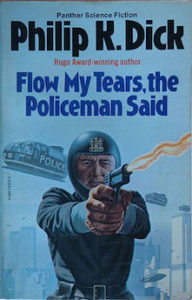 Following an attack by a jilted lover, renowned TV variety show host and singer, Jason Taverner, awakens in a cheap motel and soon discovers that he is unknown to the world. Neither his current girlfriend nor his lawyer recognizes him when he calls. Further, all records of his identity have been erased from Earth’s databases.
Rather than panic, Taverner uses his genetically enhanced intellect and survival training to arrange for forged IDs in order to pass through the numerous checkpoints of the police state that developed in the U.S. since the Second Civil War. Otherwise, Taverner risks arrest and sentencing to one of the forced labor camps for the rest of his life.
While on the run, Taverner searches for answers only to become entangled with a host of characters ranging from the eccentric and harmless to the desperate and dangerous—until he is falsely accused of murdering the sister/wife of a Los Angeles police general.
It is easy to see why Flow My Tears, the Policeman Said earned Phil K. Dick the John W. Campbell award as well as nominations for a Hugo and Nebula. It’s a fast-paced story with a protagonist both capable and mysterious. Taverner is classified as a “Six”—presumably, a sixth generation genetically enhanced human (reminiscent of the Nexus 6 androids in Dick’s Do Androids Dream of Electric Sheep?). As usual with Phil K. Dick, the antagonist in the story is not merely a single character, such as the unethical police general or his drug-dealing sibling/spouse. Rather, the enemy is the corrupt state, the totalitarian government, the decaying society.
Flow My Tears, the Policeman Said ranks as one of my top five favorite SF novels.
November 2, 2019
My Philcon Schedule
I’m always excited to return to Philcon as a program participant, even more so when I’m on discussion panels with writers I know such as Hildy Silverman, Aaron Rosenberg, and Heather E. Hutsell.
My schedule for next weekend’s Philcon is below. If you’ll be there, let’s catch up!
Saturday, 11/9 at 11:00 AM in Crystal Ballroom Three (1 hour) HOW DOES A READER DISCOVER NEW AUTHORS?
Panelists: Elektra Hammond (moderator), Timothy Pratt, Elyse Rosenstein, Mary Spila, Eric Hardenbrook, Phil Giunta
In a world where people are more likely to order new releases by their favorites off of Amazon than drive to a bookstore and browse, how do readers find authors they hadn’t previously heard of?
Saturday, 11/9 at 12:00 PM in Crystal Ballroom Promenade (Gaming) (1 hour)
AUTOGRAPHS: MICHAEL SWANWICK, TESS KISSINGER, PHIL GIUNTA
Saturday, 11/9 at 7:00 PM in Crystal Ballroom Two (1 hour)
WHAT *ELSE* MAKES A STORY SATISFYING?
Panelists: Anastasia Klimchynskaya (moderator), Ty Drago, Barna William Donovan, Phil Giunta, Michael Hanson, Aaron Rosenberg
And now for a set of *different* perspectives on the topic!
Saturday, 11/9 at 10:00 PM in Crystal Ballroom Two (1 hour)
COMPASSIONATE REPRESENTATION
Panelists: Jim Stratton (moderator), Miriam Seidel, Phil Giunta, Jay
Smith, Pam Smith
A discussion on how to avoid harmful stereotyping and tropes when
writing characters with mental illnesses—and why that’s something
you should care about.
Sunday, 11/10 at 11:00 AM in Crystal Ballroom Two (1 hour)
YOUR STORY DOESN’T START UNTIL PAGE ELEVEN?
Panelists: Hildy Silverman (moderator), Marilyn ‘Mattie’ Brahen, Oz
Drummond, Phil Giunta
…and that’s a problem. How does a writer recognize when a
narrative needs major surgery?
Sunday, 11/10 at 12:00 PM in Plaza II (Two) (1 hour)
RITUALS FOR CONJURING NOVEL TITLES
Panelists: Aaron Rosenberg (moderator), Randee Dawn, Phil Giunta, Heather Hutsell, Brian Koscienski
Is an actual summoning circle required to find the perfect name for
your book, or are there other methods you can use?
October 29, 2019
A “Full Voice” on The Infinite Bard
It’s Wednesday again and in my “FULL VOICE,” I call you to The Infinite Bard for our latest brilliant—and FREE—short story!
Click here to enjoy! And by all means, please help spread the word. Thank you for your support!
October 27, 2019
Book Revew: The Book of Philip Jose Farmer
Philip Jose Farmer was one of the most prolific writers of imaginative literature during the heyday of SF and speculative fiction beginning in the early 1950s. Although some may argue that he was overshadowed by his peers—Bradbury, Clarke, Ellison, Heinlein, and others—Farmer was no less a master craftsman in his field, creating such legendary series as Riverworld and World of Tiers.
Some of his most famous stories include Riders of the Purple Wage, “Uproar in Acheron,” “Father in the Basement,” and hundreds more. Farmer also wrote works based on Tarzan and Doc Savage and wrote a few novels under the pseudonym of Kilgore Trout, a character found in three of Kurt Vonnegut’s novels. Farmer was often considered controversial, even pornographic, for his “shocking” alternative perspectives on sex and religion.
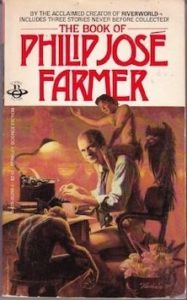 The Book of Philip Jose Farmer is a collection of the writer’s work, compiled by Farmer himself, in an effort to provide a sample of his breadth as a storyteller from SF and horror to fantasy and satire. My favorites included:
“Skinburn” – To the bewilderment of several doctors, private detective Kent Lane suffers from sunburn the moment he is exposed to even the weakest daylight. More, Lane is under surveillance by the Feds, but each time he is arrested, strange events transpires that permit Lane to be released from custody…
“The Alley Man” – a college student spends time with a deformed, delusional trash collector and his two harlots as part of a sociology study that swiftly goes awry.
“Father in the Basement” – an eleven-year-old girl employs her supernatural ability to help her father work around the clock for days to complete the first draft of his novel. He wanted it to be his final act, after all.
“Don’t Wash the Carats” – Expecting to remove a brain tumor from an unnamed patient, surgeons remove… a 127-carat diamond!
“Only Who Can Make a Tree?” – Three wacky scientists—Mough, Lorenzo, and Kerls—compete for the heart of their gorgeous colleague, Doctor Legzenbreins. Finally, she confronts them with a challenge. One of them must be willing to marry her insane daughter, Desdemona. Only then will she consider one of the “survivors” as a potential spouse…
“Uproar in Acheron” – A traveling medicine man named Grandtoul trundles into the old west town of Acheron claiming the ability to resurrect the recently dead. To prove this, he uses technology in his wagon to resurrect a young man who was shot dead moments before Grandtoul arrived. The miracle worker then offers to go to the local cemetery and do the same…
“Toward the Beloved City” – After the apocalypse—during which the hosts of Heaven supposedly defeated the Antichrist—a group of desperate and devoted Christians undertake a pilgrimage from the U.S. to the Middle East in search of the Holy City. Along the way, their leader, Kevin Norris, meets another survivor, Dana Webster. Claiming to be a fellow Christian, Webster nonetheless proceeds to question what they have been taught, which brings her under suspicion from the rest of Kelvin’s group, especially Anna Silvich, who is intent on killing Webster for her blasphemy.
October 20, 2019
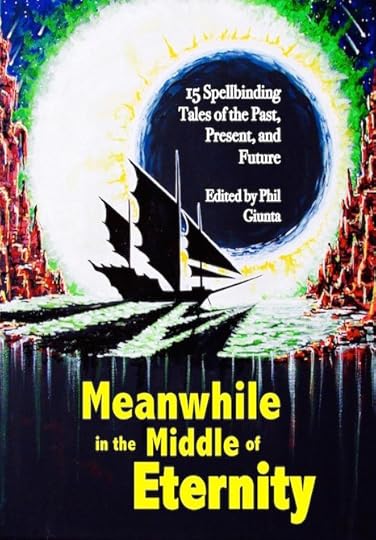
Meanwhile in the Middle of Eternity
As most of you know, all three of my novels were published by Maryland-based Firebringer Press owned by writer pal Steven H. Wilson. Additionally, I created and edited a series of speculative fiction anthologies called the Middle of Eternity series for Firebringer. The first two volumes, Somewhere in the Middle of Eternity and Elsewhere in the Middle of Eternity were released in 2014 and 2016, respectively.
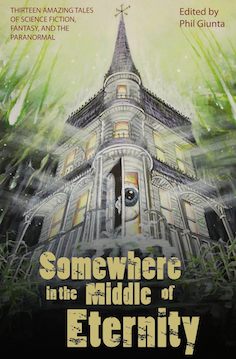

I’m excited to report that Steve and I are working on the long-awaited third volume in the series! Almost all content is in and I can tell you that the stories and interior illustrations are incredible, not to mention the cover created by returning artist Michael Riehl.
Steve and I are thrilled to welcome back series writers Michael Critzer, Daniel Patrick Corcoran, Stuart Roth, Susanna Reilly, April Welles, and Lance Woods.
New voices joining us for book three include Julie Fedon, Chris Ochs, Peter Ong, Bart Palamaro, and Richard Shawn as well as artists Laura Inglis and Tim Marron.
Stay tuned for more info in the months to come!
October 19, 2019
About This Writing Stuff…
This week, Tim Grahl reveals the ingredients to a successful book launch while Joanna Penn offers quick advice on how to combat imposter syndrome.
Over at the Kill Zone, James Scott Bell provides guidance on character description while Jordan Dane talks layering scenes and plot. We have a twofer from that wise Mythcreant, Chris Winkle, who first expounds several methods for ensuring your protagonists pull their weight, and then points out how to spot misandry in your story.
Writer pal Kathryn Craft reveals why you might be afraid of your WIP while Tiffany Yates Martin whips our editor’s brain into shape.
All that and a little more. Enjoy!
The Book Launch Framework: How I Keep Launching Bestselling Books by Tim Grahl
How Writers Can Deal with Self-Doubt and Imposter Syndrome by Joanna Penn
How to Describe Your Main Character by James Scott Bell
How to Enhance Your Writing by Layering Your Scenes & Plot by Jordan Dane
18 Ways for Protagonists to Contribute and Five Signs Your Story is Sexist—Against Men by Chris Winkle
CockyGate Update: One Writer’s Adjective; Another Writer’s Short-Lived Trademark by Matt Knight
How to Train Your Editor Brain by Tiffany Yates Martin
12 Signs You’re Afraid of Your WIP by Kathryn Craft
6 Ways to Immerse Your Readers in the Setting of a Story by Joslyn Chase