
Sonia Manzano's Blog, page 4
October 21, 2016
Thoughts about assault messages (in the Presidential race)
Thoughts about assault messages:
In my memoir, Becoming Maria: Love and Chaos in the South Bronx, I describe how, as a first grader, I had been surrounded by boys who stuck their fingers up my skirt during recess. They only stopped probing when they heard the bell that signaled playtime was over, and we all raced back inside.
Hair disheveled, dress torn, I ran to the principal’s office to complain. I remember him sticking his lardy nose in my face and scolding me, “That’s what you get for playing with boys!” I was stunned.
The next time, I was groped in Crotona Park Pool in the Bronx. I loved going to that pool as it was one of the few things the Bronx had to offer kids like me.
The summer I turned eleven I readied myself for more aquatic fun. Five minutes after my first splash I was surrounded boys, about my own age, who handled me enough to hound me out of the water.
What is remarkable is that I didn’t blame the boys. I blamed my developing body. I stopped going to the pool and sullenly and resentfully accepted having my life curtailed and narrowed even more than it already was.
By that time, I had subconsciously learned lessons taught in the macho society I was being raised in. Boys will be boys and copping a feel was what they did in order to grow up into being real men.
In fact, I had already heard many cheating husbands excuse their behavior by telling their wives’ they had no choice. That cheating was simply following their manly instincts. As a little girl I accepted that my only option was to steer clear of danger. I wonder how many little boys felt their only option was to attack.
Behavioral lessons are taught very early on. But I never thought creepy sexual messages I received as a kid, would inadvertently come from a presidential hopeful. Children are smart and pick up all cues we send them. Though it’s true they digest information and then come to their own conclusions, responsible adults are careful what ideas they broadcast.
This presidential election has made children hear so much negativity already. What will we do to control the damage?


October 14, 2016
Considering voting for a third party candidate as a protest?
When I did research for my book The Revolution of Evelyn Serrano I read up on some of the leaders of the The Young Lords, a group of Puerto Rican political activists of the late 1960’s.
I was struck how many of them; now in their late 60’s are still, or were activist long after their participation in the Young Lords, was over. The list includes Denise Oliver, who is a professor and contributing editor for progressive political blog Dailey Kos; Juan Gonzalez, who was an activist journalist for the Daily News for over fifty years; and finally Richie Perez, who advocated for minority rights until his death in 2004.
The Young Lords Party had a relatively short life span, but these people never threw their hands up in despair and left the table.
Voting for a third-party candidate is a way of making your voice heard, yes, but it will only give you momentary satisfaction. I suggest you consider America in the long run. Our next president will choose at least one Supreme Court Justice that we will have to live with for a very long time. Maybe even after both candidates are long gone.
Supreme Court decisions have impact for many years. The Dred Scott case of 1857, wherein it was decided that persons of African descent could not or were ever intended to be citizens under the U.S. Constitution, caused untold suffering to many for a very long time. We will have to live with Citizens United, a Supreme Court decision that allows corporations to contribute to campaign funds, for many years to come. Consider the ramifications of inadvertently enabling Trump to appoint a Supreme Court judge: The impact will last much longer than the satisfaction of casting a protest vote. Instead, why not use the energy of your disgust to elect Clinton and then hold her feet to the fire on the issues you believe in?
I urge you to stay at the table.
September 10, 2016
Familiar Face on ‘Sesame Street’ Tells of Her Own Childhood
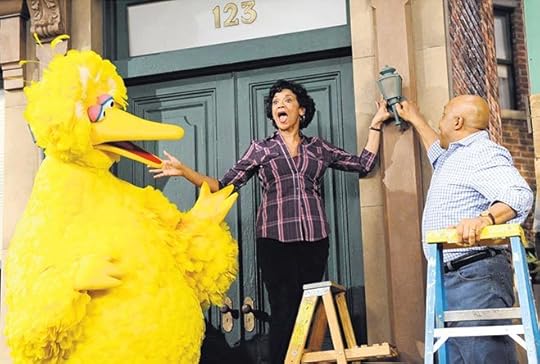
“Sesame Street” was “like a reality show without the whining,” says Sonia Manzano, a.k.a. Maria, here in 2011 with Big Bird and Gordon (Roscoe Orman). She recently announced her retirement.
By GEORGE GENE GUSTINES
Talking to Sonia Manzano feels like catching up with an old friend.
Some of the familiarity comes from the fact that Ms. Manzano played Maria on Sesame Street for 44 years. Naturally, a wave of sadness and nostalgia followed news of her retirement from the show, which she mentioned in an almost orn1and way during a speech in July at the annual conference of the American Library Association. Her listeners “gasped and they tweeted it,” she said on a recent Wednesday over lunch, at a modest Mexican restaurant in her Upper West Side neighborhood. “I always say I meant to do it five years ago, but I forgot.”
Though she’s no longer working with the Muppets – besides playing Maria, she was also a writer for the show and won 15 Emmys for that work – it does not mean that she’s idle. Ms. Manzano’s memoir, “Becoming Maria: Love and Chaos in the South Bronx,” a chronicle of her journey from an impoverished childhood amid domestic violence to adulthood, was released in late August.
Ms. Manzano, 65, who already has a novel under her belt, as well as two children’s books (a third, “Miracle on 133rd Street” is out on Sept. 22), said she had always been a fan or memoirs and was especially taken with “Angela’s Ashes,” by Frank McCourt. “What was so striking about it was that it was such a sad, miserable experience, yet it was so funny,” she said. “That kind of laughing at the absurdity of the situation you find yourself in was really appealing to me.”
Ms. Manzano had been considering a memoir at least as far back as 1995, which is the date on an early manuscript in her closet. “I’ve been working on this book for so long that my parents have since passed,” Ms. Manzano said. She responded wryly to condolences offered solely for the loss of her mother. “I have a feeling I’m going to find myself defending him,” she said of her father, who was abusive. “That’s the difficulty of being a kid – when you feel two things at the same time.” Her childhood provides plenty of material. In the book, there are moments of giddiness, as when she looks at the advertisements in a subway car and realizes that she has a new skill. She writes: “In one split second the words fall into place and I am reading. I’m reading!”
There are also times of bleakness. At one point, Ms. Manzano hides knives before her drunken father arrives home; at another, she watches him beat her mother with a broken table leg. Somehow, family life always resets to nearly normal after these tempests.
The promise of a bright future begins when she arrives at Carnegie Mellon University on a full scholarship. She is assigned to a show called “Godspell” which is being developed at the university. It is a success and moves to New York. In a 1971 article in The Times, the critic Walter Kerr described his excitement over the sight (“impertinently curved”) and sound (his ear was, he wrote, “startlingly teased”) of Ms. Manzano. The memoir is nearly at its end before the magical words “Sesame Street” appear. In 1969, Ms. Manzano happened to see a broadcast of the series at the Student union at Carnegie Mellon and was thunderstruck by what she saw: people of all different races. “I am really taken aback by the street scene depicted because it reminds me of every neighborhood I have ever lived in.”
She writes. “Becoming Maria” ends with her audition, in 1971, for the show, which was produced by the Children’s Television Workshop (now the Sesame Workshop). “It just seemed like a natural breaking point,” Ms. Manzano said. ” It was the beginning of a new tile, the beginning of separating myself a little more from my family.”
Last month, the Workshop announced that it had struck a deal with HBO in which new episodes of ”Se.same Street” would first air on that premium cable network and be broadcast on PBS nine months later. Ms. Manzano discussed the agreement in a followup email. “‘Sesame Street’ has always mirrored the sensibility of the times it exists in,” she wrote. “I guess this move to HBO means it continues to do so. I would be sadder if it wasn’t on the air at all.”
The series helped propel Ms. Manzano on her path to becoming a writer. She was often asked for her ideas about the Hispanic content and felt validated when they became part of the show. “I had a lot of support; she recalled. “They really wanted to get people of color behind the camera, as well as in front.”
Emilio Delgado, who joined the cast as Luis in 1971, was not surprised that Ms. Manzano became a writer for the show. “She’s a natural for it and she’s got a great sense for comedy,” he said. He said “Sesame Street” was a perfect place to work. “We all got along perfectly – even better than some people in families.”
The circumstances of Maria’s life often reflected what was happening to Ms. Manzano in the real world. “It was like a reality show without the whining,” she said. Ms. Manzano married a conservation foundation official, Richard Reagan, in 1986; Maria married Luis in 1988. When Ms. Manzano became pregnant, so did Maria, whose daughter, Gabi, was played by Ms. Manzano’s daughter, Gabriela, for several years.
But that did not lead to an acting career. “She didn’t like it,” Ms. Manzano said. “You have to force your kids to do enough stuff. Go to school, go to the doctor, go to the dentist. You don’t have to force them to be on television.”
Gabriela is now 27, a yoga teacher who shares her mother’s sense of humor. Ms. Manzano recalled a long drive, a few years ago, after she had completed a chapter in the memoir. She offered to read it aloud to help pass the time. Gabriela pointed to a copy of “Vanity Fair” and responded, “How about you read that story on Lady Gaga?”
Download the full article here.
August 6, 2016
Here’s to Bob, Luis, Gordon, and the “Sesame Street” Grownups
Original article: http://www.newyorker.com/culture/sarah-larson/heres-to-bob-luis-gordon-and-the-sesame-street-grownups
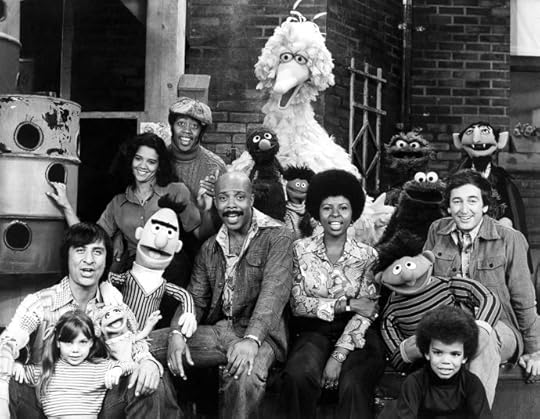
The “Sesame Street” gang in 1969. Photograph by Sesame Workshop / Everett
On a magical night not too long ago, at a party for the opening of “Somebody Come and Play: 45 Years of Sesame Street,” at the Library for the Performing Arts, I met some of my generation’s heroes: Bob, Susan, Maria, and Oscar the Grouch. It was as joyous as one might hope. Beneath Super Grover and a cloud-dotted ceiling, Loretta Long, who plays Susan, gave me a big hug; Sonia Manzano, who plays Maria, talked about Maria’s time as a construction worker; Oscar told me he was having a rotten time. (Roscoe Orman, who plays Gordon, wasn’t there; Emilio Delgado, who plays Luis, was filming an episode of “House of Cards.”) When I saw Bob McGrath—Bob—across the room, he turned and waved as if he recognized me. I briefly, crazily reverted to my kid-brain, imagining that he had seen me through the television. Anyone who grew up with “Sesame Street” might understand.
The news, this week, that McGrath, eighty-four, Delgado, seventy-six, and Orman, seventy-two, had been laid off from the show hit people hard, and contributed to a “Sesame Street” malaise that’s been gathering for a while among old-school fans. On the other hand, of course, it’s a kind of miracle that these actors were still on the show in the first place, after more than forty years—as is Caroll Spinney, who plays Big Bird and Oscar the Grouch. Manzano retired last year; Long remains on the show. But for my generation—shaped by “Free to Be You and Me,” the Muppets, “Mister Rogers’ Neighborhood,” and other progressive, respectful fare—the loss of so much of the original cast has provoked further nostalgia for what was. We worry that the show is not just losing its veterans but losing its heart.
Few, if any, of my friends’ children have the connection to “Sesame Street” that we did growing up. For many of us, Elmo, and what he represents, is to blame. (This “Sesame Street” resident’s blasé reaction to him made me laugh.) Elmo’s high voice, his aggressive cuteness, his baby talk, his third-person habit, his lack of pronouns, his role in countless too-deliberate pop-culture parodies—that’s not what the show used to be about. The qualities that Bob, Maria, Susan, Gordon, Luis, and company brought to it were.
On children’s television, there’s a vital difference between shows that talk down to kids and shows that don’t. Early on, “Sesame Street” had the respect for children to give us real art, real jazz, real weirdness, real lessons. It didn’t address us in a high, squeaky voice. In the seventies, the suspicion and alienation I felt watching stuff like “Bozo the Clown,” “Romper Room,” or “New Zoo Revue” (or “Banana Splits,” which seemed to be made by stoners, for stoners) existed in a world very far from “Sesame Street,” which combined anarchy with reason and intelligence, and treated us with dignity. In the nineties, when the simpering, dopey Barney took over the world, children’s entertainment reached a new low. (I always pitied those poor children, marching, singing, and performing Dick-and-Jane dialogue with terrifying, dubious mirth.)
When Elmo began to dominate “Sesame Street,” as the show began to shift toward a younger audience, the trust between show and audience began to shift, too. The note of condescension that he introduced has never ceased, though some lovable elements remain. Abby Cadabby, shrill, pink, hyper, and a fairy, came along for noble reasons, but she’s grating, like Elmo with princess frills and a magic wand. The show has had to change, for financial and cultural reasons, but the change doesn’t feel good to those who loved it as it was—or, often enough, to their kids.
Bob McGrath was generous about the show’s evolution, even as it slighted him, when I talked to him at the party. For one thing, the number of episodes produced each season had been greatly reduced. For another, he said, “Our audience has become much, much younger than it was. We were originally for four- or five-year-olds; now it’s pretty much like zero to three. They can’t hang on to a story line as long as the older kids could, so the human element is only about the first twelve minutes of the show—one segment, instead of six or seven or eight that ran through the whole hour.” That was one reason he had less airtime. The other was that “one always wants the show to look young and fresh. So that means a few of us dinosaurs—ha ha!—are doing fewer shows than a few other people, who deserve to be.” He named some of these deserving younger cast members, such as Alan Muraoka, who remains. “It’s a much heavier Muppet-related show, and rightfully so, because the kids who are one or two or three relate much better to a Muppet than they would a talking head,” he said. He sounded cheerful and understanding about all of this. Bob was a good sport. Of course he was!
But I felt protective of the dinosaurs. Bob and the others were the voice of maturity and reason on “Sesame Street”—loving, accepting, wise. They had assured us on some primal level that everything was all right in this shaggy oddball world: the Muppet craziness, the gritty city streets, the lessons and strange characters we encounter in life. If they explained what sound waves were or taught us how to say “hello” in Spanish, we didn’t feel lectured; we felt grateful. Their kindness and patience was key to this. In the human-puppet dynamic on the show, they were the grownups, basically, and the puppets—little noisy maniacs made of yarn and felt, these birds and monsters who mesmerized and amused us—were the kids. We didn’t see that then, but we understand it now. And to squish those grownups aside as we further foreground Elmo and Abby Cadabby, as we bring on more and more celebrities to help us brush our teeth, is to disrespect our elders, to mistreat our friends. That’s what it feels like, anyway, and “Sesame Street” taught us to express our feelings.
So I’m going to take my feelings and turn them around, as Bob, Luis, Gordon, and the gang would want me to, and type out a little love. Grownups of “Sesame Street,” thank you, from the kids of my generation and beyond. Thank you for being patient friends, good-humored teachers, and second-wave feminists. Thank you for reassuring us with your sanity after this guy showed up. Thank you for teaching us about sharing, spelling, numbers, jobs, facial expressions, and toaster repair. Here’s Bob singing “The People in Your Neighborhood” in 1969, 1971, 1977, the olden days, and 1986. Here’s Gordon riding his bike through the city, going for his morning run, teaching us about quiet and loud, and preaching about rain. (“Support your local rainstorm!”) Here’s Luis realizing he needs glasses, and singing “Baa Baa Bamba,” in Spanish and English, with sheep. Here’s Bob learning to dance. Here’s Gordon getting ready to adopt a baby with Susan. (“You’ll be a daddy.” “Whooppee!”) Here’s Maria as a librarian and a construction worker and a Fix-It Shop employee. (“I had to work hard and fix all those toasters and waffle irons.”) Here’s Oscar, Susan, and Gordon recycling, with help from a VW Bug. “Sesame Street” grownups, when we think of you, we feel the joy and jazz of “Pinball Number Count.” We love you like Oscar loves trash and Cookie Monster, that furry glutton, loves cookies. You have earned an enjoyable retirement. Thank you for being in our neighborhood.
Sarah Larson is a roving cultural correspondent for newyorker.com.
July 21, 2016
Bronx Children’s Museum Honors U.S. Supreme Court Justice Sonia Sotomayor
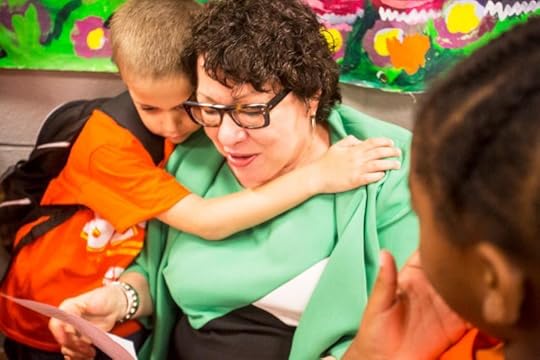
Students read letters to the Justice
The Bronx Children’s Museum held its seventh annual Dream Big Day at Bronx Community College on July 14th. The honoree was Bronx native and U.S. Supreme Court Associate Justice Sonia Sotomayor. Dream Big is the Museum’s intensive summer arts-enrichment program for children in 2nd and 3rd grades. It is held at local Community Based Organizations (CBOs), schools and community groups. Associate Justice Sotomayor has attended Dream Big Day for seven consecutive years.
This summer the theme is “Discovering Your Home.” The Museum Board decided it was time to honor the Justice once again after celebrating her life and appointment to the Supreme Court in 2010 when the Dream Big program first began.
As Hope Harley, Board President emphasized, “The Justice’s heartwarming story about working hard to achieve one’s dreams is a story we want all of our children from the Bronx to understand, identify with, and be inspired by. The Bronx Children’s Museum has been inspired by the Justice’s journey because we, too, have been dreaming big and working hard. We’ve been receiving a lot of support. As a result, construction is to begin in late 2016 on a gorgeous, landmarked, City-owned building, which we will call our home in 2018. This has been our dream for the children of the Bronx!”
In the Dream Big summer program, Bronx teaching artists engage children through the arts in the exploration of a theme or the study of a Bronx notable person. The program runs for three days a week for four or five weeks and includes a celebration day called Dream Big Day at a Bronx college and a closing celebration at their Community Based Organization or school.
This summer’s program has 100 children from Phipps Houses (Sotomayor Houses and Soundview Houses) and SCAN (Supportive Children’s Advocacy Network) at P.S. 55 in Morrisania. For the month of July, children are studying the life of the Justice using drama, the visual arts and books. The Museum also created a special video with the Justice for the 2016 Dream Big participants. In addition, this Dream Big Day morning the children had a memorable opportunity to speak directly with the Justice, and a chance to meet another of New York City’s remarkable leaders, First Lady Chirlane McCray, who spent forty-five minutes interacting with Dream Big Day participants in the morning before student workshops commenced.
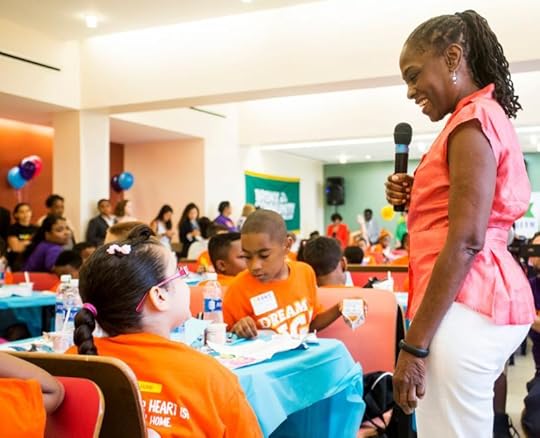
First Lady Chirlane McCray talks with students about the importance of college
In the afternoon in the Bronx Community College Playhouse, renowned Bronx storyteller David Gonzalez talked to the children about the theme of home and the importance of storytelling. The performance was interspersed with speakers including Sonia Manzano (formerly “Maria” from Sesame Street and pioneer advocate of the Museum). Ms. Manzano introduced the Justice as the Dream Big Day 2016 honoree with praise and appreciation on behalf of all Bronx children past, present and future.
When she addressed the children during the afternoon performance, Justice Sotomayor stressed her Bronx upbringing, similar to many of the children there, saying, “I want you to be me, because I am you, and that means you need to dream big.” She then invited the children on stage in order to get a better viewpoint of the many adult attendees in the auditorium, explaining that “These are the people who are here to support [you].”

Sonia Manzano shares background on her life growing up in the Bronx
Sonia Manzano had this to say about her longtime friend: “I can’t think of a more deserving person to be honored by the Bronx Children’s Museum. The Justice’s story is a testament to the great potential that exists here in the Bronx among our children. Like myself, and like many of the children here today, the Justice was born and raised here in this amazing borough, and her achievements inspire us all to dream big and work hard. With the Justice as a role model, and with the Bronx Children’s Museum providing these educational opportunities to children, I expect that we’ll see many more great artists, thinkers, and lawmakers come from the Bronx in the future.”

Performer David Gonzalez captivates students
NYC First Lady Chirlane McCray noted, “Our children cannot achieve what they cannot imagine, especially those children who begin life on the bottom rung of the economic ladder. When young people are able to interact with shining examples of success like Justice Sotomayor and Sonia Manzano, who understand their lives and even come from the same neighborhood, it fuels their imagination as to what is possible for their own future. These kind and generous leaders, and public institutions like the Bronx Children’s Museum help inspire and motivate our children to achieve. I am honored to spend time with these leaders – and the amazing future leaders – as a part of the Bronx Children’s Museum Dream Big program.”
Bronx Borough President Ruben Diaz Jr. remarked, “The Bronx has nurtured many great minds over the centuries, but few are as noted and accomplished as Supreme Court Associate Justice Sonia Sotomayor. While known best for her dedication to upholding the law, her presence here today, and at every Dream Big Day held in the Bronx over the past seven years, proves that the Justice above all else is a person who cares deeply for her community and her home. I encourage the children here to look to Justice Sotomayor as a shining example of where their dreams can take them, if they are willing to first remember where they come from.”
NYC Council Speaker Melissa Mark-Viverito said, “As the first Latina Supreme Court Associate Justice, Sonia Sotomayor has set a high standard for personal and professional achievement. In examining her journey from the public housing developments of the South Bronx to her seat on the highest court in Washington D.C., we are inspired by how far she has traveled and by her continued commitment to justice and equality. Her story teaches us all that no matter where we come from, no matter our gender, race, or religion, nothing is impossible for those willing to strive hard to accomplish their personal dreams and aspirations.”
NYC Council Member Vanessa Gibson said, “The children of the Bronx need and deserve role models that demonstrate courage, conviction, and tenacity. Supreme Court Associate Justice Sonia Sotomayor is one of those role models. In her, each Bronx child can see their own true potential and aspire to reach the same monumental heights as the Justice. I’m honored today to join the Bronx Children’s Museum in honoring the Justice for the important role she plays in inspiring the children of my borough to reach higher and try harder for the betterment of themselves and their community.”
“The Bronx Children’s Museum serves as a beacon for our youth in the Bronx. It helps our future leaders by guiding them to dream big and reach their goals through culture, science and education. Being able to provide valuable opportunities for Bronx children to learn and expand their minds this summer through its Dream Big arts enrichment program will prove invaluable, as they explore their home and the life of U.S. Supreme Court Associate Justice Sonia Sotomayor – a personal hero of mine – as well as venture into the expansive worlds of drama, the visual arts and literature,” said Assemblywoman Latoya Joyner (D-Bronx, 77th AD). “Giving our children the tools they need to succeed over the summer break will provide our youth with the necessary skills and educational development supports they need. As the state elected representative for the 77th Assembly District, which includes the Claremont, Concourse, Highbridge, Mount Eden and Morris Heights sections of The Bronx, I am happy the Bronx Children’s Museum will continue their good work in our community for our families.”
Regents Chancellor Betty A. Rosa remarked, “I am thrilled to take part in today’s event honoring Associate Justice Sonia Sotomayor. As Bronx-born Latinas, we both know the potential this Borough has to inspire greatness. For seven years now, the Bronx Museum’s Dream Big summer arts-enrichment program has provided countless children with that inspiration – and I know it will continue to do so for years to come.”
Bronx Community College President Dr. Thomas A. Isekenegbe said, “It is an honor to welcome Supreme Court Justice Sonia Sotomayor to our historic campus and to partner with the Bronx Children’s Museum on their Annual Big Dream Day. Earning a college degree is a big dream we embrace for all of our children, and it is a privilege for Bronx Community College to have a role in planting the seeds that will make this dream come true for those gathered here today.”
The Dream Big Initiative is made possible this year through the generosity of the Bronx Community College and the Bronx Children’s Museum funders: Bronx Children’s Museum Board of Trustees, the Bronx-Lebanon Hospital Center, Macy’s, the Montefiore Medical Center and The Pinkerton Foundation.
For more information contact: Nicole Wallace, Dream Big Day Manager. Phone: 646-474-5185
ABOUT THE BRONX CHILDREN’S MUSEUM
The Bronx Children’s Museum is currently a museum without walls serving over 18,000 children, family members, and caregivers annually in seven programs. Founded in 2005, the Bronx Children’s Museum provides highly effective and innovative inquiry-based educational programs and exhibits for children. As an emerging museum, the Bronx Children’s Museum has piloted programs without walls for over 50,000 children and caregivers since 2006 in some of the most underserved areas of the Bronx. Visit our map to see all the locations we’ve visited throughout the Bronx.
The Museum is developing its new facility, to open by 2018 in the old powerhouse building in Mill Pond Park across from Yankee Stadium. The Museum will provide interactive, inquiry-based programs, both inside and outside the Museum’s walls. The programs promote literacy, the arts, science, cultural enrichment, greening, and sustainability. The Museum collaborates with, complements, and supports Community Based Organizations, shelters, foster care and day-care programs, and schools, as well as cultural and recreational institutions in the Bronx.

Bronx Children’s Museum: For questions regarding the Museum and its programs please contact Richard Stein, press liaison for the board. Phone: 718-884-5715.
May 22, 2016
Sonia Manzano, a.k.a. Maria on ‘Sesame Street,’ Recalls Her Real-Life Bronx Childhood
Original article: http://www.wsj.com/articles/sonia-manzano-a-k-a-maria-on-sesame-street-on-her-real-life-bronx-childhood-1463499087
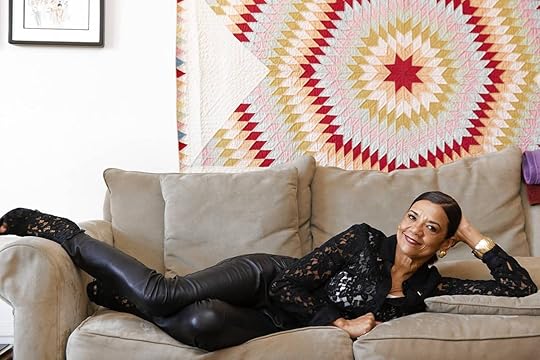
Sonia Manzano in her New York City apartment. Photo: Juliana Sohn for The Wall Street Journal
Sonia Manzano, 65, played Maria on TV’s “Sesame Street” for 44 years. She won 15 Emmys as a writer for the show and one for Lifetime Achievement. She is author of “Becoming Maria: A Memoir” (Scholastic). She spoke with Marc Myers.
When I first walked onto the “Sesame Street” set as Maria in 1971, I felt at home. Everything reminded me of my South Bronx neighborhood, including the set’s stoop, fire escape, candy store and garbage cans. In truth, my home life and neighborhood were a lot grittier. On the show, I imagined I had a chance to relive my life but make it nicer.
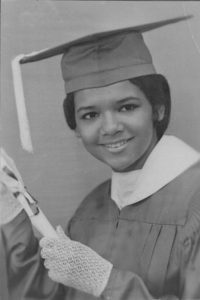
Ms. Manzano in a 1968 graduation photo from the then-High School of Performing Arts in New York City. Photo: Sonia Manzano
I spent my early childhood in a tenement building at 3858 Third Ave. near Crotona Park in the Bronx. Family life was hard and vibrant.
We lived on the fourth floor, and the elevated subway line ran past our windows. I liked the predictability of the train’s rumble every 10 minutes and watching my mother get off the train and wave to me.
I spent my early childhood in a tenement building at 3858 Third Ave. near Crotona Park in the Bronx. Family life was hard and vibrant.
We lived on the fourth floor, and the elevated subway line ran past our windows. I liked the predictability of the train’s rumble every 10 minutes and watching my mother get off the train and wave to me.
One of my earliest memories is my father coming home drunk and tearing up our apartment because my mother wasn’t home. She was out with her brother. When my uncle dropped her off, my parents argued in the street. To me, from our window, it looked like theater—a show they would put on over and over again. Between my parents, it was crazy love.
Our apartment was tight. My mother had a clothesline out one window and in another. My older sister had one tiny room, and I shared a small room with my two younger brothers. The stress at home was horrible, but I had hope.
My father, Bonifacio, was a laborer. He was the foreman of workers who applied tar to the roofs of apartment buildings. He made good money thanks to my mother, Isidra, who was a garment worker and had encouraged him to join a union as she had.
Our neighborhood wasn’t particularly safe. We had a police lock on our front door—a metal bar that ran from the top though a slot in the middle of the door to the floor. It had a medieval sound. Of course, my life wasn’t as bad as my parents had it in Puerto Rico during the Depression.
One day, I told my fourth-grade teacher that we were middle class. She said, “No, no, no, you are all poor.” I told my mother. She said, “We’re doing all right.”
My parents struggled. They kept fighting and splitting up and coming back together and not really moving forward. I thought they were like oxen, never looking up. I didn’t want to be a part of that. I always felt there was a bigger world out there.
A turning point for me came in 1961, when I was 11. One my teachers, Miss Shirley Pellman, took me and two girlfriends to see the movie “West Side Story.” I loved the film. It exalted every banal icon in my neighborhood and made everything seem beautiful.
Seeing that film had a profound effect on me. The beauty of the movie made me cry uncontrollably in the theater, and I couldn’t be consoled. I scared my teacher. That’s when I realized what art is.
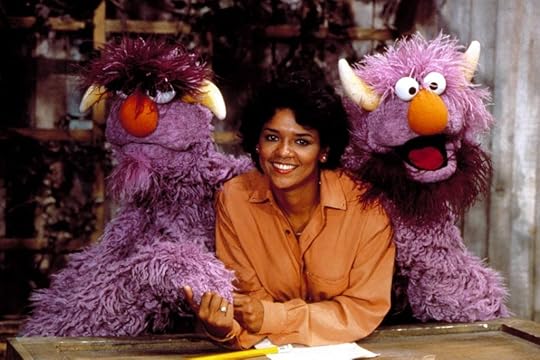
The actress in the early 1990s in her role as Maria on the set of ‘Sesame Street.’ Photo: PBS/ Everett Collection
I began acting at Manhattan’s High School of Performing Arts and then attended Carnegie Mellon University in Pittsburgh on a scholarship. One rainy day in 1969, I was in a foul mood and went to the student union. On the TV was Burt Lancaster counting to 10 and James Earl Jones reciting the alphabet. The show was “Sesame Street.”
At college, I was cast in “Godspell,” which started as a student project at Carnegie Mellon. When the musical moved to off-Broadway in 1971, I went to New York and continued in the role. Later that year my agent sent me on an audition for “Sesame Street” and I won the part. At first, I thought I was supposed to play a role on the TV show, but they insisted I just be myself. They wanted a real person who inner-city kids could relate to.
It took me a couple of years before I was comfortable being myself on purpose. It happened when I realized I couldn’t compete with the Muppets. I was the straight man.
Today, I live on Manhattan’s Upper West Side. My husband, Richard, and I live in a two-bedroom apartment on the 14th floor of a prewar building.
After 44 years on “Sesame Street,” retiring in 2015 was hard, but it was time. I think Maria’s legacy is that she helped kids accept the reality of their lives. I always imagined that children watching the show wanted an hour of comfort and sanctuary. I could only give it to them if I was myself.
May 9, 2016
Sonia Manzano Receives Lifetime Achievement at 2016 Daytime Emmy Awards
Original article: http://www.latintimes.com/daytime-emmys-2016-winners-sonia-manzano-mario-lopez-take-awards-plus-full-list-383360
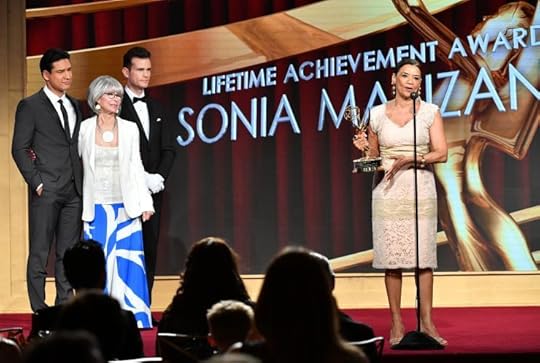 TV personality/host Sonia Manzano speaks onstage after being awarded a Daytime Emmy Lifetime Achievement Award at the 43rd Annual Daytime Emmy Awards at the Westin Bonaventure Hotel on May 1, 2016 in Los Angeles, California. Earl Gibson III/Getty Images
Sonia Manzano and Mario Lopez bagged awards at yesterday’s 2016 Daytime Emmy Awards. Despite the fact that the annual event was not broadcast on television, lots of stars atended the ceremony after walking down the red carpet at L.A.’s Westin Bonaventure.
Manzano, the beloved “Sesame Street” actress, took a Lifetime Achievement accolade. “My children and just about every child in America has grown up learning their ABC’s from the iconic character of “Maria,” on Sesame Street played by Sonia Manzano,” said Bob Mauro, National Academy of Television Arts and Sciences President. “Sonia not only brought the life events of marriage, having a baby, and being a mother to viewers young and old, she also brought a seldom-seen diversity, a Latin role-model, unlike anything on television at the time.”
Former “Saved by the Bell” star Lopez took home the Outstanding Entertainment News Program Award for his show “Extra.” Lope is rumored to be a likely candidate to take over Michael Strahan’s hosting spot on “Live! With Kelly and Michael”.
Check out the nominees before you read through the full list of this year’s winners.
Here is the complete list of winners:
Outstanding Lead Actress in a Drama Series
Mary Beth Evans, Days of Our Lives
Outstanding Lead Actor in a Drama Series
Tyler Christopher, General Hospital
Outstanding Drama Series
General Hospital
Outstanding Supporting Actor in a Drama Series
Sean Blakemore, General Hospital
Outstanding Supporting Actress in a Drama Series
Jessica Collins, The Young and the Restless
Outstanding Drama Series Writing Team
The Bold and the Beautiful
Outstanding Drama Series Directing Team
General Hospital
Outstanding Younger Actress in a Drama Series
True O’Brien, Days of Our Lives
Outstanding Younger Actor in a Drama Series
Bryan Craig, General Hospital
Outstanding Guest Performer In Drama Series
Obba Babatunde, The Bold and the Beautiful
Outstanding Entertainment News Program
Extra
Outstanding Entertainment Talk Show Host
Kelly Ripa and Michael Strahan, Live! With Kelly and Michael
Outstanding Game Show Host
Craig Ferguson, Celebrity Name Game
Outstanding Game Show
The Price Is Right
Outstanding Talk Show/Entertainment
The Talk
Outstanding Talk Show/Informative
The Chew
Outstanding Informative Talk Show Host
Dr. Mehmet Oz, The Dr. Oz Show
Outstanding Morning Program
CBS Sunday Morning
Outstanding Daytime Talent in a Spanish Language Program
Gabriela Natale, SuperLatina
Outstanding Entertainment Program in Spanish
SuperLatina
Outstanding Morning Program in Spanish
Café CNN
April 7, 2016
Sonia Manzano to receive Lifetime Achievement Award at 43rd Annual Daytime Emmy Awards
 SONIA MANZANO
TELEVISION’S “MARIA” ON SESAME STREET
TO RECEIVE LIFETIME ACHIEVEMENT AWARD
AT THE 43rd ANNUAL DAYTIME EMMY® AWARDS
To be Honored on Sunday, May 1, 2016 at the Daytime Gala
New York, NY – April 6, 2016 – The National Academy of Television Arts and Sciences (NATAS) today announced that Sonia Manzano, legendary performer of “Maria” from Sesame Street, will be honored with the Lifetime Achievement Award at the 43rd Annual Daytime Emmy® Awards on Sunday, May 1, 2016 at the Westin Bonaventure Hotel and Suites.
“My children and just about every child in America has grown up learning their ABC’s from the iconic character of “Maria,” on Sesame Street played by Sonia Manzano,”said Bob Mauro, President, NATAS. “Sonia not only brought the life events of marriage, having a baby, and being a mother to viewers young and old, she also brought a seldom-seen diversity, a Latin role-model, unlike anything on television at the time. She is one of the most beloved female performers in the history of Sesame Street, and the National Academy is proud to be honoring her with our prestigious Emmy Award for Lifetime Achievement.”
“Honoring Sonia Manzano has a special meaning for me – as we both started our professional careers doing the play, Godspell, though in different casts when we were practically children,” said David Michaels, SVP, Daytime (NATAS). “Her talent both in front of the camera and as a writer, bringing the themes of diversity to a national audience on Sesame Street, is an extraordinary achievement worthy of this well-earned recognition!”
Ms. Manzano will be joining an illustrious group of previous Lifetime Achievement Honorees including, Betty White, Oprah Winfrey, Barbara Walters, Merv Griffin, Dick Clark, Bob Barker, Alex Trebek and many others.
Sonia Manzano
Sonia Manzano (Maria) is a first generation Puerto Rican who has touched the lives of millions of parents and children as “Maria” on Sesame Street and helped them grow smarter, stronger and kinder.
Manzano was raised in the South Bronx where her involvement in the arts was inspired by teachers who encouraged her to audition for the High School of Performing Arts, where she began her career as an actress. She came to New York from Carnegie Mellon University to star in the original production of the off-Broadway show Godspell. Manzano joined Sesame Street in 1971 and holds 15 Emmy Awards for her previous work as part of the Sesame Street writing staff.
Manzano has performed on the New York stage in The Vagina Monologues, The Exonerated and Love, Loss and What I Wore. She has written for the Peabody Award-winning children’s series, Little Bill, and her children’s book, No Dogs Allowed, published by Simon & Schuster Children’s Publishing in 2004, was selected by the General Mills initiative Spoonfuls of Stories. Her second book, A Box Full of Kittens, was published in 2007. Manzano’s first young adult novel The Revolution of Evelyn Serrano, published by Scholastic in 2012, was chosen as a Pura Belpre Honor Book. A Christmas picture book, Miracle on 133rd Street was released September 2015. Her memoir Becoming Maria: Love and Chaos in the South Bronx was published September 2015 as well.
Manzano received the Congressional Hispanic Caucus Award in Washington, DC and the Hispanic Heritage Award for Education in 2003. She is proud to have been inducted into the Bronx Hall of Fame in 2004. She received an honorary doctorate in fine arts from Notre Dame University in 2005. She was voted one of the most influential Hispanics by People Magazine en Español (February 2007) and Ballet Hispanico awarded her their Inspiration Award in April 2011. She received the New York Women in Film and Television Muse award for outstanding vision and achievement in December 2013. Manzano was twice nominated for an Emmy Award as Outstanding Performer in a Children’s Series.
She has served on the March of Dimes board, the board of the George Foster Peabody Awards and the board of Symphony Space, a New York City theatrical institution. Manzano also volunteers for The Bronx River Alliance, an organization dedicated to cleaning up the Bronx River in the South Bronx. She also volunteers to make a The Bronx Children’s Museum a reality.
The Daytime Emmy Awards recognize outstanding achievement in all fields of daytime television production and are presented to individuals and programs broadcast from 2:00 a.m.-6:00 p.m. during the 2015 calendar year. The 43rd Annual Daytime Emmy Awards is a presentation of the National Academy of Television Arts & Sciences.
FX Group, Inc., is the official provider of the Daytime Emmy Award Almanac, the official program for the event. Yangaroo, Inc. is the official provider of the Digital Media Distribution System Awards Management Solution (“DMDS”) for the submission, judging and voting of all programs in the 42nd Annual Daytime Emmy Awards.
United Airlines is the official airline of the Daytime Emmy Awards and The National Academy of Television Arts & Sciences.
A full list of all nominees in all categories can be downloaded from our website at www.emmyonline.tv.
Press Registration forms for the May 1st event can be found on the NATAS website at http://emmyonline.com/day_43rd_credentials
About The National Academy of Television Arts & Sciences
The National Academy of Television Arts & Sciences (NATAS) is a professional service organization dedicated to the advancement of the arts and sciences of television and the promotion of creative leadership for artistic, educational and technical achievements within the television industry. It recognizes excellence in television with the coveted Emmy ® Award for News & Documentary, Sports, Daytime Entertainment, Daytime Creative Arts & Entertainment, Public & Community Service, and Technology & Engineering. NATAS membership consists of over 15,000 broadcast and media professionals represented in 19 regional chapters across the country. Beyond awards, NATAS has extensive educational programs including Regional Student Television and its Student Award for Excellence for outstanding journalistic work by high school students, as well as scholarships, publications, and major activities for both industry professionals and the viewing public. For more information, please visit the website at www.emmyonline.tv
On The Web: http://emmyonline.org/
Daytime Emmys: https://www.facebook.com/DaytimeEmmyAwards
DAYTIME EMMYS Twitter: https://twitter.com/DaytimeEmmys
NATAS Press Contact:
Paul G. Pillitteri, SVP, Communications – ppillitteri@emmyonline.tv
NATAS PR LA /Social Media Contacts:
B. Harlan Boll – h.boll@dcpublicity.com 626-296-3757
Lisa England – lisa.england@dcpublicity.com
July 16, 2015
Adios Amigos and See You Soon
 This must be the last picture taken of me on the Sesame Street set as Maria. (I always liked to be photographed by Oscar’s can so I could be associated with my favorite Muppet character.)
After the news of my retirement from Sesame Street became so public I look at this photo and ponder all that’s been said. I don’t want to come across as being falsely modest, I always knew the effect the show had on people, but it was, and is still gratifying to hear it from so many individuals. The outpouring of love and affection has been over whelming. Folks have said everything I want to hear; that they grew up on the show, that I had impacted on their lives, that they related to me and I was their favorite character. Some have even said I was the first Latina they ever knew off.
It has made me feel wonderful.
I remember first seeing the show at the student union of Carnegie-Melon University. In the funk of anger I was always in, I watched James Earl Jones recite the alphabet in a very deliberate manner as the letters flashed over his head. I thought it was a show that taught lip reading. But seeing Susan and Gordon talking to me from a neighborhood that resembled many of the Bronx neighborhoods I had lived in lifted my spirits! I was hooked.
My love affair with television had began long before, as I watched hours of Leave It To Beaver and Father Knows Best on a tiny black and white set, in the mid-fifties in the Bronx. The world I saw was not the one I lived in and I wondered where I would eventually fit it.
People have asked why I’ve stayed so long on the show. I came of age in the late 60’s, a very idealistic time in America. Students were taking over college campuses and the Civil Rights movement was at its peak. I was in the throes of idealistic fervor and Sesame Street fanned the flames. Sesame Street set out to close the education gap and to do its share to eliminate racism. I wanted to help them do it.
People want to know why I chose this particular moment to leave? Of course, there are many answers. The short one is that I got the writing bug with my first picture book No Dogs Allowed and now want to devote all my time to being an author. But there is also this — my friends and I, perhaps because we love theater, talk about having a third act. As we like a beginning and middle and an end or finale in a theatrical piece, we like it in our lives as well. It is time for me to begin my third act.
Sonia Manzano's Blog

- Sonia Manzano's profile
- 86 followers

