Audrey Vernick's Blog, page 11
May 14, 2011
Citrus-Scented Friendship
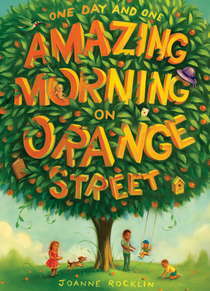 I'll bet this one's been on your radar: One Day and One Amazing Morning on Orange Street. Maybe you heard the buzz. Or noticed the stand-out cover. Or wondered about that long, interesting title.
I was lucky to meet the author right after reading the book—always a dangerous situation. You want to convey how much you loved it. But you don't want to overgush.
Joanne would be gracious even if you overgushed. She even agreed to answer some questions about writing, orange trees, and messy friendships.
Children's Literature 's review of your book says, "This book offers a joyous, life-affirming take on the power of kindness and hope—and most of all, of friendship—to buoy us in times of trial." And I wholly agree. But what I like best is the way Ali, Bunny and Leandra have a friendship that feels messy and true. How did you find that balance?
Their friendships are exactly like the ones I had when I was young–honest, crabby, ecstatic, changing all the time, as we ourselves were growing. I'm not sure I could take the intensity of those kind of friendships as an adult. It is much easier to hide behind a more polite mask, but I feel fortunate to have had those immature but honest friendships while I was exploring what it was like to grow up. Interestingly, a few of my "middle-grade" friendships have survived into adulthood, and are very calm, loving and mature!
What books spoke to you as a child? Do any characters stand out? Which character would you have liked to be your real-world friend?
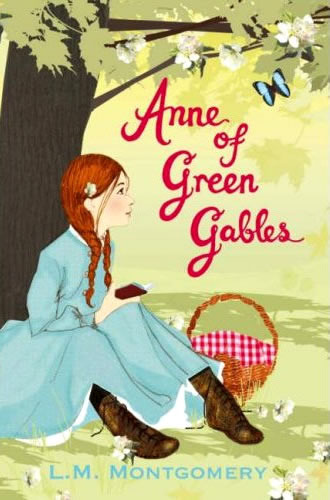 My all-time favorite character was Anne, of Anne of Green Gables. I'm from Canada, too, not that that was the main reason! I think every one of my characters has some of Anne in them, even the boys, but Anne, of course, can't be replicated. Still, her effect on me, the first time a literary character so captured my imagination, has inspired me to strive for the uniqueness of "voice" every time I create my own characters. I was powerfully drawn to her love of words, rebelliousness, imagination, optimism, honesty, lovability, and HUMOR. I gobbled up every one of L.M. Montgomery's books, following Anne to adulthood. She felt so real to me, and still does.
 Do you have a favorite literary friendship?
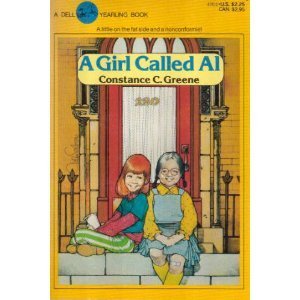
See above! I should also mention another book, more contemporary, but not that comtemporary (1969!), one I love, which was an ALA Notable book a while back, and which I like to read over and over again, especially while I'm working on my own stuff. It's also a story about a friendship. The book always reminds me to stay real and natural in tone, and to respect the true voice of each character. The tone of it is so humorous to me, only because it is right-on for the age, which is middle grade. Funny, but not always on-purpose funny. Funny because it's true. And so poignant. Bet you're wondering what the book is already…! It's Constance C. Greene's short novel A Girl Called Al, which few people have read lately.
What role do friends play in your writing life? Do you have a critique group? Friends who read your work?
It gets lonely being an author…I love getting together with writer friends from L.A. and have been working hard at making "literary friendships" here in Oakland, my newish home. It's been a joy discovering my fellow Erin Murphyites. I love, love, love talking process, and discussing the joys and pitfalls of the writing life. Reading my stuff to a group is another story. I have enjoyed being part of a critique group for the company and writing expertise, in general. But I have found it unproductive and often depressing to have isolated chapters of a novel critiqued before the whole thing is done. I'd rather just keep plugging away, make mistakes without revising them, and keep that first awful draft entirely to myself. Even my editor doesn't see it–she only gets to read the second or third draft.
When you're finished with a manuscript, does any part of you long to write a sequel, so you can have more time with the characters? Or are you ready to be done with them? Do you think Orange Street might some day have a sequel?
When I'm first finished with a novel, I can't bear to put my characters through any more misery. I'd rather torture some new ones. That said, who knows? I may change my mind in the future. Yes, I do miss the characters from Orange Street. I am quite fond of them.
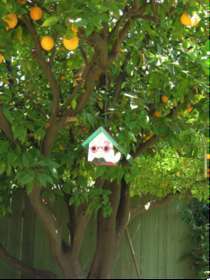
the very orange tree that inspired the novel
A citrus-scented question: what made you write this book about Orange Street?
After my mother died, I really didn't feel like writing at all, and didn't do much of it for a while. But when I finally did get seriously started on another novel, I knew I wanted to write about my beautiful old backyard orange tree, which represented both the past and the Magic Now for me,– and about the extraordinary beauty of the ordinary things in our lives which we often take for granted–family, friends, nature, and especially, community.
Just try to find a better note to end on.
You can visit Joanne's website. Writers and procrastinators of all stripes won't want to miss her great writer's block blog.
Thank you, Joanne. Like a perfect orange, this hit the spot.


May 9, 2011
Real Friends Vs. Book Friends
 I had a neighborhood friend, Claire. We were never true best friends, but we had our moments. Favorite fact about Claire: her mother always dressed her in red when she was attending pizza parties, to minimize the impact of food stains.
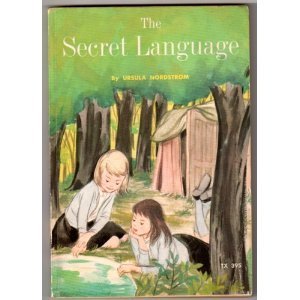
Somehow, in the early elementary grades, we discovered that we had both just finished reading the same book. And we loved it equally: Ursula Nordstrom's The Secret Language.
Neither of us had heard of boarding school before (but as readers, we were about to learn plenty about that irresistible-for-authors setting where there are no parents to watch the comings and goings of young protagonists). We were fascinated. More than anything, Claire and I were both wholly won over by the friendship that developed in that book between the painfully homesick Victoria and the wildly bossy Martha.
And we were in total awe of the secret language they shared. We tried to invent our own, and we sort of did. But our experience was more in keeping with real-world kids; we'd forget which words meant what. Martha would never forget that leebossa meant wonderful. We just couldn't compare.
 And this is a sad fact of my youth: I remember thinking that the real-world friends I had couldn't compare with the friendships I read about in books. Friends in books clicked with each other in a way I did not click with anyone else throughout elementary school.
Never fear, reader: I found those friends later. Still, I feel a little sad for that young me. But I also feel so grateful that she was a reader. And that there were secrets and friends and adventures to keep her entertained, engaged, and happy.


May 7, 2011
Simple Security, by Sharon Hazard
Trying something new today….
 I am a member of a group of sparkly women. We call ourselves the Atomic Engineers. I believe this began when we were trying to think of a name that would discourage others from wanting to join us, which sounds horribly asocial and more in keeping with my misanthropic self than with the other lovely women within this group.
We are writers, but we are not a typical critique group. At our monthly gatherings, we talk about what's going on in our writing lives, and our real lives, too. We brainstorm ideas to help with challenges, share successful strategies, and complain about the state of publishing. Each day we Atomic Engineers do many different things–research, teach, work in a library, stay home with children–but what unites us is the fact that we write.
One of my fellow Atomic Engineers, Sharon Hazard, read my post about my mother and wanted to post her writing about her own mother. Sadly, Sharon is blogless. And thus I am hosting Sharon today. These are her words:
Simple Security
When my clothes dryer broke I time-traveled back to another world. It was the reassuring world of my mother and other post-World War II brides who were satisfied with what they had: a family, a Cape Cod-style house and a nice backyard.
In those yards stood an emblem of 1950s America: the clothesline. This simple cotton rope stretched tautly over two poles that stood like protective pillars, defined a woman's domain. Our yard belonged to my mother and she to it.
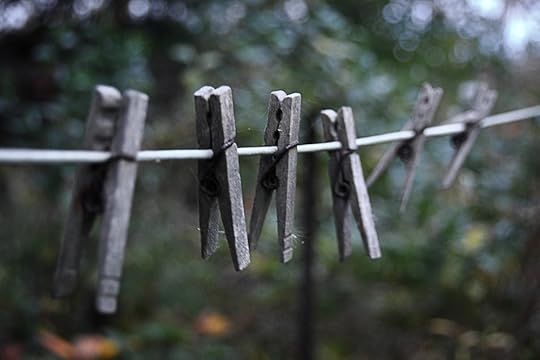 The clothesline was more than just a place to hang clean wash. It was a place for my mother to chat with neighbors, watch children as they swung from iron-posted swing sets and appreciate the simple beauty around her. Over the clothesline, my mother swapped recipes while taking time to smell the roses…and the freshly laundered items swinging in the breeze.
Mom didn't seem to need an escape from the everyday, she was happy within her own world. She didn't need nature walks. She had her own garden. She didn't need a gym to maintain her Scarlet O'Hara size waist, her daily trips to the basement washing machine and out to the clothesline kept her fit. She didn't need to go to a tanning salon; being outdoors gave her a healthy glow.
When I began to hang my own wash, maneuvering the clothes to make sure the line could accommodate my damp bundles, I felt as if I were putting together a jigsaw puzzle. I remembered my mother's meditative motions as she hung each piece of laundry, arranged by size and shape, on the line in neat rows. As I smoothed each item, visions of my mother in her crisp, pastel shirtwaist dress with deep pockets that doubled as clothespin holders appeared. I could clearly see her bending to the laundry basket, the firmly shaking out a pillowcase as she straightened her back and reached up to gently secure it with the wooden pins nestled in her pockets. At day's end, if I persisted, she would let me iron my father's handkerchiefs. How proud I was to get them perfectly smooth and folded into small, white squares, stacked and ready to be placed in the top drawer.[image error]
During my days without a working clothes dryer, I was swept away to another time and place where mothers still hung wash outdoors and went to bed with a sense of accomplishment, a firm notion of where they belonged in the world and a quiet contentment to be there. They put their heads on the pillow knowing they had done a good day's work. They had tucked their clean laundry away in linen closets and dresser drawers just as they had tucked their children into bed, clean and fresh from a day outdoors.
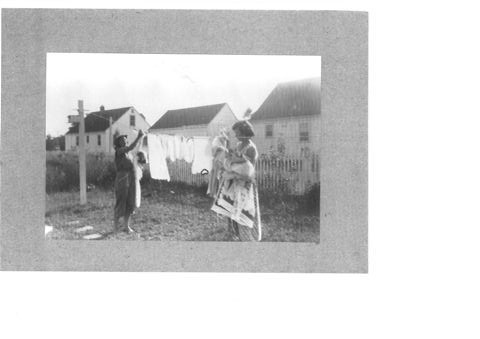
The author's mother and a neighbor taking down the wash.
It took me several weeks to call a repairman to fix my dryer. I was reluctant to leave this cozy world of Cape Cod houses, fenced-in backyards and mothers who took pride in and had time for the little things.
Happy Mother's Day Mom Dorothy Williams, 1911-2009
Visit Sharon's website or contact her sharonhazbooks@gmail.com.


May 4, 2011
Echoes of My Mother
This post is in honor of To Mama with Love, part of a collaborative online art project that honors moms across the globe and raises funds to invest in remarkable women who create hope in our world. Thanks to Olugbemisola Rhuday-Perkovich, who encouraged me to take part.
Mother's Day's a tricky one. I'm so proud to be a mother, and so in love with my children. But there's also the hole where my own mother is supposed to be.

My pre-married mother, probably in the Catskills
After raising her three daughters, my mother began taking classes in writing for children at the New School in New York. She loved everything about that class: the opportunity to help others with their stories, the teacher's feedback on her work, time spent talking with classmates before and after.
And she was good. Really, really good. She worked very hard. And she improved. So she was gooder still.
Her teacher recognized her talent by suggesting that my mother send her first novel, The Morning Glory War, to her editor. My mother did.
She sent it to one editor. And it was accepted.
Most readers of this blog will not require further elaboration on this point.
I still remember that phone call in 1989. I was working at Emerson College in Boston. My mother couldn't believe she had an offer on her book. I could. I wasn't even surprised.

I keep this picture on my desk, which was my mother's. It's from the World's Fair in Flushing Meadow
Looking back, I take some comfort that she had this time–that she knew her book would be published. I am particularly tickled by the memory of my mother choosing earrings that—for her—were a tiny bit daring to wear when meeting her editor. She told herself artists could get away with such things. (Reader: They were pretty tame.)
I am grateful that she had a day to listen to an editor at a lofty New York City publishing house praise her wonderful writing.
She died two months later: a sudden, wholly unexpected death. People always wonder–she was hit by a car while on the sidewalk around the block from our home in Whitestone, New York.

The Morning Glory War (hardcover)
It happened before she even received an editorial/revision letter.
Which left that work to my family and me. While we understood the task at hand, we also wanted to leave everything intact. It broke our hearts to even entertain changing a word. Those were HER words. (The poor editor!) Somehow, we made it through that emotionally charged revision process.
All these years later, we have the book, this miraculous book, based on my mother's childhood in Brooklyn. My children, born many years after my mother died, have read this book and know their grandmother in a way I would have never been able to convey. They know her voice. They know things about her relationship with her best friend. They have glimpses into her sense of humor, and her sense of justice. For my daughter, that book is something of a touchstone, a tangible thing to reach for when she needs it.
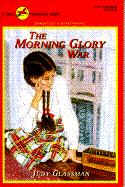
The Morning Glory War (paperback)
This week, I received the advance reading copy of my own first novel, also for middle-grade readers. That I write for children now could have probably been predicted by a sub-par therapist twenty years ago. But it still surprises me. (Reader: Early attempts did not go well.)
As I prepared to write this post, a time that coincided with the launching of this blog, I kept returning to an interesting fact: I am surrounded by echoes of my mother. My writing friends, more than any others, reflect her back at me.
How about the beloved friend who, like my mother, is an extremely talented and deeply humble writer who sold a debut middle-grade novel about coming of age in Brooklyn to the first editor she sent it to? Or the very dear friend who points out the patterns in my life and the strides I can't see myself in the gentle, supportive way a mother would? Or the newer friends who, upon hearing my mother's story for the first time, burst into tears and say, "Oh, but Audrey! Your mom would be so proud of you now."
This Mother's Day, I will be thinking of my mother's book and of my own. I will be missing my mother, as I do every day.
 We received many beautiful and touching cards in the weeks after she died. The one from her teacher at the New School touched me the most. I wasn't as well versed in children's literature then, so while I had read the book, I did not remember E.B. White's quote. Her use of it, to describe my mother, brought me to my knees: "It is not often that someone comes along who is a true friend and a good writer. Charlotte was both."
I would like to put copies of my mother's book,
The Morning Glory War
, into the hands of interested readers. If you would like to receive one of two copies I'll be giving away, please indicate interest in your COMMENT. Winners will be selected randomly.
Other mother/author/advocates will be joining this special celebration all week. Check out these stunning posts by Olugbemisola Rhuday-Perkovich and Sayantani DasGupta and look for future posts by Jennifer Cervantes, Sheela Chari and Kelly Starling Lyons.



May 3, 2011
Liz Garton Scanlon on Friendship
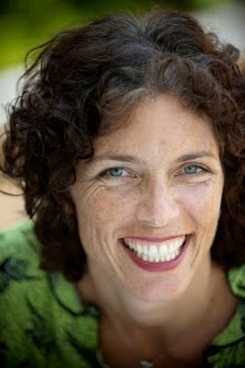 Liz Garton Scanlon is the author of the rollicking A Sock is a Pocket for Your Toes and last year's Caldecott Honor recipient All the World.
And now she has a brand new masterpiece out in the world: Noodle and Lou. Again told in simple, beautiful, crystal clear rhyme, it is the story of a true blue friendship of the rarest order.
Liz was kind enough to answer some questions about those unlikely friends, other book friends and real-world friends, too.
I know we're both fans of GEORGE AND MARTHA. Can you talk a little about those two, and what it is that makes you adore them? The thing I love most about George and Martha's relationship is the perfect balance they strike between humor and tenderness. I grew up in a very funny household and came to know (over time) teasing as a form of love. George and Martha know that, too. They blow it sometimes, or take things too far, but then they self-correct and before long the friendship is tender again.
Without that humor, honestly, I don't think we'd buy the tenderness. I mean, really. What two hippos don't have a run-in over pea soup every now and again?
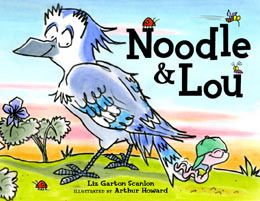 Were Noodle and Lou always a bird and a worm? Do you remember how the idea came to you? Do you think you're more Noodle or more Lou? Yep. They began as bird and worm. When I read their story to kids, someone always calls out "but birds EAT worms!" so there's the pleasure and surprise that these guys get along.
One of our reviewers said, "If a bird and a worm can find common ground, there's hope for us all!" and I just love that. They're the ultimate odd couple.
I got the idea for Noodle & Lou from watching a worm in my garden and wondering if worms know how great they are. I bet they don't. I mean,they're pretty shy and slimy and unassuming. They're probably as self-deprecating as the rest of us.

Lix Garton Scanlon and her sister Christina Garton Coppolillo
I've played both Noodle and Lou in my own life, and when I'm at my most Noodle-ish, it is almost always the perspective offered by a friend that snaps me out of it. Noodle & Lou is dedicated to my sister. She's been a True Blue Lou all my life.
What books spoke to you as a child? Do any characters stand out? Who would you have liked to be your friend? The characters I loved most — and still love most — are imperfect. Kind of like George and Martha! I never really trusted (or liked) perfect characters, but Ramona Quimby? Jo March? Madeline, or Eloise? I loved them because they were sassy and impetuous and moody and sneaky and still they were admired and totally adored.
Do you have a favorite literary friendship beyond George and Martha? Oh, that's such a good question. I love the quirky friendships in Kevin Henkes' books — like Chester's Way or Sheila Rae the Brave. And I love the really dear intergenerational friendships he creates. There are some adults who aren't half bad in his books. Oh, and the friendships in Jeanne Birdsall's Penderwicks books — both between the sisters and beyond! I love them for the same reasons as I love George and Martha. They are funny, imperfect and true…
Your ability to distill language is awe-inspiring. Your books are so brilliantly concise and contain so much. I'm guessing that doesn't happen magically. Can you speak a little about your process? You are sweet to say so. I think it might just point to my inability to write anything long!! Process is so individual and mysterious, don't you think? For me, probably the most important element of my work is reading aloud. I read my whole manuscript aloud, from the top, every time I change a single word, and as I do I hear everything else that doesn't belong there. I truly believe that everything written should be boiled down to its essence — and not just picture books, but 1,200-page epic novels, too.
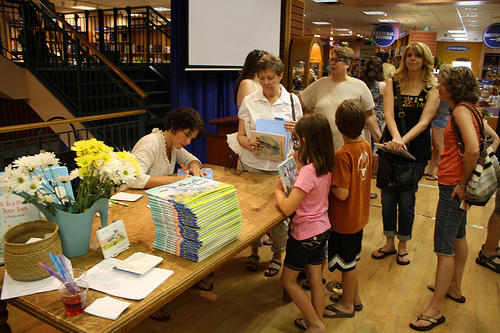
signing Noodle & Lou at BookPeople in Austin
What role do friends play in your writing life? Um, they keep the men in white coats at bay? Seriously, having community in my life is like having yoga. I'm not totally centered and grounded and healthy and happy because of it, but I'm a lot less crazy than I would be without it.
My critique groups, my agent-mates, my local posse? All dearly beloved Lous….
Like you, Audrey. You're a Lou.
Blogger's Note: That concludes this entry as the blogger is swooning. But be sure to visit Liz's website and blog, too.



April 29, 2011
Kimberly Marcus on Writing Friends
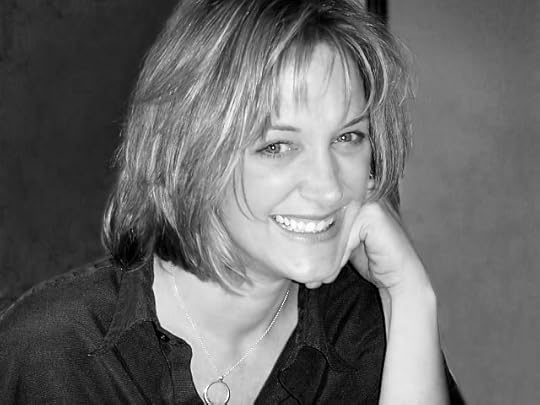 I am so happy to introduce my first guest: debut author Kim Marcus, a fine person, a fine writer, and a fine friend.
Kim's free verse young adult novel, Exposed, debuted in February and her first picture book, Scritch Scratch a Perfect Match, followed in April. She was kind enough to answer some questions on friendship, her books and beloved characters.
What books spoke to you as a child? Which character would you have liked to be your real-world friend?
When I was younger, I especially loved the Little House books, by Laura Ingalls Wilder. More than wishing to be Laura's friend, I wanted to be Laura. I wanted to live in the big woods and on the prairie. I wanted Pa to play his fiddle for me as I skimmed rocks on the banks of Plum Creek.
Do you have a favorite literary friendship? (I'm partial to George and Martha.)
Ooh! I love George and Martha, too! One author who comes to mind when I think of favorite literary friendships is Cynthia Rylant. I particularly love the relationships between Henry and Mudge and Mr. Putter and Tabby. And I find it interesting that all three of those pairings are written for the same age group!
Can you talk about the different roles your writing friends play and how you know which friend to bring particular questions to?
I'm part of a fabulous group that meets once a month to share our work and cheer each other on. Because of the size of the group, we each have thirty minutes for both reading and hearing critiques. So I've gotten in the habit of reading picture books there and then using their insight on polished sections of novels, or once I have a completed novel draft.
I also have a few select friends who will read full, completed drafts for me, and share their detailed thoughts.
And then I have my two first readers, Stacy DeKeyser and the fabulous Audrey Vernick, who are willing to read any little bit of anything in any form. They are also the first ones who hold my hand and kick my literary butt as needed.
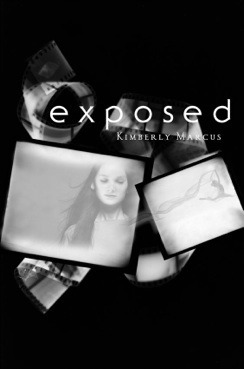 In Exposed, you do so many things that must have been so hard. In addition to the obvious major incident in the book, there's the fact that you've taken a very strong, long-term friendship and strained it beyond what it can endure. Was it hard to write that? Did a part of you want to bring them back together? What do you think Kate and Liz, at age 25, will think of each other when they look back on their years as friends?
It was hard for me to put that friendship under so much strain, and I thought long and hard about bringing them back to one another. But, given the circumstances that tore them apart, I just couldn't see a way to make that feel real and true. And, in the real world, I believe that it would have felt forced to have them continue on as forever-bests. I wanted to leave readers with a sense of hope for them and their futures.
As far as what they would think of each other at age 25, I'd like to believe they would both look back on the good parts of their friendship and hold onto those memories.
In Scritch Scratch a Perfect Match, did you set out to write a friendship story? Because really, you might win the Most Unlikely Characters Bound for Friendship Award with that one. All these years after writing it, do you think about that flea at all, or that dog?
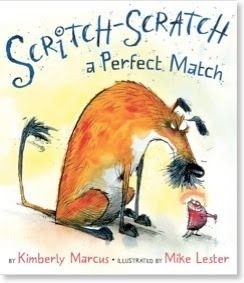
Not exactly. At the time I began writing Scritch-Scratch a Perfect Match, I was enrolled in a graduate program for picture book writing. I needed to bring something to the next class. Outside my window, I noticed a dog on his morning walk with his owner. He paused to scratch. I started playing around with the idea of an itchy pooch and the line "Flit flit flapped the flea in the yellow dog's hair" popped into my head. From there, I asked myself what would happen next, and the man came along. I saw the flea as the impetus for bringing the man and the dog together.
In early drafts, they got rid of that pesky flea and encountered something else (the buzzing of bees) at the end. But I wanted to finish on a happier note. I didn't want to leave kids worrying about the fate of these new-found pals, so I decided to give the flea a job. That's when he became a matchmaker. I do think about them. I imagine the man and the dog spending their days together as the bestest of friends, and the flea continuing to be successful in his chosen career.
We both write for young picture book audiences and older readers. What do you think about that dichotomy? Do you enjoy one more than the other?
I love that dichotomy! When I finish writing about a teenager going through tough times, it's a much-needed breath of fresh air for me to switch gears and write something young and playful. I love writing for both age groups, not one more than the other, and hope to continue doing so for a long time to come.
Thanks so much for inviting me to chat on your new fantabulous blog, Audrey! My picture book and my novel both focus on friendship, and I think it's so cool that one of my very best friends is interviewing me about them.
You can visit Kim at her beautiful website.


April 18, 2011
George and Martha
I spent the past three days in Austin, Texas. Much of that time was at an annual retreat for clients of the Erin Murphy Literary Agency.
I suspect we EMLA folk are unique in our unbridled love for each other. Professional jealousy can be a difficult problem for writers. But somehow, within that EMLA circle, it is pure love and support and genuine excitement about the success of our agency mates. Which I know sounds fake. But it isn't.
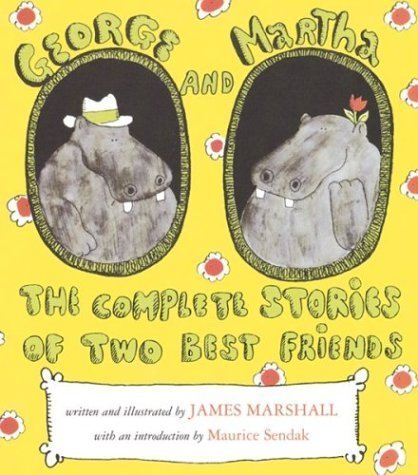 EMLA, I realized on the way home, is the George and Martha of literary agencies.
I am in literary awe (jealousy's close cousin) of the unfailing respect George and Martha share. They might prank each other (and here, Ruth Barshaw, I'm thinking of you), but their love is always apparent and abundant. To say nothing of the spiffy way they accessorize.
George and Martha support and encourage each other. And perhaps because they are hippos, it's not too sweet. It's just right.
So fellow EMLA hippos, I thank you. And to all writers, find those who will support you. And if they know how to make a quail dance, all the better.