David Sanger's Blog, page 5
November 16, 2010
Picscout updates Image Search
Can automated image recognition software help photo buyers connect more easily with stock photo agencies and individual photographers and quickly identify and license images they find on the Web?
Picscout, the 8-year-old Silicon Valley and Israel-based startup is betting yes. With a newly updated release of their ImageExchange Firefox plugin, Picscout has significantly streamlined their user interface and simplified the image discovery process. Based on detailed feedback from users, the new plugin features a live sidebar which automatically displays thumbnails of every image on the user's web page which has a match in Picscout's database of fingerprinted images. Clicking on the thumbnail displays a popover window with direct links to the websites of the participating agency or photographer.
When the PicScout Image IRC™ was first introduced last year many aspects of their business and pricing model were not clear, as I discussed in an October blog post . Now the product has been refined and plans are to leave their beta stage at the end of this year.
Ease of Use
The new sidebar is a significant improvement over the small "I" icons the previous version superimposed on the user's web page. Now you can quickly see at a glance all images found on a page.
Below is a sample display page from my own website with the sidebar showing an image used in an advertisement. Note that in this case the publisher had cropped and flopped the image.

This is the popover window with a link to the image on Photoshelter:

Coverage
As I mentioned in October the long-term success of IRC depends on buy-in from stock distributors, photographers and photo buyers. With over 50 million images now committed to their system, Picscout has significantly grown their index since last year. Signed agencies include Alaska Stock, the LIFE collection, Masterfile, Science Faction, Photoshelter, Image Source, and micro site Dreamstime. Even so, this represents only a small percent of images available online as stock photography. A Google Images search for "stock photography" displays about 1000 images (from 2 million plus total), but only 71 of the 1000 are in the Picscout index . This may well favor those agencies which use the platform. Significantly missing however are the largest players, Getty Images (with iStockphoto) and Corbis Images.

Looking through the search shows some odd anomalies. In some cases a iStockphoto image will show with a Dreamstime link, or a Magnum image with a Photoshelter (or even Flickr Creative Commons) link. Sometimes the same image is available as RF and RM. With multiple sources and uses of images, both legitimate and illicit, this is not surprising.
Pricing
Last year it seemed that Picscout planned to take a percent of sales, thus reducing ultimate revenue to providers. The new model, announced earlier this year, takes a marketing-oriented pay-per-view approach. Contributing agencies and photographers pay every time a popover window is displayed for a match to one of their images. Like Google Adwords they can set a maximum budget per month. After the budget is exhausted, the popover window will still show their name and photo credit but the link to the provider's image detail page for licensing will be hidden. Detailed reports will show page views and click through rates for each image.
So far the announced prices seem very high. In a tiered structure based on licensing model a provider pays $1 for each display for Rights Managed (RM) images, $0.50 for RF images and $.05 for microstock images. In a prerelease interview Offir Gutelzon, CEO, said they will gather data on how the platform works through the active participation of image buyers and content owners and that will drive any improvements and pricing adjustments. My guess is that very few individual photographers will be able to generate enough sales at this price level, though perhaps agencies with an established marketing budget will.
Benefits
In addition to the direct benefit of revenue from sales and licensing, Picscout emphasizes the value of IRC for providing attribution for online image uses. Even if a photographer chooses not to pay for direct links to an image detail page, the uploading and fingerprinting services are still free. This means that wherever one of their images is found on the web, the Picscout sidebar will display their name alongside the image in the display window. Standard search should then allow the provider to be found. This benefit alone is likely to induce many photographers to at least try the service.
An additional benefit could come if the system reported where each image is found on the web, thus identifying possibly unknown publications, both legitimate via agency sales, and infringing.
In summary, Picscout has continued to roll out an elegant product which shows significant promise for photo buyers and image providers. If enough players participate and pricing can settle at a reasonable level, the index could change the way images are found and licensed online.


November 15, 2010
Grass

How to show the Golden Gate Bridge and not make a cliché? This was the question as I documented the newly restored Crissy Field along the San Francisco waterfront for the National Park Service.
It was a bright blue day and the green of the newly planted California bunch grass on the restored meadow caught my eye. Green, blue and the red of the bridge: that was the image! With a Nikon 600mm. lens on a low tripod I lay on the ground and framed the triangle of the bridge tower and cables behind a few tufts of grass. Trying different focus points and apertures for depth of field I selected this shot with a slightly soft but recognizable bridge and the crisp grass caught in the wind.
(from the archives)

November 11, 2010
Google Goggles Recognizes Photo Subjects
Recognizing the subject of a photograph is a skill we humans take for granted. Whether it is the Golden Gate Bridge, the Eiffel Tower, or a photo of Uncle Harry, we "know it when we see it."
For computers, however, the task is exceedingly difficult. Variations in color, shading, angle and perspective mean that the same subject can look vastly different in different images. Only recently have academic research projects begun to make advances in efficient algorithms to solve the problem. Now Google has publicly released the first version of their image recognition software Google Goggles, first in the Android platform, and most recently as part of the latest update to their iPhone Mobile App.
How does it work? Using the mobile app the user initiates an image search and then takes a photo with the iPhone camera (3gs or 4 only since close focus is needed). The image is uploaded to the server and after a short analysis, the results identify the image as a landmark, a work of art, a logo, a book cover, a CD cover, or a piece of text.
How accurate is it? Testing with my own photographs displayed on the iPad showed that many major landsmarks were indeed recognized, but not all.


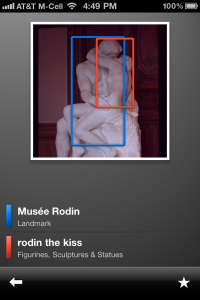
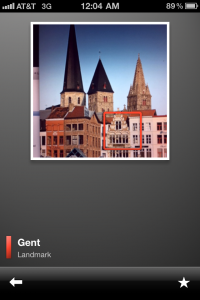
In addition to landmarks, the program also recognizes book and album covers, with links through to Amazon and iTunes. Below is a shot used as Frommers cover, and Goggles identified and linked to the book.
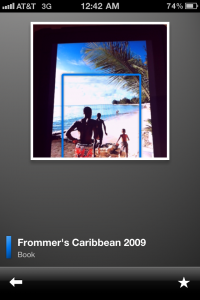

My own San Francisco Bay Book cover was recognized, as also the bar code from a Nikon lens box


At present this is a test service offered without fanfare by Google, but we can expect this technology to be much more widespread in the future. As a comprehensive database of landscapes, public scenes, faces, publications and products is developed, subject recognition and subject search will become commonplace.

November 10, 2010

Eiffel Tower
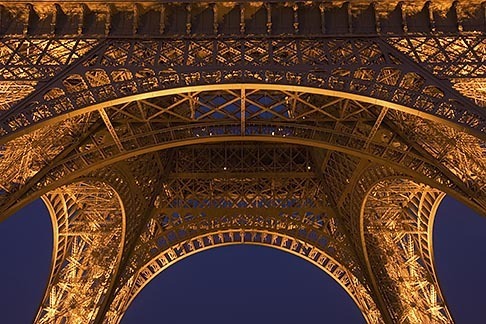
How to capture an icon? That's the perennial problem for a travel photographer. Something we've seen a thousand times, yet newly seen – that's ideal. But since we've seen it so many times, the mind jumps to a pre-seen image. We know exactly what the Eiffel Tower looks like because we've seen it in clichés so often. So to spend time with the subject, hours, night after night, trying to sense something distincitive, and then bring to it a certain particular style of seeing, that is the art of travel photography. The market has an insatiable appetite for the same subjects, newly seen, and those are the most difficult challenges of all.

September 28, 2010
What am I doing here

This intriguing question is the title of a collection of essays by the late British travel writer Bruce Chatwin. I remember once reading the book while sitting on my luggage in a derelict airport in far western China, and wondering if passersby thought the title incongruous or humorous. For any traveler the question is worthwhile. But for travel photographers the question offers a key entree to improving your images.
The first few days at a destination, after all the hassle of planning and traveling, can be a letdown. Thousands of impressions crowd in on you. New sights and scenes and most of all many clichés, images you have seen and half-seen in other places halfway around the world. Making sense of it all, forming a photographic vision of the place, sorting through and deciding what to shoot, and what to ignore, is all part of the process of engagement. Asking "What am doing here?" can focus the mind, sweep away the clichés and help you to see more simply and clearly.

March 13, 2010
Prague Rain

It was a dull and a rainy afternoon and my journey to the historic town of Kutna Hora outside of Prague had been a bust. No blue sky, no photographs. Returning to Prague and stuck in traffic I was drawn to the raindrops on the windshield, and started shooting through the drops on the glass, changing focus, trying different angles. As I drove around town looking for mood subjects, this wet bicyclist passed on the cobble streets of Mala Strana- Old Town.
Related posts:Prague Moon

March 7, 2010
Stone walls
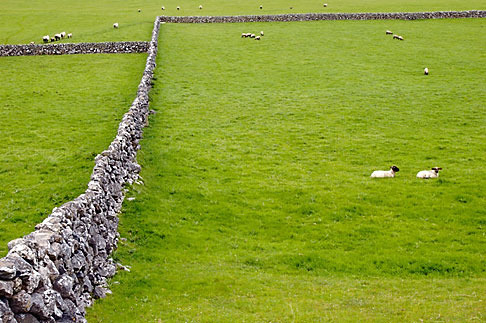
Driving through the lush Irish countryside, I was struck by the simplicity and energy of the stone walls. There is an earthy contrast between the rough-hewn gray stones, the deep green of the pastures and the white wooled grazing sheep.
The walls enclose the land, define boundaries between neighbors, and protect the sheep from wandering off.
Climbing carefully on a wall on the narrow verge of a country lane, I composed the image to crop closely, eliminating the sky and letting the walls...
March 3, 2010
Getting out the Door
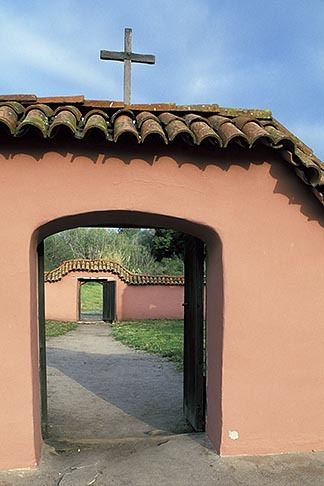
Sometime the most difficult part of photography is getting out of the front door. All sorts of events conspire against you. Once you get started, creativity can come easily, but it is that first step that is often the tough one. Here are a couple of suggestions of how to jump-start your photographic day and get moving.
Go anywhereSometimes we get hung up on waiting for the perfect project, or the best day, or for inspiration to strike, waiting for our Muse. These are all understandable...
February 26, 2010
New Look for the Stock Pages
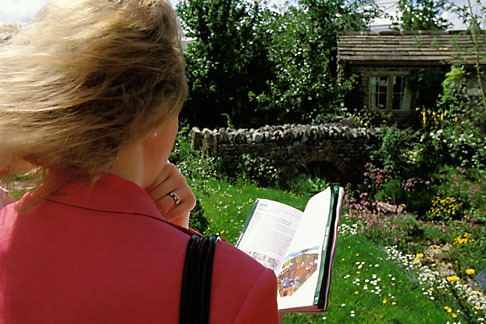
Several new features are now available on the David Sanger Photography stock pages. You'll notice that both search pages and individual image pages are now white-background, completing the conversion described in the November post Black on White.
The images are larger as well. Search result thumbnails are now 100×150 pixels and image previews 324×486 pixels. Also I've reinstated direct print sales, now with a shopping cart and Google checkout for easy credit card payment (US sales only...