L.J. Longo's Blog, page 5
October 26, 2018
Advice for Writing a Steampunk World: Part 1 Development
This is my 100th post.
Which is cool. And because that’s cool, I wanted to make sure it was a good post so I’m writing about something I’m really pretty passionate about – building a good world. And I’m going to make it about Steampunk, because having your 100 post is not a good reason to break-up a theme.
There’re a couple ways to start building a world. Maybe you have a premise for the whole world. Maybe you have a specific character problem that relies on a certain cultural restraint. Maybe you have a contest offering money for a Steampunk novella and you need to craft a non-Victorian Steampunk.
Either way, you need to grow that kernel of an idea into an entire populated world. I can’t tell which saddens me more, would-be writers with incredibly detailed worlds and no characters or plots to live there or would-be writers with a world just like ours except for one weird quirk that only seems to exist to inconvenience the really well-crafted protagonist.
Starting with a concept and filling in the story.
For me, this is the easier of the two starts. I can always find a character to play in a world. But here’s some questions to ask to flesh out a world and find the forces your characters are going to be fighting against.
Who takes out the trash? Enforces the laws? Takes care of the children?
What are the society’s ideals? Tell the story of a person in conflict with them.
Who does this society “other”?
Consider basic story types. I think Seven Plots is limiting yourself and I, of course, would add Romance to the list, but there are worse places to start than the seven basic plots. How can one of those plots work well into your world.
I’ll answer these questions for The Scribbling Windhund. I wanted a Steampunk version of Fredrick the Great’s Prussia. So, I started by researching about this time period in German history and by researching the man himself. My man, Fritz, was a benevolent dictator, almost certainly gay, and obsessed with the ideals of the Enlightenment, service to state before self, and a military genius. His legacy has been a bit muddied in America (Hitler compared himself to Frederick the Great), but I wondered what his ideal society would look like with more modern technology.
So, the concept for my Prussia became a society of people who prized the work of artists, craftsmen, and thinkers, who idolized their military, and who strongly believed in service to the state above self.
People who prized these ideals so much, that they build a city on top of their old city dedicated to their ideals.
I knew this world would be a very pretty place, with gardens and art on every building. There would be intellectual salons, state-sponsored concerts. Basically, a society built around high-brow arts. The restaurants would all run by people who were passionate about food. Every architect would be a visionary. Everyone who wanted to grow up and be an artist, or a writer, or a singer would have an outlet (that wasn’t the internet).
So, who enforces the laws?
Obviously, a strong military. Who takes out the trash and takes care of the kids was harder. Since artistic and intellectual types are incapable of tending to demeaning labor like doing their own laundry and changing diapers, someone else had to do it. But if all education was designed to create artists and philosophers… maybe the military would have to force them to do it.
This took me down a weird 1984 path. Where I started to ask what would happen to the non-artistic and I realized their only place in society would be the military protecting the artists, or in the service industry taking care of the artists. I decided to combine them, so that this sectors military is enormous—over half of the population. The people who take out the trash are soldiers. The ones who repair the roads? Soldiers. The lady behind the counter at the DMV? A soldier. The person doing your taxes. Actually, I’ve met accountants that are very passionate about money, that’s probably an artist’s specialization.
Growing the military to this size made for an interesting twist on this Artist’s Utopia. Would I live in a place that paid me to write, if I was constantly monitored by the military? I don’t think I would.
Which brings me to…
Who is not in line with the society’s ideals?
Since Prussia is a society build around service to the state, idolization of the principles of Enlightenment and arts, someone who doesn’t trust the military-state would be on the outs. Also someone one who either wasn’t an artist, or for some reason had been excluded from the society.
This character became Karl, my terrorist. The champion of the poor, the ugly, the uneducated, and those left behind and erased from history when this perfect society was created. While being a master craftsman himself, Karl knew too many people who did not possess these talents who had been overlooked when the society built itself.
Who is othered?
I cheated on this one, because I decided to make Prussia a conservative country as well and reflect some problematic beliefs about familiar ideals. This led to second-class citizens, people who had mental, physical, or emotional limitations and needed special protection from the government. Religious zealotry (i.e. any worship) and homosexuality fell into this category.
I liked the idea of making second-class citizens, people who weren’t ostracized so much as limited. They needed to be protected from the harm they do to themselves and can’t be put in positions where their limitation might affect their judgement. It gets creepy.
But this idea brought me to my second character, the everyday average man in this society. Otto, a good Prussian boy, who believes in his sector’s military, his own sexual limitations, and the superiority of this system… until he meets the terrorist.
Starting with a character and filling in the story.
It’s a littler harder to build a world around a character with a cultural restraint/element. The trouble really comes from having a great idea that relies on one aspect of the character being persecuted. It can make the world seem unfairly biased against the character and ultimately unrealistic.
Here’s the questions to ask about the cultural restraint/element.
Could this kind of cultural restraint/element exist in the real world? How is it treated and what are you saying by placing it in this context?
How do true-believers in this restraint/element view it? If the justification sounds evil or unlikely, then chances are you need to think more about this element.
What other aspects of the society would be affected by the restraint/element? For example, if your element is that your character has a steam-powered airship, what else is the society doing with that technology?
Who is in charge of this restraint/element (who created it)?
I could cheat again and talk about Otto’s homosexuality and how Prussia monitors and restricts him because of it, how I based it off of conservative communities in real life and the logical conclusion of enforcing anti-sodomy laws, and how the authorities in Prussia view homosexuality as dangerous to the individual…
But, I’m going to focus on the actually technology instead.
There are two big technological element I created for this story. The Environmental Dome and the DikTak. Both of them are vital to the story, but the dome exists in a vacuum I had to explain away.
So the character premise was: a terrorist escapes a prison by sneaking parts off an unobtrusive clock-work machine and using it to remove the environmental dome that’s been keeping all his friend imprisoned underneath the current city.
I’ll start with the DikTak. This is a simple clockwork automaton that functions as a note-taking machine because it can record what it ‘hears’ and ‘sees.’ This is fairly advanced (it only sort of exists in real life) but since I wanted the DikTak as the narrator of the story, it needed to be able to ‘see.’ But it had to be unremarkable enough to be allowed into a prison, which meant Prussia had to have not only clock-work devises by extraordinarily complex ones or else they would need to remark on how weird the DikTak was.
I could have left the DikTak as the solitary technological advancement (since its an invention of local genius, Karl Schneider), but I thought it would feel more organic in a world filled with other advancements. So, Otto mentions it casually like an advanced watch or toy. The characters don’t react to the machine like it’s extraordinary. There’s other technology like it. We see a kind of clock-work telegraph machine in action and Otto draws attention to another piece of clockwork that is even more advanced. The clockwork in the prison-tower.
So that’s how the technology effects of the aspects of the world. If I got out of the DikTak’s narration, I would show other elements of Prussian life, which probably include clockwork sidewalks and staircases. It was created fairly recently since Karl’s designed are still used by clock-work re-creationists, but it’s entered enough into daily use for a little mechanical dog to not be notably out of place.
The second big piece of tech I had was the environment domes. So far this doesn’t exist in the real world, though as a metaphor for a strict border I was saying some pretty interesting things by keeping it impermeable and having the government forcing people to remain trapped inside it.
This had to be a complicated and not easily understood technology (it takes my genius a decade to break it). If it was a simple technology that was widely understood, then the people in the Undercity would be able to fabricate their own and certain plot elements would fall apart.
So it sounds pretty evil, which meant I had to take some time to ensure that the readers saw why it was necessary. Life without the dome is impossible because the environment is unlivable outside of them. Yup, I might be saying something with those domes…
Because the domes are complex, they are not widely used in society. There’s no thunderstorm rooms, or snow-filled parks—at least not in Prussia.
And of course, in Prussia the military controls the dome. Until, of course, they don’t…
The Fantasist is a quarterly online magazine that publishes three original Fantasy novellas on the third Thursday of every third month.
And this month, while they celebrate Steampunk, one of them is mine!
[image error]Support these guys. They have good stories for free.


October 25, 2018
Images from the Past: Weirdly Accurate Images from the 1800s
I love it when Science Fiction manages to predict the future. The seashells in your ears from Bradbury’s Fahrenheit 451. Assimov’s Robotic laws forming the basis to real life robot training. Religious Zealots taking over the country like in The Handmaidens Tale…okay I don’t like that one so much.
Anyways, the Victorians had some interesting ideas about what the future would bring that make it easier to add flavor to a Steampunk world. Here’s some of the ones that came true
[image error]
I know it’s not technically a roomba, but it does the same thing. It’s very telling that even with a machine to do the work, the Victorians still assumed we’d have household servants.
[image error]
In my filthy, little mind, this is a sex hotline. She’s about to show some ankle and the operator is just like, “oh, not this foot fantasy again…”
[image error]
I want benches on the moving sidewalks in airports. I mean, I also want a suave mustache and a fancy half-cape, but this is such an improvement on the modern design!
[image error]
Their are few things more modern than going out for drinks with a friend and then ignoring that friend to look at pictures of babies and male models. I also love that the woman is red is smoking a blunt and there’s some kind of weird space car in the background. The predicted cars and legalization, folks!
[image error]
The only thing unrealistic about a machine that combines stationary bicycling and virtual reality goggles is that the owner is actually using it for exercise and not as a clothes rack.
The Fantasist is a quarterly online magazine that publishes three original Fantasy novellas on the third Thursday of every third month.
And this month, while they celebrate Steampunk, one of them is mine!
[image error]Support these guys. They have good stories for free.
October 24, 2018
Images from the Past: The Future from the 1800s
These three images directly inspired some aspects of my world.
The first two are moving houses. The black and white one is actually the cover of an early speculative fiction novel. The other is a post card of an entire town being moved someplace. I’m not sure if its meant to be unloaded or just in constant motion, but the idea of taking a city apart building by building and moving it elsewhere, probably without the unwanted parts of the city, really got my gears turning.


This bad boy has been on my computer since the early days of the internet.
[image error]
One of the hallmarks of my sectoral universe is the environmental domes. They feature briefly in Evasive Love and are central to The Scribbling Windhund. Partly it comes from my fear of natural disaster and my non-scientific mind trying to imagine how actual scientists will save us from the coming environmental apocalypse. The idea of a city encased in a glass box (complete with artificial sunlight!) has long intrigued me.
The Fantasist is a quarterly online magazine that publishes three original Fantasy novellas on the third Thursday of every third month.
And this month, while they celebrate Steampunk, one of them is mine!
[image error]Support these guys. They have good stories for free.
October 23, 2018
Steampunk Music: Bitter Ruin
Bitter Ruin has to be one of my favorite bands, partly because I like so many different kinds of music and they experiment with all of them. I’m not sure if they’d like being called Steampunk, but “Ticker Don’t Tock” definitely helped me get into that clockwork mindset while I was writing The Scribbling Windhund.
I’m not sure “Trust” has anything to do with Steampunk either, but man is this a great video.
The Fantasist is a quarterly online magazine that publishes three original Fantasy novellas on the third Thursday of every third month.
And this month, while they celebrate Steampunk, one of them is mine!
[image error]Support these guys. They have good stories for free.
October 22, 2018
Steampunk Movie Review: City of Lost Children
I realize that my number one influence for Steampunk was actually La Cité des Enfants Perdus which is the proper French title for my favorite movie of all time, The City of Lost Children. The visuals are striking and extremely Steampunk, which is odd to me because I wasn’t thinking of this as Steampunk until just today when I was thinking about the Cyclops (the fat-faced guy with the eye thing is actually a blind man in a cult that kidnaps and sells children to the really old guy).
“The City of Lost Children is…the story of Krank, a tormented scientist who sets about kidnapping local children in order to steal their dreams and reverse his accelerated ageing process. When Krank’s henchmen kidnap his brother, local fisherman and former circus strongman One (Ron Perlman) sets out on a journey to Krank’s nightmarish laboratory, accompanied by a little orphan girl called Miette.” – Umbrella Productions
It’s a weird quest story with a lot of strange world elements. The ocean is polluted (possibly poisonous, judging by the milky green hue), the world is dark (I don’t think there’s any day light in this movie), the characters are all incredibly well-rounded. Almost everyone even the smallest side characters has something they want that they can’t have.
And because trailers in the 90’s were almost as fucking weird as the movie itself, enjoy this:
The Fantasist is a quarterly online magazine that publishes three original Fantasy novellas on the third Thursday of every third month.
And this month, while they celebrate Steampunk, one of them is mine!
[image error]Support these guys. They have good stories for free.
October 21, 2018
Images from the Past: Women of the Future
There are from a set of postcards designed by Albert Bergeret in 1902. He was French and apparently these were a little risque. Personally, I think they fit very neatly into what we would now call a Steampunk aesthetic. Especially, the Lady General.
Click to view slideshow.
The Fantasist is a quarterly online magazine that publishes three original Fantasy novellas on the third Thursday of every third month.
And this month, while they celebrate Steampunk, one of them is mine!
[image error]Support these guys. They have good stories for free.
October 20, 2018
Steampunk according to L.J.
I was brought to Steampunk a little late to the game, probably by The League of Extraordinary Gentlemen and Hellboy (which might not be Steampunk…). I really wish I could say books, or music, or even the fashion brought me into the fold, but I was really not aware of Steampunk until it went mainstream enough to have movies. But that look is so cool, I incorporated the sci-fi element into my ghost tour uniform (a black skirt, corset, cape, and top hat) pretty quickly.
My top five Steampunk influences are:
The DIY fashionistas. I regularly google steampunk just to see the new retrofuture stuff that exists on the internet.
H.G. Wells, Robert Lewis Stevenson, and Arthur Conan Doyle’s speculative fiction (particularly Doyle’s illustrations).
Sherlock Holmes with Robert Downey Jr. and Jude Law.
Neil Gaiman’s graphic novel, Neverwhere. I know, it’s not really steampunk, but damn it, it feels like it to me.
The Legend of Korra which also… might not count, but I don’t care about your labels!
The official (i.e., Wikipedia) definition is a science fiction/fantasy work which uses 19th-century designs and technology like steam and clockwork, but for me, Steam-punk is a chance to talk about the modern-day issues by making them relevant to our history. Only without all the limits of actual history (you know, like not having instant communication, or gay rights, or laser guns).
I’ll also add that I’ve always had a somewhat tenuous grasp of history. I was convinced Italians still wore togas until I was in middle school. Part of the problem was that I grew up near the Amish and a Native American reservation. My mom used to watch a lot of Anne of Avonlea, and Dr. Quinn: Medicine Woman and something Victorian that I suspect was the BBC. I was utterly unable to differentiate them from the modern day, so I assumed that Canadians, Coloradans, and the British actually acted and dressed that way. I realized this wasn’t true by the time I started reading Robert Lewis Stevenson and Arthur Conan Doyle, but I was a little disappointed that I couldn’t get on a plane and step out and explore Victorian London. Steampunk was a natural fit for my skewed understanding of history and time periods.
I think it appeals particularly to female readers. There’s a very exciting genre of adventure/exploration stories that girls kinda got left out of. Steampunk, which always seems to very extremely cool female leads, lets women particulate in that era of progress as changers and not just spectators.
Steampunk is also really interesting because it lives in a positive time period that precedes one of the most violent and destructive eras in history. So, no matter what advancements a writer creates in a Victorian London, the reader has this background feeling that in a few years WWI is going to happen and be made all the more horrific for these advancements. I think, the era of progress appeals to people who want to write utopias and that might be why so many good Steampunk plots stem from trying to prevent WWI (and I think in our modern minds preventing WW2 and the Holocaust). Personally, I always found it kind of cheating when a single villainous mastermind orchestrates something as complicated as “The War to End All War,” but then again it started as a seemingly random assignation…
But thinking about WWI and progress and classism, and that bright-eyed Utopian ideal in Steampunk, really got my cogs turning for The Scribbling Windhund. I’m not writing about the past in my story in The Fantasist, so I sort of cheated as a steampunk writer. My story takes place in a future where climate change destroyed our current globalized world and forced us into segregated environmental domes where all counties had to reform their old pre-industrial identities. So, Germany becomes Prussia and again reflects the ideals of Fredrick the Great: service to the state, near worship of art and culture, but also a very heavy reliance on its military. Prussia is a very safe sector, where artists and craftsmen are the most highly prized citizens, and over half the population acts as the military/police force supervising the community to keep them from engaging in harmful behaviors.
You know, like being too gay.
The main character, Otto Lang, is pretty comfortable in this utopic state until he’s asked to interview a terrorist who’s been imprisoned for fourteen years for kidnapping the last Prussian princess. Throughout their interviews, Otto begins to question everything he believes about his sector, and his government, and his life. Eventually, well, I won’t spoil it because you can read it for free here.
The Fantasist is a quarterly online magazine that publishes three original Fantasy novellas on the third Thursday of every third month.
And this month, while they celebrate Steampunk, one of them is mine!
[image error]Support these guys. They have good stories for free.
October 19, 2018
The Scribbling Windhund: available at The Fantasist
The Fantasist is a quarterly online magazine that publishes three original Fantasy novellas on the third Thursday of every third month.
And this month, one of them is mine!
The Scribbling Windhund
Way back in the spring-time, I finished this novella just in time to send it into a Steampunk themed issue of The Fantasist. I didn’t have particularly high hopes; since I wasn’t sure a futuristic version of colonial-era Prussia about the impact of climate change, with very dark moral undertones narrated by a mechanical dog counted as steam-punk. I’m not really sure what Steampunk is. I know it when I see it… sorta.
The guest editor, Megan O’Keefe, was open to a wide interpretation of steampunk and my little love story managed to sneak into The Fantasist. In order to celebrate, I thought I’d bring you an exploration of Steam-punk.
I’m going to be showcasing the Steam-punk that inspired my story. There’s going to be music, movies, artwork, and more than a few author interviews.
Also you can find my steampunk story, The Scribbling Windhund, here.
[image error]Support these guys. They have good stories for free.
July 25, 2018
BORN TO LOVE WILD
New Anthology out by my Stars and Stones Sisters. If you like romance, summer time, and wild stories, you’ll like this collection.
 BORN TO LOVE WILD
A Paranormal Romance Short Story Anthology
from Stars and Stone Books
Featuring: USA Today Bestselling Author Traci Douglass, Cara McKinnon, Sheri Queen, Pepper McGraw, M.T. DeSantis, Read Gallo, J. Bigelow, and Andie Biagini.
Preorder Now
Kindle | iBooks | Kobo | Google Play
Traci Douglass – “Blood Strong: A Blood Ravagers Novella”
One guardian demon in love. One witch with a secret crush. One evil threatening their newfound connection.
Cara McKinnon – “A Change of Heart”
She’s a hybrid shifter who’s not supposed to exist. He’s a wolf who was born to protect her. But her secrets force him to choose: his mate, or his pack loyalty?
Sheri Queen – “The Robinson Agency”
Some are born with the gift to see into the future. Others create their own destiny.
Pepper McGraw – “Full Moon Shenanigans”
The full moon’s coming and it’s time to embrace the wildness within.
M.T. DeSantis – “Forever Love”
To find a chance… A chance to find…
Read Gallo – “The Flying Saltines”
When a river falls in love with an ordinary person will New York City survive?
Sometimes a wizard from Sweden needs help from a medium from Michigan.
Andie Biagini – “Water Temperature”
An engineering student and a cryptozoologist. One of them can talk to sea monsters, but it’s not who you think.
CLICK HERE TO FIND OUT MORE ABOUT OUR AUTHORS
 STARS AND STONE BOOKS GOODREADS FACEBOOK RELEASE PARTY
May 28, 2018
LM Spangler : Return to Me

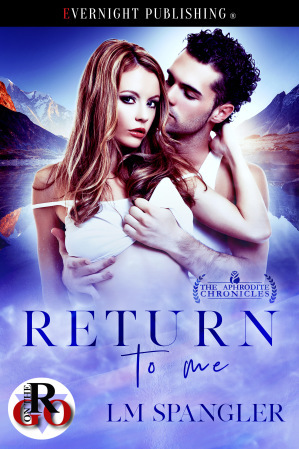
Her secret tore them apart.
Naida Bouche foolishly thought she could live as if she was only human. Her true nature hung over her like a thunderhead, driving a wedge between her and her husband.
Cooper Martin had no idea why his ex-wife divorced him. He’d treated her like a goddess. And they had no problems in the intimacy department.
Fate brings them together again. Old emotions flare to life. Can Naida see beyond her self-perceived faults and allow the flames to reignite the love she and Coop feel for one another?
EXCERPT:
Water cascaded off her nude body. Small rivulets ran over her breasts and down her slightly rounded stomach, disappearing into the surface of the lake.
She was one with the water.
She could, literally, become one with it.
Moonlight reflected off the mirror-smooth surface, adding a soft glow to the night.
Crickets serenaded her with their chirping song. The cicadas added their buzzing to the symphony. There were a lot of cicadas, hence the name of the lake. A wolf howled in the distance. Nature cocooned her.
She grinned and dove under. Liquid embraced her, still heated by the sun’s rays from earlier in the day. Her body became insubstantial, fragmenting into molecules of H2O. Disorientation left her bewildered, but the feeling came and went. Weightless warmth enveloped her, and the ebb and flow of the tide lulled her into blissful relaxation.
The moon slid across the sky. Hours had passed. Her body became corporeal with a single thought. After regaining her human form, she cut through the water with powerful strokes and rose to the surface in a rush of bubbles.
The night air chilled her damp skin, raising goose pimples along her flesh. She pushed the long fall of hair from her face and glanced into the deep, lush woods that ringed the lake. Soon the leaves would change to shades of gold, orange, red, and brown. In would come the autumnal chill. Her time in the waters would decrease, and then winter would set in and freeze her out.
When that happened, she’d resort to the swimming pool located on the basement level of her large home. Even with the greenery she had sprinkled about, it never fully replaced the exhilaration of the lake, the feel of fresh air against her skin, and the scent of the wilderness.
She repeated the cycle, year after year. The monotony had long since worn short on her nerves.
She had someone in her life, someone to break the monotony.
More accurately, she would only have him until the end of the day.
Tonight would be the last night they would be together. She’d tell him that they were over and done with. The sad part of the whole shitty deal was she couldn’t really give him a reason why.
How could he understand? Hell, she’d have trouble believing the truth, if it wasn’t her life.
The root of their problems were otherworldly, as her father was human and her mother was a water nymph.
The nymph side of her heritage presented two problems. First, she needed daily contact with water. The more the better. Like her pool in the basement. Second, she also needed sex … a lot. Preferably once or twice a day. After all, the term “nymphomaniac” had been born of a nymph’s sex drive.
They had a lot of sex, but there were times when their hectic lives interfered with his libido. He was human and his sex drive was human.
She couldn’t guess how he’d react if she said, “I’m a nympho which means we have to have sex all the time. Day and night. Over and over and over.”
He wouldn’t understand it and she’d allowed it to build a wall between them.
No, he had never known the truth of her desires.
She had pushed him away, afraid of exposing her real self.
And that fear, that uncertainty, would leave her alone … and needy.
Buy Links:
Available at your favorite e-book retailer!

Author Bio:
LM Spangler lives in South Central Pennsylvania with her husband, daughter, three dogs, a cat, a rabbit, and some fish. Her son serves his country in the US Navy.
She is a fan of college football and any kind of baseball and likes to watch the Discovery, Velocity, HGTV, DIY, Science, and any channel showing a college football game. She also watches old game shows like $25,000 Pyramid and Match Game.
Behind the Scenes: Evasive Love Part 1 [image error]
Social Media:
Website