Kate Mitchell's Blog, page 4
July 25, 2012
Book 1: Sea of Monsters - Review
Like the first book in the series, The Sea of Monsters is fun, action-packed, and witty. Riordan keeps readers on their toes while constantly teaching them about mythology, and he makes it very believable that there could be half-bloods and the Greek gods around us. Percy continues to grow in this book, both in his personal strength as the son of Poseidon and also as a person. His relationship with Tyson is believable – like any child not wanting to be mean to someone because they, too, were bullied, but also not quite enjoying their new shadow. As a whole, Riordan has written another fun way of teaching mythology and demonstrating that anyone – whether or not they have a learning disability – can be a hero.


July 22, 2012
Book 1: Sea of Monsters - Myth Connections
One of the things that stuck out to me about the use of myths in this book is to connect with students with learning disabilities. The half-bloods struggle with ADHD and dyslexia, which are actually signs of their godly parentage. According to him, their brains are hardwired for battle reflexes and to read ancient Greek, so there isn’t only a reason for their weaknesses, but they also can be seen as strengths. This serves to help connect a reader who has one or both of these conditions to Percy and the other half-bloods, and to also show them that just because they struggle does not mean they cannot be a hero.

July 21, 2012
Book 1: Sea of Monsters - Use of Myths Overview
Riordan uses myths in a number of ways, including using them as the basis for his series. Percy is the son of the god Poseidon, the camp director is the god Dionysus, the camp is for the children of one god and one human, and the greater evil force is the titan Kronos. Essentially, what Riordan explains in the first book in the series is that the gods move with the center of western civilization, so that Olympus currently sits above the Empire State Building. As Percy learns above the many ways this affects his life as a half-blood, particular components of Greek mythology get explained, so the reader does not get too overwhelmed with the many details.
Beyond that, though, Riordan uses the hero cycle and archetypes to follow Percy’s journey. The components of the hero cycle in the novel can be seen below.
Call to Adventure Arrival of giants at school Supernatural Aid Annabeth and Tyson saving him and then escaping in the supernatural taxi Threshold Guardian(s) Fighting the monsters on the hill with Clarisse and the other campers Threshold Figuring out what the next step should be (with Annabeth, building a chariot) Acquires a helper Revelation of Tyson as half-brother Acquires a mentor Gifts from Hermes Experiences challenges and temptations Experiences on the cruise ship Meets another helper Joins Clarisse on her ship of Confederate soldiers Revelation at the abyss The Abyss is the island with the Cyclops; the revelation is that he cares deeply for Tyson and won’t let them all lose Transformation Transformation into a proud warrior and Tyson’s brother Atonement Fight with Luke Receives the gift of the Goddess Clarisse leaves with the Golden Fleece Returns Returns to the camp and Thalia reappears
There are also many archetypes present. First, Percy Jackson stands in as the hero. He answers the call to adventure, and also puts others ahead of himself. This includes putting his differences with Clarisse aside to work with her for their common goal, as well as risking his life for his other friends. Another archetype present is Kronos as the villain. Although the reader already knows who he is and that he is evil from the previous book, his exact place and role are unclear until the end when Thalia is resurrected. The mother figure in some respects is Annabeth, as she guides Percy even though he is the hero. Percy also fulfills the archetype of the underdog, as his troubles with ADHD and dyslexia constantly place him at disadvantage. These are only some of the archetypes evident in this book, and they also have a role in the series as a whole.

July 18, 2012


Book 1: Sea of Monsters - Summary
The first book I have for you is Percy Jackson and the Sea of Monsters. It is second in the Percy Jackson series, following Percy Jackson and the Lightning Thief. In order to not post one gigantic post for each book that will overwhelm you and make you stop reading, I will be splitting them up and then linking them all together. But for now, the summary.
Percy Jackson is all set to return to Camp Half-Blood for his second summer, except his mom doesn’t want him to. He’s going to follow her instructions, but on his last day of school monsters try to kill him and he escapes with Tyson (his friend from school) and Annabeth, his friend from camp who he went questing with the year before. When they make it to camp, Percy learns that Tyson is actually a Cyclops – and his half-brother. The camp is also in danger, as the tree that protects them is dying. Percy, Tyson, and Annabetth secretly leave camp to save their friend the satyr Grover and to find the Golden Fleece, which will save the tree. Along the way, they run into their nemesis Luke, fight monsters, get separated, and nearly escape death multiple times. Eventually, they save Grover and find the Golden Fleece, successfully sending it back to camp with Clarissee before Luke can use it to rescue the titan Kronos. At the end, camp is saved, as well as the tree – which causes Thalia to be healed and return to her human form.
Percy Jackson is all set to return to Camp Half-Blood for his second summer, except his mom doesn’t want him to. He’s going to follow her instructions, but on his last day of school monsters try to kill him and he escapes with Tyson (his friend from school) and Annabeth, his friend from camp who he went questing with the year before. When they make it to camp, Percy learns that Tyson is actually a Cyclops – and his half-brother. The camp is also in danger, as the tree that protects them is dying. Percy, Tyson, and Annabetth secretly leave camp to save their friend the satyr Grover and to find the Golden Fleece, which will save the tree. Along the way, they run into their nemesis Luke, fight monsters, get separated, and nearly escape death multiple times. Eventually, they save Grover and find the Golden Fleece, successfully sending it back to camp with Clarissee before Luke can use it to rescue the titan Kronos. At the end, camp is saved, as well as the tree – which causes Thalia to be healed and return to her human form.
July 16, 2012
Mythology Overview
The main intention of this blog will be to examine the presence of mythology in certain young adult novels. Authors use components of myths in a number of ways, from direct interaction with them to simple allusion. Other ways that they use them include archetypes and the hero pattern. Joseph Campbell examined the hero’s journey in The Hero with a Thousand Faces (1949), and summarized it as: “A hero ventures forth from the world of common day into a region of supernatural wonder: fabulous forces are there encountered and a decisive victory is won: the hero comes back from this mysterious adventure with the power to bestow boons on his fellow man.”
Some YA books include the entire hero’s journey, while others just the bare bones of it. The hero’s journey includes a number of steps, in this order:- Call to Adventure- Supernatural aid- Threshold Guardian(s)- Threshold (beginning of transformation)- Acquires a helper- Acquires a mentor- Experiences challenges and temptations- Meets another helper- Has a great revelation at the abyss, which includes death and rebirth- Goes through a transformation- Atonement- Receives the gift of the Goddess- ReturnsThe beginning and end are both included in the known, but from the threshold to the gift of the goddess is the unknown. (source: Wikipedia)
Another part of myths and the hero pattern that has prevalence in these books is the idea of archetypes. Merriam-Webster Dictionary defines an archetype as "the original pattern or model of which all things of the same type are representations or copies" (source: Merriam-Webster). Generally, archetypes tend to be a stereotype or an epitome, and there are many different kinds found in literature. Some include:- The hero, who puts others ahead of himself - The villain, who employs strength or cunning to undermine the hero (and usually remains hidden for most of the story)- The mother figure, who cares and guides others- The father figure, the leader and protector (depending on the culture, sometimes the mother and father figures become intertwined or reversed)- The underdog, the character who is always at a disadvantage but pushes through hardship to win respect (works especially good when the reader can connect)(source: eHow)
These are only some of the archetypes prevalent in our literature, movies, tv shows, comics, and music, but they are an incredibly important part of mythology, too. As I read the books, I'll be on the look out for all of these different components, and will be sure to share my findings with you.
Some YA books include the entire hero’s journey, while others just the bare bones of it. The hero’s journey includes a number of steps, in this order:- Call to Adventure- Supernatural aid- Threshold Guardian(s)- Threshold (beginning of transformation)- Acquires a helper- Acquires a mentor- Experiences challenges and temptations- Meets another helper- Has a great revelation at the abyss, which includes death and rebirth- Goes through a transformation- Atonement- Receives the gift of the Goddess- ReturnsThe beginning and end are both included in the known, but from the threshold to the gift of the goddess is the unknown. (source: Wikipedia)
Another part of myths and the hero pattern that has prevalence in these books is the idea of archetypes. Merriam-Webster Dictionary defines an archetype as "the original pattern or model of which all things of the same type are representations or copies" (source: Merriam-Webster). Generally, archetypes tend to be a stereotype or an epitome, and there are many different kinds found in literature. Some include:- The hero, who puts others ahead of himself - The villain, who employs strength or cunning to undermine the hero (and usually remains hidden for most of the story)- The mother figure, who cares and guides others- The father figure, the leader and protector (depending on the culture, sometimes the mother and father figures become intertwined or reversed)- The underdog, the character who is always at a disadvantage but pushes through hardship to win respect (works especially good when the reader can connect)(source: eHow)
These are only some of the archetypes prevalent in our literature, movies, tv shows, comics, and music, but they are an incredibly important part of mythology, too. As I read the books, I'll be on the look out for all of these different components, and will be sure to share my findings with you.
July 15, 2012
Welcome
Welcome to Kate Reads Myths! I'm Kate, and I'll be your guide through mythology in young adult novels. I do five things: read, summarize, identify the elements of mythology, explain their connections to the real world as well as other novels, and briefly review.
Before we get to all that, though, let me introduce myself.
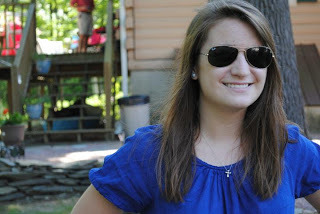
I'm a college senior in Tennessee studying Secondary Education and English. I've always been a huge reader, which mostly started from Harry Potter. I also have a mild obsession with classic literature, but I read everything from chick lit to historical fiction. Unsurprisingly, I read a lot of both. I also dabble in writing - my first novel, Aureole, came out this year - and have a heavy music background.
My big thing here, though, is mythology in young adult (YA) lit. I've always loved mythology, and they provide a number of teaching opportunities. From that angle, I'll be examining many books and the different parts of them to see how we can help students better understand and appreciate this component of literature.
Besides, in my humble opinion, myths are pretty cool.
Before we get to all that, though, let me introduce myself.

I'm a college senior in Tennessee studying Secondary Education and English. I've always been a huge reader, which mostly started from Harry Potter. I also have a mild obsession with classic literature, but I read everything from chick lit to historical fiction. Unsurprisingly, I read a lot of both. I also dabble in writing - my first novel, Aureole, came out this year - and have a heavy music background.
My big thing here, though, is mythology in young adult (YA) lit. I've always loved mythology, and they provide a number of teaching opportunities. From that angle, I'll be examining many books and the different parts of them to see how we can help students better understand and appreciate this component of literature.
Besides, in my humble opinion, myths are pretty cool.