Michael A. Greco's Blog, page 3
January 9, 2021
HI! WELCOME TO MY VERY FIRST WRITER’S BLOG!
Snarky Muse: Your opening needs revision. There’s no way to be ‘very first’. It’s not a matter of degree. First is first. Maybe you’d better reconsider this blog thing.
I will very much not. And now for a joke:
Three guys are sitting at a bar.
#1: “…Yeah, I make $150,000 a year after taxes.”
#2: “What do you do for a living?”
#1: “I’m a broker. How much do you make?”
#2: “I should clear $100,000 this year.”
#1: “What do you do?”
#2: “I’m an architect.”
The third guy has been sitting there quietly, staring into his beer, when the others turn to him.
#2: “Hey, how much do you make per year?”
#3: “I guess about $13,000.”
#1: “Oh, yeah? What kind of stories do you write?”
The joke, poignantly apropos, tells it like it is for us indie writers. Do we sweat it? Of course not! We envy it. Most of us aspire to make $13,000 a year solely from our writing. We would then be able to call ourselves ‘writers’ without the ears turning red. I’ll take that any day.
Snarky Muse: You wish!
I started writing late in life, in my fifties. I wasn’t ready when younger, wandering half-baked for the longest time, unable to express myself through prose in any real way.
I write now because I can’t not write. Just ask my family: If I’m not plugging away at something I’m not much fun to be around. When not teaching, I give myself the time to write, usually in the morning.
I would be remiss not to mention the spiritual component of having the opportunity to do something as wondrous as writing.
Snarky Muse: Oh, please. Next, you’ll be asking for Sunday alms.
Hey, I’m just saying it’s a fortune I am grateful for.
I write for myself, not for the market. I have no idea what will sell, but as long as I’m happy with a story, I will show it. I don’t know if I’m going to make any money doing this, but I don’t write to get rich. I do it for another, deeper satisfaction. I also write for the person I know best: myself.
NOW IT’S TIME TO MEET THE TEAM!… Well, that’s ME. I am the team. There’s a cat here, too. I’ve never taken a writing class. I wouldn’t know a support group from an A.A. meeting. I don’t know what a writing retreat is (though it sounds restful).
I write alone.
I have friends who will read stuff for me (I often repay with tacos, or mezcal, or something similar). I have an editor who lends me his professional eyes when he can. I Fiverr for book covers and for formatting.
No self-publishing workshops for me (even though the half-day sessions are only 79$—and what a great way to get yourself out there. What’s wrong with me?)
Snarky Muse: You’re just lazy, or cheap. Other writers are more dedicated to their craft than you. They actually pay money and leave their house to go these workshops. It’s all a part of establishing your platform.
I resent that, verily… Ok, I’m no gadabout. I just work alone because I like it, and I do what Gene Fowler once said: “Writing is easy. All you have to do is sit staring at a blank piece of paper until drops of blood form on your forehead.”
Leaving home is overrated. Very much.
A WORD ON GENRE“I forgot my mantra.” … Does everyone know this 1976 Jeff Goldblum confession in Woody Allen’s “Annie Hall”? For the longest time I felt like that guy, standing alone in a middle of a party, fretting that he didn’t belong anywhere. I had no genre I could call my own. I was in the cracks, absent any discernable category. But after my third novel, “Plum Rains on Happy House,” I saw patterns. All shared elements of absurdist fiction and black comedy. But when I searched the rules for participation in these distinct genres, my writing still didn’t fit.
I’ve settled on comic fantasy. Humor with thoughtful undertones. Visionary. Metaphysical. Childish.
But I’m not for children. I will write about teens, but not for them.
My sub-genre might be: weird fiction. But Amazon has yet to make a category for that.
Husband: The snow is nearly waist high and it’s still falling. My wife has done nothing but look through the kitchen window. If it gets worse, I may have to let her in.
Nasty and funny. In my writing, the characters take a beating; they earn their end goals. But I see myself as the wife. I’m the one standing outside in the rising snowfall. I’m the one looking inside at characters that are tearing up the rooms of the house.
Comic fantasy—weird fiction. I’ve found my mission.
Thank you very much for reading my first blog. I’ll try to write weekly.
Snarky Muse: You have some sick fixation with the word ‘very’.


First Post
Snarky Muse: Your opening needs revision. There’s no way to be ‘very first’. It’s not a matter of degree. First is first. Maybe you’d better reconsider this blog thing.
I will very much not. And now for a joke:
Three guys are sitting at a bar.
#1: “…Yeah, I make $150,000 a year after taxes.”
#2: “What do you do for a living?”
#1: “I’m a broker. How much do you make?”
#2: “I should clear $100,000 this year.”
#1: “What do you do?”
#2: “I’m an architect.”
The third guy has been sitting there quietly, staring into his beer, when the others turn to him.
#2: “Hey, how much do you make per year?”
#3: “I guess about $13,000.”
#1: “Oh, yeah? What kind of stories do you write?”
The joke, poignantly apropos, tells it like it is for us indie writers. Do we sweat it? Of course not! We envy it. Most of us aspire to make $13,000 a year solely from our writing. We would then be able to call ourselves ‘writers’ without the ears turning red. I’ll take that any day.
Snarky Muse: You wish!
I started writing late in life, in my fifties. I wasn’t ready when younger, wandering half-baked for the longest time, unable to express myself through prose in any real way.
I write now because I can’t not write. Just ask my family: If I’m not plugging away at something I’m not much fun to be around. When not teaching, I give myself the time to write, usually in the morning.
I would be remiss not to mention the spiritual component of having the opportunity to do something as wondrous as writing.
Snarky Muse: Oh, please. Next, you’ll be asking for Sunday alms.
Hey, I’m just saying it’s a fortune I am grateful for.
I write for myself, not for the market. I have no idea what will sell, but as long as I’m happy with a story, I will show it. I don’t know if I’m going to make any money doing this, but I don’t write to get rich. I do it for another, deeper satisfaction. I also write for the person I know best: myself.
NOW IT’S TIME TO MEET THE TEAM!
… Well, that’s ME. I am the team. There’s a cat here, too. I’ve never taken a writing class. I wouldn’t know a support group from an A.A. meeting. I don’t know what a writing retreat is (though it sounds restful).
I write alone.
I have friends who will read stuff for me (I often repay with tacos, or mezcal, or something similar). I have an editor who lends me his professional eyes when he can. I Fiverr for book covers and for formatting.
No self-publishing workshops for me (even though the half-day sessions are only 79$—and what a great way to get yourself out there. What’s wrong with me?)
Snarky Muse: You’re just lazy, or cheap. Other writers are more dedicated to their craft than you. They actually pay money and leave their house to go these workshops. It’s all a part of establishing your platform.
I resent that, verily… Ok, I’m no gadabout. I just work alone because I like it, and I do what Gene Fowler once said: “Writing is easy. All you have to do is sit staring at a blank piece of paper until drops of blood form on your forehead.”
Leaving home is overrated. Very much.
A WORD ON GENRE
“I forgot my mantra.” … Does everyone know this 1976 Jeff Goldblum confession in Woody Allen’s “Annie Hall”? For the longest time I felt like that guy, standing alone in a middle of a party, fretting that he didn’t belong anywhere. I had no genre I could call my own. I was in the cracks, absent any discernable category. But after my third novel, “Plum Rains on Happy House,” I saw patterns. All shared elements of absurdist fiction and black comedy. But when I searched the rules for participation in these distinct genres, my writing still didn’t fit.
I’ve settled on comic fantasy. Humor with thoughtful undertones. Visionary. Metaphysical. Childish.
But I’m not for children. I will write about teens, but not for them.
My sub-genre might be: weird fiction. But Amazon has yet to make a category for that.
Husband: The snow is nearly waist high and it’s still falling. My wife has done nothing but look through the kitchen window. If it gets worse, I may have to let her in.
Nasty and funny. In my writing, the characters take a beating; they earn their end goals. But I see myself as the wife. I’m the one standing outside in the rising snowfall. I’m the one looking inside at characters that are tearing up the rooms of the house.
Comic fantasy—weird fiction. I’ve found my mission.
Thank you very much for reading my first blog. I’ll try to write weekly.
Snarky Muse: You have some sick fixation with the word ‘very’.
June 15, 2019
BLOG 8 — Contrast, Pacing and Secrets in Project Purple
SM (Snarky Muse): Why so glum?
Me: I’m an Indie writer with marketing blues. Someone’s got to sell the stuff I write, and the family cat (now licking its butt on the windowsill with an impressive leg extension) isn’t exactly volunteering.
SM: So, it’s all up to you.
Me: Yeah, but I get distracted. First, I have to check my Gmail to see if that person ever responded to my request for a review. Then I need to go check my Yahoo to see if the girl on Fiver has responded to enlarging the cover, because I didn’t know that pink pages, instead of the white, require a larger cover size, and I don’t know how to do that stuff.
SM: Maybe you should learn.
Me: Meanwhile, my ten year old daughter is inviting her friends into the house downstairs and partying with raucous games of tag, while I’m up here trying to assess whether I have bad breath or not: I breathe out, then jump over real quick and receive the exhalation.
SM: (rolling eyes) How’s that going?
Me: It’s inconclusive.
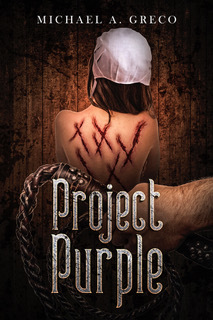
SM: Thank you for sharing. Let’s talk about Project Purple. The blurb reads as such:
Thirteen Americans volunteer for a unique three-month project to recreate America’s early colonial experience for a worldwide on-line audience.
The colonists have been deceived. They don’t know their ordeal has been gradually, brutally, altered by their organizers, and a genuine struggle for food, shelter and survival turns deadly as an Arctic winter approaches.
Is there some point to this insanity? The besieged Americans (including a police detective who throws his world away to rescue a colonist he knows only as the Goatwench) must find the primal survivor within themselves to counter the ever-increasing violence they face—all to the attentive schooling of their multi-national audience.
SM: How are the reviews?
Me: Pretty good, actually. OnlineBookClub just gave it four out of four stars, and they’re quite on the stingy side dispensing the stars. Project Purple’s got a lot of conflict, externally and internally. Everyone knows what conflict is, right? It’s the basis of drama, character, plot. It creates an engaging story. Characters out of place make for interesting situations.
I think of contrast as another form of conflict. I’m talking about making sure of a sharp difference between characters and setting, and I think that contrast is one big reason the story Project Purpleis such a compelling work. Contrast adds personality to the story: thirteen unsuspecting Americans, misled, suddenly thrust into the nether of the Russian tundra.
Fish out of water.
The colonists are the opposite of one another. They are liberal, they’re conservative, they’re Christian, they’re Atheists. They press one another for peace, for concessions, or for war, for violence. They all have to fight for survival, but they come to this realization in their own ways because of their backgrounds
They are as opposite to one another as I can get them.
SM: It’s loaded with secrets, isn’t it?
Me. It’s a story with secrets, all right. Secrets help drive it. Sometimes readers know about the secrets and sometimes they don’t. Sometimes readers figure things out based on clues throughout the story. But the secret of using secrets is to come very close to revealing the secret without actually doing so. And this can turn scenes into nail biting reading experiences.
The biggest secret, I suppose, is what the shadowy group of Internationals—the Rhizome—really want. What are they after? But there are other secrets, just as important: Why are the colonials keeping things from each other? Because they’ve got dark secrets, too. The secrets are the reason the colonials find themselves where they are. The policeman, Rigor, has a secret, too, and that’s why he’s slowly lured into the Rhizome.
SM: Isn’t it a challenge finding the right pacing when intertwining so many character threads?
Me: You bet. Chuck Palahniuk says, “I try to tell a story the way someone would tell you a story in a bar, with the same kind of timing and pacing.”
Pacing was a concern in this story. I was careful not to input too much of the historical data, as that’s when, as a reader, eyelids grow heavy, brain function appears to slow down.
SM: It’s boring.
Me: Project Purple could have had structural problem. Spending too much time on the colonials reliving life in the year 1613, and on the trials of developing the colony would have distressed plot development.
SM: Is that why you created the policeman?
Me: (nodding) To break up the colonial endeavor with another, illuminating insight into the machinations of the Rhizome. But poor scene construction, or poor overall story construction would have been a much bigger problem. If any scenes had read slowly, I would have had to examine the conflict once again: Is it insufficient? Is it overwritten? Are there too many words? Is it all just too fancy?
I wanted to create 13 fascinating, three-dimensional characters with over-the-top problems that would hold readers transfixed, and their eyelids wouldn’t grow heavy; their brain functions wouldn’t slow. I wanted readers to care what happened next. I think a story with terrific characters and terrific plot give readers a fast read—because they care. A mundane characters with weak plot challenges will ensure a slow-paced read.
SM: So, contrast, pacing, and secrets are all a big part of the success of Project Purple?
Me: Jeff Buckley said: “I’m always writing and reflecting in life. I want to suck it all in.”
SM: Well, happy sucking. What’s that noise downstairs?
Me: It sounds like a game of tag with ten-year-olds. (Standing and stretching) Guess it’s time for a little exercise.

[image error]
April 13, 2019
BLOG 7 — Neurosis and Dialog: “Plum Rains on Happy House”
 Me: I have to finish my eighth book, but this project has been excruciating. I think all this alone time is starting to get to me.
Snarky Muse (SM): What do mean ‘alone time’? You’ve got me—I’m your inspirational muse.
Me: I still feel alone. I’m starting to think it’s unhealthy. All I seem to do is have long, meandering talks with myself. I also scratch myself way too much. Then I look down at the marks and can plainly see the ragged scratches on my shins from my own fingernails. Then I start wondering why I’m so itchy down there. Have I got some kind of exotic skin condition? So I DuckDuckGo the various possible skin conditions I could have, and rule out—systematically—eczema and hives.
SM: I’m sure readers find that all fascinating (rolls eyes). But let’s move on, shall we?
Me: Then I wonder if the cat has fleas again, and this might be the reason for the itchiness. So I want to grab the cat and turn him upside down, and scour his little body for those brown pests. But first I have to hunt for the cat all over the house, and finally find him under the bed blanket right behind me!
SM: That’s one slick anecdote for the archives. So, about “Plum Rains on…
Me: But I don’t see any movement under the cat’s fur. Now I’m thinking maybe it’s just the advent of the warm weather. So, what I’m saying is be prepared for the neurosis that accompanies a long time by oneself.
SM: Neurosis might be a recommended condition for reading Plum Rains on Happy House, wouldn’t you say?
Me: Well, I wouldn’t go that far…
SM: Tell us the inspiration behind this, err, unique story.
Me: Inspiration? Well, I live in Japan, and it’s a place I know well. The book’s dedication probably says it all:
“This book is for Japan. It’s the place I call home—though it may not want me to. For over 25 years I have grappled with the dos and don’ts of my host country, destroying the language in conversation, giving up, resuming more study, eventually resigning myself to the boundless plateaus of almost-speech.
And Japan abides. Like a patient steward, it absorbs the frolics and the ribbing, while providing a solacing habitat in which to write and teach and parent and grow.”
I came over to Japan in the 80’s and I’ve lived in some pretty seedy guest houses—what we call gaijin houses—because there may be a few non-Japanese residents (though the majority of residents are usually Japanese).
In creating the residents of Happy House, I just mingled the characteristics of a few of the unique people I’ve met over the decades in Tokyo and in Los Angeles. In some cases, I didn’t need to exaggerate at all.
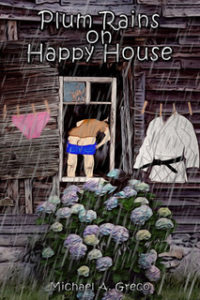
Plum Rains on Happy House is a detective story. A fellow named Harry Ballse invites the protagonist, nicknamed the Ichiban, to Japan. But the residents of Happy House all deny any knowledge of this mysterious Harry Ballse.
Of course, some readers may pick up on the references to the 1973 film The Wicker Man, about a policeman who is lured to a Scottish island to investigate the report of a missing child. It’s a game of deception. The islanders are playing with him. The paganism and the sexual activity the sanctimonious policeman finds so objectionable are simply part of the selection process—to see if he possesses the characteristics to burn in their wicker effigy so that the village will have subsequent successful harvests.
In Plum Rains on Happy House, the Ichiban must undergo his own horrific sacrifice to appease the house. My novel is a tribute to that remarkable film, and it has the same foundational plot lines, but I’ve laid down a hearty layer of satire and lots of lunacy.
SM: This has been your most ambitious work yet. Does it take a neurosis to write like this?
Me: I should be offended by that question, but I will say that nothing is easy. If women will forgive me the metaphor, creating Plum Rains on Happy House was like giving birth—it hurt a lot. There were points when I considered giving up because it was just too hard. I’m not a funny person, but I have little trouble dreaming up wacky stories and characters.
The residents of Happy House had to be distinctively quirky. I didn’t know how bawdy things were going to become, or how much depravity would creep its way into the story. But once I had the characters they took charge, and I relegated myself to being more or less their stenographer.
Dialog was also something I paid close attention to. Of course, sharp dialog is vital in any story, but for this kind of back-and-forth humor to succeed, I felt it really had to have zip. Just like a comedian practices his delivery line, the dialog exchanges had to have real punch. As with most writing, dialog should say a lot , with very little. The communication isn’t in the words being said but in the subtext. Good dialog says it without saying it. If you want a reader to read every word, you have to make every word count.
One quick example from Chapter One has the resident of Room 3 (nicknamed The Goat) explaining to the new resident about his missing foot:
“I saw you looking at the bottom of my leg.”
“Your foot?”
The Goat scowled. “Obviously, you can see that no longer exists.”
“It’s in Cambodia.”
The Goat went into a cross-eyed fluster. “What is?”
Sometimes readers need to work a bit to understand the exchange, and I think they appreciate that. Dialog is an organic process. It’s the way characters talk in my head, and I think I know how to write them because they are all a part of me. It all works toward satisfying the element of what a good scene often comes down to: one person trying to get something from another.
SM: Some of the dialog is just plain nonsensical.
Me: Tom Rickman said, “Dialog works the least well when it’s telling you what’s going on.”
Mix that in with the baffling idiosyncrasies of Japan and its language, and the vexing stages of culture shock—which frame the Ichiban’s misadventure in Happy House, and readers may have to follow closely what is happening, especially those uninitiated to life in other countries. I’m hoping this confusion is a part of the magnetism of the story. After all, the old guesthouse is haunted:
“Happy House is an amoeba everlasting, a floating world—capturing and sealing the self-indulgence of the red-light districts, the bordellos and the fleeting, delightful vulgarity of ancient Japan, an eternal time capsule of the flamboyant and the boorish.”
SM: It’s a bit of a shocker, though, what happens to the poor guy, no?
Me: Stephen King says, “I try to create sympathy for my characters, then turn the monsters loose.”
SM: How’s the reception been?
The book has received mixed reviews. Of the five books I have up on Amazon, Plum Rains on Happy House was the first to receive a customer review of one star—perhaps rightfully so: the reader was “disgusted” by some of the more explicit scenes, and I think that was my fault; the earlier cover gave no indication of the sexual content within, and this poor woman was clearly ambushed. With the one star, I know I’m finally an author, and wear it as a badge of honor.
There are, however, cultural elements in the story that some will not understand: the usage of the various slipper customs inside a house, the daily beating of the futon, the laundry poles, the shockingly steep stairwells, the neighborhood garbage trucks that play cute tunes to let you know they’re coming, the confusion between the colors of blue and green.
The dichotomy of substance versus form also plays an important part in underscoring the tension—in the way one swings a tennis racket, or walks in a swimming pool, or plays baseball, or eats particular dishes: What should predominate—what you are doing or how you are doing it?
On another level, the story examines language acquisition and the role of structure within the learning process. The residents all have their various opinions: As teachers, should English be taught through some kind of lock-step formula, or would one be better off approaching it in a more hands off manner, rather like painting? Everyone seems to have an opinion.
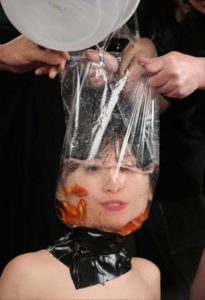
The idea of structure comes to the forefront again when discussing what one character, Sensei, calls the hidden structure of the house, which, like the neighborhood (or any cityscape in Japan) appears as an amorphous sprawl. But look underneath this sprawl and one sees the organism. The randomness, or chaos, embraces a flexible, orderly structure, likening the house to an amoeba that has the ability to alter its shape. Similarly, this amoeba can be seen as a microcosm of Japan as a whole.
 SM: A hidden structure, huh?
Me: Yeah.
SM: Amoeba…
Me: That’s what I said.
SM: Maybe you’re right about all this ‘alone time’.
Me: I’m not alone—I have my Snarky Muse!
SM: (agonized expression) Don’t remind me.
March 18, 2019
Blog #6 Juice and Heart
 I often mumble incoherently.
“Mom says you’re talking to yourself again,” my daughter yells through the door of my small study.
I’m an indie writer. I’m self-employed. The mumbling—it’s a staff meeting.
Sometimes I have to raise my voice to make a point. But the wife can hear me in the kitchen, which is directly below me on the first floor. It must be a lively meeting with lots to discuss.
I also do all my own stunts. But never intentionally. I lack exercise because I spend that time writing. It’s what writers do—we spend all this time with ourselves when we should be out exercising and considering our overall health picture.
But how can I leave the study when my new baby is so underdeveloped, so sickly? Revision is the only remedy.
James Michener said: “I’m not a good writer, but I’m an excellent rewriter.”
I know what he means. Each rewrite infuses my story with more juice. In the genre of comic fiction one can never have enough juice.
Moon Dogg is a story about reincarnation. As a writer, I ask myself: “Do you believe in reincarnation?” “No”, I answer, “but I did in my previous life.” I start joking around and the staff meeting drags on.
The juice comes in two flavors: concept and execution. Concept: Is your story creative enough? In Moon Dogg, a man is murdered, and comes back to life in the body of someone else, yet with nagging memories of his previous life. Concept-wise the story has plenty of juice.
Execution: Anything juicy is fair game, and no punches are pulled. Does an ill-functioning sewage pipe leave human waste regularly frolicking in the hallway? Put that in! Can two-headed alien babies become the star of the movie? Sure, put that in! Does the protagonist get hard-ons for his own sister? Yes. Put that in—even if it’s offensive! Flying to the moon on a Thunderbird? You bet! Put that in!
Push the limit and squeeze every scene for the last drop of juice!
Does Moon Dogg have the juice? It’s a whopping 370-page look at the life, the death, the life (again), and death (again) of one character—but with three different personas (Doggman, Abraham, Coyote).
It didn’t start out as such. The story was too back heavy, meaning a lot of really good stuff was in the back half of the story, and I wanted to push it up. By fracturing the narrative into three sections of Doggman’s life, I was able to do that. Now the juice is in all the right places.
The setting also gives the story plenty of juice. My sister had just moved to Tucson, AZ., and what better place to delve into the mysteries of the after-life than in the Sonora Desert, in the land of the people who embrace such beliefs?
Moon Dogg is really a legend within a legend of the Tohono O’dham Indian Nation. For a comprehensive understanding, readers must unravel the many legends, because they tie into one another. The overall legend is that of Coyote who is banished to the moon for stealing the chief’s pinole. The protagonist of the book is Coyote incarnate (though he doesn’t know that), and Coyote continues everlasting, reincarnating into another if it dies. The only way to get rid of troublesome Coyote is to banish it.
The second legend is that of Elder Brother, who lives in a cave on Mt. Baboquivari (what the protagonist the Dogg calls, Bob Mountain). In my story, the protagonist and the antagonist visit Elder Brother in the year 1969. One offers a gift, one doesn’t—and there are repercussions. The third legend is that of the Thunderbirds, which convey Coyote to the moon. The fourth legend is that of the saguaro, which are the souls of the dead, and which also bring the rains. They dance, too.
There is no shortage of symbolism in Moon Dogg. The mystical fertility deity, Kokopelli, takes the form of a saguaro and gives the story’s antagonist his just desserts. Dogg’s wife, Teresa, assumes the form of the nursing mesquite desert plant.
Appreciation goes to the Tohono O’odham tribe and to the kind nature of their members, who often endured my inane questions with gentle laughter, as I roamed their land developing the places, characters and stories that would become Moon Dogg.
The project started with a phone call from my brother at the turn of the millennium, recalling a dream he’d had about a man who is murdered and then comes back to life in the body of someone else. He wondered if it might make an interesting screenplay. Over the years the story has swollen with legends and sub-stories and taken quite a few turns, but the central idea of what my brother pitched to me over the phone so long ago remains.
Following (in alphabetical order) are the chief books I found to be of value in my research: Donald Bahr’s edition of O’odham Creation & Related Events, John Bezy’s, A Guide to the Geology of Saguaro National Park, Bernard Fontana’s Of Earth & Little Rain, Francis Manuel and Deborah Neff’s Desert Indian Woman, Arnold Mindell’s Earth-Based Psychology: Path Awareness, Judi Moreillon’s Sing Down the Rain, Gary Paul Nabhan’s Gathering the Desert and The Desert Smells Like Rain: A Naturalist in O’odham Country.
I think the execution, or action, of this story has the juice. But a big part of Moon Dogg, I feel, is heart.
If you want to be a writer, you have to have it.
I know writers who have openly admitted to me that putting their real, honest feelings into a story is something they avoid.
I’m not kidding—they’re afraid to do it!
There’s a key scene at the end of the book when Coyote is heading off on its celestial journey, never to see Earth again. To commemorate this rather momentous sendoff, the saguaro cactus dance on the floor of the Sonora Desert:
“And below, the saguaro infuse Coyote with a searing energy for its new life.
“Teresa!” it shouts into the wind, “The saguaro are dancing! God is an artist, like you!”
Despite never returning to Earth, Coyote gives tributes to whom it loves, and we see that—though it can be a real pest—Coyote has heart. Moon Dogg is a story with empathy and compassion. Yes, Doggman dies horribly—and twice. But his killers explain their own twisted rationale and seek atonement. Everywhere we look in Moon Dogg we find heart (another term used in the story is aliment).
If would-be writers want to become better, but hide their true selves, if they don’t know that anything creatively good must be self-revealing, then they’re not ready to write and will most likely fail.
If you can’t or won’t reveal your heart, I’m afraid you may lack the courage to be a writer, and I suggest a career change.
Salud!
February 16, 2019
Blog #5 The Cuckoo Colloquium
Hello everyone! Welcome to my fifth blog.
I know I said I’d try to write every week, and that was four months ago—but the key word there is “try”. Blogs are time-consuming. I can either finish Book three of Assunta (as I’m doing now) or write a blog—because they say it’s a good way to expand my author platform, and we all want better platforms.
Really, I have a choice: either write about the writing or do the actual writing. I choose the latter—I do the writing. So I don’t blog every week, though I’d like to talk a little about the stories I do write.
Today we’re talking about my first novel, The Cuckoo Colloquium. I had originally called it The Cuckoo Camp Christmas Colloquium, but that seemed a mouthful of unnecessary C-sound alliteration.
In the first chapter, Windy, the fat American kid, comes across an ominous leaflet that says: Cuckoo Camp personal Growthing Adventure to the End.
This is apt foreshadowing—the end, as in death.
The forest colloquium hosts six teens, who get lost in the rain forest of Sarawak. In order to survive, they need to draw on what the camp refers to as the ‘strategies for survival’: interdependence, unselfishness, fellowship. Or they die.
The teenagers are either selfish or spoiled, or both. I love them; they are rich with possibilities. It’s a tough love colloquium—they are abused, to some extent. But they learn something. They come away from the experience better people.
Each chapter is written from the perspective of one of the six teens, or from their elderly chaperone, Pete. The theme is about being lost. They would have to be lost, and being lost physically would have its metaphorical counterpart, that of being lost on the inside. In order for the lost group to find themselves physically, they have to first find themselves in a metaphorical sense.
It began as adults getting lost, but I decided to lower the ages to that of teenagers in a tough-love kind of leadership colloquium, where their very survival depends on their ability to find themselves on the inside, to understand some fundamental rules of selflessness, of sharing, and of team work.
Is it a story for young adults? Well, with the exception of old Pete, it’s certainly about young adults. Is if for them? I’ll have to let readers decide.
The Cuckoo Colloquium started in 2010 while I was trekking in Sarawak. I have travelled a bit in both Malaysia and Kalimantan and really wanted to write a jungle book. I’m fascinated by the ominous immensity of the rain forest. The first time I camped in Kalimantan was in the early 90’s (before e-mail, before pocket phones.) I’ve hiked and camped in Kalimantan several times since, as well as Sarawak and Sabah. Trekking in Sumatra, Java, and Sulawesi also gave me a good feel for the rain forest.
I’ve been to the orangutan rehabilitation camps on Kalimantan and on Sumatra, as well as tarsius reserves on Sulawesi. In the story, we get close up and personal with the birdlife, of course, but also pythons, leeches, tarsius, proboscis monkeys, pygmy elephants, sunbears, and a rather unique animal I call the donkel (donkey meets camel) There’s one reference to an orangutan, but he’s just passing by, frightened of the datuk…
The datuk is the element of fantasy I bring to the story—that of the cuckoo shrike. The idea of bestowing the cuckoo shrike with magical properties came merely from the name cuckoo shrike. What better creature to create all the mayhem than a cuckoo! Its diminutive plainness was also a charm point—no flashy colors, no striking call, just an ordinary, mild-mannered blue-grey bird.
But what is this cuckoo shrike? What is the power that generates it? Is it organic or mechanical? I’d have to say it’s a little of both, not to mention it came from a twisted, evil world that man had created some seventy years ago (more on this in volumes 2 and 3 of the Cuckoo series). Does the story continue? Yes! Readers want to know what the cuckoo is. The story has so much fuel in it, the characters so much depth, that it’s necessary to go on.
The story has got a whole lot of jungle. From the first to last page—jungle. What is it about a jungle? — The danger, lots of it; the primordial mystery of the dark unknowing, the pressing in; it impairs our vision, which is a huge part of our ability to understand our surroundings. It leaves us vulnerable.
So many ways to never be seen again.
It’s also itchy, mucky, steamy, and as the old Tarzan movies showed us, there’s a good deal of quicksand, just waiting to suck us all down into the center of the earth. Most of us have some kind of fascination with the jungle. With the tunnel of foliage, with the impossible labyrinth that it is.
Borneo is one of the oldest rainforests in the world, and has 11,000 different species of flowering plants. That’s amazing! It gets up to 200 inches of rainfall annually.
I remember reading a Lonely Planet guidebook in the early 90’s, checking to see the best time of year to visit Borneo.
The book was terse in its advice: ‘There is no best time of year to visit Borneo’.
March to October is considered the dry season, but still the chance of rainfall remains permanently high.
Okay, so it gets some rain, it’s on the hot side, and it doesn’t boast anything like the largest animals in the world. But if you want reptiles, Borneo is your place. There are more than eighty different poisonous snakes on Borneo; more than Africa, more than the Amazon.
Did I succeed in capturing the essence, the life force of the rain forest?
Not sure. A constant nag goes as follows: Damned, I need one more trek into the rain forest to get that last feel, the finishing touches!
But then I realize I’ve just finished a novel about a supposed forest in Africa, and the writer never once described that forest. In Brian Katling’s The Vorrh, he never once described the flora of the mystical place (I think there was perhaps one mention of the word oak). So the whole forest was more metaphorical than real.
If I was writing a story about a jungle, but with no reference to the actual plant or animal life in that jungle, I would have a very bad story. A cardboard-nothing story. The jungle is a character. It is the antagonist in the story. Of course, Mr. Katling omitted direct references to the forest intentionally because he was after something else entirely. But I can’t get away with that.
But just as quickly, a contradictory thought: Oh, my God, have I put in too much? Have I gone jungle mad? Is it malaria of the keyboard? Who’s going to want to read 40 chapters of jungle? Readers will look away from the book and see green walls!
I then began structuring bookends: to place the first act in the city, than move to the rain forest in a long second act, and then go back to the city for the conclusion. Yeah, that would be smart…
PHHHHT! I went all-jungle. 100% unadulterated rain forest. I want readers to itch, to feel the muck in their shoes, to sweat along with the clammy humidity, to sense the snake slithering under the bed.
I read a lot in order to supplement my own experiences. O’Hanlon’s adventures especially stand out—he is perhaps the keystone of any rain forest adventure. I’d also like to thank all the amazing people I’ve had the fortune of meeting on my journeys through the rain forest of Borneo—the fellow trekkers, the academicians, the roamers, the locals, and all the delightful tellers of jungle tales.
I also need to thank Beta readers Kurt Schreiber and Brad Perks for their valuable insights into character and story.
My editor in the early going, Cate Hogan, offered sound advice on how to shape the plot of The Cuckoo Colloquium. The final editing touches belong to Rick Taubold, who has offered me his irreplaceable expertise over the years on everything from character motivation to the proper usage of M-dashes and ellipses. In the world of writing, Rick wears many hats—he also designed this book’s original cover.
I would be remiss not to thank the authors whose real-life chronicles of jungle adventure and calamity stirred my own storybook pursuit.
For a bit of further reading on the rain forests of our planet I highly recommend (in alphabetical order) the following: Mark Eveleigh’s Fever Trees of Borneo, Yossi Ghinsberg’s Lost in the Jungle, Sam Lightner Jr.’s All elevations Unknown, Brian Row McNamee’s With Pythons and Headhunters in Borneo, Redmond O’Hanlon’s Into the Heart of Borneo, Don Wall’s Sandakan the Last March, and C. Buck Weimer’s The Darien Jungle Shakedown Cruise.
None of these works are fiction. Everything in the above books took place in the rain forest.
Will I go again?
I think I have to. Back to the energy-draining hikes. Back to the leeches. Back to the shadows. Back to the darkness. Back to the cute creatures that lay eggs in your skin.
Back to the jungle.
It’s gonna be fun.
December 29, 2018
Blog #4 The Assunta Trilogy
Happy New Year, everyone, from Kyoto, Japan!
I’m writing this blog in the wonderful week between Christmas and New Years, that time of love and cheer. No one knows what day it is. Time doesn’t really exist. Actually, the whole idea of existence is befuddling. So why not celebrate?
People rejoice in their shared humanity with parties (where it’s acceptable to kiss a total stranger), plenty of liberating alcohol, and wholesome carbohydrates. Life is joyous…
Except if you’re writing. Then you’re hunched in front of your desktop with bottomless coffee—forgetting that hunching is horrific posture; thus, straightening up, only to forget a minute later and lapse back into hunching, most likely damaging the spine forever so that in a few years you’ll duck-walk to the market like Quasimodo, or Marty Feldman.
I’m finishing my third book in the Assunta series, and the writing is going as it usually goes—with long, unhealthy bouts of ALONE time. Time to wonder how in the world the floor accumulates so much dust. Time to wonder why my shins are so itchy this time of year. Time to wonder if the smell coming from my feet is due to the two-day old socks, or if my feet really do have some bacterial agent feeding on them, and what should I do about it if, in fact, my feet are stinking.
The Assunta trilogy is about a man who comes to believe in the divine. It sounds linear, like an American football field. One can see the goalposts. Short and sweet.
Fat chance. Nothing is short and sweet. The questions that are asked in this one thousand-page beast go far beyond the scope of the original poem. They go well beyond the word “extensive.”
It all started many years ago when I began wondering if it was possible to do some kind of modern version of Dante Alighieri’s Divine Comedy.
The answer is (drum roll) … No. FLAT OUT NO. It isn’t possible to do this.
So I got started.
But any kind of adaptation does this masterpiece of the early 1300s a grave injustice. It is an extraordinary poem, a great work of world literature and belongs there as nothing other than an epic poem. I have simply borrowed the worlds of Hell, Purgatory, and Heaven, and then thrown a 21st century character into our present understandings of what Hell, Purgatory, and Paradise might be—if restricted to our earthly plane. I’ve also plundered quotations and character names and sprinkle them liberally throughout the story by way of anagrams.
There is no way to write the story in the Middle English prose of the 1300s. (I tried that.) There is also no way to write the story as one long poem. (I tried that, too.)
(Suddenly, from behind me, a voice in the linen closet: MMM-MMMM!)
What I’ve settled on is a 21st century story merely built upon a framework of references to that great work of Dante Alighieri. And it is a great work, too. Structurally, it has what’s called a terza rima rhyme scheme that goes: a-b-c, b-c-b, c-d-c, iambic pentameter with unstressed syllables followed by stressed syllables…
(The linen closet voice again: MMM-MMM-MMMM!)
Me: Excuse me a moment… (opens linen closet, rips duct tape off the mouth of Snarky Muse)
Snarky Muse (SM for short): You need me! You can’t just write about your writing. That is soooo boring!
Me: (waving SM away) So, anyway, it was written between 1308 and 1321, and it’s the central epic poem of Italian literature, establishing the Tuscan dialect as the Italian standard…
SM: (makes “L” sign with fingers on forehead) LOSER! And that’s the LOSER as in losing potential readers. Listen, with the interview format, I can throw you these soft balls, and then you can pretend great erudition, without sounding vane—like you’re just answering off the cuff. And the interaction works! We’ve got chemistry!
Me: I prefer to talk about the writing myself.
SM: Hey, I’m your muse! Without me you’d still be stuck in a classroom teaching the phonological distinction between “sit” and “shit”.
Me: I’m still teaching that distinction…
SM: Yeah, but now you’ve got BOOKS! … So why is an epic poem called a Divine Comedy?
Me: (giving in) It’s called a Commedia, but it’s more satirical than funny. You see, Dante puts the enemies of Florence into different levels of Hell.
SM: That’s hilarious. (Rolling eyes) So why—if the poem is about pestilence, human suffering, horrific killing—is it called a comedy?
Me: In ancient times comedy didn’t mean what it means today. You could read it as the divine story in which not everyone dies at the end. It’s not a tragedy. The Greeks taught us that theater was either of the smiling mask—comedy, or the frowning mask—tragedy.
SM: I guess you have to be there to really get it.
Me: That’s right. It’s a physical, spiritual journey from the gates of Hell to the highest portion of Heaven. It’s both a travelogue and an account of spiritual enlightenment.
SM: You ever consider you’ve bitten off a little more than you can chew here?
Me: From the darkness into the light. From isolation to the all-encompassing love of God.
SM: Rejecting science, embracing the spiritual. Is that it?
Me: My protagonist, a scientist by the name of Daniil Heritage is actually an anagram. You can figure it out. There are many anagrams through the three books, which reflect back on the people and places of Dante Alighieri’s life experiences. The protagonist is the only person to undergo any real change, especially in regards to his convictions. Dante’s Inferno begins in the middle of the protagonist’s life, and the dark wood in which he finds himself is a clear metaphor for a loss of direction—specifically, spiritual direction, which Dante gains over the course of the poem. The spiritual development of Daniil Heritage follows within the framework of the original, though in my story the protagonist is more than a bystander: He enters his own metaphorical Hell, rather like an exile, beset by the tempestuous virus-like entity of Assunta.
SM: Which book has all the hot sex?
Me: None, of course.
SM: That’s not what I heard. I heard there’s a butt load of hot sex.
Me: The sex is a part of our shared humanity. His wife Beatrice, a psychologist, may be the most complicated character, offering the psychological perspective of what’s going on—the problem is in our heads; it’s all about the psyche.
SM: But there’s some juicy triangle action going on, right?
Me: Dan’s rival for the affections of Beatrice is a man named Benjamin Boniface, who offers an ecclesiastical perspective on Assunta, saying religion—an organized spirituality—will solve the problem.
SM: And these characters represent historical figures in the life of Dante Alighieri?
Me: Yes, Pope Boniface the 8th was the one to exile Dante from Florence in 1302.
SM: So who’s having all the sex?
Me: I don’t know, maybe Lucifer.
SM: That brings us to Oliver Kuroyagi? Doesn’t that translate as black goat in Japanese? What’s all that about?
Me: He’s an immunopathologist, and his perspective is that science will solve the problem—that Assunta, like a wild animal, must be domesticated.
SM: He goes power berserk.
Me: He’s actually Lucifer, if you read the clues.
SM: So he’s the one having all the sex?
Me: No
SM: Fine. So in the first book our man goes to a metaphorical kind of Hell. What’s the second book about?
Me: Just as Dante’s character witnesses the cleansing of the souls of the sinners, Dan Heritage now undergoes his own ordeal with Assunta. Little does he know his wife is undergoing the same debilitating ordeal, though she keeps it secret. Bea has left him for the man he was jealous of, and this is a big part of Dan’s Hell—losing the woman he loves so deeply to a rival.
SM: Love thy neighbor. The guy you hate is tooling your beloved wife. No torment there, eh?
Me: But Dan comes to grips with his malady rather quickly, and life goes on with his new Assunta overlord. One night they come for him…”
SM: I like this part. Who comes for him?
Me: The Banshees from Old Town. Then he begins his purgation, which teaches him valuable lessons. At the end, he wins his wife back once more.
SM: In this second book we get those Seven Deadly Sins.
Me: Yes, Dan’s designated “sin” is that of Pride—as seen in his love of finery, his near-arrogance in life.
SM: His pugation is kind of harsh.
Me: None of us are perfect. We’re all guilty of a little bit of these “sins”.
SM: Ok, so what’s the deal with this last book?
Me: In Paradiso, Dan is, what one might say—evolving—in a way, but Beatrice is not. Assunta seems to have chosen some over others. Even with the animals—the Chihuahua, Amilee, now a member of the family—is also developing the skills to communicate, through words, with her human masters. However, some regress; the killing continues. Dan must deal with all that.
SM: Your ending is a little murky, isn’t it?
Me: The ending can be seen as ambiguous. I’m big on frayed edges. Things don’t always wrap up tightly. Life doesn’t work like that. The Mardi Gras parade returns them to Assunta, to the hurricane. So the question may then be, Where does Assunta come from? Is it heaven or is it Hell? The way one reads the book should well guide a reader’s thinking as to the final destination of the characters.
SM: So where are you now with this third novel in the series?
Me: well, I’ve still got about five thousand words to go to give the story the depth it requires.
SM: Gotta kill off more characters. After all, it’s a comedy, right?
Me: H.P. Lovecraft said, “Searchers after horror haunt strange, far places.”
SM: That’s supposed to mean something, I guess … So when’s the completion of this, er, masterpiece?
Me: Within a month, or a year, I’m not sure. It depends on how much static my muse gives me.
SM: Don’t blame me! You’re the one who gives these books their messages.
Me: I don’t believe that art is a vehicle for conveying a “message” per say. The story is just as important as the message. What I hope, upon completion, is that the human experience is REAL, and that the journey is AUTHENTIC. What’s most important to me is the humanity of the characters. This story can’t be told without portraying all the spiritual yearning. Don’t we all hunger for the divine?
SM: Sure—if we get hot sex with it.
(Me placing SM back in linen closet)
November 30, 2018
Blog 3: Character vs. Story
Snarky Muse: Why are you so mean to your characters?
Me: Hey, they face adversity. This is how they grow. This is what makes them interesting. I want to write about characters and stories that captivate me. Usually, they come from some amalgam of people or events that have impacted my world; people I’ve envied, mishaps I’ve condoled. I don’t polish my characters; they’re flawed.
Snarky Muse: You outright torture them.
Me: I subject them to the limits. They’re usually up against something they must change—externally or internally—and this is the hardest thing in the world for them to do. Readers don’t need to like, or even sympathize with my characters. But by the end, readers should feel some compassion for them—no matter how flawed the characters may be—and in this way, readers invest themselves in how it all turns out.
Snarky Muse: You’re going to sit there and pretend that you NEVER impose story onto your characters?
Me: Plot grows from one’s characters. The story develops from their actions. Characters should never serve as pawns for some plot you’ve just dreamed up. The development of relationships creates plot. It’s necessary to know who they are, to delve up as much as possible about the interior life of your characters as possible. Not just their externals, but their essences. What happens in their faces when they’re nervous, or bored, or thinking. Characters come from us, so there will be facets of these characters we identify with … But we have to hurt them, anyway.
Snarky Muse: Jesus, you’re dark. So where do you get your ideas?
Me: I don’t really have ideas as much as I “see” characters and scenes. In Moondogg, there are references to several Russian novels. I remember looking at illustrations of Dostoyevsky’s “The Brothers Karamazov” by the expressionist painter Alice Neel, and it got me thinking about a key scene in the novel that I’d read back in university—when Christ returns to Earth and is told by the church that he’s no longer needed. My protagonist, Jerome, Jerome Doggman, undergoes the same kind of dismissal.
Snarky Muse: You abused the living hell out of that guy. Didn’t you have him killed twice and then send him to the moon? If that’s your protagonist, I’d hate to see what you do to your enemies.
Me: Author Anne Lamott says, “A writer paradoxically seeks the truth and tells lies every step of the way. It’s a lie if you make something up. But you make it up in the name of truth, and then you give your heart to expressing it clearly.”
My latest novel, “Project Purple”, emerged from a conjoining of two mediums—the first being a PBS TV series called “Colonial House”, and the second being an extraordinary novel about the harrowing saga of the Donner party called “The Indifferent Stars Above.” Somehow the ordeals of these people from different centuries fused. I think “Project Purple” seeks to understand what it takes to draw on one’s inner survivor.
Snarky Muse: You drowned them, you poisoned them, you stoned them, and castrated them, and scalped them. Not too many of them were able to draw on their inner survivor.
Me: Molly Ivins says that freedom fighters don’t always win, but they’re always right. The point is we all know we’re going to die. What’s important is the kind of men and women we are in the face of this.”
Snarky Muse: What do you do when your work isn’t going well?
Me: I keep writing. The only way out of any kind of block is THROUGH. And who gets to decide that the work isn’t going well, anyway? I learned long ago that a “bad” day of writing is still a good day. You have to write through the bad stuff to get to the good stuff. A great reporter, David Carr, says, “Keep typing till it becomes writing.”
Snarky Muse: That is what outright torture sounds like to me.
Me: (reciting with eloquence) “All my life one of my greatest desires has been to travel—to see and touch unknown countries, to swim in unknown seas, to circle the globe, observing new lands, seas, people, and ideas with insatiable appetite, to see everything for the first time and for the last time, casting a slow, prolonged glance, then to close my eyes and feel the riches deposit themselves inside me calmly or stormily according to their pleasure, until time passes them at last through its fine sieve, straining the quintessence out of all the joys and sorrows.” That’s from “Report to Greco” by Kazantzakas.
Snarky Muse: You just inserted that last bit because your name is Greco.
Me: We must all Eat the delicious food, say the truth we’ve been carrying in our hearts like secret treasure. Be silly. Be weird. Be kind. None of us are getting out of here alive.
Snarky Muse: Is that another Greco quote?
Me: That’s from Anthony Hopkins.
Snarky Muse: I’d like to end this segment on some kind of high note, so I’ll just call you pretentious and second rate, and leave it at that.
Me: (blushing under the compliment)
November 10, 2018
Blog 2: First Drafts—Magic Beans or a Handful of Crap?
My stories start out as ordinary beans. I like to think of them as such. I don’t know what I have, but I’m compelled to water these beans. Shoots then grow into stems and my beanstalk matures. Sometimes the stems die; the story loses life. Then I travel along my beanstalk and find new stems to explore. Eventually leaves grow and there is a flowering, as the organism that is my story comes to life, and the characters take shape, and I can see them and hear their voices. Then they grow up and go off and do things I haven’t planned.
The nerve!
That’s how I know I’m getting somewhere.
Except it doesn’t happen like that all the time. Sometimes the beans turn out to be just crap. Duds. Nothing stems. Nothing flowers—no matter how much watering. The story must be killed with two slugs in the back of the head as you tell it to watch the rabbits.
But you won’t know this until you complete the first draft.
“Saul Bellow said, “You never have to change anything you got up in the middle of the night to write.”
Maybe for him. Not for me. Sometimes you’re up at 3am simply because you drank way too much. That’s no epiphany, it’s heartburn.
But you write the crap down, anyway, and under the cold light of the next day, you sigh, and then tell it to look at the rabbits.
***
I don’t do outlines anymore. I’ve found that adhering to any kind of superimposed structure closes more doors than it opens. Structure is something discovered; it reveals itself gradually. I also try to develop good rhythm in my sentences, as well as cadence and tone. You have to write it over and then again, until the sentence is attuned to the inner ear.
If I think I’ve got something special, I revise. Then I revise more. Then I revise even more. In my experience, the story always gets tighter. It always gets better.
My professor at UC Irvine once told me that, in order for someone to be considered knowledgeable about any given subject, they need to have read at least fifteen books on that subject. He actually gave a number: fifteen.
I like it. I have been revising fifteen times, in his honor. In order to feign knowledge on a subject, I aim to read at lest fifteen different sources on it. That’s what it takes—fifteen. Because he said so.
If someone tells me they’ve finished their novel, I want to ask, “How many drafts?” If you haven’t rewritten the story at least half of my accustomed FIFTEEN, then, sorry, you’re stuck with unripe beans.
As a draft develops, I steer clear of predictability. My stories have frayed edges. It’s like a tale you tell in the kitchen, one with slipups and repetition. It’s genuine. A story should feel like an off-the-cuff conversation with loved ones. Endings can be ambiguous, sometimes unsatisfying. Just like real life. Just like people. There is no black and white. We are both good and bad.
My stories also explore the existential continuum, from the bleak to the divine, from the darkness to the light. We hate and we kill. But even in the most dreadful circumstances, we also manage to hope and to love.
Theme-wise, I like to play with the idea of control—who has it, or who is losing it. Identity plays a large part in my stories; knowing who we are and what we can do weave through my writing like fine fabric: “Who am I, really?” “Why am I here?”
I often don’t know what my theme is until after several drafts of the story. Then it emerges as if stepping out from its hiding place in the woods, and I think, “Oh, I’ve indeed written about that!”
I like to write horror, but I’m not a horror writer. Steven King said, “The thing under my bed waiting to grab my ankle isn’t real. I know that, and I also know that if I’m careful to keep my foot under the covers, it will never be able to grab my ankle.”
I am fascinated by this kind of inner beast that resides within so many of my favorite writers. Whatever resides within me is nothing more than a surly Chihuahua.
Comic fantasy is more my game, and if I’ve watered my beans in the right way, then maybe I’m able to spark some kind of emotional connection with readers.
Way to go, you gorgeously crazed beanstalk!
October 29, 2018
HI! WELCOME TO MY VERY FIRST WRITER’S BLOG!
HI! WELCOME TO MY VERY FIRST WRITER’S BLOG!
Snarky Muse: Your opening needs revision. There’s no way to be ‘very first’. It’s not a matter of degree. First is first. Reconsider your adverbs or say goodbye to this whole blog thing.
I will very much not! And now for a joke:
Three guys are sitting at a bar.
#1: “…Yeah, I make $150,000 a year after taxes.”
#2: “What do you do for a living?”
#1: “I’m a broker. How much do you make?”
#2: “I should clear $100,000 this year.”
#1: “What do you do?”
#2: “I’m an architect.”
The third guy has been sitting there quietly, staring into his beer, when the others turn to him.
#2: “Hey, how much do you make per year?”
#3: “I guess about $13,000.”
#1: “Oh, yeah? What kind of stories do you write?
The joke, poignantly apropos, tells it like it is for us indie writers. Do we sweat it? Of course not! We envy it. Most of us aspire to make $13,000 a year solely from our writing. We would then be able to call ourselves ‘writers’ without the ears turning red. I’ll take that any day.
Snarky Muse: You wish!
I started writing late in life, in my fifties. I wasn’t ready when younger, wandering half-baked for the longest time, unable to express myself through prose in any real way.
I write now because I can’tnot write. Just ask my family: If I’m not plugging away at something I’m not much fun to be around. When not teaching, I give myself the time to write, usually in the morning.
I would be remiss not to mention the spiritual component of having the opportunity to do something as wondrous as writing.
Snarky Muse: Oh, please. Next, you’ll be asking for Sunday alms.
Hey, I’m just saying it’s a fortune I am grateful for.
I write for myself, not for the market. I have no idea what will sell, but as long as I’m happy with a story, I will show it. I don’t know if I’m going to make any money doing this, but I don’t write to get rich. I do it for another, deeper satisfaction. I also write for the person I know best: myself.
NOW IT’S TIME TO MEET THE TEAM!
… Well, that’s ME. I am the team. There’s a cat here, too. I’ve never taken a writing class. I wouldn’t know a support groupfrom an A.A. meeting. I don’t know what a writing retreatis (though it sounds restful).
I write alone.
I have friends who will read stuff for me (I often repay with tacos, or mezcal, or something similar). I have an editor who lends me his professional eyes when he can. I Fiverrfor book covers and for formatting.
No self-publishing workshops for me (even though the half-day sessions are only 79$—and what a great way to get yourself out there. What’s wrong with me?)
Snarky Muse: You’re just lazy, or cheap. Other writers are more dedicated to their craft than you. They actually pay money and leave their house to go these workshops. It’s all a part of establishing your platform.
I resent that, verily… Ok, I’m no gadabout. I just work alone because I like it, and I do what Gene Fowler once said: “Writing is easy. All you have to do is sit staring at a blank piece of paper until drops of blood form on your forehead.”
Leaving home is overrated. Very much.
A WORD ON GENRE
“I forgot my mantra.” … Does everyone know this 1976 Jeff Goldblum confession in Woody Allen’s “Annie Hall”? For the longest time I felt like that guy, standing alone in a middle of a party, fretting that he didn’t belong anywhere. I had no genre I could call my own. I was in the cracks, absent any discernable category. But after my third novel, “Plum Rains on Happy House,” I saw patterns. All shared elements of absurdist fiction and black comedy. But when I searched the rules for participation in these distinct genres, my writing still didn’t fit.
I’ve settled on comic fantasy. Humor with thoughtful undertones. Visionary. Metaphysical. Childish.
But I’m not for children. I will write aboutteens, but not forthem.
My sub-genre might be: weird fiction. But Amazon has yet to make a category for that.
Husband: The snow is nearly waist high and it’s still falling. My wife has done nothing but look through the kitchen window. If it gets worse, I may have to let her in.
Nasty and funny. In my writing, the characters take a beating; they earn their end goals. But I see myself as the wife. I’m the one standing outside in the rising snowfall. I’m the one looking inside at characters that are tearing up the rooms of the house.
Comic fantasy—weird fiction. I’ve found my mission.
Thank you very much for reading my first blog. I’ll try to write weekly.
Snarky Muse: You have some sick fixation with the word ‘very’.
M.G.