
Michele Lang's Blog, page 3
November 20, 2012
Coming Soon: Two New Releases
A lot of fun stuff to share…
But first, a quick update on how things are going out here. I got slammed along with the rest of the tri-state area by Superstorm Sandy and the big snowstorm that came the week after. So I have been offline for a long time. It gave me time to think (and scheme) and ultimately that is all for the good. But I am still reeling from the suffering of all the people here who are still grappling with the aftermath of these storms. And also amazed by the awesomeness of so many of my friends and neighbors 
On to the stories. I have stories in two new anthologies that are coming out in the next few weeks, and wanted to show you the beautiful covers and give you a quick overview of each. I had such a great time writing these two very different stories, and will give you the heads up again when they go live.

“The Phoenix of Mulberry Street”
A short story set in the rich, lush, gorgeous historical fantasy universe of Mercedes Lackey’s Elemental Masters. Muckraker and Fire Master Jane Emerson rescues a mysterious little match girl and does battle with a robber baron with a dragon’s lust for treasure. Magic on the Lower East Side in 1885…I loved writing this story, in this world. Publishers Weekly called this story “complex and evocative.”
I think the other stories in this collection are masterful! Out December 4th…here are some purchase links for you:
Barnes & Noble: http://www.barnesandnoble.com/w/eleme...
Amazon: http://www.amazon.com/Elemental-Magic...
Book Depository: http://www.bookdepository.com/Element...

“Fade Away and Radiate”
A futuristic tale of betrayal and redemption on a faraway snow-blasted planet. Set in my Netherwood universe, and featuring Anika Bowman, an interplanetary gardener running for her life from the truth back on Earth. She can’t resist the brash, sexy as hell, genetically-modified soldier hell-bent on saving her from corporate murderers…love found in a dangerous time.
This looks to be an amazing anthology of futuristic romance stories, coming out in January — I’m looking forward to reading these stories myself. Here are the buy links:
Amazon: http://www.amazon.com/The-Mammoth-Boo...
Barnes & Noble: http://www.barnesandnoble.com/w/the-m...
Books A Million: http://www.booksamillion.com/p/Mammot...
Happy Thanksgiving to all!
The post Coming Soon: Two New Releases appeared first on Michele Lang.


August 10, 2012
Mysticism and Angels: Angels 101
Last week, we talked about the foundations of Jewish mysticism, the sacred texts that have informed esoteric thought over thousands of years. Here is the link if you haven’t yet checked it out.
This week, we start looking at one of my favorite topics — angels! From the beginning, angels have been part of Jewish tradition, and the source material is incredibly rich and varied. The study of angels is called (and I love this word) angelology.
We are going to explore the world of angels in a lot of detail, so today is another introduction day. In order to talk about angels in different contexts, we need to understand the overall framework of how angels fit into the greater system of esoteric thought. So today, we are going to define some terms, and learn about source materials.
First of all, what is an angel? The word “angel,” malach in Hebrew, means messenger, and first and foremost angels are celestial messengers, bringing vital information from On High. There is a close connection between angels and people, and angels can travel from the celestial to the earthly realm, and provide a personal connection to a higher state of being. Angels provide protection, comfort, and love. They are emissaries of the One Above.
Angels are described and appear in a myriad of texts, some of which I touched upon last week, and others outside the official canon. They appear in different forms, and over time, scholars of angelology have defined many different categories and level of angels.
Let me quickly list here the different sources for knowledge of angels:
The Hebrew Bible
References to angels pop up throughout the Torah and Hebrew Bible. Angels wrestle, cajole, reassure, and save various figures throughout the five books of Moses, the books of the prophets, and the later books such as Psalms, Daniel, etc.
Apocrypha and Pseudepigrapha
As we discussed last week, the great sages of the Great Assembly sifted through the vast body of oral and written scholarship and history, and made decisions about which works would comprise the official Bible and which others to leave outside the official canon.
The Apocrypha (outside writings) are those books left outside the official Bible canon, and include Apocalyptic works such as the Apocalypse of Baruch, the Apocalypse of Abraham, the Testament of Levi, and notably the Books of Enoch, which contain a treasure trove of information about angels (we’ll spend some time getting acquainted with Enoch, for sure…)
The Pseudepigrapha is religious literature that is credited to a figure of antiquity, that will give the work more authority than the actual author. Before the canon was set, people received divine communication through prophets and mystics, and as the tradition became overrun with divine prophecy and oracles, claiming that a particular revelation was authored by an “official” prophet made it more likely that it would be believed.
Most of these pseudepigraphic works arose during the Greco-Roman period, after the official canon of the Hebrew Bible was fixed. My favorite work of pseudepigrapha is the Testament of Solomon, and we’ll look into this one in detail.
The Dead Sea Scrolls
These scrolls were found hidden in desert caves by a Beduin boy in 1947. An apocalyptic vision of the world was captured in these writings, most likely set down by an Essene sect, and angels play a central part in the drama contained in these scrolls.
I have been fascinated by the Dead Sea Scrolls since I was a kid, but never studied them in detail, so let’s do it here together. I know they are the subject of intense debate and speculation, and to this day the implications of these writings are hotly disputed.
The Talmud
Last week, we talked about this massive commentary on the Hebrew Bible in more detail. Angels appear in every part of this holy compendium, and the sages of the Talmud consider their role in prayer, divine revelation, and everyday life.
The Zohar and Kabbalistic literature
These medieval texts are an angelic goldmine, full of esoteric understanding of the role that angels play in the creation and unfolding of the universe. We will definitely spend some time exploring angels in the great mystical texts of Kabbalah.
Books of Sorcery/Amulets
The Book of Raziel, the Book of Secrets, Sefer Yetzirah (Book of Formation) and other documents, are books of mystical knowledge that seek to describe the foundations of creation, and how to tap into the power of creation to grow closer to higher levels of being. These books often supply practical applications of mystical thought, including ways to summon angels, create protective amulets, and even make golems.
Modern Writings
Speculation about angels, mystical traditions, and our role in creation has continued up to the present day. Scholars and mystics keep building and integrating these ancient texts into modern thought.
When I look at the breadth of material written about angels over thousands of years, I can’t help but wonder at the deep fascination human beings have for these celestial emissaries. Why are we enthralled, obsessed, by angels?
Maybe it’s because angels seem especially familiar to us, personally. I have heard about angels in the most amazing places — in courtrooms, in prisons, in movie theaters and of course in dreams. Aside from the mystical traditions of angels, I’ve encountered them in daily life, through shared stories of guardian angels, and through personal experience.
Have you ever encountered an angel?
Some folks have, some haven’t. Still other people aren’t sure. Angels play a big role in my family folklore — there’s no way I’d be alive today without the intercession of angels, and miracles galore. I am sometimes rather shy about sharing these stories, both because they are precious to my family, and also because I want to protect them from the harsh, skeptical gaze of mundane, ordinary life. But as the years go on, I find the desire to share these stories increasing. I think they are durable enough to survive contact with the world…
So, I will be sharing some family stories throughout this series, but today I’ll tell you a story about how an angel saved my own life. I was about twelve, and coming back to ballet class with two friends in town. We had gotten an ice cream or something, and had to cross the railroad tracks in town in order to get back to the ballet studio on the other side.
The guard rails were down, and a train went by on the far side. It passed, and I started moving forward…the train was already gone.
But I didn’t see the express train coming on our side of the track, the one that didn’t stop in the station but hurtled past at top speed on its way to New York. I was walking right into the path of a train that was going full speed…
We were already right on the edge of the tracks. It only would have taken a single step more for me to move in the path of the train.
But I didn’t take another step. I felt two strong hands, one on each of my shoulders, pulling me back just as the train screamed past, an inch from my nose.
I thought at first it was my friends who pulled me back. But they were short little ballet dancers like me, and these hands that I felt came from higher up, like a very tall adult standing behind me. And those hands pulled me back in a coordinated way, in a single firm, yet gentle movement.
I remember turning around to see who had pulled me back and saved my life. Couldn’t see anything. But I felt waves and waves of love, and gratitude.
Maybe it was just a figment of my imagination, or both my friends somehow reached up in unison and pulled me back. But I don’t think so…I think those hands were reaching out from a celestial realm.
This is one of the reasons I love learning about angels. Because I do believe they are here with us, as guardian angels, angels of prayer, spirits of nature. I know not everybody has had these kinds of experiences, and cannot believe in the existence of angels. But either way, they are part of a beautiful tradition, no matter what.
If you are interested in learning more about angels in Jewish tradition, there is a huge body of scholarship out there. Here is a mere smattering of accessible sources you can check out:
A Gathering of Angels: Angels in Jewish Life and Literature
By Morris B. Margolies
A wonderful introduction to angels in the course of Jewish tradition and thought, from the Hebrew Bible to the present day. If there’s just one book you pick up to explore this topic, this is the one. Love this book!
A Dictionary of Angels
By Gustav Davidson
This book is a huge compendium of angels, including fallen angels, from A-Z. Includes angels of many different faiths, including Christianity, Islam, Judaism, and Zoroastrianism. Wow.
The Encyclopedia of Jewish Myth, Magic and Mysticism
By Rabbi Geoffrey W. Dennis
I mentioned this book last week as a great overall resource for students of mysticism. As part of the greater effort, Rabbi Dennis covers the existence and role of angels in great detail. A great jumping off point for further research
The Legends of the Jews
By Louis Ginzberg
A massive seven book series that translates Midrash on many different subjects, including angels. A wonderful source in English for stories of angels, demons, and other celestial beings.
The post Mysticism and Angels: Angels 101 appeared first on Michele Lang.
August 3, 2012
Mysticism and Angels: Intro Post (Mysticism 101)
Welcome! I’m excited (and a little scared) to be embarking on another nonfiction e-book adventure. Before we get started, I thought I’d take a moment to explain why I’m doing this, what I’ve done before on this topic, and what I hope to do in this series going forward.
If you don’t know me, allow me to introduce myself. My name is Michele Lang, and I am an author of commercial fiction of all kinds — fantasy, science fiction, and romance. My most recent novels are historical fantasy (the Lady Lazarus trilogy, published by Tor) — LADY LAZARUS, the first book in the trilogy, released in 2010, DARK VICTORY, book #2, came out early this year, and the final book in the trilogy, REBEL ANGELS, is coming March 2013.
These books are set in a magical Budapest on the eve of World War II, and feature demons, angels, vampires, werewolves, wizards, imps, golems, and most importantly, the Lazarus witches of the title. Magda and Gisele Lazarus are Jewish witches, who can trace their lineage all the way back to the Witch of Ein Dor (of Book of Samuel fame), who summon angels and ancestors, seek a magical book with the power to change the course of history, and…
I’m sure you see where I’m going with this. The magic system in this series is tied to Jewish mysticism and magic, and the angels, demons, etc who are battling in this magical World War II have a *lot* of back story and baggage behind their struggles.
So, part of the reason I’m writing this series is to give my readers a companion to the fiction series, that puts the magical system and the mystical ideas in the Lady Lazarus books some sort of context. I already started doing this in my first companion e-book, The World of Lady Lazarus, which explores more of the historical context for the books (and the Biblical ties too, though my treatment of the subject was scant).
I’m encouraged by the warm response I’ve gotten from readers and fans by the slight treatment I gave the subject in non-fiction e-book #1. And I was also gratified by the outpouring of enthusiasm from fans at ConnectiCon in Hartford last month, where for the first time ever I gave a talk about Kabbalah and Angels, a subtopic of what I’m going to be covering here online.
But it’s not just readers and their requests for this e-book that compel me to do this project. It’s personal. The Lady Lazarus books are a magicalized family history, really — my own family was trapped in Budapest and Krakow during World War II, and while they did not have extensive, powerful magic at their disposal, it is truly a miracle that any of them survived.
Even more than that, though, I have been obsessed with both World War II and the roots of Jewish mysticism and folk magic since before I could read. These folk tales, Biblical stories, and mystical beliefs have informed my understanding of the world, and my writing too.
And while I have studied Jewish history and mysticism in college, I never took the time to systematize what I knew about the subject, and really think about the practical implications for my writing and my life. The books I’ve read, the classes I’ve taken, even the family stories, have profoundly influenced my writing, and yet I have not taken a conscious, methodical look at this rich, wonderful material with a writer’s eyes. I’m writing this e-book series as much for my own enjoyment and edification as for anybody else, to be honest!
This personal dimension, by the way, is part of what is scaring me about this series. I am no Biblical or Kabbalah scholar, and I have such a reverence for this vast body of material that I truly feel unworthy to opine upon it. But I love these stories, legends, and philosophies of the world, feel a connection to them, and decided to go ahead and share them, share my thoughts as a student, not an expert, in the hope that my own questions and musings will spark your own.
I don’t have any answers to give you about the Big Stuff, in other words. In much of this, I don’t even know enough to ask probing, well-informed questions. But I treasure these elements of mystical thought, and I present the resources and the background for you to explore more thoroughly should you wish.
So with this caveat — I am no great scholar of the subject, only a student — let’s get started.
Before I get into the details of various traditions, various celestial and other beings, and practical applications of this system, I need to draw you a map of the world of Jewish philosophy and texts as a whole. You need to get the sense of how, for example, Kabbalistic thought fits into the larger context of Jewish orthodoxy, folk belief, and mysticism, in order to understand its influence.
As the title states, this is Mysticism 101. Jewish history is long, far-flung, and incredibly complex, and my aim here is to give you some framework, some sense of how it all developed. We are going to take what looks like a long detour into the history of Jewish sacred texts before we even arrive at a discussion of mysticism.
Here’s a timeline of Jewish history, just to give you a sense of how much stuff *happened* over thousands of years…If you are interested in this topic, and the incredible complexity of this history, check out this introductory series on Jewish history at Aish.com. It’s a mere overview that runs for 68 chapters, and it will give you more detail than I do below. If the Aish series is a crash course, my little summary below is the merest introduction.
It all starts with the Torah, the five books of Moses. The Torah, by tradition handed down by the Almighty via Moses at Mount Sinai, means “Instructions for Living” — and it is a blueprint of all the wisdom and the glory of the universe. Everything you need to live a happy life is encoded in these books. Everything else, all the sacred texts that follow are an elaboration and exploration of the wisdom encapsulated in the Torah.
There are two editions of the Torah, if you will: the Written Torah, and the Oral or Spoken Torah. In Jewish tradition, the Almighty explained the written Torah to Moses, and the spoken knowledge was conveyed by Moses along with the written books. And it is taught that you cannot understand the written Torah without knowing the Oral Torah as well.
This oral tradition was handed down from Moses to Aaron, from teacher to student, over the ages until the destruction of the Holy Temple in Jerusalem. During the Second Temple period, the great sages of the time, the men of the Great Assembly, sought to write down this oral wisdom, and it became known as the Mishnah. They also sifted through the extensive written history of the Jewish people since the Five Books of Moses and picked the official books of the Hebrew Bible: the five books of the Torah, the eight books of the Prophets, and eleven books of “miscellaneous” — the Psalms, Proverbs, the Song of Songs, the books of Job, Ruth, Esther, etc…
During the Second Temple period, though extensive notes had been made on the Oral Torah, it had not been widely published as the Mishnah. It was not until the destruction of the Second Temple that the First Mishnah was compiled by Rabbi Judah the Prince in 188 CE.
The Mishnah is part of the Talmud, an enormous tract compiled over many centuries by great sages and scholars. There are two great branches of the Talmud, the Jerusalem Talmud, written first and never fully completed and edited, and the Babylonian Talmud, compiled by exiled rabbis living in Babylonia. The sages of both Talmuds were aware of each other and communicated with each other, but since the Babylonian Talmud is the more complete and accessible version of this wisdom committed to paper, it is considered the authoritative Talmud. The analysis of the laws expounded in the Mishnah became the commentary of the Gemara, and agadata — stories about the wealth and breadth of existence. If the Torah is the source document, the Talmud is the encyclopedia.
The Talmud is not a simple cataloguing of the law and what is expected. It is one long, intricate, intense, and never-ending debate among sages, stretching across time and space and bending time within its pages.
If you look at a page of the Talmud, it is pretty amazing (I’ve included a page of the Babylonian Talmud as this week’s illustration). In the center, like a kernel or a germ inside a seed, is the passage of Torah being considered. In a ring right outside of that is the Mishnah, the Oral law concerning that passage. Outside of that is the Gemarah, the commentary on the law. And outside of that are the additional commentaries, providing fuel for Talmudic arguments through the ages, continued by the students who sit and study the passage together today.
An additional source of enlightenment regarding the Hebrew Bible are midrash — stories, parables that seek to explain gaps in the written torah. In midrash you will find stories of angels, demons, paradise, the messiah, etc. The midrash contain folk wisdom, rabbinic wisdom, and everything in-between. These stories have been told from the beginning of things and continue to be told today, an ever-evolving body of stories meant to illuminate gaps, silences in the central texts of the Hebrew Bible.
I am leaving out a lot…won’t even go into later Talmudic sages, the great legal thinkers, political revolutions, reform movements of all kinds. All beyond my central topic, mysticism and angels.
Where does Jewish mysticism fit into all of this, you ask?
Mysticism in the Jewish tradition is an esoteric study of the hidden mysteries of the universe. It is a secret knowledge, powerful and dangerous enough to be accessible only to the fully-initiated. And in order to understand the wisdom conveyed through the mystical tradition, a student needs to be fully versed in all of the above — the Torah, the Oral Torah, and the commentary over the centuries on the Law.
I believe that Jewish mysticism encompasses far more than the written books of the Kabbalah, and the study of those books. It is my opinion that the folk knowledge, the healing amulets and rituals, the beliefs of ordinary people, are also rooted in a search for a mystical understanding of the official orthodoxies of the religion.
Before the foundational texts of the Kabbalah were written and studied, people who sought an esoteric understanding of Jewish mysticism studied and wrote. I could write a whole post about this (and probably will!) but Kabbalah and Jewish mysticism are not necessarily completely overlapping terms.
Kabbalah means Occult (Hidden) Tradition. The foundational text for Kabbalah is the Zohar, reputed to have been written by Simon bar Yochai during the years of Roman conquest of Israel (approximately 100 CE). Rabbi Moses de Leon published the Zohar in his lifetime (the 11th-12th century) but never claimed authorship, attributing it to bar Yochai.
After Rabbi de Leon, after the expulsion of the Jews from Spain, an incredible convocation of scholars studied together in the holy city of Tzfat, in the north of Israel, at the time under Ottoman rule. The great mystic Isaac Luria (the Lion) wrote very little during his lifetime, and is reputed to have performed a number of miracles. His disciples wrote down his teachings. I’ve been to Tzfat, and today it has an otherworldly, eerie aspect to it (though it has also become a tourist paradise. Somehow the two sides of sacred/profane coexist there without a problem).
The kabbalistic strain of Jewish thought, as it flowered in Tzfat, was the precursor to Hasidism, which brought this spirituality into everyday life.
Before I delve into all of these different schools of thought, their texts and teachers, in later posts, I wanted to pause to consider the admonitions of the masters of Kabbalah. This is reckoned secret knowledge, inaccessible to all but the properly initiated. In other words, if you haven’t studied the Torah, the Mishnah, the Gemara, and the commentary on these texts over the centuries, you cannot fully understand the concepts and the philosophy of Kabbalah. You’re supposed to be married, over forty…
Further, not only is this knowledge secret, but it is dangerous. It can lead you astray, to seeking magic and miracles for their own sakes, not for the greater glory of the One Creator. So will we get struck my lightning for even talking about this stuff?
Here’s my take on this. I believe there is a mystery at the heart of the world, that I can never solve this mystery, and furthermore that some things are better left in the realm of the mysterious. We don’t need to know the secret of the mystery to treasure it, and celebrate it, and find inspiration in it, and my discussion of Kabbalah will reveal the existence of such secrets, but of course not the answer to the riddle of them. Just knowing the mystery is there is enough for me…
As a writer, I also respect the power of secrecy. Julia Cameron, of Artist’s Way fame, notes that the first rule of magic is containment. I can tell you as a writer that keeping my work in progress a secret to the outer world gives it time to grow, to develop without outside influence. The few times I’ve talked about a WIP too early, all the air has gone out of it and made it dead and boring…if you’re a new writer, try keeping a new project safely under wraps until it is finished and see if the veil of secrecy helps you too.
So that’s enough for a start! Next week: Angels. The emissaries of the mystery. What are they, who are they, and have you ever met one? And then after that we will talk more about Kabbalistic thought and the implications for our world. In the next few weeks I’ll give you a road map so that we know where we’re going.
Here is a list of resources for you that will hopefully get you started if this long litany of texts has only whetted your appetite for more.
The Legends of the Jews by Louis Ginsberg
The post Mysticism and Angels: Intro Post (Mysticism 101) appeared first on Michele Lang.
July 29, 2012
New E-Book Series Starting August 3
At last, my new site is here, updated and ready to roll. Welcome!
I am happy to announce that I have begun work on a new companion e-book to the Lady Lazarus series, Mysticism and Angels in the World of Lady Lazarus. Starting this Friday, August 3rd, and running until I’m done, I will be posting weekly chapters covering Jewish mysticism, kabbalah, and angels. I hosted an intro panel on the subject at ConnectiCon, and we all had such a total blast I resolved to bring this information to you here online.
So watch this space for my weekly dispatches from the world of angels, dybbuks, secret gems, golems, healing amulets, and so much more!
The post New E-Book Series Starting August 3 appeared first on Michele Lang.
June 7, 2012
Where in the world…
[image error] Hello! I have been quiet lately, but it’s not for lack of writing. I thought I’d give you a quick update on upcoming releases and appearances:
*”The Triumph of Arachne,” a SF story featuring hubris, catharsis, and spiders in space, is featured in the June issue of Penumbra Magazine
*”Facial Recognition,” a romantic SF story, will be appearing in the Mirror Shards anthology, releasing in August from Black Moon Books
*”Fade Away and Radiate,” a SF romance short story, is appearing in the Mammoth Book of Futuristic Romance, coming in December 2012
*DARK VICTORY, book 2 in the Lady Lazarus trilogy, will be releasing in mmpb format in February 2013 (and I will share the amazing cover for this edition as soon as I can…)
*REBEL ANGELS, book 3 and final book in the Lady Lazarus trilogy, is coming in March 2013 (I think…and I can’t wait to share the cover for this book with you. It is GORGEOUS!)
*I have some other stories that I *think* will find homes soon. Will give you updates when I can.
In the last year, I have fallen in love with writing in the short form, and I am having a blast finding markets for the short stories I am writing lately.
As for appearances…
I am going to be at the LIRW luncheon tomorrow, though sadly I have lost my voice and may have to do an interpretive dance instead of using words to describe my works in progress [image error] Drinking warm tea and trying my best to conserve what little is left of my voice.
Once again, I am going to be a Guest of Honor at ConnectiCon this July — LOVE this conference! Can’t wait to come back!
More events are in the works, and I will let you know when I emerge from my writer’s lair again…
February 6, 2012
Adventures in Sci Fi Publishing (AISFP)
[image error]The fine folks at AISFP have posted a podcast and giveaway at their site here — you could win a copy of DARK VICTORY, hot off the proverbial presses.
Have a great week!
February 5, 2012
Adventures in Sci Fi Publishing (AISFP)
 The fine folks at AISFP have posted a podcast and giveaway at their site here — you could win a copy of DARK VICTORY, hot off the proverbial presses.
Have a great week!
The post Adventures in Sci Fi Publishing (AISFP) appeared first on Michele Lang.
January 24, 2012
With a Little Help from the Band: Launch Party recap

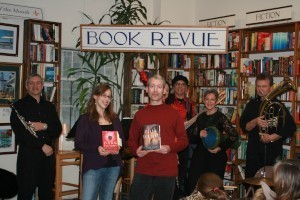 A Little Help from the Band
Authors Michele Lang (Dark Victory, Tor) and Kenneth Wishnia (The Fifth Servant, William Morrow) celebrated their books at Book Revue bookstore in Huntington, NY on Sunday, January 22. The standing-room only crowd enjoyed the sounds of the 13th Floor Klezmer Band.
Photo Credit: Michele Lang
The band! The band!
This was the photo and blurb that ran in PW Daily today, and it does a great job of summing up the event at Book Revue on January 22nd. Despite both the snow and the Giants playoffs, a standing-room-only crowd of intrepid readers joined us, for tea service with English scones, a roving band of klezmer musicians, and insider tales of the writing life. People came as far away as Florida (hi Audrey!) and NYC (hi Alexandra!) but many others traveled from all over the Island.
Thank you to everyone who braved the slushy weather and the ire of Giants fans to join us! I had an amazing, amazing time, and you all were the best part. Special thanks to the 13th Floor Klezmer band and to the fab Ken Wishnia, my co-host.
To celebrate, I'm having a little virtual Launch Party right here, right now. Introduce yourself in the comments below, or shoot me an email offline — michele at michelelang put a dot here and then com, and I will put your name in the hat. One lucky winner will get a signed copy of DARK VICTORY; another will get a signed copy of THE FIFTH SERVANT by Kenneth Wishnia. And I'll include additional goodies from the party, including packets of Harney & Sons tea from the tea service — tea as intoxicating as any served up in the Cafe Istanbul in Budapest [image error]
So say hello! And check out the additional pictures from the event below. I'll pick the winners on February 1st — and everybody on the planet is eligible to play. Thanks again to everyone for your good wishes -they mean more to me than I can ever express.
I wish I'd gotten a shot from the front of the house — there were many intrepid fans. Here's a shot from the back
More Intrepid Fans [image error]
me with Aaron Crocco, podcaster (The Geekcast) and author
me and the amazing Alexandra Honigsberg, musician, impresario, and visionary
me and the marvelous Beth of Flying off the Shelves
So many friends from LIRW came out to the party, but I didn't get enough shots with you all! This is a picture with Marilyn Levinson, a fellow member of LIRW and also of Sisters in Crime. She brought a friend, also from Sisters in Crime
With a Little Help from the Band: Launch Party recap
The band! The band!
This was the photo and blurb that ran in PW Daily today, and it does a great job of summing up the event at Book Revue on January 22nd. Despite both the snow and the Giants playoffs, a standing-room-only crowd of intrepid readers joined us, for tea service with English scones, a roving band of klezmer musicians, and insider tales of the writing life. People came as far away as Florida (hi Audrey!) and NYC (hi Alexandra!) but many others traveled from all over the Island.
Thank you to everyone who braved the slushy weather and the ire of Giants fans to join us! I had an amazing, amazing time, and you all were the best part. Special thanks to the 13th Floor Klezmer band and to the fab Ken Wishnia, my co-host.
To celebrate, I’m having a little virtual Launch Party right here, right now. Introduce yourself in the comments below, or shoot me an email offline — michele at michelelang put a dot here and then com, and I will put your name in the hat. One lucky winner will get a signed copy of DARK VICTORY; another will get a signed copy of THE FIFTH SERVANT by Kenneth Wishnia. And I’ll include additional goodies from the party, including packets of Harney & Sons tea from the tea service — tea as intoxicating as any served up in the Cafe Istanbul in Budapest
So say hello! And check out the additional pictures from the event below. I’ll pick the winners on February 1st — and everybody on the planet is eligible to play. Thanks again to everyone for your good wishes -they mean more to me than I can ever express.

I wish I’d gotten a shot from the front of the house — there were many intrepid fans. Here’s a shot from the back

More Intrepid Fans

me with Aaron Crocco, podcaster (The Geekcast) and author

me and the amazing Alexandra Honigsberg, musician, impresario, and visionary

me and the marvelous Beth of Flying off the Shelves

So many friends from LIRW came out to the party, but I didn’t get enough shots with you all! This is a picture with Marilyn Levinson, a fellow member of LIRW and also of Sisters in Crime. She brought a friend, also from Sisters in Crime
The post With a Little Help from the Band: Launch Party recap appeared first on Michele Lang.
January 21, 2012
Launch Party! Sunday January 22 at Book Revue
Tomorrow's the big day. Historical mystery and thriller author Ken Wishnia and I will be signing our books and talking about writing at the marvelous indie book store Book Revue on New York Avenue in Huntington, NY from 4-6 p.m. Our special musical guest is the 13th Floor Klezmer Band – it is going to rock so hard! (well, klezmer bands don't rock, exactly, but you know what I mean)
To celebrate the event, I'm including here an interview I did with Ken when his latest book, THE FIFTH SERVANT, first released. Ken is great people.
Hope to see you tomorrow! And if you can't make it (as one writer buddy put it, her warp drive is in the shop) I will do something festive online to celebrate once I've got some incriminating photos to share [image error]
Without further ado, here is the interview with Ken:
I had the great pleasure of meeting author Kenneth Wishnia at a Jewish Book Council's Meet the Author event. We had a great time discussing Hasidic mystics, the places in history where much of traditional epic fantasy comes from, and (best of all!) golems. I love me my golems, and thought I would bring you some highlights of our discussion. Here Ken talks about his new release THE FIFTH SERVANT (which I have just started reading and is *fantastic*).
[image error]The Fifth Servant by Kenneth Wishnia
Life in central Europe during the 16th century was daunting, especially for the Jews of Prague. Forced by papal decree to live within a walled ghetto, Jews were relatively safe from Christian persecution—but not for long. On the eve of Passover in 1592, a young Christian girl is found murdered in a Jewish shop, causing panic for Christians and Jews alike. The Jews are accused of stealing the girl's blood, a crime that threatens to remove what little security and freedom they have. Recently arrived from Poland, the rabbi's new sexton, Benyamin Ben-Akiva, is given three days by the Jewish authorities to find the real killer, or the entire Jewish population could face annihilation. Verdict: This fast-paced historical from Edgar nominee Wishnia (23 Shades of Black) combines scholarly historical details that bring the 16th century alive with believable characters and a compelling mystery. Highly recommended for mystery lovers and fans of historical fiction." — LIBRARY JOURNAL (Starred Review)
An extraordinary novel. – Sara Paretsky
Please tell us more about The Fifth Servant, including the historical background that inspired it.
Like a lot of lunatics–I mean, writers–I went through a period of fascination with the magical medieval worlds of Tolkien, LeGuin, the Book of Kells, etc. Then I discovered Major Trends in Jewish Mysticism by Gershom Sholem, which opened up a whole new world of uniquely Jewish approaches to the metaphysical and supernatural for me. This led to many more books and articles on the topic.
My original plan was to set The Fifth Servant earlier in the Middle Ages, like the 14th century, when the battle lines would have been much more clearly drawn: Jews vs. Christians, us vs. them, good vs. evil, etc. But as I did more research, the Renaissance began to present many more ambiguities and complexities. A lot of the hatred toward Jews shifts from pure racism ("They're the spawn of Satan who have to wear hats to cover their horns") to economics ("Gee, I don't feel like paying back the 500 gold pieces I borrowed from Mordecai last week, so let's burn down his shop").
I chose the year 1592 because the great Rabbi Judah Loew (of the Golem legends) was active in Prague at the time, and because the people were on the cusp of modernity, but they weren't there yet. There are always a lot of interesting dramatic possibilities in a time of great upheaval
What kind of research did you do to make the world of your book come alive?
Tons. Since my characters would have had the Torah memorized by age 6, the Mishnah at 10 and the Talmud at 15, I had to study a lot of traditional Jewish knowledge.
I also read general European history (e.g., the Catholic Counter-Reformation), Czech history (I had to read 3 books about Emperor Rudolph II just to get his character right for a single 10-page scene), and dozens of articles about such topics as witchcraft, herbal healing, 16th-century clocks, the development of wheel-lock pistol technology, etc. Once you're onto a topic, almost everything you read gives you some ideas, even if you end up not using a lot of them.
We're starting to see golems appear again in fiction these days. Did the golem legends originate in Prague? Can you describe them to us?
The earliest references to mystical rabbis creating life are in the Babylonian Talmud (cir. 5th century C.E.). Rava the Sage creates a man out of clay and sends him to Rabbi Zera, who tries to speak with him. When the clay man does not answer, Rabbi Zera says, "You are a creation of magic; return to your dust" (Sanhedrin, 65b).
The same source tells us that Rav Hanina and Rav Oshaya got together every Sabbath eve to study the Sefer Yetzira (the "Book of Creation," compiled between the 3-6th centuries C.E.) and created a three-year-old calf, which they then ate. [Insert Homer Simpson voice: "Mmm. Golem calf. (Drool...)"]
Moses Cordovero (1522-70) wrote that man can only give "vitality" to the Golem, but not life (nefesh), spirit (ru'akh), or soul (neshamah), and specific legends about the Golem (and his destructive powers) first appear in connection with Rabbi Elijah of Chelm (d. 1583). The social upheaval of the 16th century seems partly responsible for the re-emergence of this idea.
The legends associating Rabbi Loew (c. 1525-1609) with the creation of a Golem to defend the Jews against ritual murder accusations began to emerge at least 150 years after his death.
What do you think is the appeal of golems? How do golems, or the legends of golems, play out in The Fifth Servant?
In terms of the Golem being a protector of the Jews, it's clearly related to every wimpy kid's fantasy of having a big, strong friend to defend him from schoolyard bullies.
But the more frightening aspect of an unstoppable, soulless creature that begins with the Golem has come down to us via such figures as the stone statue of the Commander who comes for his murderer, Don Juan; Victor Frankenstein's famous, misunderstood creation; and most recently, the Terminator in all its forms.
The current resurgence of interest in the paranormal resembles the Romantic rejection of industrialization. The 19th and 20th century Golem figures are man-made and mechanical, products of misdirected science. The clay Golem is supernatural, created by manipulating the letters of God's name and the letters in the Torah that God used to create the universe. He is brought to life not by an electrical storm, but by calling upon God's power and writing "emes" ("truth" in Hebrew) on his forehead. It's a return to the primordial sense of the magical power of words and writing.
Of course, my characters are primarily interested in manipulating Christian fears of Jewish magic, and they use the Golem legend to great effect.
Why did you decide to write this book?
I've wanted to do something like this since I was about 15 years old (see Tolkien, above). It just took a few decades to get good enough to do it justice.
Thank you so much Ken! Now I have visions of golems dancing in my head…
Here's where you can get your own copy of THE FIFTH SERVANT:
[image error]Kenneth Wishnia was born in Hanover, N.H. to a roving band of traveling academics. He has lived and worked (and been chased by riot police) on three continents, including several years in Scotland, France and Ecuador. The urgent need for a day job forced him to earn a B.A. from Brown University (1982) and a Ph.D. in comparative literature from SUNY Stony Brook (1996). He teaches writing, literature and other deviant forms of thought at Suffolk Community College in Brentwood, Long Island, where he is an Associate Professor of English, and would like you to know that, despite all the crap ya gotta put up with, being a writer is a dream come true.
His first novel, 23 Shades of Black, was nominated for the Edgar and the Anthony Awards and made Booklist's Best First Mystery list, and was followed by four other novels, including Soft Money, which Library Journal listed as one of the Best Mysteries of the Year, and Red House, which was a Washington Post Book World "Rave" Book of the Year in 2002. His short stories have appeared in Ellery Queen's Mystery Magazine, Alfred Hitchcock's Mystery Magazine, Murder in Vegas, Queens Noir, and elsewhere.
He has held many odd jobs over the years (simultaneous translator, carpenter, furniture builder and mover, rehearsal pianist, opera chorus singer, extra in film and TV, etc. You get the idea). He studied mime in Paris, taught English to the Ecuadorian Army, and worked in New York theatre for many years. He is married to a wonderful Catholic woman from Ecuador, and they have two children who are completely insane. Visit Kenneth on the web at www.kennethwishnia.com.
Michele Lang's Blog

- Michele Lang's profile
- 41 followers


![[image error]](http://michelelang.com/wordpress/wp-content/uploads/2012/02/DarkVictory-hard-cover.jpg)
![[image error]](http://michelelang.com/wordpress/wp-content/uploads/2012/01/IMG_7698.jpg)
![[image error]](http://michelelang.com/wordpress/wp-content/uploads/2012/01/IMG_7645.jpg)
![[image error]](http://michelelang.com/wordpress/wp-content/uploads/2012/01/IMG_7728.jpg)
![[image error]](http://michelelang.com/wordpress/wp-content/uploads/2012/01/IMG_7634.jpg)
![[image error]](http://michelelang.com/wordpress/wp-content/uploads/2012/01/IMG_7746.jpg)
![[image error]](http://michelelang.com/wordpress/wp-content/uploads/2012/01/IMG_7611.jpg)
![[image error]](http://michelelang.com/2012/01/21/launch-party-sunday-january-22-at-book-revue/../wp-content/uploads/2010/05/Fifth-Servant-hc-c2.jpg)
![[image error]](http://michelelang.com/2012/01/21/launch-party-sunday-january-22-at-book-revue/../wp-content/uploads/2010/05/wishnia.jpg)