
Rebecca Klempner's Blog, page 25
July 11, 2013
The best books for Jewish kids?
Kveller presented one bubby’s Top 10 Books for Jewish Kids this week. The first seven are Jewish books, the last three are secular books that the author of the list feels can benefit Jewish kids. I’ve got some issues with the list.
1) There are many great books on the list, including one that I put on my own list — The Magician by Uri Smulevitz — and one I probably should have –Yussel’s Prayer by Barbara Cohen — but what surprised me was that none of the books were from Jewish publishers. No T...


July 9, 2013
Personal life as a metaphor
In literature, we often use the intimate details of personal life to represent broader issues. In my latest article on Tablet, I used my experience of leaving Israel after making aliyah in childhood to connect to the annual season of mourning for the destruction of the Temple in Jerusalem.
Have you read any memoirs, essays, or even novels where the personal serves as a microcosm for the world at large? Please share in comments below.


June 19, 2013
Having a funny day?

Even hyenas know when not to laugh.
A couple days ago, I read this post on the Florida Writers Conference Blog (I know I’m not from Florida, but I happen to really like this blog) about humor. And there’s a fun overview of contemporary religious Jews in comedyright now on Aish.com. So I was already contemplating the subject when I spotted an interview with Ruth Wisse on Tablet about her new book, No Joke.
Ten minutes in, Wisse talks about secular Jewish vs religious humor. If you’re a Jewish wr...
June 16, 2013
When the trolls try to drag those you love under the bridge.
“Take that, you nasty troll! Maybe you’ll think twice before saying mean things about my sister again!”
I hate trolls.
Not the fictional kind. The internet kind. I’ve blogged about it before.
But now, my sister has published her first piece on Tablet. And the very first comment she got was from a troll. A mean, nasty one who called her names.
If getting mean-spirited comments from random strangers is bad, having your sister get them is worse. I’m irate! I’m disgusted.
I have commented.
Fair readers...
June 11, 2013
Regional dialect in the U.S. – Pardon me for my nerdiness
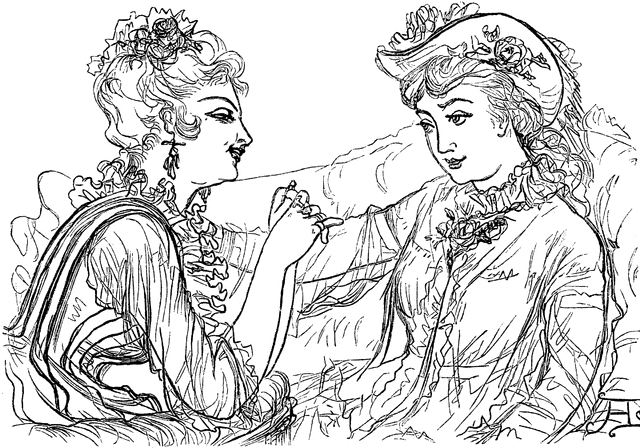
“I’m sorry I laughed at you for calling the ginger ale, ‘Coke.’” “That’s alright, Mabel. I’ll forgive you if you pardon me for laughing when you called the spigot a ‘spicket.’”
Like most people who read and write SF and fantasy, I have a tendency towards nerdiness. I watched Star Trek loyally (until I ditched my TV at age 24). I read graphic novels. I watched foreign films as a teen and young adult and snubbed “Forrest Gump” and “Titanic.”And my idea of a fun day out could easily involve a mus...
June 2, 2013
Books–still better than TV?
Liel Liebovitz, on Tablet Magazine this week, argues that TV is for Dummies.
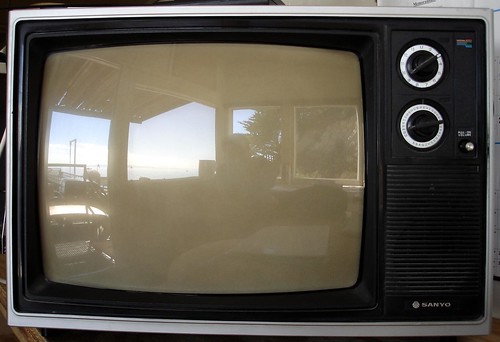
Photo of Sanyo TV courtesy of Kevin Simpson via Flickr
Like most titles, this one exaggerates Mr. Liebovitz statement: that even if TV has achieved more creative sophistication than ever before, it still fails to reach the majesty of the written word (or something to that effect). In his mind, books are still king. He bases his argument, as I understand it, on the inability of a visual art form to capture the interior...
May 28, 2013
Helpful tools to plot your story

“Excuse me, sir. Do you happen to remember that story where that guy dies and one of his sons thinks the other did the crime, but it turns out to be the mother instead?”
I was reading a post by Noelle Sterne on Writer’s Digest todaywhere she describes “How to Prevent Predictable Plots.” She cites Georges Polti, who listed36 classic plots which are constantly used and reused in literature and drama. (Sterne suggests that it’s inevitable you’ll use one of these basic plots, but that you can set...
How to plot your story
“Excuse me, sir. Do you happen to remember that story where that guy dies and one of his sons thinks the other did the crime, but it turns out to be the mother instead?”
I was reading a post by Noelle Sterne on Writer’s Digest todaywhere she describes “How to Prevent Predictable Plots.” She cites Georges Polti, who listed36 classic plots which are constantly used and reused in literature and drama. (Sterne suggests that it’s inevitable you’ll use one of these basic plots, but that you can set...
May 19, 2013
Helping out the illustrator, even when you don’t know who they are yet
I’ve been working on a new picture book manuscript, my first one in a while. It’s a poem that came out of experiences with my kids and with others’ and the troubles they face.
I put it away for a couple days, pulling it out again this morning. Now that I’ve decided it’s a picture book, I’m revising it with an eye to the requirements of the format.
O the horror! It’s unillustrateable!
(Yes, I just made that word up.)
What do I mean?
Illustrators don’t just draw nice pictures–they support the text....
May 14, 2013
To outline, or not to outline, that is the question.
I just viewed this interesting slideshowon Flavorwire containing outlines by famous writers. I use “outlines” in a broad sense–several were more like graphic organizers than true outlines. I had a weird reaction to the piece.
Usually, I start stories with clusters or notes, not with actual outlines, unless we’re talking something big–a serial (even a mini-serial) or a novel. Sometimes, I cross out and draw arrows to rearrange the elements so often, I end up rewriting the whole thing a few time...



![[image error]](http://etc.usf.edu/clipart/64900/64996/64996_knight&troll_sm.gif)