Susan Knight's Blog, page 2
March 29, 2024
The Game’s Afoot – review of ‘Eliminate the Impossible’
There’s a deal of improbability in these yarns, among them a case of apparently spontaneous combustion, a shooting presided over by the Angel of Mons and the apparition of Lady Hatton holding her heart in her hands in the self-same Bleeding Heart Yard where centuries before she had sold her soul to the devil. With his customary disdain for the supernatural, Holmes manages to blow away the fogs of irrationality to reveal the very physical explanations for these events.
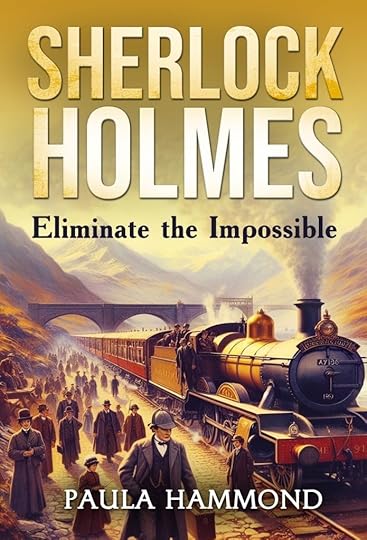 What I particularly enjoyed, apart from the tales themselves, were the notes following each story, showing them to be grounded in historical accuracy. Real people make appearances, usually with their names changed. Thus Hiram Maxim, inventor of the Maxim machine gun, appears as Dodson Hughes; Hannah and John Courtoy, whose Egyptian style mausoleum is one of the sights of Brompton cemetery in London appear here as Hannah and John Chester (deceased).
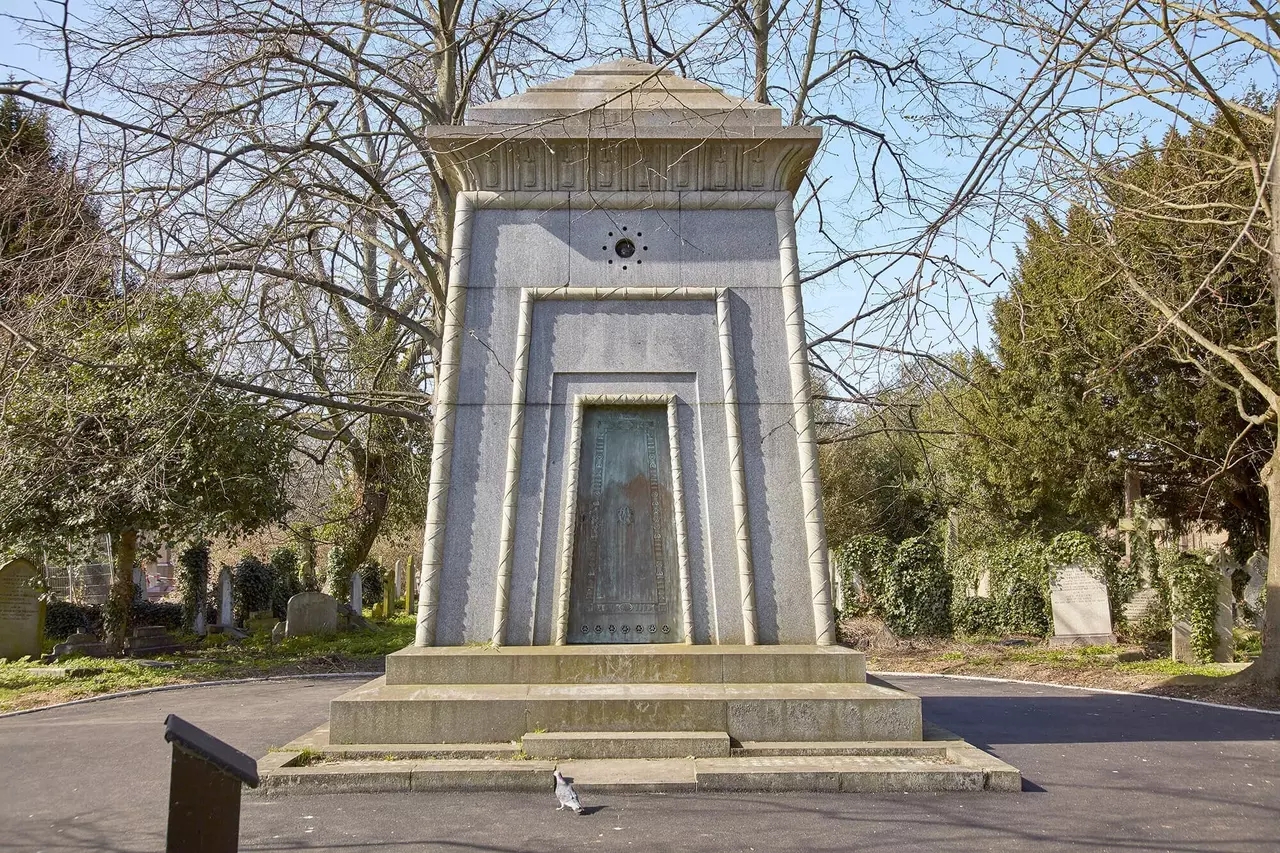 The Courtoy mausoleum in Brompton cemeteryThere’s fascinating and sometimes grisly incidental detail, too, regarding the combustibility of pigs or the fact that in certain circumstances quicklime preserves bodies rather than destroys them, the deleterious effect of prolonged ultra-low frequency sounds on the human brain, causing fear, vertigo, disorientation and even heart attacks, used to sinister effect in certain regimes to this day.The story in the collection that particularly caught my attention, since I myself am in the process of finishing a new Mrs Hudson novel set in Constantinople, is The Case of the Impossible Assassin, in which Holmes and Watson travel via the Orient Express to the then Turkish capital. It’s an intriguing tale and one which, I am relieved to say, bears no resemblance to my own story, apart from the setting.What is a well-established fact, however, is that Sultan Abdul Hamid II was a huge fan of Sherlock Holmes. When Sir Arthur and his new wife, Jean, honeymooned in Constantinople in 1907, the Sultan conferred on him the Order of the Medjidie (second class) and on Jean The Order of the Chefakat, which (spoiler) Mrs Hudson too may hope to receive quite soon.All in all, a thoroughly engaging collection. I shall certainly look out for more of Paula Hammond’s books.Sherlock Holmes: Eliminate the Impossible by Paula Hammond, edited by David Marcum (MX publishing, 2024)https://mxpublishing.com/products/sherlock-holmes-eliminate-the-impossible


March 2, 2024
In the Shadow of Sherlock Holmes: The Adventures of Mary Morstan Watson: review
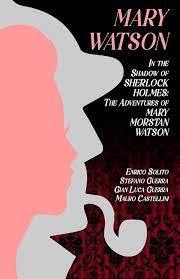
Here’s an intriguing oddity, a collection of stories written by four Italian Sherlockians, Enrico Solito, Stephano Guerra, Gian Luca Guerra and Mauro Castellini. The first two are child neuropsychologists, the others filmmakers, a potent and suggestive combination, and, since none of the stories is attributed to any individual, it would seem all of them are involved in all of them, writing by committee perhaps.
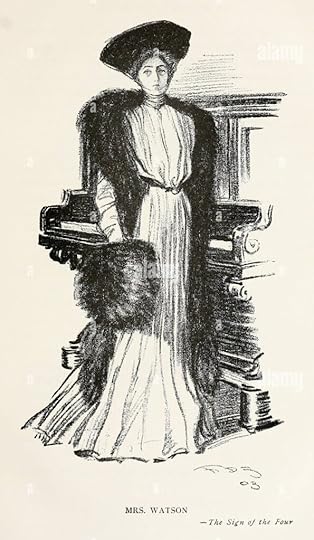
That certainly doesn’t affect the flow in this most readable and enjoyable book. The authors have taken a minor character from the canon, Mary Watson nee Morstan, who featured in the tale The Sign of Four and subsequently married Dr Watson. Many readers will know that Conan Doyle soon killed her off, presumably so that Watson could rejoin Holmes in Baker Street, but here Mary takes centre stage. The stories are supposedly part her narration and part her diary, though I sometimes wondered why the whole thing had not been written as a diary, since there seems little to differentiate the passages. (Maybe this was where the committee writing came in).
Following her marriage and, for the most part, keeping it secret from her husband to spare his worries, Mary launches herself into a series of investigations of her own, engaging with Catholics, socialists, the Salvation Army and trade unions, among others. She has a deep-seated sense of justice and energetically sets about wronging rights and supporting the oppressed, particularly women.
The stories are linked and several characters from one story appear in another, for instance, the colourful and cross-dressing ‘Clara’ who helps Mary with the many disguises she needs in order to venture into the dark heart of London.
Woven through the narrative are references to some of the cases from the canon, notably The Sign of Four, where Mary makes her first appearance. Readers will no doubt be surprised to learn that the ending of The Case of the Five Orange Pips as written up by Dr Watson, was not in fact what really happened, the truth cleverly hidden (Mary’s idea) to protect a man from his would-be assassins. The Final Solution features as well, although, sadly for our heroine, it is her own ending too, as she succumbs to tuberculosis.
Mary Watson is a most engaging heroine and her adventures will be sure to divert Sherlockians and non-Sherlockians alike.
http://mxpublishing,com/products/mary-watson-in-the-shadow-of-sherlock-holmes-paperback
February 23, 2024
Sherlock is an animal!
Two delightful children’s books have just landed on my desk for review. Both feature Sherlock Holmes, but as you may not have seen him before. In animal form, in fact!
Sherlock Cat and the Thwarted Thespian by Heather Edwards, with charming black and white illustrations by Amanda Downs, is aimed at the seven to twelve age group.
It’s a lively yarn – the second in a series which started with Sherlock Cat and the Missing Mousie – in which Spot (aka Sherlock), a Siamese, and his narrator side-kick, the plump and fluffy Kitty (Watson), investigate a series of mysterious happenings at a local theatre, which coincidentally is producing a play about the ‘real’ Sherlock Holmes.

Written with humour and featuring well-drawn characters, both human and animal, it is guaranteed to divert both you and your children.
If I have a criticism, it is the title, which might fox the average young reader, though ‘thwarted thespian’ is fun to say, and is explained by Sherlock towards the end of the story.

Sherlock Holmes and the Farmyard Caper, written and illustrated by Danielle Calloway, is a colouring book featuring Harlee and her stuffed bear, Patches.
Harlee, based on the author’s own rescue dog, Harley Davidson, likes to pretend to be Sherlock Holmes, with Patches as a silent Watson. They live on a farm, and in this story set out to track down who has been stealing the barnyard animals’ toys… without leaving any footprints.
Danielle says that she was persuaded by young friends to create colouring books so that children could both enjoy reading and learn to be artists. This fits the bill: the story is engaging and the numerous illustrations are inventive and wacky.
Sherlock Cat and The Thwarted Thespian by Heather Edwards, MX publishing https://mxpublishing.com/products/sherlock-cat-and-the-thwarted-thespian
Sherlock Holmes and the Barnyard Caper by Danielle Calloway https://mxpublishing.com/products/sherlock-holmes-and-the-barnyard-caper
November 6, 2023
The Adventure of the Found Note: review
A cry for help on a note stuck to the shoe of a night watchman sets in train a new adventure for Holmes and Watson in this page-turner of a novel.
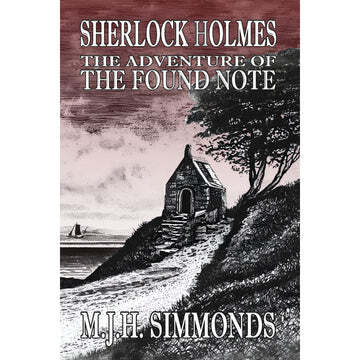
The labyrinthine plot, in which nothing and no one can be taken at face value, leads us over the country from Baker Street and all over London, to a thrilling climax on a remote island off the north-east of England.
But while Holmes is off, in one of his many disguises, infiltrating at great personal peril the murky Ex Tenebris Club, Watson is faced with solving another mystery altogether. Ever a sucker for a pretty face, the good doctor agrees to help one Catarina Hill, whose beloved husband has disappeared. At the family house in Arundel, near Brighton, he makes a startling discovery, suggesting that Hugo Hill, too, is not quite what he seems.
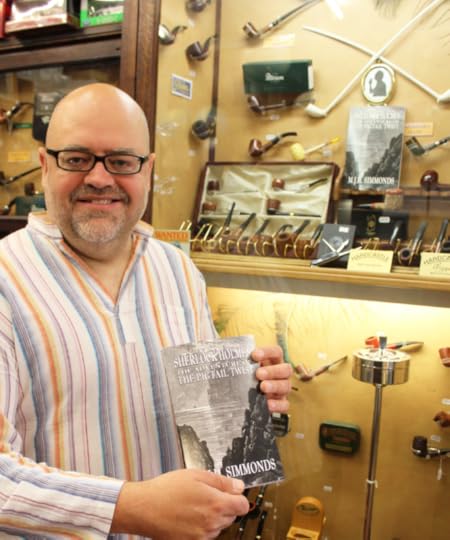
Author M.J.H. Simmonds [seen left in his family’s ‘gentlemen’s emporium’ in Bedford, England, holding his earlier novel, ‘The Adventure of the Pigtail Twist‘] skilfully weaves the main plot and subplot together.
However, I found myself worrying for the state of Dr Watson’s liver, lungs and digestion. He seems to spend such an inordinate amount of time eating rich food, quaffing brandy and smoking cigars and pipes, that I wondered how he managed to keep a clear head, never mind shoot straight.
Nevertheless, in The Adventure of the Found Note, M.J.H. Simmonds has written a most engaging addition to the ever-lengthening list of pastiches of Sherlock Holmes.
The book is available in hardback, paperback and kindle from MX publishing: https://mxpublishing.com/products/sherlock-holmes-and-the-adventure-of-the-found-note
And NB: every book you buy from the publisher buys a meal for someone in need.
Also available for pre-order from:
Amazon USA Barnes and Noble Amazon UK Fishpond Australia Kindle
October 17, 2023
‘Watson’s Wives’ reviewed

One of the very many impressive aspects of Thomas Turley’s new collection, ‘Watson’s Wives and other tales of Sherlock Holmes’, is how the author references not simply the original Canon, but also some of the pastiches that have been written by himself and others, as well as Baring-Gould’s 1962 ‘biography’ of the great detective.
He also skilfully weaves into his accounts actual historical events and people – ‘greats’ like William Gladstone, Joseph Chamberlain, Gustav Mahler, Sigmund Freud and the author Edith Wharton, together with lesser-known characters, like the colourful double Duchess (of Manchester and subsequently of Devonshire), wife of Lord Cavendish, whose brother, incidentally, was one of the men assassinated in Dublin’s Phoenix Park by Irish nationalists. Many times, I had to put the book aside to Google these fascinating individuals.
The one who caught my imagination most was Hans Rott, music student and one-time friend of Mahler.
Rott (right) was committed to an asylum after drawing a pistol and threatening a passenger on a train that he claimed had been filled with dynamite by his teacher, Brahms (who, incidentally, was scathingly dismissive of Rott’s music).

The poor composer died in the asylum aged only 25. A footnote reveals how Rott’s music has been rediscovered, performed and recorded in recent times. All this is true – stranger even than fiction – but Thomas Turley’s transformation of the factual material results in a riveting tale of ambition and betrayal.
Several of the stories, as the title of the collection indicates, concern Dr Watson’s wives. According to this author, there were three of them, all of whom died young – to the eternal heartbreak of their husband. Sherlockians will know of Mary Morstan and possibly also, thanks to Baring-Gould, of his American bride, Constance Adams. Few of us, however, will have heard of Watson’s third wife, Priscilla Prescott. In the tale related here she is the young widow of an officer whose apparent suicide during the Boer War was attributed to his guilt following shameful cowardice in the face of the enemy. Priscilla is convinced that the truth of the matter is quite different, and calls on Sherlock Holmes to investigate. The result: sordid revelations implicating none other than Lord Kitchener himself, while Dr Watson has to confront his own complicity, his years of silence in the face of evidence of the young officer’s innocence.
Altogether an intriguing, intelligent, entertaining and thought-provoking collection.
Available from mxpublishing.com/products/watson-s-wi...
Also available from Amazon.
And watch out for my own collection, ‘The Strange Case of the Pale Boy and other mysteries’, due out in November.
September 21, 2023
Sherlock Holmes and the Hellfire Heirs
What could be more delightful, as wintry nights draw in, than to curl up in front of the fire in the company of old friends, in this case, fictional ones: Sherlock Holmes and Dr Watson embarking on a thrilling new case. ‘Sherlock Holmes and the Hellfire Heirs’ is the latest of six novels by Margaret Walsh (right) featuring the iconic detective and his faithful chronicler.

Virtuous young girls have started disappearing and Holmes is called on to investigate. He, Watson and Inspector Lestrade of Scotland Yard soon find themselves plunged into the murky world of white slavers in the pay of degenerate aristocrats. The trail leads them to the stews of Wapping, in those days very far from being the fashionable and chic riverside part of London that it has become, but a place dangerous for the unwary to visit. In the words of reformed whore Maggie, ‘No bugger in their right mind goes to Wappin’ fer no reason.’
From there, it seems, girls are being shipped to France, to meet there a fate worse than death.
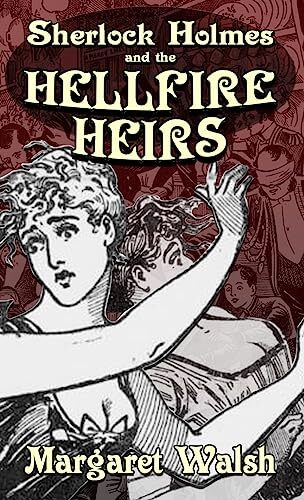
The plot unfolds at a satisfyingly breakneck speed. Or rather, at a breakneck speed, broken occasionally by Watson’s often fascinating and informative digressions, for example regarding the victims of Jack the Ripper or the history of the Paris Sûreté founded by ex-criminal Eugene Vidocq.
Elsewhere, Watson likes to describe in detail the amazingly substantial dinners he and the others regularly enjoy. Sometimes mouth-watering, at others eye-watering, like the the following: eel soup, veal sausages with stewed cucumbers and spinach dressed with cream. Glancing at the bibliography at the back of the book, I imagine Margaret Walsh has found such delicacies in ‘Mrs Beeton’s Book of Household Management’, and while present-day palates might find such fare somewhat indigestible, it is authentically Victorian, and Watson always tucks in with endearing relish.
I myself consumed this short novel in two pleasurable gulps. A tasty addition to the new Holmes’ canon.
Available in paperback or hardback from MX publishing now or from usual online outlets from November:
Sherlock Holmes and The Hellfire Heirs – Paperback
Check out my author profile at MX: https://mxpublishing.com/collections/sherlockian-author-profile-Susan-Knight
June 5, 2023
Teatime at Baker Street

‘Well now,’ said Holmes, buttering his drop scone with satisfaction. ‘I must say it is good to have Mrs Hudson back from her travels. Adequate as Clara might be in most respects, she is not a patch on our exemplary landlady when it comes to the kitchen.’
Clara is the maid servant who takes over when Mrs Hudson is away. I have always found her pleasant, obliging and more than adequate in fulfilling her duties, but perhaps I am not as fussy as Holmes. Or perhaps Clara is less willing to indulge his little foibles, such as the precise time (four and a half minutes) that he requires his egg to be boiled. He had complained most morning that it was either too hard or too soft, to which Clara, I suspected, was within an inch of retorting, ‘Well, cook it yourself, then.’
‘I trust,’ Holmes now continued, ‘that Mrs Hudson had a nice restful time with her daughter in… where was it again, Watson?’
‘In Kent, Holmes, and no. Weren’t you listening when I told you? The poor woman went there for rest and recuperation after her ordeal in Paris, only to be caught up in yet another murder mystery, and nearly getting herself killed in the attempt to solve it.’
‘Good gracious! That would have been most inconvenient,’ my friend replied. I am afraid empathy is not one of his stronger characteristics.
He wiped melted butter from his chin.
‘You say attempted to solve it. The poor woman failed, I suppose.’
‘Not in the least. She brought the culprit to justice. In fact, she has written of it in a new book, Death in the Garden of England. It is most thrilling.’
‘Hmm.’ Holmes frowned. Did he feel threatened, I wondered, by Mrs Hudson’s success in solving crimes? Surely not. And yet…
‘I hope,’ he said, ‘she has no plans for any future adventures, although…’ he reluctantly fingered a letter he had received that very morning, ‘there is something she might be able to assist me with.’
I looked askance. Holmes wishing for assistance, and not from me?
‘It’s a new case, Watson, a case that needs very delicate handling, and, I rather think, a woman’s touch.’
He folded up the letter and replaced in in an envelope embossed with a seal that I recognised. It was the seal of the Ottoman Sultan.
Were we all then heading to Turkey?
‘Death in the Garden of England, A Mrs Hudson mystery’ published by MX, is available in paperback and Kindle from Amazon at https://www.amazon.co.uk/Death-Garden-England-Hudson-Mystery/dp/B0BXFRKQFG/
December 4, 2022
The Torso at Highgate Cemetery and other Sherlock Holmes stories
Here’s yet another highly entertaining collection of stories from Tim Symonds, an author with no less than six other Sherlock Holmes novels to his name. The tales here have as tantalisingly intriguing titles as that of the anthology itself: The Mystery of the Missing Artefacts, The Case of the Seventeenth Monk, The Strange Death of an Art Dealer, The Ambassador’s Skating Competition and The Impressionist Painting, which features Professor O’Clery, a fiendish villain later to change his name to that of another Irishman, onlt too well known to fans of the canon.
The plots here are cunning and never disappoint, taking us from the darkest places of London, to the open spaces of the Sussex South Downs, and beyond, to Crete and even to a dungeon in the Sultan’s palace in Constantinople. What I also particularly like about all Mr Symonds’ writing is his scrupulous attention to rich period detail, his encyclopaedic knowledge of the social, cultural and political history of the times, as well as of the Sherlock Holmes’ canon.
Each story is followed by a set of notes, which I found almost as fascinating as the tales themselves. Thus, if the reader is a little confused as to the nature of the Trichinopoly cigars which Dr Watson mentions at one point, the notes are there to explain all. Or if, in the case of The Impressionist Painting, the reader wishes to learn more about the Monet painting, The Beach at Trouville, Mr Symonds can enlighten her. There is even a delicious sounding recipe for the Orange Fool dessert served at Boodles, one of Dr Watson’s clubs.
If I have one quibble, it is the constant description of Mrs Hudson as ‘housekeeper’. Readers of my own series of Mrs Hudson books will know that she is most pernickety on that point, being the owner of the house in Baker Street, and thus the landlady, not the housekeeper, of Holmes and Watson.
That aside, I found this a most satisfying and varied spread of stories, perfect reading for chilly winter evenings, huddled round a blazing fire.
The collection is currently available from Amazon.com and soon from Amazon.co.uk as well as from the Book Depository:
September 22, 2022
Sherlock Holmes and the Sixty Steps – Review
What a treat to read Séamas Duffy’s new collection. It is comprised of a novella – the title piece – and three carefully crafted short stories, based on Mr Duffy’s extensive research and knowledge of the Canon.
The novella is the star of the show, but the stories are intriguing as well. The Tragedy of Langholme Wyke is a clever sequel to The Hound of the Baskervilles, based on Mr Duffy’s own mock-scholarly study of that novel. The Problem of the Three Coptic Patriarchs takes inspiration from one of Holmes’ cases mentioned but never written up by Dr Watson. The sinister The Mystery of the Thirteen Bells – all cryptograms, body parts and foggy London backstreets – is a pastiche firmly in the spirit of the Canon. All three terrific reads.
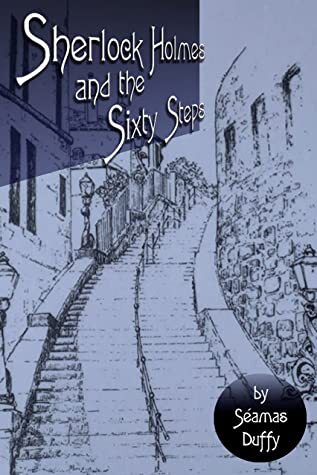
As for Sherlock Holmes and the Sixty Steps, Mr Duffy takes us to Glasgow, and to the case of a miscarriage of justice, where one Osip Stoller, a German Jew involved in petty crime, has been fitted up for the murder of an elderly spinster.
An old school friend of Dr Watson’s, Stoller’s defence solicitor, has appealed for Holmes’s help in saving his client from imminent execution, and the bored detective is as ever only too willing to take up the challenge. An ingeniously involved plot, well-drawn characters and a convincing evocation of late nineteenth-century Glasgow, all contribute to the enjoyment of the story.
By the way, the ‘sixty steps’ of the title refers to an actual landmark in Glasgow, built in 1872 by Alexander ‘Greek’ Thomson, the lovely illustration on the book’s cover calling to mind the sets of steps leading up the butte of Montmartre. The author, who himself is based in Glasgow, is donating all royalties from the sale of his book to the Greek Thomson Sixty Steps Preservation Society.
Mr Duffy writes with wit and wisdom, like Conan Doyle himself citing numerous cases not (yet) written up by Dr Watson. I’d particularly like to hear more of the case of the Bognor Prestidigitation Circle.
Nor is the author averse to a little self-mockery (and mockery of all those of us who attempt the genre): the villain is ‘a writer of third-rate detective stories – the mark of a low, scheming and venal mind – he knew well how to weave a plot and trail a red herring.’ However, Séamas Duffy is anything but third-rate by the standard of his latest book. Highly recommended.
*
Published by MX publishing, Sherlock Holmes and the Sixty Steps is available from
https://www.bookdepository.com/Sherlock-Holmes-Sixty-Steps-S%C3%A9amas-Duffy/9781804240175
July 29, 2022
Sherlock rides again…and again
Novellas are a delight: consumable in one or two great gulps and excellent for taking on the bus or train, since they fit neatly into handbags or man bags. I was delighted, therefore, when two new Sherlock Holmes adventures from MX publishing dropped through my letterbox recently. In this case they are both by well-established authors with many previous books under their belts.

The first, Sherlock Holmes and the Strange Death of Brigadier-General Delves by Tim Symonds packs a lot into its 129 pages. The plot, covering many decades, starts with a chance meeting between Dr Watson and an old army colleague from their days in Afghanistan. ‘Maiwand Mike’ Fenlon tells how he is on his way to Guernsey to assist his erstwhile commander, the eponymous Brigadier-General Delves, with his memoirs. Shortly afterwards, Watson receives an urgent letter from Fenlon, stating that he is in prison awaiting trial for the murder of Delves and entreating Sherlock Holmes’ help.
Holmes agrees to travel to Guernsey even though Fenlon has surprisingly refused to enter a plea. If we readers imagine all is now set up for the usual pyrotechnic display of genius from the detective – unravelling the mystery – we will be surprised. Has Holmes got it wrong for once? Only many years after the events, can the truth be revealed.
Tim Symonds clearly knows his history as well as he knows the Canon. The tale, though fictional, is rooted in fact, the author telling us he averages 25 books of source material for each of his books, so, as well as the story itself, Tim Symonds includes around 30 pages of explanatory notes, fascinating in themselves.
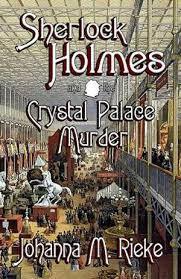
The second book, Sherlock Holmes and the Crystal Palace Murder by Johanna Rieke, is another enjoyable read. I wasn’t clear, however, how the first sixty pages, before we get to the nitty-gritty of the murder, fits in to the rest of the story, except that it introduces the murky figure of the German-Knife Grinder, of whom, I feel, we are bound to hear more in the future. In this first section, Holmes explains to Watson in some detail what was behind his apparent death at the Reichenbach Falls, and for me it dragged a little.
However, once the murder mystery starts, the story bounces on most satisfactorily. A man has been found with his throat slashed in the middle of the maze at the Crystal Palace, and it is up to Holmes, in the face of plodding police work, to reveal the truly nefarious reason for his death.
Johanna Rieke lives in Switzerland and writes in German, more proof of the universality of Holmes’ appeal. She is a mathematician as well as an author and the coded message that Holmes takes it upon himself to solve is delightfully abstruse. Like Tim Symonds, she has done her background homework well, so there is a pleasing authenticity to the detail, even if Watson comes across as a little pedantic in relaying it. I found the descriptions of the original Crystal Palace most fascinating, born as I was not far from there and, as a child only knowing of it as an intriguing name. How sad that the Palace itself, part of the Great Exhibition of 1851, and subsequently moved to South London from Hyde Park, was eventually destroyed by fire.
Both books are available from Amazon and from the Book depository.