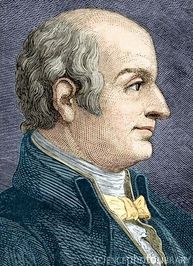
Lazzaro Spallanzani (Italian pronunciation: [ˈladdzaro spallanˈtsaːni]; 10 January 1729 – 12 February 1799) was an Italian biologist and physiologist who made important contributions to the experimental study of bodily functions, animal reproduction, and essentially animal echolocation. His research of biogenesis paved the way for the downfall of preformationism theory (the idea that organisms develop from miniature versions of themselves), though the final death blow to preformationism was dealt by Louis Pasteur.
Spallanzani researched in 1768 the theory of the spontaneous generation of microbes. At the time, the microscope was already available to researchers, and using it, the proponents of the theory, Buffon and Needham, came to the concLazzaro Spallanzani (Italian pronunciation: [ˈladdzaro spallanˈtsaːni]; 10 January 1729 – 12 February 1799) was an Italian biologist and physiologist who made important contributions to the experimental study of bodily functions, animal reproduction, and essentially animal echolocation. His research of biogenesis paved the way for the downfall of preformationism theory (the idea that organisms develop from miniature versions of themselves), though the final death blow to preformationism was dealt by Louis Pasteur.
Spallanzani researched in 1768 the theory of the spontaneous generation of microbes. At the time, the microscope was already available to researchers, and using it, the proponents of the theory, Buffon and Needham, came to the conclusion that there is a life-generating force inherent to certain kinds of inorganic matter that causes living microbes to create themselves if given sufficient time. Spallanzani's experiment showed that it is not an inherent feature of matter, and that it can be destroyed by an hour of boiling. As the microbes did not re-appear as long as the material was hermetically sealed, he proposed that microbes move through the air and that they could be killed through boiling. Needham argued that experiments destroyed the "vegetative force" that was required for spontaneous generation to occur. Spallanzani paved the way for research by Louis Pasteur, who defeated the theory of spontaneous generation almost a century later.
Spallanzani discovered and described animal (mammal) reproduction, showing that it requires both semen and an ovum. He was the first to perform in vitro fertilization, with frogs, and an artificial insemination, using a dog. Spallanzani showed that some animals, especially newts, can regenerate some parts of their body if injured or surgically removed. Spallanzani is also credited with the classification of tardigrades, which are one of the most durable extremophiles still to this day.(See Binomial Nomenclature)
Spallanzani is also famous for extensive experiments on the navigation in complete darkness by bats, where he concluded that bats use sound and their ears for navigation in total darkness (see animal echolocation). He was the pioneer of the original study of echolocation, though his study was limited to what he could observe. Later scientists moved onto studies of the sensory mechanisms and processing of this information.
His great work, however, is the Dissertationi di fisica animale e vegetale (2 vols, 1780). Here he first interpreted the process of digestion, which he proved to be no mere mechanical process of trituration - that is, of grinding up the food - but one of actual chemical solution, taking place primarily in the stomach, by the action of the gastric juice. He also carried out important researches on fertilization in animals (1780).
His indefatigable exertions as a traveller, his skill and good fortune as a collector, his brilliance as a teacher and expositor, and his keenness as a controversialist no doubt aid largely in accounting for Spallanzani's exceptional fame among his contemporaries; his letters account for his close relationships with many famed scholars and philosophers, like Georges-Louis Leclerc, Comte de Buffon, Antoine Lavoisier, and Voltaire. Yet greater qualities were by no means lacking. His life was one of incessant eager questioning of nature on all sides, and his many and varied works all bear the stamp of a fresh and original genius, capable of stating and solving problems in all departments of science—at one time finding the true explanation of stone skipping (formerly attributed to the elasticity of water) and at another helping to lay the foundations of our modern volcanology and meteorology....more