Jeremy Zimmerman's Blog, page 6
August 7, 2013
I’m Not Gonna Write You a Love Song
Originally published at Jeremy Zimmerman. You can comment here or there.
I’d be lying if I said general ennui and frustration with roleplaying games is some new thing. I’ve been dissatisfied with a lot of roleplaying games for probably the last decade, but occasionally it spikes up and I want to rant and foam a bit. I almost had a new post written when I bought the newest edition of Fading Suns. It had changed a few things, but left in a lot of the bits I thought were ill conceived. Now Shadowrun 5th Edition is coming out and I feel similarly frustrated. I want to grab someone and yell, “You left the bodies and you only moved the headstones!!”
On the flip side, a lot of Apocalypse World and Monsterhearts have made gaming a whole different level of fun. And it’s gotten me to dust off a lot of game ideas that I’d otherwise given up on.
As games, roleplaying games are weird. In what little mainstream you can claim for a niche industry, I feel it hasn’t entirely shaken off its wargaming roots. The mechanics are a reflection of your abilities, with some special attention invariably paid towards combat. But then you get to people who really love the roleplay: the portrayal of their character, the creation of a good story, etc. Sometimes you even hear the well-worn line about roleplay versus rollplay.
Which establishes this sort of weird paradox: You are playing a game, but you are discouraged from using the game mechanics to do well. You get called a “power gamer” or a “min-maxer” or whatever. You have all these books of rules, but you are the asshole for wanting to use the rules to the best of your ability.
The mechanical approach has traditionally been to layer on incentives to add flaws to your character that can lend story elements. Otherwise most game design involves (as best I can tell) “new ways to roll dice.” Within the last several years you’ve had those young folks and their indie games trying to change the idea behind how roleplaying games work entirely: what if the rules for the game are about the story and not about the combat? If you are using the rules to your full potential, then all you’re doing is making a better story.
Which pisses off people. It pissed me off. I know the first time I played Primetime Adventures I felt like I’d been tricked. “This is not a roleplaying game! Why has everyone told me this is a roleplaying game?! If I weren’t out of shape I’d flip this table! Rawr!” Because it was a very different sort of experience. And some people think of the lack of roleplaying related rules in traditional roleplaying games as a feature, not a bug. It leaves the vista open to do whatever you want. It’s not like you need rules to have a conversation.
And this leads to no serious change happening to improve roleplaying games. The last hope may have been D&D 4e, which is probably the New Coke of roleplaying games. They tried to treat Dungeons & Dragons as a game, and create the game based off of what people said they wanted. And then it all blew up, leaving Pathfinder to scamper in and claim a huge chunk of market share. Because apparently no one wants change. The most common complaint I heard was that it turned D&D into an MMORPG, as they had broken characters down into the role they play in combat.
Which brings me back to Shadowrun 5e. I have a long and troubled history with Shadowrun in general. It was the second game I’d ever played, after our Advanced Dungeons & Dragons 2e game stumbled slowly to death. It’s kind of a weird obnoxious beast, and I’ve been persistently frustrated with how cyberware is handled in the system. If you want any heavily cybered character, you really wanted to have a spreadsheet. I’ve done it with pencil and paper. I know it’s possible. I’ve also passed gall stones. I don’t want to repeat that either.
Cyberware was also a dead-end for characters. You play a mage, and you have this open ended ability to just get more and more powerful. If you burn up all of your characters resources to max out your cyberware starting out, then that’s it. You can, in theory, save up money to buy more cyberware, but that becomes prohibitively expensive over time.
Our campaigns always ended up with mages who had more money than they had a use for (because everything they wanted cost XP) or street samurais who had more XP than they had a use for, because there’s only so many skills you can buy. But only the mages were able to actually improve. The street samurais just spent all their time selling everything they could fit in a backpack on every run, and trying to scrape up every nuyen in hopes of getting the delta-grade wired reflexes 3.
I liked Shadowrun 4e. It wasn’t perfect, but it felt like a step in the right direction. Cleaner rules, a way to accommodate a broader diversity of magical traditions, advancing technology so that it fit with more modern notions of advanced technology. Cyberware was only slightly improved. It still encouraged a spreadsheet. They had also canned a lot of the cheesy fake swear words from the previous editions and some of the other slang (like “deckers” became just “hackers”), which I thought was a bummer but I guess they felt the need to say, “We’re grown-ups, we’re not writing for 14 year old boys, we don’t need fake swear words.”
Shadowrun 5e feels like it’s trying to atone for some perceived mistakes from the previous edition. They brought back all the fun slang. They brought back the “priority system” from earlier editions. They beefed it up a bit more, so that it sped up character creation a bit more. And that was their purported reason for many changes: to speed up character creation.
And then they get to buying resources. And the table of gear for the first sample character gets its own page. To be fair, this is the one with the most money to spend on gear. They fit two tables on the following page for two other sample characters. I mean, imagine that you have $400,000, and you need to list out everything you are going to buy with that. There is no way that’s fast. And with that, you also need to note all the effects the gear has on your character.
It may be that this isn’t a flaw for some people. It may be that some people like the acquisition of mad lewt. But for me its just an exercise in tedium. I had more energy for that fifteen years ago, where I’d do stupid things because I took a strange pride in doing things the hard way.
The book does offer pregens, which is a mixed bag. Sure, they do all the math for you. But (a) there’s no translation of what all the gear you have does and (b) Shadowrun pregens have traditionally sucked. They are fallback NPCs in canned adventures. “Use the Street Samurai character in the core book.” Then you do and the pack of street samurais get murtilated by the party. And I’m not talking seasoned player characters. These are fresh from the character creation booth.
It may be that I have a narrow experience with playing Shadowrun, but almost every game I’ve run or played has been about violence committed by magical cyberpunk murder hobos. (Except I was that weirdo that had this beautiful inner landscape for all his characters.) I’ve run games with very story and character driven arcs, the pinnacle of those being The Motley Institute. So it’s bizarre that they have pregens that aren’t built to do well in combat. (See note above about not playing the game like a game.)
In the past when I’ve whined about this, friends have suggested if I didn’t like the rules it’s not the right game for me. But there was a cosmology that was hard to reproduce. I played a GURPS Cyberpunk game with GURPS Magic slathered on, but it felt different. I’ve tried to do hacks of Amber Diceless with very meh results. And, ultimately, I didn’t want to reinvent the wheel.
I’d probably be trying to figure out how to reconcile myself to another version of the same-old same-old, but I feel like I’ve stumbled across something brilliantly simple with Apocalypse World and it’s many hacks (like Dungeon World!). I mean, hell, Joe McDaldno broke down the whole set of mechanics into a very generic set of rules.
(As an aside, why the hell haven’t you backed Joe on Patreon? Seriously. He just sent out a free RPG that made me cry. I’ve never fucking cried reading a roleplaying game before. But it was just so beautiful and tragic and wonderful.)
I think this is where I finally say goodbye to traditional Shadowrun. I might still play it if someone runs it, because I’m still a chump. But I can get everything I love from it with none of the awful. And if I just want to kill dudes old school, I’ve got Shadowrun Returns on my laptop and Shadowrun Online coming out soon. I wish you luck, Shadowrun 5e. I hope we meet again under better circumstances.


August 2, 2013
Why Do They Gotta Front?
Originally published at Jeremy Zimmerman. You can comment here or there.
We played our second session of our Apocalypse World game recently. This is probably the first time I’ve run a second session for any of the AW hacks. This session got me involved in the use of the Fronts and threats for the game. This is the mechanical tracking of plot threads that impact the characters. Normally I run generally off the cuff, with only a vague notion of where things are going and leaving myself open to letting the magic happen. But I figured I wanted to get the full AW experience, so I pulled out the little booklets that I’d printed out with all the other playsheets and started filling them in with guidance from the book.
The idea with the Fronts is that they establish the nature of the threats tied to them, they have a countdown clock for how easily players can avoid it, and they have actions that they can take. If you look at the PDF of the playsheets, you can see the layout of the thing at least. You’ll want to scroll down to about page 29 to see the first playsheet for Fronts. Basically, it’s broken down into types of threats (Warlords, Grotesques, Landscapes, Afflictions, Brutes). Each type of threat has moves associated with it that the MC is advised to use. They are also broken down into subtypes of threats. So a Warlord related threat could be a Slaver, a Hive Queen, a Prophet, a Dictator, a Collector or an Alpha Wolf. Each of those has different nuances to play.
Ultimately, all of this is intended to codify and structure the game prep a GM might do.
It was a little weird trying to translate what I knew to the structure provided. In the first session, we had established some pretty basic factions that were obvious story arcs. But then trying to shove that square peg into the round hole of the Fronts was difficult. The way I thought of them didn’t match up with what was in the book.
To start with, the difference between the Front and the Threats under it took me a little bit to get my head around. At first I thought one of the weaker warlords was a Front unto himself, but I lumped him with some other forces for a general Front of “Control of Beacon Island.” So each of the major warlords were listed as a threat on my little sheet.
I’d figured that the Cthulhian cult would be a warlord type of threat, but none of the options under there seemed to fit. Some seemed like they might apply, but the “Impulse” that was listed for them didn’t quite fit. It was often too narrow. Then I find out that there’s a Cult sub-group under “Brutes.” Which would never have occurred to me. Even then, I didn’t like the Impulse there, either. Their motivations have a lot of hands in the pies, and they’re pushed in a few different directions. Trying to codify them by what the book suggested they be codified as was just frustrating.
Still, there are a lot of neat tools in there for establishing the course of the threats: What are the consequences if the players wait too long to deal with a problem? What can players do to stop it? It seems like this can be a potent tool if I can just get my head around it.
July 25, 2013
Gaming Connectivity
Originally published at Jeremy Zimmerman. You can comment here or there.
One of the interesting things about our Monsterhearts game that I failed to mention were the ground rules that were set up for our gaming etiquette. I’ve never really managed to get anything like that established for my gaming groups. In the past I’ve tried to ask people for hard limits and gotten little to no response. And since it’s sometimes hard to just get players to read setting information (“I don’t do homework for fun”), I had just given up on the topic. In general, our rules tend to be an unspoken “Don’t be a dick.”
So when we got started our MC, Jason, proposed two basic things: First, we instituted the rule for the “veil.” It’s something I’ve heard about connected to story game groups. The idea is that it’s basically a safe-word. If there’s something you are uncomfortable with, you can just say you want to veil it. Then everyone has to agree that we’re just going to stop what we’re doing. Either fade to black or remove it from the story altogether. As I think about it, especially with the raw subject matter of Monsterhearts, it seems nice to explore these with the knowledge that if it gets too uncomfortable, you can play that card. None of us did, but it was good to know that we could shut something down if we needed.
The second was: No cell phones.
With my usual gaming groups, I run from my laptop. I keep my scant notes there, I do on the fly research while people are talking to flesh out some detail that I hadn’t anticipated. I use my iPhone for dice rolls and research if I don’t have my laptop handy. Other people have their laptops out as well, updating the wiki and stuff. A few people play games on their phone quietly when they are not involved in the scene. There’s always a small feast spread out and lots of booze. We don’t have any sort of “party” that the PCs are part of, so people distracted doesn’t slow the game down. It’s more ensemble cast, with individual story arcs and frequent clumping. I try to keep the camera moving around a lot and quickly, but I’ve given up any notion that devices should be put away.
So this was weird. No low impulse research. I couldn’t research the municipal structure of Virginia when we decided we wanted our fictional town to be in Virginia. I couldn’t immediately find a picture for my character. This isn’t to say it was a problem. It was just so very different from my usual mode of operating. This was a very small group and not having distractions made everything intense. There were very few side conversations. We took occasional breaks just to get up and stretch and stuff. But otherwise we were on task.
I don’t know if I could manage this as a GM. Our other gaming groups are a bit more laid back and social. There are moments that are intense, but also moments where we just socialize and comment on the cheese or the wine. And people have fun, but it’s not as diamond focused. This is probably also my reaction to being “in charge.” I can behave as a player. I don’t behave as well when I’m organizing things, because I run very fast and loose.
July 23, 2013
Monstrous Hearts and Other Apocalyptica
Originally published at Jeremy Zimmerman. You can comment here or there.
After Go Play Northwest this year, I found myself wanting to dive into Apocalypse World and its assorted hacks. In part because I have a couple hacks I want to make and don’t want to repeat my past mistakes of taking elements from a game I barely understand and then fumbling it up when I try to apply it elsewhere. In part because it’s just stupid fun. Bizarrely, I still don’t feel jazzed over “the post apocalypse” as a genre. But I’ve had stupid amounts of fun both times I’ve played it so I was willing to give it a whirl.
So while at Go PlayNorthwest, I connected with Jason, who I’d met in the past but hadn’t interacted with much. He proposed trying out a long-form Monsterhearts game (as opposed to just a one-shot). For those unfamiliar with it, Monsterhearts is a hack of Apocalypse World by Joe McDaldno and is what led me to Apocalypse World in the first place.
And, before I continue, I feel I should note that Joe has a Patreon thing going on. I don’t entirely understand it, but I don’t care. Just give him your money.
Anyway, this last Saturday we got together and started the Monsterhearts game. It was me, Jason, and both of our wives. We started right off the bat at 12:30. Played up to dinner, went and got dinner down the street, and then played for a few more hours.
We sort of loved it. A lot. And, you know, made a site. It’s also the first time I’ve ever used Obsidian Portal instead of some generic collaborative site service. This is pretty awesome so far. Just sayin’.
There was so much that spawned out of it, not all of which I think I have words for. And, not to diminish anything I’ve been a player in lately, but it’s been a long time since a game has left me obsessed. I’m still thinking about the things we did, days after the fact. Trying to dredge up what it was like to be 16 and weird was a strange experience. There’s some laughing at the sort of things that made so much sense at the time. There was some introspection over how teens are treated. (I mean, seriously, those mandatory assemblies where they had some ridiculous guest speaker. Did those have any value?) And there was some stuff that I never had to deal with: campus security, locker searches, similar sorts of treating-teens-like-criminals things.
And we fucked up. A lot. The game sort of encourages you to dig holes you can’t fill, and we dug like madmen. I played the Infernal, which has a whole junkie-who-sold-his-soul thing going on. I had power, but if I wanted to use it to get myself out of trouble, then I had to give up a little more control to the Dark Power that gave me this power. I also kind of feel that Monsterhearts is a game that is best played putting yourself in uncomfortable situations, and I dove into that.
The other thing I’ve started is a straight up Apocalypse World game. I was really iffy going in. Again: I’m pretty meh about the post-apocalyptic genre. And then we got together and made characters, and the whole thing just popped. We came up with this whole Lovecraftian apocalypse with Great Old Ones roused from the deep, water levels rising and flooding coastal cities, and set the game in what was now the Seattle Islands. Fishmen rising up from the water, cultists serving dark masters, the whole nine yards.
And we had a shit load of fun. And I’m looking forward to running it again. Yes, I made I site for it. (I’m an Amber player at heart. Making sites is what you do for Amber campaigns. Don’t judge me.)
Both of these games are just really great at leaving things open to hitting the ground running. And its sometimes amazing what a group of people can create together off the cuff. I’m increasingly atheistic as I get older, but if there’s magic I believe in it’s in this ability to make these stories just happen. I’m sure on some crude biological level, it’s a lot of sharing narrative arcs that we’ve been immersed in for years through TV and movies and books and then regurgitating it. But to see it happen just floors me.
I have a few games I want to make a hack of to see how they’d work. But with it comes looking back at games that I’ve run in them that went well. And while I’m sure they’d be fun, I could not recreate those games using an Apocalypse World hack. The various hacks that have come about are great at flagging iconic characters types and immediately getting you into those roles.
But there’s something amazing in letting players find their own role. I just started a 7th Sea campaign recently. You can look at our wiki if you like. I could have had some hack for “Swashbuckler World” and had iconic skins for it modeled after Zorro, d’Artagnan, Athos, Porthos, Aramis, the Scarlet Pimpernel, the Count of Monte Cristo, the Dread Pirate Roberts, Captain Jack Sparrow, or whatever other swashbuckly trope icon you like. And it would be a rolicking swashbuckler game that hit all the high notes. But I don’t think the skins let you jump the rails and do your own thing as well. Even though we cribbed a few notes from books and movies, these characters are each very much their own thing. And they work just as well.
I think if there’s one take-away that I’ve had, it’s the importance of connections between the characters right off the bat. It’s what my ill-fated Nobilis campaign lacked, and I think that had a huge impact. That’s another thing that Apocalypse World and its assorted hacks have going for them. Not only do you have immediate links to characters, but you also have incentive in the game to interact with them.
July 8, 2013
Go Play Northwest 2013: After Action Report
Originally published at Jeremy Zimmerman. You can comment here or there.
Once again I went out and played twee indie games with the fine folk of Go Play Northwest. This was their seventh year running it, my sixth year attending. Here’s my recap, and I’m sticking to it.
The Venue
For the second year in a row, we were at Seattle University‘s Campion Hall. It’s a dormitory with a ballroom attached and some meeting spaces upstairs. Unlike last year, Seattle was hit by what we call a heat wave. I’m sure many places in the US scoff at our temperatures, but it was hot as hell by Seattle standards. And the building did not have any significant air conditioning. So the weekend was spent with everyone sweaty and fanning themselves. But despite that, I had so much fun it offset the misery of the temperature.
At one point someone had propped open a door between the ballroom and outside and put a fan there, as though that might have helped. It was so sad it was funny.
I couldn’t say how many people had shown up, but one impression I had was that it was definitely more gender diverse than I recall from previous years. I know there have been persistent efforts by some of the indie/story game community to make that style of gaming more welcoming to a variety of people, so it was nice to see that pay off.
I don’t remember if this was true the previous year, but many of the logistical elements (checking in, getting your badge, getting your T-shirt if you ordered one) were handled by SU staff and not volunteers.
Though there were some scheduled events laid out that you could sign up for, I threw myself entirely on the mercy of the “doughnut,” where basically those with games to offer stand in a circle of those who want to play games. With some specific exceptions, I picked from the offerings of the doughnut.
Friday Night Feast
As has become tradition, they have a catered meal Friday night before the gaming starts. Because, apparently, not all geeks loathe the sun like I do, they declared the weather “nice” and the whole buffet was out in “the Quad.” The food, which I thought was sort of Thai and sort of Chinese (but I’m really not sure), was fine. The chairs were tiny frail things that filled me with soul numbing dread every time I sat in one, so I ended up standing towards the end.
The neatest takeaway was getting to meet Stephen Hood of Protagonist Labs. It’s a start-up in the Bay Area where they are trying to start a computer-based (possibly online) story game. Many games have resources that help play, but I’ve really been wanting something that was actually built within that medium. My original hope was some sort of play-and-pass app akin to the Scrabble game on my phone. But really, just having someone breach this territory is exciting.
Friday Evening: Anima Prime
There are some things that seem essential to any sort of experience. I don’t feel like I’ve really seen Kirby Krackle perform if they don’t sing “Great Lakes Avengers.” I don’t feel like I’ve really seen a Pink Pistols bout if no one gets ejected. And I don’t feel like I’ve been to Go Play Northwest without my fix of Christian Griffen’s Anima Prime. Drawing from an anime/Final Fantasy VII influence, it is without a doubt the most fun I’ve ever had in combat. And I only get to play it at GPNW.
Combat revolves around describing your character doing cool stuff while you build up power to make a more serious attack. There’s also mechanics for non-combat scenes where you explore relationships with other characters, and this then gives you bonuses in later combat. It’s just an elegant piece of work that is fun to play. For this scenario, we had two tables with two GMs (one was the game creator, Christian Griffen). There was a massive conflict that was being waged on two fronts, and some players needed to be bounced back and forth and the events of one table impacted the events of the other table. Just crazy, crazy fun.
I ended the night with a long dehydrated drive home. Lordy. The beverage vending machine was out of order and I didn’t have anything to hold water in, so I’d been going over to the drinking fountain all night.
Saturday Morning: DungeonWorld
After a few hours of sleep, I drove back down for more gaming at the ungodly hour of 9 AM and joined the doughnut. It was still awfully warm in the place, but the beverage dispensers (which I think had been outside for the meal the night before) had been moved inside and there were cups as well. Plus big coolers filled with soda. Very nice.
I ended up playing in a game of Dungeon World with my friend Ogre. I had first been exposed to this the year before, and this was my first time playing it out of the book instead of an earlier playtest.
It was just as fun as I remembered. I played the Bard, which was not as effective as I would have liked. They are great when it comes to social stuff and lore, but less great when it comes to stabbing time. I also found that my “build” for the Bard was not as effective as I would have liked. There were just a lot of fiddly bits I didn’t pick up during character creation. I had a lot of fun, but I also felt a little bumbling.
The other players were a Druid, a Fighter, and a Wizard. The joke was made about us being basically a jock protecting the nerd, the hippy and the musician. It wasn’t far off. But now I want to do a D&D/high school mashup. I found the Druid to be, perhaps, the most unusual. The animal forms had an interesting approach that is different from the mechanics from D&D 3.X. Turning into an animal was not always simple, and sometimes the animal mind seemed to have more sway.
Lunch
Lunch was in the cafeteria and came with membership at the convention. It got you a reasonable cafeteria meal that was good if unremarkable.
Saturday Afternoon: Remember the Future
After lunch, we did the Lottery. For one slot, everyone tosses a badge into a box and then they are randomly drawn out to form groups. Then the group decides what they’re going to play. It’s very much a neat social experiment that shakes you out of your standard boundaries. I really like it.
We played a cyberpunk game called Remember Tomorrow. It’s a GM-free game with each of us taking turn playing characters and factions. In theory the game runs until everyone has resolved the stories of three characters each. But we just spent the slot doing the three characters we started with. It was very fun and reminded me a lot of William Gibson’s cyberpunk, especially Count Zero or Mona Lisa Overdrive, in which the story arcs overlap but are never quite a single story.
Dinner
I had my car with me, so a friend and I jumped in the car and drove down to El Sombrero in Columbia City for Mexican food. Note to self: when they ask if you want a small or large margarita, say “small.” We then went and got ice cream at Full Tilt before returning to the con.
Saturday Night: The Last Generation
This is a game by Jeremy Tidwell that I can find no site for. I played it previously many years ago (before I began recapping GPNW, apparently) when it was called Atelier. Mr. Tidwell has been playtesting it over the last several years, and it’s a work in progress.
The premise is that the Dust Bowl became far more apocalyptic and began to wipe out humanity. By the 1950s, all of humanity would be dead. It’s a GM free game, with a set of four pre-generated characters that are angels who travel through the countryside and try to save souls one at a time. Using tarot cards we generated the town and the pillars of the community that we had to save to keep the Dust from destroying everything. It’s a pretty dark game. I was on the verge of tears by the time we finished the generation of the city, and I almost never get choked up playing a roleplaying game.
This was my first chance to game with Ryan Macklin and Lillian Cohen-Moore. It was particularly awesome to see the sort of input that Ryan had to offer on the playtest. Far more insight than I had for certain. It’s a very interesting (if dark) game and I look forward to progress on it.
Sunday Morning/Afternoon: Apocalypse World
I’d really hoped to get into a Monsterhearts game, but every game of it filled to overflowing before I even saw them. So when I entered the doughnut Sunday morning, someone offered this and I latched on. As I’d said a while back, I am pretty “meh” about the whole genre of Post-Apocalyptic fiction. There are specific settings I find interesting, but as a whole the concept doesn’t jazz me. But someone offered this and I jumped on it.
I had a ridiculous amount of fun. The group had so much fun that we kept playing in the afternoon slot. In a way, it was still very Monsterhearts-y. I played the “Battle Babe”, which is in theory both hawt and a badass. Mostly my character was only hawt. I realized a ways into the game that I hadn’t picked the right move to be a badass, and I never got enough XP to get any additional moves. I also decided to flip the Battle Babe into being male. So he was this chiseled, scantily dressed man. Equal parts Thomas Raith and Vin Diesel. The most clothes he ever wore were a pair of leather short-shorts.
Even with having had an amazing amount of fun, I can’t find a lot of excitement with the idea of Apocalypse World. Since playing, I have been struck with a serious desire to write a hack. So I’ve been psyching myself up to read through the main Apocalypse World book and run some pickup games to get a feel for it. But I’m still very “meh.” It probably doesn’t help that I’ve found the book very frustrating as I try to read it from cover to cover.
But actually playing it was fun, so hopefully this will all work out.
Sunday Night: Stumbling Home
I didn’t stick around for the Sunday night slot. The afternoon slot was scheduled to end at 4 PM. There was a 30 minute break. And then the last slot was 4:30 PM to 8:30 PM. Even if I wasn’t bone tired and fading out during the second half of the Apocalypse World, there just wasn’t a good way to get dinner and I couldn’t wait until 8:30 PM. So my lovely wife picked me up and I called it a day.
I came out of the con this year with some additional gaming lined up. (Because I don’t have enough games, apparently.) I’ve gotten a group together for Apocalypse World. I’m trying to start a PBEM of the game. And I’ve got someone else who invited me to play a long-form Monsterhearts game. I think this is the most social I’ve been with people after a Go Play event.
Here’s to gaming!
June 3, 2013
A Life Lived in Fear
Originally published at Jeremy Zimmerman. You can comment here or there.
I’ve started and trashed a few different blog posts over the last few weeks. I have a lot of things gnawing away at me that I want to comment on but haven’t really found the right words for it. But I had some recent and unexpected news that I’m trying to process. So while it’s fresh, I thought I’d share.
A while back I got permission to self-publish my novella, Kensei, as well as a sequel once the rights reverted back to me. It’s a shared world and a good chunk of the characters are taken straight from other sources. Some are co-created with other authors who have played around in that world.
It’s not something I figure I can shop around, but I’ve had at least one sequel in mind for this book for a while. And the scant handful of serious Kensei fans (both of them!) have wanted one. I’m easily led around by a stroked ego under the right circumstances. So I have been working on trying to have a manuscript ready for when the rights revert back to me. I’m in the outlining stage right now.
This week I realized that I had misremembered my contract. I thought the rights reverted back to me in three years. It actually reverts back to me in two. Meaning that I am looking to have things that I need to decide on. And then the fear settles in.
Like Patton, I am not a brave man. It’s enough of a theme in my life that I even got a tattoo to remind me to overcome it. “Vixisse pavide semivive vixisse,” a rough Latin translation of a line from Strictly Ballroom: A life lived in fear is a life half lived. (Because Strictly Ballroom is how I roll.)
So I always try to evaluate my fear. Is this something reasonable to be wary about? And if it’s not, is there value in facing it? I mean, I’m intensely afraid of heights. Even going down a flight of stairs can make me panic a little bit. So being able to go down stairs is something I feel I should face. But I see no value in jumping out of a perfectly good airplane. And as Scott Glancy has pointed out: There’s no such thing as an irrational fear of clowns.
For those who haven’t heard the story: Kensei was created as a project for my friend Nate at Timid Pirate Publishing. I’d written a few different short stories for different anthologies they’ve put out. And for the Cobalt City setting, he wanted to do a series of stories on the site that highlighted different neighborhoods of Cobalt City. I love to be helpful, so I offered to write a story. I’d already poked at the Karlsburg neighborhood one or two times, so why not?
So I decided I wanted to make a new character. Immediately I dropped into my default mode: writing a character similar to myself. It’s what I know. But there are plenty of thirty-something straight white guys in fiction. It’s a cornerstone of the genre. Did I really need to do that?
What followed then was me going through a series of double dares and double dog dares against myself, all to make this character as different from myself as possible. This would be a teenager. And a girl at that. No, wait, a lesbian. And black. No, not just black: half black, half Japanese. And she’ll be Buddhist, which is not too different from me, but she’ll be a flavor of Buddhism I’m not familiar with (Jōdo Shinshū). It was a lot of uncharted territory, but this was just a one off story that was not necessarily big enough for me to screw too much up.
What I didn’t realize is that Timid Pirate was considering doing a series of young adult books. (This was the original manifestation of the idea, before it become a one-book bundle.) They felt there was a lack of diversity with protagonists in YA fiction. (You can see Caroline’s post about it here here.) They had me at, “We want you to write a book.” (See my earlier thing about ego stroking.) But I also liked their goal with this and thought it was a worthwhile thing to pursue. Not that more than a dozen people would probably read it. But better that than not doing anything.
But when you’re a person of privilege writing about a character who is not, you run a strong risk of pissing people off. And I’m not too keen on pissing people off. (Well, okay, I don’t mind pissing off bigots.) It’s one thing to think my writing is crappy. It’s another thing if I outright offend someone that I really don’t want to offend. Again: I am not a brave man. But several friends talked me down and convinced me it was worth doing.
And it was kind of an adventure. I’ve gotten to have deep conversations with friends who are very different from me. I got involved in roller derby. I got to have a one-on-one chat with the minister of Seattle Buddhist Church. My brain has become chock full of stuff. And while I can’t personally vouch for the quality of the writing, I can at least say that of all the novels I’ve written or tried to write (and then hid in shame), I feel the most satisfied with the work I did on this from a craft point of view.
So then comes thinking about a sequel.
I’ve been thinking I want to have this book professionally edited. My wife is an awesome editor, but I’m thinking I want someone who can be a bit more vicious. But paying someone to edit a novel-length manuscript ain’t cheap. Like in the neighborhood of a couple grand. That ain’t exactly cheap. I have friends that can do layout and art for rates I can afford, but editing?
Of course, crowd sourcing is the new cool thing. When I was thinking of doing a Kickstarter for Mad Scientist Journal, at one point, I approached Lee Moyer to see how much it would cost to obtain his mad skills. (Short answer is: a lot.) Since he had just finished working on a pretty amazing and successful Kickstarter, he pointed me towards his three part blog post on the subject.
At that time, I read enough of his post to realize that I had no idea what to do for a Kickstarter for Mad Scientist Journal, so I tossed it on the back burner. But when I realized I may be looking at trying to get this ready in seventeen months, I sat down a few days ago and read it from start to finish.
And then I had a bit of a cry.
To be fair, I’m not looking to drum up $35,000 for an elaborate board game. I’m just looking at a few thousand for editing, production and some copies of the book for backers. Something on par with, say, Ripley Patton’s awesome sequel to Ghost Hand. But it’s still daunting. After calming down for a few days and thinking about it, there are a few key things that I’m struggling with.
First: You have to make a video. Which is practically a full stop right there. I’m a monster introvert. I only make phone calls under duress. And you’re telling me I need to put my voice out there as a selling point? I’m thinking, “Well, maybe I can half-ass it?” But Lee says, “The movie is a key piece of your Kickstarter. It is the first thing people will see when looking at your page.”
Well. Crap.
Ripley Patton (have I mentioned her Kickstarter?) seems to have gotten by with just music and text. So maybe that’s not that big a deal. Maybe I can make a video that does not drive me to hide in the back closet for a week.
Second, Lee’s white paper talks a lot about branding. I’ve had enough marketing education to appreciate the value of branding. But what the hell is the branding for this? I mean, I can write a back-of-book blurb. And that’s presumably fine for people who are just browsing on Amazon and thinking they might want to buy it.
But Kickstarter is more than just tossing a crab pot out there and waiting for crabs to wander in. It’s 30 days of convincing people to not only pitch in for the cause, but make it so compelling that others will as well. And that’s… a little more intimidating. I mean, I’m just this guy, y’know? I don’t know what makes my book compelling to people who really liked it. At least, not to where I think it sounds compelling in a “Rah, rah, everyone get on board!” sort of way.
Also, I don’t want to lead with the protagonist not being a straight white male, because that’s kinda exploitative and contrary to everything I’ve wanted Kensei to be. And, really, highlighting the protagonist’s differences also makes it sound like I’m putting myself in the position of being some expert on the topic. Because, obviously, I’m not. I worked hard and begged every friend that could lend some expertise to the subject tell me when I stuck my foot in my mouth. All I can say is that this is an honest attempt to write it fairly.
Also, there’s the rejection angle. The whole, “I psych myself up for this and I don’t get anyone to pledge on it besides (if I’m lucky) my mom. (And I’m sure my mom would support it, if she happened to notice the email and remember to act on it. Big if.)
It may be that I’m building this up too much in my head. It may be that I can put up a blurb, a free digital copy of the first book, and the nice things that more successful author friends said about it, and just let the magic happen. But right now it seems very daunting. But please, feel free to tell me I’m overreacting.
April 16, 2013
Norwescon 2013: After Action Report
Originally published at Jeremy Zimmerman. You can comment here or there.
Another Easter as come and gone, and with it another iteration of Norwescon. Norwescon is the largest convention of its type in the Pacific Northwest.
Though I’d bought a four day membership a long time ago, I only ended up going for one day. It’s not exactly close. Were I to leave straight from work in downtown Seattle, I’d either need to drive to work that day (and give up my left arm for parking) or bus down (which would take an hour). Or I could go bus home to the other end of Seattle, then drive 25 miles down.
Staying at the hotel was not a viable option. It was the weekend after AmberCon US, so my ability to spend money (and vacation) for another hotel when I live “close” just isn’t viable.
If there’d been an evening full of compelling events on either Thursday or Friday night, I might have gone. But there were only one or two things that made me think, “Oh that could be fun.” It wasn’t worth the pain to go down.
So I only went Saturday. And that was fine. As far as I can tell, that’s really the sweet spot for panels.
I opened my Saturday with a collection of authors from Broad Universe, organized by Mae Empson. I’d gone there only knowing the works of the awesome and talented Folly Blaine and Cat Rambo, there were also readings by Camille Alexa, Carol Berg, S.A. Bolich, and Brenda Carre. Hopefully I missed no one. All were very awesome.
Also very exciting was getting to see Lee Moyer, who was the artist Guest of Honor. Normally I don’t pay attention to who the Guests of Honor are, as I’m not well-read enough to know all the authors and artists involved. So I was pretty stunned to see that I actually knew the artist this time. Lee has always done amazing work, and seeing him interviewed by Lillian Cohen-Moore was a real treat.
In previous years I have pretty rigorously followed the writing track, but this year I had a bunch of gaming panels I sat in on. There were great panels on women and minorities in the game industry, women in gaming communities, and a comparison of story games versus Dungeons & Dragons (and other “adventure” games). A lot of what I chose involved who was on it. So I sat in on a lot of panels featuring Erik Scott de Bie or Ryan Macklin. I also made a point to catch a panel with Mickey Schulz (specifically the one on women in gaming communities).
One panel got me to reconsider looking at the original Apocalypse World book, instead of its many hacks. I still don’t like the setting, but there’s some excellent writing on gaming in there.
I also have heard a lot of good things, now, about Gamma Ray Games. Were it not in Capitol Hill, I might check it out. The place has an Ladies Night. It also hosts the Story Games Seattle Meetup. Both of which are designed to be welcoming environments for gaming curious people, especially women. Which is really pretty awesome.
Really there was just so much to see that it was hard to pick, and I missed a lot of stuff I wanted to see. But I did also need meals, or it would have been a much shorter day for me. And it would have ended in tears, maybe also blood.
I had come to the con thinking that I would bag out around dinner time. But then a friend invited me to the “pro party.” I have a general aversion to parties. I’m anti-social and my hearing isn’t great under the best of circumstances. In a crowded and noisy room I miss a lot of conversation. But I don’t see the friend often, and he’s a hero of mine, so I bit the bullet and went to the party.
I had to drive home, so I couldn’t get drunk. (And, really, the last thing I want to do at a pro party is get drunk and embarrass myself in front of The Pros.) I spent the party sitting. If I were to judge success of attending by the number of new people I met, then it was a failure. I sat in a chair and friends drifted towards me and hung out and chatted. More than one friend joked that I was holding court, which is laughable on a lot of levels.
I capped off the night going to Erik Scott de Bie’s reading (awesome!) and then drove home close to midnight.
I had considered going to the con on Sunday, but after spending 14 hours there I just couldn’t. My body was broken on Sunday. Every inch of me hurt. Which is depressing. For a few more weeks I can say, “I’m not old, I’m 37.”
All told, I had an awesome time. The volume of things to sit in and hear about was awesome, and I constantly ran into people I know that I felt comfortable around. Really the best fan convention I’ve been to this year.
April 13, 2013
AmberCon US 2013: After Action Report!
Originally published at Jeremy Zimmerman. You can comment here or there.
Once again, my lovely wife and I ventured east to the Great Lakes State to once again savor the roleplaying pleasures to be found at AmberCon!
I don’t know that much can be said about our pre-con adventures in Ypsilanti and Ann Arbor. Suffice to say we had the traditional pre-con party Wednesday night and the trek to Zingerman’s. Because it was snowing Wednesday and Thursday, we didn’t explore any of the other shops in Ann Arbor. But Zingerman’s was delish.
The con opened up with its usual meet and greet. It’s a nice catered event that allow people who have been coming for years to see the friends they only see once or twice a year.
And now, the games.
Slot 1 (Thursday Night) – All the Myths are True: A Hel of a Place to Make Your Fortune
GM: Dawn Vogel
This is the… fourth installment of this game, in which my wife has mashed up Deadlands with American Gods. It’s Deadwood as if the Norse religion had remained strong into the time of the US expansion into the west. Each of the characters has some sort of connection to a Norse god. In some ways it was a chance to finish the plot from the previous year, which I think we’d run out of time on. It tied into a deity that my character has a strong connection to: Hel. Since Chinese gods had been introduced the year before, she allowed the new player in our game to play a character with a connection to a Chinese deity instead of Norse. It’s the sort of game where thinly veiled knockoffs of Li Mu Bai and Doc Holliday have a standoff against spirit wolves in a graveyard. All told, pretty fun.
Hopefully next year it won’t all be my character’s fault.
Slot 2 (Friday Morning) – Blood: The Shadowing
GM: Matt Andrews
The concept for this was simple: A World of Darkness style setting where characters were of the Blood of Amber or Chaos but don’t know it. By the book Amber Diceless rules, with caveats specific to the setting. Mainly it had no ability to travel through Shadow. I would link to the Web site, but it appears to be down at the moment. There were the usual sorts of factions one would find in a World of Darkness setting, each featuring a different belief in what having the Blood meant or what it should be used for. There was a religious faction, a corporate faction, a government faction, etc.
I had a fair amount of fun. I wasn’t sure how serious this would be as the other game of Matt’s that I play, Nano-Victorian Future, can be a little silly at times. But I thought the tone in this worked out pretty well. I’ll be curious to see if he runs it again. My character for this game was inspired by Namor from the series he had in the early 90s. I cribbed some powers from the apocryphal Rebma Sourcebook, and decided that my character believed himself to be a scion of the lost kingdom of Atlantis. Beyond that he was a member of the Double Helix Club, which was inspired by the Hellfire Club as portrayed in X-Men.
Slot 3 (Friday Afternoon) – Shattered Judgment
GM: Me!
This was a Nobilis/Amber mashup I ran. I realized not too long ago that the concept behind the Nobilis/Sandman mashup I played could be applied to Amber: During the showdown with Brand at the edge of the abyss, Caine’s arrow struck the Jewel of Judgment and shattered it. The shards embedded into a handful of the royal family, who became the manifestations of different parts of reality.
This was a Corwin-series only Amber. There was no Logrus in the Courts of Chaos, and the Courts were not the opposite pole. They really were the end of reality as Amber knew it. They filled in the role of Excrucians in this setting I whipped up.
I think overall the game went well. We had Brand (Love), Flora (Fashion), Corwin (Luck), Julian (Hunting), and Deirdre (Sorrow). I ran it in a four hour slot, which seemed like too little time, but in the end might have been too much in some ways. There wasn’t much time to have a whole lot of existential exploration of reality. Instead it was a lot of over-the-top action.
I don’t know that it lends itself to a sequel. I don’t know that I’d get all the same players and I didn’t have a way in there to bring in new players. But as an experiment in setting and mechanics, I thought it was fun.
For those curious, here’s my character creation instructions: http://shatteredinjudgment.pbworks.com/w/page/64274509/Character%20Creation
Slot 4 (Friday) – The Nano-Victorian Future: Whispers In The Dark
GM: Matt Andrews
My other game with Matt this weekend, this is one I’ve come back to repeatedly. It’s sometimes a little weird and silly, but overall fun. In this game I play a gentleman thief who goes by the name of “Bishop”. He leaves chess pieces behind. This year I knew I was in trouble when one player played a beautiful noble con artist and another played a beautiful police detective. They are like kryptonite for my character. The game involved a rogue AI, which we ended up trying to save from the authorities without getting anyone killed. We generally succeeded, but now the con artist has blackmail material on my character and has offered to keep my secret in exchange for marriage. Because she’s a social climber.
So I had fun, since there was a lot about my character. =)
Slot 5 (Saturday Morning) – Fallen Amber
GM: Me!
Invariably, I do something (read a book, play a video game, see a movie) and I wonder, “I wonder if I could make a game out of this.” This was one of those, loosely inspired by Fallen London/Echo Bazaar. It’s been a few years since I’d played it, but the idea had nestled in my head and evolved. It merged with an idea I’d had for Amber re-imagined as Arkham, Massachusetts. Absorbed some ideas I’d had regarding a Bioshock/Rebma mashup. You can see what I did here:
http://fallenamber.pbworks.com/
The basic mechanic was the same that I use for Pulp Chaos/Rebma Confidential, but adapting some of the changes I’d made for All That Glitters. And I re-skinned it to give it a more Lovecraftian feel than pulp. The game went pretty well. I felt like the plot was a little derivative, but people seemed to have fun.
Slot 6 (Saturday Night) – Ashworth Academy: Penultimate
GM: Me!
This may be the first campaign I’ve ever run at an AmberCon. I’ve run lots of series, but this is the first time I’d ever done a “returning players only” sort of thing. The first couple years I still maintained the conceit that players could come and go. I didn’t have a fully formed notion of what was going on behind the scenes until it played out. But by the end of last year it was very clear that this was about this set of characters. I couldn’t add in anyone after last year.
The big picture that has come out through play is that the Pattern and Logrus have been destroyed and the Jewel of Judgment shattered due to something unspecified that Ghostwheel did. The last “living” world is a patchwork amalgam of Earths. Ashworth Academy is a private school that the PCs started at as Freshmen. They are Juniors this year. The school has had many nods to Amber and is, in some ways, a faint nod to Amber-That-Was.
This year, cribbing a bit from Midnight Nation, the other school got to make their argument. The characters all awoke at the Charybdis Institute, a place that echoed the Courts of Chaos. It was more of a military academy than a private school, built to train spymasters and crime lords. Bits of the world began tearing open into the Abyss. They found Brand and Deirdre. It was awesome.
Next year is going to be nuts. I think they want to keep playing after their characters “graduate.”
This game has a site: http://ashworthacademy.pbworks.com/
Slot 7 (Sunday Morning) – The Long Winter in the Dreaming City
GM: James Arnoldi
Another wonderful year in James’s game of fae noir. I again played my holistic detective, Diego del Fuego. The character started off as a parody of my fellow liberals, but I’m starting to find depth within him. It’s hard to be naively idealistic without tripping over yourself. Diego’s finding himself in the paradox of not knowing how to change the world without violating his principals of peace. This was especially true with the Winter Court in control of the city of Murias. When the Queen of the fae calls up the Wild Hunt, it’s hard to be a pacifist.
Diego already had established a non-profit organization for disenfranchised gods called Habitat for Divinity. This year he started up a new one as the plot involved the oppression of zombie slaves by a necromancer. Jokes about Undead Pride and cars with gray rainbows abounded. (Diego is calling the grey rainbows “Fifty Shades of Gray.”)
Diego’s thing is doing non-traditional divination methods and then I decide what he thinks the clue means and he follows it. He has the flaw “can never do anything the easy way.” He can’t ask people questions. He has to ask the universe. Which involves Diego wandering through town, avoiding the plot, until he arrives at the end.
This time he did an I Ching reading using coffee stirrers instead of yarrow sticks. I had the GM pick a number between 1 and 64. He gave me 43. In the way that sometimes stories just come about through magic, this is what I got:
http://www.ichingfortune.com/hexagrams/43.php
“Break-through. One must resolutely make the matter known at the court of the king. It must be announced truthfully. Danger. It is necessary to notify one’s own city. It does not further to resort to arms. It furthers one to undertake something.”
The whole description is uncannily appropriate and perhaps the most straightforward answer I’ve ever gotten with Diego. So Diego went to the Queen, and she resorted to something Diego finds abhorrent. So now he finds himself trying to understand what he can do that doesn’t just create more violence.
The site for this game: http://thedreamingcity.pbworks.com/
Slot 8 (Sunday Night) – Rebma Confidential: Kiss Kiss, Glug Glug
GM: Me!
This is my gritty street level Rebma game, which someone once described as being film noir with Cthulhu jokes. In recent years I’d cribbed plots for the game from Raymond Chandler novels, but I ran out of ones I’d read. So this year was based off of Call of Cthulhu: One of the old gods of Rebma was starting to awaken and it was giving people with a bit of psychic sensitivity nightmares. Meanwhile there was a very musketeerian conspiracy between agents of the crown (led by the Queen’s sister, Scylla) and agents of Llewella. Generally fun. We had our usual core characters in this game, with some new players that really brought a lot of energy. I always love running this game because the players so deeply define the setting through their characters. It’s like a strange and alien homecoming.
I’m tempted by this to run a game involving agents of either Scylla or Llewella, like a gender-flipped musketeer game.
For a glimpse at character creation and setting, this is the page for this: http://www.bolthy.com/rebmaconfidential/
February 28, 2013
Dinky Major Tomboy
Originally published at Jeremy Zimmerman. You can comment here or there.
Sarah “Coletta L. Damage” Ingram is the owner and operator of a store called Startle. Among her many awesome options, she does “Dinky” designs of roller girls. I imagine this is intended for skaters who want a cute cartoon graphic of themselves.
But me? I’ll never play roller derby but I’m vain enough to want one for a character from Kensei.
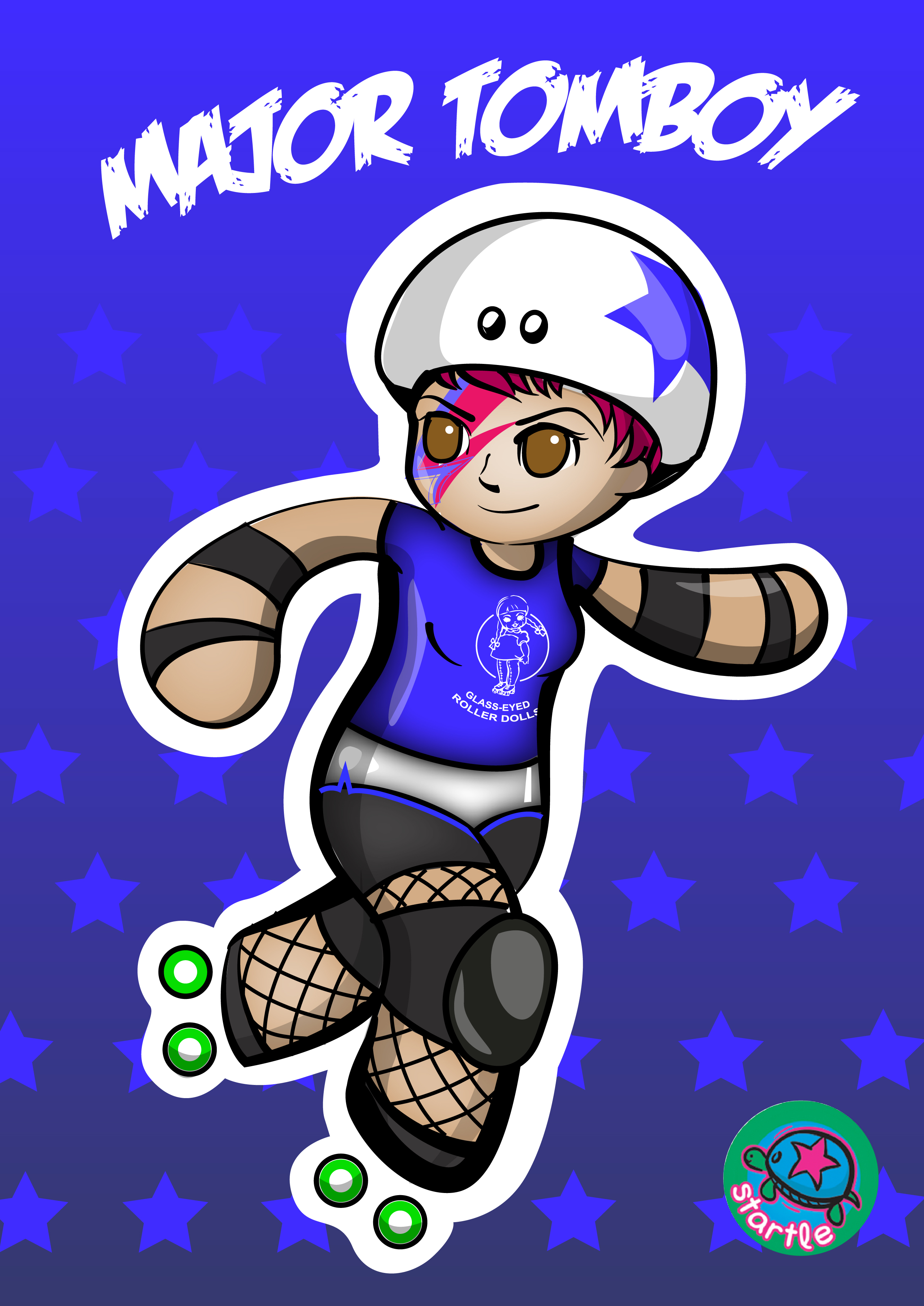
I am blown away by the awesome. And she did this in under a week! For very little money!
Added bonus? YOU CAN BUY STUFF WITH MAJOR TOMBOY ON IT. Keychain? Necklace? Stickers? Available! The only downside is that she’s in the UK, so shipping to the States will probably be a little steep. But! Major Tomboy!
February 14, 2013
Convening
Originally published at Jeremy Zimmerman. You can comment here or there.
Over the last month I’ve attended no less that two conventions. Typically I’ve done an after action report of some sort, but for each of the conventions I didn’t feel like I had a whole lot to report. For both conventions I only showed up Saturday, bagged earlier than planned, and then didn’t return Sunday. (Each time for different reasons.) So I figured I could at least talk a bit about the two conventions combined.
RustyCon XXX (meant to indicate “30″ and not “Porn”), is a relatively small local fan convention. Their web site indicates that they have about 500-700 attendees, versus the 3,000+ that the larger and more well known Norwescon draws. I’d started going a few years ago when I was wanting to meet other fellow writers and so I signed up for a bunch of local conventions. I made a few friends through this con and ended up listed as a “pro” so I got invited to sit on panels.
This year, I didn’t see as many familiar faces and felt more anti-social than usual. The panels offered didn’t really grab me. I’m not big into crafting or fan culture, so my main interest is usually in writing-related panels. Since RustyCon doesn’t attract the same volume of pro writers as other conventions, there just wasn’t as much for me to sit in on.
I was scheduled onto two panels. I’d offered to do a reading, since I’m stumping hard for Kensei, but didn’t get picked up for that. Instead the first panel I was on was about multi-media tie-ins for YA books (referencing in particular Infinity Ring and The 39 Clues). I was a little uncertain what I could contribute to it, but wanted to put in a good showing so I stuck it out. As it turns out, no one showed up for the panel. The other panelist was running late, so I ran into him as I was leaving the room after 15 minutes of solitude.
The second panel was just a general panel of young adult authors talking about writing young adult books. This was my first time being assigned the role of moderator, so I found myself trying to focus on the other two panelists and not try to make it all about me. The other panelists were Mike Birch, who is still working on his first book, and Janice Clark. Starting out it was pretty nerve-wracking, since I hadn’t prepared as much as planned and the only person in the room when we started was Janice’s brother. But people did trickle in and I think it generally went well.
I stuck around for a couple panels after that, but ended up leaving just out of exhaustion. There wasn’t much on the schedule for the following day, so I just stayed at home instead.
The other convention I went to was the combined Potlatch/Foolscap. Foolscap has traditionally been in the fall, but because of conflicts with other conventions at that time they moved the convention to February. Rather than wait a year and a half, they opted to hold the convention the very next February. Potlatch is a convention that has some loose connection to Clarion West that I don’t entirely understand. My understanding is that they had some difficulties the last couple years and, to keep the convention alive, combined forces with Foolscap. The other thing with Potlatch is that they don’t have a guest of honor. Instead they have a book of honor which (in theory) everyone reads and the panels mostly revolve around that.
I’m not entirely sure how well it works As it was, I didn’t end up on panels for either convention. I’m not on whatever broadcast is done for Foolscap looking for panelists. This year’s Potlatch book was Jo Walton’s Among Others, and most of the proposed panels had to do with a sense of community surrounding SF books. (Which I gather, without having finished the book, is a theme that comes up.) I’m not huge into “fan” communities, but I tossed my hat in the ring for some proposed panels that didn’t make the cut and didn’t end up on anything.
Last year’s Potlatch only had one track of panels, so that was still true for this year. Foolscap has, in the past, offered a few tracks of programming. This year, however, they also had one track. Or two if you counted the series of readings done in a nook nearby. I’m not sure if there were less people attending because of the sudden schedule shift or what.
Morning slots for both conventions was handled via “Open Space Programming.” Where panels were decided on that morning, people offered to sit in on them, and then the magic just happened. In general it seemed to work out okay. I know some people based their attendance on the panels that were going to be offered, so the looser structure was frustrating. Also, I was surprised to learn that the Open Space planning only covered the morning. So if you showed up that afternoon hoping that something new and interesting had been added to the afternoon panels through Open Space planning, you might have been disappointed.
Overall the panels were fine. There were some fine people talking on stuff and I enjoyed the content. I also sat in on an awesome reading by David D. Levine.
The biggest challenges I had were that I was coming down with a bug of some sort and my usual cronies were mostly absent during the time I was there. So time not spent sitting in on panels was mostly spent in socially awkward self-imposed isolation. This isn’t to say that I didn’t see anyone I knew or that I didn’t talk to anyone. I’m just lousy at conversation, so I tend not to accost casual acquaintances when I don’t really have anything to say to them. And I feel even less social when I don’t feel well.
We left a little early to attend the season opener for Jet City Roller Girls. Because you gotta have your priorities.
And then I was so exhausted the next day that I stayed home, missing the brunch. But I was miserable enough that I just wanted to stay home, brunch be damned.
I’m not sure what 2014 will hold for Potlatch and Foolscap. They both have the year listed on their sites, so presumably they are going forward together? It will be interesting to see what it will be like as the conventions gain momentum with the new format.
And, for both of these, I will hopefully do better next year. The lack of some familiar faces plus my general anti-social attitude really made these rough weekends for me. Hopefully with this insight I can find strategies to better deal with the conventions next year.