Roberto Scarlato's Blog, page 16
April 13, 2011
Lawyers, Guns and Money
What is your earliest memory of writing?
As a kid I read all the time. One of the books I really liked was Louise Fitzhugh's HARRIET THE SPY. I immediately got a notebook and started writing observations down. Later, as a teenager, I was big on keeping journals. I wrote a few short stories, but nothing that I dared show anyone.
How does it feel being published?
Well, I've been published, and I've been out of print. Published is better.
When did you decide to be a writer?
I'd taken several courses in the creative writing curriculum in college (UNC Chapel Hill). I had some great teachers like Doris Betts and Lee Smith, but I got a real inferiority complex out of the experience--I was interested in science fiction and mysteries, and there wasn't a whole lot of understanding or tolerance for "genre fiction." So I didn't write much of anything for the next thirteen years. Around 1996, I wrote a couple of short, satirical letters to the local newspaper, which led to them asking me to write a weekly column. The editor at the time said one day "Hey, you're pretty good, why don't you write a novel?" So I did. It went nowhere, but by then I had the bug.
Do you get writer's block? How do you combat it?
I don't believe in writer's block. I have, however, occasionally suffered a total failure of motivation, where everything I wrote was so god-awful to my eyes that it physically hurt to look at or even think about. When that happens, I just can't bring myself to sit down at the computer.So I try to shake things up. I'll write a chapter in longhand, for example, just for the change of pace. Or change the font. Or read something I wouldn't normally read. Anything for a little mental jolt.
Where do you write? Do you write longhand, typewriter or computer?
I write on a couple of different computers at home and at my day job. I used to have to save to a flash drive and carry the MS from place to place. Thanks to "cloud computing", though, I can now save my WIP to something like Dropbox and pick it up later to work on on another machine.
Tell us about your Latest Book.
LAWYERS GUNS AND MONEY is the story of Andy Cole, a successful small town criminal lawyer who's gotten where he is by keeping the towns' secrets and generally going along to get along. When he's asked to defend the younger brother of the local crime boss on a murder charge, he starts finding out that there are secrets even he doesn't know. The pressure ramps up on him to go along with selling out his client and keeping the secrets buried. Andy has to face the loss of everything, including his life, if he does the right thing. Along the way, he starts developing real feelings for the woman with whom he's been having an on-again, off-again affair, and she ends up at risk as well.
What advice do you have for aspiring writers?
AIC,FOK. Ass In Chair, Fingers On Keyboard. Everything else is arguable.
J.D. Rhoades lives in North Carolina, where he was born and raised and where he sets his books. He's worked as a radio news reporter, club DJ, television cameraman, ad salesman, waiter, practicing attorney, and award winning newspaper columnist. He's appeared on public television and radio and on the BBC World Service.
Why I wrote this book: Since my day job is as a practicing attorney, people have been asking for years when I was going to write a "legal" thriller. Most of those, however, have a very distorted view of how law practice actually works--you don't have just one client or case, your clients aren't always innocent (even though they may not be guilty of what they're charged with), you worry about getting paid, etc. I've also wanted to write a classic hardboiled P.I. novel, the one where the world weary and cynical sleuth finds he has a heart and a soft spot for the underdog. So this one, I hope combines the two.
LAWYERS GUNS AND MONEY for Kindle:
https://www.amazon.com/dp/B004OYTU0O
For Nook:
http://search.barnesandnoble.com/booksearch/isbninquiry.asp?ean=2940012409171
For other formats:
https://www.smashwords.com/books/view/43619
Excerpt:
He was tipped back in one of my client chairs, head thrown back, his leather cowboy hat pulled down over his eyes. His long gray ponytail hung straight down, almost reaching the floor. A battered leather satchel sat next to the chair. He had his Tony Lama boots propped up on the desk and his hands folded on his chest. He looked like he was asleep. "Voit," I said, raising my voice slightly, "I ever come in your place and put my feet up on your bar?" Slowly, he raised the hat and looked at me for a long moment. "Don't recall that, no," he said. "Then why don't you do me the same d*mn courtesy?" I knocked his feet off my desk with my free hand. He wobbled for a moment in the chair before it tipped forward and brought him upright with a thump. He sat straight up and glared at me. A lot of people would have called me crazy for laying a hand on Voit Fairgreen. He'd shot men for less, or so the legend held. He'd never been charged with anything above a class G felony, and thanks to me, he'd mostly avoided jail time for those. Mostly. But people who'd made him angry or crossed him in his diversified businesses—drugs, gambling, non-tax-paid cigarettes and alcohol--had a habit of dropping suddenly out of sight and not coming back. All that said, with some clients you have to take a stand damned quickly, or they'll make your life miserable. Voit Fairgreen definitely fell into that category. Plus, he obviously needed me, or he wouldn't be here this early, so I figured I was fairly safe. I sat down in my chair. "So what can I do for you?" I asked pleasantly. His eyes were still narrowed, but his voice was calm as he said, "I come to talk about Danny." "Ah," I said. "And how is the white sheep of the Fairgreen clan?" Of the five brothers and three sisters that Amos and Paulette Fairgreen had inflicted on an unsuspecting world, Danny, the baby of the family, was good-looking, a gifted athlete, and the only one who showed any promise of being worth a d*mn. "You ain't heard, then?" I shook my head. "He's in the jailhouse." "Huh. What's he charged with? DWI? Possession?" Fairgreen's shoulders sagged. "They say he kilt somebody." I put my coffee cup down. "Hold on just a second." I picked up the phone and hit a button. "Chuck," I said, "I'm going to need you to cover the calendar call for me this morning. Max has the files. Continue what you can, handle what you can't." I hung up the phone, cutting off Chuck's questions. He'd figure out what to do. He'd passed the Bar only three weeks ago, but being tossed into the deep end without water wings is the lot of the young associate. "Now," I said. "Who's he charged with killing?" Voit rubbed his eyes. The lines in his weathered face looked like canyons. I felt bad for being so rough with him earlier. I let the feeling pass through me. "Girl named Chloe. Worked at the Rancho. Waitress." "What makes them think he did it?" "They found him passed out in her house. With her." I nodded, keeping the poker face in place. Your client being found in the presence of a dead body is widely regarded as a bad thing among the defense bar. Still, you have to show confidence, even if you're not feeling it. "Okay. He had his 96 hour hearing yet?" A person arrested had to be brought before a judge within 96 hours of being locked up to be formally advised of his charges and his right to a lawyer. Voit shook his head. He picked up the satchel and reached inside. He came out with a bulging manila envelope, which he threw on the desk. It made a satisfying thump. "Tell me if that's not enough." I picked up the envelope and opened it. It was stuffed with bills, most of them hundreds. "Do I want to know where this came from, Voit?" "It comes from me," he said. "That's all you need to know." I let it go. "I'll be at the hearing at 9:30," I said. "Tell Danny you hired me. And tell him to keep his mouth shut. He talks to no one about this but me. No one. Got that?" Voit sounded a little insulted. "He knows all that," he said. "He's a Fairgreen." Which doesn't make my job any easier, I thought, but I didn't say it. I walked Voit out into the waiting room. Two more of Voit's younger brothers were seated there, taking up most of my waiting-room couch. It's a rare gift to be able to look as if you're looming while you're sitting down, but the twins, Liberty and Justice, were big and ugly enough to pull it off. Both twins were once and future clients as well. A lawyer with less expensive tastes and fewer ex-wives could probably have made a comfortable living off the Fairgreens alone. I nodded to them as they got up. They nodded back. As I walked back into my office, I caught a glimpse of Maxine, my office manager, in the hallway, talking to Becky-or-Becca. I couldn't see her face, but from what I could see on the receptionist's, there was a thorough ass-chewing going on. I went in, sat down, and checked my calendar. Looked like a medium-heavy day in District Court. Nothing Chuck couldn't handle. I hoped. Max came into the office. She looked like she hadn't slept in days. There were dark circles under her eyes, her normally crisp pantsuit hadn't been ironed, and her shoulders looked like she'd been carrying concrete-filled sacks. She fell into one of the client chairs and ran a hand absently through her short, iron-gray hair. "Sorry, Boss," she said, her voice rusty and hoarse. "I should have been here. He'd never have gotten past me." "No worries," I said."Say the word and she's gone." "Nah," I said. "You've put the fear in her. We'll see if it takes." I held up the manila envelope full of cash. "Looks like we've been retained."Her tired eyes got wider as I dumped it out onto the desk. "Jesus, Mary and Joseph," she said, then crossed herself. "What'd Voit do now?" "Not Voit," I said. "Danny. He's charged with murder." "Danny? No way." "I hope the jury has the same reaction. Count this up and put it in the trust account till I figure out what's going on."


April 12, 2011
Expert Assistance
What is your earliest memory of writing?Don't really have one. I made up stories when I was young, but I didn't start thinking about "writing" until junior high school.
How does it feel being published?Well, my first short story sale was in 1990. It felt great! Still feels good to sell a piece or get a book out.
When did you decide to be a writer?I start writing in 8th Grade. I had seen Star Wars and got into Star Trek. I was always creative, and then I read Asimov on Science Fiction. This was the first time I became aware of writing. I thought it sounded like a good way to channel my creativity. I've been at it ever since.
Do you get writer's block? How do you combat it?Not much, though I can be stopped when something gets strained. I've found the best way to keep from being blocked is to have more than one project to work on at one time. It's one of the reasons why I write nonfiction (mainly history) as well as science fiction & fantasy.
Where do you write? Do you write longhand, typewriter or computer?In my "office" at home, on my iMac. I really couldn't type until I started using a computer. Until recently I wrote some things in longhand when I was on the road. Now that I have an iPad, I'm going to use that if I have to write while traveling.
Tell us about your Latest Book.The book I'm plugging right now is the new edition of my first published novel, Expert Assistance.
Blurb: To get out of debt, spacer Jake Bonner takes on two odd jobs. The first, chauffeur pop star Evvie Martini on her tour; the second, helping Daniel and Clarissa Rosen overthrow their planet's tyrannical ruler. Unfortunately for Jake, Evvie finds out about his second assignment and, hoping to advance her career, invites herself to the revolution. From there the absurdity grows for Jake and his band of "freedom fighters." Expert Assistance pokes fun at revolutions, pop culture, and some of the cliches of sci-fi.
What advice do you have for aspiring writers?First off, learn the basics: plot, character, description, dialogue. Write as much as you can, every day if you can manage it, and try to write at least a couple of pages at that time. Finish what you start. Begin with short stories or articles to learn and to earn some publishing experience. Above all, keep at it!
My blog: http://robertlcollins.blogspot.com/
Expert Assistance at Amazon: http://www.amazon.com/dp/B004LGS7KO

April 11, 2011
Black Diamond Death
What is your earliest memory of writing?
I would say junior high school. I started off writing poems and I used to make up a lot of stories in my head, but I never actually put pen to paper until high school. It was then that one of my teachers suggested writing to me as a career. I remember in high school typing a short story on my dad's old typewriter and it didn't type out all the keys and when my teacher read it he said, "A good story marred by too many careless errors." And since I knew why it had the errors, all I could think about was the fact that he called it "a good story".
How does it feel being published?
It feels like I just climbed Mount Everest, and now I'm standing at the top realizing that I really can do anything. In two months I've sold almost 1,200 copies and that feels amazing. The fact that my story is out there being enjoyed by readers everywhere is more than I could have hoped for. It has exceeded every expectation I have ever had for myself.
When did you decide to be a writer?
At 17 I became fully cognizant of how passionate I was about writing, but it took two decades for me to actually decide to start and finish a book and then publish it.
Do you get writer's block? How do you combat it?
Not really. I have days where I read what I have written and I know it's not my best, but I don't worry too much about it because I know that once I edit it, it will be much better. When I write a first draft I look at it like it's the skeleton and I know I can return later and flesh it out.
Where do you write? Do you write longhand, typewriter or computer?
I write on my laptop, and even though I have a perfectly lovely desk, I am usually sitting on my bed typing away.
Tell us about your Latest Book.
My first novel, Black Diamond Death (the first in a series), was published in March 2011. It follows Sloane Monroe, a private investigator living in Park City, Utah. The story opens with a skier found dead on the slopes and then quickly escalates as the presumed accident turns to a possible murder.
Here's an overview:
"IN A PANIC I GASPED FOR AIR, BUT THERE WASN'T ANY. I TRIED TO CRY OUT, BUT I WAS ALONE, AND IN MY HYSTERIA IT HIT ME. I HAD FELT A SIMILAR FEELING BEFORE––LIKE MY BODY WAS GIVING OUT ON ME, AND I KNEW WHAT IT MEANT. I WAS DYING."
Enter the world of Sloane Monroe in Black Diamond Death...
A SKIER CRASHES
On the slopes of Park City, Utah's newest ski resort a woman is found dead. At first glance, it has all the makings of an accident. The victim, Charlotte Halliwell, collided with a tree as she schussed her way to the bottom of the hill. But what if her death wasn't an accident at all––what if she was murdered?
A SISTER IS ON A MISSION
In Black Diamond Death, Audrey Halliwell faces a problem: finding someone who believes her story.
Enter Private Investigator Sloane Monroe.
When Audrey marches into Sloane's office with claims her sister's death was no accident Sloane is skeptical at first, but agrees to take the case. With little to go on, she questions the people in Charlotte's life and discovers Parker Stanton, a jilted ex-fiancé with plenty to hide, and as the son of a prominent businessman, he will go to any lengths to protect his secrets.
A SECOND BODY IS FOUND
Just as Sloane feels she's close to solving the case she stumbles on another dead body and is forced to re-examine the clues from the beginning, but she must tread lightly. With the killer aware that Sloane will stop at nothing to find him, her life is in danger and her every move is being tracked. Will Sloane uncover the truth before he strikes again?
What advice do you have for aspiring writers?
And last but not least, I have a set of quotes by my desk that I read often including this one which is one of my favorites:
"Follow your bliss and the universe will open doors for you where there were only walls." -Joseph Campbell
Where to find Cheryl Bradshaw
Website: http://www.cherylbradshaw.com/
Blog: http://unearththeclues.blogspot.com/
Facebook Author Page: http://www.facebook.com/pages/Cheryl-Bradshaw-Author-Page/193229280695236
Twitter: http://twitter.com/#!/cherylbradshaw
Black Diamond Death Excerpt
The air was calm, but I was restless. I had a decision to make so I did what I always do when push comes to shove––I shoved back, but not in the way one might think. Skiing had always been my release. There was something about being surrounded by fresh powder in the clean, open air that reminded me what it felt like to be alive. I could stand on a mountaintop with a world of trouble on my mind, and it didn't matter. Every care I had dissolved just like the snow soon would and the mountain would be reduced to tiny patches of white, mere remnants of a ski slope that once provided the town's entertainment for the season.
In a few minutes I'd get together with Audrey for lunch and do something that didn't come easy––tell her the truth. It wasn't that I lied to her; I was a master in the fine art of keeping things to myself. I always thought it was better that way. But I was wrong to allow her limited access to my life, and I wanted to change that. So I'd explain it all to her, and once I finished I would reveal my plan and hope she'd understand. She just had to.
I rounded the last narrow pass on the slope and traveled downhill through the trees. My tongue had gone numb over the past couple hours and every time my teeth hit against it I felt nothing, like it wasn't even there, and my throat felt like a strand of lit matches were pressed hard against it. I wondered if I was getting sick. That would explain the unrest in my stomach. The flu had made its way around town so it made sense that it would make it to me, but if it was the flu, why had I lost all the feeling in my face?
I ran my gloved hand across my goggles, but it didn't help––even when I squeezed my eyes shut and opened them again the trail in front of me was a blur. With what little force I had left, I jammed my poles into the snow and tried to stop, but the slope was too steep and I couldn't bend my hands or even move them for that matter. My fingers felt like long shards of ice and in one simultaneous motion they launched a mass of frozen liquid throughout my body.
What was happening to me?
In a panic I gasped for air, but there wasn't any. I tried to cry out, but I was alone, and in my hysteria it hit me. I had felt a similar feeling before––like my body was giving out on me, and I knew what it meant.
I was dying.

April 10, 2011
Crystal Tomb
What is your earliest memory of writing?
Third grade. I had a teacher who encouraged us to write our own stories. Every child loves making up stories, but I kept it up through school until I was older and actually learned how to focus my attention on telling a complete story.
How does it feel being published?
It's great knowing that others are reading your work. It's not being published that's exciting though; it's being read. The purpose of writing is to share ideas, specifically the ones in the writer's head. Being published is just a stepping stone to sharing that with the world.
When did you decide to be a writer?
In college is when I decided I wanted to actually be a writer and started writing regularly. Of course, those early drafts sucked, but over lots of practice, I improved.
Do you get writer's block? How do you combat it?
Sometimes, but I don't think of it as writer's block. If I'm blocked, there's a reason for it, and often that reason is because something is wrong in the story but I haven't consciously worked it out. Once I have, I can move forward again.
Where do you write? Do you write longhand, typewriter or computer?
I prefer to write with my laptop on my bed. Often the best ideas come during sleep or just before falling asleep, so the bed tends to be my most creative place in the house. And I can have some peace while the family is making noise elsewhere in the house.
Tell us about your Latest Book.
I have a new book coming out Memorial Day (U.S.) week. It's the third book in my popular young adult Starfire Angels series. The title is CRYSTAL TOMB.
Description:
The Shirukan aren't the only threat to the Starfire shard Raea bears...
An alien enemy has awakened to reclaim the crystal that was theirs, and those last survivors of a war that nearly destroyed Inar'Ahben aren't afraid to kill anyone who stands in their way.
An ancient monument to a mythical civilization on Earth may hold the key to stopping the new enemy, if the secret of its origins can be unlocked. Raea is running out of time to solve the most puzzling question of human history and resolve the conflict brought to Earth. If she fails, she may lose more than the Starfire...
What advice do you have for aspiring writers?
Dreams take time to mature. If you want something bad enough, you have to work hard to make it happen. No one is going to just hand you the keys to success. Only you can make that happen.
Also, never give up trying to improve. Perfection is impossible, but making the best better is not.
Thank you for the chance to share a few thoughts.
Melanie
www.melanienilles.com>

April 9, 2011
The Cameo Trilogy

Today we have Dawn McCullough-White. She's almost finished with a very interesting trilogy.
Bio:

Dawn McCullough-White writes mainly dark fantasy and horror.
Her novels tend to favor the use of anti-authority anti-heroes as
the main characters, most commonly with a strong,
female protagonist.
Dawn was born in 1969, in Rochester, NY, and began writing
prose at age 14.
Ms. McCullough-White is married and has a young son. She is
fascinated by history and social psychology. She is a vegetarian
and animal lover. Her favorite drink is Gewürztraminer.
She's fan of Alice in Chains, U2, and Stabbing Westward, her
favorite books include The Things They Carried by Tim O'Brien,
A Movable Feast by Ernest Hemingway, and The Social Animal
by Elliot Aronson.
Questions:
What is your earliest memory of writing?
I used to write and illustrate my own comic books starting when I was around seven years old. So, that's probably the earliest example I can think of. I wrote my first novel when I was fourteen.
How does it feel being published?
It feels right, like this is what I'm supposed to be doing in my life.
When did you decide to be a writer?
I knew it's what I wanted to do when I was a teenager. At the time I was pretty naïve, and didn't really understand how the whole process really worked, but I did think long and hard about what career would satisfy me in my life and writing certainly filled the bill. Of course, I didn't go to college when I graduated from high school right away either, my parents were against it, and that probably could have helped to improve my writing at the time. Instead, I ended up learning how to write the old fashioned way- writing thousands of words, numerous novels, and improving a little more with each one, until I could finally deem my writing good enough for human consumption.
Do you get writer's block? How do you combat it?
Yes, I do. It happens mainly in between writing projects which is the worst, because when it happens I'm sitting there stressing about what book I'm going to write next, and it seems like the sky's the limit. I find limiting my choices about the plot helpful, that way I'm not just floundering around in limbo with too many pointless, unconnected ideas. It's also a lot easier when you're an Indie to write what you're passionate about. I really can't imagine the stress put on traditional writers to pump out whatever their publishing company wants them to write in whatever time frame suits them. I'd probably chew my arm off if I ended up in that position. I'm too anxiety-ridden anyhow to handle that sort of added stress to my life.
Where do you write? Do you write longhand, typewriter or computer?
On my eight year old laptop, the M key sticks but so I'm too comfortable with it to replace it yet. It will probably end up dying with one of my half written novels on it before I break down and buy a new one.
Tell us about your Latest Book.
Well, my latest book is Cameo and the Vampire and if all goes well I'll be releasing it this summer. It's the third book in the Cameo Trilogy, and should tie up all the loose ends left dangling in books one and two, and as the book suggests the main character will probably have an encounter of some sort with a vampire.
The series fall in the Historical/Dark Fantasy/Paranormal Fantasy genres- and are action adventures, with paranormal creatures such as vampires and zombies. These are fast paced, character driven novels.
What advice do you have for aspiring writers?
I'd advise them to do a lot of writing before they decide to put anything out for the public to read, and get an editor.
Preview:
Cameo the Assassin
Chapter One
Her eyes were wide, nearly sightless orbs staring into the sky. She watched as the clouds drifted overhead, gasping. She could hear her own blood bubbling at the corner of her mouth as it slithered out and slipped in a gob onto her neck. For a moment she felt nothing, her eyes went dark, and she felt herself suck in the air once more. Never had simply breathing given her such happiness, at least, not as far back as she could remember. Maybe this is exactly how she felt with the very first breath of her life.
At her throat was the dead head of Adrian, his blonde hair was tousled gently about her. It was the first gentle thing he had done with her all day. His blood was mingled with hers now, predator and prey, dead and dying lying in the beauty of the summer meadow.
Somewhere beside her lay sandwiches and colorful plates. Ivy had wanted pretty plates and had made certain that the silver was polished very well. The last she had seen of her little sister had been her lifeless form, knocked hard into the Faettan soil. She was a few feet away now, a little body lost in the sea of tall grass ... like her own ... and like that of the young lord with his head still on her breast.
The sun was warm on her face, illuminating exactly what had taken place only a little while ago, showing all of Faetta true darkness in the brilliant light of day. Somewhere, drifting in on the summer's breeze, was the sound of people passing on the ridge, chatting about their lives as she was dying just down the hill, in the meadow.
Her eyes were fixed; the transformation of the day into dusk was recorded behind those lenses. Her body rigidly awaited death. Her blood gummed up in the stab wounds in her chest, cold and nearly luminescent against her deathly pale skin, as the faintest of starlight lit her young woman's form.
The spider's web danced in the cool breeze. It was assembled beautifully in the branches of the black trees whose backs arched, and arms stretched to the sky, silhouetted against the setting sun. The meadow was turning dark. This was the moment he had been waiting for. The sun was soon snuffed out, and he did not waste any time. He burst forth from the dark house at the clearing, his black boots beat down the tall grass and the wildflowers growing in the meadow. He was tall and thin, rigid in appearance, nothing more than wispy black gauze against the stark nightfall, running like a wild animal toward his prey. He quickly fell upon the picnic basket, half-eaten food, and silverware fallen askew under the waxing moon. The forks and knives glittered in the starlight.
A fog rolled out from under the thick of the treeline; it ebbed along as if it were alive itself and fanned out with its smoky tendrils snaking around the bodies that lay there.
Haffef's black eyes found the form that he had longed for and saw the child in the distance. As he swept past the older sister, he saw the distinct rise and fall of her chest. This had been the scene of a horrible crime, and as he knelt to look into her eyes, he took in her ripped gown and saw the rape that she had endured at the hands of the others at this picnic, seeing vividly what she had seen.
Her body was covered with stab wounds, and to one side of her bruised and bloodied body lay the dead body of a man. Clutched in her fingers was a paring knife slick with blood.
The fog crept over her battered form, as if it would steal her life away and take her with it as it moved. Haffef glanced over his shoulder at the girl who was just a few feet away, then back at the teenager in front of him who had a cameo brooch embedded in her collarbone.
Kneeling beside her, he tossed the dead body off of hers, moving it with such force that he nearly took off Adrian's head. A young woman he had seen before in Terrence, he realized, now lay here amidst yellow flowers, nearly dead. He was amazed she had actually lived through the day.
She felt the long, black hair against her face, caressing her body. It was light like the frail web of a spider. She felt his slender fingers against her back, the gentle feel of him raising her neck and the shocking pain it caused. After all she had endured earlier, she found herself unable to fathom what was happening to her now. It felt like ice ripping open her throat, its shards coursing from this icy bite to her heart. She took in a breath like one she'd never known; her lungs expanded, but it was almost as if they had hardened, and it nearly hurt to make them work again. It was renewing, but there was death in that breath of life. She blinked with eyes that were dry, and all she saw were black boots that were slick with dew and long, black hair that fell to the ankle of his boots.
She pried her fingers from the paring knife, opening and closing her hand to see if it still worked. Her breath was visible in the cold night air....
The stars moved across the sky as she regained strength. She watched the cool slivers of silver-tipped clouds as they slipped overhead. The moon and stars shifted position while she remained, her eyes capturing the moments that were lost to her. With a sudden surge of energy, she flipped her body onto her stomach and pulled herself away from Adrian's corpse.

April 8, 2011
The Bayman's Bride

Today on the blog we have J. Jay camp. Without further ado, here is the interview. Enjoy.
Thanks so much for this great opportunity! I really do appreciate it so much.
What is your earliest memory of writing?
When I was eleven years old, I started writing down stories -- fan fiction, in a way -- about Han Solo. These were usually complicated soap-opera-like stories about he and I being married, the houses we lived in (primary residence and vacation home), the pets we kept, and all the fun we had together. I kept writing from there, and created different stories about whomever I liked over the years, which continues to this day, as all my books' characters are inspired by actors or musicians.
How does it feel being published?
It feels pretty surreal. I've spent twenty years submitting my work to agents, and I even managed to secure an agent at one point, which didn't do me a heck of a lot of good. It seems to me that traditional publishing houses are very narrow in their tastes, and strict in their guidelines, and my books don't really fall within those confines. So it feels good to be free to express my own ideas, and set a story in Belize if I want to (which I'd been told was too exotic a locale by agents and editors).
When did you decide to be a writer?
I decided to become a writer while I was standing in line at Tower Books in Seattle in 1990, waiting to have Anne Rice sign my copy of The Vampire Lestat. Of course I'd been writing long before that, but I'd been sidetracked by the idea of a music career in my youth, and it was only in meeting Rice that I realized I was really made to write books. I began my first novel upon arriving home from the author signing, and I've been writing books ever since.
Do you get writer's block? How do you combat it?
I've been fortunate so far in that I've never really suffered from writer's block. I tend to feel like I'm "channeling" my characters, and often they almost write themselves. I have vivid memories, for instance, of writing the character of James in The Last Killiney; if I became stuck during some part of the story, I would ask him out loud, "Well, what do you say here, James?" And the answer would come to me. Strange but true.
Where do you write? Do you write longhand, typewriter or computer?
In the beginning, after the book signing with Anne Rice, I converted an old bird aviary attached to our house into a writing den. It was quiet, out of the way, and had no distractions other than the cat wandering through once in a while. Later, I wrote a significant portion of The Last Killiney at the kitchen table at our family's vacation home at the north end of Vancouver Island in Canada, which is where much of that book takes place. By the time I wrote The Bayman's Bride, I had a writing nook installed in a corner of my bedroom...and a pair of ear plugs. As for the mechanical method of my writing, I wrote my first book on an Apple Mac Plus, which later enjoyed a revival as a door stop. Since then, I'm afraid I've been converted to PCs, and in the last ten years, I've written everything on a laptop using Microsoft Word.
Tell us about your Latest Book.
The book I'm working on right now is going by the working title of The Wager. It's book number three in the Ravenna Evans Series, and has the same characters as The Last Killiney (and also The Bayman's Bride, although that doesn't become apparent until one reads The Wager). The story is set in Belize, Dublin and Dorsetshire, and the hero is a man tormented by his inability to sleep, and by the consequences of a bet he's made in which he's lost everything. There are bits about the Irish rebellion of 1798, the Belizean "Battle of St. George's Caye," Dorset coast smugglers and time travel, so there's a lot going on in this story and I'll be very excited when it's finished!
What advice do you have for aspiring writers?
Always edit and revise your work. Listen to criticism if you're hearing the same thing from several people, but ignore those who want you to rewrite everything to fit with their ideas. And above all, keep writing!
Here are links to my books, The Last Killiney and The Bayman's Bride, as well as my Facebook page
And lastly, here's an excerpt from The Bayman's Bride:
Rowen was at the bookseller's when he first came around.
Her maid described him as a Spaniard—a dark-complected man, pleasant enough in face and manner, but with an accent so thick she'd scarcely understood a word he'd uttered.
"'Twas something about m'lord," the maid told her, putting the letter in Rowen's hand. "Said he's coming back in two days."
Rowen looked at Hester in astonishment. "Bennett is here?"
"No, the Spaniard is coming, not Lord Marlowe." With her usual perturbed expression, Hester shook her head, hands gravitating naturally to her hips as she regarded her mistress. "He'll be here to fetch you on Thursday…or at least that's what I thought he said."
"And he mentioned Bennett? Bennett sent him?"
"Well, open the letter and see, why don't you?"
So she did. With trembling, awkward fingers, Rowen unfolded the paper to find her husband's flawlessly written hand. In the corner, just as she'd expected, she saw not her first name nor the endearment of "wife," but a cool and formal address of title: To Lady Marlowe.
She shouldn't have read another word.
But of course, she had to. She'd not seen Bennett in nearly a year. Surely his letter would reveal his location, his reasons for leaving…because he'd gone away, you see. Bennett had courted her, pursued and proposed to her, and then, in an act that can only be described as premeditated cruelty, he'd gathered up his well-traveled baggage and left. On their wedding night. He'd not even consummated their nuptial vows. He'd boarded his carriage without so much as a parting kiss and journeyed to New Spain. She'd heard nothing more.
Now with his letter finally in her grasp, Rowen skimmed down the page with impatience until she found what she wanted: the Bay Settlement on the Bay of Honduras. Between the Belize and Sibun Rivers, he'd taken up lodgings at a logwood camp where "communications with Jamaica are so infrequent as to make correspondence with you all but impossible."
How convenient. She wanted to tear up the letter at his indifference. Still she forced herself to read on about how, through a Scottish settler, Bennett had learned of a city in the jungle near Belize Town. "It's a ruin," he wrote, "similar to those in Mexico City, but smaller, much more elaborately decorated. Carvings and idols cover its walls, so I've hired some workers to remove these treasures. I've sent one man to collect you forthwith, as well as to buy a ship for transport. This man will escort you to our encampment, at which I'll be waiting for you with utmost expectancy. Please abide my wishes, Lady Marlowe. Give Santiago no trouble."
So the Spaniard's name was Santiago. Rowen said it aloud, and Hester confirmed it right away. "Santiago de Escalante, m'lady. Made me repeat it three times, he did." Taking the hateful letter from her hand, Hester tossed it in the fire. "What will you do, then? Will you receive him? Or would you have me suggest where he put his ship?"
Angrily, Rowen pictured her husband—but no, not her husband. She'd try to forget that little technicality, although she recalled everything else about the man. The particular shade of his dark blond hair, his close-set eyes the color of sage, Bennett had been attractive, true, but he'd carried himself with the poise of an ostler or a potato farmer. He'd been vastly intimidating, and yet his manner had been so painfully reserved, so genuinely shy, she'd often felt sorry for him.
Not anymore.
"Well?" Hester asked. "Surely he can't make you go?"
Rowen gazed at the fire in the hearth, the little flames rising on Bennett's letter. "No," she said. "He can't make me go. 'Twould take twenty Spaniards to get me on that ship."
"And even then we'd fight, wouldn't we?"
"If he thinks—," and Rowen almost shook with rage in considering the notion, "—if Bennett believes he can marry me to suit his father, then command me to join him in some mosquito-infested jungle…"
Hester raised an eyebrow. "Tropical fever's impaired his judgment."
"Well, why else would he send for me? No lord takes his lady to such a dangerous place unless he's mad, surely." Shrugging, she glanced at the maid in frustration. "You know he's reclusive. Bennett's never needed a woman, much less a wife. God knows his idols amuse him more, and in the way of family, he can't mean to start one, unless—"
"Unless his father's demanded an heir?"
Rowen shuddered. Of course that's what the old duke wanted. His Grace would have Bennett produce a son, a successor to the estate's three houses, 46,000 acres and rent role of £27,000 a year, not to mention the duke's legacy of statesmanship which Bennett showed no interest in inheriting. In all these things Roselund needed a grandson.
Bennett cared only for antiquities.
"The duke's cut him off," Hester announced.
"Then my lord will starve."
Hester tapped her foot. "I'd think not, m'lady."
Rowen ignored her, walked toward the window with her eyes fixed stubbornly on the sill. Outside, the racket of horses' hooves and carriages in the Strand was an easy distraction to the way Hester watched her. An heir! A year alone and now he wanted her? Did he think she'd forgotten the way he'd sauntered into the house after their wedding, no hand in hers, no waiting for her, just this casual business of directing the servants to load his crates? Bennett hadn't an emotional bone in his body. Take care around my vases, he'd said, and then, when she'd begun to cry, Would you suffer me to stay, my lady?

April 7, 2011
Drachar's Demons

David Burrows is the author of the Prophecy of the Kings, a fantasy trilogy comprising Legacy of the Eldric, Dragon Rider and Shadow of the Demon. David is currently working on Drachar's Demons.
I used to write stories in junior school when I was 7. Apparently I leaned right over the work which probably explains why I needed glasses at an early age. My teacher was great and I think I was teacher's pet. No, they didn't have a cage for me at the front of the class, but she used to always give me glowing reports about my stories. I think that must have had an influence. I was very good at writing stories about dinosaurs so a book involving dragons is clearly a step in the right direction. I had the idea for the Prophecy of he Kings when I was 17, but unfortunately didn't start writing the full tale until many years later.
Getting published is only the start of the process so I couldn't afford to be jubilant when I self-published Prophecy of the Kings. It was a very nice feeling to see the work in print, but anyone can do this and I think becoming an author involves a great deal more. The first reviews really made me feel more like an author, although I really think that accolade has to be reserved until you've become noticed or sales hit a good figure (10,000 books). I was awarded book of the month on one web site (http://sfbook.com/shadow-of-the-demon.htm) and also a gold award on another – (http://readersfavorite.com/cat-71.htm?review=3451). That was really excellent news and started to make me feel that I was becoming an author. I still feel I have a long way to travel.
Writing is part time which is a very good thing given how slow it can be to earn living from writing. I decided to write after reading Tolkien's Silmarillion, such an epic and sweeping tale. That was when I was seventeen. That book really enthralled me and I just felt I wanted to try my hand at writing. I have a very good imagination and for fantasy that really helps.
I wrote the books long hand originally. I liked writing on trains best of all and found I could concentrate better then. Not sure why, because it is everything I would normally try to avoid, noisy and distracting, but for some reason that worked for me. My wife was a secretary for a while so she typed the manuscript up and did a far better job than I could. I now have a laptop so I tend to write straight into Word.
Everyone gets writer's block at a guess. My way of dealing with it is not to bother. I wait, and wait and wait. This is the advantage of writing part time and not having dead lines. The reason for my writer's block was I wrote my characters into a corner; a fix; trouble. This is where the tale led me and I refused to rewrite the tale. I really took a long time waiting for inspiration. Sometimes months. When it came it was like reading someone else's book, turning a page and going – wow, that's a really neat idea. I would like to think that Prophecy of the Kings is full of really good ideas and some of the reviews confirm that. The other area where I struggled was in making up names. For a fantasy book of nearly 250,000 words, that can be a real challenge. I solved this one by using anagrams of people I know. A witch in book two became Ariome, nearly an anagram of Moira – the mother in law! Boy was I in serious trouble for a while. She took it in her stride though and bought me a small witch on her travels, to go in my car. I often spin it, hoping to make her feel sick. That's boys for you.
My latest book is Drachar's Demons and I am thoroughly enjoying writing it. It is a prequel to Prophecy of the Kings. I can hear some groans from Star Wars fans – they either love or hate their prequels. However, a prequel was very natural to write. I created a whole new world in the Prophecy of the Kings. You really have to have a background plot to tell a good tale in my opinion; something that the current book sits comfortably over. What is the surprise though is how hard it is to tell that tale. You have to keep true to the sequel and try not to change anything, chasing a good storyline. What was really good though was that Drachar's Demons just flowed from imagination to computer and I found the plot waiting to be let out. It was far easier than Prophecy of the Kings. Still occasional blocks, but so far I have completed three quarters of the tale in record time (for me). So far it has taken me 3-4 months, writing part time.
For any aspiring author I would suggest, have a go, but manage your own expectations and be prepared for some really harsh criticism. Some authors take it to heart when people criticise their work. You cannot do that, you have to take the criticism and use it to grow and become a better author. Most of all is to have fun writing. If it is not fun, then it isn't working.
Best wishes
David

April 6, 2011
The Russian Renaissance

Today on the blog we have writer Ian Kharitonov to talk about his new book The Russian Renaissance.
What is your earliest memory of writing?I began writing an Indiana Jones fan fiction story when I was about 6 or 7. Shame I didn't finish it!
How does it feel being published?It's a great feeling to get your book out to readers. I'd never imagined anyone would care about my novel when I started, I did it purely for myself, but my novel ended up winning an award from Clive Cussler.
When did you decide to be a writer?I've always been creative, and I realized that I wanted to be a writer when I was 15.
Do you get writer's block? How do you combat it?When I get writer's block it means that something is wrong with the story. The only way to combat it is improving your work, by editing weak areas or doing more research on the subject you're dealing with.
Where do you write? Do you write longhand, typewriter or computer?I still jot down notes in an old-fashioned exercise book, and write on my Macbook at home.
Tell us about your Latest Book.The Russian Renaissance is an award-winning international thriller. Following the tradition of Cussler, Ludlum and Morrell, it's full of high-octane action, intrigue and exotic locations. Unlike other thrillers set in Russia, it's been noted for its high level of authenticity and chilling factual detail.
Here's the blurb:
"Constantine can no longer hide in Europe. As he discovers a century-old secret, he must flee back to Moscow, chased by assassins.Only one man can save him. Eugene Sokolov: an officer in the world's most elite rescue unit, a martial arts legend… and Constantine's brother.They face an enemy unlike any other. In a game run by a KGB spymaster, the fate of Russia will depend on their survival."
What advice do you have for aspiring writers?Learn your craft. A lot will come from experience, but at least two books are essential: Techniques of the Selling Writer by Dwight V. Swain and The Successful Novelist by David Morrell. After that, don't listen to any advice and follow your heart.
EXCERPT : The Russian Renaissance
PROLOGUE
1941
The Soviet Union
Death was the only destination in the train's five-year-long schedule.
Even its name sounded like a shrill omen. The Felix Dzerzhinsky, a 137-tonne locomotive, was a child of its era—an unstoppable mass of raw power fleshed in metal.
During 1936, its first year of operation, the Felix Dzerzhinsky coursed between Russia's faceless stations and towns, hauling cattle. The animals had filled the tidy new freight cars with the lingering smell of their sweat and waste, parasites infesting the cracks between the hoof-dented boards, the feeling of imminent slaughter staying with the train forever.
Soon enough, the cattle was replaced by people. Men and women, old and young, most sick, some bleeding, all filled the freight cars heading to the gulags, towards a fate far more dreadful than that of the animals. The luckiest died on the way.
Now, as the war broke out, the Felix Dzerzhinsky carried a special cargo to the safety of Central Asia: hundreds of wooden crates stacked from the secret vaults of Leningrad and Moscow. Special passengers in the form of a six-man Red Army escort occupied the newly-fitted first class carriage.
The single beam of light sheared the night as the Felix Dzerzhinsky roared across the vast Kazakh steppe. The train pushed its boilers to the limits, charging to the invisible finish line. Yet its run was cursed by the presence of the treasured cargo.
Death still waited at the other end.
Inside the confines of the single passenger car, the gunshots boomed above the monotonous throbbing. The Red Army soldiers were too slow to react. They had not expected an attack from within. Not from their commander, Comrade Yehlakov of the NKGB.
At close range, Yehlakov blasted the heads of four soldiers keeping watch, each barely eighteen. While the other two fumbled for their bolt-action rifles, shocked awake from sleep, confused, Yehlakov finished them off.
The new car was now also smeared with death.
Yehlakov replaced the empty clip of his TT semiautomatic, and entered the driver's cabin, gunning down the crew. The driver clutched his throat, trying to clog the wide open hole, and the torrent of blood gushing from it mingled with the soot on his hands. He stumbled, gurgling, looking at his black blood. A second gunshot destroyed his face, and he crashed over the corpse of his fireman.
Stepping over their bodies, Yehlakov pulled the brake handle. The brakes locked onto the wheels and the enormous friction showered sparks in every direction. A piercing screech of protesting metal reverberated around the compartment. The train shook as it tried to restrain its own momentum. Gradually, the Felix Dzerzhinsky came to a stop.
Yehlakov climbed down from the cabin and looked around. The gloom was impenetrable. The train's lamp would serve as a position marker.
Leningrad, the origin of the Felix Dzerzhinsky, was a city commanded by evacuation mayhem. Fuel, provisions, armaments and entire factories were being relocated from the advancing Germans, and many consignments lost in the process. The disappearance of the train, if it were ever noticed, would be written off to a Luftwaffe raid in Moscow by Army staffers fearful of repercussions. Yehlakov didn't care much. There was little chance of Moscow surviving anyway.
A column of trucks appeared in the distance, their flickering lights drawing closer. The huge ZIS-5 vehicles stopped in front of Yehlakov, washing him in the beams of their headlights. In the blinding light he couldn't make out the faces of the men approaching him.
"Right on time," Yehlakov said, squinting.
"Too bad for you," the man from the lead truck replied. Three figures leveled their machine guns at Yehlakov—the recognizable silhouettes of American Thompsons.
Yehlakov's cry was cut short by a hail of .45-calibre bullets that shredded his body.
"All right men," an order sounded. "Move, move, move!"
The tiny figures of two dozen soldiers scurried to the Felix Dzerzhinsky like scavengers ravaging a beached whale.
Reloading all the crates into the trucks proved to be a massive job, but the attackers carried it out with efficiency. Trouble arose only once. A crate crashed, bursting open, and antique icons poured from it onto the dusty ground. Gleaming through the darkness in their radiant halos were the faces of saints. The holy men gazed at killers with divine serenity, their eyes full of suffering and forgiveness.
After it was all over, raging flames engulfed the empty cars, and the attackers vanished back into the night.
The dead metal beast had completed its final, blood-drenched journey.
***www.iankharitonov.comwww.amazon.com/dp/B004PLMJ3Gfacebook.com/rusrentwitter.com/rusren
-- Ian Kharitonov

April 5, 2011
A Heart In Sun And Shadow

Today we have Annie Bellet with her new book A Heart In Sun And Shadow. Here's what she has to say about the craft of writing.
What is your earliest memory of writing?
My earliest memory of writing fiction at least was when I was eight. We had a substitute teacher in our class that day and she asked us to write a short story on whatever we wanted to write about. I panicked because I didn't know what to write about and she noticed and came over. I told her I didn't know any stories well enough to feel comfortable writing them down. She looked at me for a moment and then said, "so make something up." That pretty much sealed my fate.
How does it feel being published?
It feels good, I guess. Nerve-wracking sometimes. The first acceptance letter I got for a piece of fiction (non-self-published) threw me. It came after so many rejections that I started to auto-file it as a rejection and then noticed they were offering me money.
As for indie publishing, it feels very freeing to have this avenue open. I know now that anything I write can find readers and that's a very fun thought.
When did you decide to be a writer?
When I was eight, I guess. I "got serious" about trying to make a living at it on Feb. 4th, 2009. I'd been writing for years and years before that (about 20) and been in an MFA program that wasn't quite what I wanted (it was more geared toward literary work and I wanted to write fantasy and science fiction). So I decided that in order to get good, to really focus and start selling my stories, I needed to take it seriously and treat writing as a job. So I quit my job and started a new one. It's been a bit of a roller-coaster, but it's fun and I wouldn't trade writing for any job in the world (unless I could figure out how to get paid to just sit around and read good books, and maybe not even then).
Do you get writer's block? How do you combat it?
I don't get the traditional form of writer's block meaning I never, ever run out of ideas. I do get stuck sometimes in a particular story and I have to step away from it and either take a walk or work on something else. I just push through it after letting whatever is bugging me sit on my brain for a little while. I've found that just getting the work done helps and I can train my mind into problem-solving such blocks on the go. Sometimes I get too many ideas and don't know which to write immediately, and that's a different sort of writer's block I guess. Mostly, any issues that crop up, I just keep going and try not to second-guess myself too much.
Where do you write? Do you write longhand, typewriter or computer?
I write on the computer in my office. It's nice to have a private space full of books where I can turn on music and focus and get to work. I take notes and jot down ideas long-hand though. I have notebooks full of ideas and research notes.
Tell us about your Latest Book.
The one that I just put up (my first indie novel!) is a fairytale fantasy set in a sort of re-imagined ancient Wales. I love Welsh fairytales and was lucky enough to be able to study the language and culture of medieval Wales while I was in college. So I decided to put that to good use and invent my own fairytale.
What advice do you have for aspiring writers?
Write. Don't stop. Read everything. Read the best-sellers in your genre and look at what they have in common. Then keep writing. Practice and persistence are what make it in this business. If your first book sucks, that's okay. You'll write more books. Don't get too attached to one story. You can always re-draft it later when your skills catch up to your imagination. If you study good stories (books that sell!) and keep writing new, better fiction, you will improve and you will learn to write stories people want to read. Follow your dreams and don't let anyone tell you they aren't possible.
I talk more about my own journey as a writer (in real time with hard numbers and all the fun of rejection!) at my blog:http://overactive.wordpress.com/
Here's the links to my novel, A Heart in Sun and Shadow :Kindle: http://www.amazon.com/Heart-Sun-Shadow-Chwedl-ebook/dp/B004QS93K0/Kindle UK: https://www.amazon.co.uk/dp/B004QS93K0Nook: http://search.barnesandnoble.com/books/product.aspx?ean=2940012236227Smashwords: http://www.smashwords.com/books/view/45418
And the book's description:
In an ancient Wales that never was…
The twin brothers Emyr and Idrys are cursed to live as hounds; Emyr by night, and Idrys by day. The twins believe they will be trapped this way forever until they meet the fierce and curious Áine, a changeling woman born with fey blood and gifts struggling to fit into a suspicious human world.
Áine unravels the fate of Emyr and his twin as all three of them fall in love. To free her lovers from the curse, she embarks on a journey to the realm of the fey where she confronts her own unique gifts and heritage. Ultimately, she must decide where her heart truly lies and what she's willing to risk to get what she desires most.
I also have a science fiction short story collection available as well as a near future, hard science fiction novella. Links to those plus traditionally published stories available online for free are listed here: http://overactive.wordpress.com/read-my-fiction/
My website is: www.anniebellet.com

April 4, 2011
Formed Of Clay
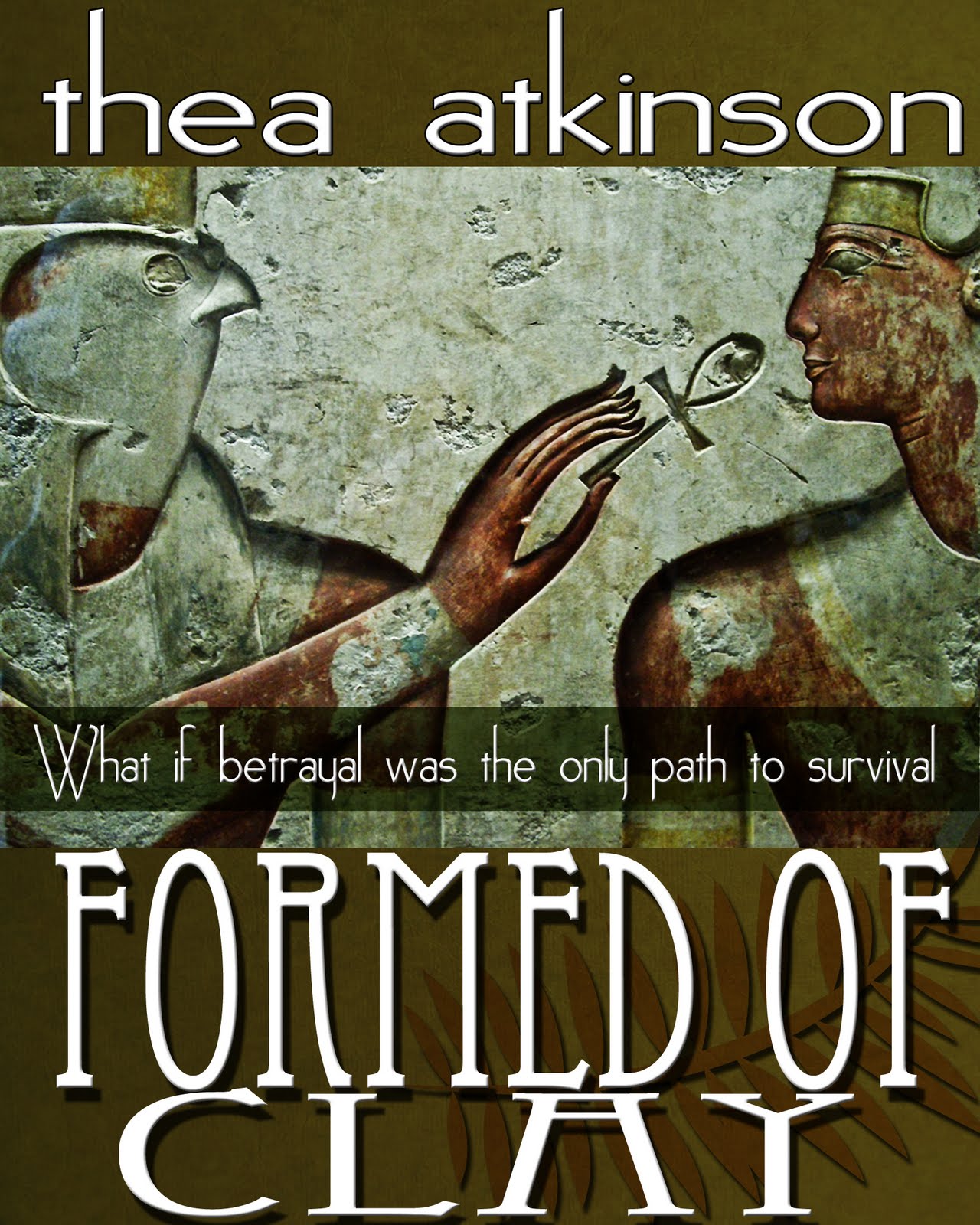
Today we'll be talking with Thea Atkinson. Here is the interview. Enjoy.
What is your earliest memory of writing? I remember writing an essay in grade 3 or 4 as an assignment and the teacher was planning to submit the best of them to our local radio station. My best friend won and was allowed to read her paper on the radio. I was so thrilled for her that I wanted to pull her hair out. As terrible as it sounds, she actually inspired me. I hadn't realized until then that anyone could write and other people would 'read' it.
How does it feel being published?
Once upon a time, I thought the most magical thing in the world would be to be published. I remember getting the first magazine my short story was published in and I immediately started dreaming of the next. I wanted more. I felt validated as a writer. I've published dozens of short stories in journals and magazines since then and even more nonfiction, and the hunger has never left. I wanted more: I wanted the same for my novels. Publishing always made me feel like a real writer—but only because of the reaction of other writers when you can admit to some publication credits. In these last years of my writing career, that's changed. I've learned to eschew publication as validation for my efforts. Now, it's "Have you written today," Meaning: Are you working on your craft. That's what matters to me. Of course, it's still always nice when someone reads your writing and wants to publish it.
When did you decide to be a writer?
Not sure there was a decision. I've just plugged at it since forever because I wanted to tell stories.
Do you get writer's block? How do you combat it?
I must admit to having it once. Right after my agent took me on. I remember lying in bed that night thinking, "Holy Hannah, what if people read me? What if they buy me and read me and ask for their money back?" I totally froze.
What I did was spend a couple of years with my camera and with a graphics program and fed the creative beast until the writing wanted back.
Where do you write? Do you write longhand, typewriter or computer?
Anywhere, but typically my kitchen with the sun streaming in like now. My black lab, Abbi, sits at my feet sometimes groaning that I'm not petting her because my fingers are busy typing. Sometimes in a notebook with a pencil. I'm not picky.
Tell us about your Latest Book.
Hmmm. Formed of Clay is a novella that opens a series I'm working on. It lays the foundation for a variety of characters and how they are connected. FOC is a tale of betrayal and a search for redemption, all set in ancient Egypt. It's still my regular genre, though, of what I suppose is called psychological thriller.
What advice do you have for aspiring writers?
Read. Read. Read. Write. Write. Write. Always take criticism graciously even when you don't agree with it. And always help the next writer coming through the door.
http://theaatkinson.wordpress.com
http://www.amazon.com/Formed-Clay-ancient-betrayal-ebook/dp/B004PVSOZS/
Formed of Clay Excerpt:
He wanted justice black as shade, and sure as death.
They were strangely deep feelings for a ten-year-old to fathom, stranger still, that he could articulate them clearly at all, but fury settled into his organs and twisted them into a hate he'd never felt before. Some part of himself felt broken off, and Sentu wondered if he looked up at the thatched ceilings, would he be able to see that shadowed part lingering there before dissipating like smoke through the crevices.
Someone was speaking. Yes. His father. He tried to offer respectful attention but all he saw as he looked into the almond colored skin and black eyes crouched next to him was a face so unlike his that he finally understood. Fellahin. That's what he was. Poor mud digging class born to do nothing but turn the fetid land into some sort of substance, to fish the waters, to drink from the edges of the Nile, braving the beasts within as they waited for their supper.
"Sentu, did you hear me?" the man was saying. "Did you hear me say it doesn't matter to us?"
He stood there trembling, the limestone walls threatened to fall in. This man. This man was not his father. That's what he was saying.
"Sentu, it is okay. But you needed to know."
He needed to know. And why was that? For all these years that he has endured the taunting of his neighbors, fought in the dusty avenues to protect his mother's honor. Why does he need to know this now? What of that man who sired him: that coward. That he would leave these people to lie for him year after year.
Sentu felt a strange clump in his throat, one that had the feel of choked off words that his mind had to break apart, to separate into sounds. His true father: who was he, really, but a traitor to his flesh. A man not worthy to carry the label this foster father had owned all these ten years.
And when some sense of words did come, they were hateful ones, formed in curses that had Sentu begging for Set to come in furious victory, to seek out and dismember that man like he had done to his god brother Osiris; scatter his body to the four winds.
He wanted to speak. Words tangled in his voice box.
"You came to us straight from your birth," his foster father said, trying to soften the news. Such a wonderful man, was this man, so considerate. "She was young, too young to be birthing."
The woman spoke then: his supposed mother. The woman whose honor he had fought for. "I am barren," she tried to explain. "You were a gift from the aten; who were we to refuse it?"
She snicked in closer to her husband and reached out so that his palm met her elbow, drawing her closer as though to create a wall that fury could not get through. A jasper amulet swung from her long neck, a large drop of rock that she had fashioned herself with bits of scavenged gold. Sentu had helped her craft it, spent hours melting and shaping and hammering the links to wrap around the tiny pebble. "Jasper is for inner power," she'd told him. "It fosters loyalty and courage."
She wore it everyday, and Sentu often wondered why she would need a stone to remind her to be devoted. Now he knew. He wasn't of her flesh. This thin, graceful woman next to this man of sturdy build--almost too sturdy for a man of wisdom within Pharaoh Menes's court--was so doting Sentu had never questioned his heritage. But he should have known. Their skin was far lighter; he should have known he didn't belong. He was foolish. Stupid.
Both of them were the color of the brief bit of skin that surrounded the almond, a seed prized in Kamt for its rich oil. Prized. Valuable. His more base hue of Nile mud revealed his true worth. He'd been foolish enough to argue when the other boys insisted he was different, when he'd overheard their mothers gossiping about the dark boy and how he might have ended up in such a light skinned household. Surely, some educated person of the elevated hedj shentis would never debase themselves by fostering such filth. He must have come from an outside union. An unholy union. A disgrace.
Sentu had spat in their bread, those gossip mongers, as the rounds lay on benches outside to cool for the shame they spoke of this woman he'd always called mother. He saw the moisture collect in the stamped initials they put in the dough so they got the right loaf from the ovens.
The same shame thickened into a sludge that crept along his veins and hardened his heart. He felt it cure the muscle to a stone that barely trembled with its own heartbeat. He wondered if his blood would move through his veins at all. He certainly felt like a ruin.