
Jared C. Wilson's Blog, page 31
March 1, 2016
10 Reasons Easter Giveaways Are Unwise
 We are nearing the day many Christians look forward to all year. Yes, there’s the somber reflection and penitence of the Passion week, culminating in the resurrection of Jesus to celebrate on Easter Sunday, but there’s also some fabulous cash and prizes. Every year some churches seek to outdo themselves — and their local competition — by luring unbelievers (and I suppose interested believers) to their Easter service(s) with the promise of big shows and in some cases big giveaways. One guy in Texas made national news a couple of years ago for giving away new cars. More and more churches each year are dropping prize-filled Easter eggs out of helicopters to gathered crowds below. Local churches with more modest budgets sometimes promise door prizes like iPods or iPads or gift certificates to local restaurants.
I’m not against “Easter egg hunts” and kids having fun and all that, but I think the sort of large-scale, giveaway promotion that takes over this time of year in the church calendar is profoundly unwise and in many cases very, very silly. I want to offer ten general reasons why, but first some caveats: I’m not talking about a church giving out gifts to visitors. Gift cards, books, etc. to guests can be a sweet form of church hospitality. What I’m criticizing is the advertised promise of “cash and prizes” to attract people to the church service. Secondly, I know the folks doing these sorts of things are, for the most part, sincere believers who want people to know Jesus. But I don’t think good intentions authorize bad methods. So:
Ten reasons luring people in with cash and prizes is not a good idea.
1. It creates buzz about cash and prizes, not the Easter event. When the media takes notice, nobody wants to interview these pastors about the resurrection. They want them to talk about the loot.
2. It identifies the church not with the resurrection, but with giving toys away. It makes us look like entertainment centers or providers of goods and services, not people of the Way who are centered on Christ.
3. Contrary to some offered justifications, giving prizes away is not parallel to Jesus’ providing for the crowds. Jesus healed people and fed them. This is not the same as giving un-poor people an iPod.
4. It appeals to greed and consumerism. There is no biblical precedent for appealing to one’s sin before telling them to repent of it. This is a nonsensical appeal. We have no biblical precedent for appealing to the flesh to win souls.
5. Yes, Jesus said he would make us fishers of men, but extrapolating from this to devise all means of bait is not only unwarranted, it’s exegetically ignorant. The metaphor Jesus is offering here is just of people moving from the business of fishing to the business of the kingdom. There is likely no methodology being demonstrated in Jesus’ metaphor. (But the most common one would have been throwing out nets anyway, not baiting a hook.)
6. It is dishonest “bait and switch” methodology. Sure, the people coming for the goodies know they’re coming to church. But it’s still a disingenuous offer. The message of the gospel is not made for Trojan horses.
7. It demonstrates distrust in the compelling news that a man came back from the dead!! I mean, if nobody’s buying that amazing news, we can’t sell it to them with cheap gadgets.
8. It demonstrates distrust in the power of the gospel when we think we have to put it inside something more appealing to be effective. What the giveaways really communicate is that we think the gospel needs our help, and that our own community is not attractive enough in and of itself in its living out the implications of the gospel.
9. The emerging data from years of research into this kind of practice of marketing-as-evangelism shows the kind of disciples it produces are not strong. I have no doubt these churches are going to see many “decisions” Easter weekend. We’ll see the running tally heralded on Twitter. As questionable a practice as that can be, I’d be extra interested in how discipled these folks are in a year or two years or three. Hype has always produced “decisions.” Would anyone argue that after 30 years or so of the attractional approach to evangelism the evangelical church is better off, more Christ-centered, more biblically mature?
10. What you win them with is what you win them to.


February 23, 2016
10 Common Ways Churches Get Off Mission
 The Lord has called his people to be on gospel mission for the sake of his glory. Most churchfolk will readily acknowledge this, and yet many churches have drifted away — often subtly — from thinking of themselves as missionaries in their respective communities and beyond. Here are some common ways churches engage in “mission drift.”
1. They over-program.
In this way, we mistake activity for mission and busy-ness for fruitfulness. And while Christians fellowshiping and “doing life” with each other is important, some churches fill the calendar with so many programs and meetings, etc. that their people have little to no margin to be on mission.
2. They pour all their energy into the weekend service.
For many churches, the extent of their weekly thinking, planning, strategy, creativity, etc. is channeled into the production of the weekend gathering. They justify this inward focus by trying to design this service as evangelistically and seeker-minded as possible, but it effectively turns the “go and tell” of mission into the “come and see” of attraction.
3. They use too much insider lingo.
The church service in particular is biblically for the Christian, but the New Testament still tells us it ought to be intelligible to “outsiders.” Some churches communicate only “inside baseball” in their services and groups so that it becomes difficult for interested unbelievers to follow and seek to understand.
4. They are just plain unwelcoming.
We all know about churches that don’t acknowledge visitors. There are also community groups that don’t have an open door for curious unbelievers and other visitors. There are people who look down their noses if someone is in their parking space or pew. Some church communities just aren’t interested in growing or reaching out.
5. They are preoccupied with politics.
Their pastors are too busy culture-warring to be soul-winning and their people are too busy arguing about who should be President to consider how their anger and worry might (or might not) adorn the gospel.
6. They are still stuck in the past, culturally speaking.
Some churches look frozen in time. While there are lots of rich things from our history and tradition worth holding onto, having a church that looks like it stepped out of a time machine in the 1970s probably isn’t it. Some churches are so committed to preserving how they’ve always been, they cannot adequately contextualize the gospel for their communities today.
7. They’re trying to re-create the past.
Some churches have moved on from the past, but are desperate to get it back. But a church can kill its future by constantly trying to recapture “the good ol’ days,” mainly because this is an inward focus and also because outsiders, visitors, and the lost don’t care one bit about your church’s “good ol’ days.”
8. They are preoccupied with social justice causes but not doctrine.
Meeting people’s felt needs and addressing systemic, cultural ills can be biblical and valid implications of the gospel, but a lot of churches forget the gospel part. They trade in the primary purpose of the gospel for its implications. This is a particularly deceptive mode to be in, because socially-conscious churches look like they’re on mission. But if the gospel is not at the center of what we say and do, it’s not God’s mission that we’re on.
9. They are doctrinally rigorous but socially withdrawn.
The opposite of the above problem. These churches are hearers of the word only. Sometimes they are so suspicious of “social justice” and the “social gospel” that they’d rather die than be caught making a concerted effort to care for the poor, the widow, and the orphan.
10. They are divided or otherwise riddled with conflict and power plays.
Some churches are fertile ground for power-hungry folks or divisive personalities jockeying for position. In many of these churches, the leaders may be interested in kingdom mission but find that so much of their energy is occupied in mediating arguments, managing contentious member meetings, defending themselves, or just trying to keep the peace. In these cases, people have forgotten what a church is even for.
February 19, 2016
But Do You Adore Jesus?
 We are typically very quick to note when someone is not showing love for their neighbor. But what about love for Jesus? Should it settle implicitly? Is love for Christ something that is sufficient when latent?
What I notice a lot every day in the Christian spheres of social media is just how incredibly adept we evangelicals are at doctrinal criticism, cultural rebuke, theological analysis, biblical exegesis, contending for the faith in apologetic and ethical debates, pithy spiritual bon mots, religious advice, and of course the quoting of Christian leaders present and past, but what seems less prevalent is adoration of Jesus.
When we see a Bible verse, we run its meaning through our mind and can expound on it with intelligence, but when we see Christ before us, do we stagger at his beauty and exult in it with awe? Do we adore Jesus?
When we see a lost person acting a fool in the news, our righteous indignation runs right through our fingertips to our keyboards, but when we see Christ before us, does our righteousness crumble and run right to his feet in a posture of supplication? Do we adore Jesus?
When we see one of our Christian heroes saying something smart or funny or challenging, we send them a virtual high-five and echo the proclamation in shouts of appreciation, but when we see Christ before us, do we lift him high in our hearts and herald his glory with shouts of acclamation? Do we adore Jesus?
When we see that someone is wrong on the Internet, we feel the responsibility to speak up, to be the one to stand in the gap between their ignorance and our assurance, but when we see Christ before us — supreme and sovereign and saving — do we feel the wonders of his radiance?
When we look at Jesus, are we warmed? Or do we shrug our shoulders?
Some professing Christians don’t seem to speak of Christ at all. Let them ask themselves, “Do I adore Jesus?”
Has Jesus become our mascot, our projection? When you look at him, what do you see?
There’s nothing wrong with using the Internet public squares for all kinds of messages, from the serious to the silly, and I don’t mean to suggest that there is. I just want to ask sometimes, “But do you adore Jesus? It seems you are fired up about all sorts of things, but it is not clear if you love Jesus.” I don’t think we should simply assume from some peripheral fire that the central ignition is love of Christ.
Christ is the apex of all that is precious, the center of all that is glorious and delightful. He is the very point of existence. He is the Son of the living God, the Alpha and Omega, the first and the last who was and is and is to come. “O come let us adore him!”, not scrutinize, utilize, or analyze him.
Let the redeemed of the LORD say so…
— Psalm 107:2How beautiful upon the mountains
are the feet of him who brings good news,
who publishes peace, who brings good news of happiness,
who publishes salvation,
who says to Zion, “Your God reigns.”
— Isaiah 52:7
February 16, 2016
Jesus is For Losers
 One year ago yesterday I preached my final sermon at Middletown Church before moving on to assume my current role at Midwestern Seminary. I wrote a reflection on all the pain and glory entailed in working through this transition a few months later – The Gospel for Ministry Quitters. Perhaps you will find it a blessing. A snippet:
He is all-surpassing, he is all-wonderful, he is all. Everything beautiful and glorious finds its union in him and emanates from him. He is so precious. Before time began, his designs were on you. In his prayer, you’re in his mind. In his death, you’re on his heart. In his resurrection, your life is in his power. In his ascension, you are seated with him in glory.This makes most of our dreams so pale and temporary. This makes all of our idols demonic.
This ought to make giving up whatever he calls us to give up easy. Like the man who sold all he had just to buy that one pearl of great price. Christ is worth all that God would have you give up, because if you have him, you already have everything.
So, godly quitters, let’s say it together:
Wish-dream be shattered.
Idols be damned.
We’re coming to Jesus, we’re trusting Jesus.
In the pastoral ministry world, we sometimes get the impression from the Bright Minds Among Us that only losers quit. Well, maybe so. But — praise God — Jesus came for losers.
Read the whole thing.
February 10, 2016
3 Reasons Why You Should Ignore Most Relationship Advice
 People mean well; they really do. As with all advice, your friends and family and countless blog post authors whose helpful little lists proliferate on Facebook, etc. are sincerely wanting to improve your relationships. But all too often their good advice proves unhelpful in the end. Why? Usually for one or more of these 3 reasons:
A Lot of Relationship Advice Assumes Relationships are Simple
I’d say most relationship advice contains kernels of truth but still winds up being woefully pragmatic. It treats relational success or happiness like a formula. You’ve probably heard this kind of advice before, or maybe even given it yourself:
- If a wife would just have sex with her husband more, he would not use pornography or have an affair.– If a husband would just talk with his wife more, she would be less cranky.
– If you will go on a date once a week, you will keep the flames of romance burning.
– If you raise your children right, they won’t turn their backs on the faith.
You can likely list umpteen more examples. Each of these bits and others like them, as I said, contain kernels of truth. The problem is that they urge us to treat our relationships like some kind of psychological vending machine: if I just push the right buttons, I’ll get the right response. Formulaic. Pragmatic.
But in reality, people are incredibly complex! Our hearts are ridiculously nuanced things. We are a mix of our pasts and our personalities and our fears and our frustrations and our assumptions and our upbringing and our desires and our habits, etc. And let’s not forget that we’re all sinners! So you put this recipe into an intimate relationship, and you’re going to find that the “If you will _____, then they will ______” is an amazingly superficial approach to relationships.* People don’t work that way.
We can all think of examples of marriages where one spouse did “all the right things” (though nobody is perfect, of course), and yet could not win the heart of the other. This kind of advice is incredibly harmful in abusive situations, because it implies blame should be carried by victims. No, people are much more complex and sin is much more enmeshed in our hearts than most relationship advice is able to reliably sort out.
A Lot of Relationship Advice Assumes Both Parties Want the Same Thing
The advice formulas all seem to assume that if you got your relational act together, your partner would get their act together too. There’s even a marriage book out there full of advice for wives titled Have a New Husband By Friday (which I think is an awful premise for a book). But this kind of advice assumes, in fact, that the person who’s become your project actually wants to get his or her act together! It assumes they give a rip about having a good relationship. Or it assumes they don’t already think the relationship is fine as is.
When I was a pastor, this was one of the first things I’d ask a couple who’d come to me for marriage counseling: “Are you both here because you want to be? Do you both want to do whatever it takes to have a healthy relationship?” Because if they both don’t want to change, if they both don’t want a healthy marriage, it didn’t matter how much counsel I gave the both of them — it wasn’t going to “work.” Most couples would say they both wanted the same thing, but over time, I could discern that really one spouse was interested in experiencing healing in their marriage and the other was just sort of there as a last resort or to get their partner to stop nagging them about it. Invariably, without fail, when both parties aren’t interested in the same goal, they did not see any growth together. It didn’t matter how much advice I gave one or both of them — if one of them was not relationally on the same page, it didn’t work. And this is where the next place relationship advice often fails comes in . . .
Most Relationship Advice is Wrongly Aimed
When you only have one spouse really interested in marital health, the advice must shift to where it should have been all along, to where it should always be even when both spouses are interested in a healthy marriage — the glory of God. See, most relationship advice has as its aim the happiness of the one seeking the advice. Most relationship advice has as its end goal the advice-follower getting what they want, feeling a certain way, accomplishing a certain end. But when the other person isn’t cooperating or when the formulas don’t seem to fit the excruciating complexity of two broken human beings negotiating idolatry and habits and wounds in the context of intimacy, the advice-follower becomes tempted to throw up their hands and surrender. Why? Because the aim has been self — self-fulfillment, self-validation, self-esteem. Aimed this way, even if you win some little battles, you discover it’s never quite enough.
Look, it’s not a bad thing to want to be happy, to feel romance, to desire all the wonderful kinds of intimacy that comes with a healthy marriage, or to experience the joy of healthy friendships. But in our fallen world the only sure thing is the glory of Christ coming to bear in and through God’s children. In 1 Corinthians 13 — a passage many married couples interestingly have read in their wedding day ceremonies, only to carry on in their marriages without giving it a second thought — we do not see a love that is aimed at the self. We see the selfless kind of love, the truest and best kind of love, the kind of love that gives God the most glory.
Paul says, “Love never fails.” How can he say that love never fails? Is it because the lover always gets what he or she wants? No. We know from experience that’s not the case. Love frequently “fails” that way. Lovers frequently find that their love, even in marriage, isn’t reciprocated. So how can it be said that love never fails? The kind of love Christ has for us — gracious, selfless, sacrificial, enduring all things and hoping all things — is the kind of love we are called to give the sinners we’re in relationship with. That’s the kind of love Jesus gave us. Do you think it was predicated on our being easy to love? If so, you don’t understand the gospel. No, the Jesus kind of love is love without strings, affection without expectation, service without demand. (Because love that only exists so long as the love is returned is not really love at all — not according to 1 Corinthians 13, anyway.) That kind of love never fails because it brings glory to God, and nothing that brings glory to God can be considered anything but a victory.
—
* Some of the advice could be rescued a bit by simply removing it from the if/then formula. Husbands should remember, generally speaking, that their wives feel loved when they feel heard, considered, known. Wives should remember, generally speaking, that for husbands sex encompasses more than physical release but is often tied to feelings of encouragement and approval. But even when removed from the if/then formula, this kind of advice can often erroneously assume a simpleness on the part of the advice-follower! Many wives struggle loving their husbands sexually not because of anything “wrong” with their husbands but because of a host of internal barriers and hesitations or even past wounds and triggers. Many husbands struggle communicating with their wives well not because they don’t want to communicate but because they too have an enormous amount of internalized hangups and fears, or they’ve never experienced healthy communication at any other point in their lives. We are all incredibly complex people, making impeccable advice-following and reliable behavior-changing really difficult!
February 9, 2016
Football to the Glory of God?
 Rest, play, and fun are are gifts from God meant to help us celebrate being made in God’s image as Creator and project in some way the creative story he is telling with the universe.
But this can be difficult to do in the kinds of play that look like battle. It is difficult to do in the kinds of play that involve competition at any level. But this is not because “battle play” and competition are inherently bad. They can actually echo God’s story, if we think of them the right way and keep his purposes at the forefront.
Competition in play, for instance, can serve lots of helpful ends. It drives people to work hard to refine the gifts and talents God has given them. It can remind us how fearfully and wonderfully made we are. Reflecting on athletic achievement and competition, Matt Reagan writes:
God could have created us to be just a pair of eyes, beholding his glory and being perfectly content—but he didn’t. He gave us bodies.The body is a staggering gift, and it enables us to be creators, achievers and accomplishers of remarkable things. In Genesis 1:27–28, God gives humanity the mandate to exercise dominion over the creation, to multiply, and to cultivate the land and its resources. The value of reflecting his beauty through our God-imaging abilities to accomplish is further demonstrated in his call to build the tabernacle with precise and ornate detail, in his later call to build the temple, and in his call to Nehemiah to build the wall, among others. God created us to be creators, and thus reflect him. Building, creating, achieving and accomplishing are good. . . .
Our enjoyment of God in the midst of athletic achievement is a critical component of his glorification.
So if we run fast and enjoy it, which we should, we should enjoy it the way the first frog did. According to Chesterton, the riddle goes like this: “What did the first frog say?” “Lord, how you made me jump!” Jumping and running are enjoyable because they give us the capacity to participate in the beauty and power of God, and they are always gifts from him. As Eric Liddell memorably said in Chariots of Fire, “God made me for a purpose, but he also made me fast. And when I run, I feel his pleasure.” Perhaps this would be the only legitimate reason for it to be more enjoyable for me to make a jump shot, or run fast, than to watch my friend or teammate do it—just as the Apostle Paul gloried more, it seems, in his experiential participation in the lives of new believers in the early churches than in just hearing about it.
Games of battle play like football and basketball and wrestling, and I would even argue like boxing or mixed martial arts, can glorify God if the hearts of the competitors are in the right place. Battle play, whether its kids playing war in the neighborhood woods or two pugilists sizing each other up in a title bout, can remind us of lots of noble things: human strength and ability, the war between good and evil, self-discipline and training, and even platform-building for the gospel. (Athletes like A. C. Green, Kurt Warner, and Tim Tebow are good examples of that.)
When used in their proper proportion, sports played hard are a very noble thing. Ray Ortlund writes:
There is only one way to play football—110% effort every play, all the way to the end of the fourth quarter. You lay it all down on that field. Then you crawl off the field after the final gun with nothing left to give. Football must be played with wholehearted abandon. It’s the nature of the game. It prepares us for life.If I could change the Bible, all I would do is add “play high school football” to the qualifications for elders. Men who have experienced such intense effort, hurling themselves into every play, especially as a team sport—such men understand what ministry demands and how good it feels to give their all for a cause greater than self.
Of course, there are other ways God provides for men to punch through to the experience of total abandon. Football is not the only way. But every man needs some kind of experience like this, to become the warrior God wants him to be.
There is only one way to serve Christ—all-out passion. Passive men don’t understand, men who are afraid they might get knocked down or hurt. Christianity must be lived with wholehearted abandon. It’s the nature of the faith. It prepares us for eternity.
Men with a whole heart — joy awaits them!
Of course, there are cautions to remember in competitive play, especially in battle play competitions like football or boxing. In relation to the former, Owen Strachan urges sober-mindedness:
Football . . . is physically brutal, and therefore raises concerns for Christians, who of all people have the most stake in human flourishing based on the imago dei, the likeness of man to God (Gen. 1:26–27). The game asks a great deal of those who play it, not just in the pros. In terms of concussions alone, taking a shot to the head can leave athletes dazed for days, even weeks. Concussions are the scariest part of the game, and researchers freely confess that they have much to learn about them. It is quite clear that concussions are under-reported and under-diagnosed in youth sports, and despite the millions of small children in football leagues across the country, there are almost no studies of the effects of youth football on the human brain. . . . Football, more than any other mainstream American sport, depends on violence—the cultivation of violent instincts, the use of violence in the moment, and the game yields positive reinforcement after successful acts of violence. Some training in violence is necessary—soldiers defending their country, for example. But the culture of football should concern Christians. The number of football-related arrests, assaults on women and tiny children, murders, drug charges, and more should not glance off the evangelical conscience. The physical brutality of the game likely factors in here. Many of the athletes who have gone off the rails and killed themselves and others suffered from CTE. This is not conjecture. It is fact. We kid ourselves if we don’t acknowledge the deleterious effect of continuously traumatic contact.
The cautions should be well taken. But should they cause us to reject the thing entirely? Some may argue yes. Some in fact do argue yes as it pertains to competitions like mixed martial arts, and the like. And of course, Christians are free to differ on the moral questions about these certain sports. As Strachan goes on to say, “Football is not impervious to the effects of the curse of Genesis 3. This game is subject to fallenness as all of life is.”
So like any good gift God gives, recreation can be misused. Play goes awry when it becomes totally flesh-driven, appetite-driven, and used for our own personal glory and self-satisfaction.
In 2014, the Seattle Seahawks won the Super Bowl. In his postgame celebratory remarks, Seahawk defensive back Richard Sherman, largely considered the best cornerback in the NFL, went on a bit of a rant, saying in part:
I’m the best corner in the game! When you try me with a sorry receiver like Crabtree, that’s the result you’re going to get. Don’t you ever talk about me. . . . Don’t you open your mouth about the best, or I’ll shut it for you real quick.
Crabtree was referring to San Francisco 49ers wide receiver Michael Crabtree, whom Sherman guarded most of the game. Later, Sherman called his losing opponent a “mediocre receiver.”
When I was a kid, we would call such outbursts “poor sportsmanship.” But I was astounded to see many Christians defending Sherman’s remarks, referring to the heat of the celebration, the adrenaline, and so on. Some even argued that the position of cornerback requires such an attitude. But what people interested in the dignity and nobility of sports, what people interested in grace, can easily see is that Sherman, in this instance, was engaging in an honest moment of self-exaltation. His rant was a great example of how not to win.
See, when we use sports poorly, for our own glory and our own sake, we not only lose sorely but win poorly. And athletes, whether they’re Christians or not, reflect more the heart of God when they accept responsibility when losing and deflect credit when winning, when they seek the good of their team and the dignity of their opponents, when they do things like give up achievable salaries in order to provide financial advantage for their team in employing more highly skilled players who can benefit the organization. But when an athlete plays only for himself, he loses even if he wins. Many athletes love Philippians 4:13: “I can do all things through him who strengthens me,” but would that they’d also take Philippians 2:3 to heart: “Do nothing from selfish ambition or conceit, but in humility count others more significant than yourselves.”
Pride affects all of us, and it affects all the ways we play. This is why a lot of us competitive folks need to see the great value in lightening up.
When sports go awry, when pride rears its ugly head in our heated moments, as in the stress of competition, the problem is not with the sport. It is with the sportsman.
Paul occasionally used athletic illustrations. A sampling:
An athlete is not crowned unless he competes according to the rules. (2 Tim. 2:5)Do you not know that in a race all the runners run, but only one receives the prize? So run that you may obtain it. Every athlete exercises self-control in all things. They do it to receive a perishable wreath, but we an imperishable. So I do not run aimlessly; I do not box as one beating the air. But I discipline my body and keep it under control, lest after preaching to others I myself should be disqualified. (1 Cor. 9:24–27)
For while bodily training is of some value, godliness is of value in every way, as it holds promise for the present life and also for the life to come. (1 Tim. 4:8)
Of course, Paul is not directly promoting running and boxing and working out. But by using these things as illustrative examples in promoting spiritual endeavors, he must not find them objectionable in and of themselves. He is drawing out what is good in athletics to point us to the ultimate good of pursuing God’s glory. I think most would agree that self-discipline is a good thing and can honor God very much. This is what Paul seems to be aiming at mostly in his references to running, boxing, and training.
Paul probably knows that sports, games, and competition resonate with us because they tap into a profound sense of accomplishment, of reward, and of victory that is found both in God’s law and in God’s gospel. Just the discipline, the training, and even the pain endured in sports, for instance, can be surprisingly pleasurable. Ray Ortlund writes elsewhere:
It is possible for two psychologies to coexist in our hearts at once—pain and praise. It’s like a football player who plays hurt. He feels bad. But he also feels good. Both at the same time. It is so meaningful to be on the team and not in the stands, on the field and not on the bench. A man doesn’t mind the two-a-day practices and the wind sprints and the drills and the work and the sweat. He’s glad to be playing the game, and not an easy game. That is the very thing that satisfies a man’s heart.
Ray is using the pain-enduring football player as an analogy for Christians turning their suffering into praise. But the illustration works for the example of sports and play in general themselves. We were made to work and to rest and to worship, and somehow, in the good gift of however it is you enjoy playing, when thanks is given in it to God, all three of these can exist at once. And the result is deeply satisfying to the God-tuned heart.
– Adapted from Jared C. Wilson, The Story of Everything: How You, Your Pets, and The Swiss Alps Fit Into God’s Plan for the World
February 4, 2016
The Revenant of God’s Sovereignty
 [This article contains spoilers for the movie The Revenant.]
Beloved, never avenge yourselves, but leave it to the wrath of God, for it is written, “Vengeance is mine, I will repay, says the Lord.”
— Romans 12:19
I had the great pleasure of getting to see Alejandro Iñárritu’s film The Revenant recently with two of my colleagues from Midwestern Seminary — Owen Strachan, who serves as Assistant Professor of Christian Theology and Director of The Center for Public Theology, and Matt Millsap, who serves as Assistant Professor of Christian Studies and Assistant Director of Midwestern’s Library Services. The Revenant tells the ostensibly true story of the fight for survival of frontiersman Hugh Glass (played by Leonardo DiCaprio), who, while on a fur trading expedition, is left for dead after being mauled by a bear and witnessing the murder of his son.
The three of us were quite affected by the film and later discussed some of its philosophical and theological implications via email. I’ve compiled our conversation below with the hope that those of you who’ve seen the film may find it interesting.
STRACHAN: I read this reflection on The Revenant and I feel it captured the central tension of the movie pretty well, better than I did upon first reflection.
I was originally thinking about the film more as a display of one man’s quest for revenge. The film was incredibly well-made, but that theme in and of itself did not strike me as profound (though visceral). But this review pointed me to the following question: is Iñárritu pondering which force is a stronger motivator in our fallen world? If this is the director’s controlling question, then the film is asking a more profound question than I first thought.
Now, when I see the movie again, I’ll be asking this particular question and charting it throughout the film. I can’t immediately say what Iñárritu’s answer is. I think it might be revenge. But the point is, there really is something profound going on in the film. It’s not simply “a revenge story.”
WILSON: Yes, I thought Glass’s decision at the end was Iñárritu telling us that Glass’s journey, though driven so long by revenge, had forged in him something else. He wanted to execute his own justice but his own unlikely survival probably showed him that there is something more sovereign and indomitable than the human will — what the Pawnee man he meets refers to as “the Creator.”
Glass discovered he could trust the Creator with his own journey of survival, so in the end he decided to trust the creator with Fitzgerald’s fate too.
I wonder about that saying he keeps remembering from his wife too, the bit about how if you watch the branches of a tree in a storm, you will be sure it will fall. But, she says, “The wind cannot defeat a tree with strong roots.” Somehow at the end, when he had his chance to kill Fitzgerald, Glass decided his roots were deep enough to help him weather this storm.
MILLSAP: I agree insofar as we’re talking specifically about the end of the film. It seemed to me that the journey was primarily driven by revenge, with Glass reaching an epiphany of sorts when he had Fitzgerald at his mercy following their fight. It’s almost as if he had to be reminded at that moment that love was the more powerful force and that his only option was to relinquish his thirst for revenge over to the Creator.
I’m not saying that his will to survive and find Fitzgerald wasn’t also powered by his love for his son, but I still think, if we’re honest, that revenge was the primary motivator all the way through his decision to forgo recuperation and pursue Fitzgerald immediately so that he would not have the chance to escape.
I find the final shot to be the face of a man who has weighed both revenge and love, ultimately siding with the latter, though just barely.
He may have gone with the Creator, but the thirst for revenge – the sense of self-sovereignty — is always there, underneath the surface.
WILSON: I don’t know if I’d define his other option as “love.” Meaning, I don’t think he’s thinking “Love is better,” even at the end. If we’re identifying his motivation in that ultimate moment as “love,” I’m not sure it would be love for his son that drives him to release his captive anyway; it’d be love for Fitzgerald, which I think it’s obvious he doesn’t have.
What I meant when I said “something bigger forged in him than revenge” was more along the lines of this quasi-religious, nature-as-gauntlet, Native American fever dream sense of “bigness” — the mysterium tremendum? — that he labels as “the Creator.” It’s God he’s thinking about in that last-minute remembrance of what the Pawnee man who saved him said.
My take is that when he got to the end of realizing his quest for vengeance, he decided to hand Fitzgerald over to the one thing greater than human will/determination — the sovereignty of the Creator, the thing he realizes had actually determined his own fate.
I think a lot of people will come away from the film struck with ideas of human resilience, endurance, etc, and certainly the film shows us that. But I think the meaning is more about how Glass was really lucky — blessed? predestined? guided, at least — by something greater. And in the end, at least in that decisive moment, he for the first time surrendered to it. He surrendered to God’s sovereignty at the climactic moment he had planned to exercise his own.
STRACHAN: Well said. Chewing on this. That makes more sense than the simplistic love versus revenge theme. Your argument about the film being ultimately about God/the Great Being/sovereignty makes sense in light of Fitzgerald’s comments around the fire to Bridger about “God as squirrel.” Remember? He tells the story about the trapper who went to find God and he climbed a tree and discovered that God was a squirrel, so he shot it and ate it. That was a funny exchange, obviously, but I also marked it as important when we saw it. The Revenant may really be about “God as squirrel” v. “God as Cosmic Sorter of Human Fates.”
Meaning, Iñárritu is in fact making a movie about the nature and character of God. Tom Hardy’s Fitzgerald represents amoral atheism and DiCaprio’s Hugh Glass represents the struggling, imperfect, even tortured search for that which is beyond.
Fitzgerald is all here and now. Survive. Do what you need to keep going. By contrast, Glass is at the very least haunted by something bigger. And ultimately that something bigger in some imperfect but real way grabs him at his lowest point, and keeps him from being Fitzgerald. God stops him from becoming what he hates.
So at the end, he isn’t Fitzgerald. And that is not a soaring victory, but it is something, and says something about both the nature of man and the work of the Supreme Being in the world of man.
WILSON: I think you’re exactly right with the squirrel bit. And what I find delicious is that, of course, at the end, it was the “squirrel” who ate the proud Fitzgerald.
MILLSAP: The sovereignty angle is really insightful. You do have to admit that there were many instances of “luck” in Glass’s favor: he could have been shot in the initial attack, could have died from his mauling, could have starved to death, could have died when found by the Indians, could have died in the waterfall, could have died of hypothermia, could have died from the fall off the cliff, etc. So you’re absolutely right that there’s something more at play than just a standard “will to live” scenario. Glass should be a dead man. But he isn’t.
And Owen, echoing your thoughts on Glass’s spiritual nature vs. Fitz’s materialistic nature, it’s worth pointing out specifically that Glass is the only main character in the movie who seems to have some sort of spiritual grounding that moves beyond a nominal Christianity of “last sacraments” and “Lord’s Prayers.” So yes, I agree Inarritu wants the audience to notice the spiritual nature of Glass and how there is divine assistance aiding his innate, natural will to live.
I like the language you used of “surrender,” as describing Glass’s final actions, Jared. Perfect descriptor. Would it be too far, though, to still find that infused with love? I agree that we aren’t necessarily talking about love for his son. It’s very interesting that the flashbacks focus on his relationship with his wife more so than they do on his relationship with his son, whom he clearly loved deeply as well. And the visions he continues to have — again, his wife.
I think there’s more to this than his wife simply being the means through which the “Creator” is speaking to him or guiding him. There is special significance in his thoughts repeatedly returning to her. Perhaps it might be accurate to say that Glass doesn’t recognize the tension as being between vengeance and love, though when you boil it down, it actually is? Would surrendering one’s will to the Creator be an act of love? I don’t know, maybe I’m just too much of a sap in that regard. But I will say that Glass’s final state with that final shot feels to be one of confusion. He hasn’t quite yet sorted out the magnitude of everything that has transpired.
WILSON: A revenant, of course, is like a ghost, someone who’s returned from the dead or a long, given-up-for-dead absence. The most literal way to read the title is that Glass is the revenant, “back from the dead” to exact revenge. But I think, in a unique way, the notion of God is the real revenant in the movie. Glass has survived so long, almost acting like an animal. He’s forgotten what it’s like to be human, to be connected to something greater than just his appetites and instincts. But he gets glimpses along the way, in his dreams and visions. The dream where he’s standing in the ruins of a church is a great image of this, a great image of himself — one made in the image of God and yet broken, empty, a shell of himself. But there’s something still there, a wisp of the numinous still remains. And in the end, when he’s getting to the point of fulfilling his animal bloodlust and his fleshly thirst for vengeance, he sees those Indians in the distance, a reminder not just of his Pawnee rescuer who reminded him of the Creator’s sovereignty, but of his own humanity and its implications. The sole authority of God to judge returns, rising from the ashes of its dormancy during Glass’ journey. The reality that vengeance belongs to the Lord, in a way, “comes back from the dead.” In the end, it’s God’s sovereignty that is the truer and better revenant.
February 2, 2016
5 Reasons You Should (Probably) Leave Your Attractional Church
 Two caveats, then the list you clicked through for:
Caveat #1. By attractional, I do not mean big or “contemporary.” This is something I go to great lengths to discuss in The Prodigal Church — “attractional” is not code for megachurch or contemporary church. There are healthy big churches and unhealthy small ones, healthy contemporary churches and unhealthy traditional ones. Attractional is not synonymous in my mind with the kind of attraction that a biblical church — centered on Christ, teeming with grace, on kingdom mission — (super)naturally is. By attractional, I am referring to the ministry paradigm that has embraced consumerism, pragmatism, and moralism as its operational values. I am not referring to a church worship style, but of course this philosophy of ministry has big implications for one’s aesthetics and expressions in the worship service and beyond.
Caveat #2. Leaving your church is no little thing, even if your church is legitimately unserious about discipleship or membership, even if your church isn’t gospel-centered or just isn’t as gospel-centered as you’d like it to be. Nobody should leave any church lightly, and it should never be a Christian’s first impulse or first resort. A covenant lightly instituted might still be heavily held. Nevertheless, there are a few circumstances that might warrant moving one’s fellowship, and that’s what this list is about.
So, when do you know it might be time to go? You should (probably) leave your church if:
1. It is rare to hear anything from the stage resembling the gospel.
Evaluating this absence takes a lot of discernment. It is not simply about preaching style — topical vs. expositional, or what-have-you — but about the dominant message being presented from the primary point of communication. Is the dominant takeaway from the weekly worship experience the good news of Christ’s sinless life, sacrifical death, and glorious resurrection? Is Christ made the hero of every text and topic? Is the functional subject of the church’s message Jesus or man? Is the primary aim of the church’s message God’s glory and Christ’s fame or self-actualization, self-esteem, and self-worth? Is the Bible preached as authoritative and sufficient or is it used for quotes? These are all important questions to consider. This isn’t the only thing to consider, but it’s likely the most important thing. (And obviously you should leave if not only is the gospel rare but also repudiated, if outright heresy is being taught in the church or if the most influential voices speaking into the lives of your teachers and leadership are themselves false teachers.)
2. There is no meaningful membership process or pastoral care.
I remember serving in an attractional church where I discovered an unmarried couple living together were allowed to volunteer as leaders in the student ministry. An elder at the same church charged with providing premarital counseling told some engaged friends of mine that the Bible says nothing about premarital sex. I suppose I don’t have to tell you that not only are these incidents problematic but that they are symptomatic of an essential dysfunction in the church — unqualified leaders, unaccountable members, and inch-deep discipleship. Ask these questions: Does your church have membership? If it does, does it function beyond assimilating volunteers into areas of service in the church? Is there a ministerial structure in place that oversees and cares for the needs of members, taking responsibility for their ongoing discipleship, and disciplining them when they engage in unrepentant sin? Do you have any kind of beyond-superficial relationship with any pastor or elder or anybody else in leadership responsible for your spiritual well-being?
3. There is no significant attention given to life or discipleship beyond the weekend worship service.
In many attractional churches, all the energy and thought is poured into the weekend “experience” and not much is afforded other areas of growth and development. Some of these churches actually acknowledge this and will sort of confess they will take responsibility for winning lost people and maybe other churches can specialize in growing them up. Sort of a “it’s a feature, not a bug” attitude. But a church that exists mainly as an evangelistic event is barely a church at all. We are not called simply to make converts but to make disciples. If your church puts very little energy toward helping Christians at all stages of spiritual life grow in Christlikeness, it’s possible you have outgrown them and need to covenant with a church that functions more like the multi-faceted body of Christ.
4. You’re not in a position of significant influence.
It is a noble idea to want to stay and influence an attractional church toward gospel-centrality, but I have to tell you quite frankly it is very unlikely to happen. It’s not impossible, but it is improbable. It’s especially improbable if you are not in any kind of leadership position. You may think yourself a missionary for the gospel in your church — these people do exist, as sad and necessary as that is — but it’s more likely you will be seen as a divisive and disgruntled person. The gospel is divisive, of course, but if you are not in a leadership position to cast vision or in a position approximate to the leaders who do, the discord you sow will undoubtedly not be worth it. Even if you are in a secondary leadership position, if you represent a minority viewpoint among other leaders or you are not regularly trusted by those in authority over you to help steer the ship, as it were, you will have to face the reality that you are in that position to support and facilitate the vision cast by somebody else. You have not been hired to set vision but to help implement it. If you find that you can’t “play ball,” you will probably need to begin planning your exit.
5. The teaching your children are receiving in the church is training them to become the consumeristic moralists the church is currently reaching.
This was a key turning point for my wife and me once upon a time. As unsettled and as constantly discouraged as we were by our church’s emphases, we at least had the discernment to know what was unbiblical and unhelpful. Our daughters, however, did not. And while the local church doesn’t hold the sole or even primary responsibility for discipling children, it is incredibly problematic if the kind of teaching/training they receive at church runs counter to the kind of teaching/training you want them to have. If your primary parental discipleship of your kids consists largely of trying to “undo” or protect against what they’re getting in Sunday School or children’s church or the Fantabulous KidZone, this might be a good prompt to reconsider which covenant community you want supporting your development of them as followers of Jesus.
I know lots of people struggle with these issues and with this decision, because I hear from so many of them. The fact that it produces such angst in them is a credit to their heart for their brothers and sisters and for the gospel itself. Those of you who read this post and immediately are angered or irritated that I’d encourage this kind of critical thinking about the attractional paradigm need to stop for a minute and consider how many mature Christians — not pharisees, not legalists, not traditionalists, but mature, Christ-loving, church-devoted brothers and sisters — are becoming disillusioned by the places that are effectively starving them out spiritually.
I don’t offer this list as a handy-dandy airtight decision maker for you, but as a guide to important questions that will help you get beneath the unsettled feeling you’re already dealing with. Nobody should ever leave any church flippantly or angrily or divisively. But there are times to go. I pray the Lord will give you wisdom and discernment and a spirit of gentleness — and of courage.
January 27, 2016
Do Not Put a Period Where J.I. Packer Puts An Exclamation Point
 So this is the story of how J.I. Packer made me cry. Sort of. It starts like this:
I had the great privilege of contributing to Crossway’s Knowing the Bible study series by writing the entry for Paul’s letter to the Romans. I was intimidated by the prospect from the very beginning, but editor Dane Ortlund assured me I was not contacted by mistake, that indeed they didn’t want that other “Jared Wilson” or somebody smarter, but actually me. And even though I was further intimidated by the fact that the series editor was none other than the aforementioned evangelical giant, Dr. Packer, I studied and wrote my little heart out and produced what became this. Then I went back to minding my own business.
Later I was visiting with my friend Matt Capps, who wrote the Hebrews entry in the KTB series, and we were reminiscing about our experiences, and he mentioned that Dane had sent him Packer’s edits on his manuscript. [Insert gape-jawed emoji here.] Hold up. What? That’s an actual thing that’s possible? I was instantly jealous. And curious. I thought to myself, “Why didn’t Dane send me Packer’s edits on my manuscript?”
The answers I entertained varied. Maybe he was only hands-on with certain submissions but not all of them. Maybe my manuscript pages were lost. More than likely, however, I assumed my manuscript was terrible and the pages had become bloody with Packer’s savage editorial pen and Dane was just protecting me from getting my feelings hurt. But I had to know. So I wrote him and said very pitifully, “Hey, Matt got his manuscript with Packer’s edits. Could I have mine?” Dane overnighted it to me. All right, then.
I worked out the pages from the FedEx pouch with fear and trembling and started thumbing through. Turns out I didn’t have much to worry about. Packer’s pen was light and friendly. Most of his corrections had to do with word choices or expansions of my thinking, adding the clarity and theological precision he has always been known for.
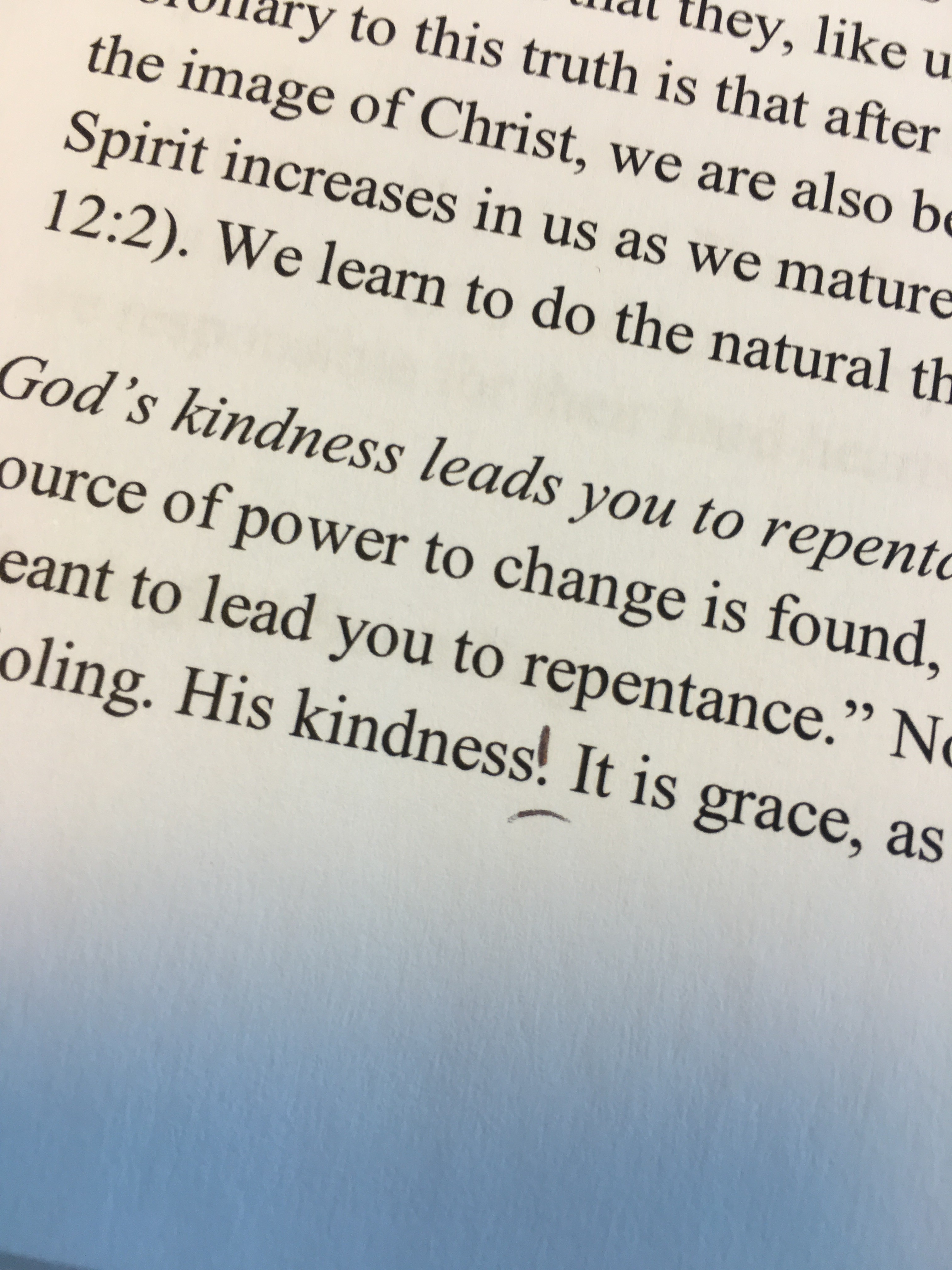
But then I came to it. Page 18. There at the bottom of that page, as I was expounding on Romans 2:4 in a section of the study called “Gospel Glimpses,” I had written this:
In yet another wonderful affirmation of where the source of power to change is found, Paul reminds us in Romans 2:4 that “God’s kindness is meant to lead you to repentance.” Not his law, not his berating, not his exasperation or his cajoling. His kindness.
Period. End of thought.
But Dr. Packer added one thin vertical pen stroke, turning my period into an exclamation point, and underlining it to show the change. It’s not’s God kindness — yawn — that leads us to repentance, but God’s kindness! Exclamation point!
As I looked at this correction, I couldn’t stop looking at it. And then I began to weep. And I’ll tell you why. Twelve years ago when I was at the bottom of the barrel and the bottom of my life and felt useless and worthless and unlovable and didn’t want to even be alive any more, I could not have imagined in my wildest dreams that some day I’d be staring at something I had written that had been edited by J.I. Packer. If you had said that to me then, I would have laughed at you and then punched you (probably). I had no capacity for such things. And as I stared at this edited sentence — just this one little pen stroke that makes a world of difference — in a cushioned chair behind my big desk at Midwestern Seminary, I started crying remembering what it was like to be face down on the floor of my guest bed room wishing I was dead.
Because it was in that very experience that God put an exclamation point where I had put a period. Indeed, that entire terrible despair was the rotten fruit of my own sinful choices and my own inner darkness. But God! His kindness! It led me to repentance.
I am grateful for these reminders, the big ones and the little ones, that help me not take the grace of God lightly. The gospel is an exclamation point.
January 19, 2016
Pastor, Mind Your RBM or Risk Burnout
 Most faithful ministry leaders I know are tired. Many are the good kind of tired — they work hard, stay diligent and productive, and love their churches and ministries well. But many are the bad kind of tired — they overwork, they over-commit, they’re one or two more ministry crises or conflicts away from falling apart. So how can a pastor work to protect himself from crashing and burning? Incorporate the necessary ministry rhythm of RBM.
What’s RBM?
Rest. Boundaries. Margin.
Every pastor needs to intentionally and strategically make sure his ministry life includes the right amount of RBM.
Rest
It’s not optional. It’s not a suggestion. God commanded it. Not every now and then. At least weekly. Every human being needs regular rest from work. A lot of pastors I know do not take a day off, or spend their day “off” working on their sermon or doing other things that aren’t exactly restful. You might say your season of life does not allow for much rest, and I would say that you’re setting yourself up for a disastrous next season.
Boundaries
When I was pastoring I committed Fridays to my wife. That was our day together. Once this became known, a couple of people in the church took it upon themselves to test this boundary, repeatedly asking for meetings on that day. But I protected it. Your boundaries might be different, but you still need them. I’m not talking about ignoring actual crisis or emergency situations. I’m just talking about regular ministry life.
It may sound noble and godly to keep convenience store hours, but it’s a fast-track to physical exhaustion, as well as gradual resentment of the flock. A pastor without boundaries has an idolatry problem, and he is encouraging his church to have idolatry problems too. Good pastors are available to their churches, yes, but bad pastors try to be available 24/7. Read this closely: You. aren’t. Jesus. Stop trying to be. Only Christ is omnipresent. Only Christ is omnipotent.
Margin
Margin is similar to rest, but it’s not about not working, but about intentionally incorporating into your schedule open spaces for the more quiet kind of work. Making sure I had plenty of margin in my ministry week for praying, reading, studying, and just thinking was extremely helpful. It’s also a good preparation for the weeks when ministry burdens are unexpectedly heavy, or when there are surprise crisis situations or sudden counseling sessions needed.
If you’ve already scheduled your week to the limit with meetings and other ministry tasks, dealing with the occasional crises or surprises that come up will prevent you from completing necessary tasks, add burdens to support staff or other team members, overload your mental and emotional circuits, create a more frenetic week than necessary, and nullify your rest time. Incorporating margin allows you to be flexible and adaptive to the different needs of your ministry week to week. Schedule a reasonable amount of time of “free space” in your work week, use it in helpful, productive ways on things that could be set aside in the moment if something comes up.
So there you go. It’s not rocket science. Mind your RBM and you will go good way’s toward protecting yourself from ministry burnout.


