
Greer Gilman's Blog, page 57
February 6, 2014
Flakes
At midnight, in a diamond-dust of snow, there was a man in a T-shirt who had cleared away eight or nine inches of frosting from an outdoor table--down to the bare ice--and was dancing on it, all alone. Something between a cakewalk and flamenco.
There are several good sculptures in the Yard--I like the Easter Island head--but nothing to compare with other years: the perfect knee-high Giza, Sphinx, pyramids, and all; the empty suburban living room, in all its spiritual blankness; the Not-Actually-the-Founder's statue remodeled as a herm.
In the library now: no snow, but some amusing laptop transformations. I adored the one with Snow White gazing at the glowing Apple in her hands. Turing would have smiled: life, death, and afterlife.
Nine
There are several good sculptures in the Yard--I like the Easter Island head--but nothing to compare with other years: the perfect knee-high Giza, Sphinx, pyramids, and all; the empty suburban living room, in all its spiritual blankness; the Not-Actually-the-Founder's statue remodeled as a herm.
In the library now: no snow, but some amusing laptop transformations. I adored the one with Snow White gazing at the glowing Apple in her hands. Turing would have smiled: life, death, and afterlife.
Nine


February 5, 2014
If on a winter's night...
Noncanonical Cockaleekie
Forty years of heretical meditation on Dorothy Hartley's recipe: "…the oldest cock is best…let it simmer and simmer and simmer—and then simmer, until the bird is rag and the leeks are pulp, and the broth is lovely…Don't spoil this superb old dish by doing things to it."
So I do.
For 3 or 4:
bunch of leeks
pound of carrots
four or five plump chicken thighs
eggcup (or two) of barley (ca. 1/8-1/4 c.)
mug of water (ca. 1 1/4 c.)
salt & pepper
There should be about as much white and pale green of leek as there is carrot. Cut the root ends off, cut (most of) the coarse dark green leaves off, split lengthwise and wash the mud out. (It gets between the leaves.) Chop into rounds, about knuckle-length.
Peel and cut the carrots into fat crayon-stubs. (The prepared baby carrots are a godsend—just tip 'em in.)
Skin the chicken thighs. I leave the bone in—seems tastier that way. If you'd rather have breasts or necks or whatever, go ahead.
Put leeks, carrots, chicken in a stewpan with the barley. Add the water. (No it's not too little: this is an Eintopf, or stew, not a soup—you could eat it with a fork, and sup the broth.) Cover.
Simmer until done—about 40ish minutes. The leeks and carrots should be fork-soft, and the chicken should be falling from the bone.
Fish out the bones.
Salt and pepper to taste. (Coarse is good.)
Dish up in deep bowls.
Good with oatcake or farmhouse bread and butter.
————
Note: proportions don't matter much. Except that barley swells.
Prunes? What prunes?
Nine
Forty years of heretical meditation on Dorothy Hartley's recipe: "…the oldest cock is best…let it simmer and simmer and simmer—and then simmer, until the bird is rag and the leeks are pulp, and the broth is lovely…Don't spoil this superb old dish by doing things to it."
So I do.
For 3 or 4:
bunch of leeks
pound of carrots
four or five plump chicken thighs
eggcup (or two) of barley (ca. 1/8-1/4 c.)
mug of water (ca. 1 1/4 c.)
salt & pepper
There should be about as much white and pale green of leek as there is carrot. Cut the root ends off, cut (most of) the coarse dark green leaves off, split lengthwise and wash the mud out. (It gets between the leaves.) Chop into rounds, about knuckle-length.
Peel and cut the carrots into fat crayon-stubs. (The prepared baby carrots are a godsend—just tip 'em in.)
Skin the chicken thighs. I leave the bone in—seems tastier that way. If you'd rather have breasts or necks or whatever, go ahead.
Put leeks, carrots, chicken in a stewpan with the barley. Add the water. (No it's not too little: this is an Eintopf, or stew, not a soup—you could eat it with a fork, and sup the broth.) Cover.
Simmer until done—about 40ish minutes. The leeks and carrots should be fork-soft, and the chicken should be falling from the bone.
Fish out the bones.
Salt and pepper to taste. (Coarse is good.)
Dish up in deep bowls.
Good with oatcake or farmhouse bread and butter.
————
Note: proportions don't matter much. Except that barley swells.
Prunes? What prunes?
Nine
February 3, 2014
Long, Last
Zeno's edition of Little, Big inches toward Readercon. I so hope it's born! From what I've seen of the interior, it will be a book to set beside the Kelmscott Chaucer. If, when?
Good speed to the press.
Nine
Good speed to the press.
Nine
February 2, 2014
Nothing like the sun
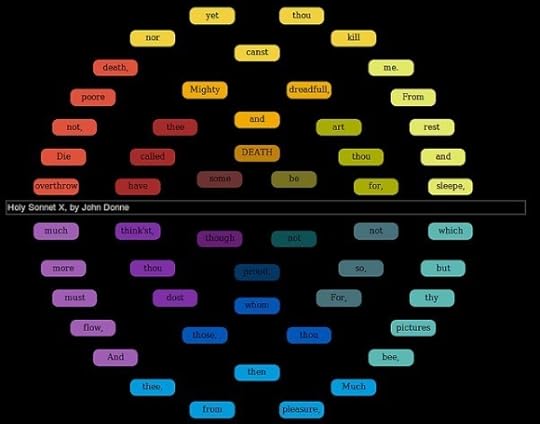
When I in dreams behold thy fairest shade
Whose shade in dreams doth wake the sleeping morn
The daytime shadow of my love betray’d
Lends hideous night to dreaming’s faded form
Were painted frowns to gild mere false rebuff
Then shoulds’t my heart be patient as the sands
For nature’s smile is ornament enough
When thy gold lips unloose their drooping bands
As clouds occlude the globe’s enshrouded fears
Which can by no astron’my be assail’d
Thus, thyne appearance tears in atmospheres
No fond perceptions nor no gaze unveils
Disperse the clouds which banish light from thee
For no tears be true, until we truly see
"The work has no single author. It’s a collaboration whose only living human agent, the aforementioned [J. Nathan] Matias, also now a fellow at the Berkman Center for Internet and Society, at Harvard University – whose mind was responsible for the final word selections, and thus also for assembling (and dissembling) the poem’s core meaning — describes as requiring an acknowledged role for each of its different agents (i.e. both human and machine)."
Not bad for a chimera.
Nine
January 30, 2014
Queens Parade
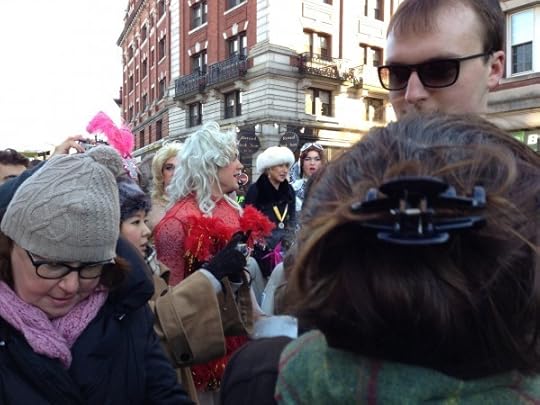
Well, look what wandered across my lunch break! The Queen:
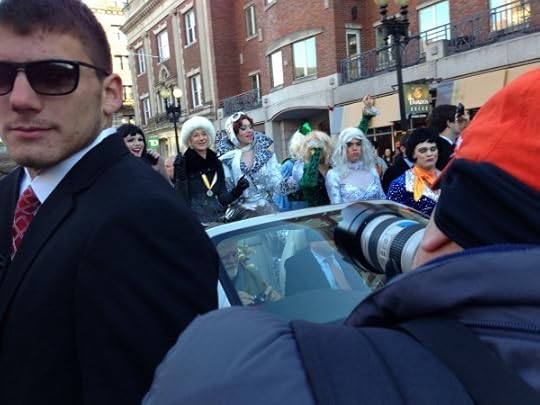
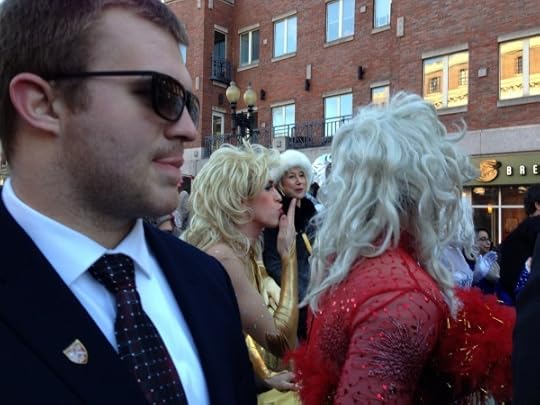
and her ladies-in-waiting:
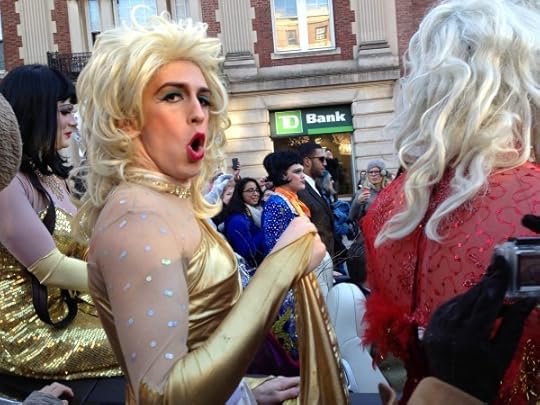
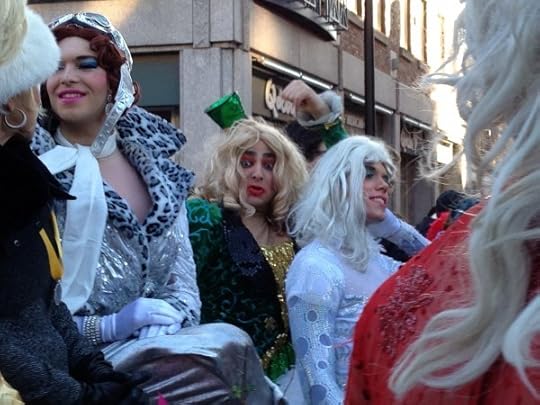
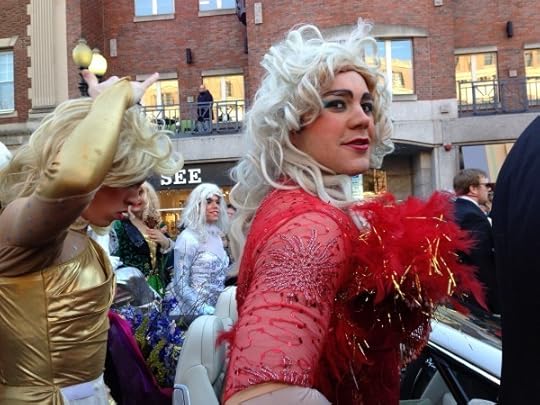
I'd happened on the Hasty Pudding Club parade, this year celebrating Helen Mirren. Things got fraught:
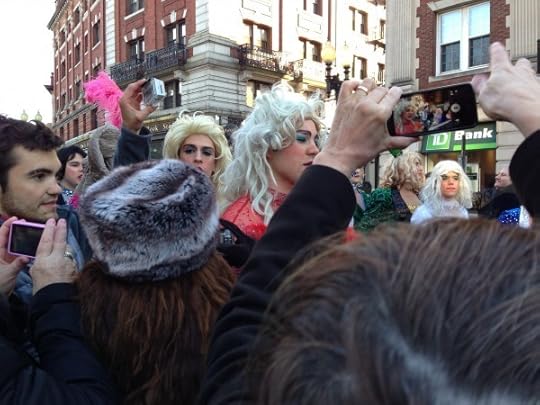
I admired the aplomb (a plum?) of the guy in the woolly hat, eating chocolate ice cream (Harvard Square! gotta love it), doubtless celebrating the precipitous rise of the mercury to somewhere in the 20s. Didn't push, didn't crowd, didn't call. He simply asked in a clear, conversational tone, "Helen, tell me, what medal is that?" She answered, "From the Hasty Pudding..."; but in the tumult (what'd she say? what'd she say?), I didn't quite hear what she said about Moscow and her Stanislavski Award.
Nine
and her ladies-in-waiting:
I'd happened on the Hasty Pudding Club parade, this year celebrating Helen Mirren. Things got fraught:
I admired the aplomb (a plum?) of the guy in the woolly hat, eating chocolate ice cream (Harvard Square! gotta love it), doubtless celebrating the precipitous rise of the mercury to somewhere in the 20s. Didn't push, didn't crowd, didn't call. He simply asked in a clear, conversational tone, "Helen, tell me, what medal is that?" She answered, "From the Hasty Pudding..."; but in the tumult (what'd she say? what'd she say?), I didn't quite hear what she said about Moscow and her Stanislavski Award.
Nine
January 26, 2014
“Like quills upon the fretful Porpentine”
Went out last night in a raw wind and a snittering snow to an abandoned piano factory, where Theatre Sans Argent—sorry, The Porpentine Players—were giving their last performance of A Man for All Seasons. I was so fortunate to have caught that.
It was, of course, a truly Geoffrey-worthy venue—after all, this was the first production of a fire-new, barely-for-profit company. The factory building somewhere in the Isle of Dogs, the unfindable door, the unspeakable bathroom (scrubbed, yes, but haunted with an unlaid odor and with scuttlings in the corners, eek! and portaled like the crypt: it had a keyless, clanging door), were all as he envisioned theatre. But the production was as well, Geoffrey-worthy: “infinite riches in a little room.”
After all, it was a snug little theatre, a good space, decked out with some rather splendid heraldry (More’s moorcocks were particularly, spikily defiant), a few small portable black boxes, and a properties chest. One determined unseen spider tried in vain to redesign the set: she had in mind great tapestries, which time o’erswept.
The madmen—er, visionaries—and the founders of this company are Jon Taie, who directed the play, made it shapely as chamber music, with most excellent pacing and dynamics; and Sharon Lacey, who did the set designs and costumes, and managed to give us the Renaissance on a shoe-string.
And above all, the players were terrific. This was true ensemble work.
Ronald Nelson Lacey’s Sir Thomas More was beautifully done. He gave us a saint without a halo: soft-spoken, witty, adamantine. By the end, when his body not his will was broken, he seemed hollowed out like a candle, structurally compromised but with his fire taintless. It would flare at last.
The great scene of parting with his wife and daughter was magnificent. His wife, lion Alice (Jenny Gutbezahl) is the pragmatist: we need her voice. And his true daughter Meg (April Singley) cannot mirror him in this. He had taught her recollection, stillness. Humanism is no glass for violence. His family cannot understand or assent to his martyrdom; they can only recognize his singularity. For one last embrace, the family seemed bonded like a single molecule; which the apologetic Jailer split.
I so liked the Porpentines’ cherubic Richard Rich (Conor Burke). He looked like Sister Perpetua’s pet third-grader who stays behind to clap erasers as a special treat, and filches from her desk. Nuns shouldn’t eat chocolate, anyway. The sidelong glance of guilt above the smile was singularly disturbing.
Floyd Richardson’s Norfolk was wonderfully pre-modern, a fist for a falcon: coarse, generous, assured, and so very very landed. You could see the reed thatch growing up through him.
On the other hand Cromwell, as played by Phil Thompson, was the coming man. Thomas Howard was merely raw power; but this Cromwell could harness, divert, direct it, cut it off. He ran the millstones. And oh! with what a voice.
Not least, the multitudinous derspatchel
played the Common Man, in an array of hats, caps, and one baneful black hood: a Steward, a Boatman, a Publican, a Jailer, a Foreman of the Jury, and a Headsman (all, in one way or another, paid off); and an Academic, in
sovay
’s gold spectacles. Each was different, face and voice: sly, apologetic, snuffling, hang-dog, bewildered, stiff with solemnity (you could just feel how tight his collar was, straining to attend). A six-pack of Ealing Tragedy, with a chaser of tonic.
derspatchel
played the Common Man, in an array of hats, caps, and one baneful black hood: a Steward, a Boatman, a Publican, a Jailer, a Foreman of the Jury, and a Headsman (all, in one way or another, paid off); and an Academic, in
sovay
’s gold spectacles. Each was different, face and voice: sly, apologetic, snuffling, hang-dog, bewildered, stiff with solemnity (you could just feel how tight his collar was, straining to attend). A six-pack of Ealing Tragedy, with a chaser of tonic.
Spatch has a lovely gift for the comic, as a condition of life. He never forgets
That even the dreadful martyrdom must run its course
Anyhow in a corner, some untidy spot
Where the dogs go on with their doggy life and the torturer's horse
Scratches its innocent behind on a tree.
As many of you know, Spatch broke his leg on Christmas Day (dear gods, how Dickensian) and he rose to the problem of playing all the characters-with-all-the-business as a dot-and-carry-one, most inventively. He sat amid a jury of hats on crutches; he crutch-poled his wheelchair boat across the river, having taken his coins. It was blackly hilarious.
Carry on, Charon!
And last, I liked the quiet disclaimer on the program:
“No porpentines were harmed in the making of the production.”
Nine
It was, of course, a truly Geoffrey-worthy venue—after all, this was the first production of a fire-new, barely-for-profit company. The factory building somewhere in the Isle of Dogs, the unfindable door, the unspeakable bathroom (scrubbed, yes, but haunted with an unlaid odor and with scuttlings in the corners, eek! and portaled like the crypt: it had a keyless, clanging door), were all as he envisioned theatre. But the production was as well, Geoffrey-worthy: “infinite riches in a little room.”
After all, it was a snug little theatre, a good space, decked out with some rather splendid heraldry (More’s moorcocks were particularly, spikily defiant), a few small portable black boxes, and a properties chest. One determined unseen spider tried in vain to redesign the set: she had in mind great tapestries, which time o’erswept.
The madmen—er, visionaries—and the founders of this company are Jon Taie, who directed the play, made it shapely as chamber music, with most excellent pacing and dynamics; and Sharon Lacey, who did the set designs and costumes, and managed to give us the Renaissance on a shoe-string.
And above all, the players were terrific. This was true ensemble work.
Ronald Nelson Lacey’s Sir Thomas More was beautifully done. He gave us a saint without a halo: soft-spoken, witty, adamantine. By the end, when his body not his will was broken, he seemed hollowed out like a candle, structurally compromised but with his fire taintless. It would flare at last.
The great scene of parting with his wife and daughter was magnificent. His wife, lion Alice (Jenny Gutbezahl) is the pragmatist: we need her voice. And his true daughter Meg (April Singley) cannot mirror him in this. He had taught her recollection, stillness. Humanism is no glass for violence. His family cannot understand or assent to his martyrdom; they can only recognize his singularity. For one last embrace, the family seemed bonded like a single molecule; which the apologetic Jailer split.
I so liked the Porpentines’ cherubic Richard Rich (Conor Burke). He looked like Sister Perpetua’s pet third-grader who stays behind to clap erasers as a special treat, and filches from her desk. Nuns shouldn’t eat chocolate, anyway. The sidelong glance of guilt above the smile was singularly disturbing.
Floyd Richardson’s Norfolk was wonderfully pre-modern, a fist for a falcon: coarse, generous, assured, and so very very landed. You could see the reed thatch growing up through him.
On the other hand Cromwell, as played by Phil Thompson, was the coming man. Thomas Howard was merely raw power; but this Cromwell could harness, divert, direct it, cut it off. He ran the millstones. And oh! with what a voice.
Not least, the multitudinous
derspatchel
played the Common Man, in an array of hats, caps, and one baneful black hood: a Steward, a Boatman, a Publican, a Jailer, a Foreman of the Jury, and a Headsman (all, in one way or another, paid off); and an Academic, in
sovay
’s gold spectacles. Each was different, face and voice: sly, apologetic, snuffling, hang-dog, bewildered, stiff with solemnity (you could just feel how tight his collar was, straining to attend). A six-pack of Ealing Tragedy, with a chaser of tonic.Spatch has a lovely gift for the comic, as a condition of life. He never forgets
That even the dreadful martyrdom must run its course
Anyhow in a corner, some untidy spot
Where the dogs go on with their doggy life and the torturer's horse
Scratches its innocent behind on a tree.
As many of you know, Spatch broke his leg on Christmas Day (dear gods, how Dickensian) and he rose to the problem of playing all the characters-with-all-the-business as a dot-and-carry-one, most inventively. He sat amid a jury of hats on crutches; he crutch-poled his wheelchair boat across the river, having taken his coins. It was blackly hilarious.
Carry on, Charon!
And last, I liked the quiet disclaimer on the program:
“No porpentines were harmed in the making of the production.”
Nine
January 25, 2014
Sisters in ink
Sofia Samatar's marvellous first novel, A Stranger in Olondria, has won the Crawford Award, as Moonwise did, all those long years ago. We are sisters in ink. I rejoice with her, and with our Small Beer Press, upholders of the odd.
Nine
Nine
January 21, 2014
"I was adored once too."
Just read a teaser for the second Ben novella at Arisia—bears!—and came back to find this lovely review of the first, by Brit Mandelo:
"It’s about transformation, trauma, and the supernatural; gender, the stage, and the ghosts of history. It’s probably no surprise that I adored it. Between the richly realized setting, the clever haunting of the text with the poets and playwrights who loom large in the English tradition, and the stunning prose, I was enamored from the first—and my appreciation didn’t dwindle as I kept reading."
Nine
"It’s about transformation, trauma, and the supernatural; gender, the stage, and the ghosts of history. It’s probably no surprise that I adored it. Between the richly realized setting, the clever haunting of the text with the poets and playwrights who loom large in the English tradition, and the stunning prose, I was enamored from the first—and my appreciation didn’t dwindle as I kept reading."
Nine
January 16, 2014
A damson on a black-thorn
The new Jacobean theatre in London "feels as if it's always been there and was just waiting to be uncovered."
The Duchess of Malfi "is one of the great female roles in the canon and Gemma Arterton brings to it beauty, determination and a sense of moral goodness. ... But the image of this production I shall retain is of Dawson's {Ferdinand's] pale, pinched features glimpsed by a flickering candle as he vows to go hunt the badger by moonlight."
If there were tickets, I'd swim.
Nine
The Duchess of Malfi "is one of the great female roles in the canon and Gemma Arterton brings to it beauty, determination and a sense of moral goodness. ... But the image of this production I shall retain is of Dawson's {Ferdinand's] pale, pinched features glimpsed by a flickering candle as he vows to go hunt the badger by moonlight."
If there were tickets, I'd swim.
Nine
January 15, 2014
Cakes and ale, round three
And now for Twelfth Night! But first I met Tragedy on Central Park East.
The day being March-like, jacket weather, I thought I’d walk down Fifth to the theatre and met the Theatre coming up Fifth.
Lurching toward me in a tragic topple, like the all-but-extinct Sarah Bernhardt as Electra (positively her Last Appearance On This Or Any Other Stage) was a grande dame in furs. Besides the opulent ankle-length coat she wore, sailing open (as if she’d brought her own wind machine), she was festooned and garlanded with flat fauna—
Like a slaughterhouse, so to speak,
Garnished with furry deaths
And many shipwrecks of stoats.
I didn’t even really see her own face: I was riveted by all those glass-eyed masks.
And she was begging. Not aloud, but with all her body: pleading with an absence, staggering against an unfelt wind, as if she’d hurl herself at kingly knees. As if the Parcae of Park Avenue were hunting her.
I suppose (in afterthought) that she might have been drunk. Or mad. Or had Parkinsons, or even a broken high heel...But coming from the art galleries, I thought of her as an Edward Gorey illustration, as Medea of the Minks.
Beyond her, things got springlike.
There was even a Strand-in-a-box at the Plaza corner, very Parisian.
Ah, but you may note that it had been a very long time since breakfast, which was meagre even for the Lowood School. There are no sandwiches on Fifth, it seems. Elegant bars, yes. Pushcarts in plenty, yes. But a hot dog? I did not wish to be seized with cramps in mid-performance. As I got to midtown, I kept looking about for something on ground level with coffee and sandwiches: a deli, a Starbucks, even.
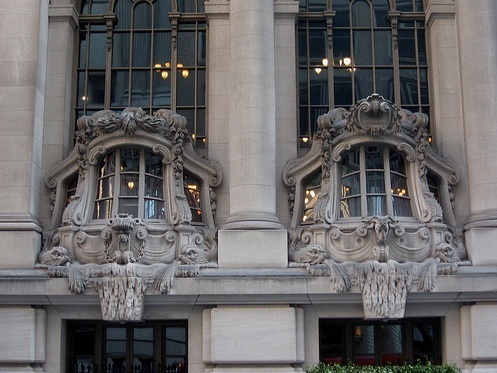
The Belasco is on 44th. Hey, so that’s where the Algonquin is! Cool. And the Yacht Club (with glorious galleon windows). And the Harvard Club. If she walked in, would they serve a poor theatre-goer a sandwich? Would they rum, sodomy, and the lash!
I did find at last a coffeeshop opposite the theatre that would do me a mocha. No savories. Thus fortified, I rang my companions.
B. and B., of course, had found my imagined deli. After a blessed egg salad sandwich and some chocolate, I was loaded for white bear. Could have torn an arm’d rhinoceros, or th’ Hyrcan tiger.
Nice tickets: first balcony, center. I’d had the forethought to bring my mother’s second-best pair of mother-of-pearl opera glasses (not the ones in the original shaped-leather case, red-velvet lined: Carlo Tailor, ottico di Baviera, Napoli). What I really wanted was a light pair of birder’s glasses, but those I don’t own.
And we were well in time to watch the actors tiring and to hear the loud bassoon. Or rather, the rauschpfeifes, hurdy-gurdy, sackbuts, bagpipes, shawm, and curtal; the recorders, lute, theorbo, cittern; the assorted drums. Afterward, B. marvelled that the lutenist was always in tune. In a theatre full of humans breathing! On a planet with air! I theorized that he had six of them stacked up behind him, in case the second or the fourth was flat, the third and fifth sharp.
And meanwhile, players were laced, smocked, trussed, and buttoned, prinked, powdered, combed and curled. My dears! Such costuming! Laurel to the skin. Stephen Fry, in an interview, said his buttons were cast from a 1600 button-mold, as the play is 1602. He asked the designer, if the buttons were from 1603, would you have used them? No.
This had better be a special feature on the DVD.
Too soon, they were dressed and gone. The playhouse servants came to light the candles and to raise them.
"If music be the food of love, play on!”
Rapture.
By the time Feste sang his wind and rain, and all the company came forward in a galliard and a hey (with Sebastian and Viola fleetingly and slightly cross-entangled), I was dizzy with joy
Fabulous fabulous fabulous production.
And what of the performances? The celebrated drag? I confess that Mark Rylance’s Olivia is not my cup of tea. Or rather, not my espresso machine: it was a brilliant automaton, a brass-levered, steam-powered, exquisitely managed performance, with a virtuoso twiddle of foam on each cup. A heart.
Mind you, I don’t for a second think his performance was heartless: it was truly alien. The past is another planet. Time and again, the comparisons that come to mind are fantastical or SF. His wonderful glide is a Dalek by Hilliard; the histrionics, Gormenghastly. But there: I cannot see Irma Prunesquallor saying “item, two lips, indifferent red; item, two grey eyes, with lids to them; item, one neck, one chin, and so forth.” That’s it: the Rylance Olivia had melancholy, music, passion, and spectacular artistry; but no self-awareness, no irony.
No inside. All folded, black on white.
I’d guess that the histrionic approach might work brilliantly for Richard III, who is always conscious of his own theatrics.
Now I see this Olivia as the exact counterpart, the other mask, to my Fifth Avenue Furball, Allerleirauh of the Avenues. Tragedy and Comedy.
Nonetheless, Rylance was utterly essential. I could feel his/her manic energy powering the whole ensemble. Odd and wonderful to think of a skirt part being “The force that through the green fuse drives the flower,” but there it is. Genius as spirit. As muse.
It was exhilarating.
Ah, but the poetry? Now that resided in Samuel Barnett’s lovely coltish Viola, with her plaintive reedy voice. (I love an actor with an instrument.) Clearly she’s copying her brother’s manners, not as in a mirror but a mirror reversed, so lefts and rights get muddled. She's Sebastian through the looking-glass. You could see her flipping places in her head, remembering to remember how to bow. (Your other left!) That sword-hanger was a sheer perplexity.

Poor Scots Orsino (Liam Brennan) had no idea he’d crossed the gender bourne—swept past it somehow in his sleep and waked elsewhere. (
Of course, one gorgeous thing about boy players is that the twins look just like twins, so that never mind the other characters, the audience was dizzy disentangling them. If his hopelessly devoted Antonio (John Paul Connolly) was dogging him, he was probably a he, and Sebastian (Joseph Timms). Who had waked in Elysium: "
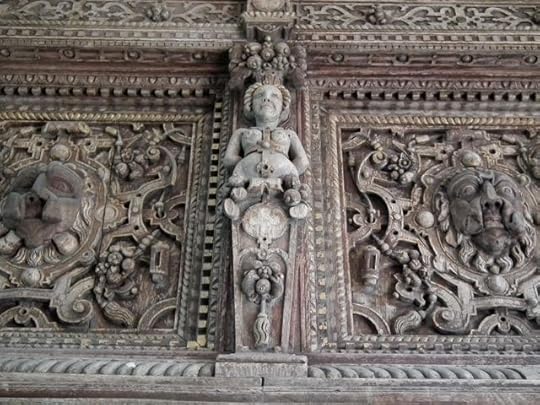
And the gravitas? That comes in Stephen Fry’s swag-eyed Malvolio, own cousin to his Jeeves: but here an ass who views his glass complacently. (I never thought of this before, but is Malvolio akin to Bottom? Darker, of course, but alike vainglorious. And spanked.) You can see him building noble kitchenless Renaissance architectures on the air. Upheld with satyrs.
He himself is not a grotesque (though an unpracticed smiler): he is, I think, the least fantastical of all the players on the stage. Fry's a humanist and plays him sympathetically. For all his priggishness, his joyless, jack-in-office despotism, it hurts when he’s mocked. As well it should.
Not that I hated his quintet of torturers. (They kept a Fabian.) For sheer inventive raucous joyousness, it would be hard to beat the three conspirators. I loved Paul Chahidi’s classic pantomime dame of a Maria, mistress of the tickle; Colin Hurley’s pickled gherkin of a Toby Belch; and (speaking of drunken noodles), Angus Wright’s skew-whiff Sir Andrew Aguecheek, whose stripes don’t ever quite line up.
And saving not the least for last, I adored their Feste, Peter Hamilton Dyer in motley. An admirable fool: he sings well, dances well, plays the pipe and tabor. Is quite the quirkiest and sanest creature on the stage. I wish he could play my Armin! “A gill to Ben’s quartpot: his slight quick tumbler’s body in a mole-gray scholar’s gown, mischief as justice. He’d an ill-matched face--a fortune in a fool--two faces in one coin, like moon and dark of moon. Himself his guising. He’d a trick of turning, overturning what you saw in him. Now mirth, now melancholy: child; confessor; lunatic.”
Bliss. Utterly.
B. and B. and I came out on a frothing great wave of elation, into Wonderland. Who would have thought (in our dim distant youth) that Times Square would be one day full of children in family groups? We passed Hello Kitty and Elmo selling nothing but photo-ops (I hope).
We laughed all the way to South Station. And I'm smiling still.
Nine
The day being March-like, jacket weather, I thought I’d walk down Fifth to the theatre and met the Theatre coming up Fifth.
Lurching toward me in a tragic topple, like the all-but-extinct Sarah Bernhardt as Electra (positively her Last Appearance On This Or Any Other Stage) was a grande dame in furs. Besides the opulent ankle-length coat she wore, sailing open (as if she’d brought her own wind machine), she was festooned and garlanded with flat fauna—
Like a slaughterhouse, so to speak,
Garnished with furry deaths
And many shipwrecks of stoats.
I didn’t even really see her own face: I was riveted by all those glass-eyed masks.
And she was begging. Not aloud, but with all her body: pleading with an absence, staggering against an unfelt wind, as if she’d hurl herself at kingly knees. As if the Parcae of Park Avenue were hunting her.
I suppose (in afterthought) that she might have been drunk. Or mad. Or had Parkinsons, or even a broken high heel...But coming from the art galleries, I thought of her as an Edward Gorey illustration, as Medea of the Minks.
Beyond her, things got springlike.
There was even a Strand-in-a-box at the Plaza corner, very Parisian.
Ah, but you may note that it had been a very long time since breakfast, which was meagre even for the Lowood School. There are no sandwiches on Fifth, it seems. Elegant bars, yes. Pushcarts in plenty, yes. But a hot dog? I did not wish to be seized with cramps in mid-performance. As I got to midtown, I kept looking about for something on ground level with coffee and sandwiches: a deli, a Starbucks, even.
The Belasco is on 44th. Hey, so that’s where the Algonquin is! Cool. And the Yacht Club (with glorious galleon windows). And the Harvard Club. If she walked in, would they serve a poor theatre-goer a sandwich? Would they rum, sodomy, and the lash!
I did find at last a coffeeshop opposite the theatre that would do me a mocha. No savories. Thus fortified, I rang my companions.
B. and B., of course, had found my imagined deli. After a blessed egg salad sandwich and some chocolate, I was loaded for white bear. Could have torn an arm’d rhinoceros, or th’ Hyrcan tiger.
Nice tickets: first balcony, center. I’d had the forethought to bring my mother’s second-best pair of mother-of-pearl opera glasses (not the ones in the original shaped-leather case, red-velvet lined: Carlo Tailor, ottico di Baviera, Napoli). What I really wanted was a light pair of birder’s glasses, but those I don’t own.
And we were well in time to watch the actors tiring and to hear the loud bassoon. Or rather, the rauschpfeifes, hurdy-gurdy, sackbuts, bagpipes, shawm, and curtal; the recorders, lute, theorbo, cittern; the assorted drums. Afterward, B. marvelled that the lutenist was always in tune. In a theatre full of humans breathing! On a planet with air! I theorized that he had six of them stacked up behind him, in case the second or the fourth was flat, the third and fifth sharp.
And meanwhile, players were laced, smocked, trussed, and buttoned, prinked, powdered, combed and curled. My dears! Such costuming! Laurel to the skin. Stephen Fry, in an interview, said his buttons were cast from a 1600 button-mold, as the play is 1602. He asked the designer, if the buttons were from 1603, would you have used them? No.
This had better be a special feature on the DVD.
Too soon, they were dressed and gone. The playhouse servants came to light the candles and to raise them.
"If music be the food of love, play on!”
Rapture.
By the time Feste sang his wind and rain, and all the company came forward in a galliard and a hey (with Sebastian and Viola fleetingly and slightly cross-entangled), I was dizzy with joy
Fabulous fabulous fabulous production.
And what of the performances? The celebrated drag? I confess that Mark Rylance’s Olivia is not my cup of tea. Or rather, not my espresso machine: it was a brilliant automaton, a brass-levered, steam-powered, exquisitely managed performance, with a virtuoso twiddle of foam on each cup. A heart.
Mind you, I don’t for a second think his performance was heartless: it was truly alien. The past is another planet. Time and again, the comparisons that come to mind are fantastical or SF. His wonderful glide is a Dalek by Hilliard; the histrionics, Gormenghastly. But there: I cannot see Irma Prunesquallor saying “item, two lips, indifferent red; item, two grey eyes, with lids to them; item, one neck, one chin, and so forth.” That’s it: the Rylance Olivia had melancholy, music, passion, and spectacular artistry; but no self-awareness, no irony.
No inside. All folded, black on white.
I’d guess that the histrionic approach might work brilliantly for Richard III, who is always conscious of his own theatrics.
Now I see this Olivia as the exact counterpart, the other mask, to my Fifth Avenue Furball, Allerleirauh of the Avenues. Tragedy and Comedy.
Nonetheless, Rylance was utterly essential. I could feel his/her manic energy powering the whole ensemble. Odd and wonderful to think of a skirt part being “The force that through the green fuse drives the flower,” but there it is. Genius as spirit. As muse.
It was exhilarating.
Ah, but the poetry? Now that resided in Samuel Barnett’s lovely coltish Viola, with her plaintive reedy voice. (I love an actor with an instrument.) Clearly she’s copying her brother’s manners, not as in a mirror but a mirror reversed, so lefts and rights get muddled. She's Sebastian through the looking-glass. You could see her flipping places in her head, remembering to remember how to bow. (Your other left!) That sword-hanger was a sheer perplexity.
Poor Scots Orsino (Liam Brennan) had no idea he’d crossed the gender bourne—swept past it somehow in his sleep and waked elsewhere. (
Of course, one gorgeous thing about boy players is that the twins look just like twins, so that never mind the other characters, the audience was dizzy disentangling them. If his hopelessly devoted Antonio (John Paul Connolly) was dogging him, he was probably a he, and Sebastian (Joseph Timms). Who had waked in Elysium: "
And the gravitas? That comes in Stephen Fry’s swag-eyed Malvolio, own cousin to his Jeeves: but here an ass who views his glass complacently. (I never thought of this before, but is Malvolio akin to Bottom? Darker, of course, but alike vainglorious. And spanked.) You can see him building noble kitchenless Renaissance architectures on the air. Upheld with satyrs.
He himself is not a grotesque (though an unpracticed smiler): he is, I think, the least fantastical of all the players on the stage. Fry's a humanist and plays him sympathetically. For all his priggishness, his joyless, jack-in-office despotism, it hurts when he’s mocked. As well it should.
Not that I hated his quintet of torturers. (They kept a Fabian.) For sheer inventive raucous joyousness, it would be hard to beat the three conspirators. I loved Paul Chahidi’s classic pantomime dame of a Maria, mistress of the tickle; Colin Hurley’s pickled gherkin of a Toby Belch; and (speaking of drunken noodles), Angus Wright’s skew-whiff Sir Andrew Aguecheek, whose stripes don’t ever quite line up.
And saving not the least for last, I adored their Feste, Peter Hamilton Dyer in motley. An admirable fool: he sings well, dances well, plays the pipe and tabor. Is quite the quirkiest and sanest creature on the stage. I wish he could play my Armin! “A gill to Ben’s quartpot: his slight quick tumbler’s body in a mole-gray scholar’s gown, mischief as justice. He’d an ill-matched face--a fortune in a fool--two faces in one coin, like moon and dark of moon. Himself his guising. He’d a trick of turning, overturning what you saw in him. Now mirth, now melancholy: child; confessor; lunatic.”
Bliss. Utterly.
B. and B. and I came out on a frothing great wave of elation, into Wonderland. Who would have thought (in our dim distant youth) that Times Square would be one day full of children in family groups? We passed Hello Kitty and Elmo selling nothing but photo-ops (I hope).
We laughed all the way to South Station. And I'm smiling still.
Nine
Greer Gilman's Blog

- Greer Gilman's profile
- 42 followers
Greer Gilman isn't a Goodreads Author
(yet),
but they
do have a blog,
so here are some recent posts imported from
their feed.

