
Greer Gilman's Blog, page 52
July 22, 2014
Oranges & lemons
Here's my Loncon 3 schedule. Rather nice! Mostly Thursday.
Thursday August 14
13:30 - 15:00, Capital Suite 9 (ExCeL)
When is a Fantasy not a Fantasy?
Miriam Weinberg (M), Greer Gilman, Paul Kincaid, Graham Sleight, Jonathan Strahan, Catherynne M. Valente
Many of the more liminal fantasies play with the idea of psychosis as a blurring the boundaries of the world (Megan Lindholm's Wizard of the Pigeons, Steve Cockayne's The Good People, Jo Walton's My Real Children); many 'mainstream' novels present worlds built of dream, the afterlife, or metaphor. What determines whether something is a fantasy or not: authorial intent, genre signals, reader perceptions? How far should we accept characters' own sense of the world, and when can we judge them as unreliable witnesses?
16:30 - 18:00, Capital Suite 13 (ExCeL)
Better Worldbuilding Through Poetry
Catherynne M. Valente (M), Jenny Blackford, Amal El-Mohtar, Greer Gilman, Neil Williamson
When you ask someone to think of poetry in SF and fantasy novels, they are liable to think first of the epic or pseudo-epic verse of Tolkien and his inheritors -- language used to elevate and mythologise the world and the events they create. But poetry can be put to many and varied uses within larger works, as evidenced by such recent books as Anne Carson's "Red Doc" (a verse novel), Sofia Samatar's "A Stranger in Olondria" (which includes poetry as imagined literary history), or Kim Stanley Robinson's "2312" (prose-poems evoking AI consciousness). How do these and other SF and fantasy works use poetry to help create moods, worlds, or characters? What forms and what kinds of language are most common, and why? And to what extent is poetry contextual -- are there examples of writing that we accept as the next page of a novel, but would treat as a poem if published separately?
19:30 - 20:00, London Suite 1 (ExCeL)
Reading: Greer Gilman
Greer Gilman
Friday August 15
21:00 - 22:00, Capital Suite 7+12 (ExCeL)
You Write Pretty
Geoff Ryman (M), Greer Gilman, Frances Hardinge , Christopher Priest, E. J. Swift
Beauty is in the eye of the beholder, they say, so let us behold some fine fantastical sentences. Our panel have each picked a sentence, and will have a chance to make their case for why theirs is the fairest of them all -- but it will be up to the audience to decide.
Sunday August 17
18:00 - 19:00, London Suite 4 (ExCeL)
Kaffeeklatsch
Simon Guerrier, Greer Gilman
So, should I read from Cry Murder! In a Small Voice? Or from Exit, Pursued by a Bear? A bit of both?
Nine
Thursday August 14
13:30 - 15:00, Capital Suite 9 (ExCeL)
When is a Fantasy not a Fantasy?
Miriam Weinberg (M), Greer Gilman, Paul Kincaid, Graham Sleight, Jonathan Strahan, Catherynne M. Valente
Many of the more liminal fantasies play with the idea of psychosis as a blurring the boundaries of the world (Megan Lindholm's Wizard of the Pigeons, Steve Cockayne's The Good People, Jo Walton's My Real Children); many 'mainstream' novels present worlds built of dream, the afterlife, or metaphor. What determines whether something is a fantasy or not: authorial intent, genre signals, reader perceptions? How far should we accept characters' own sense of the world, and when can we judge them as unreliable witnesses?
16:30 - 18:00, Capital Suite 13 (ExCeL)
Better Worldbuilding Through Poetry
Catherynne M. Valente (M), Jenny Blackford, Amal El-Mohtar, Greer Gilman, Neil Williamson
When you ask someone to think of poetry in SF and fantasy novels, they are liable to think first of the epic or pseudo-epic verse of Tolkien and his inheritors -- language used to elevate and mythologise the world and the events they create. But poetry can be put to many and varied uses within larger works, as evidenced by such recent books as Anne Carson's "Red Doc" (a verse novel), Sofia Samatar's "A Stranger in Olondria" (which includes poetry as imagined literary history), or Kim Stanley Robinson's "2312" (prose-poems evoking AI consciousness). How do these and other SF and fantasy works use poetry to help create moods, worlds, or characters? What forms and what kinds of language are most common, and why? And to what extent is poetry contextual -- are there examples of writing that we accept as the next page of a novel, but would treat as a poem if published separately?
19:30 - 20:00, London Suite 1 (ExCeL)
Reading: Greer Gilman
Greer Gilman
Friday August 15
21:00 - 22:00, Capital Suite 7+12 (ExCeL)
You Write Pretty
Geoff Ryman (M), Greer Gilman, Frances Hardinge , Christopher Priest, E. J. Swift
Beauty is in the eye of the beholder, they say, so let us behold some fine fantastical sentences. Our panel have each picked a sentence, and will have a chance to make their case for why theirs is the fairest of them all -- but it will be up to the audience to decide.
Sunday August 17
18:00 - 19:00, London Suite 4 (ExCeL)
Kaffeeklatsch
Simon Guerrier, Greer Gilman
So, should I read from Cry Murder! In a Small Voice? Or from Exit, Pursued by a Bear? A bit of both?
Nine


July 16, 2014
You can call me Spike
A friend of mine who has a highly distinguished Bernese Mountain Dog, and cannot keep another (one to a walker, one to a car), would like a companion for him. He (this is not he) is a clubbable gentleman.

Her friends who have kennels assure her that Havanese pups are ideally temperamentally suited to be family with Berners. and have offered her a bitch.
This is not her idea of a DOG:

She would like a name for a "substantial creature," a name with attitude, something with the feel of Spike.
Dido? Sophie? Spike?
Ideas?
Nine
Her friends who have kennels assure her that Havanese pups are ideally temperamentally suited to be family with Berners. and have offered her a bitch.
This is not her idea of a DOG:
She would like a name for a "substantial creature," a name with attitude, something with the feel of Spike.
Dido? Sophie? Spike?
Ideas?
Nine
July 14, 2014
Techno-sofer
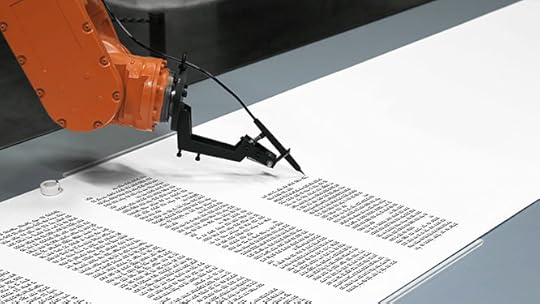
Some artists in Germany have made a robot which is writing out a Torah even now. With a quill. Its Torah isn't real, of course--it isn't on parchment and its scribe is uncircumcised, unconscious of G*d, unblessing and unblessed--but if a robot could be programmed to pray?
Nine
Nine
July 13, 2014
Guess I'm scary. Who knew?
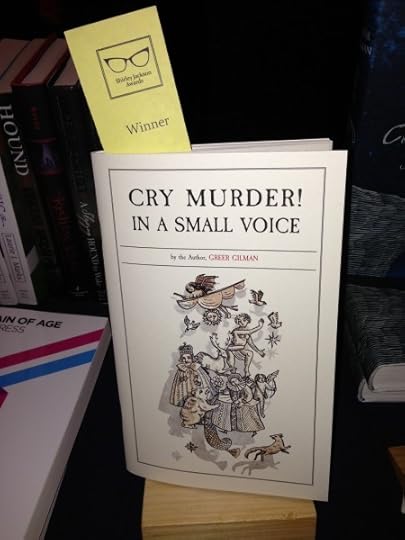
Thrilled to bits.
Update: people seemed to like my acceptance speech, so here it is, more or less as spoken:
Thank you so much.
Guess I’m scary. Who knew ?
I was monster angry when I wrote this. That—film Anonymous had just come out, and the media was full of its promoters, saying that the glover’s son Shakespeare wasn’t privileged enough to be a writer. Here:
“Whoever Shakespeare was, he wasn't a little ordinary yeoman … I'm quite certain that he was a quite exceptional aristocrat who had to keep totally quiet and needed Shakespeare as cover."
“A little ordinary yeoman.” My little Haitian dressmaker. My houseboy.
And that? was Vanessa Redgrave of the Workers Revolutionary Party. As my friend Cathy Butler said, "Scratch a socialist, find an extra from Downton Abbey."
Shirley Jackson would have laughed.
Look around this room, Vanessa. We’re all weird.
All of us write.
The Anonymian cult also believes that writers only write about their own quite exceptional lives. One must be a prince to write Hamlet, a vampire to write Dracula—
Let’s stake that conceit, shall we?
I myself have been a ghost, now and then, a whole pantheon of vengeful goddesses, a murder of crows—and I love that I get to be Ben Jonson, in all his fury, his fatness, and his honesty. I love playing in his world of players, writing poetry and taking names.
I give my Shakespeare teachers thanks for my good grounding, and absolve them of all blame.
That goes to
 nineweaving
’s obstreperous LJ friends. You dared me.
nineweaving
’s obstreperous LJ friends. You dared me.My extraordinary thanks to Sonya Taaffe, who shaped this tale in colloquy; to Lila Garrott, who reshaped it; and to Kelly Link, who conjured “moments of strangeness.”
I am indebted to Leah Zander and Faye Ringel for their excellent close readings of the manuscript; and to Madeleine Robins for advice on dirty swordplay.
All praise to Kathleen Jennings for her enchanting cover art; and above all to my beloved, tiny, celebrated Small Beer Press—Kelly Link and Gavin Grant—who call forth stories from the vasty deep. They publish monsters.
Nine
July 7, 2014
Whee!
Exit, Pursued by a Bear has gone to press!
Fingers crossed for Readercon.
Nine
Fingers crossed for Readercon.
Nine
July 4, 2014
By the pricking of my thumbs
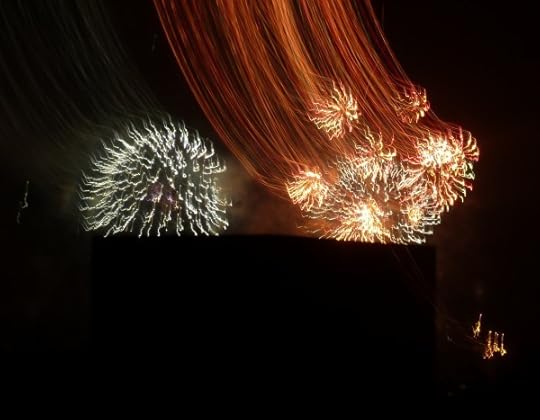
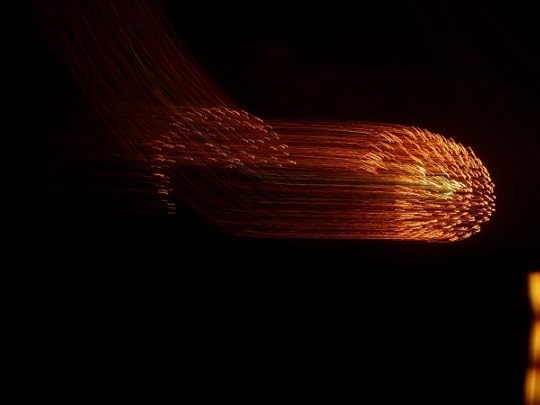
They'd moved the fireworks to the 3rd of July, to evade the hurricane, only to be ridden over by a magnificent storm from the west. Usually the pyrotechnics are balletic, moving from a stately adagio to a transcendent chord of light, an immanence made up of vanishings. This year they scratched the choreography, and shot 'em off scherzo. It was like a banquet on the Titanic. Gobble, gulp, bail out. Even in the middle of the show, they were calling for the lifeboats. To the east, a toylike spark and scatter; to the west, dart and lour and no joke. You could feel the front, the portent of it, and the bowing of the trees; see the sidelong lightning lick and lick the air. A bundled Ouroboros. It uncoiled. I stayed on the roof until I couldn't--and then the entire sky, fire and water, flattened itself against my windows. Spectacular squall.
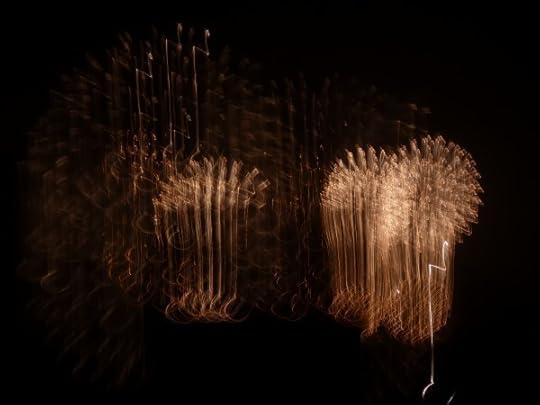
"The Corn was Orient and Immortal Wheat which never should be reaped, nor was ever sown..."
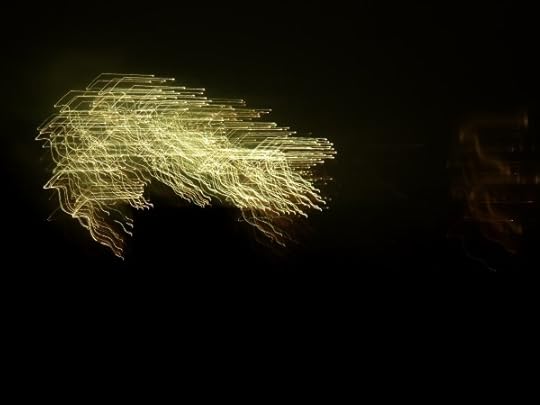
A herd of green deer.
Nine
"The Corn was Orient and Immortal Wheat which never should be reaped, nor was ever sown..."
A herd of green deer.
Nine
July 1, 2014
"As he that sees a star fall, runs apace, And finds a jelly in the place"
This is how Google Books describes John Donne: Selected Letters:
"In a society where a comic equates with knockabout amusment for children, the sudden pre-eminence of adult comics, on everything from political satire to erotic fantasy, has predictably attracted an enormous amount of attention..."
Nine
"In a society where a comic equates with knockabout amusment for children, the sudden pre-eminence of adult comics, on everything from political satire to erotic fantasy, has predictably attracted an enormous amount of attention..."
Nine
June 27, 2014
Irenicon
Another Readercon! Overture and beginners, please!
Thursday July 10
8:00 PM
The Map and the Story
Jonathan Crowe (leader), Chris Gerwel, Greer Gilman, Shira Lipkin
Maps are a familiar sight in our field, but lately a number of stories have placed maps and cartography at the core of the story itself. Maps serve as portals to other worlds, cartographers remake the world in a map's image, and mapmaking itself becomes a means to discuss the distance between perception and reality, between the map and the territory. Panelists will discuss the ways in which maps and cartography have escaped from the endpapers in recent works of fiction.
9:00 PM
Theater and the Interrupted Ritual
C.S.E. Cooney, Greer Gilman, Andrea Hairston (moderator), Kenneth Schneyer
Theater theorists have put forth the idea that most theater begins with an interrupted ritual. This goes back to ancient Greek theater, which generally literally began this way, but in modern theater we see this in more subtle ways, with characters making a cup of tea or sorting the mail when someone else comes in. At Arisia 2012, Andrea Hairston talked about theater and performance being tied to spiritual practice, which resonates with the idea of the interrupted ritual. How does this idea relate to storytelling in general, and what can writers do with it?
Friday July 11
6:00 PM
Education in Speculative Fiction
Greer Gilman, Lev Grossman, Rosemary Kirstein, Faye Ringel, Delia Sherman (leader), Rick Wilber.
Schools and educational settings abound in genre fiction. Ender's Game, Harry Potter, A Wizard of Earthsea, Lovecraft's Miskatonic University... why? Is it SF/F's roots in juvenilia, or does the school setting lend itself in particular to made-up worlds where the protagonists (and readers) have much to learn about how it works? Or is it that writers have so much of their lives shaped by their educational experiences that we necessarily incorporate them?
7:30 PM
Reading: Greer Gilman
Greer Gilman
Greer Gilman reads from "Exit, Pursued by a Bear,” Ben Jonson's next case.
9:00 PM
Kaffeeklatsch
Greer Gilman, Jack Haringa.
Saturday July 12
12:00 PM
Writing and the Visual Arts
Greer Gilman, Shira Lipkin, Eric Schaller, Romie Stott (leader), Diane Weinstein
Writers who are also photographers and visual artists may find that the two fields influence each other in surprising ways, whether by bringing narrative to image-making or by writing from a camera-influenced viewpoint. Panelists will discuss this experience and the ways they find the written and visual media complimentary or antithetical. Does the camera never lie, or does it create fiction? Is a picture worth a thousand words or is a word worth a thousand pictures?
Sunday July 13
1:00 PM
Long Live the Queen
Greer Gilman, Theodora Goss, Catt Kingsgrave (leader), Faye Ringel, Diane Weinstein.
If steampunk is, essentially, Victoriana that puts the corset on the outside where it shows, then many of our genres and subgenres are still wearing that corset underneath. There are strong influences of the Victorian gothic novel in horror literature today; of the ethos of colonialism in space opera; Dickens presages The Hunger Games; and Victorian erotica presages paranormal romance! How many of our modern genre conceptions are inherited, and how many are shaped by reaction against their predecessors? How does awareness of these dynamics shape contemporary work? In what ways can pointing to steampunk's propensity for wearing its underwear over its sleeves inflect conversations about our own genre clothing?
That's a lovely set of panels and appearances. I hope I can do them justice. My only sorrow is that I'm scheduled opposite some fabulous things with amazing people that it breaks my heart to miss. Ah well. That's Readercon...
I'm not exactly on two other things, but I'm in them, in a manner of speaking.
Graham Sleight's papers are always a Readercon joy for me, and this year I may be namechecked in one. Even if I'm edited out at the last moment, just look at the company I'm in! It's worth the last thirty years of hard work to be named on a list like that.
Friday July 11
2:00 PM
I'm a Believer
Graham Sleight
Graham Sleight discusses the question of belief in sf and fantasy. What do we mean when we say we find a story believable? How much do stories require or demand our belief? And how much do characters have to believe the stories they're in? Authors mentioned include Jane Austen, John Crowley, Dante, Greer Gilman, M. John Harrison, Kelly Link, Ursula K. Le Guin, Kim Stanley Robinson, John Scalzi, and Jo Walton—as well as the theories of Brian Attebery, John Clute, Thomas M. Disch, and Farah Mendlesohn. Sleight's scribbled notes for the talk also suggest that it will discuss Cecil and Carlos, branding theory, hard SF, the Hovercraft of Disbelief, Monty Python, and Matt Smith. Probably.
And not least, Cry Murder! In a Small Voice is up for a Shirley Jackson Award this year, which is thrilling. Fingers crossed.
Sunday July 13
11:00 AM
The Shirley Jackson Awards
Chesya Burke, F. Brett Cox, Jack Haringa, John Langan, Sarah Langan, Kit Reed, Paul Tremblay
In recognition of the legacy of Shirley Jackson's writing, and with permission of the author's estate, the Shirley Jackson Awards have been established for outstanding achievement in the literature of psychological suspense, horror, and the dark fantastic. Jackson (1916–1965) wrote classic novels such as The Haunting of Hill House and We Have Always Lived in the Castle, as well as one of the most famous short stories in the English language, "The Lottery." Her work continues to be a major influence on writers of every kind of fiction, from the most traditional genre offerings to the most innovative literary work. The awards given in her name have been voted upon by a jury of professional writers, editors, critics, and academics, with input from a Board of Advisors, for the best work published in the calendar year of 2013 in the following categories: Novel, Novella, Novelette, Short Story, Single-Author Collection, and Edited Anthology.
Nine
Thursday July 10
8:00 PM
The Map and the Story
Jonathan Crowe (leader), Chris Gerwel, Greer Gilman, Shira Lipkin
Maps are a familiar sight in our field, but lately a number of stories have placed maps and cartography at the core of the story itself. Maps serve as portals to other worlds, cartographers remake the world in a map's image, and mapmaking itself becomes a means to discuss the distance between perception and reality, between the map and the territory. Panelists will discuss the ways in which maps and cartography have escaped from the endpapers in recent works of fiction.
9:00 PM
Theater and the Interrupted Ritual
C.S.E. Cooney, Greer Gilman, Andrea Hairston (moderator), Kenneth Schneyer
Theater theorists have put forth the idea that most theater begins with an interrupted ritual. This goes back to ancient Greek theater, which generally literally began this way, but in modern theater we see this in more subtle ways, with characters making a cup of tea or sorting the mail when someone else comes in. At Arisia 2012, Andrea Hairston talked about theater and performance being tied to spiritual practice, which resonates with the idea of the interrupted ritual. How does this idea relate to storytelling in general, and what can writers do with it?
Friday July 11
6:00 PM
Education in Speculative Fiction
Greer Gilman, Lev Grossman, Rosemary Kirstein, Faye Ringel, Delia Sherman (leader), Rick Wilber.
Schools and educational settings abound in genre fiction. Ender's Game, Harry Potter, A Wizard of Earthsea, Lovecraft's Miskatonic University... why? Is it SF/F's roots in juvenilia, or does the school setting lend itself in particular to made-up worlds where the protagonists (and readers) have much to learn about how it works? Or is it that writers have so much of their lives shaped by their educational experiences that we necessarily incorporate them?
7:30 PM
Reading: Greer Gilman
Greer Gilman
Greer Gilman reads from "Exit, Pursued by a Bear,” Ben Jonson's next case.
9:00 PM
Kaffeeklatsch
Greer Gilman, Jack Haringa.
Saturday July 12
12:00 PM
Writing and the Visual Arts
Greer Gilman, Shira Lipkin, Eric Schaller, Romie Stott (leader), Diane Weinstein
Writers who are also photographers and visual artists may find that the two fields influence each other in surprising ways, whether by bringing narrative to image-making or by writing from a camera-influenced viewpoint. Panelists will discuss this experience and the ways they find the written and visual media complimentary or antithetical. Does the camera never lie, or does it create fiction? Is a picture worth a thousand words or is a word worth a thousand pictures?
Sunday July 13
1:00 PM
Long Live the Queen
Greer Gilman, Theodora Goss, Catt Kingsgrave (leader), Faye Ringel, Diane Weinstein.
If steampunk is, essentially, Victoriana that puts the corset on the outside where it shows, then many of our genres and subgenres are still wearing that corset underneath. There are strong influences of the Victorian gothic novel in horror literature today; of the ethos of colonialism in space opera; Dickens presages The Hunger Games; and Victorian erotica presages paranormal romance! How many of our modern genre conceptions are inherited, and how many are shaped by reaction against their predecessors? How does awareness of these dynamics shape contemporary work? In what ways can pointing to steampunk's propensity for wearing its underwear over its sleeves inflect conversations about our own genre clothing?
That's a lovely set of panels and appearances. I hope I can do them justice. My only sorrow is that I'm scheduled opposite some fabulous things with amazing people that it breaks my heart to miss. Ah well. That's Readercon...
I'm not exactly on two other things, but I'm in them, in a manner of speaking.
Graham Sleight's papers are always a Readercon joy for me, and this year I may be namechecked in one. Even if I'm edited out at the last moment, just look at the company I'm in! It's worth the last thirty years of hard work to be named on a list like that.
Friday July 11
2:00 PM
I'm a Believer
Graham Sleight
Graham Sleight discusses the question of belief in sf and fantasy. What do we mean when we say we find a story believable? How much do stories require or demand our belief? And how much do characters have to believe the stories they're in? Authors mentioned include Jane Austen, John Crowley, Dante, Greer Gilman, M. John Harrison, Kelly Link, Ursula K. Le Guin, Kim Stanley Robinson, John Scalzi, and Jo Walton—as well as the theories of Brian Attebery, John Clute, Thomas M. Disch, and Farah Mendlesohn. Sleight's scribbled notes for the talk also suggest that it will discuss Cecil and Carlos, branding theory, hard SF, the Hovercraft of Disbelief, Monty Python, and Matt Smith. Probably.
And not least, Cry Murder! In a Small Voice is up for a Shirley Jackson Award this year, which is thrilling. Fingers crossed.
Sunday July 13
11:00 AM
The Shirley Jackson Awards
Chesya Burke, F. Brett Cox, Jack Haringa, John Langan, Sarah Langan, Kit Reed, Paul Tremblay
In recognition of the legacy of Shirley Jackson's writing, and with permission of the author's estate, the Shirley Jackson Awards have been established for outstanding achievement in the literature of psychological suspense, horror, and the dark fantastic. Jackson (1916–1965) wrote classic novels such as The Haunting of Hill House and We Have Always Lived in the Castle, as well as one of the most famous short stories in the English language, "The Lottery." Her work continues to be a major influence on writers of every kind of fiction, from the most traditional genre offerings to the most innovative literary work. The awards given in her name have been voted upon by a jury of professional writers, editors, critics, and academics, with input from a Board of Advisors, for the best work published in the calendar year of 2013 in the following categories: Novel, Novella, Novelette, Short Story, Single-Author Collection, and Edited Anthology.
Nine
"...if I could see the puppets dallying..."
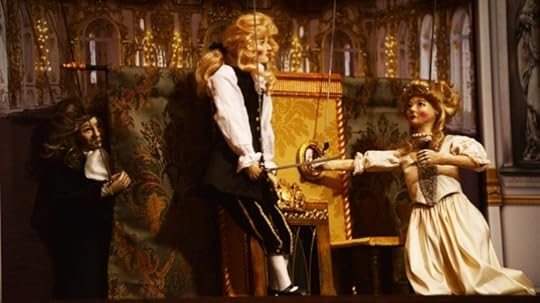
An Eighteenth-Century Puppet Hamlet
"In 1781, a text (dated 1710) of a play entitled 'Der Bestrafte Brudermord' (Fratricide Revenged) was published in Gotha in Germany. It tells an exaggerated, action-filled version the story of Shakespeare’s Hamlet that is often hilarious. The Ghost of Hamlet’s father sneaks behind the sentries to box their ears; ‘Ofelia’, sex-crazed with madness, hurls herself at the clown Phantasmo; Hamlet rids himself of two murderers by asking them to shoot him at the same time – he ducks and they shoot one another instead. What is this slapstick, bawdy romp of a Shakespeare tragedy? And how did it come about?"
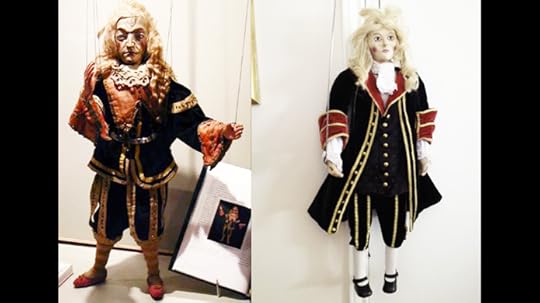
Their lead actor is based upon an beautifully sinister Italian "Amleto" puppet (1667), more like a pirate than a prince:
NineIn 1781, a text (dated 1710) of a play entitled 'Der Bestrafte Brudermord' (Fratricide Revenged) was published in Gotha in Germany. It tells an exaggerated, action-filled version the story of Shakespeare’s Hamlet that is often hilarious. The Ghost of Hamlet’s father sneaks behind the sentries to box their ears; ‘Ofelia’, sex-crazed with madness, hurls herself at the clown Phantasmo; Hamlet rids himself of two murderers by asking them to shoot him at the same time – he ducks and they shoot one another instead. What is this slapstick, bawdy romp of a Shakespeare tragedy? And how did it come about? - See more at: http://www.puppetcentre.org.uk/animations-online/features/eighteenth-century-puppet-hamlet/#sthash.SUpM0WZ7.dpufAn Eighteenth Century Puppet HamletAn Eighteenth Century Puppet Hamlet
Greer Gilman's Blog

- Greer Gilman's profile
- 42 followers
Greer Gilman isn't a Goodreads Author
(yet),
but they
do have a blog,
so here are some recent posts imported from
their feed.

