
Pamela Carey's Blog, page 6
December 4, 2018
Interview with Novelist Wendy Blake Pottinger

Wendy Blake Pottinger was born and raised in central Ohio before moving to South Florida. Her short stories have been published in several anthologies and she has written for PBG Lifestyle Magazine. Her love of travel throughout the United States was the inspiration for her novel, A GIFT OF GRACE. To her, life is about family.
Pam: When did you discover you wanted to be a writer?
Wendy: I have always been a writer. If you don't believe me, just ask to see the many journals tucked into the old trunk in my attic. On second thought, no one should ever read those. I had some issues in the 70's.
Pam: How did your childhood influence your novel?
Wendy: Growing up in a small town in central Ohio was wonderful. Life was right out of a Rockwell painting - sledding the hills, skating the ponds in winter; swimming and fishing in the spring and summer; jumping in the leaves, hayrides, and festivals in the fall. Mostly, these moments were made more magical by being surrounded by family.
Pam: Is the story line in A GIFT OF GRACE a reflection of you or your family?
Wendy: My novel traces a journey made by three siblings after losing their mother. Many of the stories come from actual occurrences throughout the years.
Pam: Please explain a little how your story line evolved.
Wendy: The inspiration for my novel came from one year when my three kids were home from college. I was sad to see how they had grown apart. They all lived within ten miles of each other, but it seemed to me in their independence in life, they had left behind these special relationships. My book is based on a mother who sends her children on a 21-day journey together across the U.S. to spread her ashes.
Pam: What was the best writing advice you ever had?
Wendy: In Stephen King's book, ON WRITING, he is explicit in his advice to write what you know. I have to agree. You have to love your characters and your story. If not, why tell it? I have three kids. My daughter did pee in a laundry basket, my son did sprain his glute muscle. Did they enjoy my sharing their stories? Yes, they did. They all had input and opinions through the writing process.
Pam: So you got additional writing advice within the family! Do you have specific rituals when you write?
Wendy: I write daily. Usually mornings, but sometimes I have an idea and I've learned, if you think you'll remember that idea later, you're wrong! So, I may stop during the day and do a quick outline for a particular idea. Since I work on multiple books at the same time (I'm a Gemini), I need to keep the ideas filed with the correct book. I certainly don't want my time traveler to end up in my 1800's veterinarian story. While I might outline an idea, I've never outlined a book. That said, I usually know my beginning, middle, and end. But I love to see where the characters will take me.
Pam: What's currently on your nightstand?
Wendy: Another piece of advice is: to be a great writer, you need to be a great reader. I have a stack of seven books currently on my bedside table. Some of the authors I'm savoring at the moment are Lee Child, Barbara Kingsolver, David Baldacci, and Debbie Macomber. Also I have local authors' books, including your book, SURVIVING YOUR DREAM VACATION, and JM LeDuc's EVIL AWAKENED.
Pam: Thank you for taking the time to read the rules and anecdotes in my new travel book! What are you working on at the moment?
Wendy: My next novel, a love story with a time travel twist, will be out in January. The working title is SHADOW PEOPLE.
In addition to writing, I love to help new authors. If your readers have any questions or comments or just want to say, "Hi," contact me at: wpottinger3@gmail.com
Pam: Many thanks for your time, Wendy, and best of luck with the new book!


November 12, 2018
A Remarkable Bird
Take a guess: what bird mates for life, returns to the same nest every year, migrates up to 3500 miles in autumn and again in spring in a state of semi-sleep, and can spend forty hours in the air at 25-30 mph without stopping?

 Nest on Westport River, Massachusetts
 Nest in shallow water on left The answer? An osprey. In both Florida and Massachusetts, we live near osprey breeding grounds. We see their nests, the size of queen beds, made from anything the scavengers can lift. They balance on platforms at the top of high poles or on man-made structures like bridges. Some of the platforms have been erected by the Audubon Society.
 Osprey nest on Westport River. Note piece of scrap iron hanging from bottom right. The Intracoastal Waterway in Florida and branches of the Westport River, Massachusetts (leading into Buzzard’s Bay below Cape Cod), provide supplies of fish, the birds’ only diet.
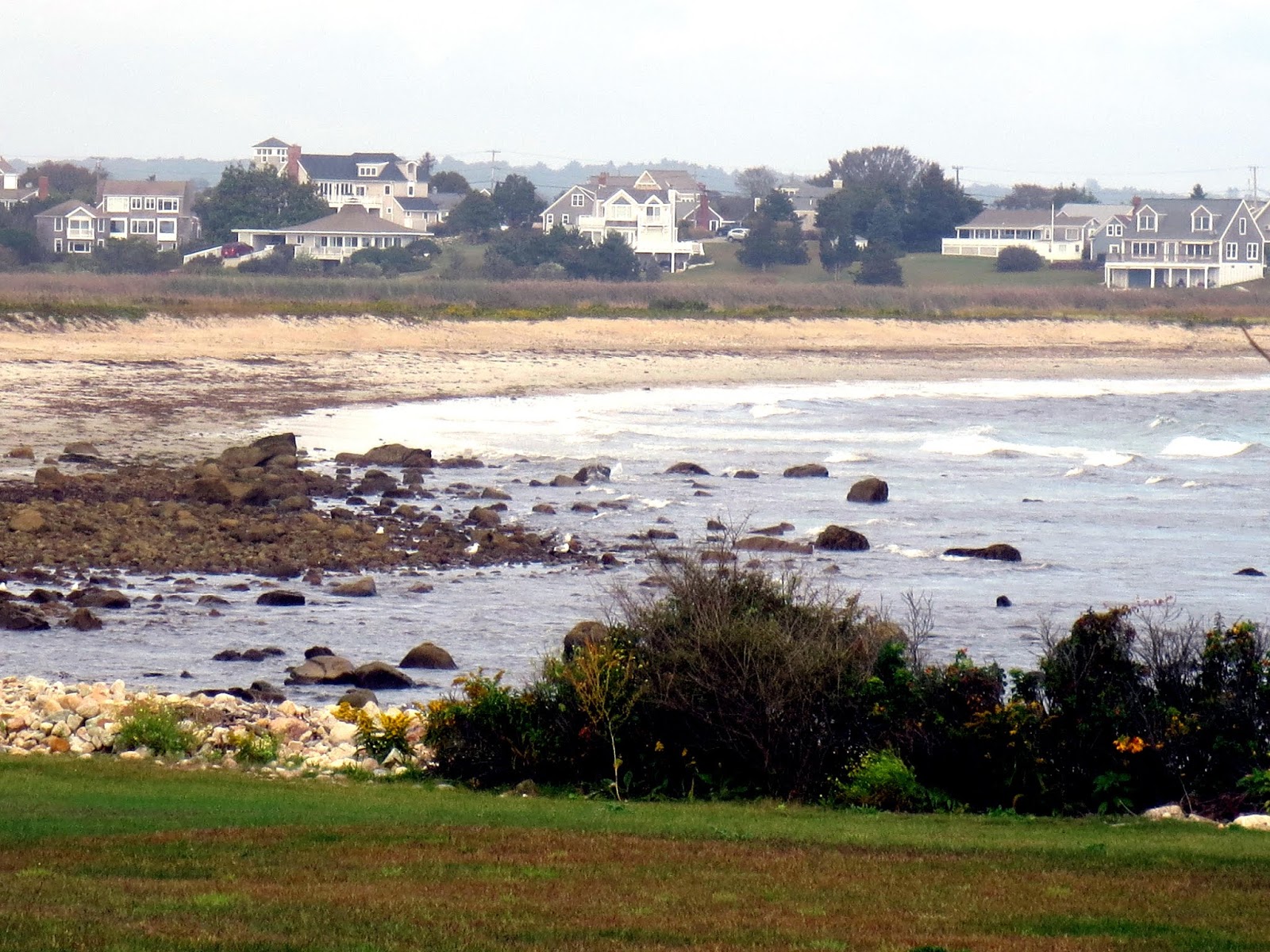 Buzzard's Bay, Massachusetts Their curved talons and an under-surface on their toes consisting of short spines allow them to hold squirming fish while flying. Once when my mother was visiting us in Massachusetts, a foot-long, wet fish landed next to her on the deck. "Why were you throwing a fish at me?" she later asked her son-in-law (Charley).
 “Evelyn,” Charley said, laughing, “I was working on the other side of the house and wouldn’t have had the strength to throw a heavy fish that far. Besides, I would never throw anything at you! An osprey probably let go.”
 Twenty years ago, the osprey became endangered in the U.S. The pesticide DDT caused the birds’ eggshells to become thin. As a result, the young exhibited symptoms of pesticide-poisoning or never hatched. After DDT was banned in the 1970’s in the U.S., the osprey population rebounded. The population worldwide today is estimated at 460,000.
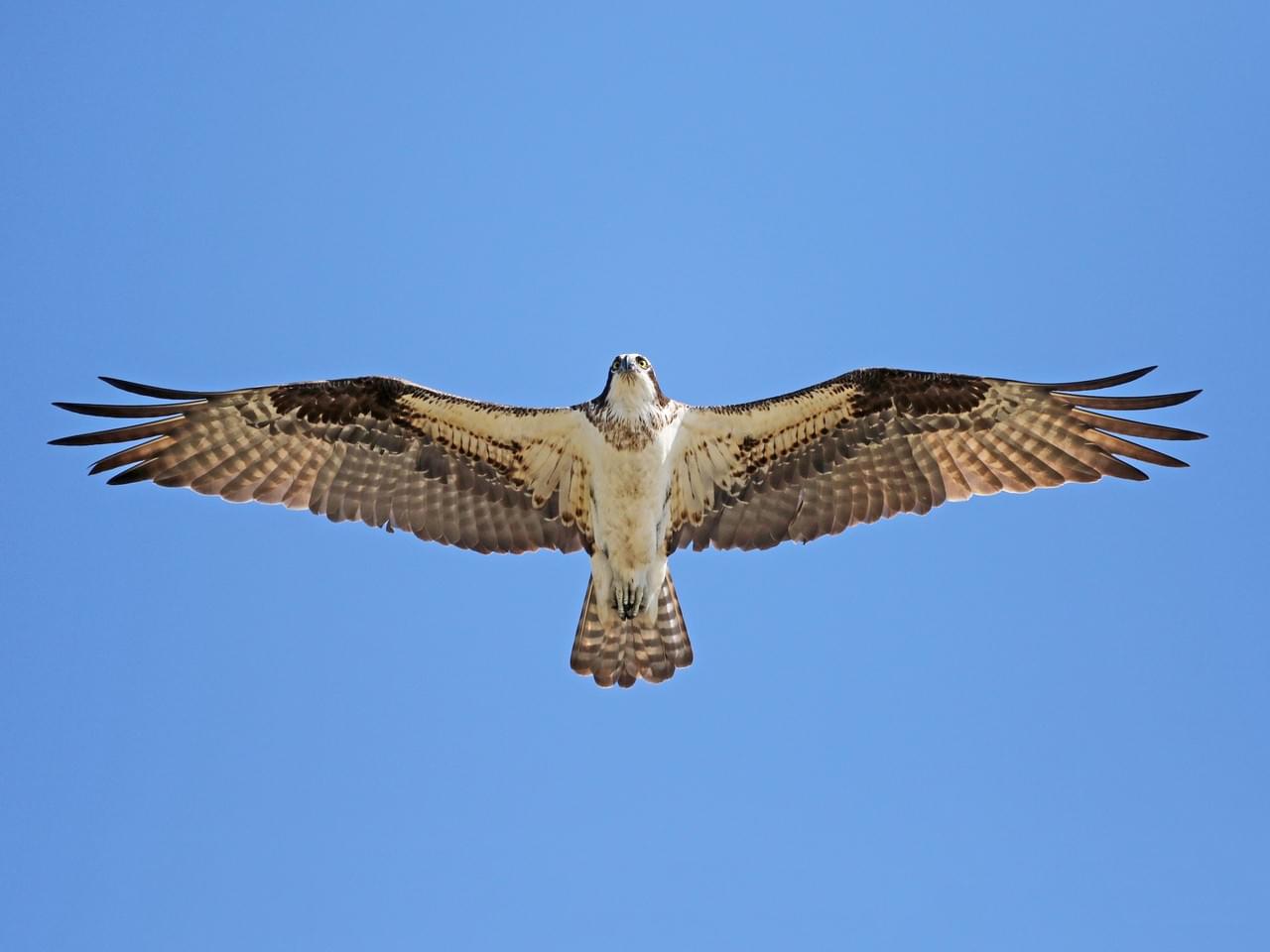 Adult osprey in flight Typically, two to four eggs are laid in April, always in the same breeding ground and in the same nest. Incubation lasts approximately 38 days. Fledglings may leave the nest at 44-59 days, but will still rely on parental care for six weeks. Sexual maturity isn’t reached till age three. A typical lifespan is seven to ten years, with their only known predators the great horned owl, golden eagles, and bald eagles.
 Juvenile osprey in flight In shallow inland or coastal fishing waters, winter brings ice in northern regions. Fish head away from the surface, making it almost impossible for osprey to spot them from the air, despite their dense and oily plumage for diving feet-first. The larger-bodied mother leaves the nest first in late August through November, to migrate from North America to the shallow waters of Central and South America. Those residing in California and Florida don’t migrate.The Westport Watershed Alliance, Massachusetts, has placed transmitters on a sample population, allowing GPS signals to trace the migration thousands of miles. Ospreys can rest half their brains en route, shutting one eye and letting half their brain sleep. They fly in hot air rising (thermals) for hours without flapping their wings. When they start to lose altitude, they drop, glide, and search for another thermal. Their high-pitched chirps mingle with the wind. The father leaves the nest second to join his mate, and finally the juveniles. In late March or early April they make the return trip to breed.
 A lone juvenile staring down at me in October from his nest on the Westport River, before leaving to migrate
October 16, 2018
Travel Photos - Children
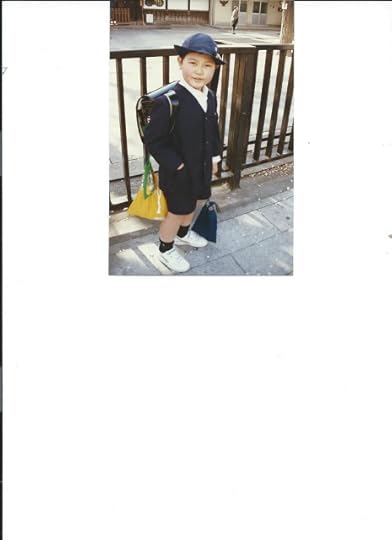
School boy, Tokyo, 1996
 School kids, Ardmore, Ireland, 2017
 Campers on Ischia, Italy, 2015
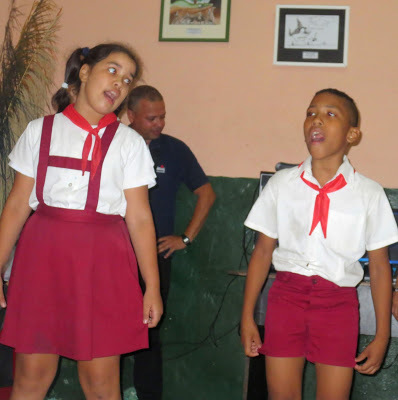 Singing of revolution for us in elementary school's principal's office, Havana, 2018
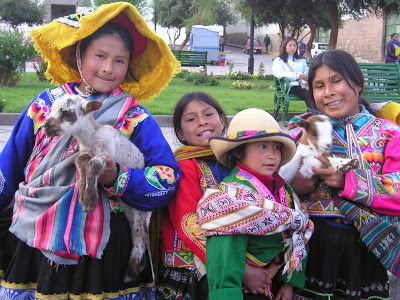 Cuzco, Peru, 2008
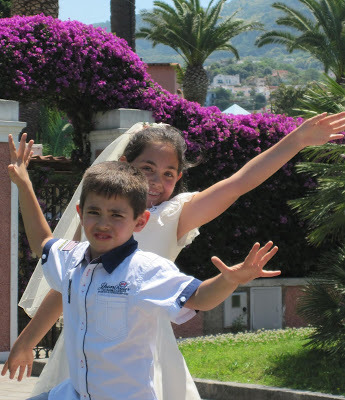 Confirmation Day, Ischia, Italy, 2011
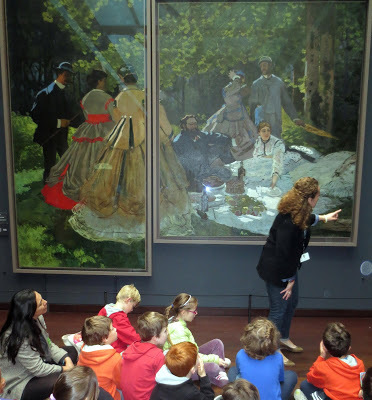 Class studying Monet in Musee D'Orsay, Paris, 2016
Tokyo school children, 1996
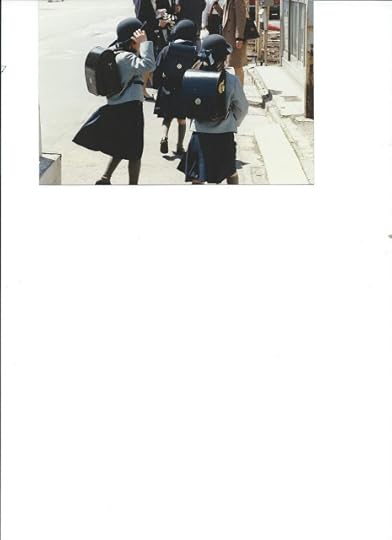

 School kids, Ardmore, Ireland, 2017
 Campers on Ischia, Italy, 2015
 Singing of revolution for us in elementary school's principal's office, Havana, 2018
 Cuzco, Peru, 2008
 Confirmation Day, Ischia, Italy, 2011
 Class studying Monet in Musee D'Orsay, Paris, 2016
Tokyo school children, 1996

September 27, 2018
Travelogue, Ischia, Italy, 2018
We have been traveling to the same island of Ischia, off the Amalfi coast of Italy in the Tyrrhenian Sea, for nineteen years. No matter where else our travels take us, we hop a hydrofoil from Naples to relax, climb the hillsides (in a futile attempt to work off the extra pounds), and swim in the Gulf. Our visit usually coincides with our anniversary in June.
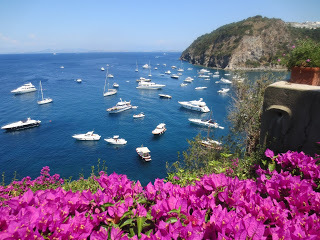 A view from our hotel on Ischia toward Naples and Mt. Vesuvius Ischia faces Capri but lacks Capri's glitz. It is characterized by fishing villages that have exploded into resort towns. There are no cruise ships or designer boutiques. Towns spill over the lush thermal hillsides into each other and motorbikes veer in every direction on the winding roads lined with fuchsia bougainvillea. Mt. Vesuvius across the Gulf of Naples and Mt. Epomeo above our heads remind residents and visitors that the area is ripe for volcanic activity, as evidenced by an earthquake last year in Casamicciola, one of the towns on our walking route.
 Flea market on Sundays, Casamicciola, Ischia
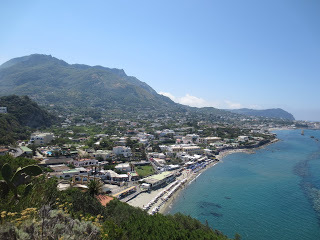 Town of Forio, Ischia Our hotel was a former lookout tower sitting on a promontory facing the mainland. In its "-1" rooms in the "basement" are the thermal waters of the spa and all other spa amenities. Rooms are spread throughout the tower, as well as across the hillside. The climb is not easy over the cobblestones and up the stone steps to our room in the forest, but going down takes no time when we're hungry! Dining is al fresco in a separate pavilion overhanging the pool and sea.
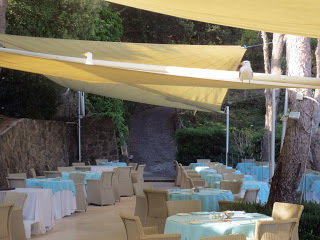 Dining pavilion at our hotel and tower above pool.
After nineteen years, we know the staff and their families well. Each year the same faces return. We experiment with our limited Italian, though they all speak English.
At our anniversary dinner under the stars this year Charley raised his glass to mine. "Happy number 53, honey," he said.
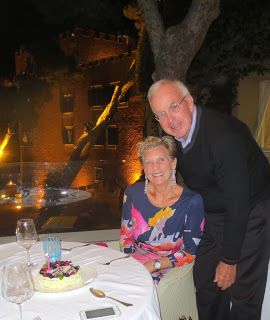 Anniversary cake "Oh, I think you've got the date wrong," I replied. "It's not till tomorrow. I thought you knew the day we got married," I teased..
"Today's not the 26th?" he said, checking his calendar watch. "My watch must be wrong."
"That's ok. We'll celebrate tomorrow night when it IS the 26th."
"Well, not to ruin the surprise, but like I've done every year, I ordered a cake from the maitre d' for our anniversary. I guess I'll have to change it right away." With that, he jumped up to speak to Salvatore and reschedule the cake for the following night's dinner.
"No problema," Salvatore said (a familiar response in Italy). "We'll have it ready tomorrow evening, Mr. Carey."
After dinner we began receiving text messages of congratulations from family, there being a six-hour time lag back in the States. I texted them all back, saying, "Thanks for remembering us, but our anniversary is actually tomorrow."
"That's strange," I said to Charley. "Why are they congratulating us today?"
"Well, what does your phone say?" I reopened my phone and read "June 26" on its face - our anniversary! I'd completely lost track of the days. I guess that's what a vacation was for?
"I'm so sorry, honey! Your watch was right. Happy Anniversary!"
"Well, you won't be getting your surprise cake till tomorrow night. I feel like the grandfather in the movie 'Moonstruck,' after he sees his engaged granddaughter (Cher) with another man. I'm so confused," Charley said, burying his head in his hands, laughing.
"You know, we're having a guest for dinner in two nights. Maybe they could hold the cake till then."
"No way I'm going to ask Salvatore to change it again," Charley said.
The next night we enjoyed vanilla cream cake decorated in fresh berries while the other guests and staff sang to us. "Thanks, everyone, but it was actually yesterday," Charley explained to the dining room. He didn't tell them why we were sharing our cake with them a day late.
*********************************************************************************
Pasquale owns the leather shop in the town of Lacco Ameno, along one of our walking routes. We had purchased several wallets and travel bags from him and returned for Charley's new wallet two days before our departure this year. Pasquale was seated at a desk/cashier table, reading a document.
"It's my taxes," he said in English. "I pay too much! I have two rental properties and a house. I pay 1400 Euros. Then I pay 400 Euros for garbage collection and 20% of my income to the federal government."
"Raise your rents," Charley the banker said.
"I can't. The tenants have low-paying jobs and no-one wants to buy the properties. I made a big mistake. Someone offered to buy my house ten years ago but my wife didn't want to leave. So we added 950 square feet and now we can't sell it. It's too big. The taxes keep going up."
Charley took out his white handkerchief and rubbed his eyes. "I'm crying for you," he joked, thinking of the taxes we pay in the U.S. Pasquale began laughing.
On our last day on the island we walked past the leather shop. Pasquale was sitting outside. Charley took out his handkerchief and waved it at the shop owner. Pasquale removed his from a pants pocket and waved it back, laughing with his American friend.
*********************************************************************************
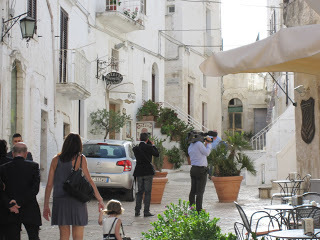 Just enough room to park! Italians park anywhere they like, whenever they like. If there is enough space to fit only the hood of the car, they will edge it in. The remainder might hang out, filling a pedestrian walkway or blocking a street.
Or they might park at an angle to fit the front left bumper in, blocking cars nearby from getting out. They abandon cars to run into pesharias (fish markets) and pet stores (see above photo).
A garbage truck in Lacco Ameno stopped horizontally across the road. It blocked both directions of traffic, while recycling bottles crashed into the void of the truck. Garbage bins were next, stinking the street.
When one lane of blocked traffic began honking, the garbageman yelled, "Quoi??" (What??) "Do you want my job?"
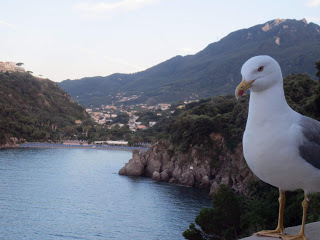
 A view from our hotel on Ischia toward Naples and Mt. Vesuvius Ischia faces Capri but lacks Capri's glitz. It is characterized by fishing villages that have exploded into resort towns. There are no cruise ships or designer boutiques. Towns spill over the lush thermal hillsides into each other and motorbikes veer in every direction on the winding roads lined with fuchsia bougainvillea. Mt. Vesuvius across the Gulf of Naples and Mt. Epomeo above our heads remind residents and visitors that the area is ripe for volcanic activity, as evidenced by an earthquake last year in Casamicciola, one of the towns on our walking route.
 Flea market on Sundays, Casamicciola, Ischia
 Town of Forio, Ischia Our hotel was a former lookout tower sitting on a promontory facing the mainland. In its "-1" rooms in the "basement" are the thermal waters of the spa and all other spa amenities. Rooms are spread throughout the tower, as well as across the hillside. The climb is not easy over the cobblestones and up the stone steps to our room in the forest, but going down takes no time when we're hungry! Dining is al fresco in a separate pavilion overhanging the pool and sea.
 Dining pavilion at our hotel and tower above pool.
After nineteen years, we know the staff and their families well. Each year the same faces return. We experiment with our limited Italian, though they all speak English.
At our anniversary dinner under the stars this year Charley raised his glass to mine. "Happy number 53, honey," he said.
 Anniversary cake "Oh, I think you've got the date wrong," I replied. "It's not till tomorrow. I thought you knew the day we got married," I teased..
"Today's not the 26th?" he said, checking his calendar watch. "My watch must be wrong."
"That's ok. We'll celebrate tomorrow night when it IS the 26th."
"Well, not to ruin the surprise, but like I've done every year, I ordered a cake from the maitre d' for our anniversary. I guess I'll have to change it right away." With that, he jumped up to speak to Salvatore and reschedule the cake for the following night's dinner.
"No problema," Salvatore said (a familiar response in Italy). "We'll have it ready tomorrow evening, Mr. Carey."
After dinner we began receiving text messages of congratulations from family, there being a six-hour time lag back in the States. I texted them all back, saying, "Thanks for remembering us, but our anniversary is actually tomorrow."
"That's strange," I said to Charley. "Why are they congratulating us today?"
"Well, what does your phone say?" I reopened my phone and read "June 26" on its face - our anniversary! I'd completely lost track of the days. I guess that's what a vacation was for?
"I'm so sorry, honey! Your watch was right. Happy Anniversary!"
"Well, you won't be getting your surprise cake till tomorrow night. I feel like the grandfather in the movie 'Moonstruck,' after he sees his engaged granddaughter (Cher) with another man. I'm so confused," Charley said, burying his head in his hands, laughing.
"You know, we're having a guest for dinner in two nights. Maybe they could hold the cake till then."
"No way I'm going to ask Salvatore to change it again," Charley said.
The next night we enjoyed vanilla cream cake decorated in fresh berries while the other guests and staff sang to us. "Thanks, everyone, but it was actually yesterday," Charley explained to the dining room. He didn't tell them why we were sharing our cake with them a day late.
*********************************************************************************
Pasquale owns the leather shop in the town of Lacco Ameno, along one of our walking routes. We had purchased several wallets and travel bags from him and returned for Charley's new wallet two days before our departure this year. Pasquale was seated at a desk/cashier table, reading a document.
"It's my taxes," he said in English. "I pay too much! I have two rental properties and a house. I pay 1400 Euros. Then I pay 400 Euros for garbage collection and 20% of my income to the federal government."
"Raise your rents," Charley the banker said.
"I can't. The tenants have low-paying jobs and no-one wants to buy the properties. I made a big mistake. Someone offered to buy my house ten years ago but my wife didn't want to leave. So we added 950 square feet and now we can't sell it. It's too big. The taxes keep going up."
Charley took out his white handkerchief and rubbed his eyes. "I'm crying for you," he joked, thinking of the taxes we pay in the U.S. Pasquale began laughing.
On our last day on the island we walked past the leather shop. Pasquale was sitting outside. Charley took out his handkerchief and waved it at the shop owner. Pasquale removed his from a pants pocket and waved it back, laughing with his American friend.
*********************************************************************************
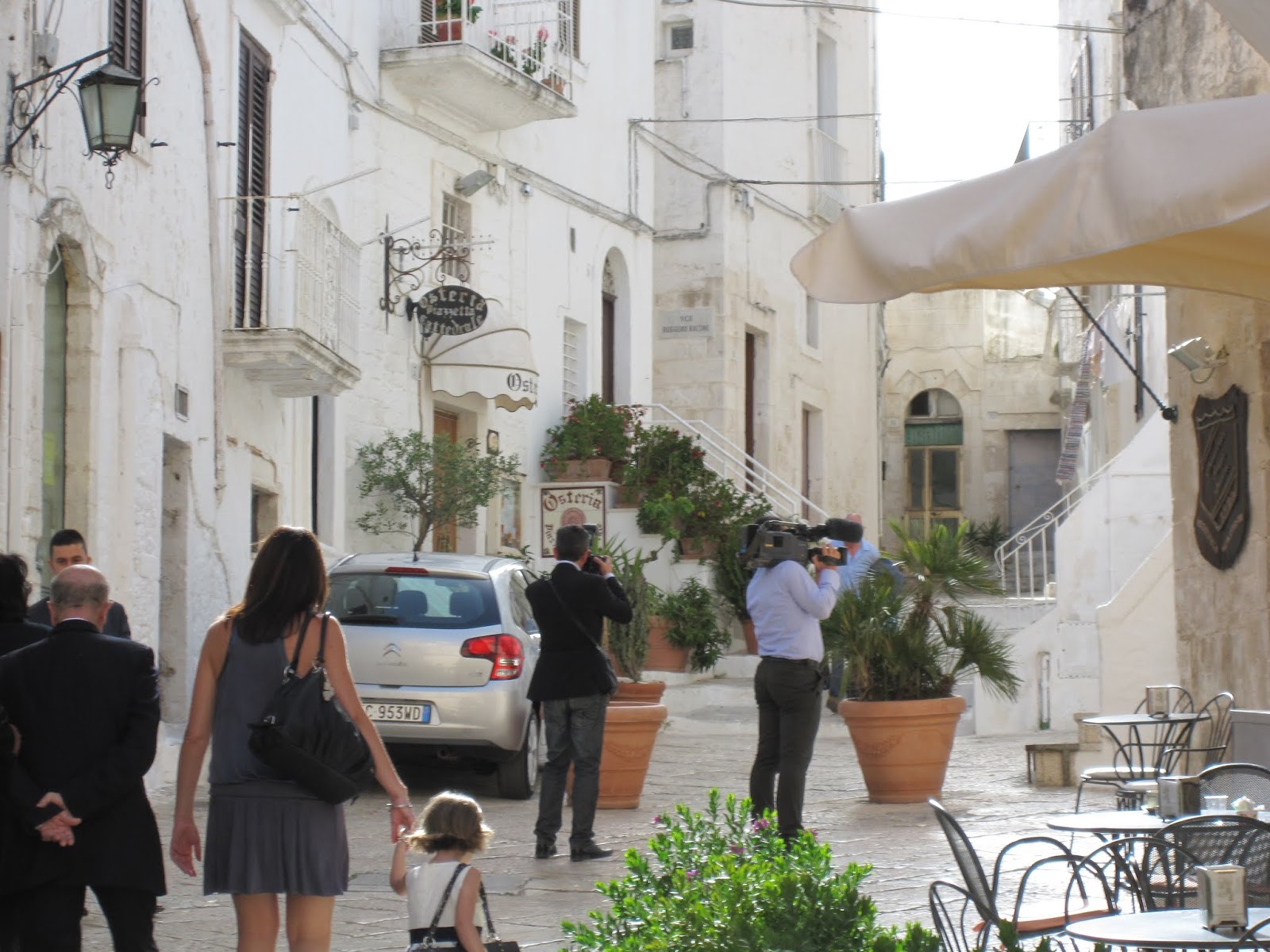 Just enough room to park! Italians park anywhere they like, whenever they like. If there is enough space to fit only the hood of the car, they will edge it in. The remainder might hang out, filling a pedestrian walkway or blocking a street.
Or they might park at an angle to fit the front left bumper in, blocking cars nearby from getting out. They abandon cars to run into pesharias (fish markets) and pet stores (see above photo).
A garbage truck in Lacco Ameno stopped horizontally across the road. It blocked both directions of traffic, while recycling bottles crashed into the void of the truck. Garbage bins were next, stinking the street.
When one lane of blocked traffic began honking, the garbageman yelled, "Quoi??" (What??) "Do you want my job?"

September 11, 2018
Our Guide through the Basque Country, 2018
In "The Keys Behind Treasured Stops" (NY Times Travel Section, August 19, 2018, p.4), Elaine Glusac writes, "... a great trip should involve a journey, embody a culture, and script a story to tell later." Here is one story of our guide through the Basque Country of France and Spain.
On a previous trip to France, we'd hired Christian Mayer to take us from Paris through Monet's Giverny and the villages of Honfleur and Bayeux (where the 230-foot-long tapestry resides depicting Norman events leading to William, Duke of Normandy's, conquest of England in 1066). Christian drove us to Deauville, with its grand casino, racetrack, and wide beach, as well as to Ste. Mere-Eglise, where paratrooper John Steele from the 82nd Airborne remained suspended when his parachute got caught in the church steeple on D-Day, 1944. Unlike the depiction in "The Longest Day," the American was taken prisoner and escaped to become a town hero. From Ste. Mere-Eglise where we stayed, we toured the beaches, cemeteries, and museums of World War II on the Normandy coast.
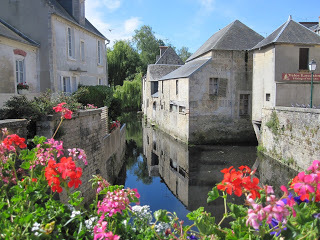 Bayeux, France
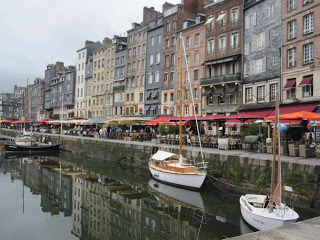 Honfleur, France
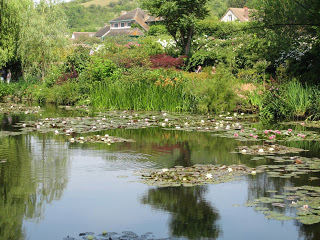 Monet's Giverny Lily Pond and House (in background)
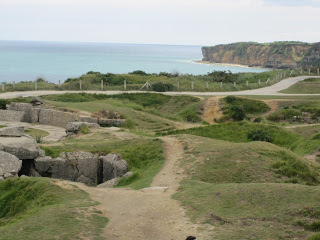 Crater Bombardment on Omaha Beach, France
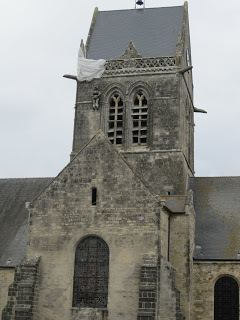 Recreation of parachutist John Steele hanging from church steeple in Ste. Mere-Eglise, Fr., on D-Day
Our guide, Christian, was an American from New Mexico who'd married a French woman and relocated outside Paris. In June, 2018, we returned to France and hired Christian to guide us from Biarritz, on the Atlantic, through the Basque country of France and Spain in the Pyrenees, close to Christian's home where he and his wife were raising their family.
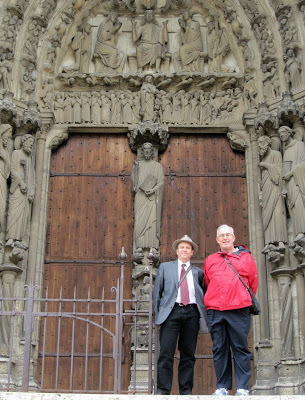 Christian Mayer with Charley at Chartres Cathedral, France, 2011 Christian's father's family was French; his mother's family was Austrian. We learned his family story during our rides through the mountains between France and Spain - one of the many personal souvenirs we've collected during our travels.
Since the name "Mayer" sounded Jewish to the Germans during the Occupation of France, his paternal grandparents were forced to sell their mountain camp for children and relocate in Nice, where they opened a restaurant. They moved on to settle in Cap d'Antibes, where they operated a hotel. Christian's grandmother ran messages to the resistance in a pump tube on her bike. His grandfather was arrested, charged with an "act of resistance," while his granduncle was executed by the S.S. Christian's grandmother washed the linens of a Frenchman sympathetic to the Germans and got her husband released.
"My grandmother didn't want her two sons drafted into the War," Christian told us. "My uncle Jean and my dad 'Dadou' were members of the French National ski team, so the family was able to make its way to Paris. I remember my dad telling me they heard Allied bombers overhead for an hour before they actually bombed. He described the German revolving machine guns that enforced curfews in the City.
"A German with the code name 'Ernie Blake' had been a double agent and was rewarded by the U.S. with cheap forest land in New Mexico.There he built a ski lodge and the St. Bernard Hotel in what became Taos Ski Valley. He advertised for a ski instructor/hotel operator. 'Dadou' was the only one who answered the ad. Eventually dad was able to bring his brother Jean, also a ski instructor in France, and the rest of the family to Taos. The two brothers pooled their money and their parents added their savings to become owners of the St. Bernard Hotel. It's still there.
"My mother was from Vienna and answered an ad for an 'au pere' in Taos, where her brother was the ski lift engineer. That's where my parents met. Eventually dad and uncle Jean split and dad bought out Jean's portion of the St. Bernard. Uncle Jean opened the Eidelweis Hotel there. The two hotels stood side-by-side.
"My cousins and I grew up on skis and snowboards, despite the fact that snowboards were forbidden on the slopes of Taos at the time. We used to sneak down to the weekly concerts in the hotels and hung out with the musicians. I guess that's how I got started playing the sax. I formed my own band and started touring Europe."
"How did you become enamored with the sea if you grew up in New Mexico?" I asked Christian.
"Well, my dad was a U.S. citizen and after my parents divorced, he moved to Hawaii. I loved to surf out there."
"Did your mother become a citizen?"
"Well, mom was a proud Austrian. She refused to apply till after the divorce, when she had to go to work."
On a previous trip to France, we'd hired Christian Mayer to take us from Paris through Monet's Giverny and the villages of Honfleur and Bayeux (where the 230-foot-long tapestry resides depicting Norman events leading to William, Duke of Normandy's, conquest of England in 1066). Christian drove us to Deauville, with its grand casino, racetrack, and wide beach, as well as to Ste. Mere-Eglise, where paratrooper John Steele from the 82nd Airborne remained suspended when his parachute got caught in the church steeple on D-Day, 1944. Unlike the depiction in "The Longest Day," the American was taken prisoner and escaped to become a town hero. From Ste. Mere-Eglise where we stayed, we toured the beaches, cemeteries, and museums of World War II on the Normandy coast.
 Bayeux, France
 Honfleur, France
 Monet's Giverny Lily Pond and House (in background)
 Crater Bombardment on Omaha Beach, France
 Recreation of parachutist John Steele hanging from church steeple in Ste. Mere-Eglise, Fr., on D-Day
Our guide, Christian, was an American from New Mexico who'd married a French woman and relocated outside Paris. In June, 2018, we returned to France and hired Christian to guide us from Biarritz, on the Atlantic, through the Basque country of France and Spain in the Pyrenees, close to Christian's home where he and his wife were raising their family.
 Christian Mayer with Charley at Chartres Cathedral, France, 2011 Christian's father's family was French; his mother's family was Austrian. We learned his family story during our rides through the mountains between France and Spain - one of the many personal souvenirs we've collected during our travels.
Since the name "Mayer" sounded Jewish to the Germans during the Occupation of France, his paternal grandparents were forced to sell their mountain camp for children and relocate in Nice, where they opened a restaurant. They moved on to settle in Cap d'Antibes, where they operated a hotel. Christian's grandmother ran messages to the resistance in a pump tube on her bike. His grandfather was arrested, charged with an "act of resistance," while his granduncle was executed by the S.S. Christian's grandmother washed the linens of a Frenchman sympathetic to the Germans and got her husband released.
"My grandmother didn't want her two sons drafted into the War," Christian told us. "My uncle Jean and my dad 'Dadou' were members of the French National ski team, so the family was able to make its way to Paris. I remember my dad telling me they heard Allied bombers overhead for an hour before they actually bombed. He described the German revolving machine guns that enforced curfews in the City.
"A German with the code name 'Ernie Blake' had been a double agent and was rewarded by the U.S. with cheap forest land in New Mexico.There he built a ski lodge and the St. Bernard Hotel in what became Taos Ski Valley. He advertised for a ski instructor/hotel operator. 'Dadou' was the only one who answered the ad. Eventually dad was able to bring his brother Jean, also a ski instructor in France, and the rest of the family to Taos. The two brothers pooled their money and their parents added their savings to become owners of the St. Bernard Hotel. It's still there.
"My mother was from Vienna and answered an ad for an 'au pere' in Taos, where her brother was the ski lift engineer. That's where my parents met. Eventually dad and uncle Jean split and dad bought out Jean's portion of the St. Bernard. Uncle Jean opened the Eidelweis Hotel there. The two hotels stood side-by-side.
"My cousins and I grew up on skis and snowboards, despite the fact that snowboards were forbidden on the slopes of Taos at the time. We used to sneak down to the weekly concerts in the hotels and hung out with the musicians. I guess that's how I got started playing the sax. I formed my own band and started touring Europe."
"How did you become enamored with the sea if you grew up in New Mexico?" I asked Christian.
"Well, my dad was a U.S. citizen and after my parents divorced, he moved to Hawaii. I loved to surf out there."
"Did your mother become a citizen?"
"Well, mom was a proud Austrian. She refused to apply till after the divorce, when she had to go to work."
August 27, 2018
Travelogue, Spanish Basque Country, 2018
After leaving France for the coast of Spain on the Basque Corniche, we checked into the Maria Cristina Hotel in San Sebastian. Built in 1912, the facade resembled a Belle Epoque palace. We were led to a sumptuous room, recently renovated in grays from slate to fog. In fact, the entire hotel had been renovated in 50 shades, from "greige" (beige with a touch of gray) to thundercloud. A plaque on the door next to us proclaimed it had been Bette Davis' suite while she was in residence. In fact, she had stayed there just three days before her death. Her photos remained on the walls of the bar and grill room off the lobby.
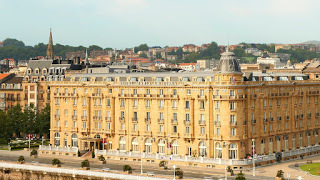 Hotel Maria Cristina, San Sesbastian, Spain San Sebastian is known for three things: its spectacular beaches, its Parto Vieja ("Old Part" of the city), and its food. The international jazz festival in July and international film festival in September call San Sebastian home. We walked around Monte Urgull, the hill that rises abruptly at the edge of the Old City along the peninsula's shore and used toothpicks to spear pinxtos ("haute cuisine in miniature") with olives, green or red peppers, anchovies, pork meatballs, or fried potatoes, displayed on a bar. The bartender tallied them up, along with the Rioja district wines we'd sampled, when we were ready to leave.
The following day we shopped inside the old walled city and walked the broad promenade above Playa de la Concha, the beach closest to the city with waves less formidable than the eastern Playa de Zurriola, which attracted international surfers. On the far western end of the Gulf of Vizcaya was Playa de Ondarreta, with few amenities. For dinner (10:00 p.m. in the Parto Vieja) we wound down narrow alleys to sit against a newer version of the old city walls in a restaurant where fishermen unloaded their catch in the front and the cooks hustled the catch inside. We ordered some greens and a lobster salad to share. When the "salad" arrived, a mountain of seafood sat on a platter before us: two cooked, split lobsters; steamed mussels and clams; potatoes; tomatoes; whole onions; kernels of corn. At home in Massachusetts we called this meal a "clam boil" or a "lobster bake," depending on whether it's boiled in a steamer pot or cooked over seaweed in a pit. Somehow we managed to devour our "salad."
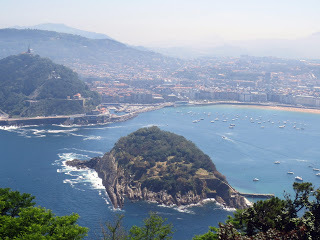
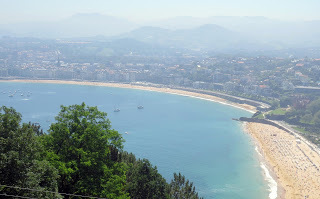
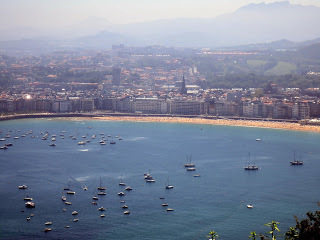
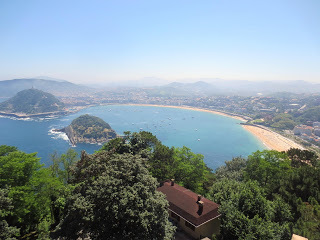
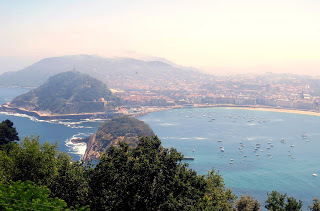 Views of city of San Sebastian from amusement park atop Mt. Ulia with Pyrenees in background. Surfers' beach is around promontory to left.
Basque poet Kirmen Uribe summed up the appeal of his native coastline between San Sebastian and Bilbao: "I'm going to stay here - between the green waves and the blue mountains." We drove west along the coast through Zarautz, a former whale-hunting town with extensive photo museum and huge surfing waves rivaled only in Mundaka, which boasted long rollers and left-curling pipeline. "Hip" sculptures lined the beach promenade in Zarautz. We followed the twisting sea road west through Zumaia, a fortified medieval town with fossils embedded in rock cliffs where artist Ignacio Zuloaga thought the light magical. Next were Ondarrao and Lekeito, the Basque Country's leading fishing ports with major tuna fleets. Finally we headed inland toward Gernika and Bilbao.
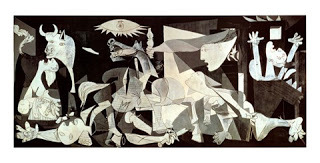
Picasso made the Basque village Gernika (Basque spelling) famous with his mural representing Spain in the 1937 International Exposition of Arts and Techniques in Modern Life (Paris). In April, 1937, German Luftwaffe planes terror-bombed the Basque town of Gernika at the invitation of General Francisco Franco. Why Gernika? Since medieval times, regional leaders of the Basques had gathered there beneath an ancient oak tree to govern themselves. The fierce independence of the Basques, alone in opposing Franco's bid to overthrow the elected government, offended him. His German allies killed between 200 and 2,000 citizens in the village on a market day but missed the oak.The black and white photos in newspapers reporting the bombing infuriated Picasso, so he painted the mural in stippled grays, evoking those first reports and the dark cloud of war. His mysterious images brought the cause of Spanish suffering before the world. Picasso vowed his mural would never be exhibited in Spain as long as Franco lived. It was returned to Spain from exhibition in N.Y.C.'s Museum of Modern Art following repatriation in 1981.
As recently as the 1980's Bilbao was a steel and ship-building city in decline. Bilbainos thought the government crazy to court a major museum and name an architect to create another landmark (Frank Gehry). But civic audacity paid off. The Guggenheim Bilbao, an "armored beast" in metal, opened in 1997 and jump-started a transformation of the riverfront. A city of 355,000 has now become a laboratory for contemporary architecture. Cesar Pilli created a master plan of walkways, contemporary sculpture, and innovative architecture for the city.
The Casco Viejo or "Old Town" is a compact triangle nestled on a bend in the river. Basque identity is the subject of the Museo Vasco, while the Archeological Museum traces the human presence in the region from the arrival of Neanderthal man to the emergence of a coherent Basque region in the Middle Ages. The Museo de Bellas Artes is a gem of a conventional art museum outside Casco Viejo on the Guggenheim side of the River Bilbao..
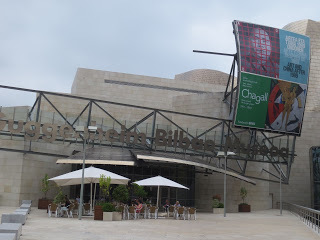
Entrance to Guggenheim Museum, Bilbao, Spain
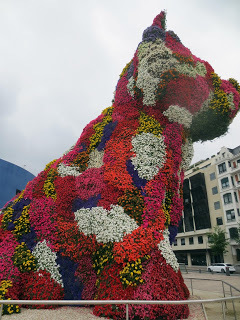 Jeff Koons' 3-story flower "Puppy" outside
View of Guggenheim Museum from street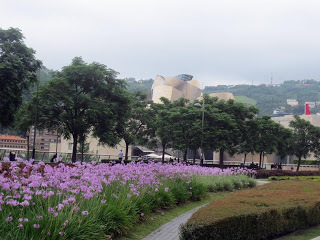
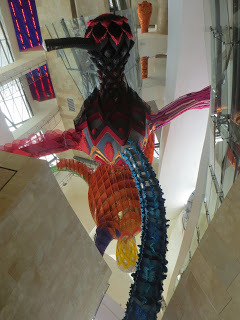
Three-story fabric "creature" hanging in atrium
A three-story sculpture of flowers titled "Puppy" by Jeff Koons stands on the esplanade outside the Guggenheim. Three mimes' arms extend from tented blankets to perform to music along the walkway. A two-story iron taranchala titled "Maman" by Louise Bourgeois stands behind the building. Walking through the building necessitates an audio tour, as the museum experience is cutting edge. One is walking through a grand sculpture, certainly with more star quality than many of the exhibits, in my opinion. The artwork is sometimes ten feet to three stories high, floating suspended or sunk in concrete, mind-boggling in conception, weight, and installation. The Chagall exhibit is the only one hanging on the walls. Signage is in Basque, Spanish, and English. An exhibit titled "Art and China after 1989: Theater of the World" caused me to flee. I followed Charley into the first room, dominated by two gigantic boxes on platforms. The structures were surrounded by lucite walls that rose above our heads. The contents of the two boxes looked like children's dioramas. Statues of Buddhas sat along a green hillside. Below the hillsides were openings resembling grottos. Lifelike tortoises and a yellow snake with brown markings sat motionless on the hillside beside a pool in the first eight-by-ten-foot box. I turned to the attendant standing along the wall. "Those aren't real, are they?" I said. "Oh yes," she answered. Just then the tortoise moved one leg. Then the other. Which caused the snake to raise its head and move forward an inch. I moved quickly to the next box, approximately twelve-foot square. When I got there, SIX snakes emerged from the opening under the diorama. The yellows, corals, greens, and browns muddled together in a tangle, as the snakes crawled over each other. I ran.
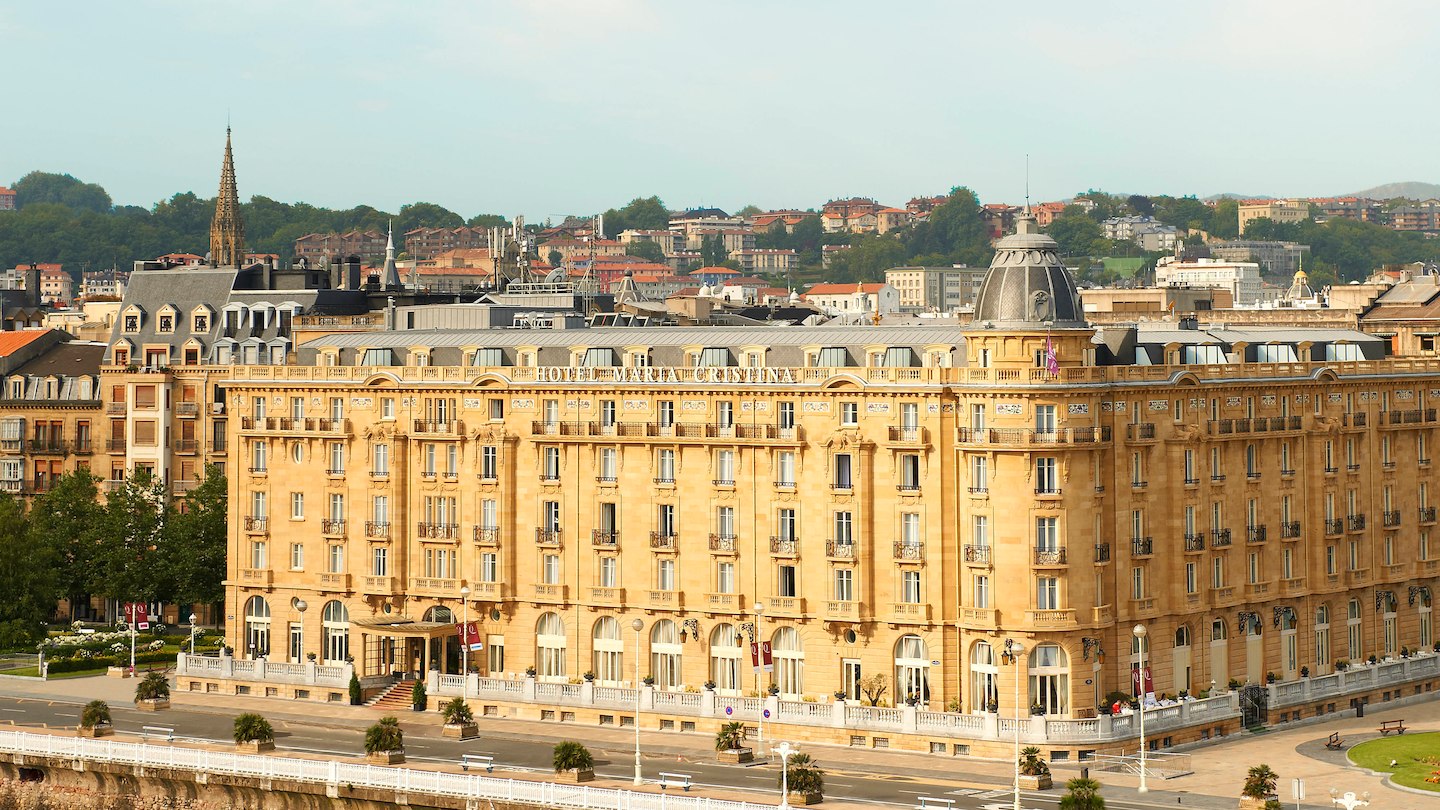 Hotel Maria Cristina, San Sesbastian, Spain San Sebastian is known for three things: its spectacular beaches, its Parto Vieja ("Old Part" of the city), and its food. The international jazz festival in July and international film festival in September call San Sebastian home. We walked around Monte Urgull, the hill that rises abruptly at the edge of the Old City along the peninsula's shore and used toothpicks to spear pinxtos ("haute cuisine in miniature") with olives, green or red peppers, anchovies, pork meatballs, or fried potatoes, displayed on a bar. The bartender tallied them up, along with the Rioja district wines we'd sampled, when we were ready to leave.
The following day we shopped inside the old walled city and walked the broad promenade above Playa de la Concha, the beach closest to the city with waves less formidable than the eastern Playa de Zurriola, which attracted international surfers. On the far western end of the Gulf of Vizcaya was Playa de Ondarreta, with few amenities. For dinner (10:00 p.m. in the Parto Vieja) we wound down narrow alleys to sit against a newer version of the old city walls in a restaurant where fishermen unloaded their catch in the front and the cooks hustled the catch inside. We ordered some greens and a lobster salad to share. When the "salad" arrived, a mountain of seafood sat on a platter before us: two cooked, split lobsters; steamed mussels and clams; potatoes; tomatoes; whole onions; kernels of corn. At home in Massachusetts we called this meal a "clam boil" or a "lobster bake," depending on whether it's boiled in a steamer pot or cooked over seaweed in a pit. Somehow we managed to devour our "salad."


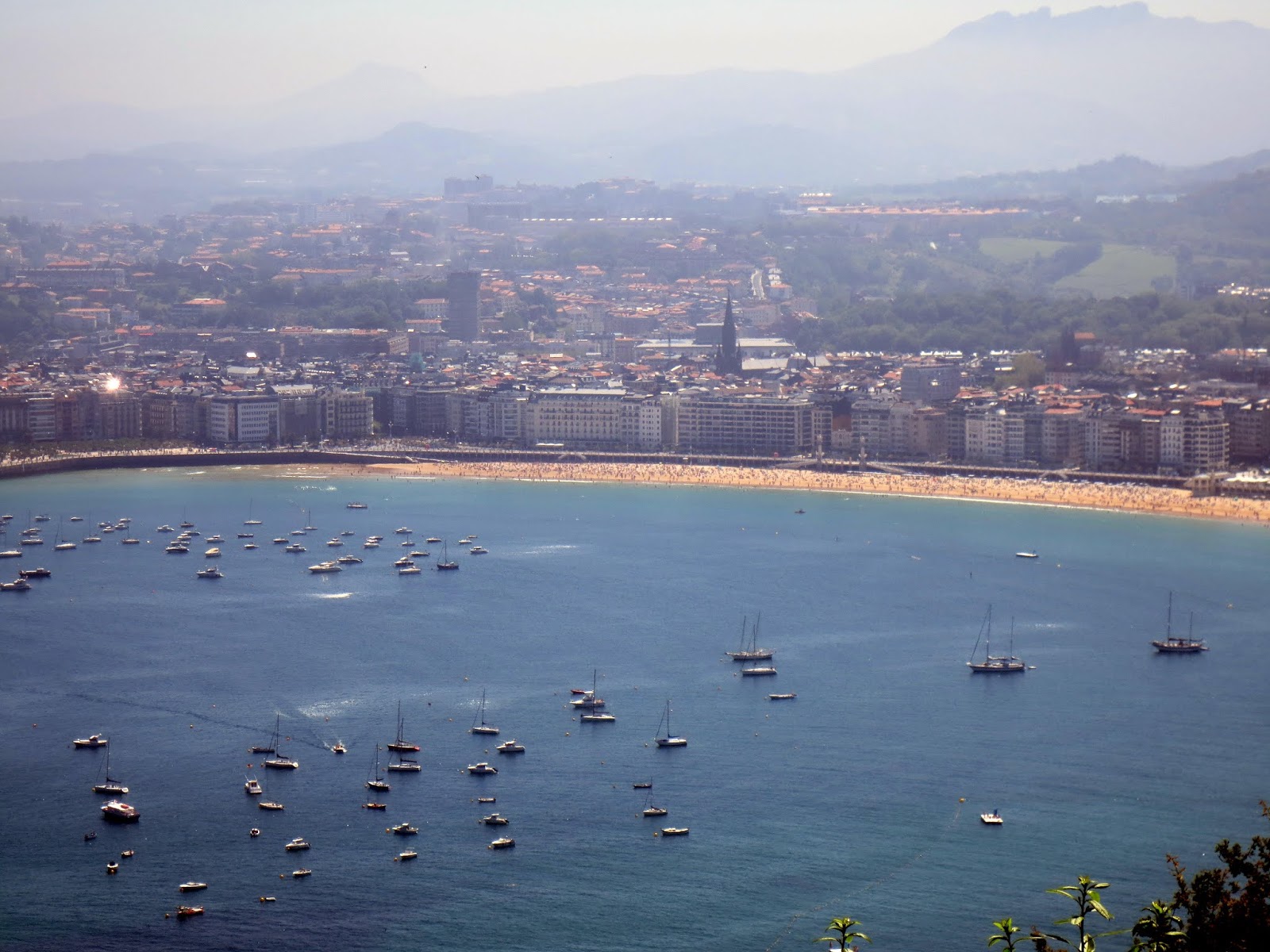

 Views of city of San Sebastian from amusement park atop Mt. Ulia with Pyrenees in background. Surfers' beach is around promontory to left.
Basque poet Kirmen Uribe summed up the appeal of his native coastline between San Sebastian and Bilbao: "I'm going to stay here - between the green waves and the blue mountains." We drove west along the coast through Zarautz, a former whale-hunting town with extensive photo museum and huge surfing waves rivaled only in Mundaka, which boasted long rollers and left-curling pipeline. "Hip" sculptures lined the beach promenade in Zarautz. We followed the twisting sea road west through Zumaia, a fortified medieval town with fossils embedded in rock cliffs where artist Ignacio Zuloaga thought the light magical. Next were Ondarrao and Lekeito, the Basque Country's leading fishing ports with major tuna fleets. Finally we headed inland toward Gernika and Bilbao.
Picasso made the Basque village Gernika (Basque spelling) famous with his mural representing Spain in the 1937 International Exposition of Arts and Techniques in Modern Life (Paris). In April, 1937, German Luftwaffe planes terror-bombed the Basque town of Gernika at the invitation of General Francisco Franco. Why Gernika? Since medieval times, regional leaders of the Basques had gathered there beneath an ancient oak tree to govern themselves. The fierce independence of the Basques, alone in opposing Franco's bid to overthrow the elected government, offended him. His German allies killed between 200 and 2,000 citizens in the village on a market day but missed the oak.The black and white photos in newspapers reporting the bombing infuriated Picasso, so he painted the mural in stippled grays, evoking those first reports and the dark cloud of war. His mysterious images brought the cause of Spanish suffering before the world. Picasso vowed his mural would never be exhibited in Spain as long as Franco lived. It was returned to Spain from exhibition in N.Y.C.'s Museum of Modern Art following repatriation in 1981.

As recently as the 1980's Bilbao was a steel and ship-building city in decline. Bilbainos thought the government crazy to court a major museum and name an architect to create another landmark (Frank Gehry). But civic audacity paid off. The Guggenheim Bilbao, an "armored beast" in metal, opened in 1997 and jump-started a transformation of the riverfront. A city of 355,000 has now become a laboratory for contemporary architecture. Cesar Pilli created a master plan of walkways, contemporary sculpture, and innovative architecture for the city.
The Casco Viejo or "Old Town" is a compact triangle nestled on a bend in the river. Basque identity is the subject of the Museo Vasco, while the Archeological Museum traces the human presence in the region from the arrival of Neanderthal man to the emergence of a coherent Basque region in the Middle Ages. The Museo de Bellas Artes is a gem of a conventional art museum outside Casco Viejo on the Guggenheim side of the River Bilbao..

Entrance to Guggenheim Museum, Bilbao, Spain
 Jeff Koons' 3-story flower "Puppy" outside
 View of Guggenheim Museum from street


Three-story fabric "creature" hanging in atrium
A three-story sculpture of flowers titled "Puppy" by Jeff Koons stands on the esplanade outside the Guggenheim. Three mimes' arms extend from tented blankets to perform to music along the walkway. A two-story iron taranchala titled "Maman" by Louise Bourgeois stands behind the building. Walking through the building necessitates an audio tour, as the museum experience is cutting edge. One is walking through a grand sculpture, certainly with more star quality than many of the exhibits, in my opinion. The artwork is sometimes ten feet to three stories high, floating suspended or sunk in concrete, mind-boggling in conception, weight, and installation. The Chagall exhibit is the only one hanging on the walls. Signage is in Basque, Spanish, and English. An exhibit titled "Art and China after 1989: Theater of the World" caused me to flee. I followed Charley into the first room, dominated by two gigantic boxes on platforms. The structures were surrounded by lucite walls that rose above our heads. The contents of the two boxes looked like children's dioramas. Statues of Buddhas sat along a green hillside. Below the hillsides were openings resembling grottos. Lifelike tortoises and a yellow snake with brown markings sat motionless on the hillside beside a pool in the first eight-by-ten-foot box. I turned to the attendant standing along the wall. "Those aren't real, are they?" I said. "Oh yes," she answered. Just then the tortoise moved one leg. Then the other. Which caused the snake to raise its head and move forward an inch. I moved quickly to the next box, approximately twelve-foot square. When I got there, SIX snakes emerged from the opening under the diorama. The yellows, corals, greens, and browns muddled together in a tangle, as the snakes crawled over each other. I ran.
August 20, 2018
Travelogue, French Basque Country, 2018
We arrived in Biarritz, France, in June, 2018, for a trip through the Basque Country of France and Spain. Our travels would take us from Biarritz on the Atlantic through the Pyrenees to the city of San Sebastian, Spain, on the coast and down to Bilbao.
The Basque region of France and Spain ("Pays Basque Francais" in French and "Pais Vasco" in Spanish) is a culture apart. Unrelated to any other tongue, Euskera (the Basque language) is spoken in the region bordering France and Spain and much of Navarra (the area of Spain which includes Pamplona). To an untrained ear, it sounds most like the Hungarian language. The town of "San Sebastian" in standard Castilian Spanish becomes "Donostia" in Basque, for example; "Vitoria" becomes "Gasteiz" in Basque. Road signs are in both standard Spanish and Basque.
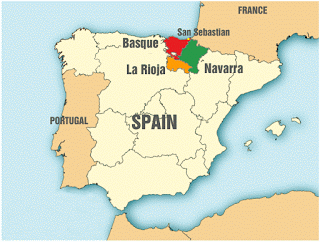 The origin of the Basques is a mystery, but mainstream archaeology classifies them as offspring of migrants who first populated the area 35,000 years ago. Fiercely independent, they cut deals with the Romans to respect Basque law and tradition. A long succession of monarchs followed who abided by these promises. In 1876 the Spanish crown abrogated these fueros (promises), setting off the first stirrings of Basque separatism.
Although the Basque Country is largely self-governing under modern Spanish and European Union law, a popular political movement for full separation from Spain (and to a lesser extent France) remains. Unfortunately, Basque separatism today is best known for the terrorist acts by the group ETA, whose last major attack was the Madrid airport bombing in 2006. While we traveled through the region in June, 2018, we saw no political agitation of any kind.
Our guide through the region was Christian Mayer, an American who married a French woman and relocated, following his heart. We first met him in Paris, when he drove us through the Normandy beaches and down across the Loire Valley. Subsequently he and his wife moved to the Dordogne region, just north of Basque Country, to raise their daughters.
Christian picked us up at our hotel in Biarritz and we drove north along the French coast through Bayonne before heading southeast toward the town of Sare inland. In Sare a gear-wheeled train climbs thirty-five minutes up the western-most peak of the Pyrennes, affording a spectacular 360-degree view of the seven Basque provinces across the mountains and along the Atlantic. The Grotto of Sare is nearby, a large cave inhabited in prehistoric times (with hieroglyphics) and discovered at the end of the 19th Century under the exploration of Edouard-Alfred Martel.
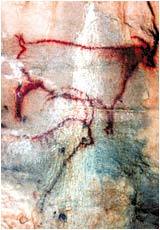 Hieroglyphics in prehistoric cave, Sare, Fr.
We stopped next in Ainhoa, a typical French Basque town in the foothills with shutters painted the red and green of the Basque flag. Names on the headstones in the cemetery were spelled in Basque. The Place du Fronton was central, featuring a large red wall against which two players hit a ball in the sport of Pelote (similar to Jai Alai). Each town we visited revolved around the fronton. Red chili peppers hung to dry on the outside of the houses.
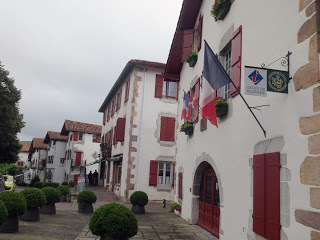 Ainhoa, France
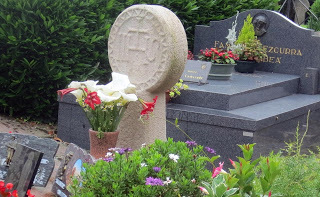 Above-the-ground cemetery with inscriptions in Basque, Ainhoa, Fr.
St. Jean Pied de Port ("St. John at the Foot of the Pass") was a lovely stop for lunch along the River Nive. The town stands at the base of the Roncevaux Pass through the Pyrennes and is the pilgrims' starting point on the French side before the arduous mountain crossing during their Camino de Santiago pilgrimage.
The Camino de Santiago pilgrimage is a network of pilgrims' paths to the shrine of apostle Saint James, said to be buried in the Cathedral in Compostela in the northwestern-most area of Spain. The pilgrims carry a document purchased for a few euros through their church or the National St. James Organization which gives them access to inexpensive, sometimes free, accommodations marked by a seashell. The document serves as proof that the journey was accomplished according to an official route of towns along the trail. In 2017 there were 300,000 pilgrims who made the trek, following the sign of the seashell. The City Gate in St. Jean Pied de Port was added by UNESCO as a World Heritage site.
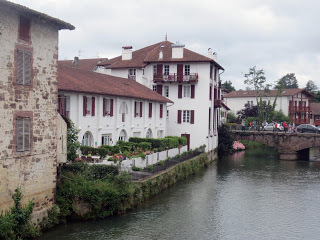 St. John Pied-de-Port, Fr.
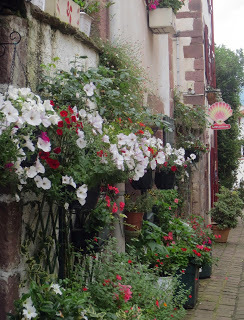 Street scene, St. John Pied-de-Port, Fr.
Note the seashell symbol above the door.
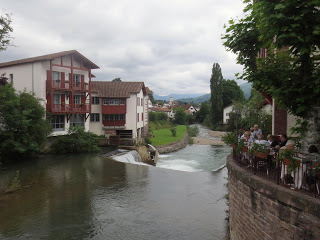 Outdoor restaurant above waterfall, St. John Pied-de-Port, Fr.
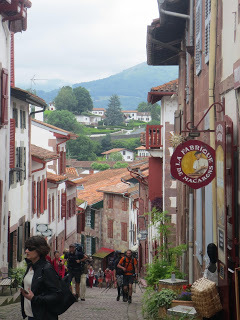 Street scene, St. John Pied-de-Port, Fr.
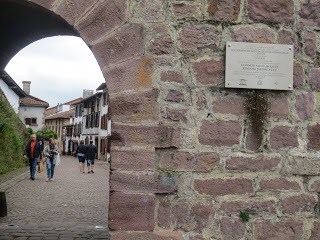 Pilgrims' portal now a UNESCO World Heritage Site, St. John Pied-de-Port, Fr. Our last stop on the French side was St. Jean de Luz, a larger bustling town with pedestrian main street, whose shopkeepers announced their professions outside in sculpture, similar to towns in Austria. The Cathedral there had typical Basque rows of balconies along two walls, Romeo and Juliet style, with gilt ornamentation, making the inside much less austere than the outside.
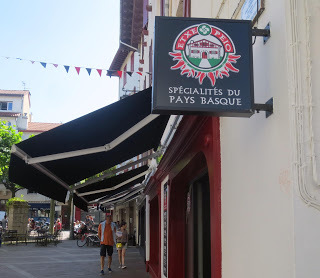 St. John de Luz, Fr.
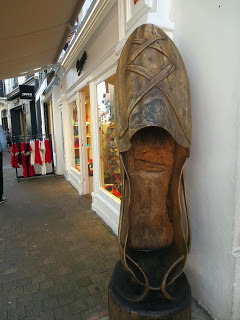 Shoe store, St. John de Luz, Fr.
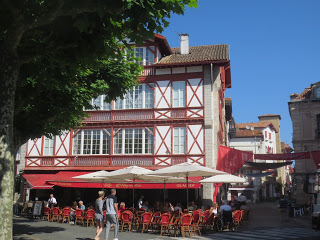 Main square, St. John de Luz, Fr.
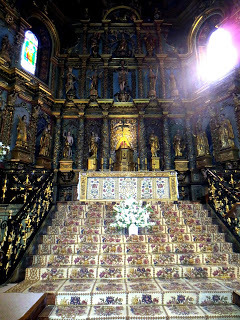 Altar inside Cathedral in St. John de Luz
From there we took the Basque Corniche along the coast toward San Sebastian, Spain.
Spanish Basque travelogue to follow.....................
The Basque region of France and Spain ("Pays Basque Francais" in French and "Pais Vasco" in Spanish) is a culture apart. Unrelated to any other tongue, Euskera (the Basque language) is spoken in the region bordering France and Spain and much of Navarra (the area of Spain which includes Pamplona). To an untrained ear, it sounds most like the Hungarian language. The town of "San Sebastian" in standard Castilian Spanish becomes "Donostia" in Basque, for example; "Vitoria" becomes "Gasteiz" in Basque. Road signs are in both standard Spanish and Basque.
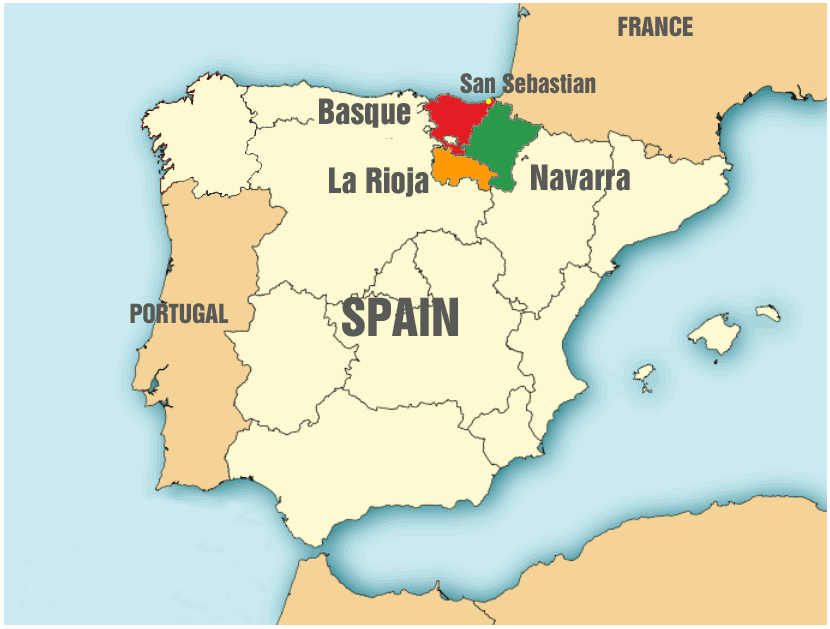 The origin of the Basques is a mystery, but mainstream archaeology classifies them as offspring of migrants who first populated the area 35,000 years ago. Fiercely independent, they cut deals with the Romans to respect Basque law and tradition. A long succession of monarchs followed who abided by these promises. In 1876 the Spanish crown abrogated these fueros (promises), setting off the first stirrings of Basque separatism.
Although the Basque Country is largely self-governing under modern Spanish and European Union law, a popular political movement for full separation from Spain (and to a lesser extent France) remains. Unfortunately, Basque separatism today is best known for the terrorist acts by the group ETA, whose last major attack was the Madrid airport bombing in 2006. While we traveled through the region in June, 2018, we saw no political agitation of any kind.
Our guide through the region was Christian Mayer, an American who married a French woman and relocated, following his heart. We first met him in Paris, when he drove us through the Normandy beaches and down across the Loire Valley. Subsequently he and his wife moved to the Dordogne region, just north of Basque Country, to raise their daughters.
Christian picked us up at our hotel in Biarritz and we drove north along the French coast through Bayonne before heading southeast toward the town of Sare inland. In Sare a gear-wheeled train climbs thirty-five minutes up the western-most peak of the Pyrennes, affording a spectacular 360-degree view of the seven Basque provinces across the mountains and along the Atlantic. The Grotto of Sare is nearby, a large cave inhabited in prehistoric times (with hieroglyphics) and discovered at the end of the 19th Century under the exploration of Edouard-Alfred Martel.
 Hieroglyphics in prehistoric cave, Sare, Fr.
 We stopped next in Ainhoa, a typical French Basque town in the foothills with shutters painted the red and green of the Basque flag. Names on the headstones in the cemetery were spelled in Basque. The Place du Fronton was central, featuring a large red wall against which two players hit a ball in the sport of Pelote (similar to Jai Alai). Each town we visited revolved around the fronton. Red chili peppers hung to dry on the outside of the houses.
 Ainhoa, France
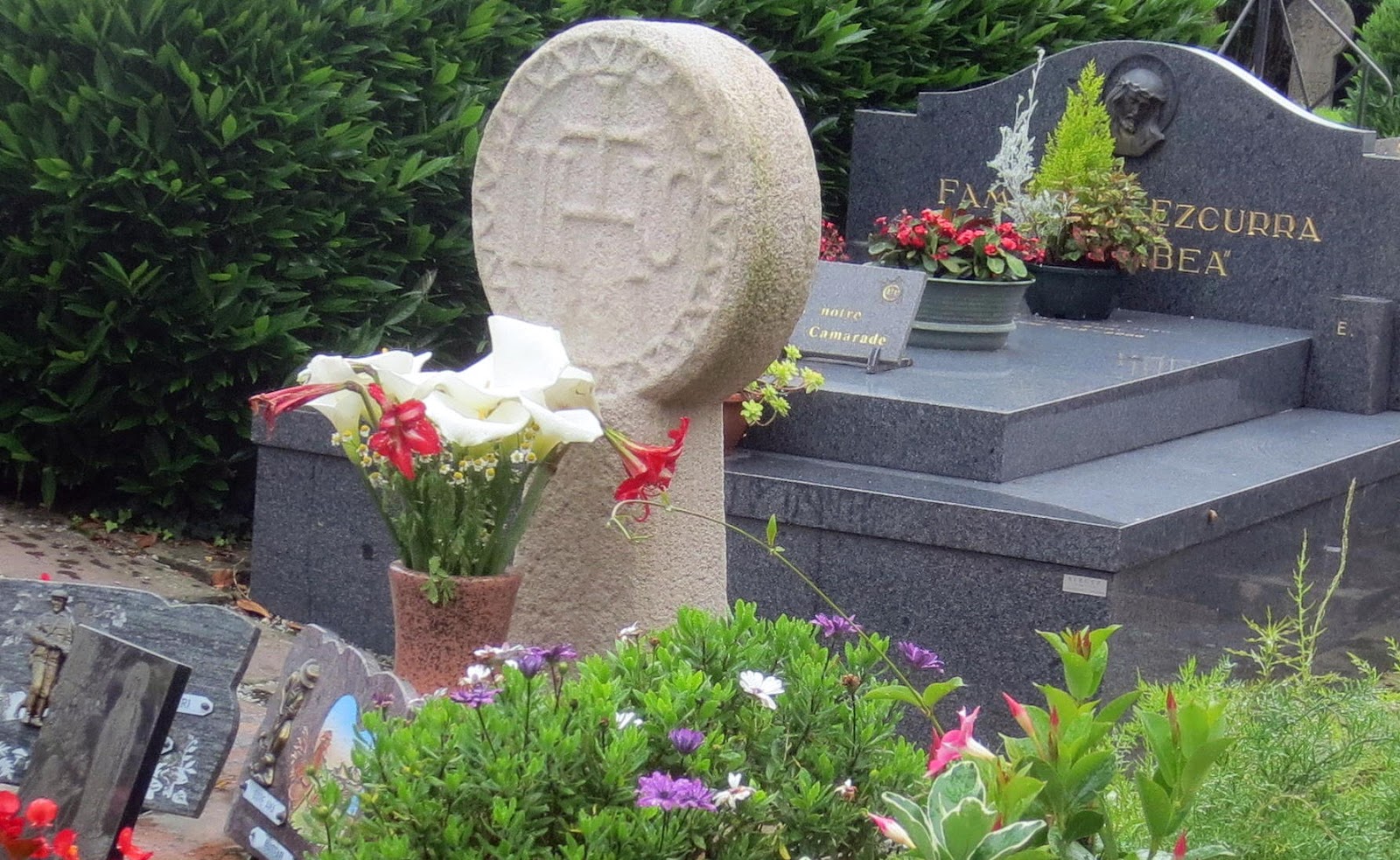 Above-the-ground cemetery with inscriptions in Basque, Ainhoa, Fr.
St. Jean Pied de Port ("St. John at the Foot of the Pass") was a lovely stop for lunch along the River Nive. The town stands at the base of the Roncevaux Pass through the Pyrennes and is the pilgrims' starting point on the French side before the arduous mountain crossing during their Camino de Santiago pilgrimage.
The Camino de Santiago pilgrimage is a network of pilgrims' paths to the shrine of apostle Saint James, said to be buried in the Cathedral in Compostela in the northwestern-most area of Spain. The pilgrims carry a document purchased for a few euros through their church or the National St. James Organization which gives them access to inexpensive, sometimes free, accommodations marked by a seashell. The document serves as proof that the journey was accomplished according to an official route of towns along the trail. In 2017 there were 300,000 pilgrims who made the trek, following the sign of the seashell. The City Gate in St. Jean Pied de Port was added by UNESCO as a World Heritage site.
 St. John Pied-de-Port, Fr.
  Street scene, St. John Pied-de-Port, Fr.
Note the seashell symbol above the door.
 Outdoor restaurant above waterfall, St. John Pied-de-Port, Fr.
 Street scene, St. John Pied-de-Port, Fr.
 Pilgrims' portal now a UNESCO World Heritage Site, St. John Pied-de-Port, Fr. Our last stop on the French side was St. Jean de Luz, a larger bustling town with pedestrian main street, whose shopkeepers announced their professions outside in sculpture, similar to towns in Austria. The Cathedral there had typical Basque rows of balconies along two walls, Romeo and Juliet style, with gilt ornamentation, making the inside much less austere than the outside.
 St. John de Luz, Fr.
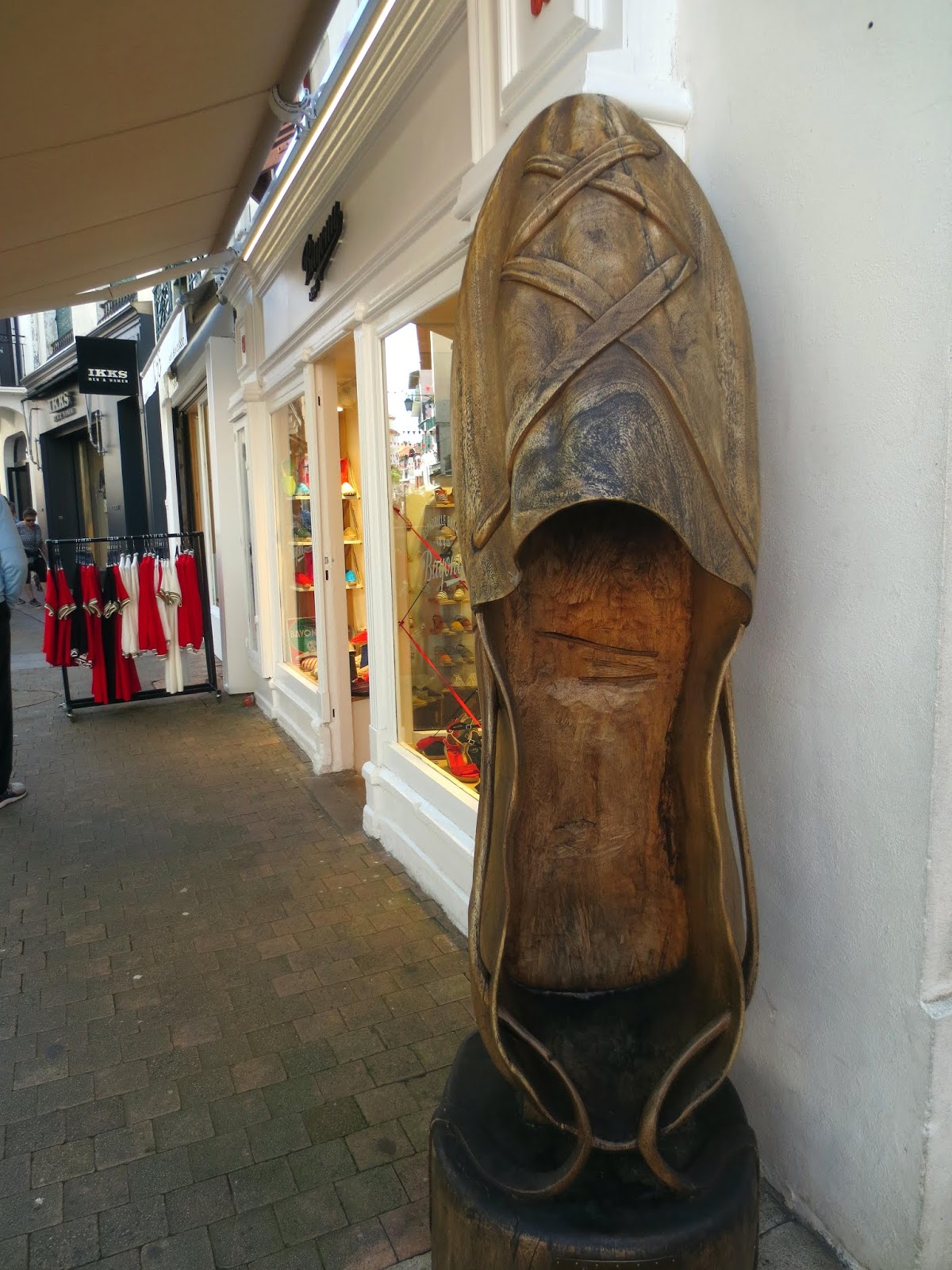 Shoe store, St. John de Luz, Fr.
 Main square, St. John de Luz, Fr.
  Altar inside Cathedral in St. John de Luz
From there we took the Basque Corniche along the coast toward San Sebastian, Spain.
Spanish Basque travelogue to follow.....................
August 8, 2018
Travelogue, France and Spain, 2018
We were staying at Le Regina Hotel, Biarritz, France, on the Atlantic. Each day we walked down the hillside from our location near the lighthouse to the beach, which lay beneath tiers of stone steps. The sand was wide and the surf cold. Wetsuits on boards dotted the waves. Elderly couples, young lovers, and skateboarders shared the wide promenade. At the far end was the casino. Around the curve we sat for wine and seafood in a marina. Needless to say, we got grimy and our clothes were limp with weather that began in misty fog in the morning and rose to mid-eighties in the afternoon.
When we got back to the hotel after walking, I wanted to use my trusty detergent packets from my suitcase to wash our tees. Our sculptured white elliptical Bosch sink had a depth of maybe three inches total. It was so shallow at the lip we couldn't knock our toothbrushes to get the water out without the bristles hitting the side of the sink. I looked for a stopper in order to get a sink full of suds. Couldn't find one.
I called Housekeeping and since the person on the other end spoke only French, she sent her Supervisor. The woman came slightly out of breath from her immediate trot to our room. She ran the water at full blast and pronounced, "Non problema" - a standard response in Italy, but we hadn't heard it before in France.
With hand gestures Charley and I pushed in a downward motion at the site of the phantom stopper to show her there was no way to keep any water in the sculpture. Prongs protruded upward from the hole. As our meaning became clear, the woman made another pronouncement. "Non, c'est impossible!" Another beautiful French object that was nonfunctional, just like itsy-bitsy Parisian hotel rooms and their toilets with the flush button on the wall behind your head, which a woman can hit only if she is a contortionist. Or the "green" movement in France that prohibits bags of any kind from being distributed for purchases but crams toilet paper rolls into the dispenser so tight that scraps float like amoebas across women's stalls displaying fingernail gouges where users tried to dislodge a few sheets.
Our Supervisor of Housekeeping motioned in sign language she would bring up a tub for our tees.Which she did.
The plastic tub must have been used to dye something brown before we got it, because a rich chocolate color sat within the corners. Since it didn't yield to my scrubbing, I went ahead and submerged our shirts.
After a few hours outside the room, I came back to fish out our tees. They had turned a warm, earthy brown.
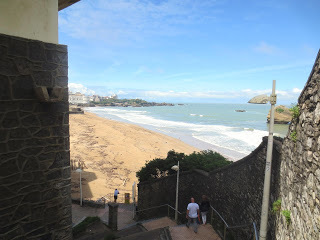 Staircases leading to beach, Biarritz, France
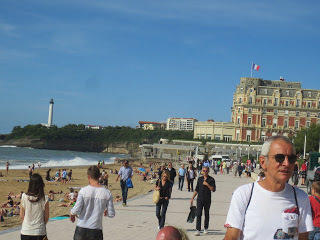 Promenade looking toward Napoleon's Hotel deVille, Biarritz, France
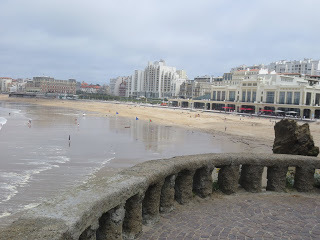 Beachfront, Biarritz, France
 Promendade looking toward casino, Biarritz, France
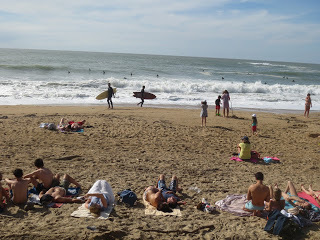 Cold Atlantic Ocean, Biarritz, France
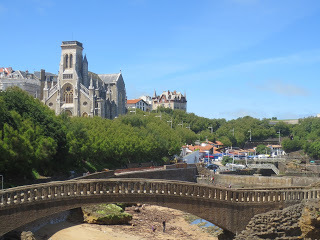 Marina beneath Cathedral, Biarritz, France
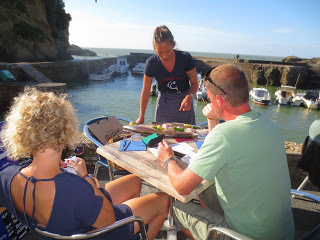 Fish selection in marina, Biarritz, France
*********************************************************************************
As a security measure in France and Spain, a traveler may have to wave a plastic electronic room key in front of a digital pad on an elevator. After he does this, he must touch the floor number in order to ascend. The cage won't move until this sequence happens. However, in the Hotel Maria Cristina in San Sebastian, Spain, wide carpeted staircases wound upward right next to the elevators, open to the public without security of any type. Go figure!?
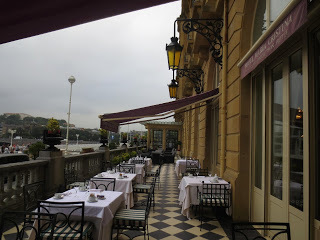 Front entrance, Hotel Maria Cristina, San Sebastian, Spain
When we got back to the hotel after walking, I wanted to use my trusty detergent packets from my suitcase to wash our tees. Our sculptured white elliptical Bosch sink had a depth of maybe three inches total. It was so shallow at the lip we couldn't knock our toothbrushes to get the water out without the bristles hitting the side of the sink. I looked for a stopper in order to get a sink full of suds. Couldn't find one.
I called Housekeeping and since the person on the other end spoke only French, she sent her Supervisor. The woman came slightly out of breath from her immediate trot to our room. She ran the water at full blast and pronounced, "Non problema" - a standard response in Italy, but we hadn't heard it before in France.
With hand gestures Charley and I pushed in a downward motion at the site of the phantom stopper to show her there was no way to keep any water in the sculpture. Prongs protruded upward from the hole. As our meaning became clear, the woman made another pronouncement. "Non, c'est impossible!" Another beautiful French object that was nonfunctional, just like itsy-bitsy Parisian hotel rooms and their toilets with the flush button on the wall behind your head, which a woman can hit only if she is a contortionist. Or the "green" movement in France that prohibits bags of any kind from being distributed for purchases but crams toilet paper rolls into the dispenser so tight that scraps float like amoebas across women's stalls displaying fingernail gouges where users tried to dislodge a few sheets.
Our Supervisor of Housekeeping motioned in sign language she would bring up a tub for our tees.Which she did.
The plastic tub must have been used to dye something brown before we got it, because a rich chocolate color sat within the corners. Since it didn't yield to my scrubbing, I went ahead and submerged our shirts.
After a few hours outside the room, I came back to fish out our tees. They had turned a warm, earthy brown.
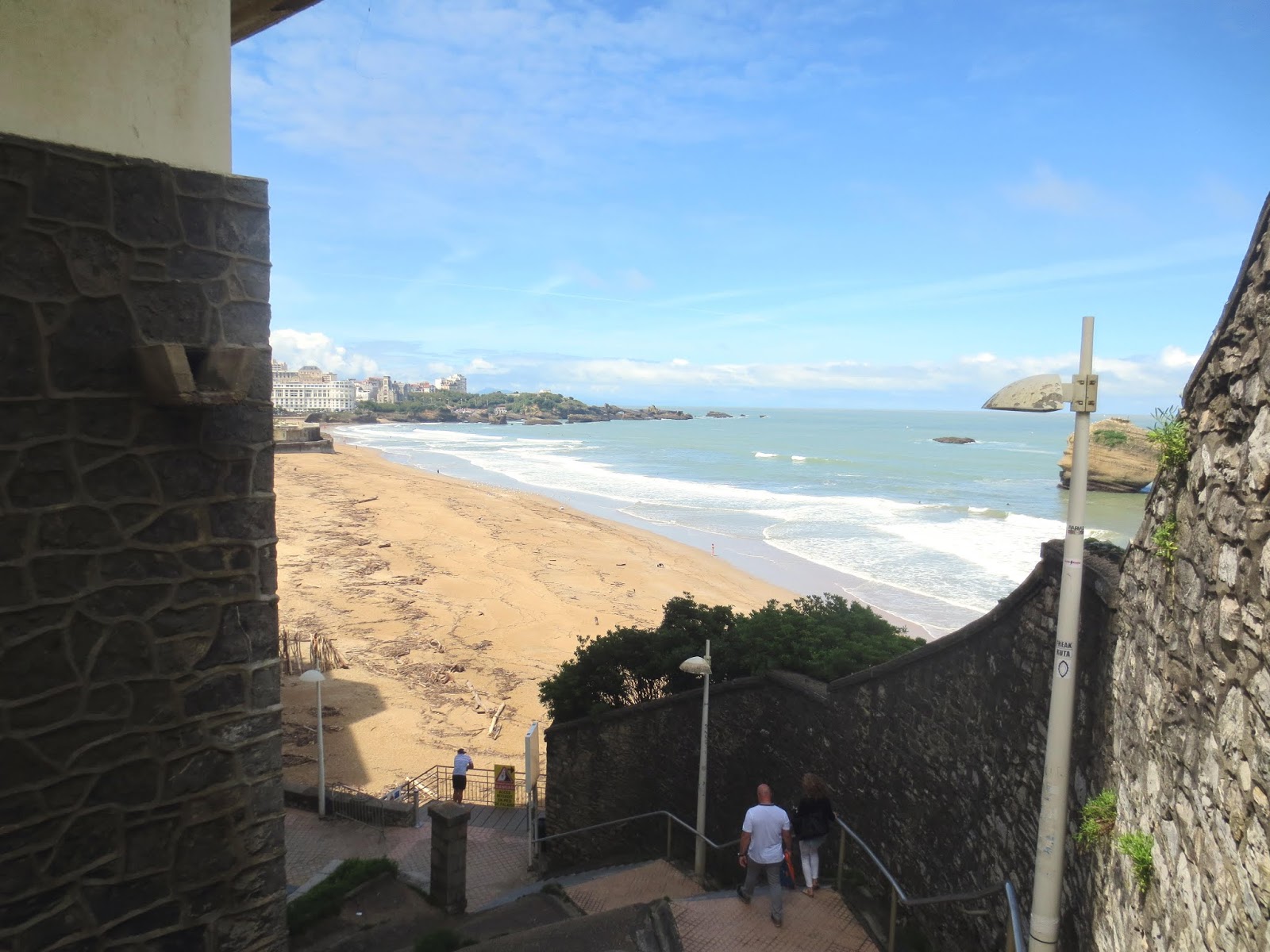 Staircases leading to beach, Biarritz, France
 Promenade looking toward Napoleon's Hotel deVille, Biarritz, France
 Beachfront, Biarritz, France
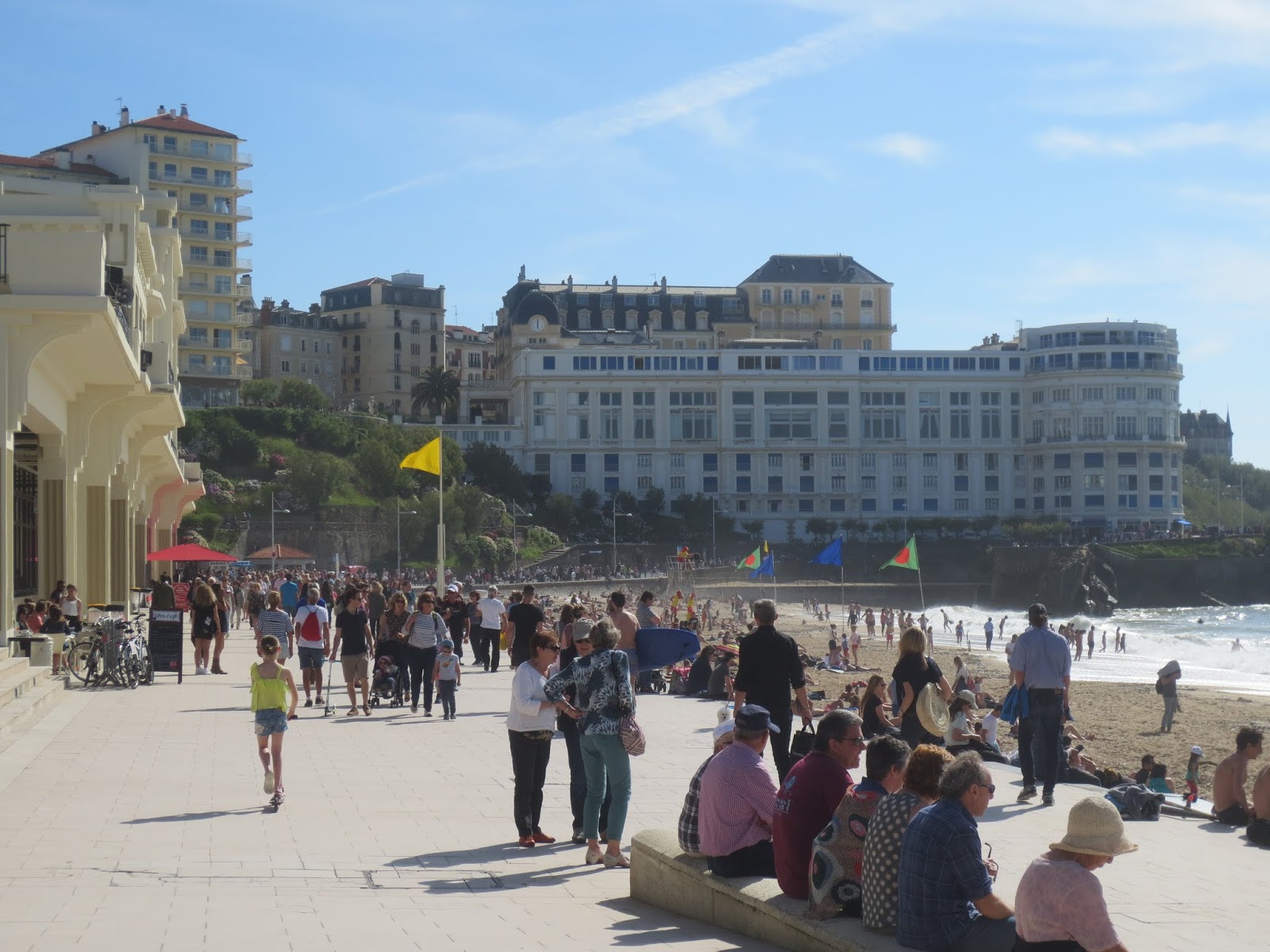 Promendade looking toward casino, Biarritz, France
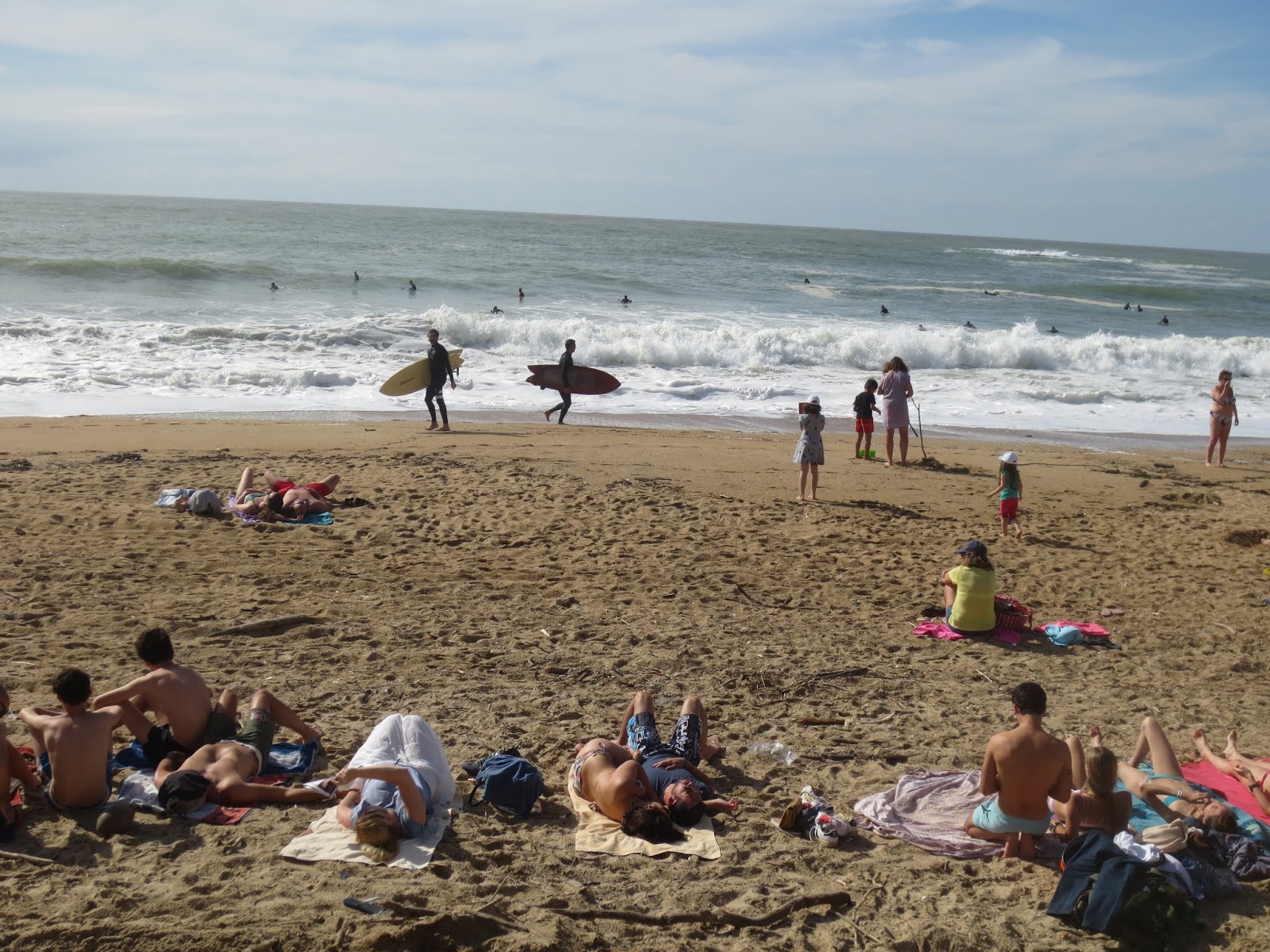 Cold Atlantic Ocean, Biarritz, France
 Marina beneath Cathedral, Biarritz, France
 Fish selection in marina, Biarritz, France
*********************************************************************************
As a security measure in France and Spain, a traveler may have to wave a plastic electronic room key in front of a digital pad on an elevator. After he does this, he must touch the floor number in order to ascend. The cage won't move until this sequence happens. However, in the Hotel Maria Cristina in San Sebastian, Spain, wide carpeted staircases wound upward right next to the elevators, open to the public without security of any type. Go figure!?
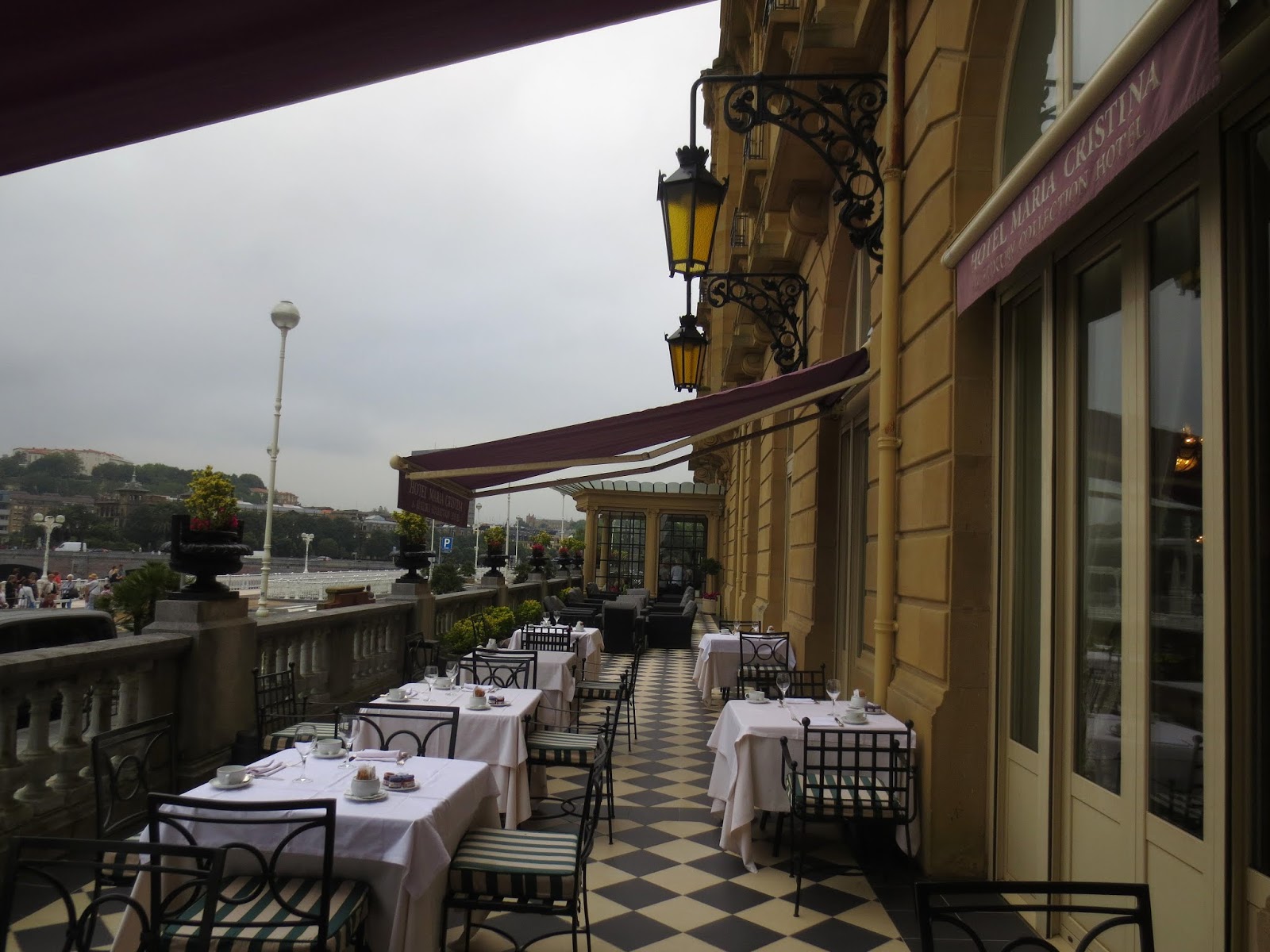 Front entrance, Hotel Maria Cristina, San Sebastian, Spain
July 17, 2018
Cuban Travelogue, Part V
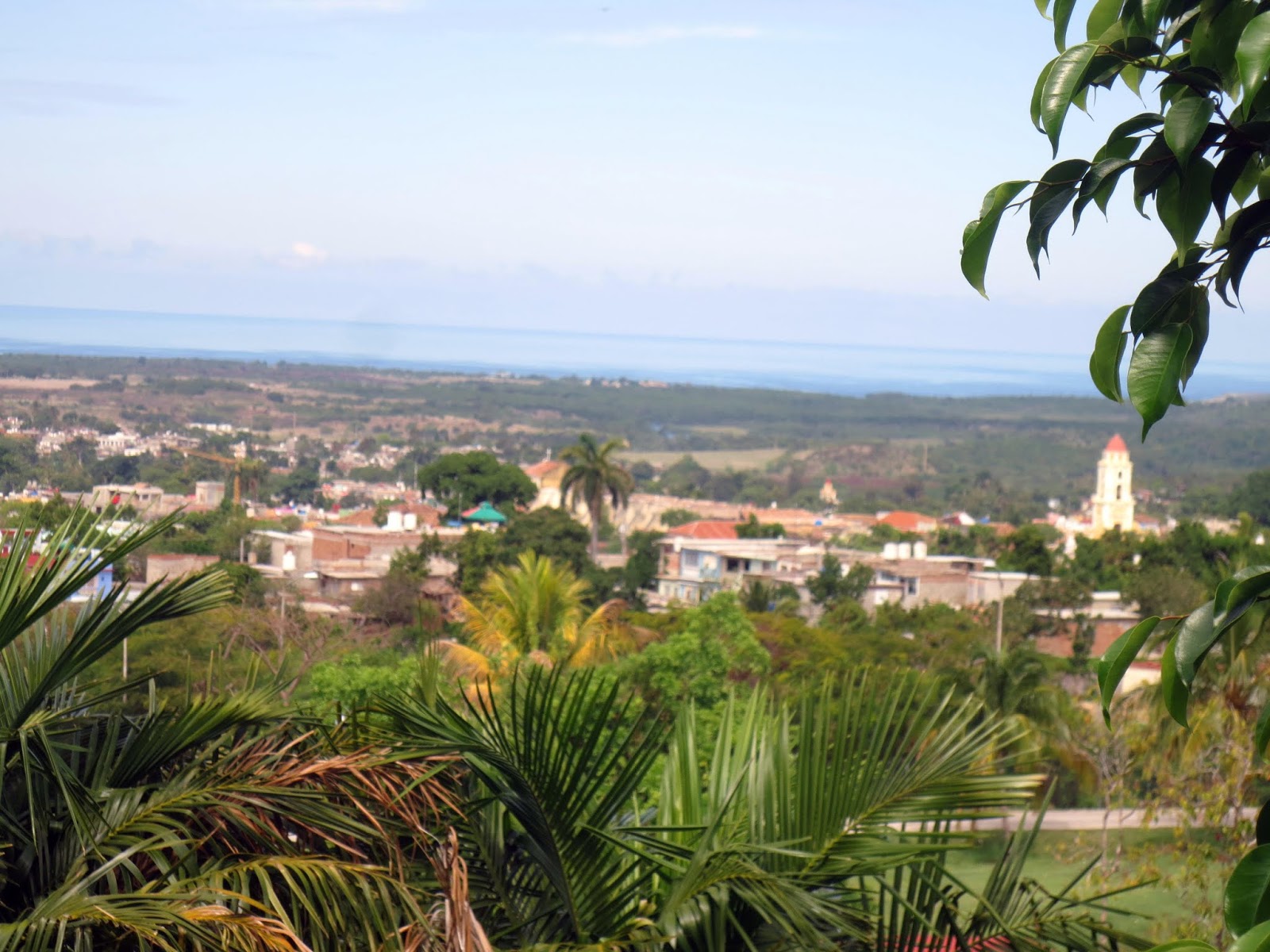 South coast looking toward Cienfuegos and Caribbean
 Machete cutter of sugarcane climbing with ropes and hob-nailed shoes
 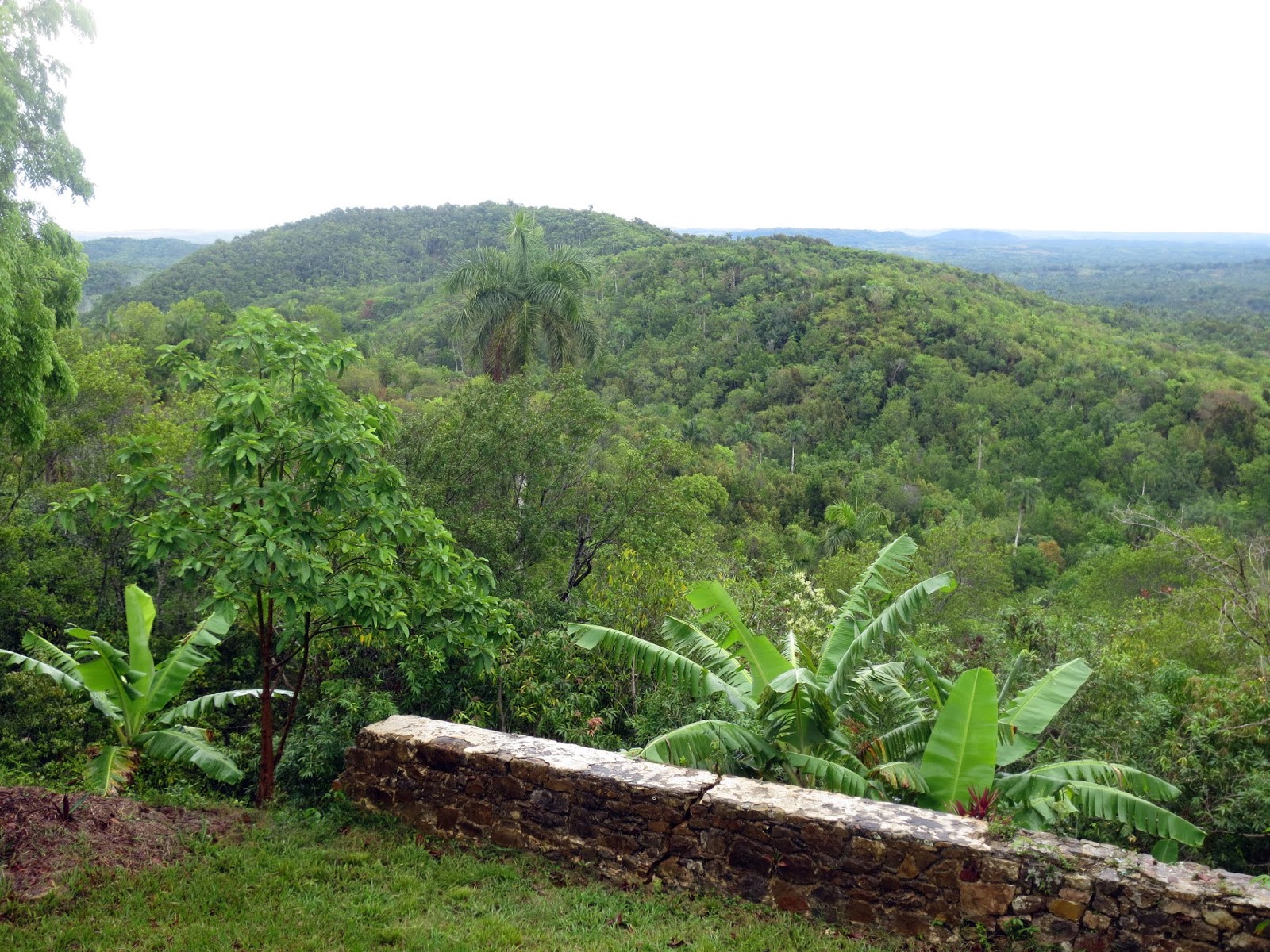 View toward Fla. Strait from former coffee plantation in the Sierra del Rosario Mts., northwest Cuba. Each seedling was planted. After four days eating the national cuisine of pulled or roasted pork, fricasseed or grilled chihcken, black beans and rice, some of us experimented with local specialties like ceviche or octopus. Mojitos, Cuba Libres (the national cola mixed with rum), and Pina Coladas were served liberally with ice cubes from the local water supply. As a result, several of our group began to have gastrointestinal ailments. There was a doctor on duty 24/7 in our hotel, who provided an antibiotic shot in the derriere. "Octopus is notorious for causing your problem," he told the patients. There was no charge.
Excluding hotels, public restrooms throughout our tour had attendants standing outside with a roll of toilet paper. With the equivalent of a $.25 tip, one received several sheets before entering. There were none inside. A bucket stood next to each toilet to prevent paper from being flushed into the sewer system.
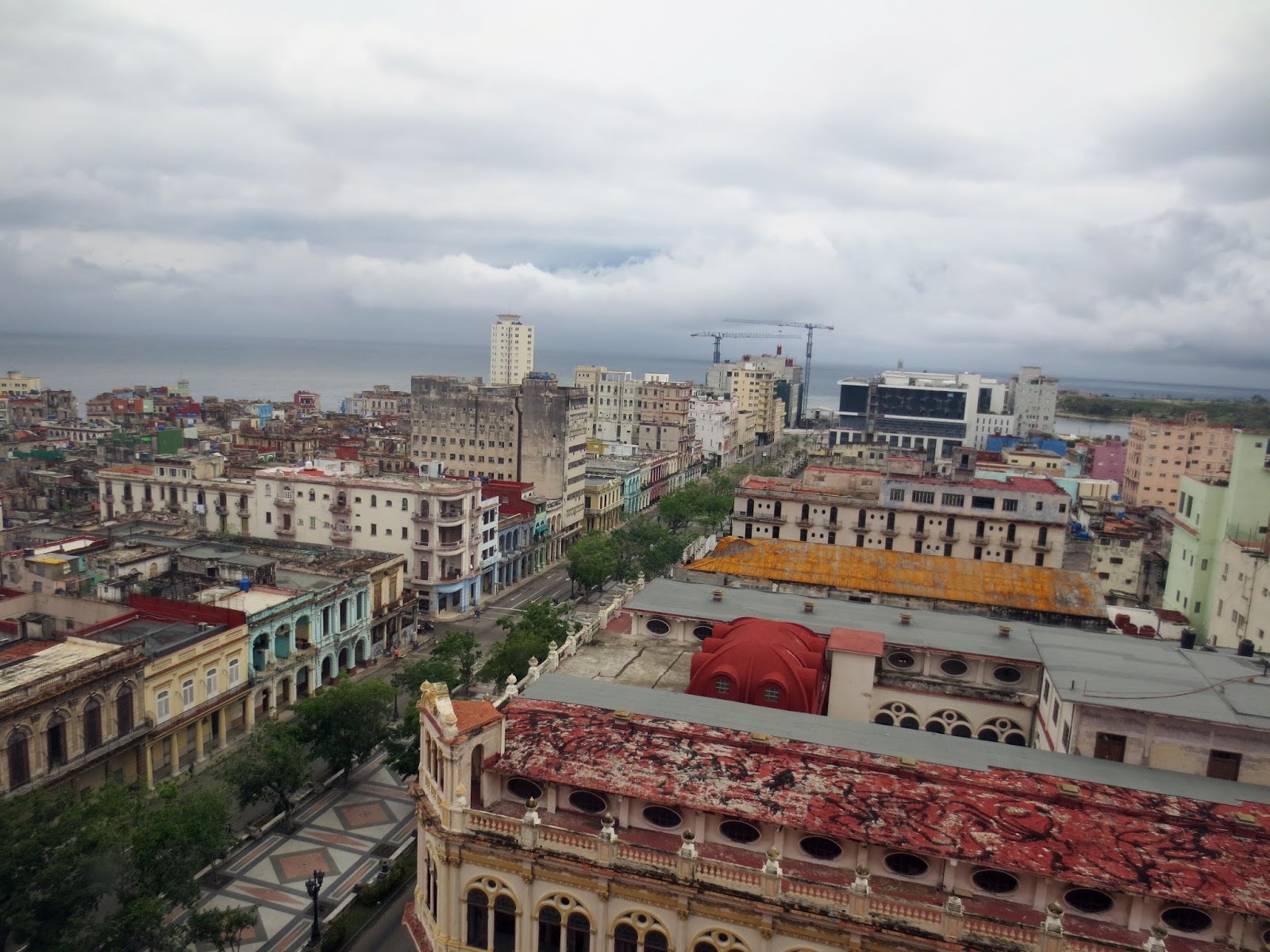 Havana skyline I
 Havana skyline II At the end of our week-long sojourn we had the highly-anticipated ride through Havana in classic cars of the 50's. There were approximately 60,000 vintage cars throughout Cuba. Owners needed permits from the state to maintain their status, if they wanted to use the cars as vehicles for tourism. "Everyone must survive," our Cuban guide told us, "even the inspectors." Translation: the inspectors accepted bribes. "Car owners find spare parts on the internet. The engines are patched together with parts from Europe and the Soviet Union. Some owners have three old motors in reserve."
 Artist Jose Fuster's casa outside Havana, made entirely of ceramics
 St. Francis Cathedral, Havana, across from the cruise ship terminal Our vintage car did not disappoint! Charley and I rode in a 1950 Buick with its original engine. Only one windshield wiper worked and the speedometer had died a long time ago. When it started to rain, the owner put the canvas top up. Each of us got wet through a two-inch gap, but we didn't even feel it!
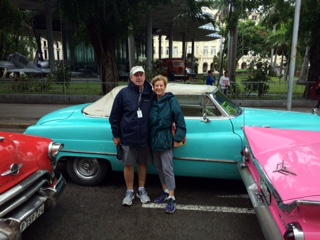 A 1950 Buick for our ride through Havana
 A fellow traveler took our photo in the rear view mirror
 Batista's office in his Havana palace. During the Revolution he escaped through a side door and fled the country.
 Cathedral o f Havana at night
 Department of Tourism employees, Havana
 Another Tourism Dept. employee
 Park Havana
 Ted doing a selfie
 Ronnie and Amit in the back seat
 The End
July 5, 2018
Cuban Travelogue, Part IV
One of our most interesting tours was the H. Upmann cigar factory in Havana. Inside a cement building five stories high, iron railings surrounded an open atrium. There was no air-conditioning. A huge photo of Fidel holding what must have been an Upmann cigar hung down the inside of the building in front of us. "Sorry, no photos above ground level," the factory guide warned us. "No stealing secrets."
 Fidel and his cigar watch over the factory. The tobacco leaves had been cut in the fields and dried on racks in barns, where they were spritzed with a combination of water and a flavor (rum, e.g.). Because of the humidity in Cuba, the environment served as a natural humidor. Originally, field hands read Romeo and Juliet or The Count of Monte Cristo to those cutting in the fields. The cigars took their names from the books being read. Today, I wouldn't be surprised if cigars were named Fifty Shades of Gray (or 64 Shades, because there are 64 cigars in a box).
We began by walking up cement steps to the fourth floor, where women and a couple of men sat behind glass in rows of high-top tables, removing veins from the dried leaves and sorting them by color and shade. There were three colors and eight shades of each color. One woman had her daughter sitting next to her doing homework. Both waved at us.
We walked down the stairs to another level. On this floor, employees rolled, pressed, and cut the leaves into shape, securing the end with a rubbery natural liquid from Canada that acted as glue. Each worker had a different quota per day, depending on the shape and size of the cigar. A worker rolling and pressing Monte Cristos, for example, had a quota of 90 cigars/day. We watched through the glass as workers at long tables, both men and women, smoked cigarettes, drank beer, or watched movies on their cell phones between finished products. The jobs were highly paid and handed down through the generations, provided the applicant passed entrance qualifications. A ten-month training period was mandatory for everyone in the factory. On another level down, a paper ring slid onto the shaft of each product, which was then boxed in an adjoining room.
 One of the products of H. Upmann Cigar Factory in Havana Back at our hotel, Geo. Lopez-Sanchez, Professor of Economics and International Relations, discussed the Cuban economy. When the U.S. OK'ed flights into the country, the total number of tourists rose from 500,000 to 1,000,000 in one week. Canada sends the highest number, with the U.S. in second place, though declining. "What infrastructure can be fixed if goods and remittances coming into our country are hidden and can't be taxed? What should the visitors' revenues be used for first?" he asked.
The Executive Director of the Fundacion Ludwig de Cuba gave us a tour of the National Museum in Havana. "There is one work that depicts our country's recent journey," he told us, leading us to the collage titled, "Revolucion" by Alejandro Aquilera. "The word 'Motherland' is a colloquialism for us, referring to a political movement that is unfinished and constantly changing. Our allegiance after the Revolution is not to individual rights but to independence as a whole. In this collage, the artist started on the left with strong letters, which deteriorate toward the end into fragments. It is a mix of many materials and scenes, just as Cuba is a mix of peoples and beliefs. The bloody revolutionary fervor no longer sustains us, but the concept is unfinished. We are mingled in grayness."
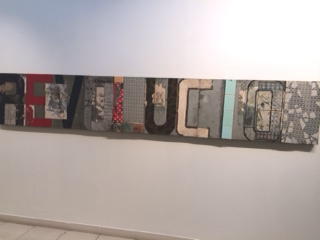 "Revolucion" by Alejandro Aquilera, National Museum, Havana Confirming that point of view, our Cuban tour guide told us, "In general, Cuban people today have no specific religious beliefs. We pick and choose a little from this and a little from that. If we were born after the Revolution of 1959, we have no idea what Christmas represents. Christmas trees are only placed in tourist hotels. Our backgrounds are Spanish, African, English, Chinese. The tribes native to the island were almost completely exterminated when they were used as laborers by the Spanish."
 Art from the Revolution, National Museum, Havana
On a free night, Charley and I walked to Sloppy Joe's restaurant near our hotel. It was an offshoot of the bar made famous by Hemingway in Key West. Hemingway had befriended the owner there and persuaded him to open a second establishment in Havana, where Hemingway had a residence.
 Hemingway's boat dry-docked on the tennis court at his Havana estate We both ordered cheeseburgers. They arrived an inch-and-a-half thick. "Could we have some ketchup, please?" Charley said.
"I'll look," the waiter said in English.
He came back several minutes later. "Sorry, but this is the only one I could find. We don't expect another shipment this week." He handed Charley a bottle of congealed red paste, stuck in the neck of the bottle.
"Cuba is like a 40-watt light bulb," one of our group members quipped.

To be continued...
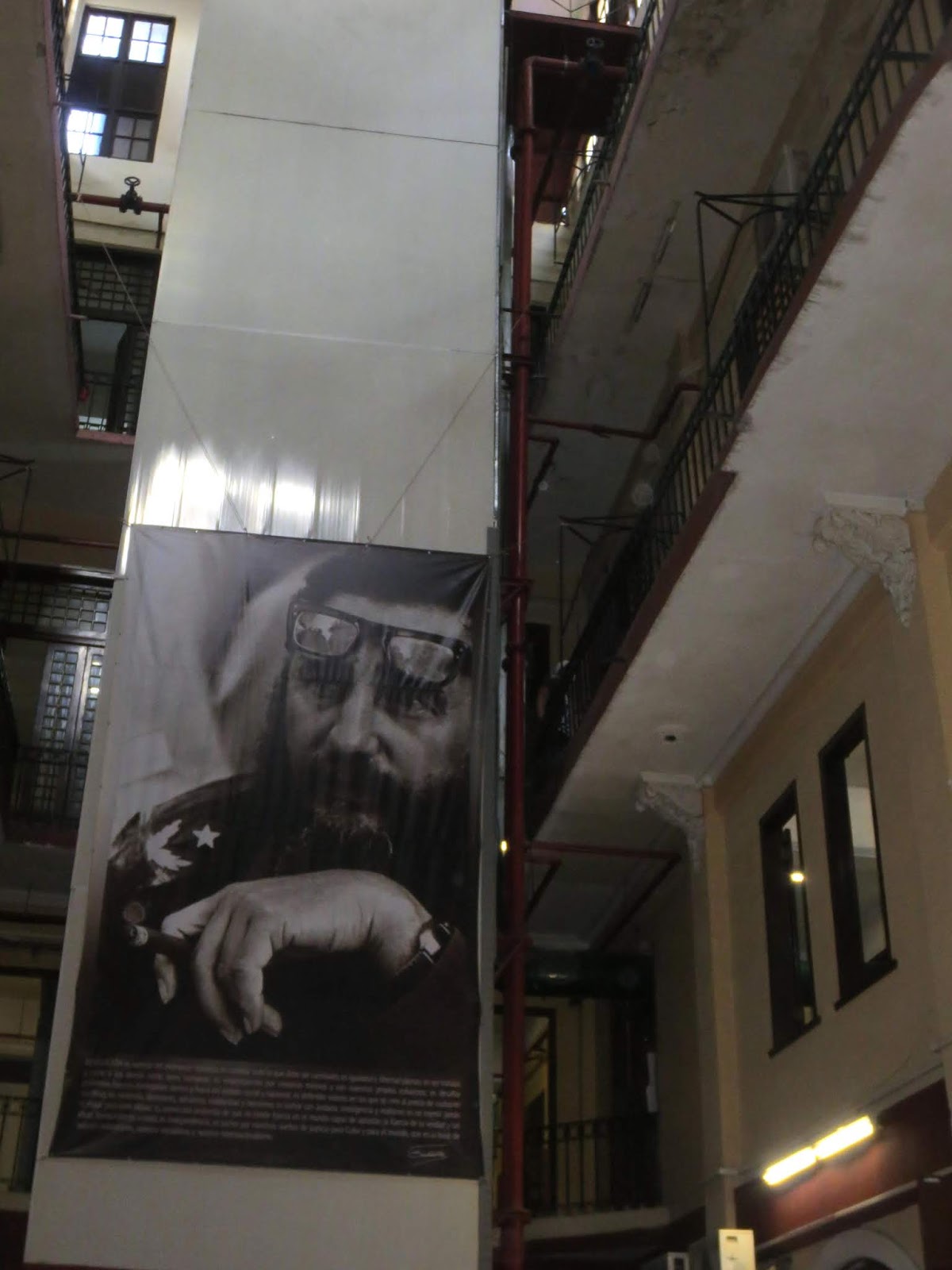 Fidel and his cigar watch over the factory. The tobacco leaves had been cut in the fields and dried on racks in barns, where they were spritzed with a combination of water and a flavor (rum, e.g.). Because of the humidity in Cuba, the environment served as a natural humidor. Originally, field hands read Romeo and Juliet or The Count of Monte Cristo to those cutting in the fields. The cigars took their names from the books being read. Today, I wouldn't be surprised if cigars were named Fifty Shades of Gray (or 64 Shades, because there are 64 cigars in a box).
We began by walking up cement steps to the fourth floor, where women and a couple of men sat behind glass in rows of high-top tables, removing veins from the dried leaves and sorting them by color and shade. There were three colors and eight shades of each color. One woman had her daughter sitting next to her doing homework. Both waved at us.
We walked down the stairs to another level. On this floor, employees rolled, pressed, and cut the leaves into shape, securing the end with a rubbery natural liquid from Canada that acted as glue. Each worker had a different quota per day, depending on the shape and size of the cigar. A worker rolling and pressing Monte Cristos, for example, had a quota of 90 cigars/day. We watched through the glass as workers at long tables, both men and women, smoked cigarettes, drank beer, or watched movies on their cell phones between finished products. The jobs were highly paid and handed down through the generations, provided the applicant passed entrance qualifications. A ten-month training period was mandatory for everyone in the factory. On another level down, a paper ring slid onto the shaft of each product, which was then boxed in an adjoining room.
 One of the products of H. Upmann Cigar Factory in Havana Back at our hotel, Geo. Lopez-Sanchez, Professor of Economics and International Relations, discussed the Cuban economy. When the U.S. OK'ed flights into the country, the total number of tourists rose from 500,000 to 1,000,000 in one week. Canada sends the highest number, with the U.S. in second place, though declining. "What infrastructure can be fixed if goods and remittances coming into our country are hidden and can't be taxed? What should the visitors' revenues be used for first?" he asked.
The Executive Director of the Fundacion Ludwig de Cuba gave us a tour of the National Museum in Havana. "There is one work that depicts our country's recent journey," he told us, leading us to the collage titled, "Revolucion" by Alejandro Aquilera. "The word 'Motherland' is a colloquialism for us, referring to a political movement that is unfinished and constantly changing. Our allegiance after the Revolution is not to individual rights but to independence as a whole. In this collage, the artist started on the left with strong letters, which deteriorate toward the end into fragments. It is a mix of many materials and scenes, just as Cuba is a mix of peoples and beliefs. The bloody revolutionary fervor no longer sustains us, but the concept is unfinished. We are mingled in grayness."
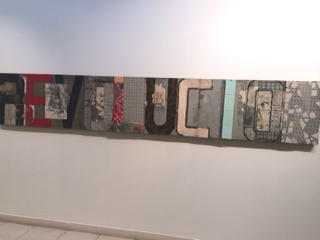 "Revolucion" by Alejandro Aquilera, National Museum, Havana Confirming that point of view, our Cuban tour guide told us, "In general, Cuban people today have no specific religious beliefs. We pick and choose a little from this and a little from that. If we were born after the Revolution of 1959, we have no idea what Christmas represents. Christmas trees are only placed in tourist hotels. Our backgrounds are Spanish, African, English, Chinese. The tribes native to the island were almost completely exterminated when they were used as laborers by the Spanish."
 Art from the Revolution, National Museum, Havana
On a free night, Charley and I walked to Sloppy Joe's restaurant near our hotel. It was an offshoot of the bar made famous by Hemingway in Key West. Hemingway had befriended the owner there and persuaded him to open a second establishment in Havana, where Hemingway had a residence.
 Hemingway's boat dry-docked on the tennis court at his Havana estate We both ordered cheeseburgers. They arrived an inch-and-a-half thick. "Could we have some ketchup, please?" Charley said.
"I'll look," the waiter said in English.
He came back several minutes later. "Sorry, but this is the only one I could find. We don't expect another shipment this week." He handed Charley a bottle of congealed red paste, stuck in the neck of the bottle.
"Cuba is like a 40-watt light bulb," one of our group members quipped.

To be continued...


