
Janice Hardy's Blog, page 77
April 23, 2019
5 Podcasts & YouTubers For the Crime or Mystery Writer
 By Bonnie Randall
 Part of the How They Do It Series
JH: Today's online world offers a tremendous amount of research opportunities for writers. Bonnie Randall shares some of her favorites today.
Want a fun way to learn authentic investigative procedures, build insight into the emotional impact of crime, or maybe just satisfy your own appetite for real life mysteries? Then check out the following—my Top 5 Podcasts & Chans – and how they’ve informed my fiction.
1. Missing Maura Murray
If you are writing about a cold case, particularly about a person who vanished many years ago, then this heart-wrenching, confounding podcast is for you. The case of Maura Murray is filled with a lot of promising corridors leading to no discernable solutions to its escape room, and is an excellent (albeit tragic) example of how a real-life mystery truly can be littered with opportunists, red-herrings, shady characters, and a passage of years with no lucrative leads. Continue ReadingWritten by Janice Hardy. Fiction-University.com


April 22, 2019
Two Reasons Why Your Protagonist Isn't Driving Your Plot
 By Janice Hardy, @Janice_Hardy
 The protagonist is the driving force behind the plot, but sometimes he or she feels just along for the ride. Here's an updated look at why your protagonist might not be driving your plot.
First drafts are often full of holes and weak characters, which is fine since we don’t always know where a first draft will lead. It’s okay for it to be a mess. But once we know how the story unfolds, it’s time to go back and make everything is serving that story.
A good place to start is with the protagonist. Is (s)he driving the story or is (s)he just along for the ride?
First draft protagonists can go several ways, but two common miss-directions are too much time spent in their head and too little. Too much is a draft filled with lots of internalization and thinking out every detail, but not a whole lot of actual doing going on. Too little is all plot and not enough thought to know why any of it matters. For a well-rounded story, you want both.
Continue ReadingWritten by Janice Hardy. Fiction-University.com

April 21, 2019
Sunday Writing Tip: Make Note of What’s Good in Your Writing
 By Janice Hardy, @Janice_Hardy
Each week, I’ll offer a tip you can take and apply to your WIP to help improve it. They’ll be easy to do and shouldn’t take long, so they’ll be tips you can do without taking up your Sunday. Though I do reserve the right to offer a good tip now and then that will take longer—but only because it would apply to the entire manuscript.
We spend so much time looking for ways to improve our writing, let’s take a few hours to notice what we’re doing well.
This week, pick a few chapters of your manuscript at random and highlight the parts that you’re proud of.
It’s easy (and common) to think a draft sucks, but even when it is still in its ugly stage, there’s good writing and strong moments to be found. Find the great lines, the clever plays on words, the gut-punching emotional beats—whatever aspects make you smile and feel good about the work.
Save the marked-up chapters for days when you feel low about your writing to remind you that you do have skill at this.Written by Janice Hardy. Fiction-University.com

April 20, 2019
Real Life Diagnostics: Does This YA Opening Draw You In?
 Critique By Janice Hardy, @Janice_Hardy
Real Life Diagnostics is a weekly column that studies a snippet of a work in progress for specific issues. Readers are encouraged to send in work with questions, and we diagnose it on the site. It’s part critique, part example, and designed to help the submitter as well as anyone else having a similar problem.
If you're interested in submitting to Real Life Diagnostics, please check out these guidelines.
Submissions currently in the queue: Four
Please Note: As of today, RLD slots are booked through May 18.
This week’s questions:
1. Do the opening and closing paragraphs grab your attention and make you want to read on?
2. Is the internalization too much like 'telling' and boring?
Market/Genre: YA Contemporary Fiction
On to the diagnosis…
Continue ReadingWritten by Janice Hardy. Fiction-University.com

April 19, 2019
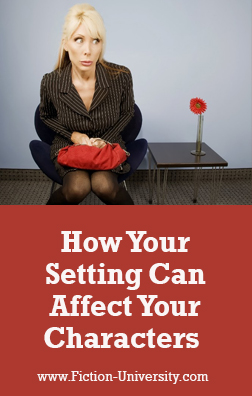
How Your Setting Can Affect Your Characters
 By Janice Hardy, @Janice_Hardy
 This week's Refresher Friday takes another look at how your setting can help you craft better scenes.
Setting is an often underused tool. We all create one, usually more than one, but we don't always take advantage of what the right setting can do for our novels--the setting is just "a place where the novel takes place," not something crafted to serve the story.
This is a missed opportunity, because setting can bring out subtleties in the story and deepen an entire scene. It can evoke both character and reader emotions.
Let's say you have scene where you want your protagonist to feel uncomfortable, because she's confronting a co-worker who just stabbed her in the back at work, and she dislikes both the co-worker and confrontation.
Where would you set it?
Continue ReadingWritten by Janice Hardy. Fiction-University.com

April 18, 2019
Sight with Insight: Maximizing Your Author Senses
 By Sherry Howard, @SherLHoward
 Part of The Writer’s Life Series
JH: A writer’s senses are important tools in crafting fiction. Please help me welcome Sherry Howard to the lecture hall today to share some thoughts on making the most of your senses.
Sherry Howard lives in Middletown, Kentucky, in a household busy with kids and pets. She worked as an educator, and now has the luxury of writing full time. Her debut picture book, Rock and Roll Woods , released in October, 2018. And her middle grade NF, Deep Sea Divers , just released. She has more books in the pipeline for publication soon.
Sherry loves to meet other readers and writers, so be in touch on social media here:
Website | Facebook | Twitter | Instagram | Goodreads
Take it away Sherry…
Continue ReadingWritten by Janice Hardy. Fiction-University.com

April 17, 2019
Raise Your Novel's Stakes by Narrowing the Focus
 By Janice Hardy, @Janice_Hardy
 Making readers care about your story takes more than just creating likable characters. Here's an updated look at handling stakes in a story.
Stakes are critical to every story, because without stakes, readers have no reason to care about what's going on. As interesting as protagonist Bob might be, if nothing he does matters he won't hold interest for long. Even if he does intrigue readers at first, if nothing ever worsens for him, they'll get bored almost as fast. That's why it's so important to keep escalating the stakes in a story.
But escalation is only half of it. The other half, is making readers care about those stakes.
You might be tempted to open with lives in danger, the world about to end, or puppies and kittens in peril. As the adage goes, "Start with the action," and characters in dire straights says, "Look how important this is!" right away.
Continue ReadingWritten by Janice Hardy. Fiction-University.com

April 16, 2019
Writing Realistic Teenagers in YA
 By Jodi Turchin, @jlturchin
Part of the How They Do It Series
JH: The young adult market has been hot for years, and many writers are testing these deep waters. Jodi Turchin visits the lecture hall today to share some tips on writing realistic teens. Please help me give her a warm welcome.
Jodi Turchin is a Young Adult novelist represented by Dawn Frederick at Red Sofa Literary. She’s also a photographer, a high school English teacher, a former actress and director, an Independent Scentsy Consultant, a Younique presenter, and a dog-mom.
Website | Twitter
Take it away Jodi…
Continue ReadingWritten by Janice Hardy. Fiction-University.com

April 15, 2019
Why Conflict Is so Hard to Create in Romance
 By Janice Hardy, @Janice_Hardy
Romances don’t usually have a villain, but there is a strong conflict driving the plot.
The romance genre is an odd mix of writing difficulties. On one hand, it’s easy to write because it has a clear structure and set of goals for every story—get two people to fall in love and live happily ever after. One the other, since both protagonists want the same thing, it’s extremely difficult to create conflict—and plot is created by conflict.
Unlike most novels, there is no mustache-twirling antagonist standing between the lovebirds and happiness. And since the protagonists need to come together in the end, you can’t have one defeat the other. Without these common antagonistic elements, finding a conflict strong enough to drive a plot can be quite the challenge.
Until you realize that most romance novels have a person vs. self conflict.
Continue ReadingWritten by Janice Hardy. Fiction-University.com

April 12, 2019
What's the Problem? The Four Classic Conflict Types
 By Janice Hardy, @Janice_Hardy
This week's Refresher Friday takes another look at the different types of conflict--something I received a lot of questions about at the California Dreamin' Writers Conference I spoke at last weekend.
Conflict is vital to any story, but it isn't always between people, which can be a bit confusing for writers looking for their antagonist. Some stories pit the protagonist against society, or a natural disaster. Others have the traditional hero vs. villain setup.
No matter the genre though, there will be conflict in the story, and understanding what's at the heart of yours will make it easier to write. For example, if you have a person vs. self conflict, you'll know your protagonist will act in ways that are personally harmful, and the plot will show how he or she overcomes that trait or flaw causing trouble in his or her life.
Let's look at the four classic story conflict types and how they define the basic conflict structure.
Continue ReadingWritten by Janice Hardy. Fiction-University.com


