
Janice Hardy's Blog, page 39
October 6, 2020
Do You Wrimo? 5 Fast-Drafting Tips to Get You through November
 By Jodi Turchin, @jlturchin
Part of The How They Do It Series
JH: NaNoWriMo is right around the corner. Jodi Turchin shares tips on fast-drafting your way through November.
Jodi Turchin is a Young Adult novelist represented by Dawn Frederick at Red Sofa Literary. She’s also a photographer, a high school English teacher, an adjunct college professor, and a former actress and director.
Website | Twitter
Take it away Jodi…
Continue ReadingWritten by Janice Hardy. Fiction-University.com


October 5, 2020
Struggling to Start Your Novel? Here's What Makes a Good Beginning
 By Janice Hardy, @Janice_Hardy
 A strong beginning does more than simply start the story.
Writers spend a lot of energy on the “beginning” of their novel, but what they’re really focusing on is the opening. They agonize over the first line, the first page, the first scene, and the first chapter.
Which is all good, as every one of those is important, but they ignore the bigger picture—a strong beginning covers more than the opening line or the opening scene. It’s the entire setup for the novel, and getting the beginning right positions the novel to unfold the way they envision it.
Or as my girl Mary Poppins says, “Well begun is half done.”
I believe this wholeheartedly. Starting strong makes it a whole lot easier to finish strong. The whole beginning establishes what the middle will cover, and sets the expectations for the ending.
Continue ReadingWritten by Janice Hardy. Fiction-University.com
October 3, 2020
WIP Diagnostic: Is This Working? A Closer Look at a YA Fantasy First Page
 Critique By Maria D'Marco
 WIP Diagnostics is a weekly column that studies a snippet of a work in progress for specific issues. Readers are encouraged to send in work with questions, and we diagnose it on the site. It’s part critique, part example, and designed to help the submitter as well as anyone else having a similar problem.
If you're interested in submitting to WIP Diagnostics, please check out these guidelines.
Submissions currently in the queue: Three
Please Note: As of today, critique slots are booked through October 24.
This week’s questions:
1. Are you connected to the main character enough to keep reading?
2. Are there too many character names introduced to keep them straight?
3. Do you have enough setting to ground you in the scene?
4. Is this opening compelling enough to believe the entire story will hold your attention?
5. Is the pacing on point or does it feel slow?
Market/Genre: YA Fantasy
On to the diagnosis…
Continue ReadingWritten by Janice Hardy. Fiction-University.com
October 2, 2020
Why "Start With the Action" Messes Up So Many Writers
 By Janice Hardy, @Janice_Hardy
Sometimes really great advice is anything but helpful.
If I took a poll for the most common writing advice, “start with the action” would make the list.
Which it should, as it’s great advice. But it’s also like saying, “show, don’t tell.” We know we ought to do it, but we don’t always know how, and those four words don’t help us with the beginnings of our novels.
This can be especially hard on new writers, because they might think they’re doing everything right, but still get negative feedback or even rejections on their manuscripts. “I do start with action,” they cry. “Can’t you see that car barreling off that cliff there? What do I have to do, blow up a planet?”
Well, no. Continue ReadingWritten by Janice Hardy. Fiction-University.com
October 1, 2020
The Fascinating World of History, Gender, and Characters in Deborah J. Ross's "Collaborators"
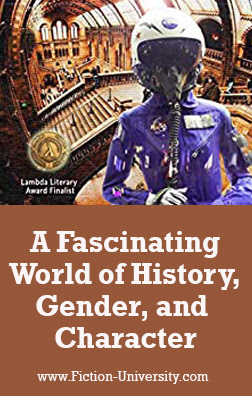 By Deborah J. Ross
 Part of The How They Do It Series
JH: Creating alien worlds and cultures is a staple of science fiction. Deborah J. Ross shares how she developed the world and cultures in her novel, Collaborators.
Deborah J. Ross is an award-nominated writer and editor of fantasy and science fiction, with over a dozen novels and six dozen short stories in print. Her work has earned Honorable Mention in Year's Best SF, and nominations for Lambda Literary Award, Gaylactic Spectrum Award, the National Fantasy Federation Speculative Fiction Award for Best Author, and inclusion in the Otherwise Award List, Locus Recommended Reading, and Kirkus notable new release lists. She has served as Secretary to the Science Fiction Fantasy Writers of America (SFWA) and chaired the jury for the Philip K. Dick Award. When she's not writing, she knits for charity, plays classical piano, and practices yoga.
Her novel Collaborators releases today.
Website | Goodreads |
Take it away Deborah…
Continue ReadingWritten by Janice Hardy. Fiction-University.com
September 30, 2020
5 Ways to Fix Too-Perfect Characters
 By Janice Hardy, @Janice_Hardy
 We all dream about that “perfect person,” but in fiction, perfect people make for bad novels.
Writing has a certain level of wish-fulfillment to it. We envision characters with traits we admire, develop relationships we dream we could experience, and brutally dispose of people who picked on us in high school (maybe that’s me?).
But sometimes in our strive for perfection, we go a tad overboard and create characters we’d probably hate if we met them in real life.
Why?
Because they’re perfect. They have it all—looks, talent, life fulfillment, their friends all love them and they never have to struggle to get through the day. Even if that day requires facing off against a serial killer, a boardroom of CEOs, or a dark wizard with some serious family issues.
Continue ReadingWritten by Janice Hardy. Fiction-University.com
September 29, 2020
How to Get Readers Onto Your Mailing List... And Keep Them!
 By Dave Chesson, @DaveChesson
Part of The Indie Authors Series
JH: A mailing list helps authors connect to their readers, and keeps them updated on their books. Dave Chesson shares how to encourage readers to sign up for your list.
Dave Chesson is the founder of Kindlepreneur.com and creator of Publisher Rocket, a software that helps authors market their books more effectively.
Website | Twitter | Facebook
Take it away Dave…
Connecting with your readers is an important part of being an author, whether you’re independently published or traditionally published. Why? Because staying in touch with past readers gives you the chance to tell them about future books! Continue ReadingWritten by Janice Hardy. Fiction-University.com
September 26, 2020
WIP Diagnostic: Is This Working? A Closer Look at a First Chapter Ending
 Critique By Janice Hardy, @Janice_Hardy
WIP Diagnostics is a weekly column that studies a snippet of a work in progress for specific issues. Readers are encouraged to send in work with questions, and we diagnose it on the site. It’s part critique, part example, and designed to help the submitter as well as anyone else having a similar problem.
If you're interested in submitting to WIP Diagnostics, please check out these guidelines.
Submissions currently in the queue: Three
Please Note: As of today, critique slots are booked through October 17.
This week’s question:
Would this be a good enough dramatic ending for the first chapter to make you want to read more?
Market/Genre: Middle Grade Historical
On to the diagnosis…
Continue ReadingWritten by Janice Hardy. Fiction-University.com
September 24, 2020
Character Creation Made Easy-ish
 By Jacqueline Myers
Part of The How They Do It Series
JH: Figuring out who your characters are is often harder than figuring out your plot. Jacqueline Myers shares tips on how to create characters with ease.
Jacqueline is currently happily at work on her second mystery series (under the pen name, Gilian Baker) while sharing what she's learned with other writers. Using the synergy of personality theory and brain science, Jacqueline coaches writers using a proprietary methodology that helps them overcome their debilitating creative blocks so they can write un-put-down-able books.
If you are struggling, she'd love to see how she can support you! Schedule your free story strategy session here. You can also email her at jacqueline@intuitivewritingcoach.com.
Grab her first cozy mystery, Blogging is Murder, for FREE here.
Take it away Jacqueline…
Continue ReadingWritten by Janice Hardy. Fiction-University.com
September 23, 2020
The Recipe for Writing a Great Scene
 By Janice Hardy, @Janice_Hardy
A great scene is a lot like a great meal. It whets an appetite for more, it fills up the senses, and it satisfies the hunger.
A lot of things can happen in a scene. Plot things, character things, backstory things. We even describe them as “this is the scene where Bob finds the body in the trunk,” as if the scene has one purpose only.
But great scenes subscribe to the other rule of three: Every scene needs at least three reasons for being in your novel.
That doesn’t mean three plot things, however. It means that every scene will accomplish multiple tasks.
It might advance the plot, develop a character, reveal information, describe the world, explore the theme, raise the stakes, up the tension, foreshadow an event, etc. Which three (or more) elements in a scene is up to the writer.
Continue ReadingWritten by Janice Hardy. Fiction-University.com


