
Janice Hardy's Blog, page 32
January 14, 2021
How the Highlighter Tool Can Help You Write Faster
 By Joan Koster, @womenwewrite
Part of the How They Do It Series
JH: Any tool or trick that lets us write faster is a good tool. Joan Koster shares how the highlighter tool helps her write fast first drafts.
When she is not writing in her studio by the sea, Joan Koster lives with her historian husband and a coon cat named Cleo in an 1860’s farmhouse stacked to the ceiling with books. In a life full of adventures, she has scaled mountains, chased sheep, and been abandoned on an island for longer than she wants to remember.
An artist, ethnographer, educator, and award-winning author who loves mentoring writers, Joan blends her love of history, and romance into historical novels about women who shouldn’t be forgotten and into romantic thrillers under the pen name, Zara West. She is the author of the award-winning romantic suspense series The Skin Quartet and the top-selling Write for Success series.
Joan blogs at JoanKoster.com, Women Words and Wisdom, American Civil War Voice, Zara West Romance, and Zara West’s Journal and teaches numerous online writing courses.
Website | Goodreads | Facebook | Twitter | Pinterest | Instagram
Take it away Joan…
Continue ReadingWritten by Janice Hardy. Fiction-University.com


January 13, 2021
The Inner Struggle: Guides for Using Internal Conflict That Make Sense
 By Janice Hardy, @Janice_Hardy
 Here’s an easy way to develop character arcs in your novel.
Years ago, I sat in on an amazing workshop at an RWA conference. Michael Hague's Using Inner Conflict to Create Powerful Love Stories was one of those workshops that discussed a topic I already knew, but he presented it in such a way that I saw a super easy way to apply inner journeys to my stories (something this plot-focused gal can always use).
While the workshop was about romance specifically, the pieces of Hague’s inner conflict template work for any character journey. He calls the overall arc the “journey from living in fear to living courageously.”
Continue ReadingWritten by Janice Hardy. Fiction-University.com
January 12, 2021
Going from Pantser to Plotter
 By Gerald Brandt, @GeraldBrandt
Part of the How They Do It Series
JH: Changing our process can be tough, but sometimes we need to do things differently to meet our writing goals. Gerald Brandt shares his recent switch from pantser to plotter.
Gerald Brandt is an International Bestselling Author of Science Fiction and Fantasy. He is a member of the Science Fiction and Fantasy Writers of America. His current novel is The Rebel – A San Angeles Novel , published by DAW Books. His first novel, The Courier, also in the San Angeles series was listed by the Canadian Broadcasting Corporation as one of the 10 Canadian science fiction books you need to read and was a finalist for the prestigious Aurora Award. Both The Courier and its sequel, The Operative, appeared on the Locus Bestsellers List. By day, Gerald is an IT professional specializing in virtualization. In his limited spare time, he enjoys riding his motorcycle, rock climbing, camping, and spending time with his family. He lives in Winnipeg with his wife Marnie, and their two sons Jared and Ryan.
Website | Goodreads | Facebook | Twitter |
Take it away Gerald…
Continue ReadingWritten by Janice Hardy. Fiction-University.com
January 11, 2021
Is Your Plot Going Somewhere Readers Will Follow?
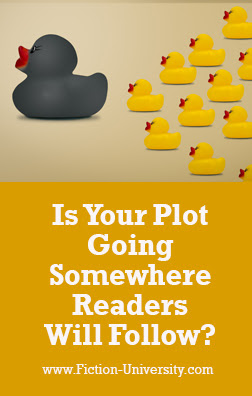 By Janice Hardy, @Janice_Hardy
 Just because you have a plot, doesn’t mean you have a story.
The first novel I ever wrote was all about the plot. This happened, and then that happened, and I explained how these awesome (I thought) characters discovered this cool mystery about the history behind my fantasy world.
It was terrible.
The writing wasn’t half bad, and the idea itself was pretty cool (to me), but there was no story to speak of. My characters followed a predetermined path that explained how a situation came to pass. The surprises and twists came not from what my protagonist did, but only when I decided as the author to finally reveal a piece of information.
This was not a book anyone else wanted to read.
If you want readers to read your novel, give them a plot they want to follow.
Continue ReadingWritten by Janice Hardy. Fiction-University.com
January 10, 2021
WIP Diagnostic: Is This Working? A Closer Look at a Fantasy First Page
 Critique By Janice Hardy, @Janice_Hardy
WIP Diagnostics is a weekly column that studies a snippet of a work in progress for specific issues. Readers are encouraged to send in work with questions, and we diagnose it on the site. It’s part critique, part example, and designed to help the submitter as well as anyone else having a similar problem.
If you're interested in submitting to WIP Diagnostics, please check out these guidelines.
Submissions currently in the queue: None
Please Note: As of today, critique slots are open.
This week’s question:
Does this opening work?
Market/Genre: Fantasy
On to the diagnosis…
Continue ReadingWritten by Janice Hardy. Fiction-University.com
January 8, 2021
4 Reasons Over-Explaining Will Kill Your Novel
 By Janice Hardy, @Janice_Hardy
Don’t let the urge to explain ruin your novel.
Writers have trust issues sometimes. We worry whether or not our readers will get what we're trying to do. Will they spot that oh-so-subtle hint in chapter three? Will they get the subtext between the romantic leads in scene five? Is the protagonist’s backstory clear or should we throw in a flashback that explains it?
We worry so much readers might miss something, we end up shoving the story right down their throats.
And that's bad.
Explaining a novel is not the same as telling a story.
For one thing, it frequently leads to bad writing, because we're explaining what happens, we’re not dramatizing a scene as it unfolds. For another, it robs readers of the chance to discover the story and connect to it on their own level. They’re not given the opportunity to make their own choices and decisions about the characters and story and what it means to them.
Continue ReadingWritten by Janice Hardy. Fiction-University.com
January 7, 2021
5 Options for Creating Your Amazon Ad Copy
 By Beth Whitney
 Part of The Indie Authors Column
JH: Authors are great at writing stories, but we're not always so great at writing ad copy to sell those stories. Beth Whitney shares tips on finding the right words for our Amazon ads.
Take it away Beth...
We’ve all sat staring at that blinking cursor, waiting for the right words to jump into our brains. But as I’ve written for Best Page Forward, I’ve gradually developed some strategies for quickly creating ad headlines. Now the short and snappy taglines are my favorite part of the blurb to work on. I save them for last, like leaving a sweet for after dinner.
Continue ReadingWritten by Janice Hardy. Fiction-University.com
January 6, 2021
5 Places in Your Novel That Probably Aren’t Terrible Enough
 By Janice Hardy, @Janice_Hardy
 With so much at stake, the smart writer takes a closer look at their stakes before they send that manuscript out.
Just a quick heads up that I’m guest posting over at Writers in the Storm today, talking about a simple change you can make to improve your writing success this year. Pop on over and say hello.
I know this is a touchy subject for some writers, but…I love revisions.
First drafts are also fun, but it isn’t until I’ve been through the story once that I see where I can dig in and make it worse.
Yep, you heard me. Worse.
As in, raise the stakes and be as evil to my characters as I can. Because high stakes and personal consequences keep tensions cranked up and the pace chugging along, and that keeps readers glued to the page.
First drafts are all about getting the story down on paper, and we frequently don’t know everything about that story yet. For a rare few, one draft is all they need, but for most of us, several drafts (at least) are required to fully understand the full potential of the conflict. Continue ReadingWritten by Janice Hardy. Fiction-University.com
January 5, 2021
Voice in Fiction – Vague, but Vital
 By Ann Harth, @Annharth
Part of the How They Do It Series
JH: Every writer has their own voice--even if they haven't found it just yet. Ann Harth shares tips on how to develop both your author, and your characters' voice.
Ann Harth writes fiction and non-fiction for children and adults. Strong, interesting female characters creep into many of her books, and many arrive with a sense of humor.
She taught writing for the Australian College of Journalism for eight years before taking the leap into freelance writing and structural editing work.
Ann is the Far North Queensland coordinator for The Society of Children’s Book Writers and Illustrators. She’s had a number of fiction and non-fiction children’s books published in Australia and the UK and over 130 short stories sold internationally.
When not tapping the keys, Ann stuffs a notebook into her pack and searches for remote places to camp, hike or explore.
Website | Goodreads | Facebook | Twitter |
Take it away Ann...
Continue ReadingWritten by Janice Hardy. Fiction-University.com
January 4, 2021
An Easy Fix for a Tighter Point of View
 By Janice Hardy, @Janice_Hardy
 You might be inadvertently pushing your readers away from your novel.
Decades ago, a detached, omniscient point of view was all the rage.
Readers wanted to be told a story, so the stories read as if someone was indeed telling them. That style faded as readers sought a more immersive read, and tighter points of view became popular. The pendulum keeps swinging, and these days, readers read on both sides of the narrative fence.
What does this have to do with point of you, you ask?
Because narrative distance is what makes the different point of view styles feel different.
Regardless of who the narrator is, that’s the “person” readers experience the novel through. A tight first-person narrator, an omniscient third, a limited third, it’s all filtered through somebody’s eyes—their point of view (POV).
Continue ReadingWritten by Janice Hardy. Fiction-University.com


