
Susan Barrett Price's Blog, page 9
October 20, 2014
Roadtrip: Santa Fe NM (Five Things)
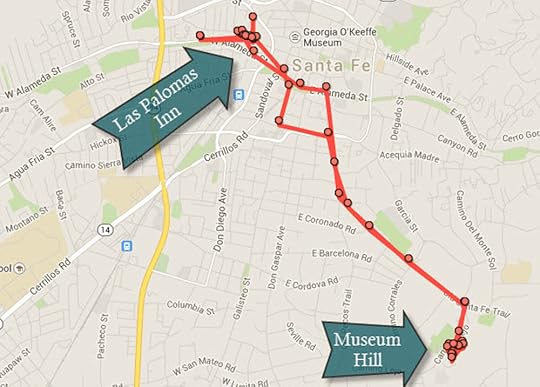 As you can see from the map above, we didn’t travel very far from our campsite today. Five things: – Continue here>>>


October 19, 2014
Roadtrip: Amarillo TX to Santa Fe NM (Five Things)
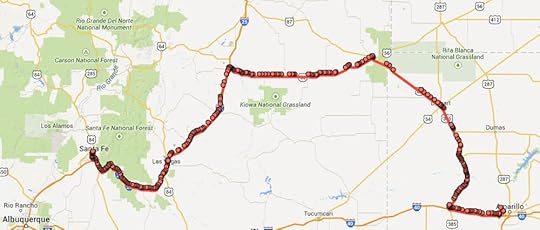 Arrived at Las Palomas about 3:45 PM after the scenic drive above — turning 230 miles into 8 hours. So… Wine poured. Computer fired up. Photos downloaded from cameras. Hail storm outside. – Continued here>>>

October 18, 2014
Roadtrip: Catoosa OK to Amarillo TX (Five Things)
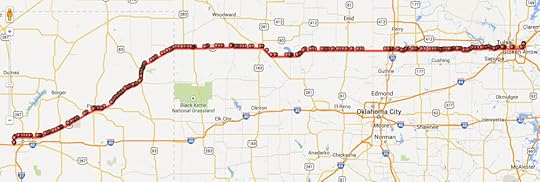
Five things about today’s 381 miles (by our odometer) — or 353 miles by Google tracking (map above):
1. Oklahoma Route 51 west of Tulsa takes a while to graduate from Tulsa/Oklahoma City exurbia. But after the intersection with US 81 it settles down to the land of pickup trucks, wind turbines, and small cattle herds. Giant herds of wind turbines — a sight to behold.

October 17, 2014
Roadtrip: St. Louis MO to Catoosa OK
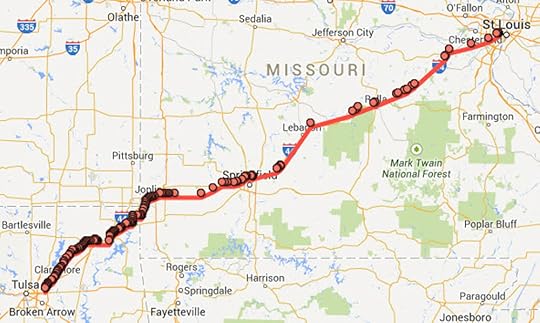
Getting my computer organized to do some “Mad” entries while we travel. Discovered that Google keeps track of my every move, so with a quick visit to maps.google.com/locationhistory and a screen capture (see above), I have an automatic map of our day’s travels, including the report that we traveled 343.783 miles.* Cool, in a creepy sort of way. – Continued at: Mad In Pursuit >>>

October 10, 2014
Fun with Soft Scrub (With Bleach!)… Results May Vary
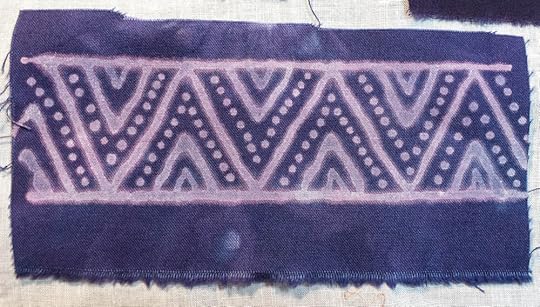 Did you know… That you can iron down the shiny side of grocery-store freezer paper to make a stencil on cloth? That art stores sell little teensy plastic squeeze bottles with very fine little nozzles? That Soft Scrub With Bleach (cream not gel) makes a great “discharge paste” to bleach designs into cotton? – Continued here>>>

October 9, 2014
Learning More About Hand-Dyeing Cloth
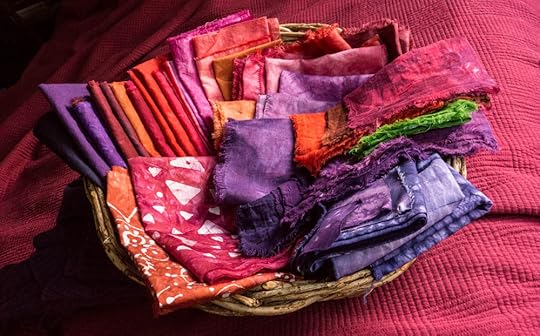
hand-dyed cotton and linen
In September I transferred my dye station from kitchen/deck to ground floor study/utility room. The ambiance is less “summer fun” and more “mad scientist.” I said before that hand-dying cloth is like cooking — many recipes to get the same “chicken soup.” Unfortunately, the cookbooks are few and far between.* Upshot: no choice but to experiment. Want a color? Buy some “fiber reactive” dyes, mix tiny amounts in various proportions and use them like ink on watercolor paper to start your own recipe sampler. But don’t forget to wear a face mask or respirator when handling dye powder. – Continue here>>>

October 8, 2014
Patchwork Scarf: Kitty Mom’s Roses — Revised
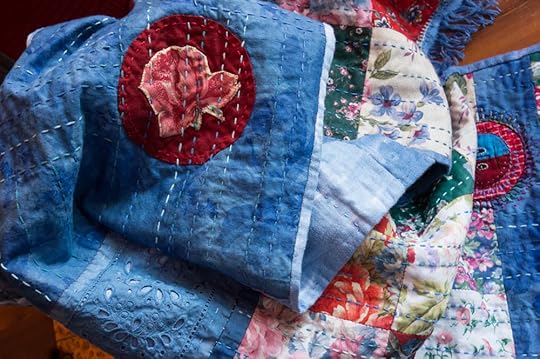 [cont'd from 7.29.14] I loved my rosy scarf but it turned out shorter than I intended. A couple people said what a nice table-runner it would make, which was not what I was after. If there is anything I learned from my coursework with Jude Hill, it’s “as ye sew, so shall ye cut asunder.” Or as Bill Cosby said, “I brought you into this world; I can take you out.” So… I laid my ruler across the center point of the scarf, picked up my rotary cutter, and (with apologies to King Solomon) sliced my baby in half. – See more at: http://madinpursuit.com/Journal2014/20141008.html#sthash.gi6amTDU.dpuf

September 9, 2014
Digging the Dog Tooth Beads
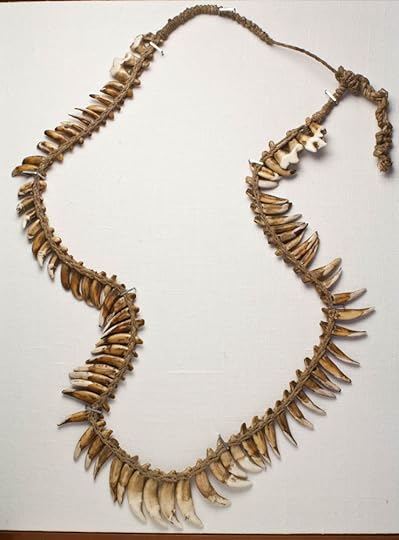
I bought this strand of “beads” in 1997 at the Sapto Hudoyo gallery in Yogyakarta, Indonesia. Yogya was smaller and more old-fashioned than Jakarta, which thrilled me. I had been reading The Year of Living Dangerously since we’d arrived. The story takes place in 1965 in Jakarta, before Friendship Circle was hemmed in by skyscrapers. I was disappointed that we’d missed a more colorful place.
But in Yogya, the old traditions were still mainstream. You could still travel the streets by becak, a human-powered two-person vehicle (a.k.a. rickshaw). We saw a traditional shadow-puppet show — the wayang kulit — where good and evil battle it out amid the clanging and chanting of the gamelan orchestra. Outside the city, we visited the ancient world heritage sites of Buddhist Borobudur and Hindu Prambanan and felt like religious pilgrims. Continued>>>

September 4, 2014
Shibori with Traditional Japanese Stitching (Part 2)
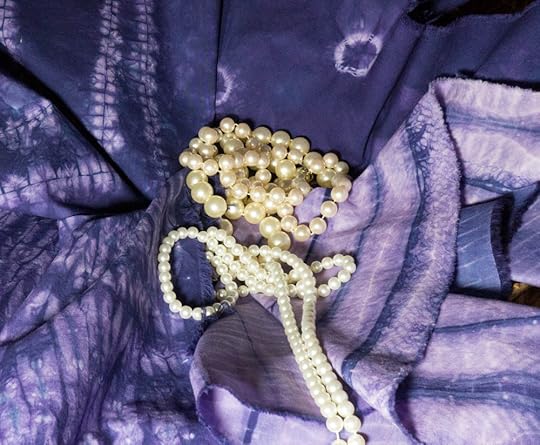 Dyeing cloth is like cooking. You can find dozens of recipes for, say, Irish soda bread — the ingredients are roughly the same, but the proportions vary. There is no correct recipe, only the one you like best. And you collect your favorites. Realizing this has eased my frustration about finding the exact recipes for how much Procion MX dye to mix with a quart of solution. In the end, only experimentation will give me the shade of purple or red or green that my heart desires. And I better keep records. Continued here >>>

Shibori with Traditional Japanese Stitching (Part 1)
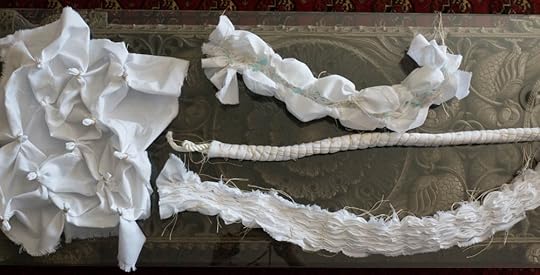
The standard way to teach folks the joy of creating their personal statement on fabric is through good old 1960s-style tie-dye. Scrunching or folding fabrics and holding them in place with clamps or rubber bands prevents the dye from seeping into the bound portions and creates a design. “Resists” — whether by wax (as in batik), by flour paste, or by folding/twisting/scrunching — are at the heart of traditional fabric beautification.
During our indigo adventures, Jim and I had a good time trying various manipulations. The results were always interesting in a random kind of way. Last time, I tried some of those handy “just-do-this!” instructions but found that the coolest designs only came out on, say, the topmost sections of my folded cloth and weren’t carried through to the insides. What was I missing? Continued here>>>


