Malcolm Blair-Robinson's Blog, page 164
June 17, 2015
Greece: Tempers Fray
As crunch moment draws ever closer, tempers are fraying both in Greece and all across the eurozone. This could signal the final shouting match which proves agreement is near, or it could demonstrate that agreement is now impossible. There is however a change in the political dynamics of the corners into which Germany and Greece are boxed. The loss of tens of billions German Euros will be hard for Merkel to explain to her taxpayers if Greece defaults and national bankruptcy was not what Tsipras promised his voters. This may just be enough to force both to cut a deal.
The trouble is the deal will be just that. It is unlikely to last and the crisis will return, so in some ways it might be better all round to bite the bullet and accept reality. This is that Greece is bust big time, it should never have been allowed into the Euro in the first place and having let it join it should never have been allowed to borrow so much. Because there was nobody in charge of this ungoverned currency and because the system of governance in Euroland generally suffers from an acute deficit of democratic legitimacy, one thing led to another with nobody calling the shots. When shots finally began to be called they all came from Berlin, which set out such strictures of fiscal puritanism that none of the measures which might have helped were applied in time.
What is now left if the day is to be saved and not just deferred, is a write off of 75% of Greece’s debt and a quantitative easing programme to reboot the Greek economy. The process would keep Greece in the euro and a side effect will be to devalue it. That would help re-energise the whole euro economic zone. Germany will never agree, so the alternative is for Greece to default and re-issue the drachma with the IMF supporting, together with the World Bank, the financial reconstruction of the Greek economy. Germany will not like that a lot either. What must not happen is a marginal haircut and tinkering around with repayment dates coupled with more loans. That will not work and to attempt it would be just plain silly.


June 16, 2015
Labour Leadership: Move Left To Win
This blog is among those who feel that Ed Milliband should have remained leader during the navel gazing period of introspection which follows political defeats. Once the analysis was complete and the party had an idea where it is headed, it is easier to find the right leader. As it is the line up of candidates, with the possible exception of Jeremy Corbyn, is one many will find a vintage ensemble of the instantly forgettable. Moreover in lamenting its defeat few in the Labour party understand why it happened. We will now explore this. Some things are clear, though not to Labour.
Defeat came not from a failure to proclaim aspiration, admire entrepreneurs or have a love in with business. It came because Labour has ceased to promote the interests of the mass of the working people; by this I mean all those whose income is derived from working for others and whose salaries and wages have a glass ceiling, otherwise costs are out of control, but without whose contribution there is a collapse of civilised and commercial society. All these people depend on someone to speak for them and promote their interests, so that they get a fair cut of the cake. This is their bargain with their country. They will keep it running so that the ambitious can aspire, entrepreneurs can risk their all, and big business can compete in a global market.
The source of the defeat was not the Conservatives, who gained barely any new votes and for whom less than a quarter of those eligible voted. It came from the SNP in Scotland in a spectacular electoral massacre and from Plaid Cymru in Wales by syphoning off working class votes from Labour. But in England the blow came from UKIP. Because whereas blue UKIP supporters went back to the Tories in fear of a Labour victory when Cameron promised both a referendum and all sorts of tough action over immigration, red UKIP supporters stayed with Farage. This was in part because Labour was vague about its intentions over both issues, but more because there was a feeling that Labour had turned its back on the working class. This has been an increasing strand made clear by a look at historic figures. The following are the Labour totals for the last six elections.
1992 Kinnock 11.5 m
1997 Blair 13.5m
2001 Blair 10.7 m
2005 Blair 9.5m
2010 Brown 8.6m
2015 Milliband 9.3m
It is easy to see that from the point of Blair’s first landslide Labour’s total votes fell at each subsequent election, although he won two more before Brown’s defeat. It can also be seen that the second highest Labour vote after Blair’s 1997 landslide is Kinnock’s 1992 defeat. 2015 is the first time the Labour vote has gone up in five elections, and that is in spite of disaster in Scotland and losses in Wales. To me this says that as soon as the working class saw the true colours of New Labour in government, large numbers stopped voting.
This is borne out by the turnout. It had traditionally been in the mid to high 70s. In the first Blair re-election it fell off a cliff to 59% and since then it has struggled back to 65%. So the figures suggest the hesitant shift to the left by Ed Milliband was a small step in the right direction. What Labour needs to do to win is not to chase after people who will only vote for them in exasperation if the Tories have made a complete horlicks of their own mission, but to reconnect to the millions who have turned away from politics and democracy because it does nothing for them. That means moving left.
Between 1945 and 1979 the centre moved steadily to the left. Between 1983 and 2015 it has been drifting to the right. But with the gap between rich and poor growing ever wider and productivity at record lows, with numbing financial pressures building up in public services, including health, education and defence, there is a sea change in the air. The centre is ready to move again to the left. Labour now has the opportunity to find a leader who will start the process in England which the SNP have pioneered in Scotland.
The challenge facing Labour is significant. The next election will be fought against a Tory party most likely lead by the charismatic Russian speaking Boris with his populist style, against a backdrop of cash strapped public services and an even bigger gap between rich and poor. Even if the budget is balanced and that is a very big if, the annual cost of the debt mountain will be almost the biggest drain on the national income and the trade deficit will continue to be huge. The economy will still be driven by house price inflation and consumption and it will not have been rebalanced in favour of manufacturing and exports. Productivity will still be low and the skills shortage will be growing. Infrastructure renewal will be close to crisis.
To meet that challenge Labour will have to offer a good deal more than a few macro policies to appeal on the doorstep. It will have to present a new vision of a different society in which the power of the establishment shrinks as the power of the people grows, through economic reform, modernization of democratic institutions and how and where they work, rebuilding the country’s industrial base, its infrastructure and its affordable housing stock to rent (two million of those), its health and social care and the harmony of its multi-cultural society. It will have to have a robust policy about energy generation and distribution and a much less fragmented approach to education. The list of injustices to iron out will be long and growing longer.
So the next Labour leader must have a big vision and be a big hitter. Whoever it is must recognise the era of New Labour has failed the nation and is over. And one more thing. There must be planning for a worst case scenario that by the next general election in 2020 Britain will have left the EU and as a consequence Scotland will have left the UK. We hope not but it may happen.
June 15, 2015
Greece: Is The End Near?
The latest meeting to resolve the Greek crisis has ended without agreement. The rhetoric is now building to prepare the world for a Greek default. Talk of a state of ‘Emergency’ by the ECB should Greece pull the plug reveals that at last the better part of a continent in denial has woken up to where it is headed. Whether anything can now be done is becoming ever more doubtful, not least because both the Greeks and the Germans have backed themselves into domestic political corners which allow neither any further room for compromise. A marginal concession here or there would not be enough. Another fudge is possible, though whether the markets would accept it is another matter. Yet it could be true that the markets have already moved on and that the big damage would be political rather than financial. It may not be long before we find out.
The worst thing for the euro would be for the Greeks to leave it, go back to the drachma and then recover and prosper. Maybe fear of that will make Germany blink.
June 13, 2015






Greece: How Much Longer?
It is difficult to find a rational explanation about the never ending saga of Greece hovering on the threshold of Euro membership. Certainly it is guilty of a reckless period of spendthrift abandon. But that is in the past. When dealing with a whole nation of people you cannot proceed as if with one errant individual. Everyone in Europe, save for those concerned in the financial governance of the eurozone, can see that for whatever reason Greece is bust, and the strictures and demands being made by its creditors in order to provide more money so as to enable Greece to continue to pay them, are politically impossible. It can also be said that lending money to allow worthless assets to acquire notional value, ie Greek debt held by European banks and others, is fundamentally pointless, even dishonest.
Moreover it is clear that the Greek government was elected by a popular mandate which refuses to countenance further austerity in an economy already shrunk by a third and that for outside powers to try and enforce such a programme upon an unwilling people is not only undemocratic, but flies in the face of everything which the EU is supposed to stand for as a democratic union of free people. The driving force of European governance is its richest and most populous power, Germany. Berlin must now pause and consider where it is headed. Not for the first time does it stand in command of a chain of events of which it can easily lose control and in the consequent upheaval it becomes the big loser.
If Euroland proves too inflexible to cut Greece a viable deal to reboot its economy and Greece goes back to the drachma, it will be a blow to the whole of the EU and there will be a period of nervous uncertainty. The likelihood of the UK throwing in the towel and voting to leave will increase. One thing could lead to another. We have been there before and there is something we have learned the hard way. The end is never foreseen at the beginning.
June 12, 2015
Downfall In Downing Street. Corruption and Sex
Set in the mid nineteen nineties, this fast moving 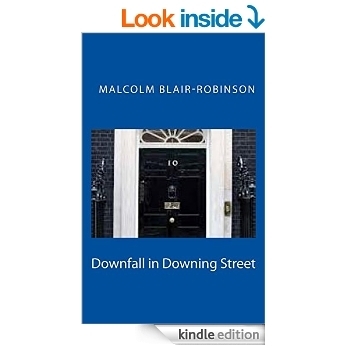 thriller lifts the curtain on sex, sleaze and corruption in high places as the long reign of the government totters to an end, following the ousting of the iconic Margaret Thatcher. The novel catches the mood of those times with a host of fictional characters who engage in political intrigue, sex, money laundering and murder, pursued by an Irish investigative journalist and his girlfriend, the daughter of a cabinet minister found dead in a hotel room after bondage sex.
The Battle of Orgreave
I never voted for Thatcher but I did support her reform of trade union practices which had got out of control in the 1970s and were crippling the country to the detriment of everybody, including trade unionists. Arthur Scargill was a hero to some but to the majority he was an inflammatory hate figure. So public opinion was against the miners and behind Thatcher. Her victory over the miners and later the print unions were among her great triumphs in which she showed a steely resolve wholly lacking in previous governments, both Labour and Tory.
Since then disturbing echoes have emerged. The Scargill claim of a pits closure list, vehemently denied by the government at the time, turns out to be true from recently released Cabinet documents. More disturbing in many ways is the realisation that the police were widely used to support government policy with aggressive and sometimes violent methods against the miners and the Fleet Street unions, which went way beyond their constitutional function of enforcing the law. This has left a bitterness among mining communities whose whole life purpose was centred on the coal mining industry. Central to this are the circumstance surrounding what came to be known as the Battle of Orgreave and the collapse of the subsequent trial of those accused of causing a riot.
The decision of the IPCC not to open an inquiry on the technical point of the time elapsed is disappointing and appears, whether it is or not, an excuse to avoid awkward revelations. The alternative of a public inquiry seems now necessary and rather than let this wound which many ex miners feel remains real and raw, fester interminably, such an inquiry should be held without further delay.
June 11, 2015
Dynamic Quantitative Easing: Learn About It for .99p
An idea to stimulate economic growth without further government  borrowing. Written in plain English and very easy to follow, this is the only really fresh approach out there to the intractable problems of the UK economy, and it is just beginning to be noticed in important places. Buy! Download only .99p Paperback £2.99
City Ethics: The Governor Speaks Out.
Mark Carney is normally measured and careful in his pronouncements; a caution here, a warning there, encouragement too. This made his outspoken attack on the low life ethics in parts of the City, the flaws in markets driven by excess, the controls and penalties which would in future be enforced and above all the demands of the social licence as he called it, which underpins everything through which capitalism prospers in a democracy. Due to changes in the format of BBC rolling news, only clips of the speech were shown. If you have time the whole thing is worth a read over a cup of coffee. Here is a link. MARK CARNEY MANSION HOUSE SPEECH