
Rebecca Bloomer's Blog, page 2
May 26, 2012
Six Sentence Sunday:
This is my first ever post for Six Sentence Sunday. It’s the last six sentences from my current work in progress. I like them and I hope you do too [image error]
I slapped my knees and glared at her across the fire. “What is it with you people and the bloody wind? I can read cards, I can see stuff in water, sometimes I even pull things out of nowhere, but the wind does not and never has, whispered anything to me.”
Right as I finished my tirade, a black feather wafted down from the sky. Laleh reached up, plucked it out of the air and smiled her most angelic smile at me. “Perhaps Aishe, you simply have not listened closely enough.”


May 19, 2012
When Reality & Writing Collide…
[image error]I’ve had one of those moments recently, where what I’m writing collides with what’s happening in reality. What am I writing? The last book in a trilogy about a time-travelling gypsy.
No, I have not stumbled upon the Tardis so I have not, alas, been time travelling. Instead I’ve been watching the arrest of gypsy beggars from Romania, who have moved into Marble Arch, in London.
While writing this Travellers Fate series, I’ve been worried about how it will be received. After all, tinkers, pikeys, gyppos and travellers, nobody likes them (not unless you’re one of them). But that’s not who I’m writing about and it’s not who’s being arrested.
The people being arrested are straight out of Rromania, some of them Rroma (gypsies) and some of them not. It’s a discomfiting thing, to see them pointing to their disfigurements, huddling over their children and pleading for a crust. They’re being arrested because they’re a nuisance, they annoy people and make us feel uncomfortable as we walk past them in our pinstripes and designer scarves.
[image error]But here’s the question…shouldn’t we be uncomfortable? After hundreds of years of hunting, disfiguring, burning and branding them, ought we not feel a little nervous in their presence? Being that we used to cut the ears off their children, is it a surprise that they don’t trust us to educate their babies? Should we be shocked when a population we’ve spent centuries subjugating, finally grovels at our feet as we walk down the street?
Maybe it’s not the beggars who make us nervous. Maybe our consciences see them and recognise a universal wrong. Perhaps it’s an awareness of poverty in the face of our own (relative) wellbeing, that makes us squirm. It’s okay to be discomfited by these things; that makes us human. Putting them in handcuffs and dragging them away? Well…that just means that nothing’s changed.
May 16, 2012
Review Competition
[image error]Okay, I know a lot of people have got UnEarthed sitting on their kindles (Amazon tells me that stuff), either read or unread, and I know that taking that extra step to actually write a review is sometimes just one step too many.
Because I know that people have to put themselves out in order to write reviews, I’ve decided to offer a little incentive.
As you may or may not know, UnEarthed is due for release as a paperback in late May/early June (hello Odyssey Books!). I would like to offer two or three great reviewers, the chance to see their own words in print!
That’s right, you can post your review on Amazon, post it in a comments box on this blog or email it to me via my ‘contact me’ page, or plant it on my Facebook page. However you do it, get your reviews in.
Selected review writers will see their words in print when they receive a signed copy of UnEarthed!
Good luck and happy reviewing.
May 15, 2012
Scene Sequel & The Head-hop Dilemma
I’ve returned as promised, to explain the concept of writing in a scene-sequel format in order to avoid ‘head hopping’. If you want to get a good look at a scene-sequel layout, take a good look at your average romance novel.
Romances aside, since my last post, I’ve encountered several books in which this process of changing POV has ruined a perfectly good story for me. How did it do that? Frankly, I was just confused. I couldn’t keep up with who was telling the story.
In one book, within the first two chapters I’d met at least six characters and heard the story from their POV. In some cases the setting changed, in other cases only the head changed. Either way, I was lost. Neither did I really understand why the POV had changed. There didn’t seem to be a definable pattern for readers to use.
This leads me to my first rules for writing scenes and their sequels:
1)Two characters are the general rule. The chief protagonist gets the scene, their counterpart gets the sequel. In romances usually the female gets the scene, the male gets the sequel. In your book, you choose.
2)With two people the pattern of moving from scene to sequel is easily established, but to help readers (like me) who read at night, give a visual clue as well. Whether it’s the five little asterisks in a row or some more ornate divider use it to help sleepy readers change heads.
This is a single character scene/sequel breakdown. Imagine for our purposes that yellow is Character 1 & Blue is Character 2
The next rules are equally as important but slightly less obvious:3) There has to be a reason for why you’re changing heads and usually that reason is plot progression. In romances it seems like all the writer is doing is giving you insight into character, but if you look a little more closely, the sequel is always reflective, it takes place in a moment after the scene. Yes, it does give insight into the secondary character re motivation etc, but also at the end of the sequel something happens, it’s that something which moves the plot forward and enables the next scene.
4) Each character should have a different ‘voice’. Writing in this method gives insight into characters, so if they all sound the same it makes your characters feel flat and…well…characterless. Use the scene-sequel tool to your best advantage. Flesh out your characters; give readers individual and unique points of view for each character. A sequel should always have a different ‘vibe’ to its preceding scene.
This last rule is probably self-evident but I’m going to say it anyway:
5) Like paragraphs, scenes and their sequels are self-contained stories within your larger story. They each should have an interesting beginning, an interesting middle and a ‘cliffhanger’ end. You’re a writer, so deploy your craft as well as your talent when you take up your tools.
If you’d like to see how your current work-in-progress is succeeding with regard to scene-sequel arrangement, try the following activities.
a) Go through your manuscript and put a scene marker every time you ‘change heads’. If you have scene markers every three or four paragraphs, you’ve either got too many heads or extremely short scenes. Try rewriting a couple of pages without the scene changes. Does it detract from your story when you do? If not, you don’t need the scene change.
b) Some characters POV can be removed simply through the use of crafty dialogue. See if you can use dialogue to overcome the need for a head-hop.
c) Be fair to your readers. Using scenes and sequels to keep readers in the dark regarding clues or motivation, might seem like an ‘easy out’ but really it means you haven’t plotted well enough. See if you can’t drop your hints more subtly without changing scenes.
That’s it folks. Easy peasy. If you’re a reader with an example of great use of scene sequel arrangements, or a writer with questions/advice, please put them in the comment box. I love new ideas [image error]
April 15, 2012
Why Ebooks?
I’m about to rant. I know I promised you some tips on scene-sequel formatting but that will have to wait, because I need to rant. That means you should grab a hold of something solid and prepare for the ride. Why?
Because I am SO tired of hearing the rubbish sprouted about why people read ebooks.
Recently I read an article posted by a Harper Collins representative who made the thinly veiled implication that anybody who reads ebooks, must be lacking in either intellect or discerning taste. In fact, anyone with either of those things stopped following this Tweep when they read the article. After all, I can find Dickens on Kindle, just as readily as I can find new or emerging writers.
Then yesterday, while watching some morning program (truth be told I was eating breakfast, reading emails and watching the program) when my attention was grabbed by a group of women and a journalist explaining that the real reason women love their ebook readers, is that they’re now able to read erotica without displaying raunchy paperback covers in public. Kathy Lette, Aussie feminist icon and writer of great books was part of this group and I was mightily disappointed…until I remembered how easily her participation was probably edited and smushed to suit journalistic purposes (I’m giving you the benefit of the doubt Ms Lette, I hope I’m right)
Grrrrr….
Firstly, it’s appalling to assume and then reinforce the notion that women ought to be ashamed of their reading choices. Secondly if I want to read erotica on a bus, I don’t need an ebook reader to do it! In the days before ebooks, if I was worried about offending old ladies or small children with a racy book cover, I put one book inside another (come to think about it, that’s also what I did in high school).
Let me make this VERY clear. Women’s inhibitions do not explain the popularity of ebooks.
Ebooks are popular because of what they offer readers. Those things are as follows:
1) Budget Books – I can buy an ebook for approximately 1/4 to 1/10 the price of a paperback.
2) Fewer Dead Trees – In ebook circles, paperbacks are currently referred to as DTB’s (dead tree books). If I can save a few trees and reduce my carbon footprint, because my massive library is neither paper, nor shipped from one side of the globe to another…well…yay me.
3) 24HR Service – Should I finish the first book in a series at 2am, I can quite happily wander into the bookstore and buy the next book right then! I am not forced to buy according to the storage capacity or trade deals or even trading hours of my local bookstore.
4) New Authors – When I’m paying between $2.99 and $8.00 per book, I’m much more willing to take a chance on a new author, than if I were paying between $20 and $30.
5) Portability – My ebook reader currently contains about 300 books. Some I’ve read, others I’m getting to. I travel a lot and my library now travels in my handbag instead of costing me extra in excess baggage charges.
I am a writer published in both ebook and paperback format. More importantly I’m a reader in both formats. I don’t appreciate representatives from any of ‘the big four’ (publishing houses), condescending to, or insulting me because I own an ebook reader. Furthermore, I can’t see how this process of denigration facilitates any kind of victory on their part. They sell ebooks too! Alienating readers can’t be good for business (lord knows it’s not good for my blood pressure).
So, I’m proposing a revolutionary idea. Let’s live and let live. If you love your DTB’s and can’t imagine life with an ebook. Well, yay you. If you’re a devoted ebook fan, then good for you. Anyone on the spectrum in between, I applaud you good reader, for engaging your mind and reading a BOOK. I hope it’s a good one. I hope you enjoyed it. I hope you tell your friends about how great the book is. Because it is the story, the narrative, the information and all the ideas it inspired within you, that is the important thing about a book…NOT what format it came in.
March 28, 2012
It’s My BIRTHDAY
March 19, 2012
A Window & A Point Of View
In my former life as an English teacher, I was once required to teach my class of Turkish students about Point Of View (what we authors happily abbreviate to POV). We were reading Death Of A Salesman at the time, and my kids were often confused when scenes flipped from present to past.
Following my fairly longwinded explanation of POV — in which I tried to explain that despite these changes in time, the POV was still that of Willie Lohman— one of my beautiful students put up his hand and said “It’s like looking through a window. We can look in, or we can look out, but it remains the same window.” Thus I was effectively redundant for the rest of the lesson.
The window analogy was, of course, perfect, especially as we so often consider the eyes to be the windows to the soul. If we are looking through the eyes of Willie Lohman, we can look inward or outward, but we cannot see through someone else’s eyes.
Why does this matter to us as writers more than it does to English teachers (and it matters quite a bit to English teachers, I must say)? It matters because choosing the correct POV for a story, and then maintaining that POV is vital to the continuity and understandability of the story you’re writing.
The first step to mastering your POV is to choose the character best able to tell your story for you. Whether you write in the third or the first person, it’s still necessary to choose ONE character. I got a great laugh recently, when I read The Guide To Writing Fantasy & Science Fiction by Philip Athans, in which he says “In my mind there is no difference between third person omniscient and third person lazy.” In other words, pick a character from whose POV the story will be told…and work with it.
I have to say, for my latest book UnEarthed, I was tempted, so very tempted, to slip in, at the last minute, a POV different from the rest of the book. I resisted because it would have been cheating. It would have ruined the flow of the book and it would not have worked. It didn’t help when my editor said “I’d love to read the scene where Astrid…”. I took a deep breath and said “I could do that, but then I’d have to rewrite the rest of the book offering Astrid’s POV throughout the whole thing. I think that might ruin the story, don’t you?” So we didn’t do it, and I’m glad. (I am however, saving that scene as an extra for my website)
I also read that Markus Zusak rewrote The Book Thief a number of times. Each time, he was trying out a different POV. Finally when he stumbled on Death as the narrator, he knew he was onto something great.
So rules for POV,
Step One: Choose your weapon
Step Two: Hone it. An appealing POV requires a believable voice. You only get that by getting to know your narrator.
Step Three: Remain loyal. Once you’ve chosen your POV, you can look only through their window. You can open the window for a smell. You can hang out of it and dangle from the ledge. You can touch things through it. You can look out the window, or in through it, but you may not hijack anyone else’s window.
The only time this rule can be mangled, is if you are practicing a scene-sequel technique. This is a process most common for romance authors (and I’ve written a few of those, so I know), which allows them to tell the story from both a male and a female perspective. It’s a technique you must choose deliberately and deploy thoughtfully; it’s not randomly hopping from one person’s mind to the next with neither method nor indication. In fact, that might be my next blog post…
In the meantime, here’s a little activity. Look at the picture below:
 1) Whose point of view are we seeing?
2) Describe what you see from this point of view.
3) Pretend you are the girl in the window. What does she see from where she is now? What would she see if she stood outside her window and looked back in?
You cannot be the girl and the person on the street. This is the essence of maintaining a POV.
For more about building POV and voice, visit www.anphobos.com
March 12, 2012
Giveaway for a THOUSAND Tweeps…
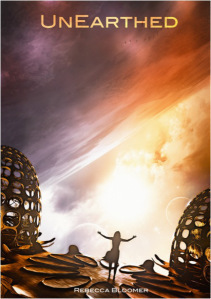
Get UnEarthed for free!
So, I was the person who was never going to Twitter. I swore on my (still living) mother’s grave, that I would never, EVER Twitter. People, I argued, should be able to live without advertising their lives. What happened? Ummm…I read a book explaining that people need to get to know you in order to want to buy your book. So I began an experiment. My experiment grew. I got to know my Tweeps. Their comments and observations made me laugh, think and umm…buy books.
Obviously interacting with my Tweeps has not replaced my face-to-face interactions with people geographically close to me, but it did expand my horizons.
Today, I discovered I have one thousand, that’s right ONE THOUSAND Tweeps. That’s not a lot, really. Some people have squillions, but for a girl who was never going to Twitter, and who has been forced by her Tweeps to reconsider several aspects of social media, I think a thousand is quite the milestone.
As such, I’m hosting a giveaway over at Amazon. Click here (or on the cover image) to take yourself off and get a free copy of my book. This offer is for four days only. There are no strings, no catches and I will not be hassling you with follow-up emails or whatever. This is me being happy, excited and feeling like I should give my Tweeps a little love!
March 4, 2012
On Finishing what you start
Advice On Finishing what you start
I once was told that the singular difference between a writer and an author, is that authors finish what they start. You think that’s harsh, no? At first I did too, however the more I think about it, the more I think it’s correct. Lots of people dabble in writing. Lots of them dither about collecting and creating pretty sentences or drawing up plots. Not everyone is willing to go home after work every night and write until eighty-odd thousand words have been planted. That’s to say nothing then, of the editing and publishing process.
There is a lot to be said on this topic and a lot of advice to be given to emerging writers. Some of the best has been summarised and clarified here, at Terrible Minds. If you’re one of those who wants to make the leap from writer to author, I suggest you click the link and see what they have to say!
October 24, 2011
Lost Girls
I'm back from Thailand, my life is slowly returning to some semblance of order and I HAVE blogged. Today though, I'm talking about the 'lost girls' for whom I write. Because that's a blog primarily about writing, I've left it over at my new 'strictly writing' blog, which is here: www.rebbloomer.wordpress.com
[image error]
 [image error]


 [image error]



![[image error]](http://www.rebbloomer.com/wp-content/uploads/2012/05/images.jpeg)
![[image error]](http://www.rebbloomer.com/wp-content/uploads/2012/05/roma_arrest-300x210.jpg)
![[image error]](http://www.rebbloomer.com/wp-content/uploads/2012/05/BookReviewsCG.gif)
![[image error]](http://www.rebbloomer.com/wp-content/uploads/2012/05/scene-sequel-structure5.png)