
Karl Shuker's Blog, page 46
June 8, 2014
KING HARES AND GIANT RABBITS - KEEPING CRYPTOZOOLOGY ON THE HOP!
 Statue of a giant hare at Hay on Wye (© Dr Karl Shuker)
Hares are among the most delightful and enigmatic of British mammals, and down through the ages they have been many things to many people – symbols of fertility, the moon, and Easter, to name but a few. They have also been described in many ways – magical, mystical, and even mad, but never monstrous, surely? However, a number of eyewitness accounts have been filed from various parts of the British Isles that describe mysterious, unidentified animals resembling hares, or even rabbits, but of truly monstrous, massive proportions. What could such extra-large lagomorphs be? Here is a selection of reported encounters with these so-called king hares and giant rabbits.
THE KING HARE OF DORSET
It was to the following mystery beast that the term 'king hare' was first applied. During a lengthy two-month-long hike from the Cotswolds, through the Wiltshire Downs and west Dorset's coastal regions, before ending in Butleigh near Glastonbury in Somerset, by early September 1976 Louise Hodgson had reached the Dorset hamlet of Uploders. She and two gypsy men whom she'd met a little earlier were walking their dogs together along a lonely track there one evening, in search of some hares or rabbits to catch and eat, when they came to a valley, in which they spied a group of about ten hares together – an unusual sight in itself, as these animals are normally solitary at that time of year.
 Brown hares depicted in an engraving from 1892
But even more unusual was the presence of what they initially took to be a roe deer among the hares – until they peered closer and realised to their amazement that it too was a hare, but one of enormous dimensions. They stayed for a while, gazing in wonder at this prodigious creature and keeping hold of their dogs to ensure that they did not chase after it, before finally walking away, leaving behind the king-sized hare and its normal brethren.
THE MEGA-BIG BUNNY OF BANBURY
Banbury in Oxfordshire was the epicentre of a couple of notable sightings in more recent times. The first of these took place one early evening during summer 2005. Driving home to Wendlebury, just 20 miles south of Banbury, Clive Parker observed squatting at the roadside what he considered to be a gigantic rabbit. He estimated it to be as big as a large dog, light brown in colour, with a somewhat pointed face, and sitting on its haunches watching him as he drove past. It took a few seconds for this bizarre sight to register in his shocked mind, but once it did he stopped and swiftly reversed to the spot where he'd seen this creature. Inevitably, however, the mega-bunny was gone.
 A Flemish giant fawn doe, weighing approximately 20 lb (public domain)
Clive Parker was alone when he made his observation, but the second sighting, which occurred on 24 October 2006, featured multiple eyewitnesses. These were Tim Hill, his family, and some friends, who were all taking part in a canal boat journey, travelling north along the Napton-Banbury route. On the highest stretch of the canal, they looked to their right across a sloping field, and spied what they assumed at first to be a deer. Roughly the size of a golden retriever dog, it sported reddish-gold fur, but seemed to have rather big ears for a deer. When Tim's wife Mandy and one of their friends, David, both looked at it through binoculars, however, they were astonished to discover that it was what they later described as a giant rabbit. While everyone was watching it, this remarkable animal bounded away into a hedge close by, and was not seen by them again. They felt that it was too chubby and rounded to have been a hare, and was not like a wallaby or kangaroo either – it was simply like a normal domestic rabbit, but one of decidedly abnormal stature.
THE WOR-RABBIT OF FELTON
Just a few months before the Banbury encounter by Tim Hill and company, a similar mystery creature had been hitting the news headlines much further north, in and around the village of Felton in Northumberland. The first media reports emerged during early April 2006, when twelve disgruntled local gardeners who maintained allotments on public ground in Felton complained that their prized vegetables were being regularly trampled upon and munched during night-time raids carried out by a dog-sized rabbit, black and brown in colour, and which left behind giant-sized footprints bigger even than a deer's. The first sighting had been made in February by one of the gardeners, Jeff Smith, and three other villagers also caught sight of it later.
 Poster for Wallace & Gromit – The Curse of the Were-Rabbit (© USA Theatrical and Worldwide DVD-Video/DreamWorks Animation)
With such reports receiving publicity not only so soon after April Fool's Day but also not long after the cinema release of the Wallace and Gromit film The Curse of the Were-Rabbit, a degree of scepticism was undoubtedly justified, but the allotment gardeners' protestations continued unabatedly, and the evidence of their squashed (and scoffed) produce was there for all to see. In addition, they announced that they were hiring two gunmen to mount guard upon their allotments, and who would shoot the giant rabbit on sight. Thanks to global online interest in this elusive animal, however, which by now had been variously – and amusingly - dubbed Bigs Bunny and the Wor-Rabbit in media accounts, the gardeners' statement swiftly attracted condemnation from readers worldwide. Some even offered to pay for the rabbit's unharmed capture and transportation to them.
Such requests proved unnecessary, however, when on 11 May, Rael Rawlinson, a local 18-year-old student, revealed that a month earlier, while she was driving along a road near to Felton with friends late one night, what she referred to as a "massive, abnormally big" rabbit had abruptly bounded across the road directly in front of them and had been fatally run over by her car. Such was the impact of the collision that her car's bumper had been cracked and was virtually hanging off, and when examined a tuft of rabbit fur was found attached to it. Getting out of her car, Rael had scrutinised the creature's body, which she claimed was at least 2 ft long and was very tall too, but she did not think to salvage it. When she told others what had happened, they visited the spot to find the body, but it had gone, no doubt taken by a fox or stray dog. And as no further nocturnal escapades in the allotments have been reported, it does indeed seem that the Felton mega-rabbit is no more.
KING HARES AND GIANT RABBITS IN IRELAND
Giant lagomorphs are apparently not confined to the island of Great Britain – comparable creatures have also been reported from Ireland.
During the late 1970s, while fishing one day with his father in a rowing boat at Lough Ree on the River Shannon, Morgan C. Jones of Dublin caught sight of what, when viewed through binoculars, seemed to resemble a huge rabbit, on an island in the middle of the lough.
 Irish hares (Archibald Thorburn, public domain)
Almost a decade later, during the mid-1980s, aged in his 30s, Andrew Munro of County Cork was in his mother's garden when, while walking through a gateway, he almost collided with an enormous hare. Standing on its hind legs with ears erect, it was over 4 ft tall as far as Andrew could estimate, and he and the hare stood looking at each other for what seemed like ages, even if in reality it was no more than a couple of minutes. This spell was abruptly broken, however, when Andrew's dog spotted the hare and immediately charged towards it. But with just a few huge leaps, the king hare readily evaded its canine aggressor, showing no fear – indeed, it actually seemed contemptuous of the dog – as it bounded swiftly out of the garden, across the drive, through the fence, and across a nearby field, leaving Andrew's frustrated dog far behind.
IN SEARCH OF IDENTITIES
So what could these most curious of creatures be? As far as the giant rabbits are concerned, the most likely, reasonable explanation is that they are merely escaped or even deliberately released specimens belonging to one or more of the several breeds of giant domestic rabbit that have been developed in modern times, originally for their meat but which have become increasingly popular nowadays as pets too.
 A Flemish Giant alongside an adult Shetland Sheepdog (© Stamastisclan/Wikipedia)
Notable among these breeds is the Flemish Giant, originally bred as early as the 16th Century near Ghent in Belgium. Nowadays a frequently-exhibited show breed around the world and occurring in a wide range of colours, it can weigh as much as 30 lb without being obese, and in overall size is comparable to a cocker spaniel. Another extremely large breed is the Continental Giant, descended from the Flemish Giant. The world's largest rabbit currently alive is a Continental Giant named Ralph, who tips the scale at a truly staggering, non-obese weight of 55 lb!
Click here to view a YouTube video of Ralph, the world's largest rabbit.
There is little doubt that an absconded Flemish Giant or Continental Giant could plausibly explain the Banbury mega-rabbit, and rabbit experts consulted by the irate allotment owners in Felton also consider this a likely explanation for the demised wor-rabbit. Sadly, however, it is unlikely that they would survive long in the wild. Their huge size would readily attract unwelcome, potentially lethal attention from birds of prey, foxes, and stray dogs; and they would have no knowledge of how to avoid motor vehicles, as the Felton wor-rabbit fatally demonstrated.
But what of the king hares? The British Isles is home to two indigenous species of hare. The most common, widespread, and familiar of these is the brown hare Lepus europaeus, which is absent from Ireland as a native species (though it has been introduced into Northern Ireland) but is distributed throughout Great Britain and various offshore islands. One of the world's largest species of hare, it can attain a body length of up to 30 in, plus a tail length of up to 6 in, which means that individuals at the upper end of this species' size range can be as much as 3 ft, and can weigh up to 11 lb, i.e. as big as a decent-sized dog.
 The brown hare (public domain)
As many people do not realise that hares in Britain can attain such notable dimensions, the sight of an exceptionally large hare coupled perhaps in some cases with less than accurate size-estimation skills on the part of its observer(s) may be sufficient to 'create' a king hare. Moreover, there might be individual hares possessing a mutant gene that expresses extra-large body size, or even suffering from a hormonal imbalance that results in gigantism, comparable to various endocrinologically-based conditions recorded from humans.
The second species of British hare is the mountain hare Lepus timidus, which, as its name suggests, is particularly adapted for a montane existence, and famously turns white in winter. It has been introduced into Scotland's Lowlands, many of its islands, and to the English Pennines, but is indigenous to the Scottish Highlands, and also to Ireland - represented here by a very distinctive subspecies, the Irish hare L. t. hibernicus, found nowhere else.
 White winter phase of the mountain hare (public domain)
This is another large hare, only slightly smaller than the brown hare, and all that has been suggested above as explanations for king hare sightings in Great Britain applies equally to such sightings in Ireland too – plus one intriguing additional possibility.
BELGIAN HARES AND PATAGONIAN CAVIES
After Morgan C. Jones had observed a giant rabbit on the island in the River Shannon where he and his father were fishing, his father told him that during the 1940s, a very large domestic breed of lagomorph known as the Belgian hare, much bigger in size than the Irish hare, was introduced into the Irish Republic as a potential food source. Unfortunately, it bred so prolifically, posing a major risk to the ecosystem, that it was subsequently eradicated, with the last specimens having been corralled on the very island where Morgan had seen his giant rabbit – thus suggesting that what he had spied was an elusive, still-surviving Belgian hare. Making this even more interesting is the fact that despite its name, the Belgian hare is not a hare at all, but a breed of rabbit, albeit one bred specifically to look superficially hare-like, hence its name.
 Belgian hare (© Quimby/Wikipedia)
There is also the prospect that some supposed king hares and giant rabbits, especially if only glimpsed briefly, were not bona fide lagomorphs at all, but were instead escapee or naturalised wallabies (there are naturalised populations living in several regions of Great Britain), or even those introduced but successfully-thriving small Asian deer known as muntjacs. One further non-native species well worth considering in relation to this prospect is a very curious South American rodent known as the mara or Patagonian cavy Dolichotis patagonum. It is very commonly exhibited in zoos and wildlife parks, but despite being related to guinea pigs it is extremely hare-like in overall appearance, due to its long limbs and ears plus its general body form and stance.
 As seen here, the mara or Patagonian cavy can look very hare-like (public domain)
Moreover, as one of the world's largest rodents, it could easily be mistaken for a giant hare by observers not familiar with its species, so an escapee mara existing in a given area could certainly explain reported sightings there of supposed king hares or long-legged giant rabbits.
AND FINALLY…
Remembering the hare's many traditional links to pagan lore, the occult, and even Faerie, it is only fitting that the final account of a giant mystery hare documented here is one that seemingly transcends normal cryptozoological boundaries and ventures into the preternatural.
 My figurine of a pixie riding a white hare (© Dr Karl Shuker)
While walking alone one bright summer morning through Windsor Great Park, Sibell Lilian Blunt-Mackenzie, 3rd Countess of Cromartie (1878-1962), saw a bizarre-looking animal slowly approaching her. It resembled a hare, and moved with a typically leporine, loping gait too, but it was huge, as big as a goat! Making it even more caprine in appearance, however, was the pair of curved horns that it bore upon its head. The countess was so astonished by this uncanny beast that she stood motionless, until, as it passed by her, she struck out at it with her parasol – and it immediately vanished! A strange tale indeed, but when dealing with creatures as magical and evanescent as hares, nothing should really surprise us. Or, to put it another way: hare today, gone tomorrow!
 The beautiful (if inaccurately-entitled?) painting A Rabbit Among the Fairies (the 'rabbit' is surely a brown hare!), by the popular Victorian fantasy artist John Anster Fitzgerald
Source acknowledgement: Some of the above reports originally appeared in the readers' letters pages of the British monthly periodical Fortean Times.
 Holding a magical white hare at Easter (© Dr Karl Shuker)

June 2, 2014
BLUE LIONS OF AFRICA AND ASIA
 Computer-generated image of a blue lion (© Dr Karl Shuker)
Welcome to the 400th ShukerNature blog post! To celebrate this milestone, I now have pleasure in presenting a creature that is unusual even by ShukerNature standards!
In various of my books, articles, and ShukerNature posts concerning cryptozoological and mythological big cats, I have documented lions of many different hues and shades, including black lions (click here , here , and here ), white lions (click here ), grey lions, red lions, golden lions, and even an alleged green lion (click here ) – but never a blue lion. Blue tigers, yes (click here ) – blue lions, no. Until now, that is.
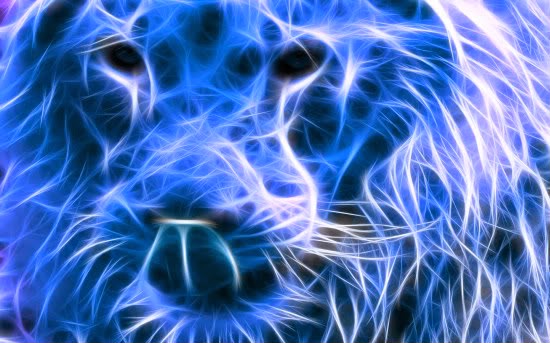 Fractal blue lion (© Artisenems)
 Within the past fortnight, however, I have encountered two entirely independent sources of blue lions – one from Africa, the other from Asia. So here they are.
The first is an African folktale contained in a fascinating, beautifully-illustrated book that I recently purchased. Entitled Fabulous Beasts: Myths and Legends and published in 1994, it is the English-language edition of an original French book - Les Animaux Fantastiques (1991), written by Claude-Catherine Ragache, and illustrated by Marcel Laverdet.
 Fabulous Beasts: Myths and Legends
(incidentally, the monkey riding the blue lion in this book's front cover illustration is actually from a different folktale in the book, not from the one featuring the blue lions) (© Cherrytree Books/Marcel Laverdet)
Fabulous Beasts: Myths and Legends
(incidentally, the monkey riding the blue lion in this book's front cover illustration is actually from a different folktale in the book, not from the one featuring the blue lions) (© Cherrytree Books/Marcel Laverdet)According to the folktale in question, at the bottom of a certain great river in Africa lives a pride of lions with deep blue fur. These exotic felids seek out their prey on land each evening, and whatever – or whoever – they capture is then brought back by them to their underwater den, and stored inside one of many huge glass jars that serve as their larder. One day, they captured a newborn baby and duly placed it, still alive, inside one of their jars, to be devoured later. Devastated, its distraught mother flung herself into the river, but when her husband learnt what had happened, he dived in and followed her footprints along the river bed (this river possesses magical powers that prevent anyone entering it from drowning). He soon found her, so together they then trekked to the den of the blue lions, cautiously entered it, and found the jar containing their baby. But before they were able to rescue it, one of the blue lions caught sight of them, and forced them inside the jar too.
Fortunately, however, the husband had brought with him a magic ngona (antelope) horn, which, when he pointed it at each of them, so reduced them in size that they were all able to crawl inside the horn and remain hidden there. The following day, the blue lion that had discovered the husband and wife came to the jar to take them out with their baby so that the pride could devour all three of them, but the only thing that the lion could see inside the jar was an old antelope horn. The perplexed cat angrily bit it, but instead of the horn crunching up, it was the lion's teeth that shattered! Totally enraged by now, the lion spat the horn out, and with such force that it flew up through the water and out of the river altogether, landing safely on the river bank – where the family swiftly crawled out, regained their normal size, picked up the magic horn, and ran home to their village, with their rescued baby safe and sound.
 A blue lion confronting the husband and wife with their baby – a gorgeous illustration from Fabulous Beasts: Myths and Legends (© Marcel Laverdet)
No specific details regarding the origin of this folktale (other than it is African) is given in the above book. However, African Genesis (1983) by Prof. Leo Frobenius and Douglas C. Fox contains a very similar folktale, which is attributed to the Wahungwe of Zimbabwe. Indeed, the only notable difference is that in the latter version, there is no mention that the water lions' fur was blue.
Although this is merely a traditional native folktale, the annals of African cryptozoology contain many accounts of supposedly genuine aquatic mystery cats, including various ones known locally as water lions - though as far as I am aware, none of them has blue fur!
 A cosmic blue lion (artist unknown to me)
 As for Asia's blue lion: in Buddhism, Bodhisattvas are beings who are seeking enlightenment or are on the path to enlightenment, and are sometimes deemed to be deities. The most significant Bodhisattva, and one of the Lord Buddha's most important disciples, is Manjusri, who is associated with transcendent wisdom. According to popular Chinese mythology, as noted in Patricia Bjaaland Welch's book Chinese Art: A Guide to Motifs and Visual Imagery (2008), consulted by me recently, Manjusri (aka Wenshu in Chinese) has been linked with the five-peaked holy mountain of Wutai Shan in Shanxi Province since the 4th Century, and has supposedly been sighted riding a blue lion in this mountain's higher reaches, above the many temples and monasteries located here.
 Blue lion (© Artisenems)
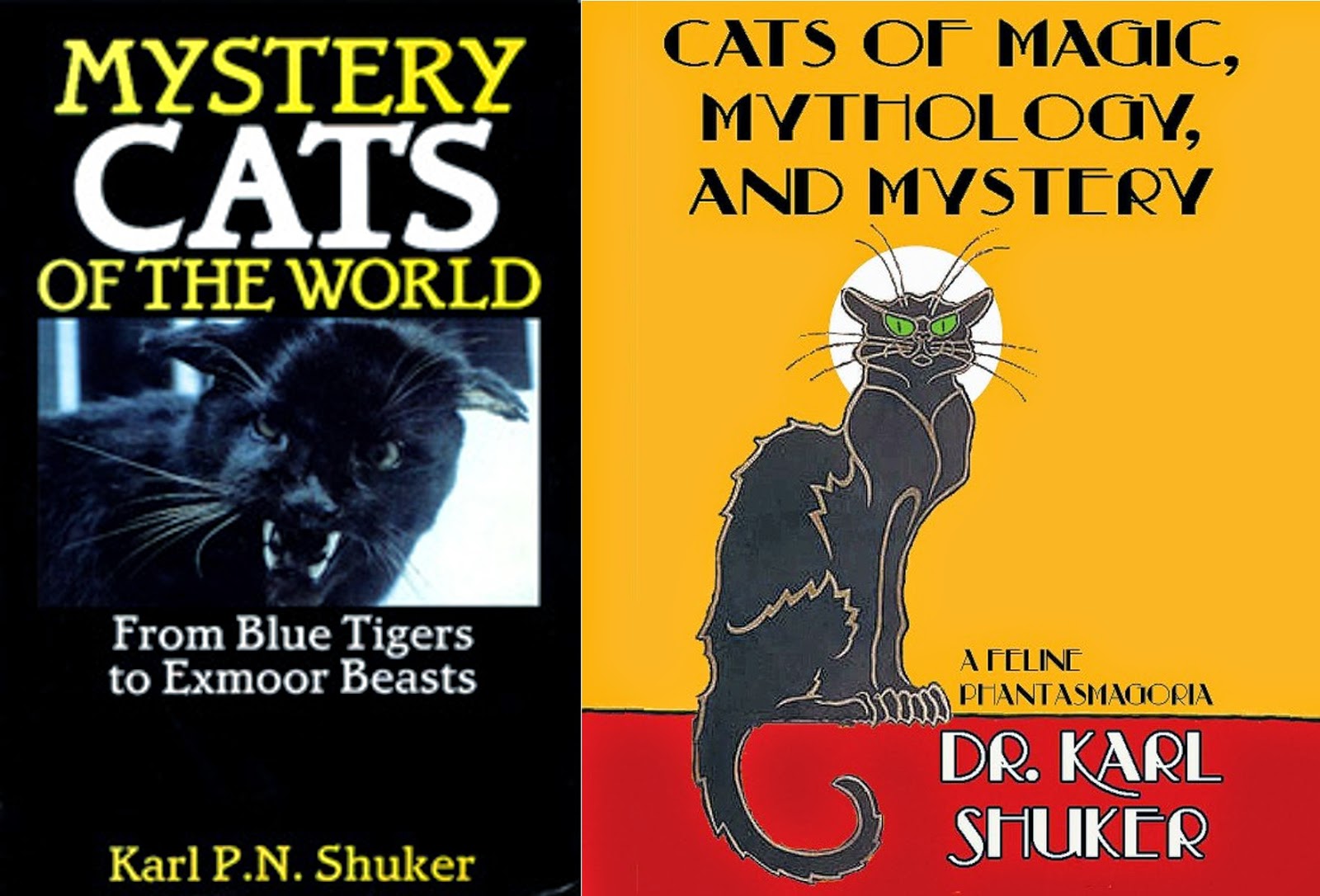
For more information on varicoloured lions, check out my books Mystery Cats of the World (1989) and Cats of Magic, Mythology, and Mystery (2012).
May 27, 2014
JUST ITCHING TO MEET YOU – THE MUHNOCHWA OR INDIAN SCRATCH MONSTER
 Line drawing of the Indian scratch monster - Schizodactylus monstrosus
Monsters can come in all shapes, sizes - and scratching capabilities!
In 2002, many strange stories emerged from Lucknow, the capital of Uttar Pradesh State in India, concerning a small but macabre mystery beast known locally as the muhnochwa or scratch monster, due to lurid claims that it inflicted vicious scratches and other lacerations upon the body of anyone unfortunate enough to come into contact with it. Equipped with six legs, it was also said to emit light when it flew through the air.
Not surprisingly, zoologists discounted such tales as imaginative fiction or, at best, superstitious folklore – until, during August of that same year, a brave local captured a scratch monster alive, in the district of Lakhimpur Kheri, close to India's border with Nepal, and took it for identification purposes to Lucknow University. Here the mysterious mini-beast, measuring approximately 3 in long, was examined by Prof. K.C. Pandey, head of the university's zoology department, who was able to identify it as the aptly-named Schizodactylus monstrosus – a large and very distinctive species of cannibalistic cricket, mostly found on the banks of rivers.
Its legs all bear a series of pointed, nail-like structures, which can leave faint marks upon the skin of someone handling this curious-looking insect, but they certainly cannot yield the painful, bleeding scratches claimed during the outbreak of 'scratch monster' panic that had preceded this bizarre case's somewhat anti-climactic denouement. Nor can this species emit light.
Clearly, therefore, just like so many other mystery creatures reported before and since, the dreaded muhnochwa owed its existence (not to mention its glowing talent!) far more to media hype and local exaggeration than to anything created by evolution or Mother Nature!
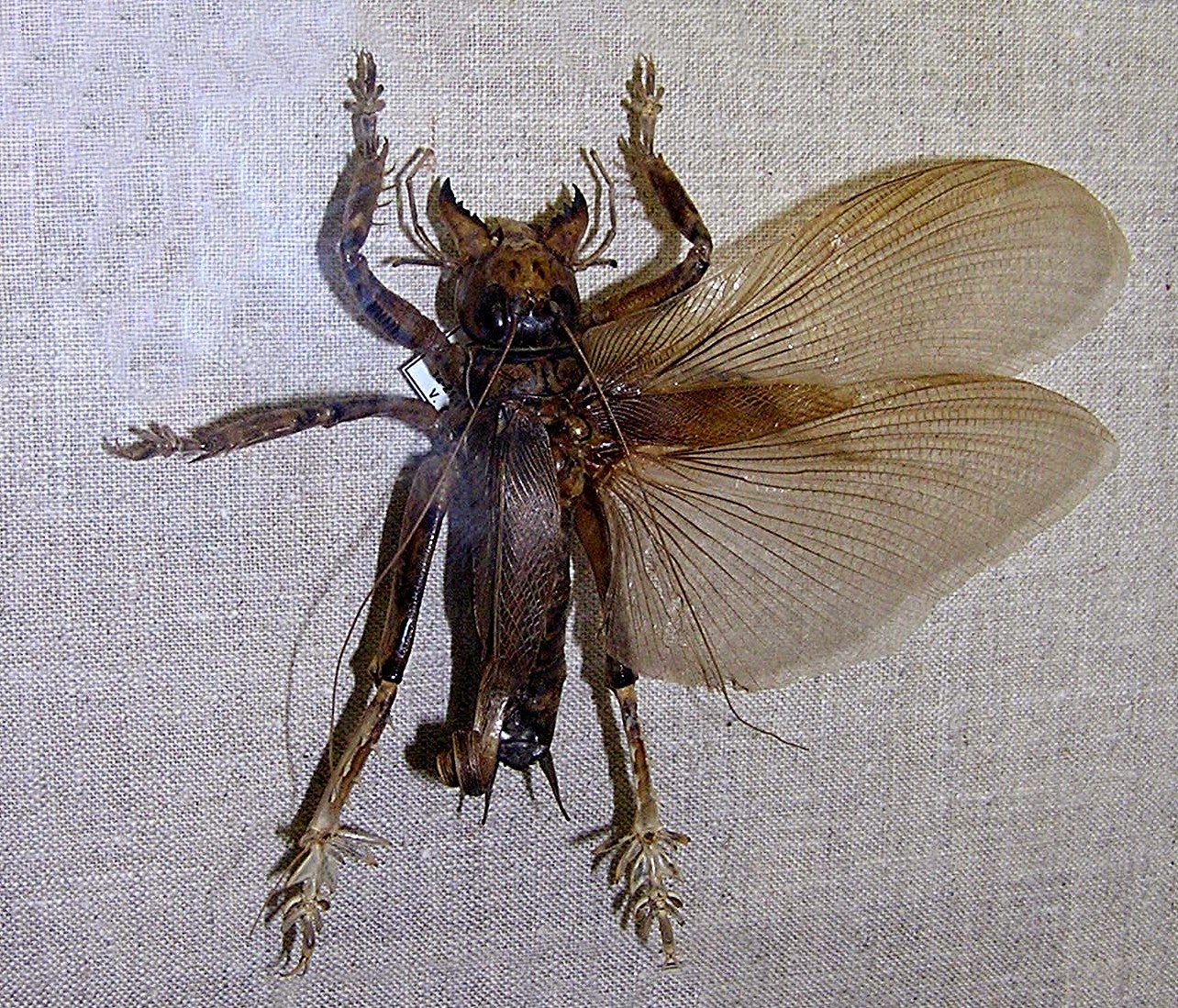 Pinned specimen of
Schizodactylus monstrosus
(© Andrew Butko/Wikipedia)
Pinned specimen of
Schizodactylus monstrosus
(© Andrew Butko/Wikipedia)May 11, 2014
PERUSING THE PEGASI – PLINY'S HORSE-HEADED MYSTERY BIRDS
 Pegasi illustration (© Tony Millionaire)
One of the best-known creatures of classical mythology is Pegasus – the flying horse who sprang into existence (along with his human brother, Chrysaor) from spurts of blood gushing forth from the neck of the snake-haired gorgon Medusa when Greek hero Perseus beheaded her with his sword.
Much less famous than Pegasus, conversely, but often confused with him on account of their similar name are the subjects of this present ShukerNature blog – the pegasi or horse-headed birds, fabulous entities variously claimed to occur in Scythia or in Ethiopia.
 A phalanx of flying horses (© Ezra Tucker)
As I've noted on previous occasions, some of my most productive and interesting investigations are cases that have been initiated by the sparsest of information, sometimes no more than a line or two, or a simple footnote, tucked away and readily overlooked in text otherwise devoted to much more familiar, extensively-documented subjects. I've presented some of these hitherto-obscure cases here on ShukerNature (as well as in articles and comprehensive, often chapter-length coverage in books) - and they include such fascinating subjects as archangel feathers (click here ), Brevet's all-black Malayan tapirs (click here ), the Iberian zebro or encebro (click here ), Sloan's blue rhinoceros (click here ) and Heuvelmans's green leopard (click here ), the exploding worm of Kalmykia (click here ) and the Isle of Wight's gooseberry wife (click here ), flying cats (click here ), flying mice (click here ), flying jackals (click here ), and flying turtles (click here ), the world's only intergeneric elephant hybrid (click here ), Jamaican monkeys (click here ) and Janus cats (click here ), the sukotyro (click here ), the purple macaw (click here ), mirrii dogs (click here ), the night jaguar (click here ), New Guinea penguins (click here ), scarlet bats (click here ) and scarlet vipers (click here ), the antlered snail of the Sarmatian Sea (click here ), stone worms (click here ) and Steller's sea-bear (click here ), white eagles (click here ), shrieking centipedes (click here ), the kuil kaax (click here ), were-worms (click here ), and much more besides.
 A Dictionary of Fabulous Beasts
by Richard Barber and Anne Riches
A Dictionary of Fabulous Beasts
by Richard Barber and Anne RichesAnd so it was that, many years ago when still a teenager, I first learnt of the pegasi (aka pegasy and pegasies) from the briefest of sources – the following single line that appeared in A Dictionary of Fabulous Beasts (1971), written by Richard Barber and Anne Riches:
Pegasi Horse-headed birds found in Scythia; Pliny, who reports their appearance, regards them as fabulous. (118)
In classical times, Scythia was the name given to a region encompassing much of present-day Eastern Europe and Central Asia. As for the bracketed 118, this referred to a numbered reference in this book's bibliography, the reference in question being Dr John Bostock's translation from 1855 of the encyclopaedic Naturalis Historiae (aka Historia Naturalis) - the multi-volume magnum opus of Roman naturalist-historian Pliny the Elder (23-79 AD).
 Title page from the 1669 edition of Pliny the Elder's Naturalis Historiae
I was able to obtain a copy of Bostock's translation via Britain's indispensable inter-library loans service, and I discovered that the lone line documenting the pegasi in the fabulous beasts dictionary by Barber and Riches was simply a paraphrasing of Pliny's original statement - which opened Chapter 70 of his encyclopaedia (a chapter dealing with fabulous birds), and read as follows:
"I look upon the birds as fabulous which are called "pegasi," and are said to have a horse's head; as also the griffons, with long ears and a hooked beak. The former are said to be natives of Scythia,1 the latter of Aethiopia."
The superscript 1 referred to a footnote by Bostock that stated:
"Scythia and Ethiopia ought to be transposed here, as the griffons were said to be monsters that guarded the gold in the mountains of Scythia, the Uralian chain, probably."
Otherwise, nothing new there. (NB - In classical times, Ethiopia referred to much of East Africa, not just the present-day country bearing this name.)
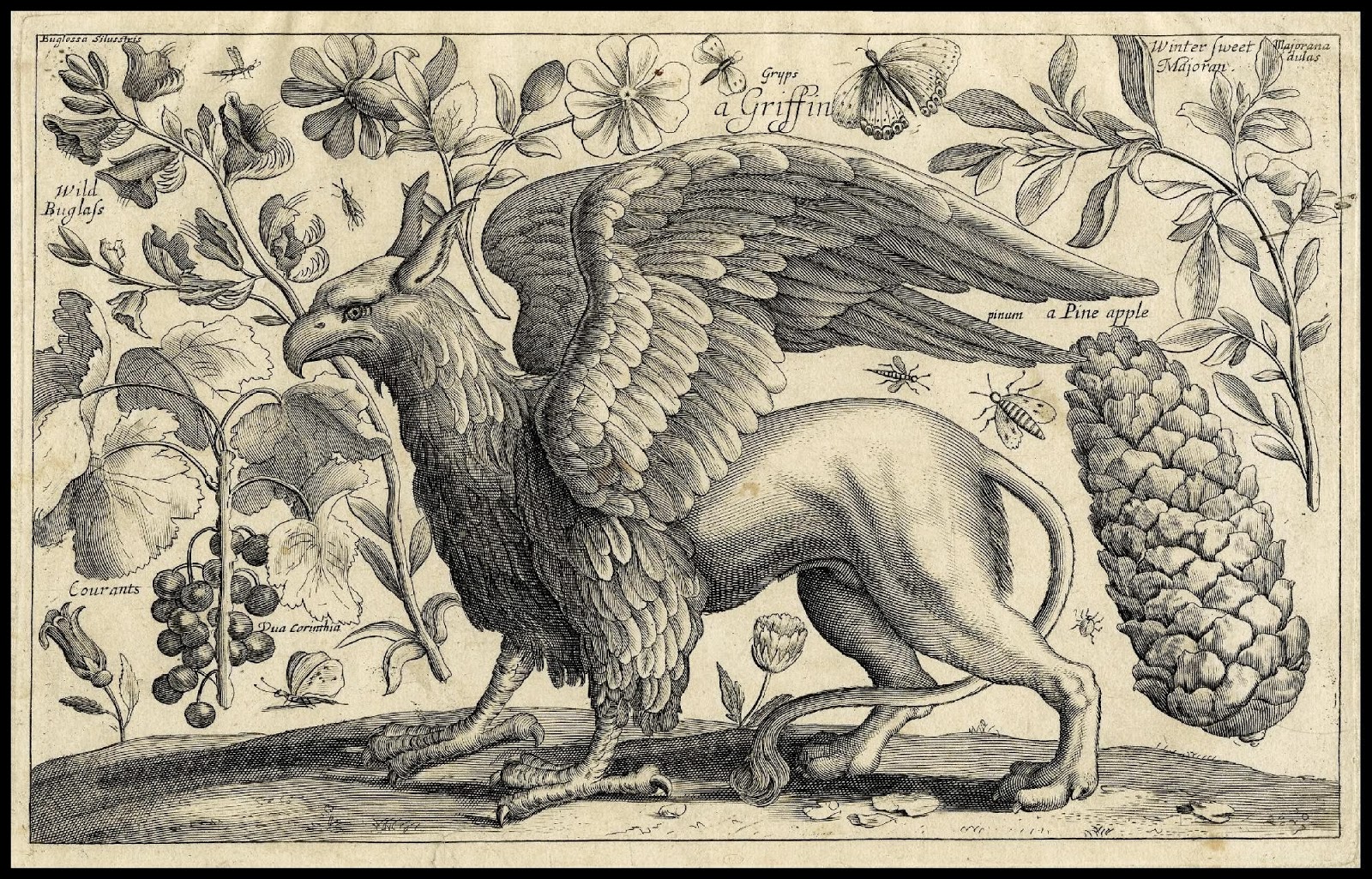 An engraving from 1663 of a griffin with ears
Moreover, despite perusing countless books and published articles on mythological animals in subsequent years, I never encountered any additional mention of pegasi. So the decades slipped by while visions of horse-headed birds periodically flapped on heavy wings across the horizon of my mind but never alighted long enough in my consciousness to induce me to investigate them any further – until quite recently, that is, when, after recalling these semi-equine enigmas yet again, I decided that it was time to pursue the pegasi online. So I did - and here is what I found out about them.
Pliny the Elder was not the only classical scholar to document the pegasi. Preceding his Naturalis Historiae was a short treatise written in c. 43 AD by Rome's earliest geographer, Pomponius Mela, entitled De Situ Orbis Libri III – which Pliny used as a major authority for the geographical sections in his own publication. And both Mela's treatise and Pliny's encyclopaedia were used as sources of material by the 3rd-Century compiler and grammarian Gaius Julius Solinus in his own master-work, De Mirabilibus Mundi (translated as The Wonders of the World). Interestingly, Pomponius Mela and Solinus merely stated that the pegasi sported horses' ears – it was Pliny who claimed that they were horse-headed. Also, the two former authors reported that these birds lived in or near a lake.
So far, however, whether horse-headed or horse-eared, the pegasi have been deemed to be entirely mythical, with no more basis in reality than their winged steed namesake, Pegasus. But is it possible that they actually constituted a distorted or embellished account of a genuine, bona fide species of bird? In his book Birds in the Ancient World from A to Z(2012), W. Geoffrey Arnott includes a short account of the pegasi, and, accepting Bostock's suggestion in his translation of Pliny's encyclopaedia that these birds were native to Ethiopia, not Scythia, he notes that there are no less than three relatively common species of East African bird with erect, pointed crests resembling a horse's ears that perch in lakeside trees. Namely, the long-crested eagle Lophaetus occipitalis, the spotted eagle owl Bubo africanus, and the white-bellied go-away bird Corythaixoides leucogaster. So could one of these be the identity of the pegasi?
 The white-bellied go-away bird (© Steve Garvie/Wikipedia)
Personally, I consider it improbable that either of the first two species would make a plausible candidate, simply because eagles and owls would already be very familiar birds to classical European scholars, and therefore it seems doubtful that even via several retellings between original observation and subsequent documentation a Chinese whispers process could convert either of these into a horse-eared (or –headed) avian anomaly. Conversely, the third species named might be a more plausible candidate, because go-away birds would be far less familiar to European scholars as they are confined entirely to tropical Africa, and are totally unlike any European bird in appearance. Consequently, a go-away bird's appearance could become distorted much more readily by the Chinese whispers process (click here for a ShukerNature article concerning go-away birds). Ultimately, however, it seems unlikely that we shall ever know for certain whether the pegasi do have a basis in ornithological fact as well as a presence in classical fable.
 Man riding a hippalectryon - damaged depiction on the interior of an Attica black-figure lip cup, 540–530 BC (public domain)
Interestingly, the pegasi are not the only horse-birds on record. There is also the hippalectryon to consider. No less obscure than the pegasi, this yellow-plumed composite beast from ancient Greek folklore is variously said to have combined the wings, legs, and tail of a cockerel (most frequently), an eagle, or a giant vulture with the head and forequarters of a horse, and could apparently be tamed and ridden by anyone brave enough to attempt this daunting feat. It is represented, sometimes bearing a bold rider, in several pieces of ancient art, including vases, statues, and coins, most commonly dating from the 6th Century BC; but the oldest known example - an askos (liquid-pouring pottery vessel) from Knossos - dates from the 9th Century BC.
Finally: horse-bird composites are assuredly the stuff of dreams, especially any dreams that can be designed by those skilled in the illusive arts of Photoshop - so here is a truly delightful example to leave you with:
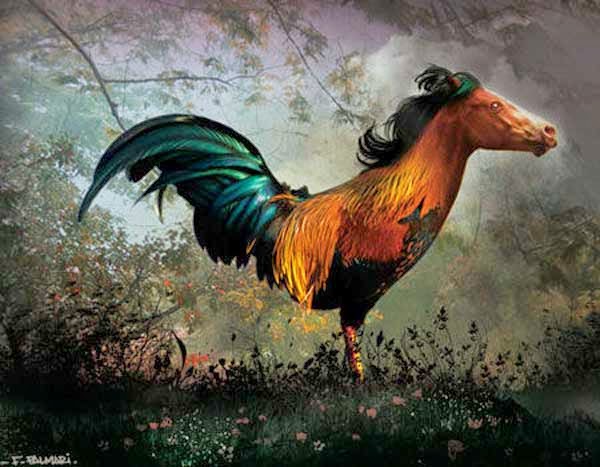 (original source/copyright owner unknown to me)
May 9, 2014
FROM BIG BIRDS TO BIGFOOT - DIATRYMA AND A VERY CURIOUS CRYPTO-DILEMMA
 Zdeněk Burian's famous artistic reconstruction of Diatryma [=Gastornis]giganteus (© Zdeněk Burian)
It was back in July 1997 when a curious snippet that apparently featured a while earlier on the internet (possibly in the Virtual Bigfoot Conference website) was brought to my attention by English palaeontologist Dr Darren Naish. However, its mysterious claim is still unverified today, so I'm posting it here on ShukerNature in the hope that readers may be able to help me finally resolve this very curious but highly intriguing crypto-dilemma.
As far as Darren could recall, the snippet claimed that several sightings had been made, the most recent during 1975, of a 7-ft-tall bird in the Mount Adams area of Washington State, USA, and which had been likened to a giant brown bird, called the pach-an-a-ho' (variously translated as 'crooked-beak bird' or 'rough-looking bird'), from traditional Yakima legends.
 Two Diatryma giganteus models photographed in Reutlingen, Germany, in 2003 (© Markus Bühler)
In addition, a party of Native Americans apparently visited a certain American museum not long before the snippet appeared online, and became very excited when they saw a life-sized reconstruction of a giant species of flightless, putatively predatory anseriform bird from prehistoric (mid-Eocene) North America called Diatryma [aka Gastornis] giganteus, because they claimed that this was the pach-an-a-ho'.
Sources informed me that issue #20 (August 1992) of the Western Bigfoot Society's newsletter, The Track Record, may include details concerning all of this. However, in April 2010 I learnt from American cryptozoologist Chad Arment that in fact this issue does not contain any mention of such a bird.
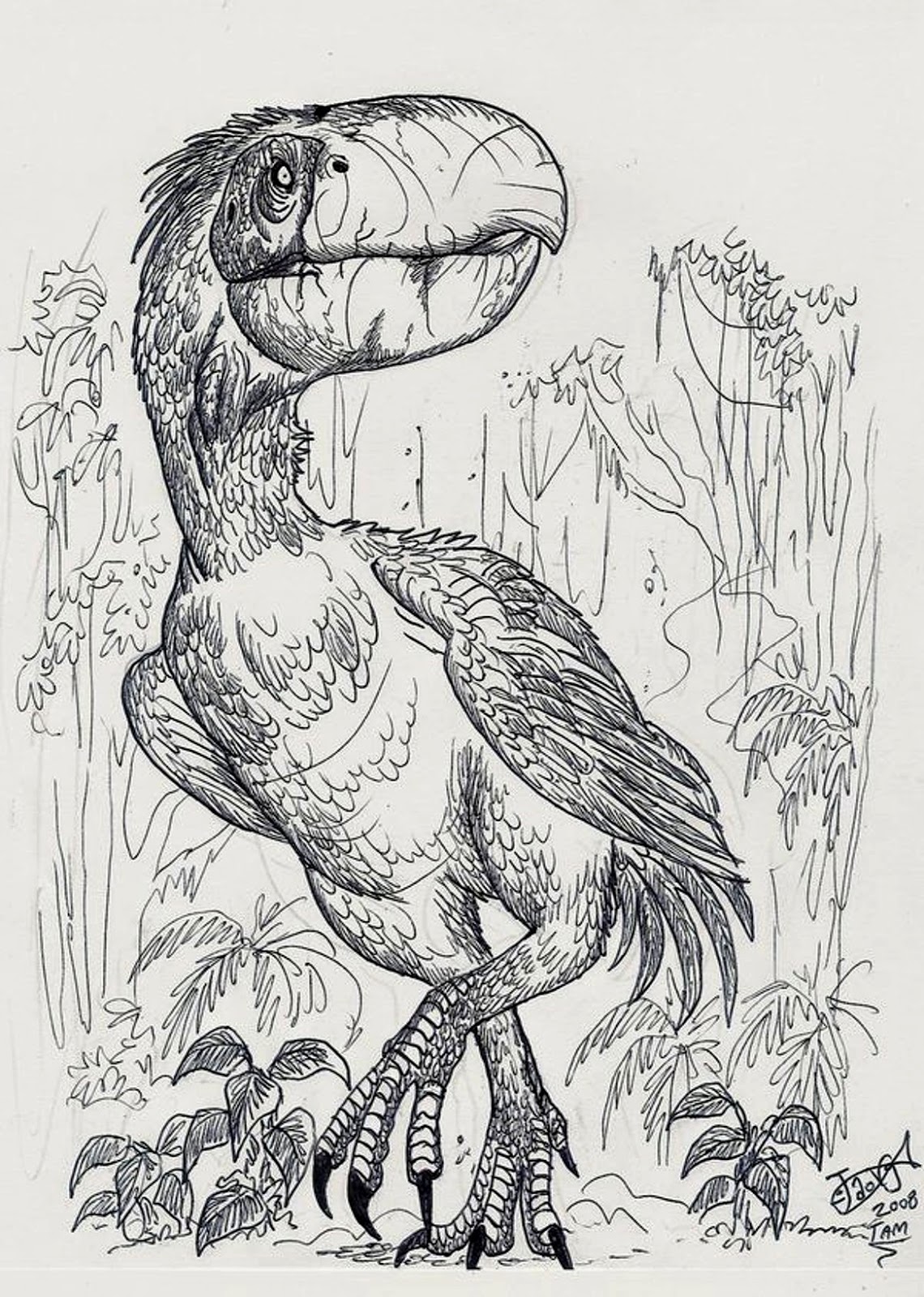 Diatryma giganteus
(© Justin Case aka HodariNundu/Deviantart)
Diatryma giganteus
(© Justin Case aka HodariNundu/Deviantart)As for Diatrymareconstructions, the only one that I am aware of in the USA was a diorama featuring two adults and a chick that was housed at the California Academy of Sciences, but it is no longer on display there.
Needless to say, I don't believe for one moment that there is a contemporary Diatryma dynasty stalking the slopes and environs of Mount Adams in scientifically-undisclosed seclusion, but the whole saga is undeniably intriguing - curiouser and curiouser, in fact, as Lewis Carroll's Wonderland-exploring Alice might well have said, had she been aware of it. Consequently, if any ShukerNature readers can shed further light upon this mystifying case, I'd greatly welcome any details.
 Diatryma giganteus
portrayed upon a postage stamp issued by the Yemen Republic in 1990
Diatryma giganteus
portrayed upon a postage stamp issued by the Yemen Republic in 1990For an extensive chapter devoted to Diatryma and other gastornithids plus the formidable phorusrhacids or terror birds, see my latest book The Menagerie of Marvels: A Third Compendium of Extraordinary Animals , to be published this coming summer by CFZ Press, and featuring a spectacular front cover by internationally-renowned Dark Artist Sam Shearon showcasing a monstrous terror bird in all its magnificent ferocity!
This ShukerNature blog post is an expanded, updated excerpt from my book Karl Shuker's Alien Zoo: From the Pages of Fortean Times (CFZ Press: Bideford, 2010).

May 8, 2014
IS THE MÜSHMURGH A MISH-MASH? - ORNITHOLOGICAL MYSTERIES IN INDIA AND IRAN
st1\:*{behavior:url(#ieooui) }
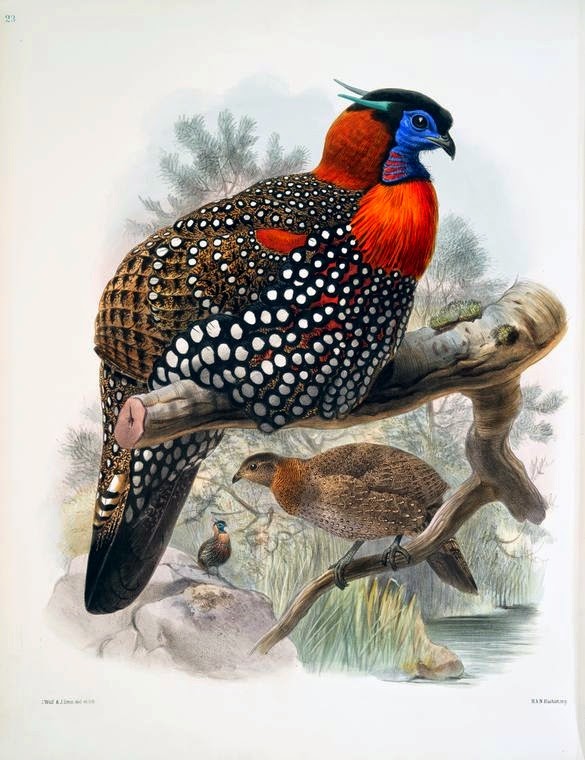 Western tragopan (male in foreground) painted by D.J. Elliot in 1872
Mystery birds have always fascinated me, especially as they tend to attract much less cryptozoological attention than mammalian or reptilian cryptids (a very unfair situation, at least in my opinion), and the following example is no exception, being both very intriguing and exceedingly obscure.
Back in February 2003, English palaeontologist Dr Darren Naish informed me of a mystifying bird, brought to his attention by A.D.H. Bivar. While serving in the pre-partition Indian army, Bivar visited the guest rooms of the Wali of Swat at Saidu Sharif in the North-West Frontier Province, whose foyer contained two stuffed birds. One was a familiar monal pheasant (of which three species are currently recognised), but the other was a very unfamiliar specimen.
 The Himalayan monal Lophophorus impejanus is native to several parts of India - this photographed specimen is a male
Sporting red foreparts, and grey posterior plumage, it was labelled as a tragopan (squat, short-tailed pheasant), but unlike all known tragopans it exhibited a lyre-shaped tail. Moreover, it was clearly distinct from the western tragopan Tragopan melanocephalus, the only species native to this region (see its illustration opening this present ShukerNature blog post). Might it have been an exotic hybrid (there are many different hybrid forms of pheasant on record), or even a distinct, still-undescribed species?
 Caucasian black grouse – male perched in foreground and in flight, female perched in background – painted in the 1800s by John Gould
Intriguingly, Bivar then alluded to a now-vanished species of bird from Iran, called the müshmurgh, whose flesh made particularly tasty eating. Could this be one and the same as the stuffed bird that he had spied? Darren wondered whether the latter specimen might conceivably have been a taxiderm composite, noting that the only lyre-tailed galliform bird in this whole area is the Caucasian black grouse Tetrao mlokosiewiczi, whose remaining plumage is very different from Bivar's bird, but Bivar dismissed that possibility.
So if this curious specimen still exists, it may well be worth a detailed examination by an ornithologist versed in pheasant taxonomy. And if anyone versed in Iranian ornithology or gastronomic traditions reading this blog post of mine has any information concerning the müshmurgh, I'd greatly welcome any details that you could post here or email directly to me.
This ShukerNature post is excerpted and expanded from my book Karl Shuker's Alien Zoo: From the Pages of Fortean Times (CFZ Press: Bideford, 2010).

May 6, 2014
WHEN JULIUS CAESAR MET THE HERCYNIAN UNICORN
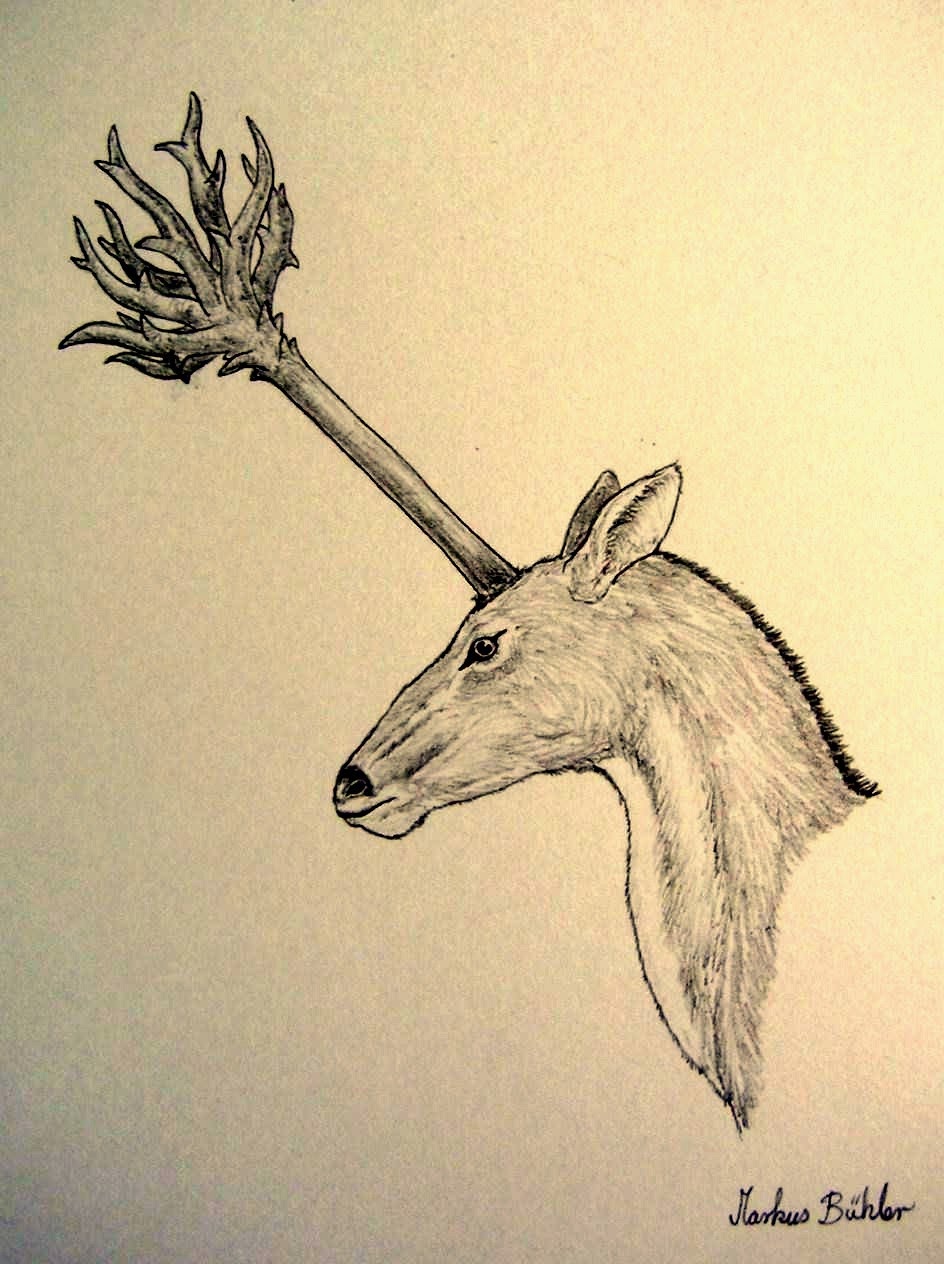 The Hercynian unicorn if indeed a uni-stag (© Markus Bühler)
Germany has long been associated with unicorn traditions, in particular with the supposed occurrence of dainty white unicorns in the Harz Mountains. In addition, a far more exotic, bizarre version was allegedly sighted in Germany's Hercynian Forest by no less eminent an eyewitness than Julius Caesar.
He described it as being an ox but shaped like a stag, the centre of whose brow, between its ears, bore a single horn, taller and straighter than normal horns. Moreover, later eyewitnesses claimed that a series of branches sprouted forth from the tip of this creature's horn.
 Bust of Julius Caesar in the National Archaeological Museum, Naples(public domain)
Long forgotten, the case of this very curious, atypical unicorn has lately been re-examined by German cryptozoologist Markus Bühler, who has proposed a very ingenious, plausible explanation for it.
Occasionally, a freak deer is born, bearing a single horn-like structure upon the centre of its skull, instead of its species' normal paired laterally-sited antlers. One recently-recorded example, pictured above, is a roe deer Capreolus capreolus 'uni-stag' aptly dubbed 'Unicorn' and born during 2007 in a park belonging to the Center of Natural Sciences in Prato, near Florence, Italy.
 Unicorn, the uni-stag roe deer (© Center of Natural Sciences, Prata, Italy)
But what if, as speculated by Markus, some rudimentary antlers develop at the tip of this aberrant central horn?
The result would be a creature bearing a very similar appearance to the extraordinary Hercynian unicorn. So perhaps the latter beast, if truly real, was not a unicorn at all, but merely a freak uni-stag!
This ShukerNature post is excerpted from my book Mirabilis: A Carnival ofCryptozoology and Unnatural History (Anomalist Books: New York, 2013)

May 2, 2014
THE BIG GREY MAN OF BEN MACDHUI - BRITAIN'S VERY OWN BIGFOOT?
st1\:*{behavior:url(#ieooui) }

Ben MacDhui’s principal claim to fame is that, at 4296 ft (1309 m), it is the highest mountain in the Cairngorms range and is second only to Ben Nevis throughout Scotland. However, it is also famous – indeed, infamous – as Scotland’s ‘haunted mountain’, thanks to the sinister, ostensibly supernatural entity known as Am Fear Liath Mor, the Big Grey Man (BGM), said to haunt its lofty peak.
PANIC ON THE PEAK, FOOTSTEPS IN THE FOG
What is so remarkable about the Big Grey Man case is the extraordinary range of mysterious phenomena associated with it, and which are every bit as dramatic as they are diverse. Take, for instance, various reports of irrational panic linked to this supposed being’s presence, which include the following, defining BGM account.
The BGM first attracted major attention beyond the immediate environs of Ben MacDhui in December 1925, when internationally-renowned mountaineer and London University’s Professor of Organic Chemistry John Norman Collie (1859-1942) startled his audience while speaking at the Annual General Meeting of Aberdeen’s Cairngorm Club by recalling a truly bizarre event that had happened to him when climbing Ben MacDhui in 1891. (Over two decades prior to the meeting in Aberdeen, Collie had spoken of his Ben MacDhui experience to a local New Zealand newspaper, but this had not attracted such interest.)
 Prof. James Norman Collie, photographed in c.1912 (© University College London(UCL) Chemistry Collections)
While descending through a heavy mist from the Cairn at this mountain’s flat, barren summit:
"…I began to think I heard something else than merely the noise of my own footsteps. For every few steps I took I heard a crunch, and then another crunch as if someone was walking after me but taking steps three or four times the length of my own.
"I said to myself, ‘This is all nonsense’. I listened and heard it again but could see nothing in the mist. As I walked on and the eerie crunch, crunch, sounded behind me I was seized with terror and took to my heels, staggering blindly among the boulders for four or five miles nearly down to Rothiemurchus Forest.
"Whatever you make of it I do not know, but there is something very queer about the top of Ben MacDhui and I will not go back there again by myself I know."
The anomalous sound of footsteps not in sync with those of the ‘ear’-witness has also been reported on several other occasions from Ben MacDhui. In 1904, while gathering biological specimens on the mountain for Aberdeen University, Hugh Welsh and his brother often heard the sound of pacing footsteps, both at night and during the day, but never succeeded in tracing their origin. Similarly, in 1940, while spending a summer’s night beneath a huge block of stone on Ben MacDhui’s slope known as the Shelter Stone, Scottish author R. Macdonald Robertson and a friend were awakened by the growls of Robertson’s bull terrier, and clearly heard the sound of crunching steps approaching them along the gravel path leading to the Stone, until, abruptly, they faded away again, and the dog then relaxed.
 Ben MacDhui's Shelter Stone, c.1905 postcard
Even stranger was the experience of fellow author Wendy Wood, also in 1940, who heard while upon the Lairig Ghru (an arduous but much-traversed pass through the Cairngorms) what sounded to her like an enormously resonant Gaelic-speaking voice directly beneath her. After vainly searching the snow all around in case someone was trapped underneath it and was calling out for help, she became very apprehensive and duly began descending the mountain. As she did so, however, she heard what she later described as “gigantic footsteps” following her where there had previously been no sound, upon which she experienced a blinding panic, sending her fleeing downwards in absolute terror.
A comparable scenario (missing only the Gaelic voice) was experienced in 1945 by competent mountaineer Peter Densham. Eating his lunch at the summit, he suddenly heard crunching footsteps emanating from the Cairn close by, but as he stood up to investigate, an inexplicable wave of uncontrollable fear washed over him, causing him to flee wildly, so wildly in fact that he barely stopped himself plummeting headlong over a treacherous cliff known as Lurcher’s Crag.
On 26 September 2006, the following account was posted on the Cryptomundo cryptozoology website by a correspondent with the user name ‘big max’:
"I was climbing back down Ben MacDhui in May 1988 when I experienced the footsteps phenomenon mentioned by others. It was pretty misty and I was alone. But it was like ’something’ was behind me, only 10 metres or so, keeping track of me. I back-tracked to see if anyone was there. I didn’t see anything, but it was weird enough to scare me, particularly as the sounds occurred both when I was moving or stationary. It was only after I told this story to a Glasgow cousin years later that I first heard about the Grey Man."
FROM BIG GREY MAN TO MOVIE STAR!
In 2007, the winning entry in the category of Best Highland Amateur Film at the annual Fort William Mountain Festival was a 10-minute-and-one-second-long video entitled ‘The Big Grey Man of Ben MacDhui’, produced by an eight-person team of film makers (including Richard Cross, Jez Curnow, and Peter George) from scottishhills.com. It was also screened at the Edinburgh Mountain Film Festival in 2006, and can presently be viewed at http://www.biggreyman.co.uk and on YouTube. It features a number of local figures and mountain experts airing their thoughts on the subject, as well as shoots at various locations on and near Ben MacDhui, including a cold Winter Solstice at Corrour Bothy on 23 December 2005, a walk along the Lairig Ghru in March 2006, and a visit to the mountain’s summit in May 2006.
AFFLECK GRAY AND THE BIG GREY MAN
The definitive publication on the subject of the BGM is The Big Grey Man of Ben MacDhui: Myth or Monster? – written by the aptly-named Affleck Gray, first published in 1970 (a second edition appeared in 1989, and a third in 1994), and containing a foreword by the acclaimed Scottish climber Sydney Scroggie.

Packed with newspaper accounts and eye/earwitness reports relating to mystifying happenings on this mountain, this fascinating book was authored by a man well-versed in the majesty and mysteries of the Cairngorms, as Gray was born and bred in Upper Strathspey, and investigated BGM reports throughout his life as a hobby. His contributions were also featured in the above-mentioned BGM film.
BGM SIGHTINGS
In spite of its descriptive ‘Big Grey Man’ name, surprisingly few visual BGM encounters are on file, and even those are far from consistent. When Prof. Collie’s account of his Ben MacDhui experience was originally published in New Zealand, it stimulated another renowned mountaineer, Dr A.M. Kellas, to write to him with details of an astonishing encounter made by himself and his brother, Henry Kellas, while climbing Ben MacDhui. Eschewing mere footsteps, the Kellas brothers claimed to have seen a huge figure, at least as tall as the 10-ft-high Cairn and described by them as “a big grey man”, walking out of the Lairig Ghru Pass and around the Cairn towards the summit where it passed out of sight. Moreover, while awaiting the entity’s reappearance, they were suddenly struck with acute fear, and raced, panic-stricken, down the mountain, convinced that the entity was pursuing them.
 Ben MacDhui in the Cairngorms, taken from Carn Liath in the Grampians (public domain)
One night in 1942 while resting at the Shelter Stone and looking out towards Loch Avon, climber Sydney Scroggie suddenly spied:
"...a tall, stately, human figure, appear out of the blackness on one side of the loch, and clearly silhouetted against the water pace with long, deliberate steps across the combined burns just where they enter the loch."
Despite rushing over to the spot, Scroggie found no footsteps or any other evidence of the figure’s erstwhile presence, but experienced such unease that he swiftly returned to the Shelter Stone.
During October 1943, while walking alone along the Lairig Ghru, mountaineer-naturalist Alexander Tewnion abruptly heard long striding footsteps behind him, and to his horror he saw through the mist a strange shape looming forth and then charging directly towards him. Drawing out his revolver, Tewnion shot three times at the figure, but it continued approaching him, so Tewnion fled downwards to Glen Derry.
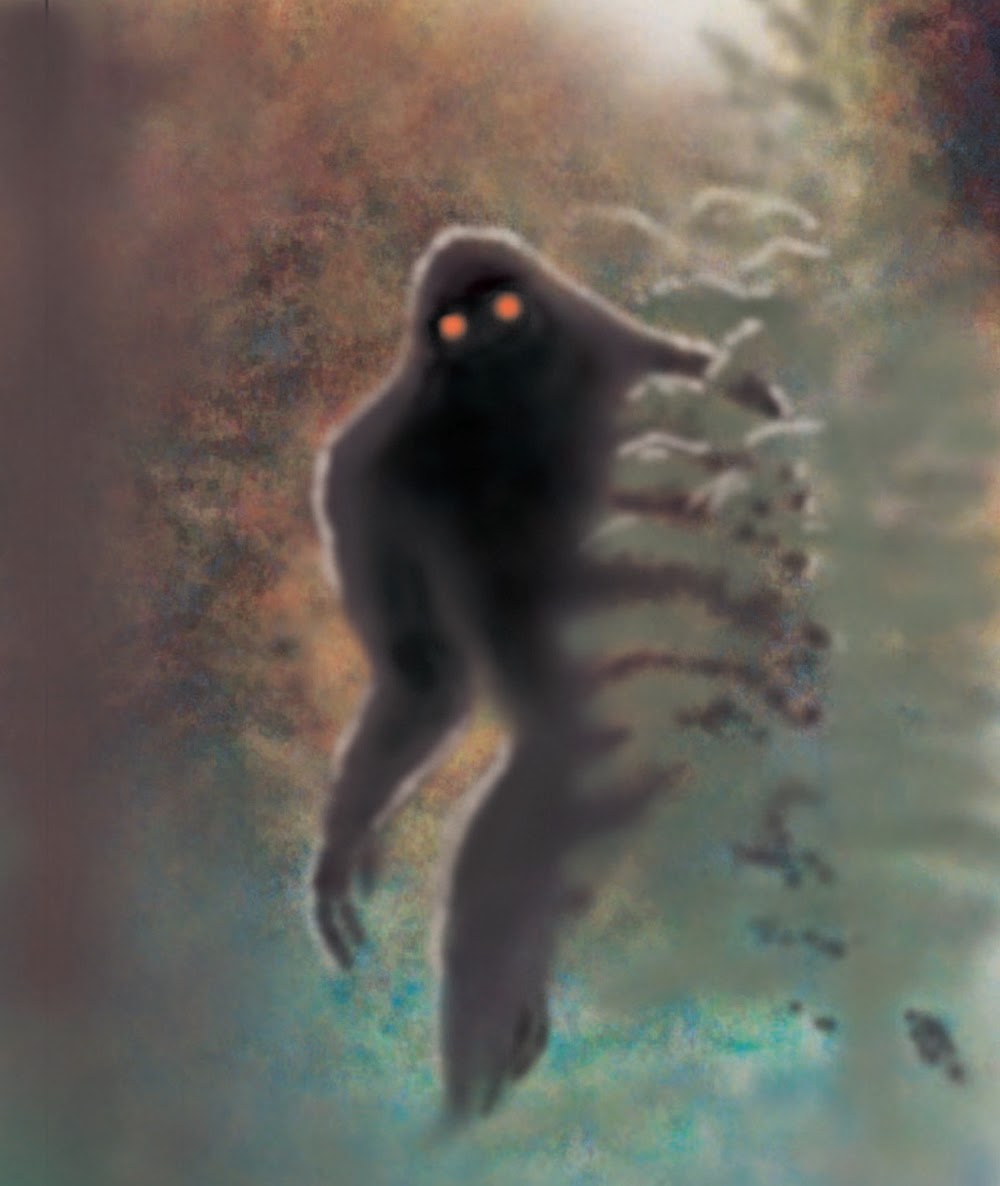 Does Ben MacDhui harbour its very own version of bigfoot? (© William Rebsamen)
Even more incredible, however, was the entity reportedly spied one night on Ben MacDhui by a friend of climber-writer Richard Frere. Having pitched a tent beside the Cairn, Frere’s friend awoke, to see a brown shape standing between his tent and the moon. So as soon as the shape moved away, his friend peered outside his tent, only to discover (according to Frere’s subsequent description) that just 20 yards away:
"...a great brown creature was swaggering down the hill. He uses the word “swaggering” because the creature had an air of insolent strength about it: and because it rolled slightly from side to side, taking huge measured steps. It looked as though it was covered with shortish, brown hair…its head was disproportionately large, its neck very thick and powerful. By the extreme width of its shoulders compared to the relative slimness of its hips he concluded its sex to be male. No, it did not resemble an ape: its hairy arms, though long, were not unduly so, its carriage was extremely erect."
By applying trigonometry in relation to surrounding objects, Frere’s friend calculated that the entity had been at least 21 ft tall.
As recently as 23 December 2005, while making their BGM film, team member Peter George was standing alone that evening outside a stone shelter hut in the Lairig Ghru called Corrour Bothy, looking out into the darkness, when:
"Out of the corner of my eye, over to the left towards the stream, I caught a glimpse of a tall grey figure. At first I thought it was one of our party, although all of them were inside the bothy. Turned to look properly and couldn't see anyone."
Just a trick of the light, or something more?
And although it was seen not on Ben MacDhui itself but on the neighbouring peak of Braeriach, mention must also be made of the bizarre entity reputedly encountered there by climber Tom Crowley. After looking round to see what was responsible for the sudden sound of footsteps behind him while descending this peak, Crowley was horrified to see a huge “…undefined misty figure with pointed ears, long legs, and feet with talons which appeared to be more like fingers than toes”. An altitude-induced hallucination, surely…?
THE SOUND OF MUSIC?
Yet another strand of this already much-tangled tale involves the hearing of mysterious music on Ben MacDhui’s lonely peak. So could the BGM be a veritable minstrel of the mountains? During one ascent of Ben MacDhui, later described by him in an Open Air article (Winter 1948), Richard Frere had reached the Lairig Ghru and was sitting there, immersed in an inexplicable bout of darkest despair, when, as well as sensing some invisible being close by, he suddenly heard an extremely high singing note, which continued unabatedly throughout his ascent to the summit and return to the Lairig Ghru – even though simple tests convinced him that it was not due to any effects of reduced pressure upon his eardrums. Then, without warning, the singing and sensation of a nearby presence ceased, and he was momentarily struck with a bout of absolute terror, followed by blissful serenity as he reached Rothiemurchus Forest.
 The summit of Ben MacDhui (© Oliver Mills/Wikipedia)
Unaccountable pipe music was heard by acclaimed author Seton Gordon while climbing Ben MacDhui with a friend in 1926, and BGM authority Affleck Gray also experienced strains of origin-lacking music here. Moreover, just a few years ago, a writer signing himself ‘Jack’ reported online (originally at http://www.ghost-story.co.uk/stories/... but this page no longer exists) that he had heard the sound of faraway music while at the Lairig Ghru.
YETIS AND URISKS AND DEVAS, OH MY!
Not surprisingly, faced with such a startling array of anomalies, the many explanations proposed for the BGM phenomena over the years have been equally disparate. Some, of course, can be readily discounted. For instance, with only a single putative report (that of Frere’s anonymous friend) on file, coupled with basic anatomical limitations, the necessity of a viable populations being present, and the undeniable fact that the Cairngorms hardly compare in terms of remoteness with the Himalayas or even North America’s vast Pacific Northwest forests, the prospect that the BGM is an elusive 21-ft-tall yeti-like (or True Giant bigfoot-like) creature of cryptozoology can be swiftly dismissed.
,+Italian+Baroque+painter.jpg) 'Homage to Diana', a painting depicting Pan, by the Italian Baroque artist Annibale Carracci (1560-1609)
'Homage to Diana', a painting depicting Pan, by the Italian Baroque artist Annibale Carracci (1560-1609)
A zooform identity offers greater leeway, unconstrained by size and breeding limitations, and is also able to explain such anomalies as footsteps made by an unseen entity, the inducement of blind panic, and even sourceless music. However, as we have no notion what zooforms are or even if they genuinely exist, to label the BGM as one is simply replacing one mystery with another. Other, even more exotic notions put forward are that the BGM is a Pan-like being of Scottish folklore known as a urisk (hence the sensation of panic experienced by those who sense its presence nearby), or perhaps some form of nature spirit such as a deva.
Leading from those thoughts is the possibility that the assortment of unexplained phenomena experienced on Ben MacDhui indicates that it harbours a 'window area' - an interface between different dimensions or alternate worlds. If so, there is a good chance that such a significant portal would have a guardian, to deter would-be intruders or trespassers. Is it just coincidence that this is the precise effect so successfully accomplished by Ben MacDhui's formidable BGM?
 A pair of Japanese hanging scrolls, c1300, depicting Bodhisattvas descending from Heaven
Very different again is the proposal offered up by practising Mahayana Buddhist Sir Hugh Rankin and Scottish mystic the Reverend Countess of Mayo among others that the BGM is in fact a Bodhisattva – one of the five “perfected men” controlling our planet’s fate. Yet as such beings are notably benevolent, such an identity hardly corresponds with the malevolent persona of the BGM.
GEOLOGICAL HOLOGRAM, OR OPTICAL SPECTRE?
During the 1970s, inorganic chemistry specialist Dr Don Robins proposed that some minerals may be capable of encoding a type of electrical energy, in turn yielding a moving image that could be projected under certain specific conditions, i.e. a veritable geological hologram. Could it be that the BGM is one such hologram, stimulated by certain specific, mountain-related mineralogical attributes, and exhibiting an additional aural component? Yet if so, why are such montane manifestations limited (at least in Scotland) to Ben MacDhui and its environs? In contrast, as documented by modern-day BGM investigator Andy Roberts, bouts of mountain panic entirely comparable with those reported from Ben MacDhui have been documented from many other mountains in Britain and elsewhere in the world.
Even more radical is the oft-mooted suggestion that the BGM may be an electromagnetic phantom – an apparition reflecting wavelengths of radiation beyond the vision of most humans (hence the rarity of sightings in contrast to the greater number of reports of footsteps), but whose presence is still sensed. It would certainly be interesting to see what might be exposed, for instance, if a camera containing UV-sensitive film were to be pointed in the direction of crunching footsteps heard on Ben MacDhui.
 Brocken spectres, 1873 engraving
As for those rare sightings, the most popular explanation is that the entity observed is merely an optical illusion, probably of the Brocken spectre kind. Under certain climatic conditions in mountainous areas, a person’s shadow is very greatly magnified and is sometimes cast upon a bank of mist or cloud, yielding the afore-mentioned spectre effect. Very unnerving to unsuspecting or uninformed observers, it could certainly yield the huge, monstrous forms claimed from Ben MacDhui, and if coupled with local precipitation might also explain the sound of supposed footsteps.
Another relevant phenomenon related to optical illusions is the autokinetic effect, in which a stationary object seen from a distance sometimes appears to move – an illusion caused if there is an absence of visual clues in the proximity of the object. If this is added to the innate capacity of the human mind to “fill in” missing details when viewing an unfamiliar object briefly or during poor viewing conditions, it is not difficult to understand how a stationary, inanimate object might seem to resemble a moving, humanoid entity.
THE MONARCH OF THE MIST – WALES'S VERY OWN BGM?
And finally: Reports of BGM-like entities in Britain are not wholly confined to Ben MacDhui, or even to Scotland. According to traditional Welsh folklore, Wales's answer to the Big Grey Man is the Grey King, also known as the Brenin Llwyd or Monarch of the Mist. A brooding silent figure allegedly frequenting Snowdon, Cader Idris, Plinlimmon, and other lofty Welsh peaks, this awesome preternatural entity is said to be an ancient earth spirit, sitting aloof and alone at the summits, enrobed in mist and clouds. Sometimes it will send the caliginous mountain mists down the slopes to envelop unwary climbers so that they lose their way, trekking helplessly over the edge of unseen precipices to their doom.
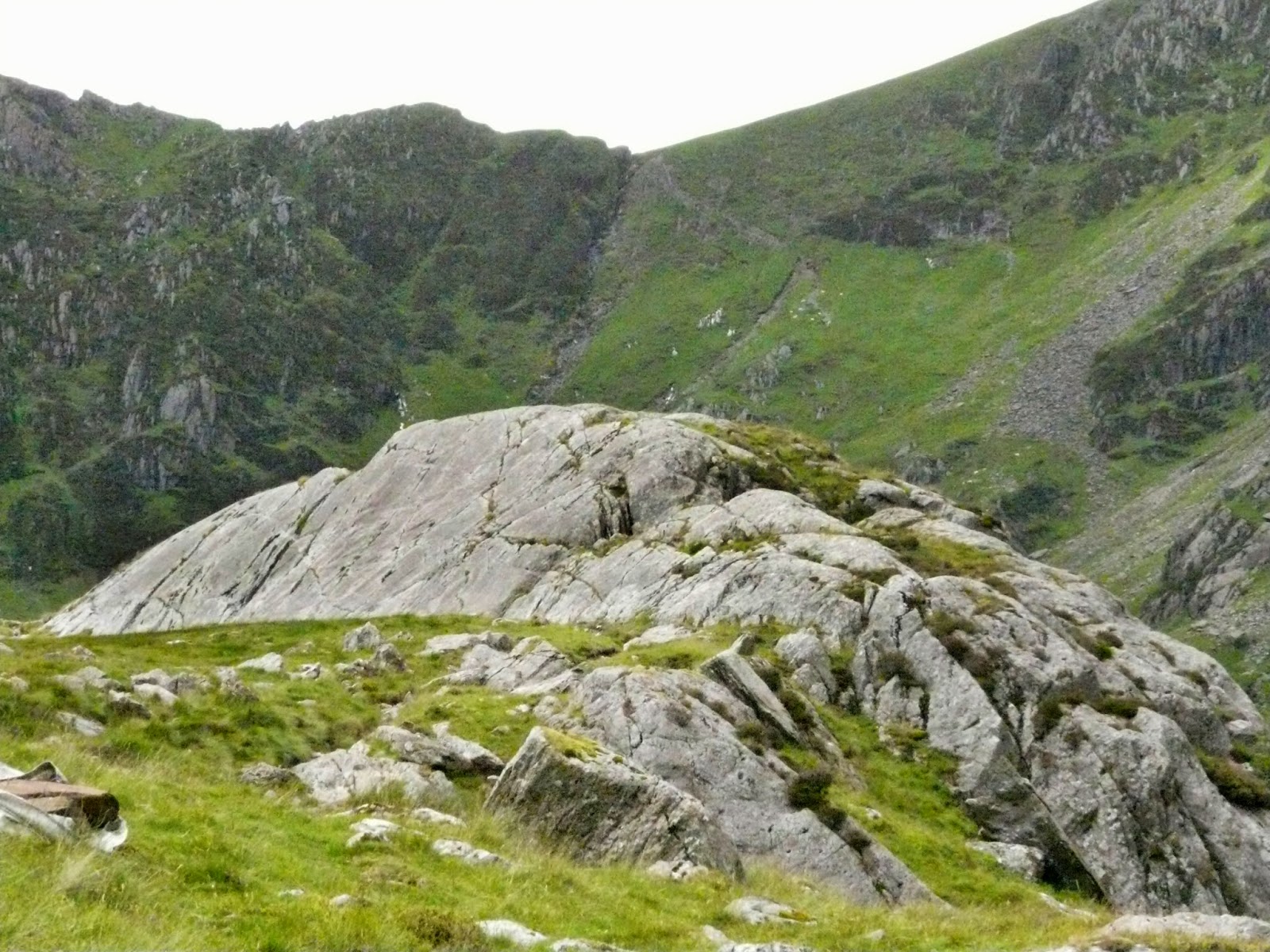 The valley of Cader Idris, domain of the Brenin Llwyd?
In times past, the Brenin Llwyd was greatly feared as a child-stealer, and even the mountain guides were nervous of venturing into its domain. It also appeared as the evil supernatural villain in the children's fantasy novel The Grey King (1975) by Susan Cooper, the fourth of five books in her Arthurian series, The Dark is Rising.
In summary: there is no single, easy explanation for the multi-faceted mystery of Ben MacDhui’s BGM. Some aspects seem to be of psychological origin, others ostensibly paranormal, and there may even be facets featuring geological or other physical phenomena that are still unverified by science. Indeed, more than a century after Prof. Collie’s classic experience here, reports from Scotland’s haunted mountain of the grim grey entity that may (or may not) lurk within its misty realm remain as tantalising and tenuous as they were then, as intangible, in fact, as Scotch mist itself – and we all know what they say about that!
This ShukerNature blog article is excerpted from Kryptos - a future book of mine, currently a work-in-progress.

May 1, 2014
CRYPTID HAS RETURNED! - ONE OF THE BEST BIGFOOT NOVELS IS NOW EVEN BETTER, AND BIGGER!
 st1\:*{behavior:url(#ieooui) } The recently-published Author's Edition of Eric Penz's bigfoot novel Cryptid (© Eric Penz)
Within my collection of cryptozoology-themed novels are several whose plots centre upon the discovery of bigfoot (aka sasquatch). Some of these, such as Lee Murphy's Where Legends Roam , are excellent; certain others are less so. One that definitely falls within the former category is Eric Penz's debut novel, Cryptid .
Originally published almost a decade ago, it has received a succession of very favourable reviews, and was chosen as joint 'Top Cryptofiction Book of the Year' for 2005 (click here ) by Loren Coleman for leading cryptozoological website Cryptomundo. Such accolades are greatly deserved, because Cryptid very successfully presents the reader with a compelling, well-written, well-researched storyline based upon the celebrated bigfoot studies of the late Prof. Grover Krantz, and featuring a fascinating, wholly original historical premise hinted at in its subtitle – The Lost Legacy of Lewis and Clark.
One of the most significant explorations in the post-Columbus history of North America, the Lewis and Clark Expedition of 1804-1806 was the very first American expedition to cross what is now the western portion of the USA. It departed in May 1804 from St Louis on the Mississippi, making its way westward through the continental divide to the Pacific coast. To quote from Wikipedia's entry for this historic venture:
"The expedition was commissioned by President Thomas Jefferson shortly after the Louisiana Purchase in 1803, consisting of a select group of U.S. Army volunteers under the command of Captain Meriwether Lewis and his close friend Second Lieutenant William Clark. Their perilous journey lasted from May 1804 to September 1806. The primary objective was to explore and map the newly acquired territory, find a practical route across the Western half of the continent, and establish an American presence in this territory before Britain and other European powers tried to claim it.
"The campaign's secondary objectives were scientific and economic: to study the area's plants, animal life, and geography, and establish trade with local Indian tribes. With maps, sketches and journals in hand, the expedition returned to St. Louis to report their findings to Jefferson."
 Captain Meriwether Lewis and Second Lieutenant William Clark (public domain)
What has intrigued Eric so much about this epic journey of discovery is the still-unexplained series of major gaps in the expedition journal written by Lewis. One such gap alone spanned 14 May 1804 to 7 April 1805, another spanned 26 August 1805 to 1 January 1806. What happened – moreover, what might have been discovered - during those very considerable, unrecorded periods of the expedition? And what might have been vigorously suppressed throughout history ever since then? As noted in its blurb, these tantalising thoughts are what gave birth to Cryptid:
"Something haunts the woods of Olympic National Park, a nightmare in hiding. Its existence has been kept secret by a conspiracy that stretches back to President Thomas Jefferson and the Lewis & Clark Expedition . The truth that we have not been alone on this earth would have forever been lost except that some species just won’t die.
"Dr Samantha Russell has spent her career seeking for truth in the only way she knows how, on her hands and knees, painstakingly digging it up from the crust of the earth. When the truth arrives by way of FedEx, she cannot help but see it as nothing more than another scientific hoax, especially considering the source. Dr Jon Ostman has practically been excommunicated by the scientific community for his interest in such subjects as the American Sasquatch.
"Suffering from her father's tragic sense of curiosity, though, Sam can't resist the question begged by the bones contained in the wooden crate. How could they be bones and not fossils since Gigantopithecus had been extinct for 125,000 years?
"Driven to know the answer, Sam delays going to her father on his deathbed and instead pursues Jon to a remote corner of Washington state where he is about to make the greatest discovery involving the origins of the human species, a discovery Lewis and Clark may have already made two hundred years earlier. However, Sam is not the only one pursuing Jon, for one of our nation's first secrets is still being kept by all means necessary.
"And if they do survive the centuries-old conspiracy, they will not only rewrite American history, but they will prove that we are not the only intelligent, bipedal primate to survive extinction."
Yet in spite of the original success of Cryptid, Eric always felt that it was not quite 'him', and so, to remedy this situation, he decided to publish in ebook form a special Author's Edition. Here is Eric's own account of how this newest incarnation of his bigfoot novel came about, as quoted from the official Cryptidwebsite (click here ), which is packed with additional information regarding both the novel and bigfoot itself:
"If it ain’t broke, don’t fix it. I’m sure your father subscribed to this advice much like my own. This sage advice could perhaps apply to me releasing an Author’s Edition of my debut novel, Cryptid. The book was well received by both reader and critic. Sales were and still are admirable for a first novel. So then why bother with a new edition?
"Good question. And I’m not sure I have an equally good answer. All I can say is that in the years since Cryptidwas published I’ve lived with a nagging concern. The book as originally published was just not quite me. Like a picture hanging on the wall askew enough to place a sliver in your mind until you leveled it that fraction of a degree, I’ve had a sliver for Cryptid. And with the new brave world of ebook publishing, putting out a new edition is now feasible. So why a new edition? In short, because I now can. It’s time to pluck the sliver free.
"More specifically, the story was simply not complete. As the subtitle implies, this story involves Meriwether Lewis and William Clark. The story begins with their amazing adventure. And yet, these two American heroes do not appear on screen. It’s time to fix that. I’ve included with this edition a new first chapter that was not included in the previous edition. This chapter stars both Lewis and Clark, though perhaps not quite as history might envision them.
"And so, I proudly present to you the Author’s Edition of Cryptid: The Lost Legacy of Lewis & Clark. Like many Director’s Cut versions of movies, this edition is the story as I believe it to be best told. It is now more me. That is not to say it is perfect. Quite the contrary. It is still a first novel, complete with all the quirks and imperfections that accompany an author’s early work. I wouldn’t change those for anything. That would be like removing a birth mark from your first born son. There are changes I could make, but I will save those for the film version.
"Without further ado, I present to you my first born son as I envisioned him to be. Enjoy the hunt.
"Two centuries in the making, Cryptid is the final chapter of the Lewis & Clark story. As with any good tale, the best secrets have been kept until the end."
The Author's Edition of Cryptid in ebook form can be purchased here on Amazon and at all other good bookstores – but this is still not all, because Eric has now announced exciting plans to produce a short film based upon his novel.
To publicise this latest endeavour, he has prepared a theatrical film trailer and some shorts, which received their debut screening on 22 April. But if you weren't there, worry not, because here are the necessary links, kindly provided to me by Eric, for you to view all of them online right now:
Teaser: https://www.youtube.com/watch?v=BPHyVKu6B7E
Trailer: https://www.youtube.com/watch?v=oVw1WdHEfX8
Cave Scene: https://www.youtube.com/watch?v=aMvKD0PxKIQ
Hunt Scene: https://www.youtube.com/watch?v=T7MxdjxHFR4
Anthology: https://www.youtube.com/watch?v=8nD8a7h3Aak
Making Of: https://www.youtube.com/watch?v=FLNnEuUem8U
Cryptidhas indeed returned, and the forthcoming film treatment will certainly ensure that it keeps on running - just like its hairy bipedal subjects, in fact!
 The original hardback edition of Cryptid(© Eric Penz/Universe Star)
April 28, 2014
STRIPE ME - A SPOTTED ZEBRA!
 The spotted zebra of Zambia's Rukwa Valley (copyright owner unknown to me)
 The fascinating - and genuine - photograph of a spotted zebra presented above appears commonly on the Net, but with no accompanying details (or at least no accurate ones, from what I have read so far). So it seemed high time that its interesting history and some relevant background information regarding it were made available online, especially as I originally documented this animal almost 15 years ago. So here they are:
Can there be anything in nature more paradoxical than a zebra with spots? Remarkably, however, spotted zebras have occasionally been reported.
Pictured in London's Daily Mirror newspaper on 3 January 1968, probably the most famous specimen of a spotted zebra was observed in a herd of normal plains zebras Equus quagga (aka burchelli) roaming northern Zambia's Rukwa Valley. As can readily be observed in that remarkable photograph, opening this present ShukerNature post, its body was distinctively decorated with rows of white spots and thin white dashes, instead of exhibiting the familiar plains zebra patterning of stripes seen below.
 A normal plains zebra (Chapman's subspecies, E. q. chapmani), exhibiting some faint brown shadow stripes ((c) Dr Karl Shuker)
 As commented upon in 1981 by Dr Jonathan B.L. Bard within a Journal of Theoretical Biology paper dealing with mammalian coat patterns, this eyecatching oddity offers proof for believing that zebras are black animals with white stripes, rather than white animals with black stripes. For as Bard noted:
"It is only possible to understand the pattern [of the spotted zebra] if the white stripes had failed to form properly and that therefore the 'default' colour is black. The role of the striping mechanism is thus to inhibit natural pigment formation rather than to stimulate it".
Embryological studies have since confirmed this, as documented in Horns, Tusks, and Flippers: The Evolution of Hoofed Mammals (2003), authored by D.R. Prothero and R.M. Schoch.
This ShukerNature post is excerpted and expanded from my book Mysteries of Planet Earth: An Encyclopedia of the Inexplicable (Carlton: London, 1999).
Karl Shuker's Blog

- Karl Shuker's profile
- 45 followers
Karl Shuker isn't a Goodreads Author
(yet),
but they
do have a blog,
so here are some recent posts imported from
their feed.

