
Lawrence R. Spencer's Blog, page 18
January 28, 2025
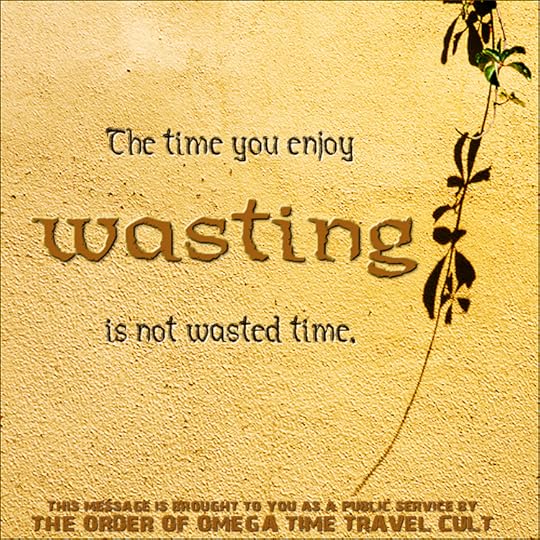
ENJOY YOU
Republished by Blog Post Promoter


January 27, 2025

January 26, 2025
Spirits of Our Forefathers – Alcohol in the American Colonies
Republished by Blog Post Promoter
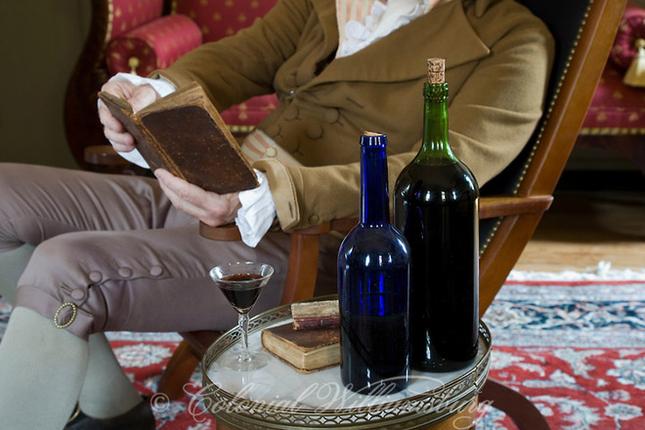
“Beer is living proof that God loves us and wants to see us happy.” – Benjamin Franklin
“Wine is necessary for life.” – Thomas Jefferson
The Spirits of Our Forefathers“My manner of living is plain…a glass of wine and a bit of mutton.” – George Washington
Alcohol’s role in the American ColoniesThe above statements by three of the Founding Fathers reflect the prevailing attitude toward alcohol in the 18th century and throughout much of our country’s early existence. Alcohol has played a major role in our nation’s history, and its use is a part of our heritage. In colonial times, Americans probably drank more alcohol that in any other era. Spirits were an integral part of daily life throughout the colonies no matter the geographic or economic differences. It was reported that the average American drank eight ounces of alcohol a day. And it didn’t matter what. Americans drank beer, and cider with breakfast; rum and wine with dinner; claret, ratafias, creams, punches, and other concoctions in the evening. (Robinson, 2001)
“Revolutionary War era persons drank a phenomenal amount. We have here an account of a gentleman’s average consumption: ‘Given cider and punch for lunch; rum and brandy before dinner; punch, Madeira, port and sherry at dinner; punch and liqueurs with the ladies; and wine, spirit and punch till bedtime, all in punchbowls big enough for a goose to swim in.'” (As cited in Washington and Kitman, 1970)
There are a number of reasons for all of this tippling. Our English heritage declared that water was bad for a person’s health. Given the sanitary standards of the day this was probably true. Beer consumption especially, was seen as a healthy substitute for water. Beer was considered a food, which showed social status (only the most destitute drank water) and allowed for persons to put in a full days work. Franklin while working in a printing house in London was known as the “water American”, because of his affinity to water, by his fellow printers who were
“great guzzlers of beer…My companions at the press drank every day a pint before breakfast with his bread and cheese, a pint between breakfast and dinner, a pint in the afternoon about six o’clock, and another when he had done his day’s work.” (As cited in Barr, 1999)
Americans of the period believed it was particularly healthier to drink lukewarm alcohol during hot weather rather than drink cold water. Signs were displayed at public wells warning individuals of the dangers of cold water during the summer. The rationale for this is that when a person sweated, heat was conducted from the inside of the body. Therefore, the stomach needed warmth, which could be provided by alcohol. (Barr, 1999)
The bias against water was so great that a recent immigrant from Italy, Phillip Massei, caused a stir at a large dinner party where he asked for a glass of water. I perceived some confusion among the servants, and the water did not arrive. The host, next to who I sat, whispered in my ear, asking with a smile if I could not drink something else, because the unexpected request for a glass upset the entire household and they did not know what they were about.” (As cited in Barr, 1999)
Beer usually replaced water as the daily drink. An early morning tankard of beer was typical in colonial America, even for children. This tradition, as stated earlier, came from England. The Pilgrims loaded more beer than water on the Mayflower. And, there is some evidence that they were put off at Plymouth, rather than Virginia, because the ship’s crew wished to make sure they had enough beer to consume on the return voyage. (Royce, 1981)
The ingredients for beer did not grow well in New England. As a substitute, the Puritans made do with hard cider. The many apple orchards of the area were planted for its production. Men usually began the day with a quart or more at breakfast.
Beer and cider were not readily available on the frontier. Settlers west of the Allegheny Mountains converted their corn into whiskey as a substitute and to make their crop transportable. Life was hard on the frontier. The pioneers called their whiskey the “Good Creature of God”, giving them the strength needed to dull the pain of the brutal manual labor of making a home in the wilderness. (Powell, 1999)
“…there is unquestionably too much spirituous liquors drank in the newly settled parts of America, but a very good reason can be assigned for it. The labor of clearing the land is rugged and severe, and the summer sweats are sometimes so great that it would be dangerous to drink cold water…”(As cited in Barr, 1999)
The first businesses established on the frontier were often simple taverns located along trails and roads to take care of the needs of travelers. Tradition of the time dictated that a drink be had at every halt in a journey. One story tells of two travelers on a seventy-mile trek by coach who drank a quart of liquor at each of the eight stops that were made.
Tavern owners enjoyed higher social status than did the clergy during the colonial era. Taverns were the center of civic life. Because of this they were often required to be located near the church or meeting house. Religious services and court sessions were often held in taverns. Judges interrupted court to drink, and clergy were obligated to drink at every house call and were often seen reeling home. (Powell, 1999)
All of this drinking did not go on without some comment. John Adams stated: “If the ancients drank as our people drink rum and cider, it is no wonder we hear of so many possessed with devils.” (As cited in History of Alcohol in America) But, among the founding fathers Adams stood pretty much alone. Washington, Franklin, and Jefferson all imbibed and enjoyed brewing or distilling their own alcoholic beverages.
Jefferson was one of the most knowledgeable wine connoisseurs ever to hold national office. And, he was the wine advisor for Washington, Madison and Monroe. He felt that wine was “…indispensable for my health.” He further advocated the virtues of wine stating “no nation is drunken where wine is cheap; and none sober, where the dearness of wine substitutes ardent spirits as the common beverage.” (As cited in Insiders Guide to Virginia Wineries)
Jefferson believed that wine stimulated conversation. There must have been quite a bit of talking at Monticello because there are records that he and his guests consumed 1,203 bottles of wine in just over two year’s time. (Garr, 1997) Jefferson, though, thought of himself as a man of moderation.
“…you are not to conclude I am a drinker. My measure is a perfectly sober one of 3 or 4 glasses at dinner, and not a drop at any other time. But as to those 3 or 4 glasses I am very fond.” (As cited in Garr, 1997)
Jefferson’s interests in wine went far beyond just drinking. He was also involved in viticulture. He planted vineyards at Monticello and encourage others to take up the practice. Jefferson’s attempts were not successful since the phylloxera louse, which was not discovered until the 1860s, attacked his grapes.
The sober picture we have of Washington is not correct if we are to believe anecdotes of his day. It was said that he could dance the night away with four bottles of wine under his belt. And, that his Revolutionary War personal expense account for alcohol from September 1775 to March 1776 amount to over six thousand dollars. (Washington & Kitman, 1970) He was a devout lover of beer; in particular a dark porter was always in ample supply at Mount Vernon. A typical Washington hosted dinner “included several wines, beer, cider.” (Mount Vernon An Illustrated Handbook, 1974)
With all the drinking that went on during this era, one tends to agree with Adams’ statement and wonder how we fought a war, won our independence, and established a government. Perhaps the Spirit of ’76, which inspired our forefathers, was indeed spirits.
By Tom Jewett
ReferencesBarr, Andrew. Drink: A Social History of America. 1999, Carroll & Graff Publishers, Inc.
Garr, Robin. “Jefferson and Wine”. 1997, www.winelovers page.com/wines/tjeff.
“History of Alcohol in America” (Cider). www.2020 site.org/drinks/cider.
Mount Vernon An Illustrated Handbook. 1974, Mount Vernon Ladies Association.
Powell, Stephen. “The Devils Drink: 1999, www.bluemoon.net/~spowell/cart.
Robinson, Matthew. : How To Toast Like Our Founding Fathers”, 2001, Claremont Institute Publications, www.claremont.org/publications/Robinson 010118.cfm.
Royce, James E. Alcohol Problems: A Comprehensive Survey. 1981, New York Free Press.
“Thomas Jefferson: Food and Wine Connoisseur”, The Insiders Guide to Virginia Wineries. www.blueridge/sb-wineries.
Washington, George and Kitman, Marvin. 1970, George Washington’s Expense Account. 1970, Simon and Schuster.
More about Alcohol in Early America:
The Whiskey Rebellion: Taxing “Sin” Then and NowAs an agronomist, Thomas Jefferson experimented with brewing beer and making wine.January 25, 2025

January 20, 2025
PHILOSOPHERS KNOW
Republished by Blog Post Promoter

A PRIEST EXPLOITS FOOLS WHO WORSHIP FLESH <> A PRIEST CONTROLS THE POWER OF GOLD <> A PRIEST ENFORCES MORTALITY on OTHERS <> A PRIEST CAN NOT PERCEIVE AN IMMORTAL SOUL <>
SEEK THE PHILOSOPHERS GOAL <> KNOW YOUR OWN SOUL <> KNOW THAT YOU KNOW <> THAT YOU ARE AN IMMORTAL SOUL <>-- Lawrence R. Spencer, 2011
January 19, 2025
WHAT IS ANARCHISM?
Republished by Blog Post Promoter
 I never studied anything about “anarchism” because I had a misconception that it had to do with advocating social chaos. I was surprised to discover that the origins and philosophy that are the foundations of this ideology are based on a deep spiritual understanding.
Chronologically the earliest anarchist themes can be found in the 6th century BC, among the works of Taoist philosopher Laozi and in later centuries by Zhuangzi and Bao Jingyan.
Zhuangzi wrote, “A petty thief is put in jail. A great brigand (criminal) becomes a ruler of a Nation.”
Diogenes of Sinope (404 BCE – 323 BCE) was a Greek philosopher and one of the founders of Cynic philosophy.
Their contemporary Zeno of Citium, the founder of Stoicism, also introduced similar topics.
Jesus Christ is sometimes considered the first anarchist in the Christian anarchist tradition. “The true founder of anarchy was Jesus Christ and … the first anarchist society was that of the apostles.” — Georges Lechartier
A political ideology named “collective anarchism” was created by Mikhail Bakunin (30 May 1814 – 1 July 1876). He was a Russian revolutionary anarchist, and founder of one of the many different political ideologies that are considered to be anarchism in the 19th century.
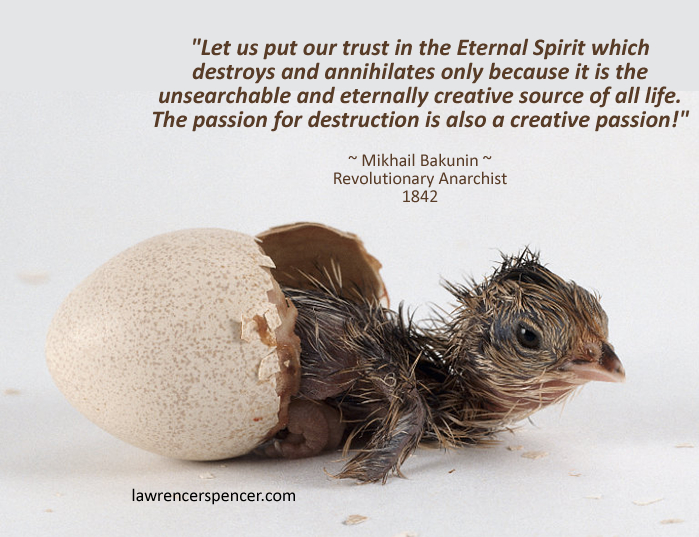
“Let us put our trust in the eternal spirit which destroys and annihilates only because it is the unsearchable and eternally creative source of all life–the passion for destruction is also a creative passion!” — Mikhail Bakunin (Reaction in Germany, 1842)
“They [the Marxists] maintain that only a dictatorship—their dictatorship, of course—can create the will of the people, while our answer to this is: No dictatorship can have any other aim but that of self-perpetuation, and it can beget only slavery in the people tolerating it; freedom can be created only by freedom, that is, by a universal rebellion on the part of the people and free organization of the toiling masses from the bottom up.” —Mikhail Bakunin, Statism and Anarchism
January 18, 2025
WASTED ON REALITY
Republished by Blog Post Promoter
When you’re wasted on “reality” on Friday night or Saturday night, or any other night on Earth, in a not-illegal-alcohol-induced haze of “I-don’t-give-a-shit-anymore” psycho-dialectician-delirium… Tom Waits is here to rescue us from the homo sapiens mind humping, brain damaged, sour-circe-de-soul-dumping, amnesiac perversion….. forget about it… fuck-it-in-the-mouth…. it ain’t worth it… blues-music-from-oblivion….holographic-hallucination-from-Hell.. You-liberation-music…..
WHAT IS THIS WORLD?
Republished by Blog Post Promoter
“What is this world? A complex whole, subject to endless revolutions. All these revolutions show a continual tendency to destruction; a swift succession of beings who follow one another, press forward, and vanish; a fleeting symmetry; the order of a moment. You judge of the continuous existence of the world, as an ephemeral insect might judge of yours. The world is eternal for you, as you are eternal to the being that lives but for one instant. Yet the insect is the more reasonable of the two. For what a prodigious succession of ephemeral generations attests your eternity! What an immeasurable tradition! Yet shall we all pass away, without the possibility of assigning either the real extension that we filled in space, or the precise time that we shall have endured. Time, matter, space—all, it may be, are no more than a point.”
Denis Diderot (5 October 1713 – 31 July 1784), Lettre sur les aveugles [Letter on the Blind] (1749)
January 17, 2025
Déjà vu
Republished by Blog Post Promoter
Déjà vu, from French, literally “already seen”, is the phenomenon of having the strong sensation that an event or experience currently being experienced had been experienced in the past.
Here are two examples of very young children who “already know” how to play the piano, masterfully! How can an adopted 3 year old, blind girl “already know” how to play the piano, instantly accompany a vocalist without ever having heard the tune before? She also plays the piano and sings.
This 5 year old “just knows” how to play the piano — without any training — like a classical master. How can this possible happen? They remember. It cannot be more obvious. Everyone has lived before, a thousand, thousand times. You and I may not be able to remember how the play the piano because we never played it before. However, there are thousands of examples in history of people being able to “just know” how to do things.
Computer scientists “just know” how to manufacture and program computer circuitry — even though ELECTRICITY wasn’t even “invented” until 150 years ago! How does a planet make the quantum leap from burning wood and candles, riding in horse carts and sailing ships to atomic bombs and global satellite systems in 150 years?! There is no “evolutionary process” involved.
It’s too simple: we have done all of these things before on other planets, in other times, in other galaxies. It’s Déjà vu.


