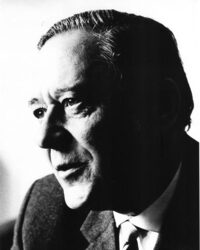
Maximilian Braun was a German Slavist, translator and author. He was born in St. Petersburg (6 February, 1903) and after the October Revolution his family left the city and moved to Dorpat in Estonia where he graduated from high school in 1921.
He began his studies at the local art academy, but then went to Leipzig to study art history and psychology. In 1926, he changed his major and began studying Baltic and Slavic philology and the history of Eastern Europe. He received his doctorate in 1930 under Reinhold Trautmann and qualified as a university lecturer in 1934 with his dissertation "The Beginnings of Europeanization in the Artistic Writings of the Muslim Slavs in Bosnia and Herzegovina."
From 1932 to 1936, he was an assistant, lecturer, Maximilian Braun was a German Slavist, translator and author. He was born in St. Petersburg (6 February, 1903) and after the October Revolution his family left the city and moved to Dorpat in Estonia where he graduated from high school in 1921.
He began his studies at the local art academy, but then went to Leipzig to study art history and psychology. In 1926, he changed his major and began studying Baltic and Slavic philology and the history of Eastern Europe. He received his doctorate in 1930 under Reinhold Trautmann and qualified as a university lecturer in 1934 with his dissertation "The Beginnings of Europeanization in the Artistic Writings of the Muslim Slavs in Bosnia and Herzegovina."
From 1932 to 1936, he was an assistant, lecturer, and instructor at the University of Leipzig. In 1936, he became a lecturer at the Seminar for Comparative Linguistics at the University of Göttingen, where he continued to teach during the Third Reich. In 1941, he was drafted into the Wehrmacht, where he headed the Russian section of the interpreter company. In 1942, he was appointed full professor of Slavic studies at the University of Posen, but never took up the post.
When the University of Göttingen reopened in the winter semester of 1945/46, he resumed his teaching activities there. In 1948, the university established a chair in Slavic studies, which he held from 1949 until his retirement in 1968.
In 1955, he served as an interpreter in the delegation that accompanied Konrad Adenauer to Moscow when the latter negotiated the release of German prisoners of war. He was the first German representative on the Commission for the History of Slavic Studies at the International Committee of Slavists, founded in Moscow in 1958.
Maximilian Braun died on 17 July, 1984 and was buried in Göttingen....more