
Marc Tyler Nobleman's Blog, page 127
June 15, 2012
Comics on Infinite Minds
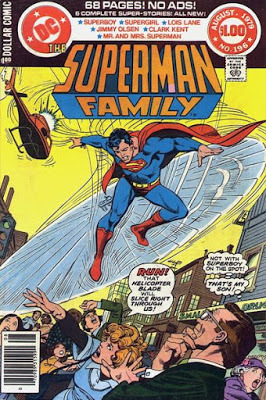
For every kid who would eventually get into comics, the first one he remembers owning is his equivalent of Action Comics #1—a seismic shift in his personal pop culture ecosystem. I remember mine—the otherwise unremarkable Superman Family #196 (7-8/79).
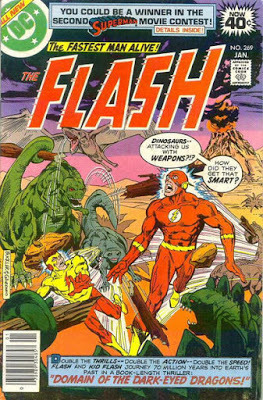
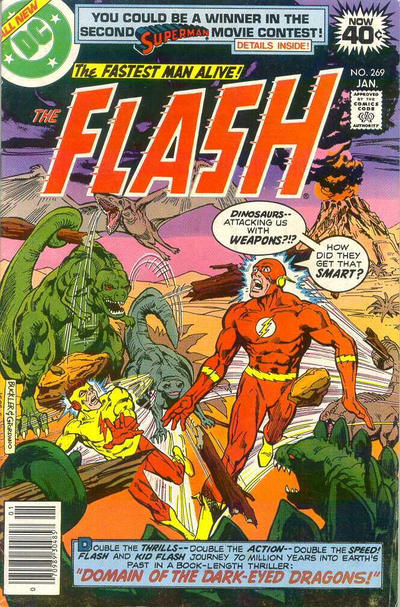
 Then there are other comics that, while not my first, are still lodged in the nostalgia lobe. I remember staring at the cover of Flash #269 (1/79), with Kid Flash and dinosaurs, on the magazine rack within the old-fashioned pharmacy-luncheonette my dad ran in New Haven.
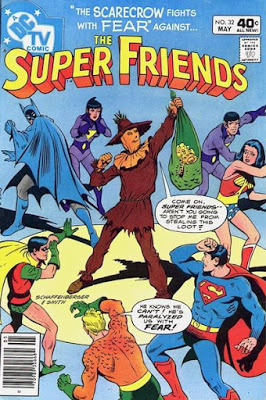
 I remember the first issue that came in the mail of the only comic I ever had a subscription to: Super Friends (#32, 5/80). (The comic in general was actually quite a bit more sophisticated than the Saturday morning cartoon it was based on; it featured many and sometimes obscure guest stars including TNT with Dan the Dyna-Mite and Black Orchid.)
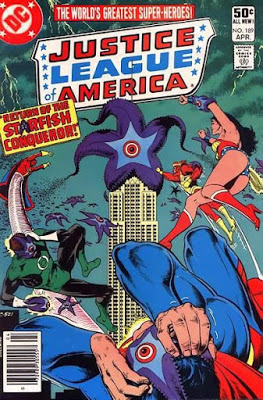
 And I remember each of the first issues I bought of what would become my three favorite series: Justice League of America (#189, 4/81), The Brave and the Bold (#178, with the Creeper; 9/81), and DC Comics Presents (#38, with the Flash; 10/81).
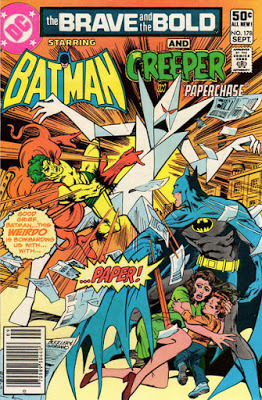
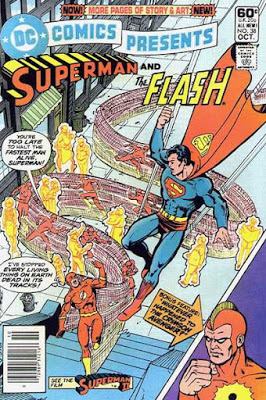 Soon began my ongoing hunt for back issues, which in the eBay age now seems quaint. Kids going forward won’t know quite the same thrill when finding The Brave and the Bold #139 (with Hawkman and Commissioner Gordon) among a random assortment strewn on a table in a small bookstore or stumbling upon DC Comics Presents #17, co-starring an electrifying (or, more precisely, transmogrifying) new character, Firestorm, in a back issue bin.
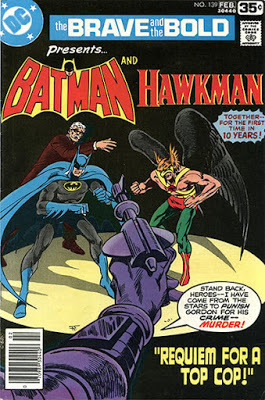
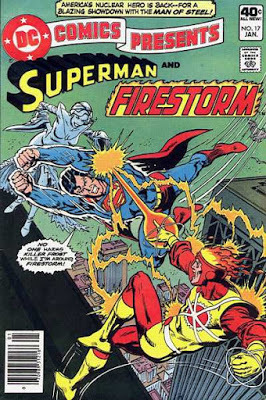 Yet forced to choose the title that impacted me the most, I must revisit a period of massive disruption in the time-space continuum (and not just because it was the year of my bar mitzvah). Not one but two blockbusters that came out in 1985 became my all-time favorites. One was Back to the Future, which for this purpose doesn’t count. The other was Crisis on Infinite Earths.
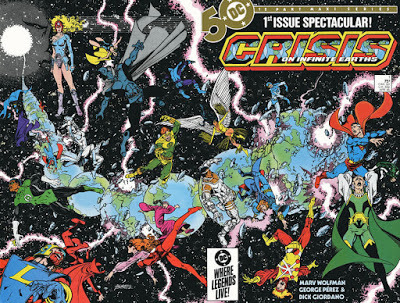 Given the various series I mentioned above, most of which were team-up or just plan team titles, this would seem consistent. Except there’d never been a gathering of characters like what Crisis delivered. The lineup on the first cover, a wraparound, was an invigorating jolt. Among those appearing: Geo-Force. John Stewart Green Lantern. Killer Frost. Obsidian. Solovar. Who the heck was Psimon? And where was (Earth-One) Superman? Wonder Woman? Batman? (I believe the guy in the blue cape tucked away on the back, small, and facing away from the camera is Owlman.)
The combinations of heroes and villains within was irresistible. I’d loved to see the permutations when the Justice League or even the Super Friends would split up (why didn’t Batman and Robin ever pair off with Hawkman and Hawkgirl?), and this was on a far grander scale. Leave it to me to bring up a game-changer like Crisis but focus on something as minor as grouping.
The action felt cinematic and the emotion felt real. Even at the often-indifferent age of 13, I was moved by little details in the cosmic epic—sometimes multiple details within the same scene: The way Superman screamed when Supergirl died. The way he positioned his hands when kneeling before her cape-wrapped corpse. The way a few plaintive tufts of snow flung out behind him when he launched to carry her to the stars. The heavens, rather,
I was even inspired to create my own Crisis comic book. Alas, I did not save it. However, I do remember the characters I included in the first scene: Batgirl, Eclipso, and the Wonder Twins. On second thought, perhaps it’s better that I didn’t save it…
Then came the break-up. In 1987, at the 7-Eleven in my Connecticut hometown, I noticed Justice League #1 on the lowest tier of the magazine rack.
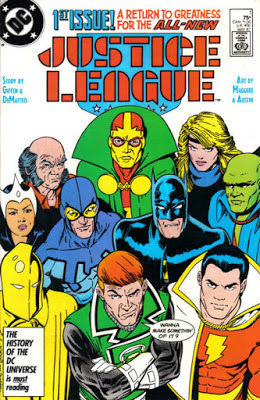 It featured heroes who’d never been in the League before; I was especially intrigued by the inclusion of Captain Marvel, Dr. Fate, and Mr. Miracle. But I was a freshman in high school and I think I thought comics and I should start seeing other people, so I didn’t buy it. And this began a comics drought that lasted until 1993.
One last comic from my formative year that remains special is yet another team book: Batman and the Outsiders #24 (8/85).
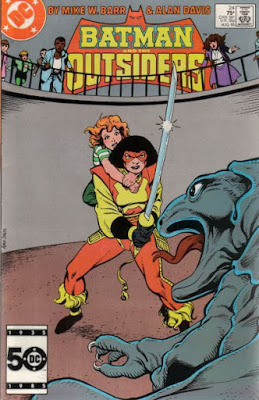 In case you didn’t immediately recall the connection, yes, that issue contained a letter by yours truly. I don’t remember if it was the only time I’d written to a comic, but I know for sure it was the only time a comic printed my letter.
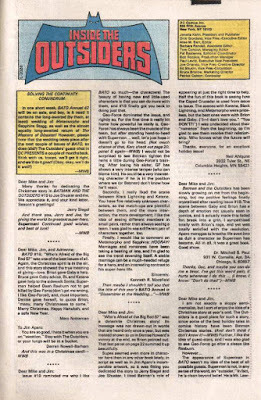 Today I call it my first DC writing credit.
Thank you to Rob Kelly of the Aquaman Shrine for granting me permission to post this.

 Then there are other comics that, while not my first, are still lodged in the nostalgia lobe. I remember staring at the cover of Flash #269 (1/79), with Kid Flash and dinosaurs, on the magazine rack within the old-fashioned pharmacy-luncheonette my dad ran in New Haven.
  I remember the first issue that came in the mail of the only comic I ever had a subscription to: Super Friends (#32, 5/80). (The comic in general was actually quite a bit more sophisticated than the Saturday morning cartoon it was based on; it featured many and sometimes obscure guest stars including TNT with Dan the Dyna-Mite and Black Orchid.)
 And I remember each of the first issues I bought of what would become my three favorite series: Justice League of America (#189, 4/81), The Brave and the Bold (#178, with the Creeper; 9/81), and DC Comics Presents (#38, with the Flash; 10/81).

 Soon began my ongoing hunt for back issues, which in the eBay age now seems quaint. Kids going forward won’t know quite the same thrill when finding The Brave and the Bold #139 (with Hawkman and Commissioner Gordon) among a random assortment strewn on a table in a small bookstore or stumbling upon DC Comics Presents #17, co-starring an electrifying (or, more precisely, transmogrifying) new character, Firestorm, in a back issue bin.
 Yet forced to choose the title that impacted me the most, I must revisit a period of massive disruption in the time-space continuum (and not just because it was the year of my bar mitzvah). Not one but two blockbusters that came out in 1985 became my all-time favorites. One was Back to the Future, which for this purpose doesn’t count. The other was Crisis on Infinite Earths.
 Given the various series I mentioned above, most of which were team-up or just plan team titles, this would seem consistent. Except there’d never been a gathering of characters like what Crisis delivered. The lineup on the first cover, a wraparound, was an invigorating jolt. Among those appearing: Geo-Force. John Stewart Green Lantern. Killer Frost. Obsidian. Solovar. Who the heck was Psimon? And where was (Earth-One) Superman? Wonder Woman? Batman? (I believe the guy in the blue cape tucked away on the back, small, and facing away from the camera is Owlman.)
The combinations of heroes and villains within was irresistible. I’d loved to see the permutations when the Justice League or even the Super Friends would split up (why didn’t Batman and Robin ever pair off with Hawkman and Hawkgirl?), and this was on a far grander scale. Leave it to me to bring up a game-changer like Crisis but focus on something as minor as grouping.
The action felt cinematic and the emotion felt real. Even at the often-indifferent age of 13, I was moved by little details in the cosmic epic—sometimes multiple details within the same scene: The way Superman screamed when Supergirl died. The way he positioned his hands when kneeling before her cape-wrapped corpse. The way a few plaintive tufts of snow flung out behind him when he launched to carry her to the stars. The heavens, rather,
I was even inspired to create my own Crisis comic book. Alas, I did not save it. However, I do remember the characters I included in the first scene: Batgirl, Eclipso, and the Wonder Twins. On second thought, perhaps it’s better that I didn’t save it…
Then came the break-up. In 1987, at the 7-Eleven in my Connecticut hometown, I noticed Justice League #1 on the lowest tier of the magazine rack.
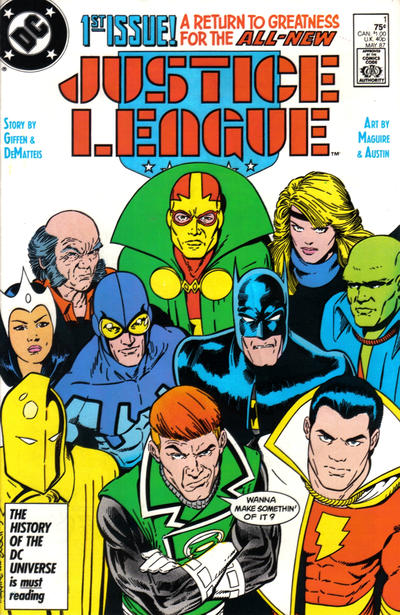 It featured heroes who’d never been in the League before; I was especially intrigued by the inclusion of Captain Marvel, Dr. Fate, and Mr. Miracle. But I was a freshman in high school and I think I thought comics and I should start seeing other people, so I didn’t buy it. And this began a comics drought that lasted until 1993.
 One last comic from my formative year that remains special is yet another team book: Batman and the Outsiders #24 (8/85).
 In case you didn’t immediately recall the connection, yes, that issue contained a letter by yours truly. I don’t remember if it was the only time I’d written to a comic, but I know for sure it was the only time a comic printed my letter.
 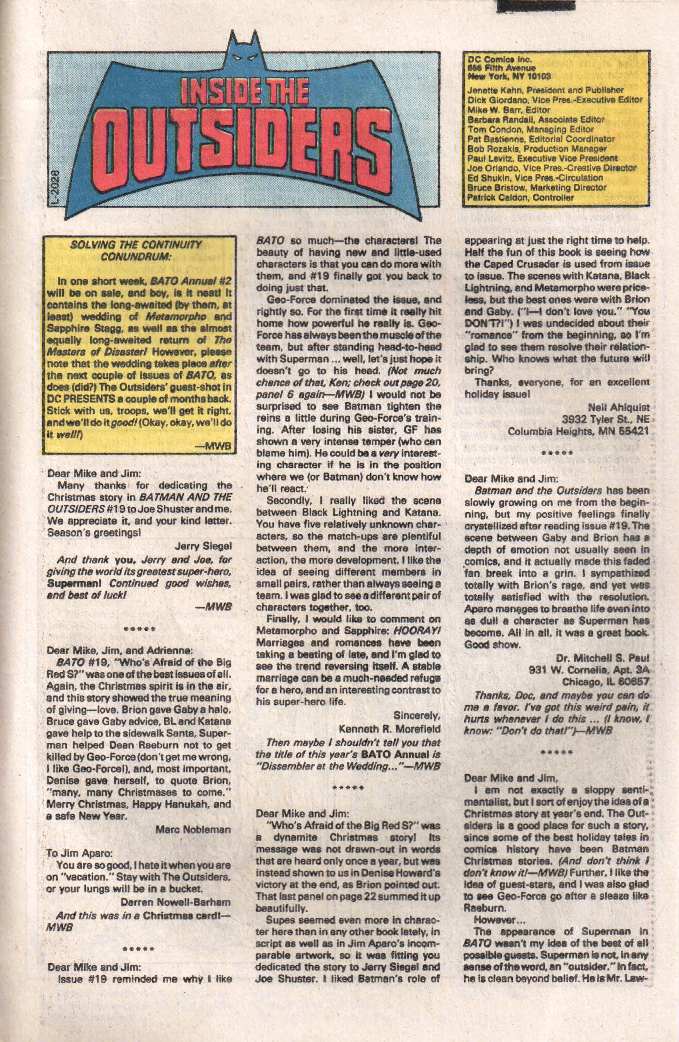 Today I call it my first DC writing credit.
Thank you to Rob Kelly of the Aquaman Shrine for granting me permission to post this.


“Bill the Boy Wonder” book giveaway—win in six words!
It’s about two weeks till July 1, the official release date of Bill the Boy Wonder: The Secret Co-Creator of Batman. (Amazon, however, has been shipping it for at least a month—earliest I heard from someone who’d received it was 5/16/12.)
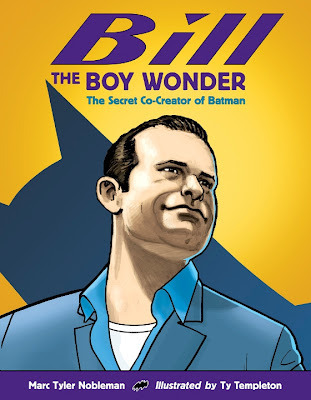 So let’s count down with a contest.
It’s very simple.
In the comments section below, describe Bill Finger’s legacy…in exactly six words. (Speaking of credit, thank you, Smith Magazine.)
For example: “Add Finger’s name. Bill Bob Kane.”
I will give away signed copies of the book to the three people whose responses I like the best. (Get your random drawings elsewhere.)
Anything other than six words is ineligible. Important: Please either include your e-mail address or e-mail me separately (my e-mail is at top right) repeating your entry; if I cannot reach you, you cannot win!
If you are competitive, please spread the word!
The deadline is June 30, 2012 at 11:59 p.m. EST.
Winners will be announced here on July 1.
Books will be sent the following week.
And hopefully Bill’s story will be shared forevermore.

 So let’s count down with a contest.
It’s very simple.
In the comments section below, describe Bill Finger’s legacy…in exactly six words. (Speaking of credit, thank you, Smith Magazine.)
For example: “Add Finger’s name. Bill Bob Kane.”
I will give away signed copies of the book to the three people whose responses I like the best. (Get your random drawings elsewhere.)
Anything other than six words is ineligible. Important: Please either include your e-mail address or e-mail me separately (my e-mail is at top right) repeating your entry; if I cannot reach you, you cannot win!
If you are competitive, please spread the word!
The deadline is June 30, 2012 at 11:59 p.m. EST.
Winners will be announced here on July 1.
Books will be sent the following week.
And hopefully Bill’s story will be shared forevermore.
June 14, 2012
Only known surviving note that Bill Finger wrote
Much has been made (by me, anyway) about how few photos of himself Bill Finger (uncredited co-creator of Batman) left behind upon his death in 1974.
Early on, I realized something that was even scarcer: Bill’s handwriting. We have plenty of Bill’s writing, of course, but almost all of it is fictional (and typed).
But what would a personal note that he wrote reveal?
The only sample of his handwriting I’d seen was his signature on a 1963 note that Mike Catron had posted:
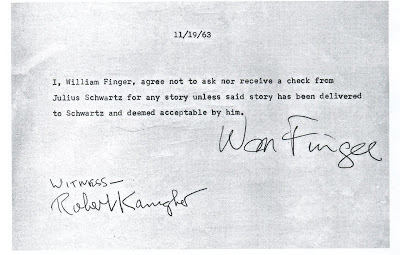 I’m no handwriting analyst so I can’t say what the curvature of his penmanship suggests about his character. Still, it was exciting to see it…until I learned of something better. Far better.
In 2006, early Batman ghost artist and Joker co-creator Jerry Robinson told me that he still has a guest book from an apartment he shared with other comic book artists in the 1940s. He said it’s filled with comments (and sketches!) by an A-list who’s who of the Golden Age (my phrasing, not his). And he said that includes Bill Finger.
On 8/12/06, when I went to Jerry’s to talk more about Bill, I asked to see the guest book. It is a peerless trove of off-the-grid comics history that would give whiplash to any fanboys with a sense of posterity. Some of the pages were loose and I urged Jerry (not that he needed a reminder) to continue to keep it safe so one day a copy of it might be shared with fandom.
Jerry generously allowed me to copy Bill’s page. I won’t yet say more about what Bill wrote because the page appears in its entirety on the last page of my book.
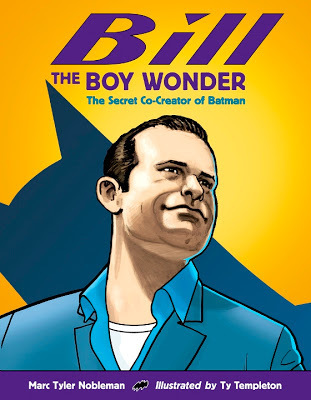 What I can say is how glad I am that I copied it when I did.
In 2010, I asked Jerry if I could re-copy the page because we needed a more high-res scan for reproduction (when I first copied it in 2006, I had not yet written the book and was so excited to get permission to copy the guest book page that I didn’t think of print quality).
I was aghast to learn that the guest book had since gone missing.
Later that year, the book resurfaced…but Bill’s page was still missing.
I suspected the book had been sent out to be scanned for Jerry’s autobiography (which came out in 2010) but couldn’t believe anyone involved could have been careless enough to let this happen. (And ultimately the Bill page did not appear in the autobiography.)
In any case, this unfortunate fluke made me the only known person in the world with a copy of this note. And as far as I know, I still am.
Incidentally, I have also dug up some personal (but typed) correspondence of Bill’s, featuring not only more signatures but some fantastic, previously unknown insight into Bill’s personality—including a Bob Kane moment that will make fans cheer. But this, too, will have to wait until my book comes out—one of those letters is quoted there, and the rest I will post here.
Early on, I realized something that was even scarcer: Bill’s handwriting. We have plenty of Bill’s writing, of course, but almost all of it is fictional (and typed).
But what would a personal note that he wrote reveal?
The only sample of his handwriting I’d seen was his signature on a 1963 note that Mike Catron had posted:
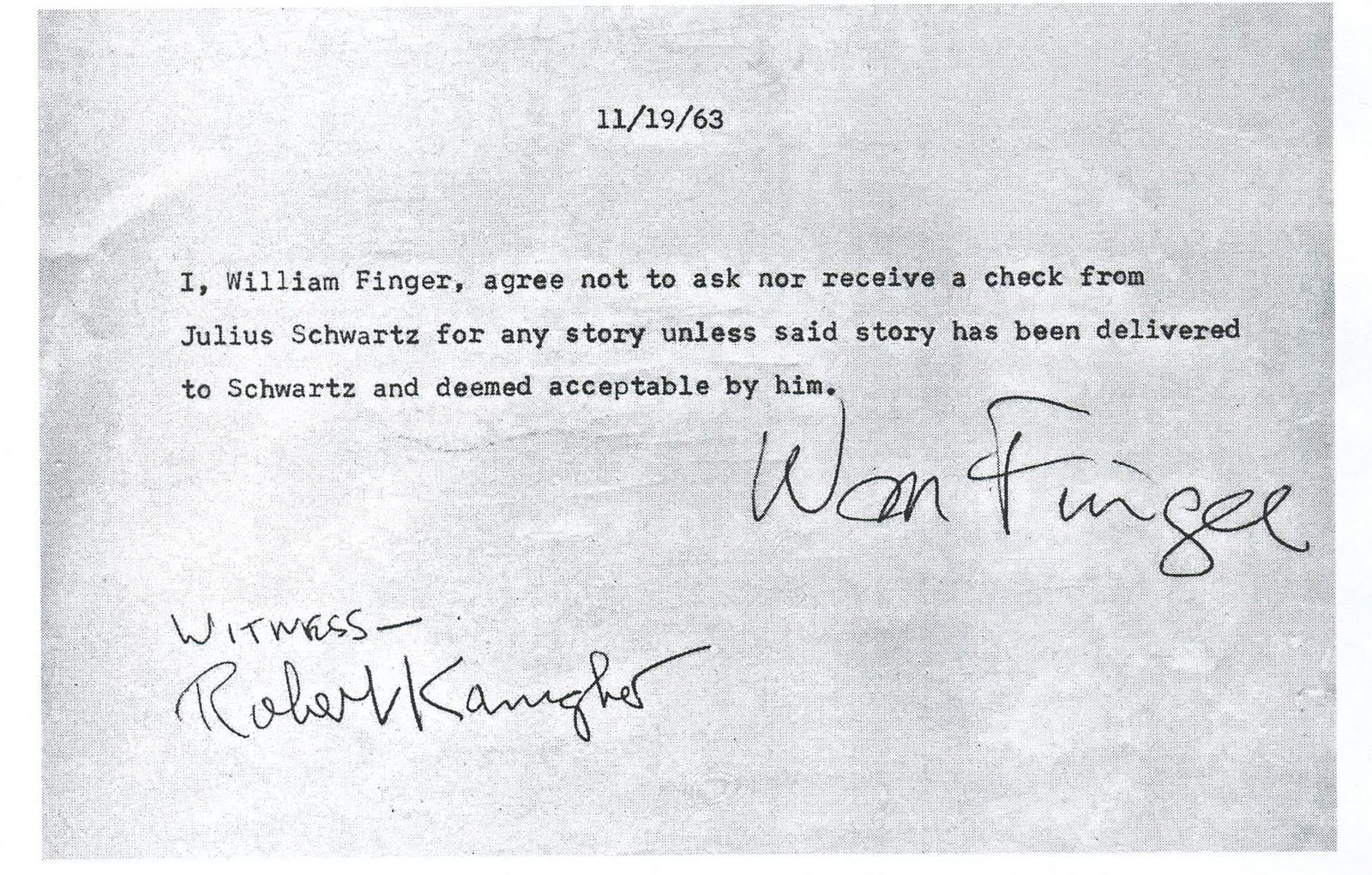 I’m no handwriting analyst so I can’t say what the curvature of his penmanship suggests about his character. Still, it was exciting to see it…until I learned of something better. Far better.
In 2006, early Batman ghost artist and Joker co-creator Jerry Robinson told me that he still has a guest book from an apartment he shared with other comic book artists in the 1940s. He said it’s filled with comments (and sketches!) by an A-list who’s who of the Golden Age (my phrasing, not his). And he said that includes Bill Finger.
On 8/12/06, when I went to Jerry’s to talk more about Bill, I asked to see the guest book. It is a peerless trove of off-the-grid comics history that would give whiplash to any fanboys with a sense of posterity. Some of the pages were loose and I urged Jerry (not that he needed a reminder) to continue to keep it safe so one day a copy of it might be shared with fandom.
Jerry generously allowed me to copy Bill’s page. I won’t yet say more about what Bill wrote because the page appears in its entirety on the last page of my book.
 What I can say is how glad I am that I copied it when I did.
 In 2010, I asked Jerry if I could re-copy the page because we needed a more high-res scan for reproduction (when I first copied it in 2006, I had not yet written the book and was so excited to get permission to copy the guest book page that I didn’t think of print quality).
I was aghast to learn that the guest book had since gone missing.
Later that year, the book resurfaced…but Bill’s page was still missing.
I suspected the book had been sent out to be scanned for Jerry’s autobiography (which came out in 2010) but couldn’t believe anyone involved could have been careless enough to let this happen. (And ultimately the Bill page did not appear in the autobiography.)
In any case, this unfortunate fluke made me the only known person in the world with a copy of this note. And as far as I know, I still am.
Incidentally, I have also dug up some personal (but typed) correspondence of Bill’s, featuring not only more signatures but some fantastic, previously unknown insight into Bill’s personality—including a Bob Kane moment that will make fans cheer. But this, too, will have to wait until my book comes out—one of those letters is quoted there, and the rest I will post here.
June 13, 2012
"Bill the Boy Wonder" ads in PW Comics World
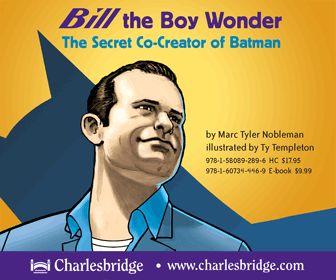
The 6/12/12 edition of the PW Comics World e-letter contains a barrage of ads for Bill the Boy Wonder: The Secret Co-Creator of Batman, each cool in a different way. In order of appearance:


 Thank you, Charlesbridge!



 Thank you, Charlesbridge!
June 12, 2012
Types of book titles I avoid using
Writers want their prose and their plots to be memorable. Why would it be different with their titles?
Below are a few types of titles I avoid in my writing. Regarding the examples I give, my criticism refers only to the titles, not the books/movies/TV shows/songs themselves, many of which are wonderful if not classics. And there are exceptions within my own work, such as Vanished: True Stories of the Missing—though I didn’t choose that title!
single words
reason: “Rosebud” aside, a single word is most likely not memorable, or even original. Search any word on Amazon and most have probably already been the title of a book.
note: This category also includes single words with “the” (The Goats—great book, by the way).
exceptions: Made-up words like Dinotopia or “Sussudio” because those are something we haven’t heard before.
two names
examples: Hondo and Fabian, Franny and Zoey, Laverne & Shirley, Lilo & Stitch.
exceptions: None really, but at least the names in the above examples are atypical.
reason: Names alone don’t reveal character—or anything about a story.
common phrases
examples: “No Way Out,” “Home Sweet Home,” “Time for Bed,” every song title on Bryan Adams’s album Into the Fire.
reason: Same as for “single words.”
"The Man/Woman/Boy/Girl Who…"
examples: The Man Who Knew Too Much, The Woman Who Wasn't There, The Boy Who Changed the World, The Girl Who Played with Fire.
reason: The character trait or accomplishment such titles single out usually seems more universal than the author may have intended. In other words, there are many boys who changed the world. I’d rather see a title that captures the essence of a person in a more specific way, or at least one that presents a fresh turn of a phrase, however inscrutable at first.
Lest it seem that I’m only being critical, think of it this way: by pointing out these types of titles, I’m also saying that the majority of titles do win points with me—namely, everything but the above.
Below are a few types of titles I avoid in my writing. Regarding the examples I give, my criticism refers only to the titles, not the books/movies/TV shows/songs themselves, many of which are wonderful if not classics. And there are exceptions within my own work, such as Vanished: True Stories of the Missing—though I didn’t choose that title!
single words
reason: “Rosebud” aside, a single word is most likely not memorable, or even original. Search any word on Amazon and most have probably already been the title of a book.
note: This category also includes single words with “the” (The Goats—great book, by the way).
exceptions: Made-up words like Dinotopia or “Sussudio” because those are something we haven’t heard before.
two names
examples: Hondo and Fabian, Franny and Zoey, Laverne & Shirley, Lilo & Stitch.
exceptions: None really, but at least the names in the above examples are atypical.
reason: Names alone don’t reveal character—or anything about a story.
common phrases
examples: “No Way Out,” “Home Sweet Home,” “Time for Bed,” every song title on Bryan Adams’s album Into the Fire.
reason: Same as for “single words.”
"The Man/Woman/Boy/Girl Who…"
examples: The Man Who Knew Too Much, The Woman Who Wasn't There, The Boy Who Changed the World, The Girl Who Played with Fire.
reason: The character trait or accomplishment such titles single out usually seems more universal than the author may have intended. In other words, there are many boys who changed the world. I’d rather see a title that captures the essence of a person in a more specific way, or at least one that presents a fresh turn of a phrase, however inscrutable at first.
Lest it seem that I’m only being critical, think of it this way: by pointing out these types of titles, I’m also saying that the majority of titles do win points with me—namely, everything but the above.
June 11, 2012
"Biographer of Underdogs"
That is the title of the podcast episode I recorded with "The Book of Life" in Miami in February 2012. I love it, especially since the underdogs that podcaster Heidi Rabinowitz Estrin are referring to are creators of the opposite of underdog—superheroes.

June 10, 2012
Pitching a Batman book to places named Gotham
Boys of Steel: The Creators of Superman tells a true story that took place in Cleveland. I contacted hotels there to pitch the book as part of a hometown pride package deal, and there was interest.
Now I'm doing the same with Bill the Boy Wonder: The Secret Co-Creator of Batman, except the venue has changed. That one took place in New York—probably the most challenging city in America to organize anything like this.
Still, I try, and here are the venues I approached:
 Gotham Bar and Grill
 Gotham Hall
 Gotham Hotel
 Gotham Comedy Club
 (This Gotham Hall is in Los Angeles.)
If you know of any other venues with "Gotham" in the name, no matter where they are, please let me know. And check back to see if any say yes...

Now I'm doing the same with Bill the Boy Wonder: The Secret Co-Creator of Batman, except the venue has changed. That one took place in New York—probably the most challenging city in America to organize anything like this.
Still, I try, and here are the venues I approached:
 Gotham Bar and Grill
 Gotham Hall
 Gotham Hotel
 Gotham Comedy Club
 (This Gotham Hall is in Los Angeles.)
If you know of any other venues with "Gotham" in the name, no matter where they are, please let me know. And check back to see if any say yes...
June 8, 2012
The ones that didn't get away
I’ve blogged about the frustration of certain people dying before they’ve been interviewed about a subject on which they are an authority.
Here’s the flip side.
I began researching Bill the Boy Wonder: The Secret Co-Creator of Batman in 2006. A priority was to talk with the people who knew Bill Finger personally, especially people who had never been interviewed about him.
I found more than I was expecting. And because Bill was born in 1914, most of his surviving contemporaries were in their eighties.
As to be expected, some who knew Bill well had died before I started the book—indeed, some before I was an author at all. And eerily, one—George Kashdan—died the very week in 2006 that it was suggested I reach out to him.
As of this writing, five more integral to preserving Bill’s legacy have passed away after helping with my research. And what an illustrious group:
Jerry Bails (died 2006)
Arnold Drake (2007)
Tom Fagan (2008)
Alvin Schwartz (2011)
Jerry Robinson (2011)
Others I talked to who have also since passed away include Martin Nodell (2006), Lew Sayre Schwartz (2011), and Sheldon Moldoff (2012).
I wish these gentlemen—especially the Jerrys—could have lived to see their old friend and colleague further honored in the form of my book. I was immensely grateful for the time they all devoted, and happy that I got to capture a bit of each of them not only for Bill’s sake but for posterity in general.
Here’s the flip side.
I began researching Bill the Boy Wonder: The Secret Co-Creator of Batman in 2006. A priority was to talk with the people who knew Bill Finger personally, especially people who had never been interviewed about him.
I found more than I was expecting. And because Bill was born in 1914, most of his surviving contemporaries were in their eighties.
As to be expected, some who knew Bill well had died before I started the book—indeed, some before I was an author at all. And eerily, one—George Kashdan—died the very week in 2006 that it was suggested I reach out to him.
As of this writing, five more integral to preserving Bill’s legacy have passed away after helping with my research. And what an illustrious group:
Jerry Bails (died 2006)
Arnold Drake (2007)
Tom Fagan (2008)
Alvin Schwartz (2011)
Jerry Robinson (2011)
Others I talked to who have also since passed away include Martin Nodell (2006), Lew Sayre Schwartz (2011), and Sheldon Moldoff (2012).
I wish these gentlemen—especially the Jerrys—could have lived to see their old friend and colleague further honored in the form of my book. I was immensely grateful for the time they all devoted, and happy that I got to capture a bit of each of them not only for Bill’s sake but for posterity in general.
June 7, 2012
Thank you, Ty Templeton
Bob Kane had Bill Finger.
Batman had Robin.
I had Ty Templeton.
We all lucked out.
Technically, the above is not a seamless parallel; Ty was not my anonymous contributor nor my sidekick, but rather my always-reliable partner in creating Bill the Boy Wonder: The Secret Co-Creator of Batman.
(Batman has actually had multiple "work partners"—Commissioner Gordon, Batgirl, Nightwing, Ace the Bat-Hound, to name a few—and I did, too; all of them are thanked in the book and some will be thanked again here.)
But back to Ty...
I first e-mailed him on 3/11/10 to tell him that I was looking for an illustrator for the project and that he was on my short list. An excerpt from his kind reply: "You couldn't find a more sympathetic soul for the plight of Finger's legacy than myself."
If that (plus talent) wouldn't sell you, nothing would.
(To be clear, the illustrator decision was not mine alone, but it did not take much convincing.)
As of this writing, Ty and I have not met in person or even talked on the phone. The vagaries of illustrated publishing...
Here is a photo I lifted from Ty's blog. I hope to be able to post a similar photo but with me as well, before long.
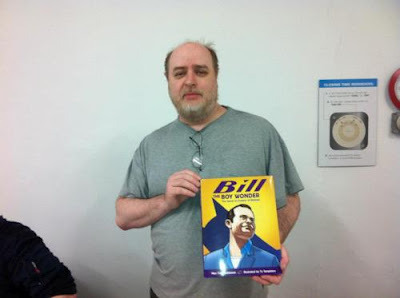 A public thank you, Ty, for acing this book.

Batman had Robin.
I had Ty Templeton.
We all lucked out.
Technically, the above is not a seamless parallel; Ty was not my anonymous contributor nor my sidekick, but rather my always-reliable partner in creating Bill the Boy Wonder: The Secret Co-Creator of Batman.
(Batman has actually had multiple "work partners"—Commissioner Gordon, Batgirl, Nightwing, Ace the Bat-Hound, to name a few—and I did, too; all of them are thanked in the book and some will be thanked again here.)
But back to Ty...
I first e-mailed him on 3/11/10 to tell him that I was looking for an illustrator for the project and that he was on my short list. An excerpt from his kind reply: "You couldn't find a more sympathetic soul for the plight of Finger's legacy than myself."
If that (plus talent) wouldn't sell you, nothing would.
(To be clear, the illustrator decision was not mine alone, but it did not take much convincing.)
As of this writing, Ty and I have not met in person or even talked on the phone. The vagaries of illustrated publishing...
Here is a photo I lifted from Ty's blog. I hope to be able to post a similar photo but with me as well, before long.
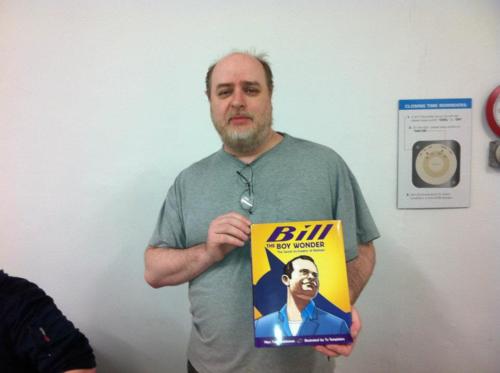 A public thank you, Ty, for acing this book.
June 5, 2012
"Children's Galleys to Grab: BEA 2012"
Publishers Weekly included Bill the Boy Wonder: The Secret Co-Creator of Batman on its list of "Children's Galleys to Grab" at BookExpo America 2012.
 PW: "[The book] unmasks Bill Finger, the unsung writer who helped dream up the caped crusader."
 PW: "[The book] unmasks Bill Finger, the unsung writer who helped dream up the caped crusader."


