
Mary Novik's Blog: Mary Novik's blog, page 3
July 7, 2014
The Blog Hop – A Writer’s Brainwaves

Karen Dodd

Jen Sookfong Lee

E.R. Brown
Today, I’m participating in a blog tour at the invitation of writer Karen Dodd, who also lives on what Vancouverites call the North Shore. This usually means that we have to drive over to Vancouver to visit friends, who are reluctant to travel to our side of town. Karen lives even further west than I do, in Lions Bay, where she often sees dolphins frolicking in Howe Sound. Maybe that’s why she’s written such a thrilling debut novel, Deadly Switch. Karen has passed on four questions for me to answer.
What am I working on?
I’m fascinated by walled cities like London and Avignon. Although London’s wall has been destroyed, except for a few traces, Avignon’s still encircles the historic city. After I finished writing Muse, I started thinking about London again. I picked up after the Great Fire of 1666, where Conceit ended, and began reading into the next century. Some amazing things were happening in early 18th-century London. I’m particularly interested in the literary authors, the booksellers, the printers, and the Grub Street hacks, who were paid for their writing by the page. In Queen Anne’s reign, the seeds were sown for the greatest works of Augustan literature. I’m at an early stage, so can’t say much more at this point, except that I am excited about completing a first draft so that I can see how the story comes together.
How does my work differ from others of its genre?
My fiction inhabits that generous and elastic genre of novels set in the past. I have also written contemporary stories. Each book I write is different from the last. Within historical fiction there’s a lengthy continuum, from more traditional writers like Philippa Gregory to experimental authors like Annabel Lyon and Michael Ondaatje. Hilary Mantel’s Booker win for Wolf Hall broke down preconceptions about historical fiction and opened the field for some very original books, like Eleanor Catton’s The Luminaries. Today literary authors often play around with genres such as the mystery or the thriller, so can’t be pigeonholed into categories. The best novels are unique and use what I’d call organic form. Each book finds its own structure in an organic way. This is what is happening with my in-progress novel. It’s growing its own shape as it evolves.
How does my writing process work?
I usually begin by obsessing about a particular historical place and its writers, for instance John Donne’s London or Francesco Petrarch’s Avignon. From that comes a plot idea and other characters, some historical, some fictional. Early in the process, I have to determine who the best storyteller is. That gives me the point of view. That’s such an important decision that if I get it wrong I have to back up, erase, and start again. The story comes alive when the characters begin to talk to one another and we get a sense of personality, conflict, and motivation.
Why do I write what I do?
I feel a compulsion to write a particular story. It begs to be told. Once it’s got a grip on my imagination, it gnaws at me, eats away at me, until it’s been set down on paper. Then I read it, reimagine it, and rewrite it. This happens over and over through successive drafts until I feel it’s done. I show it to a few trusted readers, such as my husband and my writing partners, to see if it’s ready to be shown to my agent and editor. My agent might have a few suggestions, but the real work is with my editor at Doubleday. I put it through several more drafts with my editor’s help until the manuscript is complete and ready for the copyeditor.
Passing on the torch
I’ve tagged two of my favourite writers to answer these four questions on their own blogs on July 21. Jen Sookfong Lee–who may live on “the other side” but is still one of the good guys–is a member of SPiN, my novelists’ writing group, which also includes June Hutton. Jen, who kibitzes cleverly about books on CBC radio, is the author of The End of East and The Better Mother, two novels from Knopf Canada, as well as the YA novel, Shelter. Eric Brown–who used to live on the North Shore, but has absconded to East Van under the disguise of E.R. Brown–is the author of the crime novel, Almost Criminal, which was recently shortlisted for the Arthur Ellis Award. Better than that, it was nominated for the prestigious Edgar Award in the US in the same category as Stephen King’s latest. Way to go, Eric!
If you are enjoying this blog hop, please shout and tweet the links so that we can reach other readers and spread the word about our novels. Word of mouth is so important, and we really appreciate any help you can give us!
The post The Blog Hop – A Writer’s Brainwaves appeared first on Mary Novik, author of Conceit and Muse.


June 18, 2014
Goodreads Discussion of Muse
Have you ever checked out www.goodreads.com? Goodreads has some very dedicated groups and one of my favourites, Imprinted Lives, which focusses on biography, is currently engaged in reading my novel Muse. The discussion runs from June 1 to 30, 2014 and is moderated by the amazing Asma. She is commenting enthusiastically on Muse, section by section, and is linking to some very interesting websites for background information. You can follow the group discussion at Mary Novik’s Historical Novels. Several years ago, the energetic Asma also led an amazing group discussion of Conceit. Both discussions will remain in the group archives for anyone who wants to pop in to read them later. Thank you, Asma!
The post Goodreads Discussion of Muse appeared first on Mary Novik, author of Conceit and Muse.
May 27, 2014
YouTube Video of Pope’s Palace in Avignon
Here’s a new YouTube video that takes you on a tour of the Pope’s palace in Avignon. We begin outside the west façade of the palace, where a busker is entertaining for coins, enter through the double portcullis, take a look around the courtyards, peer out of the Pope’s indulgence window. Then we join the secret palace tour to see inside a room with a decorated wooden ceiling and go up the corkscrew staircase, the only one that goes from top to bottom. We emerge on the roof, where the wind is blowing. From here, we see a 360 degree video of the city below. I had fun putting this together from my own photos and videos of the palace. I hope you enjoy it.
The post YouTube Video of Pope’s Palace in Avignon appeared first on Mary Novik, author of Conceit and Muse.
Pope’s Palace in Avignon, Setting of My Novel Muse
Here’s a new YouTube video that takes you on a tour of the Pope’s palace in Avignon. We begin outside the west façade of the palace, where a busker is entertaining for coins, enter through the double portcullis, take a look around the courtyards, peer out of the Pope’s indulgence window. Then we join the secret palace tour to see inside a room with a decorated wooden ceiling and go up the corkscrew staircase, the only one that goes from top to bottom. We emerge on the roof, where the wind is blowing. From here, we see a 360 degree video of the city below. I had fun putting this together from my own photos and videos of the palace. I hope you enjoy it.
The post Pope’s Palace in Avignon, Setting of My Novel Muse appeared first on Mary Novik, author of Conceit and Muse.
May 4, 2014
Another Publication Day for Muse, May 27, 2014
I’m really pleased that Anchor Canada is publishing a new edition of my novel, Muse, on May 27, 2014, only nine months after the original. Thanks, Random House, for the vote of confidence in my novel! The new edition is a smaller paperback, so will cost less, and they’ve given the book an attractive new look with a redesigned cover. I’ve been busy adding support material to my website and now have nine illustrated backstory essays for Muse. I’ve also created a new YouTube video about the Pope’s palace in Avignon.
I’m happy to announce that the group Imprinted Lives on Goodreads has chosen Muse for their June 2014 discussion and welcomes new members who would like to join in. If you click on the link, you’ll see that they had an excellent conversation about Conceit a while ago, so I think they will get into some interesting territory.
More information about the various Random House/Doubleday editions, including the e-book, can be found here. There’s also an Italian edition L’amante del Papa (with a sexy trailer) and a French edition is on the way from Éditions Hurtubise, with publication estimated for February 2015.
The post Another Publication Day for Muse, May 27, 2014 appeared first on Mary Novik, author of Conceit and Muse.
April 16, 2014
Getting Into Mindset of Solange
Getting into the mind of a literary character is a gradual process, just as it is with real people. My biggest wow moment in my understanding of Solange Le Blanc in Muse came when I was on the secret tour of the popes’ palace in Avignon. I stared at the bare walls of a basement chamber trying to imagine the décor of the Pope’s bathing room as the guide was describing it . . . read more
The post Getting Into Mindset of Solange appeared first on Mary Novik, author of Conceit and Muse.
April 15, 2014
Tribute to Mary Novik: Petrarchan Sonnet by Joan Boxall
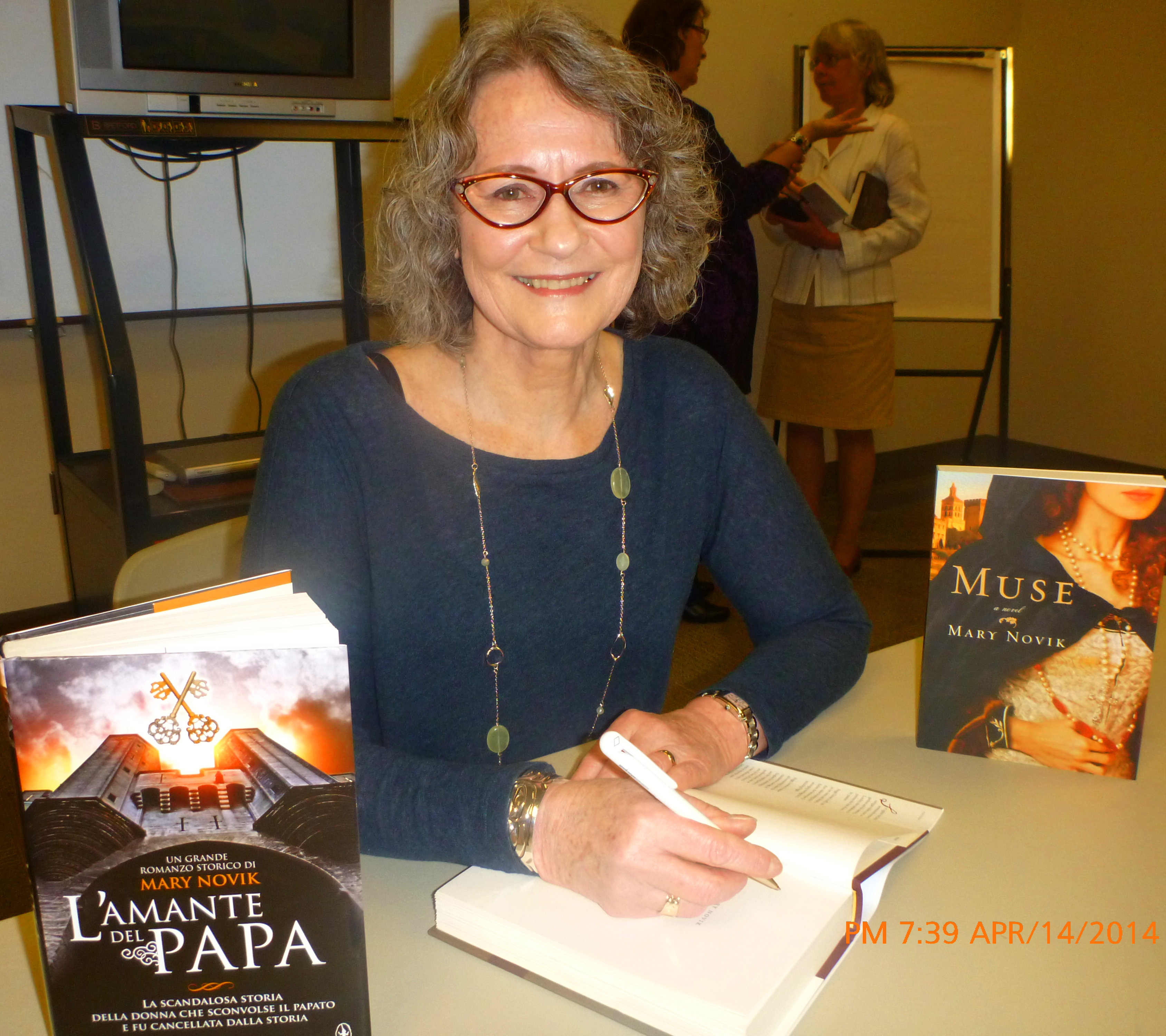
Mary at North Shore Writers’ Association
Before I spoke at the North Shore Writers’ Association meeting, clever poet Joan Boxall introduced me by singing (Joan is also the member of a Vancouver choir!) a Petrarchan sonnet she’d composed for the occasion. Here it is, courtesy of Joan. She also took the photo of me signing books for the members. Thank you so much, Joan!
Joan Boxall’s Tribute to Mary Novik and National Poetry Week
I’m pleased to introduce Mary Novik’s Muse,
A Petrarchian sonnet for this April’s Poetry Week.
It’s the muse behind the muse of which her book doth speak—
Solange, Petrarch’s Italian lover, the poet did misuse.
Petrarch, a priest, the contemplatives did use
Until at 23, he gave it up— he was too weak.
Like most of Avignon, in those days, did dance down by the creek.
But Solange, Mary’s protagonist, is the one we seek.
(a resounding refrain of ‘Sur le Pont d’Avignon, on y danse…’)
Twas she, as it turns out, had the gift of sight;
Sought clemency from Clement who was her loving Pope.
Yet Petrarch held her heart, for him she did copy— right!
For us, what could be, my point of view tonight?
As writers, and as scribes, we hold out some hope
That putting pen to paper is a plausible plight!
(‘Sur le Pont, d’Avignon, on y danse…tout en rond.’)
Translation: On Avignon Bridge (or under it as historians verify for shelter/privacy) we danse there . . . all in a writers’ circle
The post Tribute to Mary Novik: Petrarchan Sonnet by Joan Boxall appeared first on Mary Novik, author of Conceit and Muse.
Lunar Eclipses: Canada 2014 & Avignon 1343
Last night, I spoke at the monthly meeting of the North Shore Writers Association, and read a passage from my novel Muse in which a lunar eclipse takes place. Around 1 am, I rose from bed to look out the window. The moon, high in the sky, was dramatically eclipsed. We see the diagrams in the newspapers and know the cause, but in the 14th century, eclipses were terrifying. Here’s the passage, set in Avignon at Mardis Gras in 1343, that I read from Muse:
 The palace watch did not challenge me, even though I was without my customary escort. Clement had become a benign tyrant, a grand seigneur who forbade me to go outside the palais on my own, but it was Shrovetide, when anything might happen, and the guards opened the double portcullis for a coin. Although I had no lantern to hold up, the moon was full and I knew the streets and byways better than anyone.
The alleys were seething with dark forms surging towards the twelve gates in the old city wall. I liked slipping my leash and walking amongst the folk once more. I felt the force of the mob as I headed towards the rue du Cheval Blanc, where I had agreed to meet Gherardo. The gates were guarded after curfew, but the guards were common yeomen. Tonight, they were drinking liberally and turned bleary eyes on the slurry of humanity issuing out of the city. Only those foolish enough to carry lanterns, as was the law, were marked down in the record book for the city marshal’s inspection.
The canal was full, the water skimming over the top onto the marshy ground. Here in this sublunary realm, where the Pope could not enforce his curfew, a dark power welled up. There were no men of science, no dissectors of the truth, only peasants illuminated by the fickle moon. The folk were bent on enjoying themselves before being shriven on Ash Wednesday for the forty days of fasting. A vast fire was already burning and the fête du quartier was underway, a black sabbath by the looks of it, for a pig was boiling in its grease and more animals were tethered. There would be a mass-bouffe and a few sacrifices before pointed sticks would fish the boiled pig-meat out of its cauldron.
Drummers and acrobats led the dancers along the rue du Cheval Blanc. Ahead, I saw Gherardo, back in his own clothes with a wineskin fastened to his lips. The harlots had come out of the Cheval Blanc to enjoy the fête. Here, also, were liveried servants, who stood out against the dull backdrop of peasants, churlish apprentices, and dyers who could not afford to wear the purple that stained their own arms. Few of the people had bothered with masks and in the half-shadow, halflight I might be one of them again. I caught up to Gherardo to ask for a turn at the skin. Our talk of Francesco and my lost son had depressed my spirits. Tonight I felt like escaping into the world these people inhabited, but Gherardo refused to give me any drink. Instead, he handed the wineskin to a mountebank as they staggered off together, arms linked, into a passage.
All at once a pall fell over the sky, and I remembered the astrologer’s prediction. The folk pointed in horror as the surface of the moon became mottled, then blood-red. A giant unseen orb traversed the moon until the entire sky swelled with hellish red. An old weaver shrieked in langue d’oc that the devil had drawn his altar cloth across the moon. Reeking with fear, the folk cried out that the moon was dying and the whole world with it. Ignorant of eclipses, they believed they were about to die unshriven and plunge headlong into hell. Mothers wept, causing panic in their children, and ox-like men stood on the lip of the canal, ready to leap in to extinguish the hell-fire. One man held two infants in his arms, prepared to fling them into the water to spare them from the flames, and others were dragging their children to the brink to do the same.
Gooseflesh erupted along my arms and I tried to marshal my thoughts into some order. The sky was now so black it no longer held even a smudge of colour. How long had it taken the moon to darken? I knew from the court astrologer that it would take an equal time to lighten, but the terrified would drown themselves before the moon reappeared, since few of the folk along the canal could swim.
I stood on one of the planks across the canal, lifted my hands to command their attention, and shouted, “None of you will perish if you do as I tell you. Say ten paternosters, one after another, and before you say the tenth, the moon will return.”
I started chanting a paternoster loudly. The woman next to me joined in, and so did the next, and the next, and so did all the men, until all the jumpers were chanting, the children most eagerly of all. Gradually, the sky became a field of chevrons, pulsing red on black, then black on red, like the patterns that sometimes appeared on the inside of my eyelids. On the ninth paternoster, the fat red moon appeared on top of the teeth-like crenels of the city wall.
A man yelled, “The moon is back! The devil swallowed it, then spat it out!”
The jumpers left off chanting to crow at their good fortune and the musicians picked up their instruments to pluck them with gusto. The folk celebrated their escape from hell by throwing more fuel on their fire. A goose was hauled up a greased pole in a basket and the brawniest of the climbers, who finally made it to the top, earned it as a prize. A reveller chased down a striped cat, normally thought to bring good fortune. The youths nailed it to a post and took turns butting it with their heads.
What issued from the pipes, psaltry, and tabors could not be called music. It came like a disease from the gut of the poor, a dark, wounded joy. The thigh-slapping rhythm made my feet twitch with old memory and I danced until every bone felt alive and only thinly clothed in flesh.
The post Lunar Eclipses: Canada 2014 & Avignon 1343 appeared first on Mary Novik, author of Conceit and Muse.
April 10, 2014
Solange & Role of Women in Medieval Avignon
Late-medieval Avignon was a city of men. A vast number of clerics were employed by the Pope and cardinals, and foreign merchants, craftsmen, and artisans swelled the ranks of local people providing services to the church. The city was a cultural and economic magnet, an attractive place to set up shop. It was also notoriously corrupt . . . read more
The post Solange & Role of Women in Medieval Avignon appeared first on Mary Novik, author of Conceit and Muse.
April 2, 2014
Social Status & Food People Ate in 14th-century Avignon
Seven hundred years after the popes lived in Avignon, we can read reports about their banquets and gain insight into their luxurious life style. The type of food people ate depended on their rank. Although there was a vast difference between the diet of a pope and a peasant, the poor did not starve, because the Pope gave out 6,000 loaves of bread daily. The staples of a peasant’s diet were grains, legumes, onions, garlic, vegetables, coarse dark bread, eggs, and milk products, with a little fish, meat, or poultry . . . read more
The post Social Status & Food People Ate in 14th-century Avignon appeared first on Mary Novik, author of Conceit and Muse.
Mary Novik's blog

- Mary Novik's profile
- 92 followers

