Tananarive Due's Blog, page 2
September 15, 2012
Book excerpt: SOUTH BY SOUTHEAST: A Tennyson Hardwick Novel (Sept. 18th)
PROLOGUE ALL ACTORS DREAM of a meeting that will change our lives forever, but I didn’t dare hope that Gustavo Escobar would be mine. Even my agent had no idea why Escobar had called me. Escobar was an Oscar-nominated director on a hot streak, and I was lucky to have a job playing a corrupt lawyer on one of the last surviving soap operas. After twenty years in the industry, I no longer believed in the Big Bang. My microscopic part in a respected film set during the Harlem Renaissance, Lenox Avenue, hadn’t done much for my career. And the last two Hollywood heavy hitters who had contacted me—both women—craved skills that had nothing to do with my acting. Let’s just say I was wary of calls from powerful strangers.
 So when Escobar hadn’t shown up by nine o’clock for our eight-thirty dinner meeting, I was sorry I had agreed to meet him without more questions. Once again, the joke was on me. But it was hard to nurse a bad mood inside La Habana.La Habana was L.A.’s new ethnic restaurant du jour, modeled after a 1930s Cuban supper club. That night, a full orchestra played a rousing rumba against colorful walls splashed with artificially aged murals of palm trees and revelers in old-fashioned Cuban dress. Black-and-white footage of bandleaders Beny Moré and Aresenio Rodríguez flickered on overhead screens. At least I would have an excuse to call my former girlfriend, April; I was glad for any new novelties to bring us together. I was pulling out my phone to give my agent the bad news when a hand rested on my shoulder. “Lo siento,” a man said. “Sorry, I’m on Cuban Time. Gus Escobar.”I started to stand, but his firm hand on my shoulder told me not to bother. Instead, Escobar sat across from me with a wide smile, sweeping off his white fedora. I was surprised to note from his short-trimmed graying hair that Escobar was probably in his fifties, long past the norm for an overnight success in Hollywood. He had a slightly rounded midsection, but he carried himself fluidly, like a man who was fit and comfortable in his own skin. His round, thick-frame black eyeglasses were prominent, more fashion than function. His skin had only a whisper of a suntan, so I wouldn’t have guessed his Latino heritage if I hadn’t known. His accent was as much Brooklyn as Havana.“I lived in New York too long,” he said. “I never get used to the traffic.” “No problem,” I said with my trademark grin. “Just glad to meet you, Mr. Escobar.” “No, no, please, it’s Gus. You have to try the Bucanero beer. They keep extras on ice for me. Oye, Ramon!” He signaled for the waiter with two fingers. Like a lot of Hollywood types, Escobar was broadcasting himself at full wattage, creating a character, but I liked him. Rather than focusing on himself, he pulled his chair closer and gave me his attention as if I had summoned him. “You’re kind to make time for me on short notice,” he said. “I’m such an admirer. I saw Lenox Avenue, and you stole the scene. But Sofia Maitlin and I are distant cousins, did you know? She’s told me so many good things. She said you’ve never gotten full credit, but you’re a hero.” Here it comes, I thought, my grin turning to concrete. A year before, I’d helped an A-list actress save her adopted South African daughter from a kidnapping ring. I’d forgotten that Maitlin shared Escobar’s Cuban lineage on her mother’s side. I was sure Escobar was about to offer me a job as a bodyguard, and I wasn’t interested.But I was wrong. Escobar reached into his aged leather satchel and pulled out a script, which he nudged my way on the table. The title showed through the plastic sleeve: Freaknik. “For your eyes only,” Escobar said. “I have a beautiful part for you. We start shooting in Miami this fall.” Then he waited for my response as if his livelihood depended on my answer. The floor seemed to shift beneath my feet. I was glad the beer had arrived, because I needed a swig of moisture against my dry throat. I didn’t want to look as shocked as I felt. “Good, no?” Escobar said, meaning the beer. I wouldn’t know. I hadn’t tasted anything. My mind was still stuck on Escobar saying he had a part for me. Three months before, Escobar had been featured on the cover of Entertainment Weekly during the Oscar campaign for his last film, Nuestro Tío Fidel, his arty biopic of Fidel Castro. He had lost the Best Director Oscar to Martin Scorsese, but barely. Len Shemin, my agent, had told me that his entire client list would kill to be in Gustavo Escobar’s next film. “Why me?” Len would have kicked me under the table if he’d been there, but I asked. “Lenox Avenue,” he said. “The fire in you. I want that fire for Freaknik.” I wanted to hear more, but a respected young actor passing our table—I won’t say who—did a Scooby-Doo double take when he saw Escobar. He barely hid the who the hell are you glance he shot my way before he outstretched his hand to the director. He gushed at Escobar like a college co-ed meeting the team quarterback. Escobar was polite and patient while the actor angled for a meeting, but Escobar’s eyes frequently apologized to me for the intrusion. "Thank you so much, but I..." Escobar began, hinting for privacy. “Man, I’ve wanted to tell you…” the actor went on. “I’m blown away by your human portrait of Fidel. Our government talks shit about him, but you weren’t afraid to show the good he’s done. You didn’t take the easy road.” Escobar shrugged. “Truth is in the eye of the beholder, but gracias.”The actor excused himself reluctantly, his last gaze toward me full of burning envy. I gave him a mock salute before he walked away. Adios, asshole.I’d watched Nuestro Tio Fidel to prepare for the meeting, but Fidel hadn’t seemed sympathetic to me in the film, which chronicled Fidel’s transformation from a young revolutionary to a frail, paranoid dictator. Reviewers had compared Fidel’s depiction to Michael Corleone’s journey in The Godfather and The Godfather II. From what I’d heard, the Cuban exile community in Miami had practically proclaimed Escobar a patron saint.“Fidel’s good side?” I said. “Was that what you were trying to show?” “No man is only one thing.” Escobar winked, and I was sure he wasn’t talking about Fidel anymore. “The good and bad are always at war.” My father often told me how his pastor could stare at any congregant and see his story. That was how I felt sitting across from Escobar that night in La Habana, watching the glow of insight in his eyes. If he’d talked to Sofia Maitlin about me, he had doubtless spoken to others. He knew details about my history I’d tried to bury in a deep hole. He seemed to know I was broken, afraid to dream, that I’d almost talked myself out of meeting him. He might even know I had killed a man. Had Maitlin guessed and told him? I wanted to say more. To confide. To confess. To explain. Escobar nodded, as if I had spoken aloud. He sighed, and tears suddenly shone in his eyes, erased when he blinked. “Let me tell you something," he began. “I lost everything and everyone as a boy. People ask why I would follow Fidel with a horror movie. I ask, why not? Loss is one of the true universal experiences. Our walking dead follow us. They know us as their own.” For the next two hours, while patrons came and went and the orchestra packed up its music, Escobar talked to me about his project. Freaknik was a zombie movie only on the surface, he said. “This film, at its heart, is about love and redemption in the face of unspeakable evil," Escobar said, tapping the script. "The ultimate trial. Like me, Tennyson, you’ve known trials. That's why my vision won’t be complete without you.” April and my father often said everything happens for a reason, but I never believed it until that moment. My worst experiences had led me to the table with a stranger who was willing to help me build a future in Hollywood. It wasn’t just the best night of my career; it was one of the best of my life. If only I had known what real horror would be waiting in Miami. All of us are the walking dead.
South by Southeast on sale Sept. 18th. PRE-ORDER NOW. Copyright © 2012 by Blair Underwood, Tananarive Due, and Steven Barnes


July 16, 2012
Book excerpt: DEVIL'S WAKE (July 31)
Thankfully, Longview's streets weren't stacked with cars and bodies. Kendra drove past the industrial districts, those smokestacks that no longer belched white, the waterway now clogged with logs that, in saner days, would have gone to the Weyerhauser mill to build houses and make cardboard boxes. Nothing moved. Interstate 5 stayed mostly clear too. Until she'd driven twelve miles down.
 There, just as the skies were growing dark, Kendra's headlights showcased an overturned truck that looked like an oil tanker blocking the road. Kendra's heart danced with images of gas for life, until she realized it was only a milk truck. Don't get greedy, girl. She slowed and decided the embankment was gentle enough to steer around the truck, amazed at how easily she'd adapted to the challenge. Time was, she would have panicked at the blocked road, but she wasn't the same person she'd been yesterday. Or even an hour ago. Kendra pulled off, steering toward the dirt on the driver's side, her only clear passage. Her tires had just left the asphalt when a man stepped out the shadows. Kendra's eyes focused on him sharply, showing her every detail in her car's harsh light. He was a big man, with dirty, pale, densely freckled skin. A wild beard speckled white and black, with bits of yellow trapped inside. When he grinned, his teeth looked like he'd scribbled on them with yellow crayon. He'd been living outside. His hands were behind his back as if she'd interrupted him while he was pacing, deep in thought. Or maybe, just maybe, he was a freak. Kendra remembered Grandpa Joe's warning never to stop for hitchhikers, and she and the stranger had nothing to talk about. Without hesitating, she pressed her foot harder on the accelerator to make him think she would run him over rather than stop—and maybe she would. She didn't know yet. That was when he whipped out his shotgun. From four feet away, the barrel loomed as large and dark as a railroad tunnel. He'd fire if she accelerated, and was too close to miss. Heart thundering, Kendra rolled to a stop. She felt her pulse drumming as her hands grasped the steering wheel, her heartbeat shaking her body. Take your damned chances and drive over him! Kendra's mind screamed. But she didn't. Instead, with her trembling hands raised high, she got out of the car. She hoped she wouldn't lose more than the bicycle. Maybe he wouldn't see her backpack. "Heard the car from a mile off," the man said. "Don't see too many cars no more. And a pretty girl really ought not be out by herself. Get out—and bring your stuff. Everybody's got stuff." Kendra's legs barely obeyed her. She didn't like the way he'd called her pretty. She wished she looked dirtier, too. But maybe he wouldn't hurt her if she did what he told her to do. When she reached back into the car for her backpack, he gestured her over sideways, toward the ditch. That was when she saw the freak. The infected man had come down from the I-5, almost directly in line with the car, as if he were purposely concealing himself. A narrow man in a piss-stained business suit, still wearing a tie askew. It walked like most freaks, like it was having a slow-motion seizure. This was an older one, his face scabbed red. Grandpa Joe said the older, slower ones were slowly starving to death, and would do a lot more than take a single bite. Kendra moved around, backing away, so that the man with the gun was between her and the freak. Had bad luck turned to good luck so soon? The pirate's attention was on her, so he wasn't paying attention. She just needed to keep his eyes occupied for another few seconds... She summoned a warm-up exercise from a long-forgotten acting class. Kendra shimmied her hips slightly, as if she were about to do a private dance. She saw the way the pirate's eyes widened, lips peeling back in a grin, exposing those nasty teeth again. "That's more like it, girl," he said, his breathing heavy. "Show me the goods." Kendra slowly leaned over to rest her backpack on the ground, her eyes on the man with the gun. His eyes roamed over her, and his lip as if she were a steak. Over his shoulder, Kendra saw that the freak had halved the distance between them, within five yards, close enough for her to see how its eyes were foamed crimson with fungus. Which of them horrified her more? The pirate still held the shotgun with one hand, but he tugged on his jeans to unsnap them with the other. That's it, you sick bastard. Keep your eyes on me. But he must have heard something—or, more likely, smelled something. He wheeled around just in time to meet the freak face to face. Too late to run, barely time to scream. The pirate managed to get off a single shot before the freak grabbed him, and it went so wild that Kendra ducked. But not before she saw the freak's teeth tear into his exposed neck. Kendra ran, and as she did saw that there were two more Freaks...one staggering in from the west, and one running from the north. The runner was dressed like a fry cook, his apron tattered and blood-stained, his eyes filled with red veins. A fast one! The older freak was a woman, thin now but her clothes were so loose that Kendra guessed that she had once been plus-sized. Skin hung in diseased folds on her face, and her eyes were clotted red. They were driving Kendra. Funneling her toward a kill zone. They travel in packs. They lay traps. Even as she ran, Kendra struggled to comprehend. No time to jump into the car or grab her backpack. No time to do anything but flee. She climbed up the side of the road, toward the rising bank of the I-5, the freak below her now, trying to claw toward her. She heard a shot, and a scream from behind her. The scream went on so long that its gurgling echo scarcely seemed human. Kendra's world went gray, nearly white, as the fast freak’s hand clamped on her ankle, dragged her back down the incline a few feet while she kicked, expecting to feel the teeth pierce her skin at any moment. Kendra screamed like an animal. At last, a kick made contact. The freak lost its death-grip and rolled away. Kendra clambered up to the road and ran. She was running so wildly that she nearly lost her balance, flailing her arms as she crossed I-5's eight lanes to disappear down the other side--the steeper side she hadn't been willing to chance with the car. Panting hard, she ventured a peek. The thing appeared atop the far embankment and lurched like a drunk, trying to figure out which way she'd gone, and could not. It lost focus and staggered north. Sobbing, Kendra curled into a ball behind a pine tree. She had lost everything. One piece at a time her fragile world had been dismantled, the pieces ripped from her hands. She had lost her backpack, her bicycle, her rifle, the car. Her mother. Her father. Her grandpa. Everything and everyone. How had she been deluded enough to feel anything remotely resembling joy just yesterday? She'd been a fool to dream of living. Might as well just stay here, curl up in the dark. Wait to die. Then...she heard the engine. Just a groan at first, something that might almost have been mistaken for wind in the trees. Then a blue truck appeared on I-5...no, a bus. Some kind of school bus, a wedge-shaped snow plow mounted on the front. The bus slowed, pulled off along the road the way she had, its lights suddenly so bright that she could only see its hazy outline. Kendra hadn't moved, was pinioned directly in its headlights. Kendra felt no fear. No curiosity. In fact, nothing at all. Exhaustion and terror had congealed into a kind of quiet courage. She only held up one arm to shield her eyes from the bright light. The bus stopped with a tremendous squeal of brakes, and a smell of burnt rubber. The door opened, and she was able to look in past the stairwell to the driver's seat. The bus driver was just a boy, only a year or two older than she was. He wasn't dirty. He didn't have a gun. He had an angel's face with dark, curly hair and bright eyes. Behind him, she saw others on the bus: a pale girl with long black hair with a single streak of white. A narrow face, cradling a rifle in her sinewy arms. One guy standing next to her, tall, thick-chested, darker than Kendra, a toothpick in the corner of his mouth and his lips curled in a lazy smile. A dog stood at the top of the stairwell, some kind of Lab mix, eyeing her suspiciously. The driver's eyes were wide, intelligent and kind. So kind. They were, he was, the most beautiful sight Kendra had ever seen. He smiled at her. "Need a ride?" © 2012 by Steven Barnes and Tananarive Due. Devil's Wake. Atria Books (July 31)
*****
Library Journal on Devil's Wake: "The husband-and wife writing team of [Steven] Barnes and [Tananarive] Due puts a fresh spin on the zombie plague motif by hinting at an extraterrestrial origin of the phenomenon. Verdict: Gruesome but not overly graphic, this tale of young people struggling to remain human--and humane--in a post-apocalyptic near future features top-notch storytelling and believable characters."
May 21, 2012
Devil's Wake (VIDEO trailer): bringing our "zombies" to life
 The first zombie movie I remember seeing was George A. Romero’s Dawn of the Dead, probably when I was in high school—and I was mesmerized by its iconic shopping mall gore and mayhem. My mother raised me on the old Universal horror movies like The Wolfman, which were scary, but Dawn of the Deadwas jaw-droppingly shocking. I was hooked on zombies.
 Like millions of other television viewers, I’m looking forward to the new season of The Walking Dead on AMC—although the show’s premise is achingly similar to a television series my husband and collaborator Steven Barnes and I pitched years ago called Devil’s Wake.
Our original concept was simple: life in a small town after an infection creates creatures very much like the walking dead. We wanted to tackle issues like how to rebuild society once it breaks down, and how we create family after losing our loved ones.
Our pitch didn’t fly. CBS was in the midst of developing a new show called Jericho, which was too similar to our concept, substituting a nuclear event for a zombie outbreak.
Oh, well. But Steve and I had published a short story set in the world of Devil’s Wake, “Danger Word,” in an anthology compiled by Brandon Massey called Dark Dreams—recently reprinted in Living Dead 2. We always intended to expand our concept into a novel.
We got our chance with editor Malaika Adero at Atria Books, but with one change—instead of focusing on the adults, we wrote a YA/crossover novel with teenagers seeking safety on a disaster-ridden road trip in a rickety school bus. Devil’s Wake is the first in a series of novels, fulfilling our dream of bringing our zombie world to life.
 Atria Books--July 31st Our novel never mentions the word “zombie,” but Booklist says we got it right: “Zombie lovers won’t be able to put down Barnes’ [and Due’s] gripping yarn, which will leave them hungry for the next installment.”
Why do we love zombies so much? Maybe it’s our fear of our inevitable mortality, or fear of chaos and war. In the zombie culture, more than a few survivalists live as if they truly do believe the Zombie Apocalypse is only days away.
The Walking Dead won’t be back until the fall, but Devil’s Wake will be published July 31st. Until then, you can follow news from the zombiesphere with the “Devil’s Wake Survivors’ Daily” on Twitter—just follow @ZombiesFreak.
Soon, I’ll post an excerpt from the book here.
For now, we have shot this book trailer to give you a taste and a tease.
Here’s wishing you dark dreams.
Bestselling novelist Steven Barnes has been nominated for a Cable ACE award for his television writing on “The Outer Limits” and “The Twilight Zone.” He has also written more than a dozen novels, including the award-winning alternate history Lion’s Blood. He latest collaboration Larry Niven and Jerry Pournelle is the recently published e-book The Secret of Black Ship Island.
Tananarive Due, an American Book Award winner, has been nominated for the Bram Stoker Award and International Horror Guild Award for My Soul to Keepand The Good House. Her latest novel is My Soul to Take. Barnes and Due also co-author the award-winning Tennyson Hardwick mystery series in partnership with actor Blair Underwood. Her website is at www.tananarivedue.com.

April 1, 2012
Reflections on my mother: Patricia Stephens Due (1939-2012)
 Photo credit: Tallahassee Demorat My mother, civil rights activist Patricia Stephens Due, died on Feb. 7, 2012 after a long struggle with cancer. We also wrote a civil rights memoir together, Freedom in the Family: a Mother-Daughter Memoir of the Fight for Civil Rights. In 1960, she made history as a part of the first Jail-in in the student sit-in movement. "History belongs to those who write it," she often told me. These were my remarks at her memorial service in Tallahassee, Florida. She was a student at Florida A&M University at the time of her landmark arrest.
 February 19, 2012 Lee Hall Florida A&M University
To me, Patricia Stephens Due was..is…and will always be Mom. Mom was… A fierce advocate. Once, my junior high school science teacher confided to a colleague that Patricia Due was one of the most intimidating women he'd ever met. Heck, she scared me too. When I had bad news for Mom, instead of telling her in person, I preferred to write it in a note—a habit from childhood that persisted even after I was an adult. In junior high school, I was so scared to tell her I'd broken one of her dinner plates that I went out back and threw away the evidence in the canal behind our house. But anyone who knew Mom understands that beneath her gruff exterior lay the best ally you could hope for. When I sketched my first little book when I was four—stick figures and captions I called "Baby Bobby" –Mom Xeroxed it to give out to our church members and anyone else who would have one. When I became a published author, Mom was my manager who toured with me and made sure my needs were protected. She was cautious and watchful. An unfaltering role model. Mom refused to cut moral corners. Her honesty pervaded every aspect of her life, from the way she taught her children to the way she conducted herself in her daily walk. She did not believe in the gray area between right or wrong, and she taught us that we must find ourselves on the right side of any ethical line. She lived what she preached. A leader. How fitting that we're meeting here on the campus of Florida A&M University, the institution where my mother truly found her voice. Here on this campus, my mother came to know herself and her purpose. As I tell my students, she didn't set foot on this campus knowing she was extraordinary. She came to get her education and play her trumpet, and she got in a little bit of trouble along the way. But then came the CORE and the civil rights movement and my mother's REALIZATION—not a decision, but a REALIZATION—that she could not be still, she could not be quiet…that she was a warrior. I was born at the FAMU hospital, but I did not know Mom during that time. What's amazing to me is that we could hear testimonial after testimonial about what she accomplished outside of our home—when my sisters and I know that to Mom, her family came FIRST. She gave so much to us, and had still more to give to the world. Mom always said that she'd witnessed too many families suffer under the weight of the struggle, and she was determined that was not going to happen to her girls. That was her staunch belief: you give to your family first, the world second. She came to every meeting, every recital. She stretched herself every day to give us the best upbringing she could. Sometimes she was "Hello, darling" and sometimes she was "Bring me the belt." But we always knew we came first. She was at my side when I first held my newborn son, Jason, in my arms. There is hardly a single meaningful moment in my life when my mother was not there. And oh, did I want to be like her. When I was ashamed because I'd left a college anti-apartheid protest at Northwestern University to have dinner with a friend, which meant I'd missed my opportunity to get arrested with the other protesters, she told me, "Tananariva, I went to jail so you wouldn't have to." Perhaps that was her greatest gift to us: She gave us the freedom to be ourselves. She tried to pass along to us everything she learned. To prepare us to be competitive without pressuring us beyond our abilities. To teach us to love and cherish each other as sisters and as a family; a bond she knew would outlive her She told us we never had to be the best, as long as we did our best. She told us we would have to work twice as hard to get half as far. She taught us to love all people. She taught us to stand up for what we believe in. She taught us to love books. She taught us to love ourselves. She filled our house with black dolls so we would see our own faces reflected everywhere. She read us books about Dr. King, Harriet Tubman, Frederick Douglass and Sojourner Truth. She taught us "document, document, document." History belongs to those who write it. And she told us stories. She didn't tell a story once or twice. She told a story ten times—twenty times. She told a story so you would remember it. She talked about her childhood in Gadsden County, and how she and her sister, Priscilla, dodged farm work in their grandfather Richard Allen Powell's fields. Or chased snakes. She talked about her adolescence in Belle Glade, and how her stepfather, Marion Hamilton, taught students from the area known as "The Muck" how to play Count Basie and John Philip Sousa. She told us the stories of the foot-soldiers. Of the teargas. The protest marches. She told us about the Rev. C.K. Steele and his wife Lois, and their sons Charles Jr., Henry, and Darryl. She told us about Mrs. Mary Ola Gaines, the Tallahassee housekeeper who was arrested and lost her job because she dared to sit beside the students. She told us about my godmother, Judy Benninger Brown, and Dan and Jim Harmeling. Many of those stories we put in a book, Freedom in the Family: a Mother-Daughter Memoir of the Fight for Civil Rights, which I'm so grateful we were able to write during her lifetime. She told me stories, but the woman I knew was Mom. Our last major outing with Mom was in January of 2009, when my father, my sister Johnita and I went to Washington, D.C. to see the inauguration of President Barack Obama. I probably don't have to tell anyone in this room how excited Mom was about the election of the nation's first black president; a young man who spoke about the contributions of foot-soldiers and how ordinary people did extraordinary things. In the end, we watched from a downtown news monitor instead of venturing out in the cold, but we were on a rooftop along the parade route, so we saw the presidential motorcade. But Mom was still Mom. The next day, Dad and I went with Mom to the White House because she wanted to collect some soil to use to plant a tree for the foot-soldiers who hadn't lived to see the day. We came with a spoon and a small mason jar looking for soft soil outside of the White House gates. This is how we came to learn that the police don't appreciate people squatting outside of the household gates, digging in the soil—perhaps especially the day after the inauguration of the first black president. So the young police officer who said, "Hey!" when he saw us was not polite when he asked us to get up and move on. "Move—NOW," he in his I'm-guarding-the-White House voice. Some of you in this room may know where this is going. Mom was kneeling when he said this, and she wasn't in a hurry to stand back up. She started trying to explain why she wanted the soil. The police officer cut her off. "You stay on THIS side of the chain—that's why it's there. Move NOW," he said again. It was just then that I saw bad memories on my mother's face, and a growing defiance on her face as her lips began to curl. And in that instant, I imagined our perfect family trip ending in jail some kind of way. We coaxed Mom away from the police officer just in time. Mom got her soil—from a nearby tree where the soil was softer and easier to scoop. A kindly park ranger had pointed the way. My mother's pharmacist, who became a family friend and then a guardian angel, Dr. Lee Dunaway, helped my father plant a tree in her yard with that soil. Mom got her wish. Just as she got her wish to move back to Gadsden County. She'd felt a strong urge to go back home. And now, in every way, she is. We all sang to her and stroked her when she left this plane, but she is here in our hearts, in our minds, in every atom of our being. She is the voice I will always hear when I face an ethical dilemma. She is the voice I will always hear when I ask myself if I'm doing enough as a parent. Her voice is immortal. I love you, Mom. I miss you. I will stand tall, just as you taught us—and I will walk.

August 9, 2011
VIDEO: Book trailer for MY SOUL TO TAKE (Sept. 6)
What happens when you combine a giddy author fresh from Hollywood with an iPhone video camera? A book trailer on a shoestring budget! (In fact, all it cost me was time and a 1.99 iPhone app called 8mm Vintage Camera that creates neat vintage film effects.)
This is a trailer for My Soul to Take (Washington Square Press / Sept. 6). Fans of my African Immortals series will recognize the Underground Railroad and Glow from its predecessor, Blood Colony. Many readers will recognize the characters of Dawit and Jessica from the first books in the series, My Soul to Keep and The Living Blood.
But for you newbies: Glow is a healing compound derived from the blood of immortals, although most people who traffic in it don't know its origins. All they know is that it can heal anything, and the government is determined to shut down its distribution.
In My Soul to Take, my immortal teenager, Fana, and her Glow network will learn exactly how powerful the forces against Glow really are--and how close they have brushed to the end of the world.
Here's the trailer. Hope you like it! And travel safely, Glow healers.

This is a trailer for My Soul to Take (Washington Square Press / Sept. 6). Fans of my African Immortals series will recognize the Underground Railroad and Glow from its predecessor, Blood Colony. Many readers will recognize the characters of Dawit and Jessica from the first books in the series, My Soul to Keep and The Living Blood.
But for you newbies: Glow is a healing compound derived from the blood of immortals, although most people who traffic in it don't know its origins. All they know is that it can heal anything, and the government is determined to shut down its distribution.
In My Soul to Take, my immortal teenager, Fana, and her Glow network will learn exactly how powerful the forces against Glow really are--and how close they have brushed to the end of the world.
Here's the trailer. Hope you like it! And travel safely, Glow healers.
July 28, 2011
"Secrets to a Writer's Life": my first audio MP3 on writing...for writers
When I was four years old, I folded several pages of typing paper in half to create my first book, which I misspelled on the cover as "Babby Bobby." It wasn't a page-turner, just a simple story about a baby named Bobby who was sitting in his crib, drinking from his bottle and trying to get through his day. I did my own stick-figure illustrations.
A lot has happened since "Baby Bobby." With the upcoming publication of My Soul to Take (Sept. 6) [EXCERPT HERE], I have authored or co-authored a dozen novels and a civil rights memoir, in addition to short stories and a novella. I have also been thrilled to win several awards, including an American Book Award.
But it wasn't an easy road, and I didn't get to this point alone. I had great teachers, readers and advice along the way.
I also had to learn a few lessons the hard way...like, for instance, that writing never gets any easier. At a certain point with every project, I am besieged by voices that tell me my writing is terrible, my current project won't hold up to anything else I've written, and I'll be laughed out of the industry. Every project.
That's one of my secrets. Recently, when I mentioned this on Twitter, one of my followers confessed that her internal editor has prevented her from writing any fiction since January. That's no joke. For some writers, fearful voices might mean a project is never written at all.
Here's another secret: I have to fight to find time to write too. I've just been able to use my experience as a journalist to train my Muse to show up on a schedule, more or less, whether she likes it or not. To me, there is nothing mystifying about the "flow" process, and I have developed tricks to help put myself in the mood.
I think it helps writers of all levels to understand that we're all walking a similar road, fighting the same battles. That's one of the reasons I love teaching. I coach writers and teach at the graduate and undergraduate level.
But I can't reach everyone in person...so hubby (and co-author) Steven Barnes recently sat me down for a Q&A and chatted with me about everything we could think of on the topic of writing: from finding time to write to characterization to structure to marketing. So now I've "dropped" my first MP3, which is full of the advice I wish someone had given me. Just for fun, I threw in nearly 60 pages of bonus material on a PDF, including my keynote address at the 2005 Maui Writers' Conference and an in-depth lecture on adaptation and the process of adapting my novel The Good House to a screenplay.
This is my first MP3, but it won't be my last. It has a special price this week.
If you or a writer in your life could stand to learn a few secrets, CHECK IT OUT HERE.
A lot has happened since "Baby Bobby." With the upcoming publication of My Soul to Take (Sept. 6) [EXCERPT HERE], I have authored or co-authored a dozen novels and a civil rights memoir, in addition to short stories and a novella. I have also been thrilled to win several awards, including an American Book Award.
But it wasn't an easy road, and I didn't get to this point alone. I had great teachers, readers and advice along the way.
I also had to learn a few lessons the hard way...like, for instance, that writing never gets any easier. At a certain point with every project, I am besieged by voices that tell me my writing is terrible, my current project won't hold up to anything else I've written, and I'll be laughed out of the industry. Every project.
That's one of my secrets. Recently, when I mentioned this on Twitter, one of my followers confessed that her internal editor has prevented her from writing any fiction since January. That's no joke. For some writers, fearful voices might mean a project is never written at all.
Here's another secret: I have to fight to find time to write too. I've just been able to use my experience as a journalist to train my Muse to show up on a schedule, more or less, whether she likes it or not. To me, there is nothing mystifying about the "flow" process, and I have developed tricks to help put myself in the mood.
I think it helps writers of all levels to understand that we're all walking a similar road, fighting the same battles. That's one of the reasons I love teaching. I coach writers and teach at the graduate and undergraduate level.
But I can't reach everyone in person...so hubby (and co-author) Steven Barnes recently sat me down for a Q&A and chatted with me about everything we could think of on the topic of writing: from finding time to write to characterization to structure to marketing. So now I've "dropped" my first MP3, which is full of the advice I wish someone had given me. Just for fun, I threw in nearly 60 pages of bonus material on a PDF, including my keynote address at the 2005 Maui Writers' Conference and an in-depth lecture on adaptation and the process of adapting my novel The Good House to a screenplay.
This is my first MP3, but it won't be my last. It has a special price this week.
If you or a writer in your life could stand to learn a few secrets, CHECK IT OUT HERE.
July 13, 2011
VIDEO: Writing speculative fiction
Recently, I had the opportunity to take part in Art Sanctuary's "Celebration of Black Writing" in Philadelphia. After I gave a talk on writing science fiction, I was interviewed by Maurice Waters from BlackSci-Fi.com. (I think these general principles apply to writing all speculative fiction: science fiction, fantasy and horror.) Let me know what you think of these tips!

June 25, 2011
Family: the most important story
 I am generally a private person, but I was moved to write publicly about my mother's battle with thyroid cancer with an essay for CNN.com: "Behind Mom's dark glasses: A civil rights leader's biggest fight."
 My mother, civil rights activist Patricia Stephens Due, is also the co-author of our 2003 civil rights memoir, Freedom in the Family: a Mother-Daughter Memoir of the Fight for Civil Rights, which I have discussed previously on this blog.
I often say that Freedom in the Family is the most important book I have ever written.
While I was growing up, my mother spoke often of her dream to publish the stories of the unknown foot-soldiers she knew, black and white, who sacrificed their freedom, families, sanity--and, in some case, their lives--to try to win the rights we all enjoy today. Mom never set out to write about herself, but we tried to capture all of their stories in the book.
While we were interviewing my grandmother, my father (civil rights attorney John Due) and civil rights activists to write Freedom in the Family, my mother and I often reminded others to sit down and interview family members whether or not a book project was in the works.
Once those stories are gone, they're gone forever.
(To hear an NPR "Fresh Air" interview with me and my mother from 2003, click HERE.)
Never forget that your family is the most important story of all.

April 21, 2011
EXCERPT: MY SOUL TO TAKE (Sept. 2011)
NOTE FROM THE AUTHOR: This excerpt was the original prologue to MY SOUL TO TAKE, although it has now been moved to Chapter Three. I chose this excerpt because it takes the readers full circle to my original story in MY SOUL TO KEEP, the 1997 novel that introduced a Miami newspaper reporter named Jessica and her husband, David, who is secretly an immortal.
My African Immortals series ponders the price of immortality, the price of power, and what it might be like to have blood that could heal any ailment. MY SOUL TO TAKE centers around Fana, an 18-year-old girl born with the Living Blood, who must stand against a supernatural plague that threatens the world population.
If you're not familiar with my novels, you might want to read MY SOUL TO KEEP, THE LIVING BLOOD and BLOOD COLONY before reading MY SOUL TO TAKE...but it is written as a stand-alone novel. (And any title similarities to a certain Wes Craven movie are purely coincidental.)
(Pub date: Sept. 6, 2011 / Washington Square Press)
*****
A broad-shouldered man stands at Jessica Jacobs-Wolde's kitchen counter, stirring a bowl with slow, careful strokes while he watches her out of the corner of his eye. He slumps across the counter on one elbow, his face hidden by a shadow escaping the light from the bright rows of jalousie windows.
Not her husband, David. She left David sleeping in their bed upstairs. Besides, this man has the wrong shoes. Wrong posture. Wrong smell…shoe polish. And Old Spice, a smell older than David's. The man's face turns slightly, and light cleaves to his dark skin. Jessica blinks three times, more weak-kneed with each blink.
The man is her father.
Jessica's father died when she was eight, in 1978. But now he's in the kitchen as if he belongs with her in 1997, stooped over as he stirs the cobalt blue bowl she and David bought in Key West. Nineteen years have passed, but she knows his wide shoulders, salt-and-pepper hair, the small gap between his front teeth.
Time and death haven't changed her father a bit.
But his clothes aren't right. At first, he was wearing his dusty work boots, and in the next breath he's in his gray Sunday suit with shiny black shoes reeking of Kiwi shoe polish—his only church suit, the one he was wearing when they closed the gleaming rose colored casket and lowered him into a maw in the earth.
I'm dreaming, she thinks, a late realization. She has to be.
"Thought I'd make us some breakfast," Daddy says.
How dare he just show up now, out of the air! What has taken him so long?
Before she speaks, she talks herself down from her anger. Hasn't he always been near them when she and her daughter, Kira, climb down into the tiny burial cave at the foot of their front yard, near the mailbox? Don't the neighbors talk about ghosts in the mossy live oak trees? Maybe it has taken him twenty years to find her.
"Daddy?" Her voice reverts to childhood, almost too soft to hear.
Her father stirs his wooden spoon. Pancakes and fried eggs were all her father knew how to cook. It's Daddy, all right.
"'Mornin', baby girl," Daddy says.
"What are you doing here?" She can't say Daddy a second time.
His clothes change again, melting. Then he's wearing his brilliantly aqua blue Miami Dolphins jersey, number 72. Bob Greise. Daddy has gone to the Orange Bowl to see the Dolphins play all season long, sparking a fuss with her mother. The tiles on the kitchen counter turn powder blue, like the ones in their childhood home. When Jessica blinks, the tiles pale back to white.
Is Daddy trying to trick her? Daddy's face isn't quite in focus. She blinks again. Now, he looks like David. "You've been gone a long time, Jess," he says. Her father had never called her by David's nickname for her. When he was alive, he told her and her sister, Alexis, to stop letting neighborhood boys call them Jess and Alex because it sounded too tomboyish.
"Come on back with me, before you can't any more. We miss you, Jessica."
"Who's 'we'?" Jessica is surprised at how angry she sounds.
"You know who I mean, mi vida," Daddy says patiently. He heats a skillet on the stove, and butter sizzles sweet in the air. She has never heard her father speak Spanish, but his accent is flawless. He sounds like he grew up in Spain. Daddy's voice drops to a whisper. "Fana. Me. Alex. All of us."
What's he talking about? Her sister, Alex, isn't dead!
"Alex isn't with you, Daddy," she says. "She's still here. And who's…?"
She already can't remember the other name.
As if the stranger's name broke the spell, Daddy is suddenly gone. The skillet sizzles without him, the butter turning brown. No Daddy. An echo of his bright jersey still plays behind her eyes, but his absence hangs in the room.
Jessica holds her breath, waiting for him to reappear, her mind raging with questions and regrets. She is exhausted from grief. She wants to go back to bed, but her nightmares would come if she tried to sleep now. "Daddy?" she whispers to the empty room, trying the word on her tongue again.
"Lord, girl, you're burning up the butter!" Bea says from the kitchen doorway. Her loose multi-colored batik tunic fans across her arm like a choir robe.
Her mother was in last night's nightmare, Jessica suddenly remembers. Something about an airplane. Her heart. The memory fragments are sharp as glass, like physical pain.
Still here.
Jessica clasps her mother's warm hand, running her fingers across the soft, fleshy ridges of her knuckles, moistened with the Giorgio lotion Jessica gives her for Christmas every year. And the scent of Zest soap from her neck.
"Something just scared the crap out of me," Jessica says. Already, holding her mother's hand, she feels better. "Not you. It was…"
"Ommmmmm!" Kira hums, chiding her from behind Bea's skirt. "You said a bad word, Mommy! Crap is a bad word."
Jessica is surprised to see Kira up and already dressed for school—in her pink Flower Power T-shirt and slightly too-short blue jeans she wore because she loved the pink belt. The laces of her sneakers clash in bright orange.
Jessica feels sick to her stomach. A sour taste prods the back of her throat.
"Well, let's see what Grandma can whip together," Bea says, opening the kitchen cabinet.
"Kira has school, Mom. I'll fix her cereal."
"Hush," Bea says. "We have all the time in the world."
Kira gives Jessica her prettiest bright-eyed stare. "I love you, Mommy!" Kira says, and crushes herself against Jessica for a tight hug. "Forever."
Jessica kneels to the kitchen linoleum on one knee to hug Kira and savor every part of her. The sure, steady fluttering of her heartbeat. Her tiny rib-cage. The sweet Crest toothpaste on her breath. The honey scent of her uncombed hair.
Honey? Bees. Her nightmare tries to surface, but Jessica fights it back.
"You need to let her go and give her to me, Jessica," Bea says. "She's my best helper."
Kira cheers, flying to Bea's side by the stove. Smoke rises from the skillet. In the smoke, Bea and Kira are hard to see.
"Jessica, go fetch me flour some from the cellar," Bea's voice says in the smoke.
The smoke was pluming, filling the kitchen, but Jessica sees the cellar door wide open in her path. Two steps, maybe three, and she'll be inside the doorway. We don't have a cellar, Jessica thinks, but there it is. A bright light shines, and a shadow moves against the wall.
Maybe it's her father. Maybe this is where he wanted her to follow him.
Kira gaves a small cough, and Jessica's head whips around. All she sees is smoky profiles; one taller, one tiny. The kitchen smells like sweet-spicy incense.
"Mom…" Jessica begins. She had a thousand things to say. A thousand questions.
"Don't worry about Kira," Mom says. "I've got her, baby. You go on, now."
"'Bye, Mommy!" Kira calls, and Jessica's throat burns with pain.
The shadow in the cellar moves again. A disembodied arm beckons, or seems to. "Daddy?" Jessica says, and goes toward the open cellar door. The incense smell is stronger from downstairs. Bea and Kira giggle behind her.
Jessica takes her first step down the cellar stairs.
But it isn't a cellar, just as she'd thought. It's the burial cave at the end of their driveway with smooth dirt walls, built by the Tequestas to store arrow root; Kira's outdoor playhouse. The most charming fixture of her yard. Jessica's favorite place.
Jessica doesn't remember a doorway from the house to the burial cave. But here she is.
In 1997, she reminds herself. Still here.
Jessica hunches over to walk down into the cave.
A man sits cross-legged against the packed dirt of the cave's far wall. The cave is bigger than Jessica remembers it—as big as their bedroom. This time, the man isn't her father. He is nude. His face is hidden in a bright light, but she knows his body.
"Why are you in here?" Jessica says.
"You know why," her husband says. "For you, Jessica. To find you."
His voice sets her soul afire.
"You haven't lost me," she says. "You're right here."
Slowly, he shakes his head. The light plays across the burnished skin of his face, unbridling his beauty. His face brings tears to her eyes.
"The man in the bed upstairs isn't me," he says. "He's a memory, Jessica. A lie."
When he says the word lie, the ground shakes beneath her, a rumble. Her stomach aches.
"It's not a lie," she says. "I taste it, touch it and feel it every day. I'm still here."
"It's a dream you made for yourself."
Suddenly, she can't remember her husband's name. The cave is dimming around her. She feels sleepy, her eyes coaxed open by the light on her husband's face.
"We live at 296 Tequesta Road," she says. "I work for the Miami Sun-News. I'm a reporter. We have a five-year-old daughter named Kira. She's right here. And so is Mom. My mother is cooking breakfast with Kira right now."
Her husband's jaw clenches with what looks like anger, but in the light she sees it's pain. "We lost Kira, Jessica," he says. "We lost your mother."
"That's not true!" Jessica screams.
Tears water her husband's cheeks. "I wish it weren't, Jess. If I could make your dream real and step back into time, I would find a way to spare you all of it." He swallows a sob. "I would change everything. But I cannot. We cannot. I dream of your memory, too. I wish we could travel back together." For the first time, Jessica remembers her husband's true name: Dawit.
"You lied to me," she says.
"Yes."
"You stole everything."
"Yes." A whisper.
And yet, she loves him. Her love for him is deeper, somehow, than her love when she had known him only as David. But their love was brighter then. Innocent.
"Then why shouldn't I stay here?" she says. "Why shouldn't we be happy?"
"We will be happy again, Jess," he says. "We can."
"How?"
She can't remember everything about her nightmares yet, but she is waking from her dream. Not the cave—somewhere else. An underground temple. Another child.
Not Kira. Her first daughter is dead.
Fana. Her second child's name.
Fana is where Jessica's nightmares begin.
© Copyright 2011 by Tananarive Due
My African Immortals series ponders the price of immortality, the price of power, and what it might be like to have blood that could heal any ailment. MY SOUL TO TAKE centers around Fana, an 18-year-old girl born with the Living Blood, who must stand against a supernatural plague that threatens the world population.
If you're not familiar with my novels, you might want to read MY SOUL TO KEEP, THE LIVING BLOOD and BLOOD COLONY before reading MY SOUL TO TAKE...but it is written as a stand-alone novel. (And any title similarities to a certain Wes Craven movie are purely coincidental.)
(Pub date: Sept. 6, 2011 / Washington Square Press)
*****
A broad-shouldered man stands at Jessica Jacobs-Wolde's kitchen counter, stirring a bowl with slow, careful strokes while he watches her out of the corner of his eye. He slumps across the counter on one elbow, his face hidden by a shadow escaping the light from the bright rows of jalousie windows.
Not her husband, David. She left David sleeping in their bed upstairs. Besides, this man has the wrong shoes. Wrong posture. Wrong smell…shoe polish. And Old Spice, a smell older than David's. The man's face turns slightly, and light cleaves to his dark skin. Jessica blinks three times, more weak-kneed with each blink.
The man is her father.
Jessica's father died when she was eight, in 1978. But now he's in the kitchen as if he belongs with her in 1997, stooped over as he stirs the cobalt blue bowl she and David bought in Key West. Nineteen years have passed, but she knows his wide shoulders, salt-and-pepper hair, the small gap between his front teeth.
Time and death haven't changed her father a bit.
But his clothes aren't right. At first, he was wearing his dusty work boots, and in the next breath he's in his gray Sunday suit with shiny black shoes reeking of Kiwi shoe polish—his only church suit, the one he was wearing when they closed the gleaming rose colored casket and lowered him into a maw in the earth.
I'm dreaming, she thinks, a late realization. She has to be.
"Thought I'd make us some breakfast," Daddy says.
How dare he just show up now, out of the air! What has taken him so long?
Before she speaks, she talks herself down from her anger. Hasn't he always been near them when she and her daughter, Kira, climb down into the tiny burial cave at the foot of their front yard, near the mailbox? Don't the neighbors talk about ghosts in the mossy live oak trees? Maybe it has taken him twenty years to find her.
"Daddy?" Her voice reverts to childhood, almost too soft to hear.
Her father stirs his wooden spoon. Pancakes and fried eggs were all her father knew how to cook. It's Daddy, all right.
"'Mornin', baby girl," Daddy says.
"What are you doing here?" She can't say Daddy a second time.
His clothes change again, melting. Then he's wearing his brilliantly aqua blue Miami Dolphins jersey, number 72. Bob Greise. Daddy has gone to the Orange Bowl to see the Dolphins play all season long, sparking a fuss with her mother. The tiles on the kitchen counter turn powder blue, like the ones in their childhood home. When Jessica blinks, the tiles pale back to white.
Is Daddy trying to trick her? Daddy's face isn't quite in focus. She blinks again. Now, he looks like David. "You've been gone a long time, Jess," he says. Her father had never called her by David's nickname for her. When he was alive, he told her and her sister, Alexis, to stop letting neighborhood boys call them Jess and Alex because it sounded too tomboyish.
"Come on back with me, before you can't any more. We miss you, Jessica."
"Who's 'we'?" Jessica is surprised at how angry she sounds.
"You know who I mean, mi vida," Daddy says patiently. He heats a skillet on the stove, and butter sizzles sweet in the air. She has never heard her father speak Spanish, but his accent is flawless. He sounds like he grew up in Spain. Daddy's voice drops to a whisper. "Fana. Me. Alex. All of us."
What's he talking about? Her sister, Alex, isn't dead!
"Alex isn't with you, Daddy," she says. "She's still here. And who's…?"
She already can't remember the other name.
As if the stranger's name broke the spell, Daddy is suddenly gone. The skillet sizzles without him, the butter turning brown. No Daddy. An echo of his bright jersey still plays behind her eyes, but his absence hangs in the room.
Jessica holds her breath, waiting for him to reappear, her mind raging with questions and regrets. She is exhausted from grief. She wants to go back to bed, but her nightmares would come if she tried to sleep now. "Daddy?" she whispers to the empty room, trying the word on her tongue again.
"Lord, girl, you're burning up the butter!" Bea says from the kitchen doorway. Her loose multi-colored batik tunic fans across her arm like a choir robe.
Her mother was in last night's nightmare, Jessica suddenly remembers. Something about an airplane. Her heart. The memory fragments are sharp as glass, like physical pain.
Still here.
Jessica clasps her mother's warm hand, running her fingers across the soft, fleshy ridges of her knuckles, moistened with the Giorgio lotion Jessica gives her for Christmas every year. And the scent of Zest soap from her neck.
"Something just scared the crap out of me," Jessica says. Already, holding her mother's hand, she feels better. "Not you. It was…"
"Ommmmmm!" Kira hums, chiding her from behind Bea's skirt. "You said a bad word, Mommy! Crap is a bad word."
Jessica is surprised to see Kira up and already dressed for school—in her pink Flower Power T-shirt and slightly too-short blue jeans she wore because she loved the pink belt. The laces of her sneakers clash in bright orange.
Jessica feels sick to her stomach. A sour taste prods the back of her throat.
"Well, let's see what Grandma can whip together," Bea says, opening the kitchen cabinet.
"Kira has school, Mom. I'll fix her cereal."
"Hush," Bea says. "We have all the time in the world."
Kira gives Jessica her prettiest bright-eyed stare. "I love you, Mommy!" Kira says, and crushes herself against Jessica for a tight hug. "Forever."
Jessica kneels to the kitchen linoleum on one knee to hug Kira and savor every part of her. The sure, steady fluttering of her heartbeat. Her tiny rib-cage. The sweet Crest toothpaste on her breath. The honey scent of her uncombed hair.
Honey? Bees. Her nightmare tries to surface, but Jessica fights it back.
"You need to let her go and give her to me, Jessica," Bea says. "She's my best helper."
Kira cheers, flying to Bea's side by the stove. Smoke rises from the skillet. In the smoke, Bea and Kira are hard to see.
"Jessica, go fetch me flour some from the cellar," Bea's voice says in the smoke.
The smoke was pluming, filling the kitchen, but Jessica sees the cellar door wide open in her path. Two steps, maybe three, and she'll be inside the doorway. We don't have a cellar, Jessica thinks, but there it is. A bright light shines, and a shadow moves against the wall.
Maybe it's her father. Maybe this is where he wanted her to follow him.
Kira gaves a small cough, and Jessica's head whips around. All she sees is smoky profiles; one taller, one tiny. The kitchen smells like sweet-spicy incense.
"Mom…" Jessica begins. She had a thousand things to say. A thousand questions.
"Don't worry about Kira," Mom says. "I've got her, baby. You go on, now."
"'Bye, Mommy!" Kira calls, and Jessica's throat burns with pain.
The shadow in the cellar moves again. A disembodied arm beckons, or seems to. "Daddy?" Jessica says, and goes toward the open cellar door. The incense smell is stronger from downstairs. Bea and Kira giggle behind her.
Jessica takes her first step down the cellar stairs.
But it isn't a cellar, just as she'd thought. It's the burial cave at the end of their driveway with smooth dirt walls, built by the Tequestas to store arrow root; Kira's outdoor playhouse. The most charming fixture of her yard. Jessica's favorite place.
Jessica doesn't remember a doorway from the house to the burial cave. But here she is.
In 1997, she reminds herself. Still here.
Jessica hunches over to walk down into the cave.
A man sits cross-legged against the packed dirt of the cave's far wall. The cave is bigger than Jessica remembers it—as big as their bedroom. This time, the man isn't her father. He is nude. His face is hidden in a bright light, but she knows his body.
"Why are you in here?" Jessica says.
"You know why," her husband says. "For you, Jessica. To find you."
His voice sets her soul afire.
"You haven't lost me," she says. "You're right here."
Slowly, he shakes his head. The light plays across the burnished skin of his face, unbridling his beauty. His face brings tears to her eyes.
"The man in the bed upstairs isn't me," he says. "He's a memory, Jessica. A lie."
When he says the word lie, the ground shakes beneath her, a rumble. Her stomach aches.
"It's not a lie," she says. "I taste it, touch it and feel it every day. I'm still here."
"It's a dream you made for yourself."
Suddenly, she can't remember her husband's name. The cave is dimming around her. She feels sleepy, her eyes coaxed open by the light on her husband's face.
"We live at 296 Tequesta Road," she says. "I work for the Miami Sun-News. I'm a reporter. We have a five-year-old daughter named Kira. She's right here. And so is Mom. My mother is cooking breakfast with Kira right now."
Her husband's jaw clenches with what looks like anger, but in the light she sees it's pain. "We lost Kira, Jessica," he says. "We lost your mother."
"That's not true!" Jessica screams.
Tears water her husband's cheeks. "I wish it weren't, Jess. If I could make your dream real and step back into time, I would find a way to spare you all of it." He swallows a sob. "I would change everything. But I cannot. We cannot. I dream of your memory, too. I wish we could travel back together." For the first time, Jessica remembers her husband's true name: Dawit.
"You lied to me," she says.
"Yes."
"You stole everything."
"Yes." A whisper.
And yet, she loves him. Her love for him is deeper, somehow, than her love when she had known him only as David. But their love was brighter then. Innocent.
"Then why shouldn't I stay here?" she says. "Why shouldn't we be happy?"
"We will be happy again, Jess," he says. "We can."
"How?"
She can't remember everything about her nightmares yet, but she is waking from her dream. Not the cave—somewhere else. An underground temple. Another child.
Not Kira. Her first daughter is dead.
Fana. Her second child's name.
Fana is where Jessica's nightmares begin.
© Copyright 2011 by Tananarive Due
September 26, 2010
My African Immortals Series--next installment, My Soul to Take (2011)
In 1997, I published a novel entitled My Soul to Keep that marked the beginning of what I now call my African Immortals series. The story centers around a 500-year-old Ethiopian immortal named Dawit and the Miami newspaper reporter, Jessica, who is unwittingly married to him. At the time, I had no series in mind.
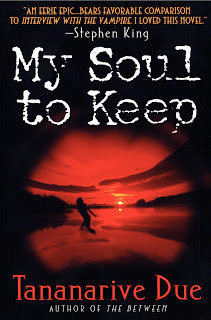 The novel was a watershed for me: It has endured as a reader favorite, and was blurbed by Octavia E. Butler and Stephen King, who wrote that it "bears favorable comparison to Inter...
 The novel was a watershed for me: It has endured as a reader favorite, and was blurbed by Octavia E. Butler and Stephen King, who wrote that it "bears favorable comparison to Inter...