
Christine Valters Paintner's Blog, page 8
March 8, 2025
Sabbath as a Way of Being in the World ~ A Love Note from Your Online Abbess
Dearest dancing monks, artists, and pilgrims,
Tomorrow Simon and I will be joined by guest musician Will Boesl for our monthly Contemplative Prayer Service. Our theme this month is the 6th principle of the Monk Manifesto, Sabbath. Here is an excerpt from our Monk in the World self-study retreat.
Principle 6: I commit to rhythms of rest and renewal through the regular practice of Sabbath and resist a culture of busyness that measures my worth by what I do.
The work of the monk is important, but equally important are rhythms of rest and restoration. The Rule of Benedict is exquisitely balanced in this way. In a world which runs nonstop where we are always accessible, we have to make the choice to step out from under its tyranny of demands. Sabbath calls us to restore ourselves and remember that the world will go on without our labors. It is ultimately an act of humility which means to remember our earthiness. Sabbath gives honor to our gifts by also acknowledging our limitations.
Sabbath may be one of the most important practices we have. As Tricia Hersey so wisely writes in her book Rest is Resistance, rest can be an act of resistance in a culture that wants to exploit and deplete our labor so others can profit. When we practice Sabbath, however that looks for our lives, we are saying enough. We are claiming rest as necessary and holy and so good.
Connected to the seasons of each day’s rise and fall, we are called to embrace times of fallowness, of doing nothing, of simply being. Sabbath offers us this gift and helps to cultivate a contemplative commitment in the world. . . .
Sabbath is not a doing, but a way of being in the world. It calls to us again and again to return to the still place within, to rest in the presence of the Beloved, and to know ourselves as loved simply for who we are. In those spaces of rest comes renewal, with dreams for new possibilities. As a culture we face so many issues that feel impossible to tackle in meaningful ways. One way to begin is to allow enough space for visions to enter, to step back and see what happens when we slow down our pace first. . . .
April Yamasaki describes Sabbath as not just an act of self-care, but community care: “Sabbath was not self-care in the narrow sense of the word but was about more broadly caring for the community and for creation . . . Instead of individual soul care, the Sabbath addresses a community of souls in the context of doing good and caring for community and creation.” The practice of Sabbath weaves us back to our principle of community and how we are called to see ourselves as intimately interrelated. It is good to pause and rest together.
Being a monk in the world means making time for this life-giving rest. A holy pause to reflect on life’s meaning. The monk in the world stays committed to the contemplative way through regular practice, but part of that practice is creating spaciousness and joy.
Join us for our Contemplative Prayer Service tomorrow and deepen into Sabbath together through song, poetry, prayer, and silence.
With great and growing love,
ChristineChristine Valters Paintner, OblSB, PhD, REACE
The post Sabbath as a Way of Being in the World ~ A Love Note from Your Online Abbess appeared first on Abbey of the Arts.


March 4, 2025
Monk in the World Guest Post: Elaine Breckenridge
I am delighted to share another beautiful submission to the Monk in the World guest post series from the community. Read on for Elaine Breckenridge’s reflection on connection with the wisdom of her body, nature, and the healing presence within.
In 2015, I took my first online community retreat with the Abbey, titled, The Wisdom of the Body. After years of neglecting my body, I began to “savor it” and care for it in life expanding ways. The biggest gift that came out of this particular retreat was yoga. Each week we were invited to watch videos with someone who led us through a simple practice.
One day, as I was driving to work, I saw my car parked in the lot of a nearby yoga studio. I really did! Of course, it was not my car, but I got the message. Later that day, I stopped by the studio and signed up for my first class. That began an important practice which nine years later continues to this day. The Abbey’s incorporation of embodied contemplative practices in all of their retreats has helped me to claim the wisdom of my own body.
A deepening relationship with nature that has emerged through my work with the Abbey is a second and important gift. I have always enjoyed reading about creation but the Abbey encouraged me to get outdoors! Outdoors, on the prescribed contemplative walks, I have fallen in love with the elements, the sky, nearby waterscapes and especially with the forest and trees. Taking the retreat and reading Christine’s book, Earth, Our Original Monastery solidified my belief that the Earth is truly a theophany of God. In the early days of the lockdown during the pandemic, Christine and John generously came out of their sabbatical and offered The Soul of a Pilgrim retreat. I was grateful to have this anchor during that odd time which led me to learn how to pray and worship outdoors. A state park bench was my pew, trees overhead rivaled any vaulted cathedral ceiling and I was happy to have birds as my choir. More recently, I have found mystic inspiration from a nearby Cedar Forest.

A third important gift I have received is the gift of healing. The retreat, A Midwinter God: Making a Conscious Underground Journey, invited me to explore childhood trauma, my dreams, and my shadow. Taking a deep dive into my soul, this poem emerged:
Beach VisionI went to the seashore today.
Sitting on a bed of shells,
leaning against a desiccated log,
I admired the sparkling waves
and noticed a stunning ripple of light and energy,
reminding me of a strand of artificial diamonds
my mother used to wear.
I saw ducks dressed in tuxedos and for a moment there,
I was Cinderella delivered from a day of routine housework.
I fell asleep.
I saw the paralyzed man lying by the healing waters of Bethesda.
Still hoping for a cure, he hoped for thirty-eight years—
without ever getting into the water.
No wonder Jesus asked,
“Do you want to be made well?”
At that point I woke up. Literally,
woke up and saw a man walking on water
coming towards me!
Coming to my physical senses,
I realized I was observing
a man on a paddleboard working hard
to make progress against the wind and waves.
“Elaine, do you want to be made well?”
“Yes!” I exclaimed.
“Then why do you lie on the beach
without even putting a toe into the water?”
I got the message.
In order for there to be progress
I must be willing to take the plunge
to explore my depths
to see what lies beneath the world of
sparkling waves that look like artificial diamonds and
ducks dressed in black tie.
I am being called to leave that world
(Not that I truly lived there)
and swim beneath the surface of old storylines.
I know there will be a new stillness under the glittery waves.
It will be a journey of letting go (damn it!)
A voyage that will demand peering into the darkness.
I hope my companions will be whales. At least one
with whom I can swim eye to eye.
© Elaine H. Breckenridge, May 2021

In the retreat, Visionary, Warrior, Healer, Sage: Archetypes to Navigate an Unravelling World, I was held by the prayers and support in the community forum as I navigated my own unravelling facing a breast cancer diagnosis, a partial mastectomy and radiation treatments.
All of these gifts received and there are many more, are also tools and practices which continue to guide me through my own series of personal resurrections. I am so grateful!
Many thanks to Christine, John and Melinda. Thank you to the Wisdom Council and the mentors who make these retreats possible. And thank you to the many Dancing Monks who have followed my journeys and allowed me to follow theirs.
It has brought me closer to living from my True Self.
Elaine Breckenridge is a retired Episcopal priest living on Camano Island, Washington. She serves as a grandmother, offers Celtic services and rituals, and enjoys Abbey of the Arts online community retreats.
The post Monk in the World Guest Post: Elaine Breckenridge appeared first on Abbey of the Arts.
March 1, 2025
Seven Gates of Mystical Wisdom for Lent ~ A Love Note from Your Online Abbess
Dearest dancing monks, artists, and pilgrims,
As someone with chronic illness, I became entranced when I discovered that many of the medieval women mystics also dealt with their own experiences of serious illness. Hildegard of Bingen is thought to have suffered from migraines, Clare of Assisi possibly from multiple sclerosis, Julian of Norwich was brought to the brink of death from illness, among many others.
While there are many portals to the liminal realm, including dreams and creative expression, illness remains one of the most powerful.
I want to make clear from the start that there is a significant difference between saying that my own lifelong struggle with rheumatoid arthritis was intended by God to teach me something and a more humble and truthful perspective that my wrestling with illness, pain, and fatigue have revealed to me depths of meaning, compassion, and wisdom. I do not believe that we are ever “given” our illnesses to teach us lessons. That is not a God I want to be in loving relationship with. But I do want to be in intimate connection with the Beloved who stays with me through the pain and helps me to bear it, to cultivate endurance and patience, and who ultimately helps transform the wounds into gift and grace.
There are many for whom the pain obliterates their sense of self and will never find meaning in it or grace. Whatever stories we tell about the divine presence need to make room for these stories as well.
I think more than theodicy (exploring why there is evil or pain in the world), what we need are examples of spiritual practices that can help us sustain our faith in the midst of pain and suffering. We need examples of others who have been able to cultivate patience and endurance.
Disability theologian Sharon Betcher explains in her powerful book Spirit and the Politics of Disablement, “we are, as a culture, experiencing massive levels of chronic pain. And we no longer have the religious or cultural know-how to tap into or open out such pain for social analysis, we no longer know how to use it as a motivational force of either personal or sociocultural change.”
In our modern medical model, eradicating pain is the goal, but we lose sight of the value that can come from approaching pain from a spiritual perspective as well. How can we live meaningful lives that encompass the pain we experience? How can our bodies reveal wisdom about living with deeper compassion for ourselves and others?
Betcher believes we might find rich models among the women mystics: “One does not overcome illness,” she writes: “one lives with it like an ascetic, assuming it as a practice through which one might learn to cull out reactive forces and numbing habits, while staying present to being alive.”
Illness and other kinds of suffering can become initiatory when we approach it not just as something we want to eliminate, but as another portal into the liminal realm. The central symbol of our Christian faith is someone who went willingly to the place of profound physical pain, suffering, and ultimately death. For many of these visionaries, Christ becomes a partner to them in their pain and a teacher of compassion.
We are often afraid of our pain and suffering because they point to our “infinite fragility” as modern philosopher Simone Weil described it. Our bodily vulnerability and mortality are sometimes terrifying aspects of being human and alive, yet they also open the door to more intense living. So many of the ancient monks believed that daily contemplation of death was necessary for a deeper relationship with life.
In a world that worships youth and health, to bear our illness with patient endurance is to stand in resistance to a culture that demands our perpetual productivity to be valued. It means we resist glib explanations for why pain exists. Pain will inevitably visit us all in some form. In her book Gravity and Grace, Simone Weil writes, “I should not love my suffering because it is useful. I should love it because it is . . . We have to accept these things, not so far as they bring compensations with them, but in themselves; we have to accept the fact that they exist simply because they do exist.”
We are called into loving presence with one another in the midst of each of our sufferings. This is how pain is transformed, by being witnessed and held. Pain can steal our energy, our time, our relationships, our sense of ourselves and our futures.
In the figure of Christ, Weil found a pain companion, who “came down and took possession of me.” Through Christ, Weil’s experience of pain becomes part of a mystical union, which connects her to the suffering, crucified Christ. By sharing her pain with Christ, and sharing in Christ’s passion, Weil found she could transform the meaning of her pain. According to Weil, God is able to fill the lonely emptiness of pain with grace.
The medieval women mystics also follow this pathway of uniting themselves to the One who suffered in such excruciating ways. In sharing their pain with Christ, they transform its meaning.
Medieval women like Hildegard of Bingen and Teresa of Avila who experienced chronic and debilitating pain, lived in a liminal space between this world and the divine realm, and were able to open to the mysteries of God and return to the beauty of this world with renewed vision.
For the medieval women visionaries, illness was transformed into a portal to deepened connection with the divine. As the Crucified One becomes more central to medieval faith, the mystics see their own suffering as a mirror of Christ’s and a doorway to intimacy with the Beloved. In the midst of their own illness and disability, they discover powerful abilities to see things in new ways.
When we approach illness with humility and without triteness of explanation, when we open our hearts to what we might be invited to learn, what wisdom is awaiting us, we can be initiated through illness. To be initiated means to move from one life stage to another. We can move from victim of our circumstance, into compassionate and wise guide for others.
This is some of the wisdom for living in challenging times the medieval women mystics offer to us. Whether you deal with chronic pain and illness or another kind of suffering, join us as we listen across time for what Margery Kempe, Julian of Norwich, Teresa of Avila, Mechtild of Magdeburg, Clare of Assisi, Angela of Foligno, and Hildegard of Bingen have to offer us.
Our retreat Seven Gates of Mystical Wisdom begins Ash Wednesday with a live two-hour retreat where I will be joined by Polly Paton-Brown and Richard Bruxvoort Colligan. Together we will cross the threshold into Lent and open our hearts to how the Beloved wants to speak to us this season.
The seven weeks that follow have weekly text and pre-recorded audio reflections and meditations from me, along with video invitations to creative practice and dance prayers, and a weekly video conversation with a scholar about each of the mystics. There will be a lovingly facilitated forum for those who want to enter into conversation.
With great and growing love,
ChristineChristine Valters Paintner, OblSB, PhD, REACE
The post Seven Gates of Mystical Wisdom for Lent ~ A Love Note from Your Online Abbess appeared first on Abbey of the Arts.
February 25, 2025
Monk in the World Guest Post: Mary Francis Drake
I am delighted to share another beautiful submission to the Monk in the World guest post series from the community. Read on for Mary Francis Drake’s poetry on “beauty, grit, and grace.”
I call my poetry ‘soul snapshots’ as they reflect a contemplation and insight of a particular moment in time. These everyday moments open to the inner gaze to reveal the sacred gifts that surround and imbue the stuff of life. I have chosen two poems from my collection called, ‘beauty, grit and grace’ (2016, Lulu Publishing).
Toast & TeaSimple morning pleasures
Steaming cup warms hands and heart
Lashings of butter on crispy bread
Tart marmalade or sweet jam
As you please, as pleases you
Then comes the sitting, sipping, staring
At nothing and everything
Ancient practice in modern chair
Sipping and staring straight through
Rain splattered window, gray sky
I am restored to myself in this moment
Of intimacy and simplicity
Hello old friend, my soul, my self
No agenda, clock, calendar
Simple being delighting
The world can wait while I resuscitate
Weightless
Floating on the water with my boy
Easy companion now grown into man
Who knows what soothes and occupies him
I watch, I paddle, I lay back in the summer sun
Weightless as the I dissolves into the all
Fair canoe, in time past birch bark
Crafted to bring this and that to here and there
Bur more a partner to a life lived close to land and lake
And here am I reunited to she who fished and farmed
To she who bore and bathed the babe at her breast
Nourishing and nurturing him into manhood, kind and strong
Creatures of the earth and sky are we as well
Weightless in time and water as hours and lives pass
Content to just be for a while, together in simple pleasures
Ghostly milfoil swaying in support, waterfowl honking their applause

Mary Francis Drake is a poet, author, minister, counselor, mother and psychology faculty. Her ministry in the contemplative, mystical Christian tradition has provided the experiences and the heart of living as a monk in the world. Her writings and psychospiritual counseling offerings can be found at madevi.org.
The post Monk in the World Guest Post: Mary Francis Drake appeared first on Abbey of the Arts.
February 22, 2025
The Medial One and the Women Mystics ~ A Love Note from Your Online Abbess
Dearest dancing monks, artists, and pilgrims,
For Lent I am so excited to finally share the wisdom of seven medieval women mystics who lived through their own challenging times.
These visionaries received their insight and images from waking dreams, voices, and bodily sensations that often overcome them in the moment. Toni Wolff, who was Carl Jung’s colleague, first called this way of knowing “medial.” She described the medial woman as one who stands in the liminal realm, receiving visions for personal and collective healing.
While Wolff calls this archetype the “medial woman,” I prefer to change it slightly to the “Medial One” to honor and acknowledge that persons of all genders have this experience available to them. Jesus himself was a Medial One who stood on the edges of life, choosing to be with those who were rejected by society. His crucifixion, something many of these women mystics prayed with, was the doorway between life and death.
Roberta Bassett Corson, a depth psychologist and clergywoman, writes in Stepping Out of the Shadows: Naming and Claiming the Medial Woman Today about two different ways of seeing the world:
“There is a great difference between looking-at and seeing-through. The ability to see-through is what primarily distinguishes medial women from others, and all her other qualities follow from this. In the process of seeing-through, the medial woman learns what to look for and how to behold what she sees with imaginative eyes. Through this practice the medial woman brings forth visions that cannot be seen when merely looking at something.”
The Medial One is a mediatrix, one who mediates their visions to the world. They stand with one foot in the earthly, tangible realm and one in the transcendent, holding the tension between the two. They are called to be a steward of these messages from the divine presence which turn upside down our assumptions about what makes life meaningful and what is of value. These messages are just tiny glimpses into the magnificent expanse that is the otherworld. They must trust deeply in the mysterious nature of the liminal and be able to stand there through the discomfort. They speak the language of the holy mysteries and help connect us to the ground of Love in a world that often feels cruel and deeply unjust.
Jungian analyst Linda Schierse Leonard writes about the visionary in Meeting the Madwoman: Empowering the Feminine Spirit:
“We cannot honor the Visionary adequately if we do not respect her vulnerable, receptive mode—looking inward and listening in the dark temple of the earth to the deep silence. The poet Rainer Maria Rilke reminds us in Sonnets to Orpheus that there is a temple in the ear, just as there is a temple in each of the senses as well as in the ‘third eye’ of the Visionary. The meter of music and poetry, and of our feet as we walk along Nature’s trails, can put us in a receptive trance to see, to smell and touch, to hear and record the voices of the angels as we travel between the visible and invisible worlds.”
Day and night dreams, creative art expression, pilgrimage, connection to the natural world, all seem to be the primary language of the Medial One. Doorways and other portals are the openings, access points in the landscape and in our hearts.
These women visionaries were committed to moving from the depths of prayer into prayerful action in the world. They stood with the dying at their own thresholds, they were with the lepers, those who stood on the edges of their society. Their visions were not an exemption from the demands of a suffering world, but an invitation to see their action in partnership with the beloved.
Because the visionary offers images that are not directly understood through rational thought, they threaten the patriarchy and hierarchical model of church. Many of the medieval visionaries were persecuted for their teachings and some even murdered.
Corson writes that the Western world: “must discover a deep transformative voice amid social crisis and change. It is also essential to claim new language and guidance in the secret, profound longing for a relationship with the divine.”
The Medial One can offer this voice. These medieval visionaries point the way.
Please join us for our upcoming Lenten retreat Seven Gates of Mystical Wisdom: A Pilgrimage to the Heart’s Deep Core. In addition to weekly teaching and meditations from me, I will be joined by Polly Paton-Brown offering creative invitations and Betsey Beckman with invitations to prayerful movement.
With great and growing love,
ChristineChristine Valters Paintner, OblSB, PhD, REACE
The post The Medial One and the Women Mystics ~ A Love Note from Your Online Abbess appeared first on Abbey of the Arts.
February 18, 2025
Monk in the World Guest Post: Richard Bruxvoort Colligan
I am delighted to share another beautiful submission to our Monk in the World guest post series from the community. Read on for Wisdom Council member Richard Bruxvoort Colligan’s reflection A Monk in the (Complicated) World.
Being a monk in the world means a complicated life. Yeah, I said it. Complicated.
We may imagine a monk in their robe, complete with centered heart, peaceful face, yada, yada. But Jesus’ quote in the gospel of John (10:10) about sharing “abundant” life? The Greek word there has connotations of “exceedingly great,” “over and above,” and “more than is necessary.” Replace the word abundant with one of the following and it might feel more like a regular life on planet Earth: full-range, extra to the point of overdoing, thick, full-to-overflowing, enriched.
This is certainly not to take anything away from those called to the monastic life. I simply want to invite you to consider your existence one of call, too.
I’m busier than I like this month. If I expected myself to be monasterial, quiet, and focused, I might think I failed. If vulnerable or pressured, sometimes I do feel that way, as if I should– drat that word– be something other than my current reality.
There’s a lot going on in an “abundant” life. For me, being a monk in the world means getting groceries, paying bills, caregiving for my spouse, playing Scrabble with said spouse, writing music, taking the dogs out, watching Netflix, leading worship, eating, writing a book, texting my friends, and sleeping with our pup Winnie. Specific parts of me are also called to move neurotransmitters, hormones, and blood to various locations in my physical body. My pancreas does something 24/7 I don’t even understand, and at the end of this sentence, a number of muscles will activate in concert to type this here period. See? Busy!
Do you ever call yourself bad names for imagining your day should– drat that word– have been different or better? You should be different or better? The best thing about the mystical, contemplative dimension of life is that This and That tend to merge. You sense the non-dual One that holds everything, yourself a part. On your best days you know this. You feel grounded and interwoven with all creation. But that doesn’t mean on other days you need to pretend to be surprised you don’t feel it. Noticing a too-busy, fragmented feeling is probably evidence that your grounded and interwoven nature is real, too.
In my small town of 1000 people, some of the church buildings have bells, including the Lutheran one across the street. They’re rung at times of worship. Back in the day, the farmers working out in the fields or in the barns would hear the Sunday morning bells and bow their heads for a moment of prayer. Amid their work, they were reminded they were connected to a community of faith.
Some of us pray the hours, moments plotted across the map of our day and night that call us to pause and practice reverence. Others of us respond to the sacred bell of a phone call from our kid. Or the blessed interruption of a colleague’s question or a pet’s nuzzle. Any of these things can bring us to the moment. When life feels complicated, I try to tell myself it’s abundant, full-range, and more than necessary. Then anyone can be a monk in the world.
Deep breath. Bless the over-busyness that reminds us we are all monks.
Richard Bruxvoort Colligan is a musician and passionate student of the psalms. He serves Mount Olive Lutheran Church in Rochester, MN, and lives with his wife Trish and their two dogs Winnie and Jack in Strawberry Point, Iowa, USA. Visit him online at WorldMaking.net
Richard also publishes songs directly to people who want them! Subscribe to get new songs each month and pay what you like at Patreon.com/RichardBC (recordings and sheet music).
The post Monk in the World Guest Post: Richard Bruxvoort Colligan appeared first on Abbey of the Arts.
February 15, 2025
Threshold, Liminality, and the Way of the Mystic ~ A Love Note from Your Online Abbess
Dearest dancing monks, artists, and pilgrims,
For Lent this year we will be offering a retreat that focuses on 7 of the medieval women mystics, to see what wisdom they have for us. These were women who lived in their own dangerous times and many of whom struggled with experiences of illness as well.
The medieval women mystics have fascinated me since my time in graduate school when I was invited to deepen my study of them. Hildegard of Bingen seized my imagination first, a mystic and visionary, writer and composer, preacher and healer, she was one example of many of a powerful woman who was able to subvert the patriarchal hold on religion and whose voice had spiritual authority.
One thing mysticism, spiritual visions, and illness have in common is a profound experience of life’s liminality and dwelling on the thresholds between worlds. The mystic lives at the juncture between heaven and earth and lifts up all the ways they see the world behind the world breaking through. The visionary is inspired by images that appear like dreams to instruct and inspire about how we are to live fully in loving relationship with the divine presence.
From my ongoing experience with chronic illness, I like to describe the horizontal perspective we receive when forced to rest and lie in bed more hours than we would otherwise prefer. The world looks very different from a prone position, more vulnerable, more attuned to the needs of the body than the vertical perspective so prized by our modern culture.
In Dr. Terrill Gibson’s beautiful book The Liminal and the Luminescent, he describes the power and necessity of making ourselves available to this liminal realm:
The liminal is “where our Destiny—both collective and individual—is revealed. Many believe that this in-between liminal realm, this vast, ripe, emptiness within our understandings of conventional time and space, is where our primal wound is healed by the only ultimate balm there is—relationship and love. . . So, it is necessary to find the doorway, the portal, into such depth chambers of the psyche in order for such repeated, transformative exposure to occur. It is through this portal that the depth psycho-spiritual journey begins.”
He goes on to describe the liminal as “an evanescent, translucent place between worlds.” This is the realm that the mystics regularly encounter and spend time. It is the place where we draw our inspiration, renewal, and healing. Rather than imagine the liminal as a space up in heaven, we might see it as a deep well within that we can draw upon through dreams and intuition, through opening our hearts to the gifts the Beloved offers to us. The portal to these healing waters is everywhere. All that is required is an opening of our eyes and our hearts, a quiet presence and attunement. We enter this liminal space in many ways – dreams, pilgrimage, through landscape and nature, ritual, and the creative arts are all doorways.
Another way we can access the veil between worlds is any experience which humbles us, brings us to our knees, undoes us, disorients us. Often this comes through illness or some other kind of loss. When we are overcome by grief and suffering, if we can stay present to what is happening with us and not run away, Dr. Gibson tells us “we have an encounter with the Divine which brings freshness, renewal, and integration. Then we can ascend again but are now humbler, more grateful for life, with a keener eye on what is essential in our lives, and greater compassion for others.”
These virtues of humility, gratitude, and compassion are essential for our own personal and collective transformation. The women mystics knew what it meant to suffer and rather than be victimized by it, they allowed themselves to be transformed. These visionaries tell us again and again that the Beloved is always pouring out divine compassion and grace and we have knit into our being a deep hunger to receive. These mystics sat in the tension between the horrors of the world and its beauty with depth and consciousness and then offered it back to their communities, and to us across time.
Please consider joining us for our Lenten retreat Seven Gates of Mystical Wisdom where you will be invited each week to explore the wisdom offered by Margery Kempe, Julian of Norwich, Teresa of Avila, Mechtild of Magdeburg, Clare of Assisi, Angela of Foligno, and Hildegard of Bingen.
With great and growing love,
ChristineChristine Valters Paintner, OblSB, PhD, REACE
Dancing Monk Icon by Marcy Hall
The post Threshold, Liminality, and the Way of the Mystic ~ A Love Note from Your Online Abbess appeared first on Abbey of the Arts.
February 11, 2025
Monk in the World Guest Post: Betty Vandervest
I am delighted to share another beautiful submission to the Monk in the World guest post series from the community. Read on for Betty Vandervest ‘s reflection Flowing with the Holy Spirit.
I believe the act of creating artwork is tapping into the Divine. The Holy Spirit is with me as I move into the flow of color and image. Time stands still. Whether I’m painting a flower or an abstraction, it’s all God’s creation that I’m focusing on, paying attention to, and contemplating. I’m a convert to Catholicism, and I’ve always been fascinated by Catholic images. I’m also a feminist, so I do have problems with the patriarchy and the way the church has feared sexuality and women. My art has helped me work through my relationship to the church.
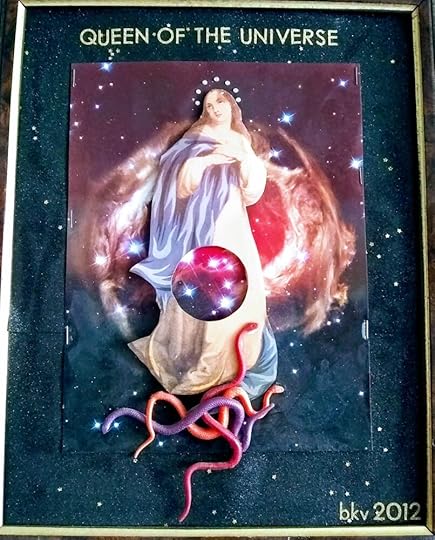
Although trained as a graphic artist, I had been away from art for a while when I found some tattered Catholic artwork at a garage sale. One was an image of the Assumption of Mary, showing her floating up to Heaven. There was actually a ragged hole in the image. I cleaned up the hole and placed her over a NASA photo of a nebula. Space is an image of God/Heaven that I find powerful. In this collage God/space shines through Mary in the area of her womb. She is crowned with seven stars in her role of Queen of the Universe. I put a lot of space snakes under her. Mary is often shown with her foot on a snake, a reference to the Garden of Eden. My version of Mary doesn’t step on a snake, but rises up to Heaven with lots of beautiful snakes!
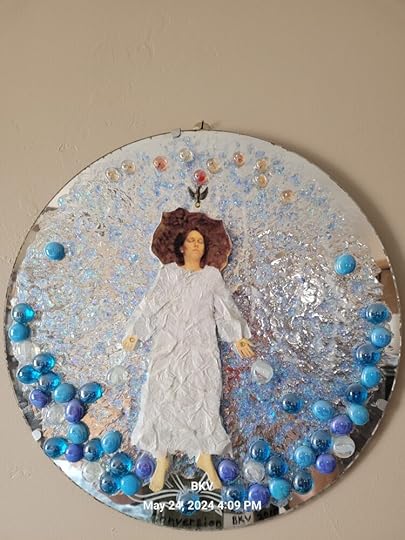
A few years later, I made “Conversion”, a mixed media representation of my conversion. I used a photo of my daughter, a mirror, bits of glass and glitter. This portrays the feeling of falling but being supported. I let go of my doubts and cynicism and float on a pool of infinite love. The Holy Spirit, in the form of a dove, is with me.
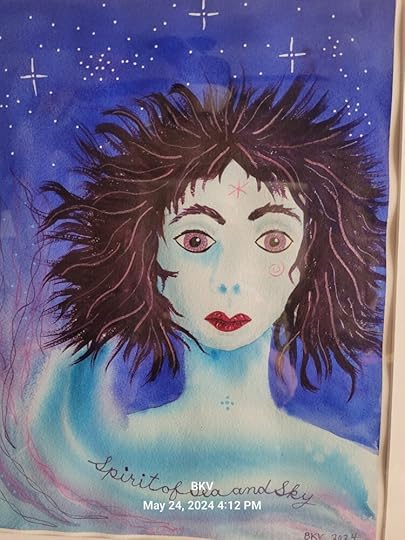
Not too long ago, I finished the watercolor, “Spirit of Sea and Sky.” This reflects my current spirituality, woman and nature centered. When I started imaging/imagining a feminine God, it was amazing! I was moved to tears, thinking of my mother and my own mothering experiences. Although I know God had no gender, male images and words are everywhere in the Judeo-Christian tradition. The patriarchy establishes rules, while my imagined matriarchy nurtures and heals. Jesus was all about healing, clearly open to his feminine side. Perhaps today he would be considered gender neutral!
As an elder I feel blessed to have the time and energy to play with art materials and dance with the Holy Spirit!
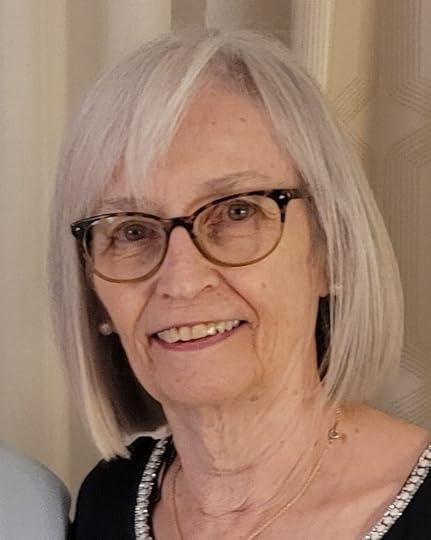
Betty Vandervest is a Catholic artist working in collage, fiber, acrylic and watercolor. You can see more at Vanderzest on Facebook.
The post Monk in the World Guest Post: Betty Vandervest appeared first on Abbey of the Arts.
February 8, 2025
The Path of Devotion ~ A Love Note from Your Online Abbess
Dearest dancing monks, artists, and pilgrims,
This Friday, February 14th, our Program Coordinator Melinda Thomas is leading a mini-retreat on Bhakti Yoga and the Inexpressible Delights of Love. Read on for her reflection on bhakti yoga and the path of devotion.
There were times in my early yoga days when I heard people talk of their singular focus on the Divine Beloved. I could not relate. When I read of the Christian mystics who had their own singular gaze on the Beloved, I could not relate. Instead I felt rather inadequate.
So why then, do I want to offer a retreat on Bhakti yoga – the path of devotion? Why carry on my tradition of theming a Valentines’ Day yoga class on Bhakti and spiritual love? The cheeky answer is because I like to refocus this holiday on Love rather than romance. The more complete answer is because I took a workshop once with William Mahony who wrote one of my favorite books titled Exquisite Love: Reflections on the Spiritual Life Based on Narada’s Bhakti Sutra, and his teaching changed my relationship with devotion.
During that workshop (and in the book) he posited that we cannot feel unloved unless there is some core part of us that knows, or once knew, the very nature of Love itself. Or, how do we know we are missing a thing if we’ve never experienced it, consciously or unconsciously, in the first place? Now, we could debate this philosophical question for ages but the point I am trying to make is that his work opened in me a relationship with Bhakti and devoted love that I had not previously considered. He writes, “The Love that stands within all existence is the ultimate source of our own human sentiments of love in all its forms.”
“Human sentiments of love in all its forms” – I can relate to that. I love my family and friends. I love the Earth and all her creatures. I love my cat sleeping across the room and the way she is curled up in a soft ball of fur. I love my son who continually expands my experience of loving. The Love I relate to sits next to wonder. The Love I relate to is love in relationship; which from a Trinitarian perspective is quite appropriate.
In Revelations of Divine Love Julian of Norwich writes, “In this little thing I saw three characteristics: the first is that God made it, the second is that God loves it, the third, that God keeps it.” I have also heard the Trinity referred to as “Love, Lover, and Loving.” Love is a noun and a verb.
In Friday’s mini-retreat we will engage contemplative practice, gentle yoga, and creative writing to explore how we express our devotion to Divine Love within the context of our relationships. We will seek out the ways our actions do or do not demonstrate Love. Together we will invite ourselves to root into the very Love “within all existence.” In doing so we will move back into our relationships with, as St. Benedict writes, “our hearts overflowing with the inexpressible delights of love.”
Please join Melinda this Friday, February 14th and explore your own capacity for love and loving.
With great and growing love,
ChristineChristine Valters Paintner, OblSB, PhD, REACE
The post The Path of Devotion ~ A Love Note from Your Online Abbess appeared first on Abbey of the Arts.
February 4, 2025
Monk in the World Guest Post: Maureen Callahan Smith
I am delighted to share another beautiful submission to the Monk in the World guest post series from the community. Read on for Maureen Callahan Smith’s reflection and poem on grief and grace.
Many of us are called to be caretakers of loved ones and know well the strength and internal resources it can involve. I was a caretaker for my younger sister, my “ Irish twin” when she was diagnosed with Stage IV Non-Hodgkin Lymphoma at 44, underwent a grueling bone-marrow transplant and died at 46. The main pillars of my own support and survival during this time and its aftermath were a reconnection with my faith, my contemplation practice, writing, walking in the woods near our home, and the miracle of a mid-life new love. During a time of intensity that seemed beyond words, I would often find a poem or piece of writing “ dropping in” fully formed, nearly as if I was hearing it on the radio. I am grateful at this point in my soul’s career here on the earth plane to have found the Abbey of the Arts and to have an opportunity to share one of these poems, which felt to me like Psalms.
Psalm III bow my head to the moss covered earth,
and kneel to smell Your breath,
and rise to watch two ducks as they take flight
calling Your name to the sky.
Now I join the community of all
who have lost those ones
they held most dear.
It is a timeless community
of survivors and glorifiers
and those who blame God.
Where shall I sit?
The icy air makes my tears for me now.
I walk when I cannot cry.
I walk to remember
and to forget
and to wonder:
Do you talk back to the ducks?
Do you hear our worried wonderings?
And are you, as promised,
setting a table to greet her,
out beyond the wind?

A clinical social worker of forty years and lifetime journal keeper, one of Maureen Callahan Smith’s happy places has always been at a desk with a pile of books in front of her. Years and hundreds of writing desks later, a memoir about grief & gratitude was born. (Grace Street: A Sister’s Memoir of Grief & Gratitude, Gray Dove Press) MaureenCallahanSmith.com
The post Monk in the World Guest Post: Maureen Callahan Smith appeared first on Abbey of the Arts.


