
Hemant Mehta's Blog, page 1991
June 26, 2014
Atheist Group Asks Pride Festival Visitors: What Are You Proud Of?
If you’re looking for an example of how atheists can connect with a larger community, check out what the Louisville Atheists and Freethinkers did over the weekend at the Kentuckiana Pride Festival:

Instead of just focusing on outreach to atheists, they asked visitors to their booth a simple question: “What are you proud of?”
The responses came in by the hundreds and you can see a sample of them on this Tumblr:

They got great coverage in the Courier-Journal, too:
Organizer Susanne Smith told me:
As the festival went on, we added the answers we got as decoration on our tent, until we ran out of materials for more answers! In all, about 350 people were able to share with us what they were proud of.
It’s just a wonderful way to showcase Humanism. We could use more of that.


Congress Passes Bill to Install God-Honoring Plaque at National World War II Memorial
The National World War II Memorial opened in Washington, D.C. in 2004 and it’s a wonderful tribute to those who risked and gave their lives for our country.
But you know what it’s missing?
God.
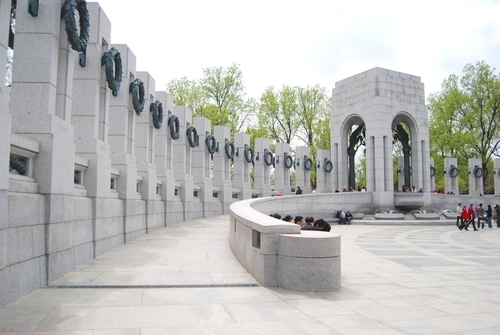
Two bills have now worked their way through Congress — H.R. 2175, introduced by Rep. Bill Johnson (R-OH), and S. 1044, introduced by Sen. Rob Portman (R-OH) — and they aim to install a prayer plaque somewhere in the area of the monument with the words that President Franklin D. Roosevelt delivered on D-Day, a portion of which is below:
Almighty God: Our sons, pride of our Nation, this day have set upon a mighty endeavor, a struggle to preserve our Republic, our religion, and our civilization, and to set free a suffering humanity.
Lead them straight and true; give strength to their arms, stoutness to their hearts, steadfastness in their faith.
…
And, O Lord, give us Faith. Give us Faith in Thee; Faith in our sons; Faith in each other; Faith in our united crusade. Let not the keenness of our spirit ever be dulled. Let not the impacts of temporary events, of temporal matters of but fleeting moment let not these deter us in our unconquerable purpose.
That’s what the “World War II Memorial Prayer Act” intends to make permanent at the memorial.
It’s just more red meat for the GOP’s Christian base. Yes, Roosevelt delivered the speech, but his religious platitudes don’t represent all the soldiers who fought in the war.
The Center For Inquiry, Americans United for Separation of Church and State, and six other organizations wrote letters to the Senate and House over the past year urging committee members to reconsider this idea:
This bill, however, shows a lack of respect for this great diversity. It endorses the false notion that all veterans will be honored by a war memorial that includes a prayer that proponents characterize as reflecting our country’s “Judeo-Christian heritage and values.” In fact, Department of Defense reports show that nearly one-third of all current members of the U.S. Armed Forces identify as non-Christian. Likewise, many of our veterans and citizens come from a variety of religious backgrounds, or have no religious belief; thus, it is inappropriate to honor the “power of prayer” in a national memorial.
None of that seems to have worked. Earlier this month, S. 1044 passed in the Senate, and the House approved it earlier this week. All it needs now is President Obama‘s signature.
Only 12 Democrats had the guts to oppose the bill and they deserve your thanks:
Mike Honda (D-CA)
Judy Chu (D-CA)
Hank Johnson (D-GA)
Tammy Duckworth (D-IL)
Suzanne Bonamici (D-OR)
Beto O’Rourke (D-TX)
Bobby Scott (D-VA)
Mark Pocan (D-WI)
Niki Tsongas (D-MA)
Katherine Clark (D-MA)
Keith Ellison (D-MN)
Jerrold Nadler (D-NY)
(“Unaffiliated” Kyrsten Sinema (D-AZ) voted Yes.)
The Freedom From Religion Foundation is urging people to call or write the White House and urge Obama to oppose the bill. They even offer a template for what you can say (though you should really put it in your own words):
… The bill sends a message to all of the many atheists in foxholes that their service to their country is less appreciated than that of their religious counterparts. Atheists and service members with no religious preference make up over 23% of the military. S. 1044 marginalizes nonreligious service members and belittles their service.
On November 3, 2011, Robert Abbey, the director of the Bureau of Land Management, told a congressional subcommittee: “The Department [of the Interior] strongly believes that the World War II Memorial, as designed, accomplishes its legislated purpose to honor the members of the Armed Forces who served in World War II and to commemorate the participation of the United States in that conflict. It should not be altered in the manner suggested by [S. 1044].” S. 1044 is an unnecessary and divisive bill intended to inject religious rhetoric into what is otherwise an inclusive, powerful memorial to those who fought and died for our country.
Obama will undoubtedly sign the bill. That’s too bad. Those soldiers didn’t risk their lives so that the U.S. government could promote the Christian faith.
(Image via Lissandra Melo / Shutterstock.com. Large portions of this article were posted earlier.)
An Interview About Atheism-Related Blogging, Outreach, and Charity Work
Chris Stedman at Religion News Service conducted an interview with me about what I’ve learned after eight years of blogging and how our (broad) atheist community can improve. Check it out here — part two will go up tomorrow!
Save Your Money: There Are No Lost Souls or Dark Energies in Your Home
There should be some standards regarding what gets published in a newspaper, right? Not when your newspaper’s parent company is owned by the same guy who owns Fox News Channel. But let’s make this clear:
It’s a problem to publish an article with the headline “Releasing lost souls or dark energies from your home.”
It’s a problem that the writer’s top qualification is that she was voted “Australian Psychic of The Year” in 2010. (Did she lose her powers since then? Who voted? Who ran the contest? So many questions!)
It’s a problem that this was listed in the “Experts” section:

So let’s see what Elisabeth Jensen advises us to do to save our homes from the evil invisible spirits:
Consider your options or consult an experienced professional psychic for the cause if it still evades you.
Well, who saw that one coming?
A psychic medium is the best person to consult if you just sense a room in your new house is cold and unwelcoming or you wake at night seeing strange shadows in your room and feeling anxious.
…
The medium should then be able to connect telepathically with these unhappy spirits and discover why they are in your house before releasing them to the light or heaven.
Yep. That’s how science works.
By the way, Jensen costs about $236 (USD) for a one hour phone consultation.
But if a psychic isn’t your thing, there’s a Plan B!
But what happens if the spirits refuse to leave you in peace and feel very heavy and scary?
…
Well, then it’s time to call in an exorcist!
Again an experienced psychic medium with additional skills and training can often do this for you or some people may prefer a priest or spiritual person they trust to help them here.
You’ll be pleased to learn that Jensen provides exorcism services, too.
After clearing the dark energies several times plus also sending clearing and healing to anybody living there affected by the energies I fill the property with light and surround it with many archangels.
Amazing that she can do all that from a distance. Sounds crazy, but she’s the expert, so who are we to doubt…?
No one else can question her either, I guess, considering that the article doesn’t allow comments. I suppose that would ruin the mystique.
(Thanks to McSkeptic for the link)
June 25, 2014
Another Christian Movie All About How Christians Are Persecuted in America
Rarely is an entire movie invalidated by the first few seconds of its trailer.
But that’s the case with One Generation Away, a film produced by Rick Santorum‘s EchoLight Studios that’s all about how Christians are being “persecuted” because they don’t get to push their faith in places like public schools.

The beginning of the trailer, as you can hear, features a reading of the Establishment Clause of the First Amendment: “Congress shall make no law respecting an establishment of religion, or prohibiting the free exercise thereof…”
No government establishment of religion. You can practice it privately, and they can’t stop you, but public schools and city councils and Congress can’t promote your beliefs for you.
(To paraphrase something Supreme Court victor Ellery Schempp once said, the word “religion” appears twice in the Constitution, and both times, it’s preceded by the word “no.”)
Persecution Complex: The Movie comes out in September.
(Thanks to @AmaLeniter24 for the link)
What Made Saudi Arabia Panic at the UN Human Rights Council?

[Note: This is an expansion on a previous post, meant to give full context and background to the story for those just learning about this issue.]
The human rights abuses of the Kingdom of Saudi Arabia are not secrets. A monarchy under Islamic Law, with only rare and arbitrary local elections, and almost total subjugation of women, the West looks on with disapproval, but impotence. They are, infamously, a U.S. “ally,” being a huge source of oil and perceived as a bulwark against Islamic terrorism in an unstable region of the world. We see the oppression, the medieval treatment of half its population, and the astounding opulence of its aristocracy, and we shrug. It’s their culture; what can we do?
While Saudi Arabia seems somewhat untouchable from the outside, what is less well known is that, within its borders, there are strong and courageous individuals and groups who exert great effort and take enormous risks to organize and agitate for reform. But just as Saudi Arabia does not tolerate its women to show their faces, nor does it countenance political or religious dissent in any form.
The organization for which I work, the Center for Inquiry, sees as part of its core mission the proliferation of the rights to free belief and expression around the world. In recent years, we’ve worked very hard to raise awareness of the threat posed by state-sanctioned anti-blasphemy laws, which criminalize religious criticism; apostasy laws, which make leaving the majority religion a crime; and the various forms these violations of human rights take, such as laws against “offending religious feelings.”
Through diplomatic efforts, grassroots organizing, and public demonstrations, we’ve worked on cases such as that of Alexander Aan in Indonesia, beaten by a mob and jailed for espousing his atheism on Facebook; the atheist bloggers of Bangladesh, several of whom were arrested for “insulting religion”; the recently-freed Meriam Ibrahim of Sudan, a young mother sentenced to death for marrying a Christian man and refusing to convert to Islam; and many others. Far too many others, really. We could never hope to even catalogue them all, let alone help them all.
Saudi Arabia, however, has been a major focus of ours in recent months, and thanks to their own defensiveness, they’ve actually helped us to shine an ever-brighter spotlight on their suppression of free speech and belief.
In 2012, liberal Saudi activist Raif Badawi, founder of a website for open discussion of religious, political, and social issues, was arrested for insulting Islam, and for apostasy, the latter of which is punishable by death. More than a year later, a court found him guilty of insulting Islam and “showing disobedience,” and sentenced him to six years in prison and 600 lashes. You read that correctly, six hundred lashes. With a whip. The charge of apostasy was dropped for the time being, but after a review almost another year later, a higher court actually increased his sentence to 10 years and 1000 lashes. He has been in prison for over two years now, awaiting his fate. His wife recently fled with their children to Canada, where she presses for international intervention on her husband’s behalf.
But this particular case does not end with Badawi himself. Waleed Abu al-Khair is also a reform activist as a human rights lawyer and founder of a human rights watchdog group in Saudi Arabia, who also happens to be Raif Badawi’s lawyer and brother-in-law. Al-Khair had long been a target of the Saudi government, and in 2013 he was charged with a number of offenses including “breaking allegiance to and disobeying the ruler,” “disrespecting the authorities,” and “offending the judiciary.” After months of court battles, al-Khair was arrested in April of this year, and could potentially remain in prison for 20 years under Saudi Arabia’s anti-terrorism laws. And why is a human rights reformer being charged under a terrorism law? As Eman Al Nafjan wrote in the New York Times, “The authorities knew all along that Waleed Abu al-Khair was guilty. They just needed something better to charge him with.”
Suffice it to say, Raif Badawi no longer has Waleed Abu al-Khair to represent him.
It is the plight of these two victims of persecution — guilty of nothing more than speaking their minds, believing as they wish, and seeking a way to a fairer and freer Saudi Arabia — that CFI chose as their focus for its statement to the United Nations’ Human Rights Council on June 23, 2014. CFI is one of many NGOs that have “consultative status” at the UN, and we frequently speak out on issues regarding free expression and belief, and the persecution of believers and nonbelievers alike. Our chief UN representative, Michael De Dora, was recently elected president of the UN’s NGO Committee on Freedom of Religion or Belief, and works alongside our allies in the NGO community, such as the International Humanist and Ethical Union. CFI has UN representatives in New York and Geneva, where the Human Rights Council convenes.
CFI planned to deliver a short and impassioned statement to the Human Rights Council, through our representative Josephine Macintosh, forcefully condemning Saudi Arabia’s persecution and imprisonment of Badawi and al-Khair, demanding that all charges against them be dropped, and that they be immediately freed.
What made this doubly powerful was that Saudi Arabia has itself recently became a member of the Human Rights Council, an irony not lost on many. Brian Pellot, the human rights reporter for the Religion News Service, rightfully called their election to the Council “a disgrace.” Be that as it may, members they are, and on this particular Monday, Saudi representatives were there in the room to hear themselves be condemned for their oppression.
They did not like it.
You can see it transpire in a video that is becoming somewhat viral (as much as a video of a UN council meeting can be viral), as Macintosh attempts to deliver the CFI statement harshly criticizing Saudi Arabia, the Saudi representative tries on three separate occasions to silence her. Three times, the Saudi representative frantically appeals to the Council’s presiding vice president, brashly shouting over Macintosh with a sense of panic in his voice. I don’t speak Arabic, but while the real-time translation of the Saudi representative interprets him as asking for the statement to end for what sounds like procedural minutia, two native Arab speakers I know told me that his words more accurately translated to “I ask you to shut her up!”
Even more remarkable was the show of solidarity from not one but four member states of the Council. Lead by the United States’ representative, the right of Macintosh to give her statement was subsequently supported by Ireland, Canada, and France. (Canada’s religious freedom ambassador Andrew Bennet later said on Twitter, “Proud that Canada defended @center4inquiry right to speak in Human Rights Council on Raif Badawi case today.”) Council Vice President Kateřina Seqeunsova ultimately sided with Macintosh, and indeed, repeatedly tried to do so. It was a sight to behold.
Why does this matter? This dust-up in the Human Rights Council is remarkable for several reasons. For one, it may have been the first confrontation of its kind for the Kingdom. As investigative journalist Ali AlAhmed tweeted, “Kudos 4 @center4inquiry 4 making history by being the 1st ever NGO to address #Saudi HR abuses at #UN HR Council.”
Secondly, while CFI is among the largest secularist and skeptic groups in the world, it is still a relatively small player in terms of the wider global NGO community, as compared to, say, an Amnesty International. And yet our statement so troubled the Saudi delegation, got so deeply under their skin, that they felt compelled to resort to embarrassing outbursts before the rest of the assembled world representatives. As Michael De Dora told the news outlet Middle East Eye, “It doesn’t look good for Saudi Arabia. By trying to silence us, and looking a bit desperate in doing so, they have actually caused more attention to be given to the statement we were delivering.”
Perhaps most importantly, our statement put on the record what everyone knows to be true, that Saudi Arabia fails every test for compliance with even the most basic tenets of universal human rights. As a member of the United Nations, it is implied that it shares a belief in what the UN charter says about “respect for human rights and for fundamental freedoms for all without distinction as to race, sex, language, or religion.” As a member of the Human Rights Council, it must be held to a high standard indeed. As we declared in our statement, over the shouts of the Saudi representative,
As an elected member of this Council, Saudi Arabia is obliged to “uphold the highest standards in the promotion and protection of human rights” and “fully cooperate with the Council”. If it is to retain any credibility as a member, we urge it to reform its laws so as to protect freedom of religion, belief, and expression, cease the use of corporeal punishment, and repeal Article 1 of its interior ministry’s decree defining atheism as terrorism.
This is perhaps what upset the Saudis most, that a statement from a relatively small organization of infidels was able to call them out before the eyes of the world for lacking credibility. We named them as blatantly unworthy of even being in that room.
The world noticed. Will they continue to shrug? We certainly aren’t going anywhere. For Raif, for Waleed, for their families, and for the countless others being crushed for their voices and their thoughts, our spotlight will ceaselessly shine directly into the faces of the oppressors until the intensity of the light, and the heat of the gaze of the civilized world, become too much for them to bear.
(My thanks to Michael De Dora for his help on this post.)
Christian Preacher Explains Why Watching Game of Thrones is Like “Recrucifying Christ”
Christian theologian John Piper has made a career out of saying whatever nonsense comes to his mind, wrapping it in biblical phrases, and having his acolytes tell him he’s a brilliant preacher.
His latest rant is addressed to a reader who asks him, “Pastor John, what would you say to a Christian who watches the cable TV show Game of Thrones?”

Piper’s answer, not surprisingly, is to remind Christians never to watch the show. But not because of the violence. Even though beheadings are commonplace and the killings seem to get more imaginative and graphic with each successive episode, Piper’s problem is the nudity.
And he proposes a list of 12 questions Christians should ask themselves whenever they might see some nudity:
1. Am I Recrucifying Christ?
…
If we choose to endorse or embrace or enjoy or pursue impurity, we take a spear and ram it into Jesus’s side every time we do.
Because seeing a boob is exactly like torturing a man until he dies. (Temporarily.)
2. Does It Express or Advance My Holiness?
…
Nudity in movies and photos is not holy and does not advance our holiness. It is unholy and impure.
I would think unholiness is also exhibited through lying and being a jackass, but that never stopped Piper before…
Just for the sake of argument, couldn’t one argue that not watching the nudity in Game of Thrones means denying the appreciation of the beauty of God’s creations?
(And should we assume Piper’s never seen a depiction of Adam & Eve before?)
3. When Will I Tear Out My Eye, If Not Now?
…
Jesus said everyone who looks at a woman with lustful intent has already committed adultery with her in his heart.
I’ve gone through several eyeballs just reading through Piper’s old posts…
He doesn’t get that there’s a difference between nudity in movies that require it, nudity that’s basically eye candy in a larger tale, and porn. The sex scenes in GoT are pretty mild compared to what else is on the Internet.
4. Is It Not Satisfying to Think on What Is Honorable?
…
Life in Christ is not mainly the avoidance of evil, but mainly the passionate pursuit of good.
John Piper has no business talking about honor given how many nasty things he’s said about women who speak up, pastors who disagree with him, and victims of natural disasters.
5. Am I Longing to See God?
…
I dare anyone to watch nudity and turn straight to God and give him thanks and enjoy him more because of what you just experienced.
Dare accepted. if God created the human body, you’d think giving Him a high five over one of His creations would go over just fine.
6. Do I Care About the Souls of the Nudes?
…
When we pursue or receive or embrace nudity in our entertainment, we are implicitly endorsing the sin of the women who sell themselves to this way and are, therefore, uncaring about their souls.
I care more about men and women making their own decisions regarding their bodies. Their souls are irrelevant because they’re only a figment of Piper’s imagination.
7. Would I Be Glad If My Daughter Played This Role?
…
… [Christians] know deep down they would not want their daughter or their wife or their girlfriend to be playing this role.
If my daughter was cast on a show that popular, more power to her. More importantly, regarding the nudity, who the hell cares what I think?
In Piper’s world, men control women’s decisions at any age. If my daughter asked for my opinion, I’d give it to her, but the decision is ultimately hers to make. Given that she’d be an adult in this situation, I don’t see why my preference should be the final say.
8. Am I Assuming Nudity Can Be Faked?
…
…nudity is not make-believe.
Who is watching the show thinking the nudity is “fake”… and that it would be okay if that were the case?
Granted, there are entire industries devoting to changing what your actual body looks like, but the only question you should be asking here is this: Did the actor/actress film the scene voluntarily? If that’s the case, who cares?
9. Am I Compromising the Beauty of Sex?
…
Men and women who want to be watched in their nudity are in the category with exhibitionists who pull down their pants at the top of escalators.
What the hell sort of malls are near Piper’s house…?
In any case, public nudity has been around for a long, long time. Yet sex is still going strong. Game of Thrones isn’t about the change that.
10. Am I Assuming Nudity Is Necessary for Good Art?
…
There is no great film or television series that needs nudity to add to its greatness. No. There isn’t.
I disagree. I’ve seen (actual, classy, meaningful) movies where nudity was central to scenes and hardly gratuitous.
To paraphrase Stephanie Drury, nudity isn’t necessary for great art, but it doesn’t imply bad art, either. Context matters.
What about sex as a ploy to get people to watch the show? Well… no shit. That’s exactly what’s going on most of the time in GoT. It’s not a secret.
11. Am I Craving Acceptance?
Who isn’t…?
Piper thinks Christians are watching GoT so people will like them.
He completely ignores the fact that the show, as its biggest fans will tell you, is incredibly compelling. They’ll watch it by themselves if they have to. It’s not about peer pressure or acceptance. It’s about entertaining.
12. Am I Free from Doubt?
I don’t even know what this one has to do with the show.
But you should be worried about anyone, Christian or otherwise, who says he’s 100% certain about his religious beliefs.
…
If we extended Piper’s argument, then Christians should never step inside art museums either, or else they’ll be punching a ticket to hell on the way out. His view is that the naked body is something to be ashamed of, never celebrated. It’s the same sort of twisted logic that has forced some religious women to cover themselves unnecessarily from head to toe, led to rampant sexual abuse in certain traditions, and made comprehensive sex education hard to enact in many states.
The guy watching Game of Thrones isn’t the problem here. The problem is that too many people take Piper’s advice seriously.
(via Right Wing Watch. Image via Christian Bertrand / Shutterstock.com)
Misogynistic Christian Speaker Justin Lookadoo Charged with Public Intoxication
Last year, a Texas high school brought in motivational speaker Justin Lookadoo to speak to the students. Lookadoo — who once spoke at a pray-the-gay-away conference — is a self-proclaimed expert on being “dateable”… which really means being straight, Christian, and just like him.

His advice includes “dateable girls know how to shut up” and dateable guys “keep women covered up.”
The students who sat through his sexist tirade began using the hashtag #Lookadouche and the administration issued a half-assed apology saying they didn’t agree with much of what he said.
Now, Lookadoo is back in the news for a very different reason:

Records show that during the investigation, deputies noticed Lookadoo had vomited inside his car and smelled of alcohol.
Authorities say he failed field sobriety tests and recorded a BAC of .07
Officials with Youth Resources tell us he was scheduled to be leading workshops Tuesday with middle school students at Teen Power Camp.
Lookadoo was charged with public intoxication.
There’s no information on what caused him to drink. Maybe he was just listening to his old speeches…?
In any case, let’s hope he gets the help he needs. Anything to keep him away from impressionable children. He’s spent the past year in the spotlight for unflattering reasons and would be wise to work on fixing himself instead of hurting others with his words.
(via Christian Nightmares)
Bob Jones University Supposedly Wants Rape Victims to Repent and Ask Their Abusers for Forgiveness
Bob Jones University is a truly troublesome place. From their history as a racist institution to their mishandling of sexual assault on campus to their absolutely insane student code of conduct, BJU has had a lot of negative press. Even when I was growing up in a cult, I knew that BJU was too extreme for me to consider attending.

The dirty laundry being aired about BJU’s issues of handling sexual assault and sexual conduct just doesn’t stop coming.
For context, first, check out my friend Dani‘s story about how she got expelled from BJU for having consensual sex with her boyfriend while attending the school. (Below are just a few excerpts from it.)
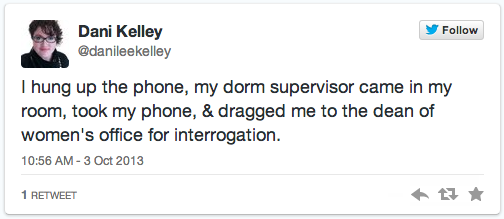
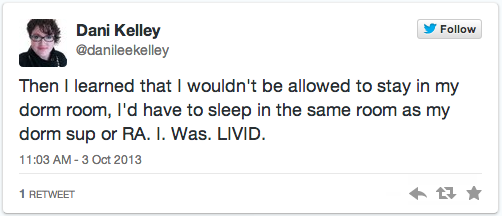
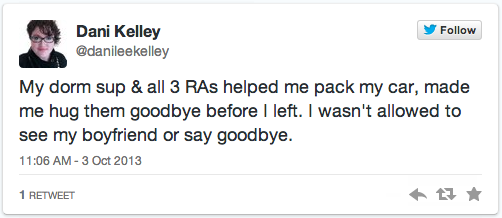
So, if that’s what happens to an adult student — Dani was 21 at the time — for having legal, consensual sex with her boyfriend… what happens at BJU when you get sexually assaulted?
According to a recent Al Jazeera report, Sarah [a pseudonym] was raped multiple times in 2004 before leaving for BJU, and eventually sought counseling through the college for the trauma.
“I would say that the impact of the two years of counseling I had with her is that I felt like I had been raped all over again,” she said.
In their many sessions, Sarah said [professor of counseling Pat] Berg fixated on her “sin,” and then blamed her when she failed to “get better.” She said Berg told her that she needed to repent of any pleasure she experienced during her abuse. Since BJU doesn’t recognize psychiatric concepts like post-traumatic stress disorder, she said she was also told that she was choosing her trauma symptoms.
“I remember her looking at me and saying, ‘You know that the nightmares are your own fault, because you’re choosing to replay pornographic thoughts in your mind,’” she said.
According to emails, Berg also advised Sarah to call her rapist and ask for forgiveness. Sarah said Berg told her that if she didn’t forgive, God wouldn’t be able to “use her.”
For what it’s worth, Pat Berg said (through a BJU spokesperson) that those allegations were “patently false.” Though an email screenshot from Sarah on the Al-Jazeera site suggests otherwise.
Another student, Julia [also a pseudonym], initially sought counseling for an eating disorder. Pat Berg’s husband Jim Berg, a former dean of students and current faculty member at BJU, told Julia that her disorder was “a lifestyle of sin.” The shaming only got more intense after Julia was raped by a fellow BJU student:
… Seven months later, she says a co-worker and Bob Jones ministry student raped her. She thought of him as “the tool that God used to punish me.”
Within a week, she said Berg found the man responsible and expelled him, but three semesters later, he was allowed to come back. When she expressed her fear to an administrator, Julia said she was asked whether she would really want to prevent a “Godly man” from getting an education that would allow him to “serve the Lord.”
Students were encouraged to initiate conversations with the intent of extending forgiveness to their abusers.
I’ve seen this before in Sovereign Grace Ministries, where children were forced to publicly forgive and hug their abusers and were drilled by their pastors into believing that they were complicit in their abuse. The inability of evangelical leaders to treat victims as victims and abusers as predatory is such a trend that I have lost all ability to register surprise when I hear these stories.
The eating disorder story, too, doesn’t surprise me much. I’ve heard churches teach time and time again that depression and anxiety are sin issues, not mental health problems, and that has extended to postpartum depression, eating disorders, and self-injury. When my younger sister was a student leader on her hall at Jerry Falwell‘s Liberty University, she told me of a girl she knew who got suspended when her self-injury habit was discovered. Both of us were angry that it happened but knew that that’s just “how it is” in evangelical culture.
This is, again (I sound like a broken record), because of the doctrine of sin in the church, where all sin is counted as equal in the minds of the church leaders, because they believe that Jesus would have had to die for any sin — small or big — to appease the [presumed] just wrath of God on mankind. So a child abuser or a rapist is maybe socially worse than a liar or a glutton, but s/he isn’t theologically worse. Often, the pastors in churches who teach this aren’t properly trained in counseling and they prioritize ideology over the victims.
If their own theology holds true, then one can only assume that they will end up regretting this oversight. In the meantime, BJU owes their students — and all of us who care about them — some answers.
Nigerian Man Held Against Will in Psych Ward Due to His Atheism
Yesterday, the International Humanist and Ethical Union confirmed a rumor that had been floating around for days: Mubarak Bala, a Nigerian atheist, was being held against his will at Aminu Kano Teaching Hospital.

Mubarak Bala, taking a hospital selfie with a smuggled smartphone
What put him in there?
Well, he’s an atheist… and… um… that’s it.
His Muslim family, upon finding out Bala didn’t believe in God, suggested he was mentally ill. A doctor said that wasn’t the case, so they asked a different doctor for an opinion. That doctor confirmed it, and Bala’s been in the hospital now for nearly two weeks:
Reaching activists online early last week, [Bala] explained that he had been detained at the hospital on the grounds of a “personality change” because, having been raised in a Muslim family, he is now an atheist.
…
He wrote: “And the biggest evidence of my mental illness was large blasphemies and denial of ‘history’ of Adam, and apostacy [sic], to which the doctor said was a personality change, that everyone needs a God, that even in Japan they have a God. And my brother added that all the atheists I see have had mental illness at some point in their life.”
According to an email he sent to blogger Godless Mom, how he got to the hospital was even more traumatizing:
“After being beaten to pulp, and choked by the neck until I passed out, (asphyxia), by my Dad and 3 of his male brothers”, he woke up to find himself in a psychiatric ward at the hospital.
Again, it may seem hard to confirm all of this from a distance given Bala’s inaccessibility, but the IHEU’s Bob Churchill says they had a lawyer visit Bala in the hospital and take up his case:
“We are joining with humanists and human rights advocates in Nigeria and the activists who have worked to highlight this case, in calling for an immediate re-evaluation of Mubarak’s case by a doctor who is entirely independent of the family, and for his swift release. We stress that holding naturalistic or atheistic views is a normal and reasonable position, that no one should be detained as a psychiatric patient for holding such beliefs, and that holding such beliefs is a human right under Article 18 of the relevant international treaties.”
What can you do to help? Right now, the best thing may be to just raise awareness of what’s going on. You can do that via Twitter (#FreeMubarak) or by signing this petition. Will it help? No less than your prayers, anyway, but maybe as more people show interest in Bala’s plight, the pressure will build on the Nigerian government to take action.
Hemant Mehta's Blog
- Hemant Mehta's profile
- 39 followers

