CK Van Dam's Blog, page 10
February 9, 2023
Will ChatGPT upend human creativity?

In preparation for this post, I asked ChatGPT to write the blog. Unfortunately, the new artificial intelligence platform (is it a platform, a software or just a fad?) is maxed out. I received this message:
ChatGPT is at capacity right now
And then it proceeded to write a sonnet about its status. Here’s the first stanza:
Amidst the rush of curious minds,
The chatbot ChatGPT stands strong and true,
Withstanding the influx of requests,
Working hard to fulfill each one’s due.
Author’s note: I’ve always found sonnets to be long and pretentious.
Wikipedia says: ChatGPT can write and debug computer programs, compose music, teleplays, fairy tales, and student essays; answer test questions, write poetry and song lyrics…
Fast Company writes that ChatGPT, with an IQ of 83, is poised to take over menial tasks: Many workers are drowned in menial, repetitive tasks, often carried out on autopilot and without much critical thinking.
The same article goes on: But ChatGPT can’t replace human ideas. That’s the key. Artificial intelligence programs are tools.
The creative world is abuzz right now with debate as to whether AI will replace human creativity. My answer: Not if we’re smart about it. To quote one of my favorite sci-fi movies, Blade Runner: Do androids dream of electric sheep? And that iconic line came from the title of the science fiction novel by Phillip Dick.
I don’t think a chatbot could concept that…or could it?
The post Will ChatGPT upend human creativity? appeared first on CK Van Dam.


January 26, 2023
A conversation with readers
Part of publishing a book is going out and talking about the book. That’s where I am in my “publishing journey” as I refer to it.
I must confess that I prefer to write words on paper than speak words to groups of people. So, I ask the audience if we can have a conversation about the book and my path to publishing it. A conversation with readers instead of a presentation to audiences.
This was a busy week of conversations.
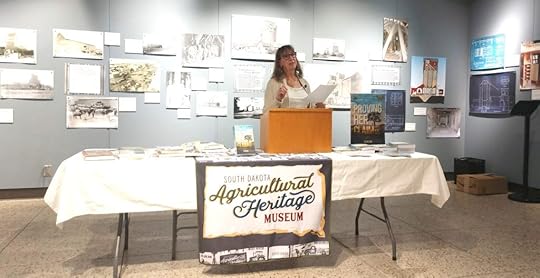 Monday, Jan 23, 2023 at South Dakota Agricultural Heritage Museum
On Monday I was invited to talk about Proving Her Claim at the South Dakota Ag Heritage Museum. It was a good turnout — especially for a Monday night in January. The audience members asked good questions and seemed to enjoy the 45-minute talk. Afterwards, I signed books and chatted with readers about my heroine, Anna Olson. One woman even showed me a vintage photo of her grandparents who had homesteaded in Dakota Territory. That was awesome!
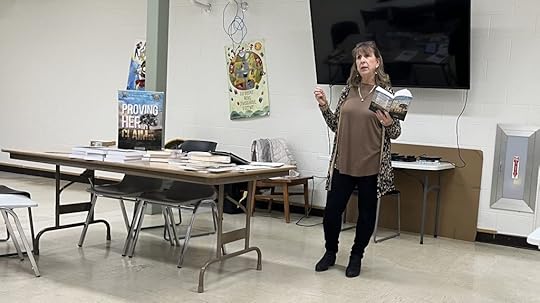 Wednesday, Jan 25, 2023 at the Nobles County Public Library
Wednesday night I was honored to talk with a group of patrons at the Nobles County Public Library in Worthington, Minnesota. The group was smaller but still engaged in the conversation. Prior to the author talk, reporter and manager Kelly Reeves of WGTN-TV3 interviewed me. We talked about the book and, more importantly, about the role that strong women play in our lives. Kelly and I are definitely on the same page.
And the best thing about speaking events? It’s listening. Listening to what readers have to say about the book. Hearing their questions about history and their “what if” conjectures about my book’s characters.
My thanks again to the South Dakota Agricultural Heritage Museum and the Nobles County Public Library for inviting me to have a conversation with readers. It was fun.
The post A conversation with readers appeared first on CK Van Dam.
January 20, 2023
Obsessed with printing presses
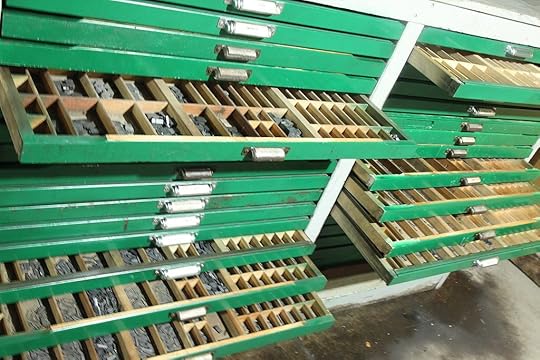
The Printing Revolution started in Germany around 1440, when Johannes Gutenberg invented the moveable-type printing press.
As a Journalism major, I spent hundreds of hours at the Printing and Journalism Building on the campus of South Dakota State University. Even the building name put “printing” before “journalism.” We toured the now-ancient press room, learned the basics of printing, and then went back “upstairs” to learn how to be journalists.
That’s where my love of the printing process started. The hands-on machinery, the moveable type and the California job cases. Oh, the California job cases: drawer upon drawer holding the tiny, individual letters used to make words, sentences, paragraphs and finally, newspaper pages. The type was sorted by Upper and Lower Case (still used in copy editing, by the way), by quantities needed. Trivia note: the “e” compartment was one of the largest the compartments because it’s the letter used most frequently in the English language.
Today, Gutenberg’s moveable type is a thing of the past. Digital documents are taking over the world. I’ve sold far more e-books than printed books, but it’s difficult to sign an e-book at a book signing. (Apparently no one wants my signature on their tablet…) Although after some research, I’ve found an app for that — of course.
But the printing process — applying ink to paper — is still “a thing.” There’s nothing like walking through a working press room, smelling the ink, hearing the wrrr of the machinery, and seeing the final, printed sheet appear at the end of the huge printing press.
There is a magic to it.
The post Obsessed with printing presses appeared first on CK Van Dam.
January 12, 2023
The prairie was their medicine cabinet
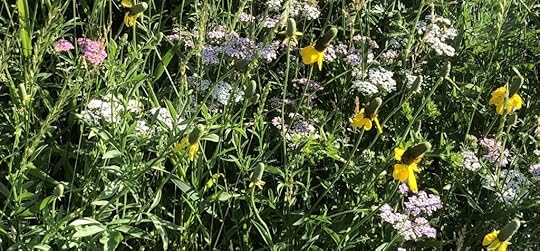
When we look at a field of prairie flowers or walk through a shaded forest, we see the beauty of nature. But before the advent of the corner drug store, our ancestors saw medicinal plants and other homeopathic remedies.
In Proving Her Claim, the heroine and her Lakota neighbors use medicinal plants to treat wounds, reduce coughs and fevers and for a myriad of other maladies. Prior to “modern medicine,” people understood that plants and other natural substances had healing powers. The practice goes as far back as the Sumerians — and even before that.
The heroine, Anna Olson, starts with a bit of knowledge about herbs, plants and even spider webs from her aunt, who was a midwife. But she learns much more from Yellow Bird, a medicine woman from the nearby Lakota tribe. Together Anna and Yellow Bird nurse sick tribal members during an influenza outbreak and help a local homesteader through a difficult childbirth. Anna also draws on her medical knowledge to treat a wolf attack.
Homesteaders did not have the luxury of calling the local physician when medical treatment was required. Instead, they learned which plants and herbs would treat the illnesses and accidents encountered on the frontier. Throughout the book, medical practices utilizing the prairie as their medicine chest include:
• Willow bark for treating headaches and fevers
• Spider webs to stop bleeding
• Red clover for coughing
• Cohosh to prevent unwanted pregnancies
• Coneflowers (echinacea) for chills, sore throats and even snake bite
Willow bark remedies were one of the most widely used. In fact, aspirin is traced back to the salicin that is derived from willow bark. Indigenous people and homesteaders also used willow bark tea for other illnesses, such as diarrhea, reducing inflammation and general aches and pains.
Today, homeopathic medicine is making a resurgence. For instance, medical researchers agree that a bowl of grandma’s chicken soup really does help treat a cold!
The post The prairie was their medicine cabinet appeared first on CK Van Dam.
January 4, 2023
Is reading fiction underrated?
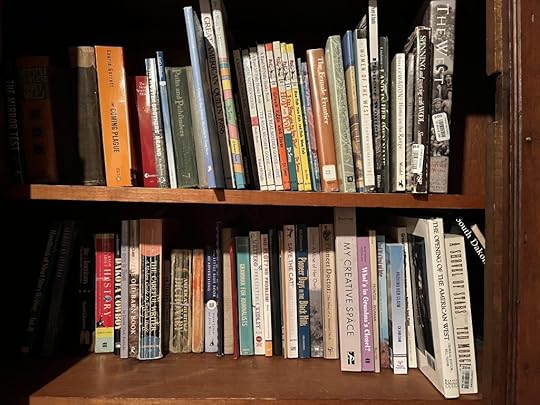
Let’s start with two questions: Is reading fiction underrated? And, what do you read? If you read to learn or to gather information, you’re a non-fiction reader. If you read to understand another culture, to feel emotions or (yes, let’s say it) to time travel, then you’re reading fiction.
From my auntie who gave me a Dr. Suess book every Christmas, to the Laura Ingalls Wilder books I discovered in elementary school, books were always part of my childhood. And ever since my mother taught me to read, I’ve read both fiction and non-fiction. When I became a mother, my go-to books were written by Dr. Benjamin Spock and Dr. Joyce Brothers. Then I graduated to Goodnight Moon.
When I first thought about writing a book (OK, when I researched writing a book) the first directive was always to read — to read anything and everything. My Goodreads account tells that story. So do the variety of titles on my bookshelves as shown above.
I especially enjoy reading fiction: historical, sci-fi, fantasy, mysteries, thrillers … I used to think of fiction as my “guilty pleasure.” But an article in the Harvard Business Review changed my mind: Research suggests that reading literary fiction is an effective way to enhance the brain’s ability to keep an open mind while processing information, a necessary skill for effective decision-making. The article goes on to say “there’s no easy answer in literature” — kind of like life, isn’t it?
I like the phrase “the power of books.” Books can power time travel, only a lot more safely. That must be why The Midnight Library by Matt Haig was the most borrowed book in 2022 from the New York Public Library. I love that book. I read it in 2021 according to my Goodreads account.
The post Is reading fiction underrated? appeared first on CK Van Dam.
December 27, 2022
Metis children connected two worlds
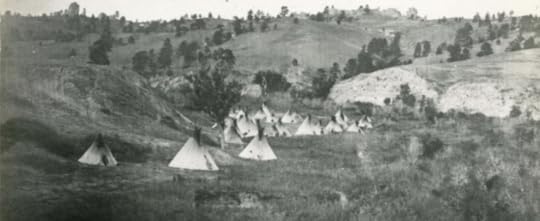
In an earlier blog, I wrote about the fur trappers who explored of the lands west of the Mississippi River. The voyageurs (“travelers” in French) worked for the fur trade companies to transport trade goods throughout the territories to rendezvous posts, connecting two worlds: the Native Peoples and the Europeans.
These intrepid entrepreneurs were often the first Europeans that the First Nations people of North America encountered. The voyageurs, many from Scotland, England or France, traded with native tribes for valuable fur pelts that were fashionable in the East and in Europe.
They exchanged trade goods — and also ideas. It was literally two worlds coming together.
Oftentimes, these men started families with native women. The mixed-heritage children of these unions were known by many names. In Canada, they were called “Metis,” which is now used widely. In Ojibwe, the children were “one who is half.” And the Lakota referred to these children as “half-burnt thigh.”
The hero in Proving Her Claim is from just that type of union. Two Hawks’ father, James MacKenzie was a Scots fur trapper and trader. Two Hawks’ mother, Yellow Bird, was a Lakota woman from the fictional Deer Creek Tribe. As a young boy, Two Hawks accompanied his father into the mountains to trap beaver. Thanks to his parents, Two Hawks met many kinds of people which helped shape his world view. He also was a scout for the Union Army.
Eventually, the Metis served a valuable role in this new world of Europeans and First People. They were often the translators, the recorders and the treaty negotiators. In addition, they served as military scouts for the US Army. Finally, they were the tribal leaders who helped their people adjust to a new reality — and sometimes, new lands.
The “mixed blood” children played an important part of the new frontier — both for the First People and for the settlers.
The post Metis children connected two worlds appeared first on CK Van Dam.
December 19, 2022
Here’s to the women
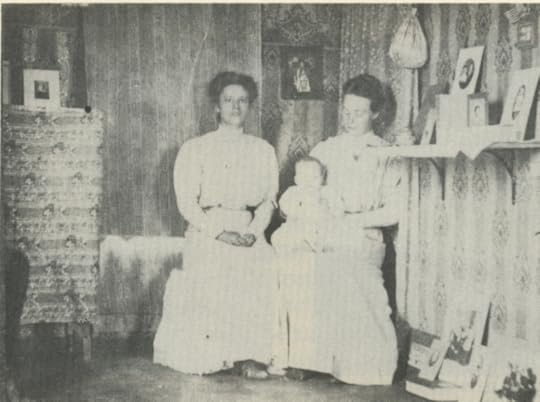 Alma Anderson with Josephine Uleberg and baby Avis. Courtesy of Avis Busse. From Land in Her Own Name.
Traditions. This time of year is all about traditions. And who are the keepers of traditions? Women. It’s women who create and kindle the memories.
Historically, it was the women who tamed the prairies. They built the church congregations. They were the school teachers, the midwives and the mothers who tended the children.
Here’s to Ida Mary and Edith Ammons who homesteaded near the Lower Brule Indian Reservation in South Dakota in the early 1900s. They made their marks: Edith was a newspaper woman and Ida Mary taught school. As homesteaders, they encountered prairie fires, rattlesnakes and blizzards. They opened a post office and a general store — in addition to proving their claim.
And here’s to the breakers of tradition — the women who persevered in spite of expectations. The 1890 Census Report on Occupations found that 14 percent of women in the West worked in professional occupations (such as lawyers, teachers or journalists) compared to only 8 percent of women nationally. There’s speculation that the West was more egalitarian. Personally, I believe that when women came West it was freeing. They realized that if they could own land, plow a field or drive a wagon, they could chart their own course professionally, too. They could choose a profession that was previously open only to men.
Here’s to the strong women who went before us. We’re standing on their shoulders.
The post Here’s to the women appeared first on CK Van Dam.
December 13, 2022
Podcast questions: What’s your favorite book?
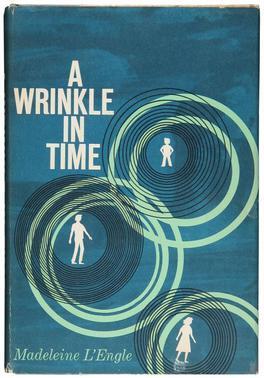 By Madeleine L’Engle
Part of marketing a book includes being a guest on podcasts. I must admit that it’s kinda fun. The podcast questions have also given me a new insight into myself. One of the questions that podcasters like to ask authors is “What’s your favorite book?”
While there are a number of authors whom I enjoy reading — and even look forward to their upcoming books — there is one book that stands out. I was a bit surprised to realize that my favorite book is “A Wrinkle in Time” by Madeleine L’Engle. It’s categorized as a sci-fi fantasy novel for readers 9 to 12. But it’s so much more.
Yes, I first read A Wrinkle in Time when I was in elementary school. At the time, the book was a wonderful adventure story with a (wait for it…) strong, smart female protagonist. That’s one of the reasons I always loved the book. Meg Murry, her genius younger brother Charles Wallace and Calvin O’Keefe (a neighbor boy whom Meg has a huge crush on) embark on a journey to find the Murry children’s missing father.
I’ve since read A Wrinkle Time as an adult and found it just as engaging — perhaps more so. The story is like an onion with layer upon layer of themes and life lessons. As I re-read the book, I was in awe of how L’Engle structured the universal theme of good versus evil. The plot lines seemed so familiar in today’s splintered world.
In 1963 the book won the Newbery Medal for excellence in children’s literature — and the judges really got it right. A Wrinkle in Time has stood the “test of time” on so many levels.
Podcast alert: You can hear my most recent podcast interview with EricZBooks on YouTube.
The post Podcast questions: What’s your favorite book? appeared first on CK Van Dam.
December 7, 2022
Fun on the frontier
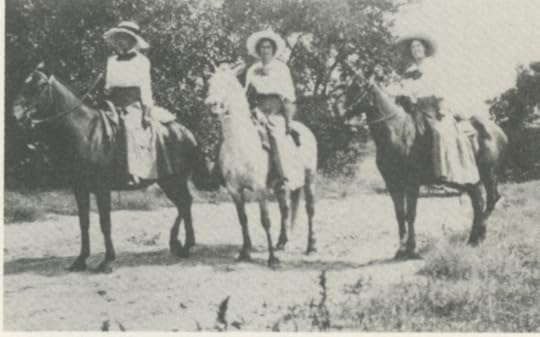 Pauline Shoemaker and friends Helen Cook and Constance Schaffner. Courtesy Sheila Robinson. Land in Her Own Name.
Today people often think of homesteading as hard work mixed with some fear and boredom. Pioneer life was viewed as lonely and frightening. That’s not what I found when researching Proving Her Claim. Women homesteaders found fun and games where they could — and invented reasons to party.
In the book H. Elaine Lindgren wrote of a fellow homesteader, “In wintertime several of us would get together and ride in bobsleds….In summertime there barn dances. I enjoyed every minute of my three years of homesteading.” That was Hilda Paulson Oaklund’s recollection of her years in North Dakota.
Neighbors were vital to the success or failure of homesteaders, especially in the early days. Lindgren wrote, “…constant visiting among homesteaders is found in Grace Jacobsen’s diary. The pages are filled with comings and goings of family and friends.”
And, just as the Homestead Act intended, women helped to “civilize” the frontier. They gathered together for sewing circles, book clubs and music groups in Dakota Territory. In addition, women were key to establishing churches in their communities, along with the Ladies Aid Societies that supported these churches.
In Lindgren’s book, she interviewed Anna Zimmerman from Dunn County, ND. Zimmerman recalled, “We visited neighbors, danced at house parties and played cards….We went as far as 25 miles horseback to dances, danced all night and then rode home.” So, homesteaders did find fun and games on the frontier!
For more blogs, follow me on Substack
The post Fun on the frontier appeared first on CK Van Dam.
December 1, 2022
What is a ‘spinster’?
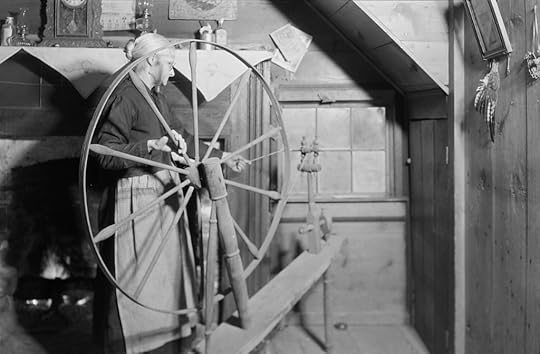
“Why are they called ‘spinsters’?” That was a question I heard at a recent book event. The press release for “Proving Her Claim” opens with this line:
The Civil War created countless spinsters and widows. Anna Olson was one of them.
Like many words in the English language, “spinster” historically refers to women who literally spun thread and yarn for a living. The term dates back to the 1300s. And, while the term initially described a woman’s job, it soon became associated with women who were single. Because unmarried women were usually poorer than married women, they ended up with lower-status, lower-income jobs — like spinning wool.
The word soon entered mainstream language and became an official term in legal documents. In the middle ages people used their occupation as a surname, such as Smith, Baker, Potter and others. But, because being a spinster by occupation was also associated with being an unmarried woman, by the 17th century, “spinster” was used on legal documents simply to mean an unmarried woman.
In addition to being a legal term, “spinster” also has a negative connotation. It was often used to shame women for not being married by a certain age. In “Proving Her Claim,” Anna Olson decided to move beyond society’s expectations and build a life for herself. Thanks to the Homestead Act’s requirement that only a “head of household” would qualify to stake a claim, that included women who were single, widowed or divorced.
The post What is a ‘spinster’? appeared first on CK Van Dam.