
Cris Beam's Blog, page 2
February 15, 2012
I could only write my memoir....After She Died
I write this blog for SheWrites last week, but thought I'd re-post it here:
I teach a family memoir class at NYU and, year after year, it’s always over-enrolled. The twenty year-olds carry around a limitless store of tales about their parents, their siblings, and the wrongs they’ve been done. But will they publish them? Probably not right away. A public airing of past struggle can be therapeutic in a class, but terrifying in the broader arena of publication—especially when that struggle implicates the living. Relatives, after all, are easily hurt or angered, they can contest your facts, and they can sue. As Samuel Goldwyn famously said, “I don’t think anyone should write their autobiography until after they’re dead.”
I’m turning 40 next month and I just published my first short memoir, called Mother, Stranger. I had to wait for my mom to die. But this wasn’t because I was afraid of what she might do or say or even feel; I didn’t write about my mom while she was alive because I didn’t have the separate self to do it. I was too angry, too broken, too enmeshed. Despite the fact that I left my mother’s house at fourteen and never saw her again, the pain I felt about my mother kept her close. Too close to see her as both light and shadow, with edges distinct from my own. Her death gave me my voice.
In a book review about six years back, Francine Prose wrote,
“What the memoir writer knows is what readers of Grimm intuit: the loving parent and the evil stepparent may in reality be the same person viewed at successive moments and in different lights. And so the autobiographer is faced with the daunting challenge of describing the narrow escape from being baked into gingerbread while at the same time attempting to understand, forgive and even love the witch.”
Sometimes death provides enough distance for equanimity; it did for me. Suddenly all the unspoken bits of our shared history formed themselves into language, and death gave way to life. I could write a memoir with my mother as a living character, and imagine my way into compassion for both of us.
I know that for some people, an obituary is the green light to finally release the monsters from the closet, since you can’t libel the dead. But I also know that keeping mum on the monsters doesn’t help anyone. Audre Lorde once said, “your silence will not protect you.” She was right, but still, silence can sometimes serve as an incubator for memoirs too raw or unformed for display. Until one day, maybe after a death in the family, that silence cracks and you’re writing, writing writing, like your own life depends on it. Because it probably does.


January 28, 2012
My memoir, Mother Stranger, is OUT!
And you can buy it! At The Atavist
January 23, 2012
I'll be reading with Ellis Avery this Wednesday!
Please come to a very exciting evening, hosted by Lambda...Lit!
Lit!: An Evening to Celebrate Authors Ellis Avery, Cris Beam, Sarah Schulman, and Laurie Weeks
The Lambda Literary Foundation, in conjunction with reading curator Karen Schechner, proudly presents:
LIT!: an evening to celebrate the recent publications by authors Ellis Avery, Cris Beam, Sarah Schulman, and Laurie Weeks.
This is not a reading; this is a straight-up party!
Join us as we toast a group of the finest writers working today. Come meet the authors, have some drinks at Heather’s too-hip-for-school bar, and possibly meet the well read partner of your dreams.
This event will take place at Heathers, located at 506 East 13th St # 1 (Between Avenues A & B) NYC, on Wednesday, January 25th, 2012. Doors open at 7:30 p.m.
Free to the public.
November 25, 2011
The Advocate just announced their best transgender titles...
And Transparent made the cut!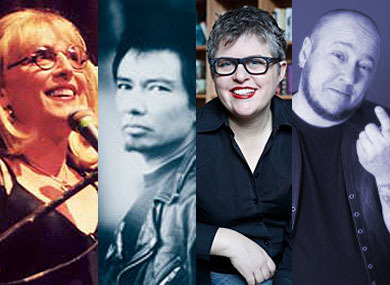
Here are the author pics they chose...
and here's the LINK to the story!
November 22, 2011
Check out this book trailer for I Am J!
A fan created this great book trailer. Watch it here:
Diversity in YA Lit
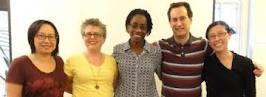
This fall, authors Malinda Lo and Cindy Pon organized a tour of young adult authors who incorporate diversity into their young adult literature.
Here's a photo from the tour!
Malinda asked me to guest blog for her awesome site, Diversity in YA Fiction, on the topic of writing transgender characters of color, since I'm cisgender and white--and this is arguably very tricky territory!
Here's that blog:
I Am J is, in a way, a kind of love letter to my partner. It was a road in, an attempt to try to understand him/her (Lo is trans, and doesn’t identify with either gender) and to access his adolescence—his bright imagination, and her pain—in the time before we knew one another.
I have been with Lo for five years, and I wrote the book during an intense part of Lo’s transition. S/he had top surgery while I was crafting the midsection of the book, and we argued a lot during that time. I wish I could say I was the perfect partner, nursing Lo to health, and compassionate to his physical and psychic needs. But really I was scared. I was scared that in the carving away the parts Lo hated, s/he would find s/he didn’t need me anymore. Really, I was selfish. Really, I wasn’t listening. And writing J was a way to listen.
 J is not Lo, he’s a character from my imagination, but they do share some characteristics. They embody similar defenses, which cloak a tremendous tenderness and a kind of intelligence of the heart. They both watch everybody around them, with the keen attenuation of someone who’s suffered, and with a conflicting yearning to both belong and be independent. They both have parents from different cultures, and they both grew up in New York (Lo from the age of twelve), continually mitigating the generational, language, and cultural differences between their home and chosen communities.
In this, actually, there’s an interesting story. J had been a nascent character in my head for a long time, before I ever met Lo. In my mind, he always spoke Spanish, probably because I have a foster daughter who’s Guatemalan, and also transgender. J was kind of an imaginary counterpart to my foster daughter, because I met so many of her friends and interviewed them for my first book, Transparent. In any case, all of the transboys I talked to, many of them Latino, ended up falling out of the book—but I wanted to come back to their stories, in a fictional form, with I Am J.
I know this is deeply problematic: I am neither Puerto Rican nor Jewish (J’s parents are these two things), nor am I of trans experience. And issues of representation are fraught and dangerous. The stakes are high, as they should be. I thought about making J white (like me) and a lesbian (like me) and that all would have been safe. But then I had an experience with a book editor that made me stick with the original J-voice in my head, born from the family I love.
This editor came to me after I published Transparent asking if I’d be interested in writing a young adult book about a transgender teenager. I jumped at the chance and gave her fifty or so pages about J. She turned it down. “Why does he have to have so many issues?” she said. “Does he have to be Puerto Rican? Does he have to be poor? Isn’t being transgender enough?”
The implication, of course, was that being white and straight and middle class were the center, the base, the neutral position. Anything else was an issue. But for me, J was the center. Like my lover and like my daughter, the center of my world. Luckily, I found another (wonderful!) publishing house that understood this.
The trick though, is this: I understand, especially when there’s so little published material in a certain area (like trans lit) the pressure is particularly high to represent well, to represent most, to represent both the spectrum and the particular. And then there’s art, which is supposed to break the rules, lest it pander to social control. I just hope to strike a balance somehow and know that J is just one of many thousands of transgender voices to be caught upon the page. This one’s a love letter, after all.
Cris Beam's Blog

- Cris Beam's profile
- 77 followers

